Introduction
The Douglas-fir beetle, Dendroctonus pseudotsugae Hopkins (Coleoptera: Curculionidae), is one of the most important insects associated with Douglas-fir, Pseudotsuga mensiezii (Mirbel) Franco (Pinaceae), throughout its range in western North America (Furniss and Carolin Reference Furniss and Carolin1977). Endemic beetle populations are usually found at low densities across the landscape, infesting recently dead or highly stressed trees (Johnson and Belluschi Reference Johnson and Belluschi1969; Furniss Reference Furniss2014a). At these densities, a close association exists between the Douglas-fir beetle and root pathogens such as Phellinus weirii (Hymenochaetaceae) in coastal forests (Hansen and Goheen Reference Hansen and Goheen2000). In this role, the beetle plays important ecological functions that facilitate decomposition and nutrient cycling (Edmonds and Eglitis Reference Edmonds and Eglitis1989) and that provide species and structural diversity important for wildlife habitat and other ecosystem services (Hadley and Veblen Reference Hadley and Veblen1993; Ross and Niwa Reference Ross and Niwa1997). Beetle reproduction is high in these trees, which have little or no defensive capabilities. However, recently dead and highly stressed trees are usually relatively scarce, so beetle populations remain at low densities. Large-scale disturbances such as wind storms, wildfire, defoliator outbreaks, prolonged drought, and snow and ice storms can provide an abundance of highly suitable breeding sites for the Douglas-fir beetle (Johnson et al. Reference Johnson, Wright and Orr1961; Furniss Reference Furniss1965a; Johnson and Belluschi Reference Johnson and Belluschi1969; Furniss et al. Reference Furniss, McGregor, Foiles and Partridge1979; Wright et al. Reference Wright, Berryman and Wickman1984; Fredericks and Jenkins Reference Fredericks and Jenkins1988; Hood and Bentz Reference Hood and Bentz2007; Furniss Reference Furniss2014a). Following these events, beetle populations often become high enough to overcome the defences of healthy as well as stressed trees, leading to significant tree mortality that may interfere with resource management objectives and homeowner values in the wildland–urban interface (Cornelius Reference Cornelius1955; United States Department of Agriculture Forest Service 2000). Outbreaks can last from one to several years, depending upon geographic location, stand conditions, weather, additional natural disturbances, and management actions (Furniss Reference Furniss2014a).
Historically, resource managers have had few options for reducing the negative impacts of tree mortality caused by the Douglas-fir beetle. Because the beetle preferentially colonises large, mature host trees (Shore et al. Reference Shore, Safranyik, Riel, Ferguson and Castonguy1999), the combined harvest of mature stands and conversion of stands to younger trees was considered a reasonable management option when forests were viewed primarily for the economic value of timber (Schmitz and Gibson Reference Schmitz and Gibson1996). The beetle also preferentially colonises trees growing in dense stands (Steele et al. Reference Steele, Williams, Weatherby, Reinhardt, Hoffman and Their1996; Negron Reference Negron1998; Negron et al. Reference Negron, Schaupp, Gibson, Anhold, Hansen, Their and Mocettini1999, Reference Negron, Anhold and Munson2001), so thinning before an outbreak can increase the defensive capabilities of residual trees and reduce the likelihood they will be successfully colonised (Williamson and Price Reference Williamson and Price1971; Schmitz and Gibson Reference Schmitz and Gibson1996). Sanitation and salvage logging can directly reduce local beetle populations and reduce breeding sites, as well as use the dead and dying trees (Furniss Reference Furniss1959; Lejeune et al. Reference Lejeune, McMullen and Atkins1961; Furniss et al. Reference Furniss, McGregor, Foiles and Partridge1979; Schmitz and Gibson Reference Schmitz and Gibson1996). However, these methods rarely prevent outbreaks from occurring and, when they have been successful, it has been with small, localised populations in accessible areas. These methods also may not be consistent with management objectives that include a variety of ecosystem services. Furthermore, most of these approaches are preventative and require action before an outbreak occurs: none prevent tree mortality or influence the distribution of mortality during an outbreak. Applications of insecticide to the boles of susceptible trees before colonisation are effective at preventing unwanted tree mortality by other bark beetle species (Fettig et al. Reference Fettig, Grosman and Munson2013) and possibly Douglas-fir beetle, but this treatment is feasible for only the most high-valued trees. It also presents potential negative impacts, such as nontarget effects, persistence in the environment, and human exposure.
More recently, pheromone-based management practices have become a reality for the Douglas-fir beetle and have provided managers with additional options for protecting resource values. This paper describes the history of the development of 3-methylcyclohex-2-en-1-one (MCH) treatments for the Douglas-fir beetle, presents some previously unpublished data on novel applications of MCH, and discusses the efficacy of MCH treatments for the Douglas-fir beetle relative to other bark beetle antiaggregation pheromone treatments.
The development of effective MCH treatments was founded on an understanding of basic biology and driven by technological advances and critical intervals of interdisciplinary collaborations that facilitated rapid advancements. Contributions were made from multiple disciplines, including entomology, forestry, chemistry, chemical engineering, engineering, meteorology, toxicology, and resource management. It is hoped that this review will help to ensure that future bark beetle pheromone-treatment development programmes are based on ecologically sound principles and focus on treatments with a high potential for successful development and application efficacy.
Early research on bark-pheromone identification
The identification of the first bark beetle aggregation pheromone for the California five-spined engraver, Ips paraconfusus (Coleoptera: Curculionidae) (identified at the time as Ips confusus; Wood et al. Reference Wood, Browne, Silverstein and Rodin1966, Reference Wood, Browne, Bedard, Tilden, Silverstein and Rodin1967a, Reference Wood, Stark, Silverstein and Rodin1967b) was followed by a period of rapid research to identify pheromones for other bark beetles and to develop ways to use them to reduce negative impacts of bark beetle–caused tree mortality. The Douglas-fir beetle was one of the economically important species that was the focus of research by federal, state, university, and industry scientists.
One of the first reported studies of the Douglas-fir beetle pheromone system suggested that the aggregation pheromone produced by female beetles was composed of a mixture of three or more components (Borden et al. Reference Borden, Silverstein and Brownlee1968). Subsequent research identified compounds released by female beetles that are attractive to both sexes of adults. These compounds included frontalin (1,5-dimethyl-6,8-dioxabicyclo[3.2.1]octane), seudenol (3-methylcyclohex-2-en-1-ol), and MCOL (1-methylcyclohex-2-en-1-ol) (Pitman and Vité Reference Pitman and Vité1970; Vité et al. Reference Vité, Pitman, Fentiman and Kinzer1972; Rudinsky et al. Reference Rudinsky, Morgan, Libbey and Putnam1974a; Pitman et al. Reference Pitman, Hedden and Gara1975; Libbey et al. Reference Libbey, Oehlschlager and Ryker1983). Ethyl alcohol and host monoterpenes increase the attractiveness of frontalin alone or in combination with either or both alcohols (Furniss and Schmitz Reference Furniss and Schmitz1971; Pitman et al. Reference Pitman, Hedden and Gara1975; Ross and Daterman Reference Ross and Daterman1995a). Another compound identified as a component of the female Douglas-fir beetle pheromone early in this period of discovery was MCH (Kinzer et al. Reference Kinzer, Fentiman, Foltz and Rudinsky1971). Based on their laboratory bioassay, the authors stated, “While not indicating the function of 3-methyl-cyclohexene-1-one in the various phases of aggregation, mate assurance, and colonisation, this laboratory bioassay established the response to the compound by male D. pseudotsugae” (Kinzer et al. Reference Kinzer, Fentiman, Foltz and Rudinsky1971).
Malcolm Furniss (United States Department of Agriculture Forest Service, Intermountain Forest and Range Experiment Station, Moscow, Idaho, United States of America; now retired), who was involved in this early period of research, recently reported that J. Rudinsky (deceased), a professor in the Entomology Department at Oregon State University (Corvallis, Oregon, United States of America), who was also involved in the early research, originally felt strongly that MCH was an attractant (Furniss Reference Furniss2014a). Rudinsky eventually developed a theory, based mostly on laboratory studies, that MCH was produced by female beetles to mask their aggregation pheromone in response to sonic signals from males (Rudinsky and Michael Reference Rudinsky and Michael1972; Rudinsky et al. Reference Rudinsky, Morgan, Libbey and Michael1973).
However, Pitman and Vité (Reference Pitman and Vité1974) clearly demonstrated that male beetles are the primary source of MCH. Their chromatographic analyses showed that female beetles contained frontalin at emergence and produce other attractants while feeding and that male beetles contain MCH at emergence at much higher quantities than female beetles do. Consequently, as pioneer females are joined by other females in fully colonising a host tree, the amount of aggregation pheromone initially increases. As the colonisation process continues, more male beetles join the females, mate, and release MCH (Pitman and Vité Reference Pitman and Vité1974), while females cease production of aggregation pheromones (Borden et al. Reference Borden, Silverstein and Brownlee1968; Pitman and Vité Reference Pitman and Vité1970; Vité et al. Reference Vité, Pitman, Fentiman and Kinzer1972). Later-arriving beetles receive a signal that the tree is fully occupied and continue their search for a suitable breeding site. Based on these documented shifts in pheromone production by adult beetles, it appears that the aggregation pheromone first increases to a peak with increasing numbers of colonising females and then declines, while MCH increases somewhat later to a peak when the tree is fully occupied by mating pairs of beetles. However, this process has not been experimentally demonstrated in the field.
Using MCH to prevent colonisation of recently downed trees
Not surprisingly, once MCH was recognised to be an antiaggregation pheromone, the first attempts to develop management applications involved efforts to prevent the beetle from breeding in recently downed trees (Furniss Reference Furniss2014b). Until at least the late 1980s, timber production was the predominant use of both public and private forest lands in the western United States of America, and most Douglas-fir beetle outbreaks had resulted from beetles breeding in recently windthrown or otherwise downed trees (McCowan and Rudinsky Reference McCowan and Rudinsky1958; Johnson and Pettinger Reference Johnson and Pettinger1961; Furniss et al. Reference Furniss, McGregor, Foiles and Partridge1979). The first management application envisioned in the 1970s was to use MCH to prevent populations from increasing in downed trees and subsequently colonising and killing live trees. A slow-release formulation of MCH in dimer acid polyamide beads was developed (Furniss et al. Reference Furniss, Daterman, Kline, McGregor, Trostle, Pettinger and Rudinsky1974; Rudinsky et al. Reference Rudinsky, Sartwell, Graves and Morgan1974b; Furniss et al. Reference Furniss, Young, McGregor, Livingston and Hamel1977) and field-tested in helicopter applications over felled and windthrown trees (Furniss et al. Reference Furniss, Clausen, Markin, McGregor and Livingston1981, Reference Furniss, Markin and Hager1982; McGregor et al. Reference McGregor, Furniss, Oaks, Gibson and Meyer1984). It was shown to reduce the Douglas-fir beetle colonisation of recently downed trees by 92–97% and to reduce brood production by 93–99%. On 9 October 1979, the United States Patent and Trademark Office granted patent number 4,170,631, “Controlled release formulations of Douglas-fir beetle anti-aggregative pheromone, 3-methyl-2-cyclohexen-1-one”, to J.W. Young and M.M. Furniss as inventors, with the United States Department of Agriculture as the Assignee. Clearly, the United States Department of Agriculture Forest Service anticipated using MCH on an operational scale.
Although this treatment was developed and proven to be operationally feasible, it was never used because of a number of constraints, including cumbersome manufacturing methods, the expense of helicopter applications, and obstacles in the registration process with the United States Environmental Protection Agency. Because the Federal Insecticide, Fungicide, and Rodenticide Act describes a pesticide “…as any substance or mixture of substances intended for preventing, destroying, repelling, or mitigating any pest…”, pheromones used to prevent negative pest impacts are considered pesticides and are subject to regulation (Tinsworth Reference Tinsworth1990). Although the United States Environmental Protection Agency recognised in 1979 that pheromones and other semiochemicals were a special class of pesticides, called biorational pesticides, that were inherently safer than traditional toxic pesticides and recommended processes to facilitate their registration, the registration process continued to present obstacles to the registration of pheromones (O’Connor Reference O’Connor1990). As far as large chemical companies are concerned, forestry is a relatively minor market for any pest control product. At the time, most companies were interested in pursuing the costly process of registering a pest control product only if it could be used on major agricultural crops that would provide a consistently large market to recoup their development and registration expenses (O’Connor Reference O’Connor1990). Consequently, the United States Department of Agriculture Forest Service took on the unprecedented responsibility of attempting the technical registration of MCH as an active ingredient, with the expectation that private companies would then be able to register formulated products at a reasonable cost.
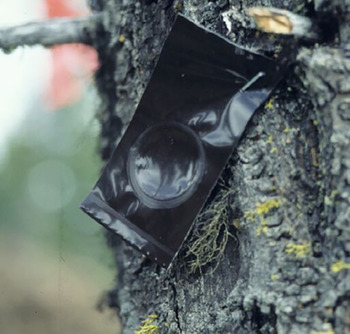
Because this was the Forest Service’s and the Environmental Protection Agency’s first attempt to register a forestry-use semiochemical, the process moved slowly over a number of years. The Forest Service did not have the capacity to gather toxicology data within its organisation, so it contracted with Syracuse Environmental Research Associates to obtain the necessary data for registration. Syracuse Environmental Research Associates (1998) confirmed in their final report, 3-Methylcyclohexen-1-one (MCH) – human health and ecological risk assessment: final report, that MCH was of low toxicity to vertebrates and a low risk to applicators but that it had some toxicity to aquatic life. One year later, Phero Tech Inc. (then Vancouver, British Columbia, Canada; now Delta, British Columbia, Canada) obtained an end-product registration for the MCH bubble capsule. Twenty years had elapsed since Young and Furniss had first anticipated operational MCH use before MCH was actually available for commercial use in the United States of America. By that time, the bubble-capsule formulation of MCH (Fig. 1) had been developed and was shown to be effective for protecting live trees from infestation (Ross and Daterman Reference Ross and Daterman1994, Reference Ross and Daterman1995b; Ross et al. Reference Ross, Gibson, Their and Munson1996). It was first applied operationally in the spring of 2000. At the present time, four companies have registered formulations of MCH that are marketed for preventing Douglas-fir beetle–caused tree mortality (Chemtica Internacional S.A., Santo Domingo, Heredia, Costa Rica; Hercon Environmental, Emigsville, Pennsylvania, United States of America; ISCA Technologies, Inc., Riverside, California, United States of America; and Synergy Semiochemical Corp., Delta, British Columbia, Canada). The most common formulation currently available is some type of bubble capsule. Bubble capsules are created by forming small depressions of about 30 mm in diameter in a sheet of plastic film, putting the pheromone in the depressions, then fusing another sheet of plastic film around the perimeter of the depressions, thereby encapsulating the pheromone in a plastic bubble. The pheromone then diffuses through the plastic at a rate that depends upon the chemical properties of the pheromone and the characteristics of the plastic film.
A 3-methylcyclohex-2-en-1-one (MCH) bubble capsule manufactured by Phero Tech Inc., Delta, British Columbia, Canada, deployed in the field.

The development of the bubble-capsule formulation for dispensing pheromones was a major advancement that led to the current operational MCH treatments. Axel Meisen (University of British Columbia, Vancouver, British Columbia, Canada; now professor emeritus) devised a simple semipermeable membrane blister package to deliver pheromones very efficiently. Meisen’s assistant, V. Le, built the first prototype machine out of parts scavenged from old laboratory equipment in the early 1980s. In a two-step process, bubble cavities were first heat-formed along a thin strip of polyethylene film. The cavities were filled and sealed one at a time with another polyethylene membrane. As soon as Le experimentally validated the bubble-capsule slow-release concept, the equipment was given to Phero Tech Inc. The simple membrane device proved to efficiently deliver several bark beetle pheromones. The devices were portable, withstood most weather, and performed well in the forest. The original bubble-capsule machine could manufacture approximately 30 capsules per hour. Phero Tech Inc. soon needed more rapid production capabilities to provide commercial quantities of formulated pheromones. Benno Bucher, an engineer working for a food equipment manufacturer in Vancouver, British Columbia, Canada, repurposed a 20-year-old Multivac form, fill, and seal machine (Multivac Canada Inc., Brampton, Ontario, Canada), originally designed to package meat, into the first commercial bubble-capsule machine. High-speed production meant large quantities of bubble capsules could be produced at low cost. It was the perfect fit for emerging MCH tree-protection technology; the low-cost, easy-to-deploy devices delivered virtually all the formulated MCH to the target location.
Using MCH to prevent colonisation of live trees
By the late 1980s and early 1990s, forest management in the western United States of America was changing dramatically, particularly on federal lands. Emphasis on timber production was being replaced with a more holistic approach to forest management that recognised the many ecosystem services provided by public forestlands. The amount of mature and old-growth forests throughout much of the Pacific Northwest and accessible areas of the Rocky Mountains had been reduced to a small fraction of what had occurred historically. In many places, the remaining old-growth forest was in developed recreation sites, special interest areas (i.e., research natural areas and designated wilderness), and administrative sites. These forests were also potentially highly susceptible to Douglas-fir beetle–caused mortality during outbreaks, because the beetle preferentially colonises older, larger trees.
In this context, I started my position as a professor in the Department of Forest Science at Oregon State University in 1990. Soon after arriving, Gary Daterman (United States Department of Agriculture Forest Service, Pacific Northwest Experiment Station, Corvallis, Oregon) invited me to join him in a renewed effort to develop pheromone-based management strategies for the Douglas-fir beetle. The initial promise of new management approaches using bark beetle pheromones had passed with little operational success. Daterman, along with his federal forest service colleagues Gene Amman (Rocky Mountain Experiment Station, Fort Collins, Colorado, United States of America) and Patrick Shea (Pacific Southwest Experiment Station, Albany, California, United States of America) successfully generated new support for bark beetle pheromone research in the western states, with the specific goal of developing pheromone-based management strategies that would be useful to resource managers.
Daterman and I began a research collaboration in 1991 that continued until his retirement in 2003. We began with two broad goals that were guided by the needs of United States Department of Agriculture Forest Service resource managers and forest health staff at the time. The first was to develop a pheromone-based strategy to protect high-value, high-risk trees and stands during Douglas-fir beetle outbreaks. We envisioned this treatment being applied to campgrounds and other recreational or special use areas, as well as to residential sites at the urban–wildland interface. Our second objective was to see if we could develop pheromone-based management tools that could be used more broadly to manipulate Douglas-fir beetle–caused tree mortality during an outbreak at the drainage or landscape scale, thereby reducing impacts on resource values. For the remainder of this paper, I will describe our research related to the first objective – to develop a pheromone-based strategy to protect high-value, high-risk trees and stands from the Douglas-fir beetle during outbreaks. In 1991, when we began our research, no published reports demonstrated that MCH could be used to protect live trees.
In 1992, our first study to explore the potential for using pheromones to protect high-risk Douglas-fir involved using MCH deployed around the perimeter of 1-ha circular plots to be protected, along with aggregation pheromone–baited traps in the vicinity of the core area (Ross and Daterman Reference Ross and Daterman1994). The conceptual basis was to reduce the local beetle population with the aggregation pheromone–baited traps and to simultaneously use the MCH to send a signal to the Douglas-fir beetles searching for a host tree that all trees in the area to be protected were already fully occupied. Although the treatment was successful at significantly reducing Douglas-fir beetle–caused tree mortality in the area to be protected, it also made clear a hazard in using such an approach. We had placed the aggregation pheromone–baited traps as far from potential host trees as possible, in meadows, rocky scablands, and nonhost stands, but even though they were 16–60 m from the nearest host trees, considerable spillover still occurred. This was not unexpected, because earlier studies had documented this effect when using a combination of frontalin and host terpenes as bait for the Douglas-fir beetle (Knopf and Pitman Reference Knopf and Pitman1972; Pitman Reference Pitman1973; Ringold et al. Reference Ringold, Gravelle, Miller, Furniss and McGregor1975).
In retrospect, it seemed that our baited traps not only collected beetles in the vicinity of the plots but also probably attracted a much larger number of beetles from the surrounding landscape that otherwise might not have dispersed to that location. Obviously, spillover into Douglas-fir trees near the area to be protected would become a problem the following year if the trees could not be harvested and removed before the brood adults emerged. Based on the positive results and the problem of spillover from aggregation pheromone–baited traps, we tested MCH alone in 1993 (Ross and Daterman Reference Ross and Daterman1995b). In that second study, MCH alone applied at a rate of 45–76 g/ha (113–189 bubble capsules per hectare) on plots ranging in size from 2.1 to 2.6 ha significantly reduced colonisation by the Douglas-fir beetle. In both of these early studies, we used a bubble-capsule formulation containing 400 mg of MCH that released 7 mg/day at 25 °C (Phero Tech Inc.). Furthermore, we used rates of MCH that we expected were on the high side, based on earlier work with bead formulations to prevent infestation of downed trees (Furniss et al. Reference Furniss, Clausen, Markin, McGregor and Livingston1981; McGregor et al. Reference McGregor, Furniss, Oaks, Gibson and Meyer1984). Consequently, the next step in the development process was to identify the lowest effective dose of MCH for protecting live trees. We conducted a study in collaboration with forest entomologists in the United States Department of Agriculture Forest Pest Management (now Forest Health Protection) offices in Idaho, Montana, and Utah to assess lower doses of MCH (Ross et al. Reference Ross, Gibson, Their and Munson1996). Over the two-year study, doses of 6, 12, 20, 40, and 60 grams of MCH per hectare (15, 30, 50, 100, and 150 bubble capsules per hectare) were tested. Actual field release rates of 1.2–1.6 mg/day/bubble capsule were determined in this study by deploying and retrieving pre-weighed bubble capsules at various intervals throughout the season. All but the two lowest doses of MCH significantly reduced the percentage of host trees colonised by Douglas-fir beetle. Based on the collective results of these studies, it was recommended that 75 bubble capsules per hectare be used in operational treatments to provide a margin of error slightly above the lowest possible effective dose (Ross et al. Reference Ross, Gibson and Daterman2001).
In some instances, individual trees rather than small stands of trees may need to be protected, most notably in residential or urban park settings or in campgrounds located in mixed conifer stands. Consequently, we tested the efficacy of applying MCH bubble capsules to individual trees as an alternative to area-wide treatments. These results have not previously been published. The study included one MCH treatment and control. The MCH treatment involved attaching four MCH bubble capsules (Phero Tech Inc.) equally spaced around the tree bole at a height of approximately four metres. Weak aggregation lures formulated in our laboratory to contain frontalin and seudenol in polyvinyl chloride releasing at 1.0 and 0.5 mg/day at 24 °C, respectively, were attached to the north side of each tree at about two metres high. The purpose of these lures was to ensure beetle pressure on the study trees. Each replication of this study included six pairs of trees. Within a replication, trees were spaced about 100 m apart, and replications were a minimum of 100 m apart. All trees were at least 45 cm in diameter at breast height (1.4 m from the ground). A total of six replications were installed: two in the Slate Creek Ranger District, Nez Perce National Forest, about 18 km southeast of Grangeville, Idaho, United States of America on 8 May 2001, and four on the Rexford Ranger District, Kootenai National Forest, Montana, United States of America on 19 and 20 April 2001. Two of the four Montana replicates were approximately 13 km north and two were approximately 13 km south of Eureka, Montana, United States of America.
All trees were sampled in the fall after Douglas-fir beetle flight had ended. Each tree was classified as infested or uninfested, based on the presence or absence of boring dust on the lower bole of the tree. The diameter of each tree at breast height was also recorded. The mean diameters of MCH-treated and control trees were 58.1 and 58.0 cm, respectively, and the difference was not statistically significant by a one-way analysis of variance (F = 0.01; df = 1, 5; P = 0.905). One of the MCH-treated trees on one replication appeared to have been cut down and lost from the study. Overall, all 36 control trees were infested, based on the presence of large amounts of boring dust on the base of the boles, and only one of the 35 MCH-treated trees was infested. Not surprisingly, the Chi-square statistic indicated a highly significant treatment effect (χ 2 = 67.1; P < 0.0001). The results of the study confirmed those of a preliminary test conducted in 1999 with six pairs of trees (unpublished), indicating that placing four MCH bubble capsules on an individual tree at a height of four metres effectively prevents infestation by the Douglas-fir beetle.
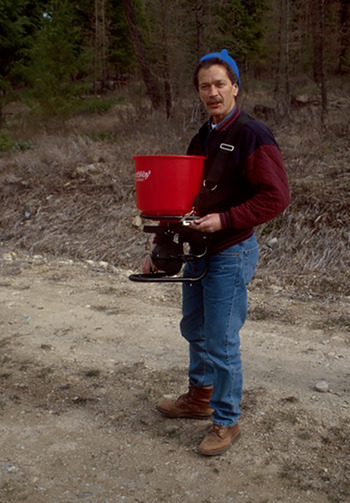
In 2001, Daterman, Ken Gibson (United States Department of Agriculture Forest Service, Northern Region, Forest Health Protection, Missoula, Montana, United States of America; now retired), and I installed a study in the Fortine Ranger District of the Kootenai National Forest in northwestern Montana to test a plastic bead formulation of MCH for protecting live trees. These data have not been previously published. The study involved four replications of three treatments in a randomised complete block design. Treatments included (1) the previously established MCH bubble-capsule (Phero Tech Inc.) application at 75 capsules per hectare, (2) 4.48 kg/ha of a plastic bead formulation containing 4% MCH (prepared by Dave Wakarchuk, Synergy Semiochemicals Corp., Delta, British Columbia, Canada, then with Phero Tech Inc.), and (3) an untreated control. The 12 two-hectare square plots were located northeast of Murphy Lake, between United States Highway 93 and United States Department of Agriculture Forest Service Road 7006, within sections 4 and 5 T34 N R25 W. Bubble capsules were attached to the north side of trees at about two metres high spaced on a 12 m × 12 m grid. The original plan was to apply the beads by helicopter, but after running into problems scheduling the work with local contractors, we resorted to applying the beads using Professional Hand Crank Broadcast Spreaders (18-kg capacity; Earthway Products, Bristol, Indiana, United States of America; Fig. 2).
Dr. Gary Daterman preparing to apply MCH bead formulation to research plots on the Kootenai National Forest in northwestern Montana, United States of America, in 2001.
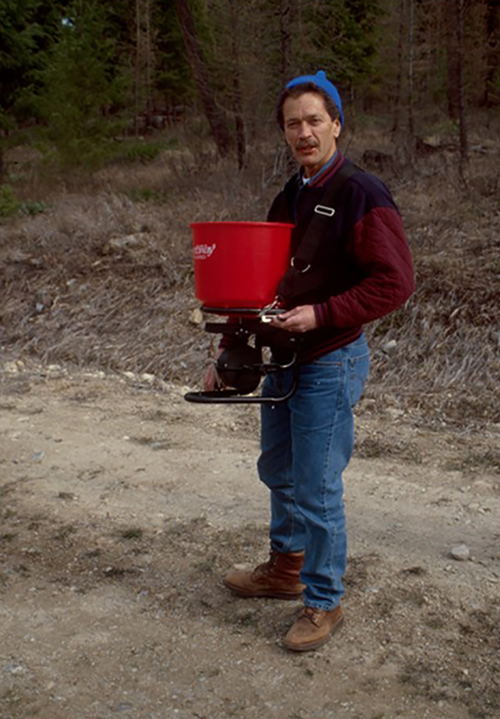
Plots were located in relatively open, predominantly Douglas-fir stands with little forest floor debris and flat-to-moderate slopes. After a little practice with unformulated beads, we were able to achieve the desired application rate by walking at a constant pace through the stands. Treatments of MCH were applied on 18 April 2001, and a 16-unit multiple funnel trap baited with 10 mg frontalin and 5 mg seudenol in 5% polyvinyl chloride formulations that had been synthesised in our laboratory (Daterman Reference Daterman1974) was installed at each plot centre on 19 April 2001. Trap contents were collected weekly until the beetle flight ended in August. Plots were surveyed to assess the stand characteristics and infestation status of Douglas-fir on 15–17 October 2001. Across all plots, stand composition was 84% Douglas-fir, 9% western larch (Larix occidentalis Nuttall) (Pinaceae), and 7% Engelmann spruce (Picea engelmannii Parry ex Engelmann) (Pinaceae). Mean diameters at breast height (cm) and tree densities (stems/ha) of Douglas-fir trees that were at least 25 cm in diameter at breast height were 38.6, 39.1, and 40.9, and 212, 215, and 195 for the control, MCH bubble-capsule, and MCH bead treatments, respectively. Across all replications, an average of 8% or 17 Douglas-fir per hectare were colonised by Douglas-fir beetle on the control plots, and no trees were colonised on any plots receiving either of the MCH treatments. Although the data were not subjected to statistical analyses, the efficacy of the bead formulation is apparent from the raw data.
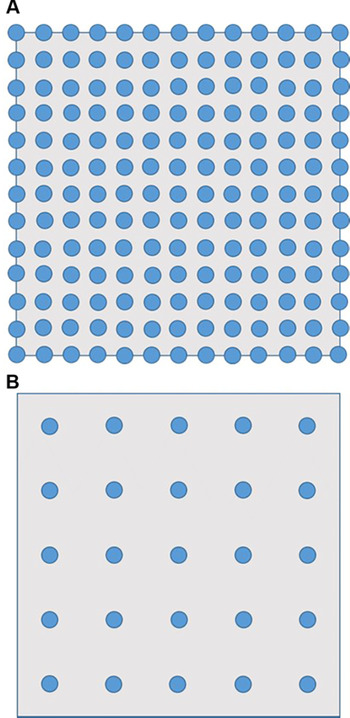
Despite the positive results of the trial with the bead formulation of MCH, it was never registered for commercial use, in part because the beads were not biodegradable. Our attention turned instead to increasing the efficiency of ground applications rather than developing aerial applications, because the latter would be expensive, involve logistical challenges, and have very limited potential application. Subsequently, a polymer flake formulation of MCH that could be applied aerially was developed, tested, and used in a few operational projects (Gillette et al. Reference Gillette, Mehmel, Webster, Mori, Erbilgin, Wood and Stein2009). By increasing the MCH release rate at individual release points and reducing the number of release points per unit of the treatment area, the cost and time required for ground applications could be significantly reduced (Fig. 3). Higher release rates are easily achieved by placing multiple bubble capsules at individual release points. The idea to pursue this line of work was suggested to me in 1998 by Cam Oehlschlager (Chemtica Internacional, S.A., Santo Domingo, Costa Rica; formerly Simon Fraser University, Burnaby, British Columbia, Canada) at the Western Forest Insect Work Conference in Jackson, Wyoming, United States of America. I mention this here to give Oehlschlager credit for planting the seed in my mind that has led to more efficient MCH applications and to illustrate to early-career entomologists the value of informal interactions at professional meetings and reaching beyond the narrow scope of colleagues in your own discipline.
Comparison of the number of release points in (A) the established standard MCH treatment (12 × 12 m grid) and (B) a treatment using six times the standard release rate at each release point (28 × 28 m).

Our earliest attempts to increase MCH release rates from fewer release points first on 1-ha plots, then on 2-ha plots, produced similar results (Ross et al. Reference Ross, Daterman and Gibson2002; Ross and Wallin Reference Ross and Wallin2008). In both studies, releasing MCH at three times the rate of a standard bubble capsule at a correspondingly wider spacing to keep the amount of MCH released per unit area the same was as effective as the standard bubble-capsule treatment. However, in the earlier study, releasing MCH at nine times the standard release rate at an even wider spacing was ineffective. A modelling exercise using a plume dispersion model and results of previous field studies suggested that MCH release rates up to six times the standard rate at correspondingly wider spacing would be effective for preventing Douglas-fir beetle infestation (Strand et al. Reference Strand, Ross, Thistle, Ragenovich, Matos and Lamb2012). A subsequent field study found that MCH release rates up to seven times the standard at wider spacings were as effective as deploying individual bubble capsules on a 12 m × 12 m grid (Brookes et al. Reference Brookes, Ross, Strand, Thistle, Ragenovich and Lowrey2016). However, because the field studies demonstrate collectively that the threshold of effectiveness is somewhere between seven and nine times the release rate of individual bubble capsules, current recommendations are to not go beyond about four to five times the standard release rate in operational applications to provide a margin of error (Ross et al. Reference Ross, Gibson and Daterman2015).
A couple of cautionary comments are warranted regarding these new recommendations: first, some manufacturers have begun marketing MCH formulations that contain twice the amount of MCH as the traditional bubble capsule and that release the MCH at twice the rate as the standard bubble capsule. As new products come on the market, it is important that manufacturers and end-users communicate clearly about the amount of MCH in the reservoir – that is, how much is in the formulated product – and the MCH release rate. These are two different and distinct characteristics of any pheromone formulation. One advantage of formulations containing more MCH is that they are more likely to continue releasing pheromone throughout the beetle flight period that may be extended depending upon weather conditions in the current and previous year (Bedard Reference Bedard1950; Vité and Rudinsky Reference Vité and Rudinsky1957; Furniss Reference Furniss1965b; Johnson Reference Johnson1967; Furniss Reference Furniss2014b). This may become increasingly important in an era of rapidly changing climate. Second, the relationship between release rate and spacing of releasers is not linear; for example, the correct spacing of three-times releasers would be 20 m × 20 m, not three times the spacing of individual releasers, because area is two dimensional. At higher release rates, the amount of MCH released per unit area should remain the same. The correct spacing of release points for release rates from two to seven times the standard is reported in the most recent version of the MCH users’ guide (Ross et al. Reference Ross, Gibson and Daterman2015).
Comparison to other bark beetle antiaggregation pheromone systems
The bark beetle antiaggregation pheromone MCH has been available for operational use to protect live trees in the United States of America since 2000. It is difficult to know for certain how many hectares have been treated each year, but based on conversations with representatives of companies that market MCH products, demand has been increasing annually, and the current number of releasers sold in a year would treat approximately 8 000 hectares. From my own experience on research plots and all that I have heard from my forest entomology colleagues, I know of no cases where MCH did not provide significant protection to treated stands at any Douglas-fir beetle population density. The collective results of research and operational use of MCH to protect trees and stands are unparalleled with any other bark beetle system in the world. That raises the question of why this treatment is so consistently effective when attempts to develop similar treatments with other bark beetles have not produced similar results despite decades of research.
I believe the answer lies in the differences in biology and ecology among the most studied bark beetle species in North America. During a Douglas-fir beetle outbreak, whether in relatively pure coastal Douglas-fir forests or the mixed conifer forests of the inland Pacific Northwest and Rocky Mountains, the beetle kills trees in groups of various sizes across the landscape (Negron et al. Reference Negron, Anhold and Munson2001), and outbreaks typically only last from one to several years following the disturbance that precipitated them (Furniss Reference Furniss2014a). In contrast, both the mountain pine beetle (Dendroctonus ponderosae Hopkins) and spruce beetle (Dendroctonus rufipennis (Kirby)) (both Coleoptera: Curculionidae) can cause the mortality of nearly every host tree throughout entire drainages and regions during outbreaks that may last a decade or longer (Baker and Veblen Reference Baker and Veblen1990; Berg et al. Reference Berg, Henry, Fastie, De Volder and Matsuoka2006; Safranyik and Carroll Reference Safranyik and Carroll2006; Jenkins et al. Reference Jenkins, Hebertson and Munson2014). This difference in ecological impact among the species is likely due both to differences in the beetles themselves and to differences in the silvics of their host trees. Regardless, both mountain pine beetle and spruce beetle reach population densities well beyond any level ever seen with Douglas-fir beetle. At such high population densities, it is likely that the pheromone communication system breaks down; that is, beetles stop responding to pheromones at high densities in the same way that they would at lower densities. At high densities, many mountain pine beetles and spruce beetles are dispersing through environments that may have a very high background level of antiaggregation pheromone in most places. Under such circumstances, it is likely that physiologically stressed beetles will initiate colonisation on any potential host tree before dying. Not surprisingly, the application of an antiaggregation pheromone in such a context is likely to be ineffective. Indeed, this is just what occurred recently in British Columbia, Canada, where mountain pine beetle reached unprecedented densities, and beetles were found colonising tree species such as spruce that are not normal hosts (Huber et al. Reference Huber, Aukema, Hodgkinson and Lindgren2009). It has been demonstrated that spruce beetle responds differently to host monoterpenes during the colonisation process, depending upon spruce beetle population density (Wallin and Raffa Reference Wallin and Raffa2002). A behavioural shift may occur in response to pheromone signals that is similar to what occurs in response to host monoterpenes.
Other potential reasons may exist for the differences in efficacy of similar pheromone-based strategies for different bark beetle species. For example, it has been suggested that verbenone may not be a true antiaggregation pheromone for the mountain pine beetle and is instead an indicator of microbial decay of tissue and a suboptimal food source (Lindgren Reference Lindgren1995). Furthermore, despite all of the research on bark beetle pheromones, including antiaggregants, we still do not understand the specific behavioural steps that are mediated by their presence or absence, or by their blends as perceived by dispersing adults (Lindgren Reference Lindgren1995). Until we have a more complete understanding of pheromone functions in bark beetle behaviour, it will be difficult to develop effective pheromone-based management applications.
The important point is that one size does not fit all when it comes to developing pheromone-based management practices for bark beetles. A treatment strategy that works for one species may not be feasible for even a closely related species because of differences in biology and ecology. Researchers must understand the biological and ecological limitations of the systems in which they work to design treatments that are realistic and have a reasonable potential for success. We should have learned by now that we cannot impose our wishes on biological systems with the brute force of technology. The natural systems will always win, and researchers who do not fully understand them will end up frustrated and unsuccessful.
Recommendations for future research and development
The Douglas-fir beetle pheromone system is among the most well studied, and effective management applications using the pheromones have been developed and implemented. Even so, there is much that we do not understand about the specific behavioural response of beetles to the pheromones, particularly antiaggregation pheromones. A more complete understanding of the actual behavioural responses of individual beetles to pheromones at different concentrations could make it easier to develop pheromone-based management strategies for other bark beetle species. For example, Rudinsky suggested that MCH had the dual function of being attractive at very low concentrations but repellent at high concentrations, based on laboratory studies (Rudinsky and Michael Reference Rudinsky and Michael1972; Rudinsky et al. Reference Rudinsky, Morgan, Libbey and Putnam1974a). Pitman et al. (Reference Pitman, Hedden and Gara1975) questioned the validity of these conclusions after demonstrating that ethanol, which was used as a diluent in Rudinsky’s experiments, was attractive to the Douglas-fir beetle. However, a positive response to low concentrations of MCH does theoretically make sense from an ecological and evolutionary perspective. At low concentrations, MCH could signal to dispersing adult beetles the general location of suitable host trees and bring them to the vicinity of potential hosts, all of which may not have been fully colonised. In such a way, it is possible to see how this response to low concentrations of MCH could provide an adaptive advantage to dispersing beetles. This possible dual function of MCH should be studied under field conditions.
Acknowledgements
In this paper, I review many studies that took place over more than 25 years. Financial support for that research came from several United States Department of Agriculture Forest Service offices, including the Forest Health Protection Washington Office and Region 6, the Pacific Northwest Research Station, and the Forest Health Technology Enterprise Team, in Morgantown, West Virginia, United States of America. Support was also provided by the College of Forestry, Oregon State University. Many colleagues throughout the western United States of America collaborated and are included as coauthors on cited papers. However, Ken Gibson was particularly instrumental in making many of these studies a reality by identifying research sites, helping with the field work, and reviewing and coauthoring many of the papers. I could always count on Ken finding the perfect location for a study, often with a less-than-perfect description of the conditions I was looking for. Ken was involved in Douglas-fir beetle management and research long before I arrived on the scene, and he was always quick to share his knowledge, experiences, and opinions. Any day in the field with Ken was a good one! We had some great days in the mountains of western Montana conducting these studies. Ken also provided helpful comments on an earlier draft of this manuscript. I thank him for all of his support and advice over the past 25 years. I also thank three not-so-anonymous reviewers for outstanding reviews. They provided many helpful suggestions that substantially improved the final version of this paper. I thank Dave Wakarchuk for providing many details on the registration of MCH and the development of the bubble-capsule formulation.
Dedication
This paper is dedicated to the memory of my good friend, mentor, and collaborator, Gary E. Daterman. Gary was, and still is, one of the most accomplished and influential forest entomologists in the area of forest insect pheromones. He was unique in spanning basic research of pheromone identification through the development of pheromone-based management strategies for a variety of pest insects, including shoot borers, defoliators, and bark beetles. He introduced me to the fascinating field of applied forest insect chemical ecology. He also taught a young, ambitious forest entomologist to slow down and enjoy the journey. He showed me the best places to stop in for a piece of pie or an orange-flavoured cinnamon roll on the long drives from Corvallis, Oregon to eastern Oregon and central Idaho, United States of America. My life and career would not have been as full and productive without his friendship and advice.