Significant outcomes
In this study, the most prevalent ASEX domain observed in our patients was erection/lubrication, followed by orgasm, orgasm satisfaction, stimulation and sexual desire. The ASEX total scores of our patients were correlated with age and H&Y stage. Depression in patients with PD is correlated with orgasm satisfaction.
Limitations
The lack of any control group and the small number of patients included.
Introduction
Parkinson’s disease (PD) is a chronic progressive disorder and clinically defined by bradykinesia, rigidity, tremor and postural instability (Reference Hughes, Daniel, Kilford and Lees1). Although, PD is a movement disorder, patients often experience non-motor features and autonomic dysfunction such as constipation, depression, anxiety, sleep disturbances and sexual dysfunction (SD) (Reference Witjas, Kaphan and Azulay2).
Neurological disease frequently alters sexual response. SD is one of the most disabling and less investigated but important view of quality of life aspects of PD. SD in older people can be caused by age-related decline in body systems, and this decline can be increased when an individual has a chronic illness. PD, as a chronic condition is known to negatively affect the quality of life as well as sexual function. Several studies have investigated the relationship between PD and sexual function (Reference Meco, Rubino, Caravona and Valente3,Reference Rees, Fowler and Maas4).
A series of human experiments measured pleasurable sexual feelings in relation with deep brain stimulation of reward sites, such as the amygdala, mesencephalic tegmentum and the septal nuclei (Reference Rees, Fowler and Maas4). Then, functional imaging has confirmed that these areas are activated by the sexual response (Reference Rees, Fowler and Maas4,Reference Redoute, Stoleru and Pugeat5). Sexual expression requires functioning of the body’s autonomic, sensory and motor systems, sufficient blood supply and hormonal system and a stable emotional state (Reference Meco, Rubino, Caravona and Valente3,Reference Rees, Fowler and Maas4).
Psychiatric disorders, including depression and anxiety, may precede the motor manifestations of PD by years (Reference Ishihara and Brayne6). Depression is a very common non-motor symptom of PD, occurring in ~40% of patients (Reference Cummings7). And it is a major determinant of health-related quality of life, and the prevalence of depression in PD patients is higher than in patients suffering from other disabling disorders (Reference Tolosa, Gaig, Santamaría and Compta8). The damage to the coeruleus/subcoeruleus complex and disruption of serotoninergic afferent pathways seen in stage 2 might be the reason of depression (Reference Rodríguez-Violante, Cervantes-Arriaga, Berlanga-Flores and Ruiz-Chow9,Reference Braak, Bohl, Muller, Rub, De Vos and Del Tredici10). Anxiety is also a common non-motor symptom among patients affected by PD with a prevalence ranging from 25% to 49% (Reference Riedel, Klotsche and Spottke11,Reference Dissanayaka, Sellbach and Matheson12), which is much higher than that reported in healthy or comparably disabled elderly controls. Anxiety symptoms have a negative impact on health-related quality of life. As the etiopathogenesis of anxiety in PD, a dysfunction in the dopaminergic system might be implicated. The pathophysiology of anxiety in non-PD people has focused on the prefrontal cortex and the amygdala (Reference Davidson13), that project to the striatum. It is not clear whether depression and anxiety share the same pathophysiological mechanisms (Reference Bowron, Porter, Chandler and Walker14).
To better understand the relationship, we aimed to find out whether sexual function in patients with PD was associated to PD-related disability and whether this relationship was modulated by depressive and anxiety symptoms.
Methods
Patients with idiopathic PD were recruited from the Movement Disorders Clinic of the School of Medicine of the Ordu University, Turkey. Eighty-nine consecutive patients with idiopathic PD who attended to our movement disorders outpatient clinics between January 2011 and June 2014 were included in this study. The diagnosis of PD was confirmed by a movement disorders specialists in Neurology, according to UK Parkinson’s Disease Society Brain Bank Criteria (Reference Rosen, Riley, Wagner, Osterloh, Kirkpatrick and Mishra15). The Unified PD Rating Scale (UPDRS) motor (Reference Goetz, Tilley and Shaftman16) was used to assess motor disability and Hoehn and Yahr (H&Y) stage (Reference Hoehn and Yahr17) was used to establish disease severity. Cognitive function was assessed by the Mini-Mental State Examination (Reference Folstein, Folstein and Mchugh18). Patients who had score >24 were included the study. Patients were also administered the Hamilton depression (HAMD) (Reference Hamilton19) and anxiety rating scales (HAMA) (Reference Hamilton20). HAMD scale consist of 17 questions and upper score limit is 53. Scores 0–7 are considered normal, scores between 8 and 16 indicate the mild depression, and score >17 means major depression. HAMA consists of 14 questions and upper score limit is 56. Scores 0–5 are considered normal, scores between 6 and 14 indicate the mild anxiety, and score >14 means major anxiety. The sexual functions of the patients were rated by applying the Turkish version of the Arizona Sexual Experiences Scale (ASEX) (Reference Mcgahuey, Gelenberg, Laukes, Moreno and Delgado21,Reference Soykan22). According to the ASEX, a total score between 5 and 30 can be reached from five groups (ASEX total, ASEX sexual desire, ASEX stimulation, ASEX erection/lubrication, ASEX orgasm, ASEX orgasm satisfaction) each between 1 and 6 points. Lower scores indicate a strong, easy, and satisfying sexual response, whereas higher scores reflect the presence of SD. Patients who had cognitive impairment, stroke, head trauma, treatment with neuroleptics or if they had atypical features for PD were excluded from the study. The study was approved by the by the institutional ethics committee of Ordu University.
Statistical analyses were performed using the Statistical Package for the Social Sciences (SPSS), Version 20. Descriptive statistics were used to summarise all measurements. All continuous data were shown as mean±standard deviation. The Pearson or, if measurements were ordinal, the Spearman correlation tests were used for correlation analysis. The level of statistical significance was set as p<0.05.
Results
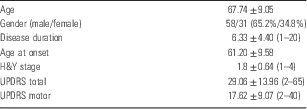
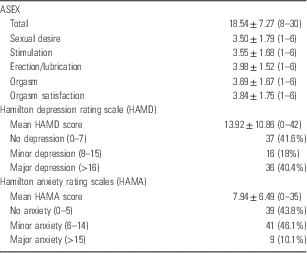
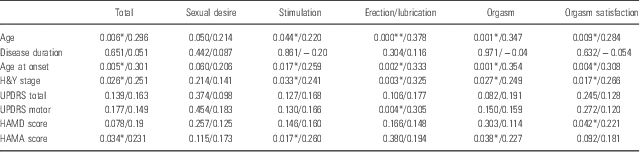
Scoiodemographics and PD characteristics are presented in Table 1. The mean age at the time of the study visit was 67.74±9.05. Male/female ratio was 1.87. Mean UPDRS total was 29.06±13.96 and mean UPDRS motor was 17.62±9.07. Mean HAMD score was 13.92±10.86, 58.4% of the patients had minor or major depression; and mean HAMA score was 7.94±6.49, 56.2% of the patients had minor or major anxiety (Table 2). In 44 patients (49.44%) both depression and anxiety were present together. The most prevalent ASEX domain observed in our patients was erection/lubrication: 47 (56%), followed by orgasm: 44 (52.4%), orgasm satisfaction: 40 (47.6%), stimulation: 38 (45.2%), and sexual desire: 34 (40.5%). The mean ASEX score was 18.54±7.27 out of a maximum of 30. ASEX total scores were correlated with age, H&Y stage and HAMA scores. Age and also age at onset were correlated with ASEX subdomains except sexual desire. There was no correlation between disease duration and ASEX subdomains. UPDRS motor score was correlated with erection/lubrication. HAMD was only correlated with orgasm satisfaction. HAMA score was correlated with stimulation and orgasm. The correlation of ASEX total and subdomain scores to age, disease duration, HAMD and HAMA scores, UPDRS total and motor scores are shown in Table 3.
Demographics and PD characteristics of the patients (n=89)
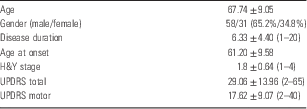
H&Y, Hoehn and Yahr; PD, Parkinson’s Disease; UPDRS, Unified Parkinson’s Disease Rating Scale.
ASEX, Hamilton depression and anxiety rating scales (n=89)
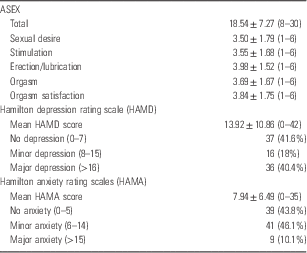
ASEX, Arizona Sexual Experiences Scale.
The correlation of ASEX total score and UPDRS total and motor score, HAMD and HAMA scores
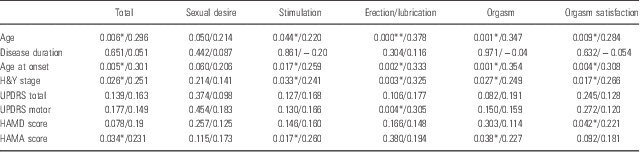
*p<0.05, **p<0.001.
ASEX, Arizona Sexual Experiences Scale; HAMA, Hamilton anxiety; HAMD, Hamilton depression; H&Y, Hoehn and Yahr; UPDRS, Unified PD Rating Scale.
Discussion
The purpose of this study was to examine the prevalence of SD, anxiety and depression in PD patients, and also to investigate the relationships between anxiety and depression and the SD.
In this study, the most prevalent ASEX domain observed in our patients was erection/lubrication: 47 (56%), followed by orgasm: 44 (52.4%), orgasm satisfaction: 40 (47.6%), stimulation: 38 (45.2%) and sexual desire: 34 (40.5%). Basson clinically described the sexual concerns of 25 people with PD. In the article, the author found changes in areas of sexual desire, of sexual function, of sexual satisfaction (Reference Basson23). Bronner et al. investigated sexual function in 75 people with PD: women reported difficulties with arousal (87.5%), with reaching an orgasm (75%), with low sexual desire (47%), and with sexual dissatisfaction (38%); men reported erectile dysfunction (68%), sexual dissatisfaction (65%), premature ejaculation (41%) and difficulties in reaching an orgasm (40%).
In a study, it has shown that the most important factor in the development of SD is ageing (Reference Bancroft24). In our study, we found that age was correlated with ASEX subdomains except sexual desire.
Hence, it may be assumed that SD in PD may not be the direct result of PD-related disability, and probably be moderated by other factors. Moore et al. assessed both quality of sexual life and quality of life in PD patients. The authors found that quality of sexual life was reduced in all patients and it worsened with disease progression and ageing (Reference Moore, Gurevich, Korczyn, Anca, Shabtai and Giladi25). This finding was similar with our study that the ASEX total scores of our patients were correlated with age and H&Y stage. Whereas, our findings revealed no correlation of ASEX total scores to the UPDRS total or motor score. It is not resolved that if the specific neurological genital dysfunction is a feature of PD (Reference Rees, Fowler and Maas4). Some studies have shown that dissatisfaction of sexual experiences in PD is more common than in controls, and the major determinants are age, severity of disease and depression (Reference Jacobs, Vieregge and Vieregge26,Reference Welsh, Hung and Waters27).
Our findings revealed a relationship of ASEX total scores to H&Y stage. There are only a few studies examining the relationship between PD and sexual function. In a past study carried out on PD patients in outpatient neurology clinics in Turkey, the mean ASEX score was reported to be 24.7±5.5 for females and 14.4±4.6 for males, which is similar with our results as 18.54±7.27. They reported that, female patients with PD had higher rates of SD than healthy controls by using ASEX scale, but male patients were only slightly different from the controls. They discussed that it might be cause of the most patients had mild-moderate disease. Nevertheless, they did not investigate the relationship between the affected domains of sexuality and UPDRS total, motor, H&Y stages or duration of disease (Reference Celikel, Ozel-Kizil, Akbostanci and Cevik28). In our study, UPDRS motor score was correlated with erection/lubrication and H&Y stage was correlated to all ASEX subdomains except sexual desire. In agreement with their study, we also did not find a relation between ASEX scores and disease duration.
Depressive symptoms have been shown to be related to SD in the general population (Reference Shindel, Eisenberg, Breyer, Sharlip and Smith29) and in large clinical samples (Reference Aslan, Beji, Gungor, Kadioglu and Dikencik30). Depression and anxiety were reported to be high in PD patients than expected in the general population (Reference Schrag and Schott31,Reference Rojo, Aguilar, Garolera, Cubo, Navas and Quintana32). Depression and anxiety are disorders affect both each other and sexual functions. In our study, 44 of the patients (49.44%), both depression and anxiety were present together. Our findings seem to indicate that depression in patients with PD is correlated with orgasm satisfaction. Welsh et al. (Reference Welsh, Hung and Waters27) found that PD patients were less satisfied with their sexual relationships, and were more depressed in comparsion with controls. The mean HAMD score was 13.92±10.86 and with the identification of minor or major depression in 58.4% with a probable impact on sexual function of our patients. The frequency of depression in our patients is higher than previous studies which were reported 30–45% (Reference Wichowicz, Slawek, Derejko and Cubala33,Reference Reijnders, Ehrt, Weber, Aarsland and Leentjens34). It may be due to the depression scale we used was applied by interview but not self reported like the others.
In a recent study, Rodríguez-Violante et al. (Reference Rodríguez-Violante, Cervantes-Arriaga, Berlanga-Flores and Ruiz-Chow9) reported that depression were common in patients with PD and like in our results, could not find any correlation between the depression and sexual symptoms. Our results, on the other hand, in patients with PD, ASEX total is not correlated with depression, but with anxiety. HAMA score was also correlated with stimulation and orgasm. The mean HAMA score was 7.94±6.49, and 56.2% of the patients had minor or major anxiety, which is higher than previous studies with a prevalence of 25–49% (Reference Riedel, Klotsche and Spottke11,Reference Dissanayaka, Sellbach and Matheson12).
The main limitation of this study is the lack of any control group and the small number of patients included. Since, sexuality is a sensitive topic with privacy for people, SD maybe obscured or disregarded by PD patients and this is another shortcoming of the study.
In our study, SD seemed very common, while not related to UPDRS scores, disease duration and depression, but correlated with age, age at onset, H&Y stage and anxiety. In patients with PD, there may be a common factor that modulates both depression, anxiety and sexual function. In our current knowledge, we cannot say that SD in PD is the result of depression and anxiety or a common pathological course leads to PD and mood disorders. Further studies are needed to clarify the exact relationship of depression, anxiety and sexual problems.
Acknowledgements
All authors met the following authorship criteria: (1) substantial contributions to conception and design of, or acquisition of data or analysis and interpretation of data, 2) drafting the article or revising it critically for important intellectual content and 3) final approval of the version to be published.
Conflicts of Interest
None.
Ethical Standards
The authors assert that all procedures contributing to this work comply with the ethical standards of the relevant national and institutional committees on human experimentation and with the Helsinki Declaration of 1975, as revised in 2008.