In addition to creating infrastructure and securing resources, the protection of artistic traditions and the creation of an improved material culture were integral parts of the Austro-Hungarian civilizing mission in the occupied territories of Bosnia and Herzegovina after 1878.Footnote
1
Although the Austrians were not imperialists in the classical sense, the scholars, bureaucrats, and industrialists who flocked to the provinces used a variety of tropes involving progress, technology, and education to describe their work, and their self-representation often echoed the colonial, imperialist, and orientalist rhetoric of their European neighbors in the era of the “new Imperialism.”Footnote
2
For this reason, the application of postcolonial theory to the Austrian experience in Bosnia has opened several interesting new lines of inquiry.Footnote
3
But Austrians’ representations of Bosnia had several overlapping components, depending upon their audiences. To outsiders, the imperialist rhetoric was useful, particularly insofar as Austrians believed themselves to be exemplary colonial administrators. For those living inside the Dual Monarchy, however, Bosnia had the potential for other meanings. First, it could be interpreted as a “proximate” colony where Austrians could find wealth, adventure, and opportunity for professional advancement in service of the civilizing mission. In addition, from the military or strategic perspective, Bosnia represented the ability to both fill the power vacuum created by Ottoman disintegration and expand the reach of the Imperial and Royal Military into the Balkans. Next, Austrians simultaneously admired the remnants of Ottoman material culture in Bosnia while acknowledging the opportunity to redeem the Southern Slavs from an oriental stasis and decline imposed by Ottoman rule. This made Bosnia a place that contained elements of the dangerous, exotic, and strange while on the cusp of becoming an increasingly tamed, benign, and accessible tourist destination.Footnote
4
This multiplicity of discourses about Bosnia created a backdrop to the intellectual and cultural life of Vienna at the end of the nineteenth century. A powerful example of this is in Heimito von Doderer's novel, Die Strudelhofstiege, whose hero, Melzer, was stationed in Bosnia in the years before the outbreak of war in 1914. Throughout the novel, Melzer's recurring memories of Bosnia serve as a repository of an Austrian sensibility that disappeared forever in 1918. Early in the book, Doderer provides this rendition of the young Lieutenant Melzer attempting to please his imposing host—a railway engineer awaiting a contract for Bosnia—at a meal in the countryside in the year 1910:
“So, Melzer when will we begin to build railroads for you and your Bosniaks down there?”
“Without a doubt very soon, Sir.” answered Melzer without the slightest hesitation.
“We are doing everything down there: Hotels, streets, bridges [he continued.] The land is beautiful; don't believe what they say about it being only a pile of hot rocks. Of course a railroad network will be built, indeed—within the next few years.”Footnote
5
[Emphases mine]
Melzer expresses the confidence, energy, and ambition of Austrians in Bosnia by envisioning progress in terms of infrastructure and access, whereas his host, the engineer, is eager to begin his own profitable enterprise in the territory. For these two protagonists, Bosnia is an Austrian proving ground and symbol of its benevolence before 1914; this was the official mind of the Habsburg Empire.
One of the chief conduits through which the official rhetoric of the Bosnian Administration flowed into Cisleithanian Austria was the “exhibitionary complex” of museums and educational institutions in Vienna. Drawing from Foucault, the historian Tony Bennett has proposed that the exhibitionary complex was the manifestation of state power that combined new institutions such as the public museum with new disciplines of knowledge—such as art history and anthropology—after the Great London Exhibition of 1851.Footnote
6
For Bennett, the rise of the exhibitionary complex represented a softer form of state power; its denizens organized knowledge for the purpose of “winning the hearts and minds” of citizens, educating the masses, and communicating state ideologies.Footnote
7
The following pages consider the fluidity of the Austrian imagination with regard to Bosnia. They discuss ways in which Bosnia was invented and put on display for Austrian—and Western European—audiences and suggests that the extent of the region's material and imaginative contribution to Vienna's fin-de-siècle culture of the applied and visual arts has yet to be explored. To accomplish this, we shall consider three representations of Bosnia in Vienna. The first of these is the taming of the Ottoman threat in the region and the transformation of its Muslim population into ornamental and grateful subalterns. Second is the improvement of Bosnian arts and crafts for sale and exhibition in Vienna. Finally, we consider the gendered display of the Austrian-Bosnian relationship through ballet. Each of these events delineates the process of staging Austria's “civilizing mission” in Bosnia. We begin, however, with a consideration of Austria and the problem of imperialism during the final quarter of the nineteenth century.
I. Austria and the “New Imperialism”
Despite its lack of overseas colonies, the Austro-Hungarian Monarchy often presented itself as a colonial power in Bosnia and Herzegovina. In this, the Dual Monarchy was no different from the other European great powers that were dividing the world among themselves in the late nineteenth century. This was possible because the Austrian occupation of Bosnia in 1878 was part of a greater European agreement (following the Russo-Turkish war) that also included North Africa. The Berlin Conference of 1878 permitted Austrian occupation of the Ottoman territories, but the great powers also gave the island of Cyprus to the British Empire, setting the stage for its occupation of Egypt a few years later. In addition, Otto von Bismarck encouraged the French to seize the “ripe Tunisian pear” as recompense for Great Britain's gains. Once England and France had acted on these opportunities, the Scramble for Africa began in earnest. From a global perspective, therefore, the Austro-Hungarian occupation of Bosnia and Herzegovina was one component of a greater colonial game being played among European powers.
Indeed, many contemporary onlookers interpreted Austria's abstention from the Scramble for Africa in the context of the Berlin Conference. Europeans outside of the Habsburg monarchy viewed the occupation of Bosnia as the equivalent of (or substitute for) a stake in Africa. As an anti-colonial parliamentarian in the German Reich suggested, perhaps the Austrians had the better deal: “That little slice of Herzegovina could well be worth more than the whole of East Africa.”Footnote
8
A Habsburgertreu Czech used another popular metaphor: “In terms of geographical science, Bosnia and Herzegovina have been very much like the great white spaces on the maps of central Africa.”Footnote
9
For some Western Europeans, Bosnia and the Balkans surely seemed like Africa, a rugged, unknown space on the map of southeastern Europe, waiting to be explored, civilized, and plumbed for raw materials and resources.
This view might not have been held among politicians within the Dual Monarchy—for whom the Balkans and the Ottomans had been topics of concern for centuries. Nevertheless, the rhetoric of imperialism created a set of shared tropes for interpreting Bosnia to outsiders. In keeping with this rhetorical strategy, Benjamin von Kállay (1844–1902), the chief Habsburg administrator in Bosnia after 1882 and the Joint Minister of Finance (and Hungarian nobleman), believed that his enlightened administration of the territories served as a model of colonial rule for other European great powers. Those wishing to understand how to rule their overseas colonies wisely and well need only look at the Austrians in Bosnia.Footnote
10
This was also the argument of the Russian/Swiss Orientalist and weapons collector Henri Moser (1844–1923), a booster for Kállay's regime, whose defense of this idea won him the position as general director of the Bosnian Pavilion at the Paris 1900 Exhibition.Footnote
11
But imperialism was not the whole story. For others, both the proximity of Bosnia to the Dual Monarchy's borders and the Ottoman legacy of the region also fueled the Orientalist fantasies of its occupiers.Footnote
12
This led Habsburg administrators not only to greater research and interest in Islam, but also efforts to reform and rehabilitate the region. As Maximilian Hartmuth has demonstrated, Austrian scholars did a great deal to catalog, comprehend, preserve, and “restore” Islamic architecture and ornamental traditions in the region.Footnote
13
Indeed, despite its overzealousness in restoring some mosques, overall the Occupation Government's behavior toward Islam was exemplary in its evenhandedness.Footnote
14
The government's construction of the Muslim theological school in Sarajevo in 1887–1889 was an effort to adapt the “neo-Moorish” style (first displayed in the Egyptian pavilion at the Vienna World's Fair of 1873) for several government buildings. The style, derived from Spanish and Moorish art, was a nod to the significance of Islam in the region. Sarajevo's City Hall (Vijećnica), completed in 1896, was an additional example of this trend.Footnote
15
But another aspect of Austrian rhetoric involved the traditional tropes of Orientalist discourse: decline and stasis. Although Bosnia's population was descended from the Slavic races, they were seen as Orientalized through Ottoman rule, and therefore in need of help from the West. During a visit to Sarajevo in 1888, Crown Prince Rudolf declared: “Our mission [here] is to bring western culture to the Orient.”Footnote
16
For other Slavs in the Dual Monarchy, the task was to help their Southern Slavic brethren. As the Sarajevo Craft School director, the Czech-born Alois Studnička wrote, “I was invited by Kállay to join the Bosnian services, and I accepted this offer enthusiastically, looking forward to working with my southern Slavic brothers.”Footnote
17
There was, therefore, a variety of overlapping and sometimes contradictory ways to present and invent Bosnia to audiences in Vienna and Western Europe. As we consider how imperial, colonial, and Orientalist perceptions of the occupied territories merged with the exhibitionary complex of Vienna, we begin with a case study: the Bosnian peddler, whose image shall accompany us through our discussion.
II. The Bosnian Peddler
Vienna was a multicultural and cosmopolitan city in the late nineteenth century. As imperial capital of a multinational empire and a growing industrial center, it was home to a variety of ethnic groups ranging from Bohemian factory workers to Galician Jews. In the late 1880s, however, one more colorful figure could be seen on the streets of Vienna: the Bosnian peddler, selling his wares from door to door. An article in the Bosnian Post described him in the following way:
These peddlers from “new Austria” are clothed in the national costume, wearing narrowly pleated pants, colorful bordered jackets, the fez, and wide belts which hold a threatening array of small weapons. Carrying practically an entire arsenal, these peddlers are a walking warehouse of ivory-inlaid knives, [as well as] match boxes, and cigar holders made of rosewood. … These peddlers are a type of pioneer, who seek to find a market for their admittedly modest goods in the great metropole of the Empire. They give an Oriental flair to Vienna's streets, but they are also a constant reminder of our mission in the East.Footnote
18
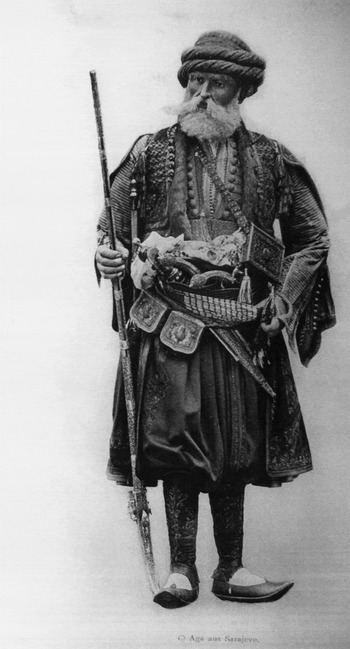
The Bosnian peddler might have resembled a poorer version of a mannequin in Sarajevo's Provincial Museum (Zemaljski Muzej, Landesmuseum), which was created at about the same time (fig. 1). The figure presents a Muslim aristocrat, whose smiling eyes and gentle demeanor are in sharp contrast to the weapons he carries. His right hand holds a flintlock, and his fabric belt is stuffed with daggers and pistols as was typical of Bosnian nobility. This particular mannequin traveled, with his compatriots, to an exhibition in Vienna in 1891, and we shall discuss this in detail later. For the moment, however, we can use this example to imagine our Bosnian peddler: a more run-down and shabbily clad version of the Bosnian's traditional dress.
Figure 1:
A Muslim Notable from Sarajevo with Weapons [“Mohamedaner (Aga) aus Sarajevo im Wafffenschmuck”]. From Karl Masner, Die Costümausstellung im k.k. österr. Museum 1891. (Wien: J. Löwy, 1894).
The text of the newspaper article provides a lively and humorous description of a Bosnian bristling with weapons on the streets of Vienna. It is rich with the vocabulary of the Austrian colonial/Orientalist discourse regarding Bosnia; the occupied territories are christened “new Austria,” and the fierce-looking Bosnian is a cultural pioneer. He is not a threat but a sober reminder of the Austrian civilizing mission to the East.
More important, however, is the interplay between fear and patronization we encounter in the newspaper's depiction of the peddler. The Bosnian nobleman and his doppelgänger, the peddler, represent several of the richly textured material interconnections between Vienna and the occupied territories. First, the newspaper account indicates how the sight of the peddler evokes fear for a brief moment: the strange man, armed with weapons and dressed in a fez, certainly seemed a bit like the Turkish bogeyman of old. Second, his arsenal of metal objects—once dangerous but now sold as trinkets—represents a more recent memory: the fierce Bosnian warrior who had put up such determined resistance to Austrian occupation in 1878. Finally, his modest trinkets represent the Regional Government's efforts to rehabilitate Bosnian crafts in Sarajevo and other Bosnian towns. Let us consider the taming of this warrior/peddler in Vienna.
III. Frontier Orientalism
André Gingrich has described the interaction between Austria and Bosnia as “frontier Orientalism,” a process that (departing slightly from Said's definition of Orientalism) was shaped by the lack of distance between Austria and the territories. This resulted in a feeling of familiarity mixed with fear, a master narrative that had two components with regard to the inhabitants of the region:
On one hand he [the Bosnian] appears as a dangerous Turkish soldier, an armed representative of another high culture, an equal military foe whose defeat is necessary for one's own imperial ascent. On the other hand, he appears as a subjugated Bosnian colonial who remains loyal to the end, fighting against the enemies of the Empire.”Footnote
19
We see this ambivalence in the text: the peddler only seems to be forbidding; in reality he is harmless.
But this had not always been the case. The inhabitants of Vienna knew full well the effort it had taken to pacify the region in 1878. Despite the Foreign Minister Count Andrássy's confidence that Austrian forces could occupy the territories with little effort (“a squadron of Hussars and a regimental band”),Footnote
20
the Habsburg forces met with serious resistance upon entering Ottoman territory. The Ottomans retained de jure sovereignty until 1908, so these were still Ottoman lands. This delayed the progress of Austrian troops, and the battle for Bosnia was unexpectedly difficult. After entering Sarajevo on 19 August 1878, the Austro-Hungarian commander Field Marshal Josip Philippovich requested reinforcements; eventually over 250,000 men (roughly one third of the imperial and royal [k.u.k.] army) were required to put an end to local resistance. The ferocity of the fighting was legendary, with accounts of decapitation and mutilations by Bosnian insurgents.Footnote
21
The Bosnian warrior was a fearsome opponent, and the first assignment of Austro-Hungarian rule was to subjugate all resistance forces.
This was largely accomplished by 1881, and the other component of frontier Orientalism—winning over the former insurgent—began. The Austrians proceeded to integrate Bosnians into the k.u.k. army by creating special regiments made up of Muslim troops, who wore a colorful red fez and light blue trousers. The Bosniaks, as these soldiers were called, were lauded as the fiercest of all the different ethnic groups of the army; their ornamental uniforms added an “oriental flair” to the cities (like Graz) where its regiments were stationed. The ferocity of 1878 was slowly recast into a popular image of the Bosniaks as a superior martial race.Footnote
22
The British had their Ghurkas, and the Austrians had their Bosniaks.Footnote
23
The Bosnian peddler was a reminder of those early insurgents, but his weapons were now tamed. Indeed, the ornamental weapons in his belt—knives, pistols, and powder boxes—were demilitarized into colorful trinkets. This was the second aspect of taming the former warrior. Turning Bosnian swords into tourist souvenirs was part of a larger administrative program of arts and crafts reform in Bosnia. What the newspaper described as the peddler's “modest wares” in 1889 were already being cataloged, analyzed, and refined by experts from the metropole.
IV. Swords into Souvenirs—Craft Reform in Bosnia
The process of bringing the benefits of Western rule to Bosnia began after the pacification of the territories was complete. In 1882, the military government withdrew and Kállay was appointed civilian administrator of the region.Footnote
24
Kállay firmly believed that institutions of modernization and good government would eventually create loyal subjects. In an interview with the English newspaper, The Daily Chronicle, he described his aims:
To make the people contented, to ensure justice, to develop agriculture, to render communication easy and cheap, to spread education, to retain the ancient traditions of the land vivified and purified by modern ideas—that is my administrative ideal. …. Austria … is a great Occidental Empire, charged with the mission of carrying civilization to Oriental peoples.Footnote
25
Within a few years of establishing civilian rule, Kállay turned his attention to the craft and artisanal traditions of the former Ottoman territories. Noting the decline of local handicrafts in the face of cheap Western imports, Kállay began to consider ways to revive them. In 1887, he began his initiative for craft reform, establishing government ateliers and craft schools in Sarajevo and other Bosnian towns to instruct a new generation of handworkers in traditional techniques.Footnote
26
Kállay's intention was the “vivification and purification” of the artisanal traditions of the region in order to make them a source of income for both local peoples and the Regional Government. In 1878, the Austrian and Hungarian delegations that approved the occupation declined to authorize funds to support a civilian administration. Thus, Kállay had to find new and creative ways to finance his government.Footnote
27
No doubt he hoped that sales of Bosnian crafts would ultimately contribute to the administration's budget.
To accomplish his aesthetic and commercial goals, Kállay relied on an extensive structure of craft education that was already well established in Cisleithanian Austria. In 1863, Emperor Franz Joseph established the Austrian Museum for Art and Industry (das österreichische Museum für Kunst und Industrie) to improve both public taste and Austrian manufactures. This effort followed the pattern of industrial design reform practiced at the South Kensington Museum (now the V&A Museum) in London. Over the following decades, the Museum administrators developed industrial production alongside craft education through its Central Applied Arts School (Kunstgewerbeschule) in Vienna.Footnote
28
Graduates from this school often went out to administer and teach at a secondary level of regional craft schools. By the late 1870s, the Museum and its educators had become more deeply involved in the improvement of the folk arts in the most peripheral regions of Cisleithania—where industrial processes had not yet completely displaced local handicrafts.Footnote
29
This was part of an effort to sustain the local populations, give them livelihoods beyond agricultural work, and popularize the folk arts in Vienna. By the time Kállay began his initiative in Bosnia, therefore, the Museum in Vienna had already experienced great success in popularizing a variety of ethnic crafts for consumers in Vienna through its nexus of education and display.
Kállay adopted the Cisleithanian model for Bosnia by establishing a central government craft atelier in Sarajevo, with lesser schools in Livno, and Foča.Footnote
30
His plan included schools for carpets, embroideries, wood crafts, building, and metalworking. Local artisans’ willingness to enter a government-sponsored atelier was probably an indicator of the degree to which craft production in Bosnia had indeed suffered through political upheavals and war before 1878.
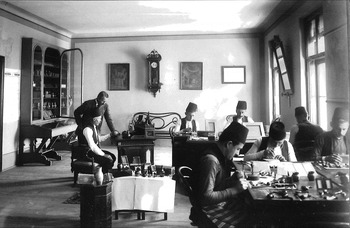
According to government reports, this effort came just in time. The crafts dedicated to wire and mother-of-pearl inlay techniques for weapons, for example, were practiced exclusively by Muslims, and according to official documents, by 1887 this artisanal tradition had almost completely died out. Only one living practitioner of metal wire-inlay could be found that year.Footnote
31
Although he died less than twelve months later, government authorities prided themselves in having created an environment where he could pass along his expertise to the next generation (fig. 2). The imperialist and patriarchal subtext of their reportage was clear: the revival of Bosnian crafts—in the form of help from Austrian administrators—had arrived just in the nick of time.
Figure 2:
Workroom at the Metal School in Sarajevo. Postcard, ca. 1900.
Many of these metal crafts were carried into Vienna: transforming the Bosnian peddler's “modest goods” invariably meant improving them for the tastes of city consumers.Footnote
32
As a result, craft educators in Bosnia had the dual mandate to revive craft traditions and inculcate the aesthetic principles of the West. This meant exposing local artisans to the aesthetic standards of the metropole. To that end, in 1889 a Sarajevo silversmith, Mustafa Bektić, traveled to Vienna to study principles of classical drawing at the Museum for Art and Industry's school (Kunstgewerbeschule).Footnote
33
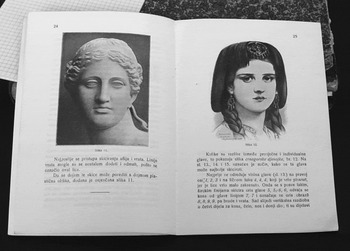
Vienna came to the provinces, too. Craft teachers from Austria arrived in Bosnia after 1887. Every instructor was a graduate of the craft education system in Vienna, and every one of them brought their training with them. After arriving in Sarajevo in the 1890s, Alois Studnićka wrote design handbooks in the local language that introduced the major historical styles for application in mosaics, inlaid wood, or drawing. The classical influence of his education is readily apparent in his adaptation of a local peasant girl's face along classical linesFootnote
34
(fig. 3). In this regard, arts and crafts education in Sarajevo was a hegemonic discourse insofar as it promoted a classical aesthetic that emanated from Vienna and was disseminated through the government craft schools and ateliers.
Figure 3:
Classical and Peasant Faces. From Alois Studnićka, Zbirka Pregledalcia za prostoruko crtanje III: Nekoliko Motiva Narodnodnoga Veziva [Images for Freehand Drawing III: Various Motifs and People] (Sarajevo: Zem Vlada, 1898), p. 8.
The newly established Provincial Museum (Landesmuseum/Zemaljski Muzeji) in Sarajevo also contributed to this educational project. Founded in 1888, the Museum's curators (mostly educated in Cisleithania) quickly amassed a large ethnographic collection of weapons, textiles, costumes, and other objects.Footnote
35
The Museum's best examples of indigenous crafts items circulated among the schools; this allowed students to observe and imitate well-made objects. In this way, an institution of the emerging exhibitionary complex interacted with education, artisanal traditions, and commerce in Sarajevo.
Although Maximilian Hartmuth has described the formation of the Museum as inspired by local leaders, it also seems clear that other prime movers and educators were the bureaucrats and scholars who came to Sarajevo from outside Bosnia—in search of professional opportunities and quick advancement. Thus, while the Museum's staff promoted research into Bosnian design, they were also complicit in the project of improving its local manufactures in accordance with a mediated view of what constituted an “original” or “pure” Bosnian creation.
This had the outcome of creating an “invented tradition” for Bosnian wares. By 1900, the metal inlay and incrustation techniques from Bosnian weapons were being applied to a new range of consumer items for the tourist trade. In 1905, an observer remarked:
The products of these schools are … carefully made with the western market in mind. Instead of pistols and powder boxes, nowadays only inlaid cigarette holders, hatpins, picture frames, brushes, and letter openers are created.Footnote
36
Old, albeit improved, techniques had been adapted for new consumer demands. And the weapons craftsmen—having lost the local market because of Austrian restrictions—found a new market in souvenir shops frequented by both a growing number of tourists and successive contingents of k.u.k. troops from all over the monarchy. Doderer's protagonist Melzer made use of his Bosnian coffee service for many years after the end of World War I:
At home the Major prepared quickly—from years of practice—his Turkish coffee in a beaker of worked metal with a long handle. He used the service he had owned since Bosnia. The long, small mill, whose form was determined by the way that the Arab carried it tied to his saddlebags, the large copper serving tray with the tiny cups of white porcelain in copper holders, and the sugar can with its half-moon standing tall and straight on its lid.
Der Major bereitete zuhause schnell—in alter Übung—türkischen Kaffee in einem getriebenen Kännchen mit langem Stiele. Er benützte ein Service das er schon in Bosnien besessen hatte. Die lange, schmale Mühle, deren Form daher kommt, daß der Araber sie an der Sattletasche geschnallt mit sich führt, die große kupferne Servierplatte mit Ziselierungen, die winzigen Tassen vom weißem Porzellan in kupernen Hältern, und die Zuckerdose mit dem aufrechtstehenden Halbmonde über dem Deckel.Footnote
37
Decorative weaponry was another craft that never disappeared completely. In 1875, an English traveler noted: “In the small Turkish market there were many second-hand goods, and amongst them magnificent flintlocks of antique form, with stocks richly inlaid with mother of pearl and golden arabesques.”Footnote
38
This was part of local tradition. Another visitor noted how, under the Ottomans, Bosnian men “armed themselves with damascene swords, daggers, pistols and muskets. Hundreds of skilled craftsmen found work and were able to support themselves.”Footnote
39
Nevertheless, traditional Bosnian uses of ornamental weaponry declined under Austrian administration. Decades later, on the eve of the annexation, a visitor from Berlin noted the change:
These richly ornamented weapons can now be worn only by a few, privileged men. They may not actually use them however, so it is a natural outcome that soon no one will expend the effort to make them.Footnote
40
The weaponry had become ornamental, its uses limited to either those Muslim aristocrats who supported the Austrian administration or the tourist trade. Indeed, the presence of tens of thousands of Austrian troops in the region over the next three decades created a new market. Countless versions of these ornamental pistols, daggers, or coffee services were an obligatory purchase for the soldiers who rotated through Bosnia until 1918. Many of the weapons later found their way into Vienna's antique shops and flea markets as “Turkish” weapons left from the siege of 1683.Footnote
41
Weapons as tourist trinkets: swords into plowshares. The revival of Bosnian crafts testified to the success of the civilizing mission.
Yet the outcome of this process, for those who submitted to the demands of the craft schools, was the creation of yet another subjugated and aestheticized Bosnian colonial. The Bosnian craftsman working in the government workshop had replaced the Bosnian insurgent. The warrior with sash and sabre was now an exotic anachronism.
V. The Bosnian Carpet
Another local craft tradition that attracted considerable attention in Vienna was carpet manufacturing. According to Austrian authorities, this was another type of domestic (household) production that was in “decline” before Austrian occupation, and it was revived only through the combined efforts of experts at the museums in Vienna and Sarajevo. These efforts proceeded in several phases: the establishment of a carpet factory in Sarajevo in 1879 through the auspices of a Viennese textile firm, Philip Haas and Sons, the absorption of that project into the Austrian administration in 1892, and the creation of a government carpet school.Footnote
42
One aspect of economic development of Bosnia meant the creation of viable local industries that could compete with Western products.Footnote
43
In 1879, the Viennese carpet manufacturer Philip Haas obtained a concession from the military government to establish a carpet factory in Sarajevo. This decision to form a production facility in Sarajevo was inspired by several considerations. First, the cheaper labor and raw materials made economic sense; not until annexation in 1908 did employers in Bosnia have to comply with the increasingly regulated manufacturing and workplace safety guidelines of Western Europe. In addition, the flat-weave carpet used in peasant households—called locally the ćilim – was a popular consumer item among urban populations who could not afford the more expensive Oriental (knotted) rugs. It was also more practical: the flat weave textile could be displayed on both sides, making it useful for other functions such as bedcovers, wall hangings, and cushions. Finally, the Haas venture in Sarajevo was undergirded by a shift in consumer tastes. In Vienna, public interest in artifacts from Bosnia also reflected a growing interest in the folk arts from many of the regions of Cisleithanian Austria that began after the Vienna World's Fair (Weltausstellung) of 1873.Footnote
44
Haas believed that, with a bit of refinement, Bosnian carpets could become suitable for sale to urban consumers as well.
Haas also used the Austrian educational infrastructure for his carpet factory in Sarajevo. In 1879, he invited Josef von Storck (1830–1902), the director of the Museum for Art and Industry's Applied Arts School, to be the artistic consultant for the carpet factory.Footnote
45
Storck's collaboration with the Haas enterprise began the process of “refinement” and study; this eventually culminated in the creation of an official canon of Bosnian motifs that made their way into official catalogs.Footnote
46
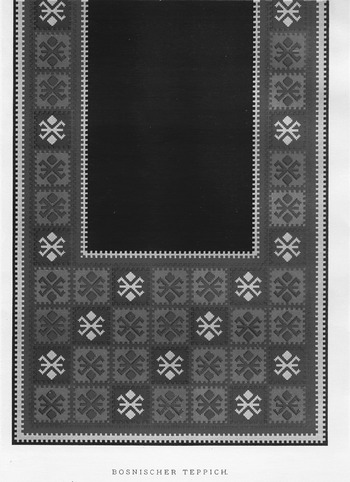
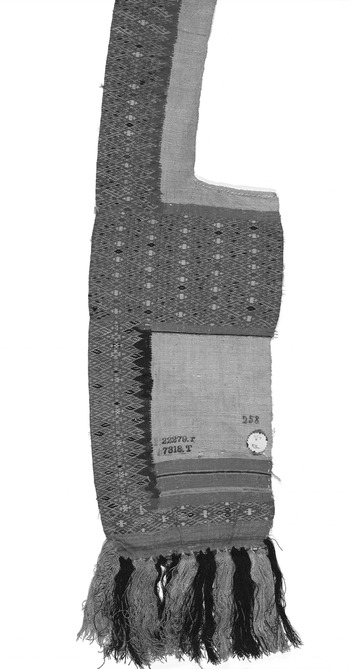
One of the many paradoxes of Storck's work was his inexperience with the actual designs of the region, however. Storck published several of his so-called “Bosnian carpet designs” in the applied arts journal Blätter für Kunstgewerbe (fig. 4). At first, Storck had no access to the collections in Sarajevo. It is likely that he took his first designs from the few remnants of Southern Slavic aprons in the Vienna Museum's collectionFootnote
47
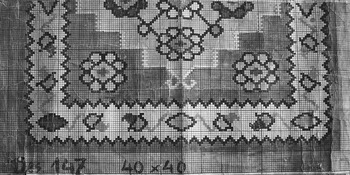
(fig. 5). Storck's designs were lackluster in comparison with designs originating in Sarajevo as administrators from the Provincial Museum began bringing examples from real carpets to light. These designs, often fragments, were cataloged, studied, and standardized. And as looms were both mechanized and enlarged, women at the carpet factory began to work with paper patterns—now calibrated for production in several sizes (fig. 6).
Figure 4:
Bosnian Carpet design(s) by Josepf von Storck. From Blätter für Kunstgewerbe 21 (1892), Figure 59.
Figure 5:
Apron Fragments in Kilim technique MAK- Austrian Museum of Applied Arts/Contemporary Art, Vienna, Inv. T-7318 158 and 160. ©MAK/Georg Mayer.
Figure 6:
Pattern for Design 24, Carpet Factory, Sarajevo. National Museum of Bosnia and Herzegovina. Image by author.
In 1889, several Bosnian carpets traveled to Vienna to adorn the Museum for Art and Industry's Twenty-fifth Anniversary exhibition.Footnote
48
The display of Bosnian carpets created a sensation that nearly overshadowed the museum's anniversary celebration itself. They were, as one reporter exclaimed, the “ball gown” (Festkleid) of the exhibition. The gendered metaphor expressed both the colorful impression the rugs made within what was ostensibly a display of historicist originals and copies and the decorative (femininized) aspects of Bosnia. The carpets were seen as the crowning achievement of the exhibition—and a testament to the “new Austria” that was emerging in the occupied territories.Footnote
49
The excitement in Vienna was palpable.
The paradoxes of the carpet production process were ignored, however. As the reporter blithely praised the work of the administrators in Sarajevo, he also unmasked some of the contradictions inherent in the program of improvement:
The wool is of Bosnian origin ... [but] it is brought to Vienna to be dyed and then sent back down there to be worked. Also the designs and motifs are old, but they have been happily updated and refined by Storck's artistic hands. Footnote
50
Wool from Bosnia was dyed in Vienna, returned to Bosnia, and woven into carpets based upon the improved Viennese designs. It surprised no one that the revival of Bosnian carpets should rightly occur under the supervision of Viennese educators utilizing the superior industrial techniques of the metropole.
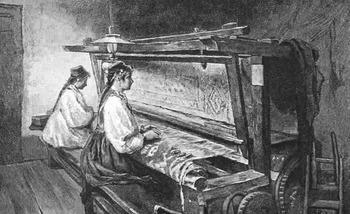
In 1892, control of the carpet factory reverted back to the administration government, which subsequently combined a manufacturing center with a school for carpet workers. It produced printed catalogs from designs that were now standardized and available for sale in several sizes. Meanwhile, the practice of bringing in local women to teach them the standard designs to reproduce at home continued. Naturally, the women produced according to the patterns they had been taught (fig. 7). More important, the Regional Government was now able to sell its products directly in Vienna.
Figure 7:
Bosnian Women at Weaving Stool with Pattern. From Die österreichisch-ungarische Monarchie in Wort und Bild, Volume 22: Bosnien und Hercegowina (Vienna, 1901), p. 515.
VI. Selling Bosnia in Vienna
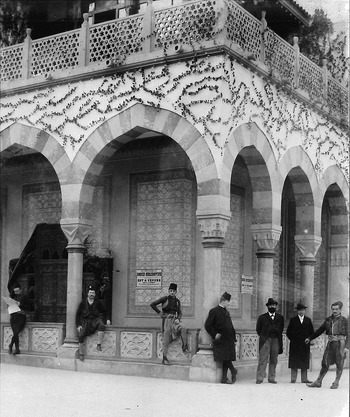
The Bosnian crafts were sold from the Bosnian Bureau for Arts and Crafts in Vienna's first district.Footnote
51
Administrators worked on upper floors that were richly furnished with furniture and carpets produced in Sarajevo. Meanwhile, the ground floor was a shop for Bosnian crafts produced at the government ateliers in Sarajevo.Footnote
52
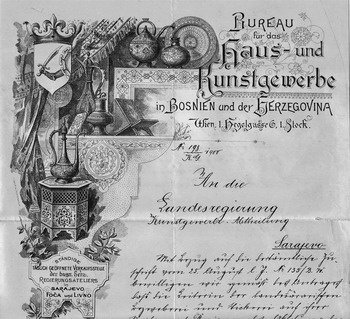
All products were guaranteed by the Regional Government. In this way, Kállay secured additional revenues to support his administration. Advertisements in local journals enhanced sales (fig. 8).
Figure 8:
Letterhead and Correspondence from Office for Bosnian Arts and Crafts, Vienna.
The Bosnian Bureau also sponsored regular exhibitions of Bosnian crafts at other locations in Vienna. Starting in 1888, the administration participated in the annual Christmas Bazaar at the Museum for Art and Industry, where invited manufacturers created special sales displays. Because of their exotic appeal, the Bosnian crafts attracted a great deal of public attention and sold out quickly. For the administration, this was an unmitigated public success: Bosnian crafts were sold at every annual Christmas bazaar thereafter.
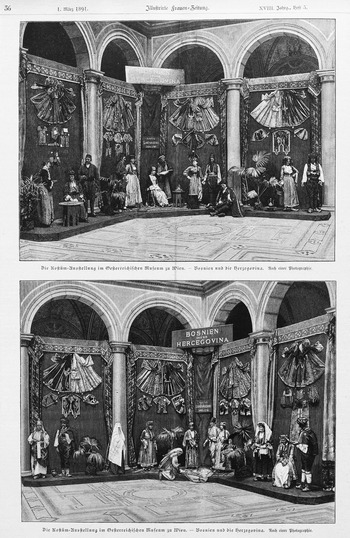
But displays of Bosnia in Vienna combined commerce with the exhibitionary complex. The exotic appeal of Bosnia created another public sensation in 1891 at the Museum for Art and Industry's Costume Exhibition. The Museum had planned an extensive exhibition of historic costumes, but at the last minute, its administrators accepted Benjamin von Kállay's offer of a collection of ethnographic costumes from the Regional Museum in Sarajevo. The costume collection in Sarajevo had grown steadily and, inspired by the mannequins of Swedish folk costumes at the Paris Exhibition of 1889, administrators in Sarajevo had recently ordered a set of lifelike mannequins for their collection.Footnote
53
When the two dozen figures from Sarajevo were arrayed in the Museum's entrance hall, they quickly became a major attraction (fig. 9). Once again, the Bosnian costumes attracted more attention than the Museum's more conventional display of historical costumes.
Figure 9:
Austrian Museum for Art and Industry, Vienna. Central hall, Costume Exhibition 1891, from Illustrierte Frauen Zeitung (Berlin) XVIII, Heft 5, 1 März 1891, p 36.
The mannequins had been worth the effort and expense. Scholars in Sarajevo had taken special care to order each figure with the proper skin tone, eye color, and facial characteristics (according to the latest scholarly assumptions) to match the ethnic clothing and trinkets adorning them. Twenty more figures were stationed throughout the museum, blending scholarly accuracy with the public spectacle of colonial displays.Footnote
54
For special effect our congenial Bosnian nobleman (see above fig. 1) was stationed in the center of the entrance hall to the Museum in Vienna to welcome visitors. Over the next decade, this mannequin became a standard image of Austrian rule in Bosnia. His smile indicated that, despite his weapons, Austrians now had nothing to fear from this Bosnian. A wise and tolerant occupation government had won over the urbane Muslim leaders within the local population. The nobleman and his compatriots became the administration's silent ambassadors, gracing every subsequent international exhibition of Bosnia in Europe.
With displays such as this, Bosnian crafts gained international attention elsewhere on the continent: Karlsruhe 1891, Budapest 1896, Brussels 1897, and Paris 1900.Footnote
55
Exhibition organizers used heraldic arrangements of weaponry, glass vitrines, and armor-clad mannequins to display both old traditions and new products from the craft schools, and many items were for sale. This trajectory culminated in the spectacular stand-alone pavilion (fig. 10), constructed in a vernacular style, at the Paris Exhibition of 1900. By this time, the neo-Moorish style had been abandoned, replaced by a studied rehabilitation of Bosnian domestic architecture. This blended the scholarship and spectacle of the exhibitionary complex with the colonial/Orientalist rhetoric of a civilizing mission—and a twist of commerce thrown in for good measure. The revival of a putative Bosnian style was taken as proof of Austria's benign administration of its proximate colony.
Figure 10:
Bosnian Pavilion, Paris 1900. Sarajevo, National Museum of Bosnia and Herzegovina. Inf. Br. 2179, Foto: F Topić, 1900.
VII. A Wedding in Bosnia
Bosnia's place in the Viennese popular imagination can also be seen in a ballet performed in the Royal Opera House in 1893. Here, too, the expertise of Vienna's exhibitionary complex merged with music, dance, and theatre to create a Gesamtkunstwerk of imperial fantasy. The ballet was performed in the Royal Opera as part of the engagement festivities of Archduchess Margarete Sophie on 21 January 1893. The title was, appropriately enough, “A Wedding in Bosnia.”
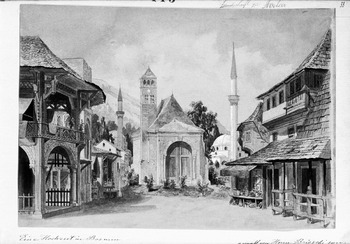
The stage design showed a peaceful, prosperous, and multi-confessional Bosnian village (fig. 11). Religious buildings frame the scene, and the shop windows are full. The plot of the ballet was straightforward: a group of Austrian (Viennese) tourists find themselves in this quaint village on the morning of a wedding. They begin to watch the preparations. They stay on to observe the proceedings as outsiders, but little by little, the Viennese are drawn in to the festivities and begin to mingle with the locals. After a while, they join in the local dances, which they have trouble learning. Spirits rise, friendships solidify, and at the climax of the ballet, the tourists begin to teach the Bosnians their dance: the waltz. The young Bosnian men and women look on with curiosity, but soon they want to learn the new steps as well. The music shifts imperceptibly into 3:4 time, and in the climax of the ballet, the Austrian tourists have taught the Bosnians how to waltz. Urbane Austrians and Bosnian rustics waltz around the stage in a display of harmony in diversity. The Bosnians have learned to keep step with Vienna's civilizing cadence. The message of this ballet was clear. As the Neue Freie Presse reported the next day, the ballet depicted the “moral conquest of Bosnia” through Austrian grace and elegance. A waltz, not a military march, had been the instrument of seduction.Footnote
56
Austria's use of “soft power,” not military might, was to carry the civilizing mission in Bosnia forward.
Figure 11:
A Wedding in Bosnia, Stage design by Antonio Brioschi (1885–1920), Theatermuseum, Vienna.
Just as remarkable was the reporter's description of Emperor Franz Joseph's reaction: “As the Bosnians began dancing the waltz, suddenly laughter could be heard coming from the center loge. With surprise, everyone turned to look. It was the Emperor, laughing heartily, and all the archdukes and archduchesses quickly followed his example.”Footnote
57
Given the emperor's well-known reserve, his laughter on this occasion must have been a remarkable moment for the audience and performers. Its meaning is clear: he was delighted with this version of the Austrian civilizing mission in Bosnia. This made for great entertainment, and the ballet was performed in Vienna for three more years.
Less obvious, perhaps, but just as important, was the ballet's putative accuracy. Every aspect of the ballet was a product of Vienna's exhibitionary complex. The stage set was conceived by Antonio Brioschi, who had studied under Joseph von Storck at the Applied Arts School. It faithfully replicated “typical” examples of Bosnian architecture. The costumes by Alfred Roller (who later became an important Secessionist) were copied from the costumes and mannequins on display at the Museum in 1891, which had been carefully photographed and cataloged. Finally, the music of the ballet, before it drifted into a waltz, used “national motifs” that had been gathered from research into the folk songs, particularly the Gusarenlieder, of the Southern Slavs.Footnote
58
In these ways, Vienna's scholarly culture provided a guarantee of the ballet's truthfulness.
The ballet also presented a gendered version of the Habsburg rule. The tourists from Vienna represented a masculine form of Austrian rule that observes the rustics with generous, albeit patronizing, amusement. But this was a special kind of male: a chivalrous and charming suitor, not a rough and militaristic conqueror. The instrument of domination was a waltz—the symbol of Vienna's musical and slightly frivolous side. What a contrast to the militarism of the German Reich. The emperor had to be pleased with this image of Austria as a genteel and gracious conqueror who charms his way into the Bosnian heart.
VIII. “That Is Austria!”
Bosnia was more than a far-off place in the minds of the Viennese before 1900; it was the stage and screen that held the power to receive any number of projections about Austria, its identity in Central Europe, and its role in the Balkans—while hiding any unpleasant realities. Bosnia was a popular tourist destination, a proximate colony, and a nearby frontier. Above all, it was a symbol of the Austrian idea. At the same time, it was comfortably Oriental, a place where one could experience the new, witness the exotic, and take pride in a civilizing mission. It could even be a substitute for an unexplored white space on the map: a wild region of rivers and valleys awaiting railroads, bridges, hotels, and mines. Bosnia was familiar because it was staged and exhibited in a multiplicity of forms in Vienna well before 1900. Museum exhibitions, Christmas bazaars, a retail store, a ballet, Bosnian troops, and Bosnian peddlers all shaped the Viennese awareness of the provinces and stoked its pride in the good work being done in Bosnia.
Scholarly research and popular entertainments indicate the ways in which the workers within the exhibitionary complexes of Vienna and Sarajevo were complicit in an exchange of a multiplicity of imperial, colonial, and Orientalist discourses regarding Bosnia. For scholars in Vienna, Bosnia was just one more of Austria's colorful territories to be both curated and copied. Although these hegemonic discourses radiated out from Vienna, they also raise several questions about how much awareness of Bosnia permeated the everyday lives of the peoples of Cisleithanian Austria.
If, as Homi Bhabha has pointed out, the construction of national identities occurs through both pedagogic institutions and performative events (exhibitions and competitions),Footnote
59
the Austrian idea and its civilizing mission in the Balkans were also part of this discursive field, which started to take shape after the formation of the German Reich in 1871. In general, this followed the pattern established at that time by Rudolf von Eitelberger, the director of the Austrian Museum for Art and Industry, who began to promote a multinational Austrian Idea based upon its many nationalities and their folk designs. His rhetoric of Austrian identity emphasized a diverse and aestheticized pluralism that, after 1878, expanded to include the Orientalized Southern Slavs. To be Austrian meant to respect, revive, and consume the variety of crafts available from the many ethnic groups of the monarchy. The image of Austria as a “colorful ethnic mosaic” of primitive crafts, all of which were continually exhibited in regional and international events, was a constituent element of an Austrian identity that, by 1900, was striving to rise above local nationalisms.Footnote
60
In the case of Bosnia, it was as if a multinational Austria was uniquely qualified to administer and civilize an equally diverse colony, perhaps better than any of the other European nations. As Kállay remarked, “We like Europe to know what we have done [in Bosnia] … and to say, ‘That is Austria!’”Footnote
61
This was not only a rhetoric that was imposed upon Bosnia; it was also a supranationalist strategy for a multinational empire.
Yet, the aesthetic education of the Bosnian man had several critics. It seemed clear to outside observers that there was little about Austrian rule that was actually liberating, for its goal was the creation of subalterns, not equals. As Markus Nani, the Czech-born director of the Holzbauschule (Wood School), told his graduating students in 1900, it was their task to remain grateful to the government. “Do not forget,” he admonished, “the fatherly care that the government has dedicated to your education.”Footnote
62
Despite the seemingly generous investment of the administration, craft education in Bosnia was not intended to turn the “sons into the fathers.”Footnote
63
The rehabilitation of Bosnian craft was a mixture of paternalist pedagogy and colonialist rhetoric, and despite the other gains made in Bosnian infrastructure and capital investment, it still had elements of fakery.
As time went by, some craft school educators seemed to agree. A young teacher in Mostar, Jelica Belović, claimed that the schools often submitted fake drawings or embroidery samples to exhibitions—teachers did the work and passed it off as student work—all with the full knowledge and cooperation of school authorities.Footnote
64
The Czech-born Alois Studnička tried to eradicate such practices at his school in Sarajevo.Footnote
65
Both of these sincere educators attested to the high levels of corruption and graft in the Austrian administration; both suffered professionally for their criticism of the Regional Government.
Following Kállay's death in 1902 and the annexation of the provinces in 1908, criticism of Kállay's initiative increased. In 1910, an outside inspector from Vienna suggested that the handicraft educational systems had created an “education in deracination.”Footnote
66
He observed that the reforming impulse of the Regional Government was creating an atmosphere of resistance to Austrian rule. Everything, he observed, from the imposition of a standardized building style for school buildings to the preponderance of foreign bureaucrats and teachers, seemed to communicate only one thing to the inhabitants of Bosnia: “Everything here is bad! Everything here needs improvement!”Footnote
67
This message could only produce an undesirable radicalism among the young people of the newly annexed territories. In addition, the changes imposed on Bosnian crafts by well-meaning improvers created products (created by a new proletariat) that were neither appealing nor Bosnian.Footnote
68
Describing the local carpets, he wrote:
To my astonishment I learned that in the Sarajevo weaving center they now only work according to established patterns, which was not the case years ago [before Austrian occupation]. When one restricts the weavers from the freedom to create their own patterns, which used to be determined by the local dyes and motifs, we are allowed to ask the question: what is specially “Bosnian” about these products?Footnote
69
This observer suggested that Bosnian crafts had had too much of a good thing and were disappearing under the weight of overmanagement and consumer demand. On the eve of the assassination, the distance between the staging of the Austrian civilizing mission in Vienna and the realities on the ground in Bosnia had grown wide indeed.
IX. Conclusion
The display of Bosnia in Vienna was one component of a large system of education and exhibition in Cisleithanian Austria after 1866. The process of introducing Bosnia into Vienna occurred through staging and presenting the occupied territories as a place where Austria could expand, explore, and extract while doing all manner of good work on behalf of a civilizing mission. The rhetorical strategies of these processes included a multiplicity of claims about Austrian identity in Europe and its role as a great power in international affairs.
Vienna's impact on Bosnia was, and remains, visible in its hotels, buildings, bridges, and railroads. In addition, Austrian craft education in the region established a canon of “Bosnian style” in carpets and other craft traditions that continued well into the twentieth century. Yet this essay has explored how Bosnia was “known” in Vienna through a variety of discourses, and suggests that Bosnia, both real and imagined, was part of the background cadence of daily life in Cisleithanian Austria. How much that beat accompanied the development of an Austrian identity and the explosion of creativity and innovation of Vienna's fin-de-siècle culture is a topic that requires more investigation.





 You have
Access
In addition to creating infrastructure and securing resources, the protection of artistic traditions and the creation of an improved material culture were integral parts of the Austro-Hungarian civilizing mission in the occupied territories of Bosnia and Herzegovina after 1878.Footnote 1 Although the Austrians were not imperialists in the classical sense, the scholars, bureaucrats, and industrialists who flocked to the provinces used a variety of tropes involving progress, technology, and education to describe their work, and their self-representation often echoed the colonial, imperialist, and orientalist rhetoric of their European neighbors in the era of the “new Imperialism.”Footnote 2 For this reason, the application of postcolonial theory to the Austrian experience in Bosnia has opened several interesting new lines of inquiry.Footnote 3
But Austrians’ representations of Bosnia had several overlapping components, depending upon their audiences. To outsiders, the imperialist rhetoric was useful, particularly insofar as Austrians believed themselves to be exemplary colonial administrators. For those living inside the Dual Monarchy, however, Bosnia had the potential for other meanings. First, it could be interpreted as a “proximate” colony where Austrians could find wealth, adventure, and opportunity for professional advancement in service of the civilizing mission. In addition, from the military or strategic perspective, Bosnia represented the ability to both fill the power vacuum created by Ottoman disintegration and expand the reach of the Imperial and Royal Military into the Balkans. Next, Austrians simultaneously admired the remnants of Ottoman material culture in Bosnia while acknowledging the opportunity to redeem the Southern Slavs from an oriental stasis and decline imposed by Ottoman rule. This made Bosnia a place that contained elements of the dangerous, exotic, and strange while on the cusp of becoming an increasingly tamed, benign, and accessible tourist destination.Footnote 4
This multiplicity of discourses about Bosnia created a backdrop to the intellectual and cultural life of Vienna at the end of the nineteenth century. A powerful example of this is in Heimito von Doderer's novel, Die Strudelhofstiege, whose hero, Melzer, was stationed in Bosnia in the years before the outbreak of war in 1914. Throughout the novel, Melzer's recurring memories of Bosnia serve as a repository of an Austrian sensibility that disappeared forever in 1918. Early in the book, Doderer provides this rendition of the young Lieutenant Melzer attempting to please his imposing host—a railway engineer awaiting a contract for Bosnia—at a meal in the countryside in the year 1910:
“So, Melzer when will we begin to build railroads for you and your Bosniaks down there?”
“Without a doubt very soon, Sir.” answered Melzer without the slightest hesitation.
“We are doing everything down there: Hotels, streets, bridges [he continued.] The land is beautiful; don't believe what they say about it being only a pile of hot rocks. Of course a railroad network will be built, indeed—within the next few years.”Footnote 5 [Emphases mine]
Melzer expresses the confidence, energy, and ambition of Austrians in Bosnia by envisioning progress in terms of infrastructure and access, whereas his host, the engineer, is eager to begin his own profitable enterprise in the territory. For these two protagonists, Bosnia is an Austrian proving ground and symbol of its benevolence before 1914; this was the official mind of the Habsburg Empire.
One of the chief conduits through which the official rhetoric of the Bosnian Administration flowed into Cisleithanian Austria was the “exhibitionary complex” of museums and educational institutions in Vienna. Drawing from Foucault, the historian Tony Bennett has proposed that the exhibitionary complex was the manifestation of state power that combined new institutions such as the public museum with new disciplines of knowledge—such as art history and anthropology—after the Great London Exhibition of 1851.Footnote 6 For Bennett, the rise of the exhibitionary complex represented a softer form of state power; its denizens organized knowledge for the purpose of “winning the hearts and minds” of citizens, educating the masses, and communicating state ideologies.Footnote 7
The following pages consider the fluidity of the Austrian imagination with regard to Bosnia. They discuss ways in which Bosnia was invented and put on display for Austrian—and Western European—audiences and suggests that the extent of the region's material and imaginative contribution to Vienna's fin-de-siècle culture of the applied and visual arts has yet to be explored. To accomplish this, we shall consider three representations of Bosnia in Vienna. The first of these is the taming of the Ottoman threat in the region and the transformation of its Muslim population into ornamental and grateful subalterns. Second is the improvement of Bosnian arts and crafts for sale and exhibition in Vienna. Finally, we consider the gendered display of the Austrian-Bosnian relationship through ballet. Each of these events delineates the process of staging Austria's “civilizing mission” in Bosnia. We begin, however, with a consideration of Austria and the problem of imperialism during the final quarter of the nineteenth century.
I. Austria and the “New Imperialism”
Despite its lack of overseas colonies, the Austro-Hungarian Monarchy often presented itself as a colonial power in Bosnia and Herzegovina. In this, the Dual Monarchy was no different from the other European great powers that were dividing the world among themselves in the late nineteenth century. This was possible because the Austrian occupation of Bosnia in 1878 was part of a greater European agreement (following the Russo-Turkish war) that also included North Africa. The Berlin Conference of 1878 permitted Austrian occupation of the Ottoman territories, but the great powers also gave the island of Cyprus to the British Empire, setting the stage for its occupation of Egypt a few years later. In addition, Otto von Bismarck encouraged the French to seize the “ripe Tunisian pear” as recompense for Great Britain's gains. Once England and France had acted on these opportunities, the Scramble for Africa began in earnest. From a global perspective, therefore, the Austro-Hungarian occupation of Bosnia and Herzegovina was one component of a greater colonial game being played among European powers.
Indeed, many contemporary onlookers interpreted Austria's abstention from the Scramble for Africa in the context of the Berlin Conference. Europeans outside of the Habsburg monarchy viewed the occupation of Bosnia as the equivalent of (or substitute for) a stake in Africa. As an anti-colonial parliamentarian in the German Reich suggested, perhaps the Austrians had the better deal: “That little slice of Herzegovina could well be worth more than the whole of East Africa.”Footnote 8 A Habsburgertreu Czech used another popular metaphor: “In terms of geographical science, Bosnia and Herzegovina have been very much like the great white spaces on the maps of central Africa.”Footnote 9 For some Western Europeans, Bosnia and the Balkans surely seemed like Africa, a rugged, unknown space on the map of southeastern Europe, waiting to be explored, civilized, and plumbed for raw materials and resources.
This view might not have been held among politicians within the Dual Monarchy—for whom the Balkans and the Ottomans had been topics of concern for centuries. Nevertheless, the rhetoric of imperialism created a set of shared tropes for interpreting Bosnia to outsiders. In keeping with this rhetorical strategy, Benjamin von Kállay (1844–1902), the chief Habsburg administrator in Bosnia after 1882 and the Joint Minister of Finance (and Hungarian nobleman), believed that his enlightened administration of the territories served as a model of colonial rule for other European great powers. Those wishing to understand how to rule their overseas colonies wisely and well need only look at the Austrians in Bosnia.Footnote 10 This was also the argument of the Russian/Swiss Orientalist and weapons collector Henri Moser (1844–1923), a booster for Kállay's regime, whose defense of this idea won him the position as general director of the Bosnian Pavilion at the Paris 1900 Exhibition.Footnote 11
But imperialism was not the whole story. For others, both the proximity of Bosnia to the Dual Monarchy's borders and the Ottoman legacy of the region also fueled the Orientalist fantasies of its occupiers.Footnote 12 This led Habsburg administrators not only to greater research and interest in Islam, but also efforts to reform and rehabilitate the region. As Maximilian Hartmuth has demonstrated, Austrian scholars did a great deal to catalog, comprehend, preserve, and “restore” Islamic architecture and ornamental traditions in the region.Footnote 13 Indeed, despite its overzealousness in restoring some mosques, overall the Occupation Government's behavior toward Islam was exemplary in its evenhandedness.Footnote 14 The government's construction of the Muslim theological school in Sarajevo in 1887–1889 was an effort to adapt the “neo-Moorish” style (first displayed in the Egyptian pavilion at the Vienna World's Fair of 1873) for several government buildings. The style, derived from Spanish and Moorish art, was a nod to the significance of Islam in the region. Sarajevo's City Hall (Vijećnica), completed in 1896, was an additional example of this trend.Footnote 15
But another aspect of Austrian rhetoric involved the traditional tropes of Orientalist discourse: decline and stasis. Although Bosnia's population was descended from the Slavic races, they were seen as Orientalized through Ottoman rule, and therefore in need of help from the West. During a visit to Sarajevo in 1888, Crown Prince Rudolf declared: “Our mission [here] is to bring western culture to the Orient.”Footnote 16 For other Slavs in the Dual Monarchy, the task was to help their Southern Slavic brethren. As the Sarajevo Craft School director, the Czech-born Alois Studnička wrote, “I was invited by Kállay to join the Bosnian services, and I accepted this offer enthusiastically, looking forward to working with my southern Slavic brothers.”Footnote 17
There was, therefore, a variety of overlapping and sometimes contradictory ways to present and invent Bosnia to audiences in Vienna and Western Europe. As we consider how imperial, colonial, and Orientalist perceptions of the occupied territories merged with the exhibitionary complex of Vienna, we begin with a case study: the Bosnian peddler, whose image shall accompany us through our discussion.
II. The Bosnian Peddler
Vienna was a multicultural and cosmopolitan city in the late nineteenth century. As imperial capital of a multinational empire and a growing industrial center, it was home to a variety of ethnic groups ranging from Bohemian factory workers to Galician Jews. In the late 1880s, however, one more colorful figure could be seen on the streets of Vienna: the Bosnian peddler, selling his wares from door to door. An article in the Bosnian Post described him in the following way:
These peddlers from “new Austria” are clothed in the national costume, wearing narrowly pleated pants, colorful bordered jackets, the fez, and wide belts which hold a threatening array of small weapons. Carrying practically an entire arsenal, these peddlers are a walking warehouse of ivory-inlaid knives, [as well as] match boxes, and cigar holders made of rosewood. … These peddlers are a type of pioneer, who seek to find a market for their admittedly modest goods in the great metropole of the Empire. They give an Oriental flair to Vienna's streets, but they are also a constant reminder of our mission in the East.Footnote 18
The Bosnian peddler might have resembled a poorer version of a mannequin in Sarajevo's Provincial Museum (Zemaljski Muzej, Landesmuseum), which was created at about the same time (fig. 1). The figure presents a Muslim aristocrat, whose smiling eyes and gentle demeanor are in sharp contrast to the weapons he carries. His right hand holds a flintlock, and his fabric belt is stuffed with daggers and pistols as was typical of Bosnian nobility. This particular mannequin traveled, with his compatriots, to an exhibition in Vienna in 1891, and we shall discuss this in detail later. For the moment, however, we can use this example to imagine our Bosnian peddler: a more run-down and shabbily clad version of the Bosnian's traditional dress.
A Muslim Notable from Sarajevo with Weapons [“Mohamedaner (Aga) aus Sarajevo im Wafffenschmuck”]. From Karl Masner, Die Costümausstellung im k.k. österr. Museum 1891. (Wien: J. Löwy, 1894).
The text of the newspaper article provides a lively and humorous description of a Bosnian bristling with weapons on the streets of Vienna. It is rich with the vocabulary of the Austrian colonial/Orientalist discourse regarding Bosnia; the occupied territories are christened “new Austria,” and the fierce-looking Bosnian is a cultural pioneer. He is not a threat but a sober reminder of the Austrian civilizing mission to the East.
More important, however, is the interplay between fear and patronization we encounter in the newspaper's depiction of the peddler. The Bosnian nobleman and his doppelgänger, the peddler, represent several of the richly textured material interconnections between Vienna and the occupied territories. First, the newspaper account indicates how the sight of the peddler evokes fear for a brief moment: the strange man, armed with weapons and dressed in a fez, certainly seemed a bit like the Turkish bogeyman of old. Second, his arsenal of metal objects—once dangerous but now sold as trinkets—represents a more recent memory: the fierce Bosnian warrior who had put up such determined resistance to Austrian occupation in 1878. Finally, his modest trinkets represent the Regional Government's efforts to rehabilitate Bosnian crafts in Sarajevo and other Bosnian towns. Let us consider the taming of this warrior/peddler in Vienna.
III. Frontier Orientalism
André Gingrich has described the interaction between Austria and Bosnia as “frontier Orientalism,” a process that (departing slightly from Said's definition of Orientalism) was shaped by the lack of distance between Austria and the territories. This resulted in a feeling of familiarity mixed with fear, a master narrative that had two components with regard to the inhabitants of the region:
On one hand he [the Bosnian] appears as a dangerous Turkish soldier, an armed representative of another high culture, an equal military foe whose defeat is necessary for one's own imperial ascent. On the other hand, he appears as a subjugated Bosnian colonial who remains loyal to the end, fighting against the enemies of the Empire.”Footnote 19
We see this ambivalence in the text: the peddler only seems to be forbidding; in reality he is harmless.
But this had not always been the case. The inhabitants of Vienna knew full well the effort it had taken to pacify the region in 1878. Despite the Foreign Minister Count Andrássy's confidence that Austrian forces could occupy the territories with little effort (“a squadron of Hussars and a regimental band”),Footnote 20 the Habsburg forces met with serious resistance upon entering Ottoman territory. The Ottomans retained de jure sovereignty until 1908, so these were still Ottoman lands. This delayed the progress of Austrian troops, and the battle for Bosnia was unexpectedly difficult. After entering Sarajevo on 19 August 1878, the Austro-Hungarian commander Field Marshal Josip Philippovich requested reinforcements; eventually over 250,000 men (roughly one third of the imperial and royal [k.u.k.] army) were required to put an end to local resistance. The ferocity of the fighting was legendary, with accounts of decapitation and mutilations by Bosnian insurgents.Footnote 21 The Bosnian warrior was a fearsome opponent, and the first assignment of Austro-Hungarian rule was to subjugate all resistance forces.
This was largely accomplished by 1881, and the other component of frontier Orientalism—winning over the former insurgent—began. The Austrians proceeded to integrate Bosnians into the k.u.k. army by creating special regiments made up of Muslim troops, who wore a colorful red fez and light blue trousers. The Bosniaks, as these soldiers were called, were lauded as the fiercest of all the different ethnic groups of the army; their ornamental uniforms added an “oriental flair” to the cities (like Graz) where its regiments were stationed. The ferocity of 1878 was slowly recast into a popular image of the Bosniaks as a superior martial race.Footnote 22 The British had their Ghurkas, and the Austrians had their Bosniaks.Footnote 23
The Bosnian peddler was a reminder of those early insurgents, but his weapons were now tamed. Indeed, the ornamental weapons in his belt—knives, pistols, and powder boxes—were demilitarized into colorful trinkets. This was the second aspect of taming the former warrior. Turning Bosnian swords into tourist souvenirs was part of a larger administrative program of arts and crafts reform in Bosnia. What the newspaper described as the peddler's “modest wares” in 1889 were already being cataloged, analyzed, and refined by experts from the metropole.
IV. Swords into Souvenirs—Craft Reform in Bosnia
The process of bringing the benefits of Western rule to Bosnia began after the pacification of the territories was complete. In 1882, the military government withdrew and Kállay was appointed civilian administrator of the region.Footnote 24 Kállay firmly believed that institutions of modernization and good government would eventually create loyal subjects. In an interview with the English newspaper, The Daily Chronicle, he described his aims:
To make the people contented, to ensure justice, to develop agriculture, to render communication easy and cheap, to spread education, to retain the ancient traditions of the land vivified and purified by modern ideas—that is my administrative ideal. …. Austria … is a great Occidental Empire, charged with the mission of carrying civilization to Oriental peoples.Footnote 25
Within a few years of establishing civilian rule, Kállay turned his attention to the craft and artisanal traditions of the former Ottoman territories. Noting the decline of local handicrafts in the face of cheap Western imports, Kállay began to consider ways to revive them. In 1887, he began his initiative for craft reform, establishing government ateliers and craft schools in Sarajevo and other Bosnian towns to instruct a new generation of handworkers in traditional techniques.Footnote 26
Kállay's intention was the “vivification and purification” of the artisanal traditions of the region in order to make them a source of income for both local peoples and the Regional Government. In 1878, the Austrian and Hungarian delegations that approved the occupation declined to authorize funds to support a civilian administration. Thus, Kállay had to find new and creative ways to finance his government.Footnote 27 No doubt he hoped that sales of Bosnian crafts would ultimately contribute to the administration's budget.
To accomplish his aesthetic and commercial goals, Kállay relied on an extensive structure of craft education that was already well established in Cisleithanian Austria. In 1863, Emperor Franz Joseph established the Austrian Museum for Art and Industry (das österreichische Museum für Kunst und Industrie) to improve both public taste and Austrian manufactures. This effort followed the pattern of industrial design reform practiced at the South Kensington Museum (now the V&A Museum) in London. Over the following decades, the Museum administrators developed industrial production alongside craft education through its Central Applied Arts School (Kunstgewerbeschule) in Vienna.Footnote 28 Graduates from this school often went out to administer and teach at a secondary level of regional craft schools. By the late 1870s, the Museum and its educators had become more deeply involved in the improvement of the folk arts in the most peripheral regions of Cisleithania—where industrial processes had not yet completely displaced local handicrafts.Footnote 29 This was part of an effort to sustain the local populations, give them livelihoods beyond agricultural work, and popularize the folk arts in Vienna. By the time Kállay began his initiative in Bosnia, therefore, the Museum in Vienna had already experienced great success in popularizing a variety of ethnic crafts for consumers in Vienna through its nexus of education and display.
Kállay adopted the Cisleithanian model for Bosnia by establishing a central government craft atelier in Sarajevo, with lesser schools in Livno, and Foča.Footnote 30 His plan included schools for carpets, embroideries, wood crafts, building, and metalworking. Local artisans’ willingness to enter a government-sponsored atelier was probably an indicator of the degree to which craft production in Bosnia had indeed suffered through political upheavals and war before 1878.
According to government reports, this effort came just in time. The crafts dedicated to wire and mother-of-pearl inlay techniques for weapons, for example, were practiced exclusively by Muslims, and according to official documents, by 1887 this artisanal tradition had almost completely died out. Only one living practitioner of metal wire-inlay could be found that year.Footnote 31 Although he died less than twelve months later, government authorities prided themselves in having created an environment where he could pass along his expertise to the next generation (fig. 2). The imperialist and patriarchal subtext of their reportage was clear: the revival of Bosnian crafts—in the form of help from Austrian administrators—had arrived just in the nick of time.
Workroom at the Metal School in Sarajevo. Postcard, ca. 1900.
Many of these metal crafts were carried into Vienna: transforming the Bosnian peddler's “modest goods” invariably meant improving them for the tastes of city consumers.Footnote 32 As a result, craft educators in Bosnia had the dual mandate to revive craft traditions and inculcate the aesthetic principles of the West. This meant exposing local artisans to the aesthetic standards of the metropole. To that end, in 1889 a Sarajevo silversmith, Mustafa Bektić, traveled to Vienna to study principles of classical drawing at the Museum for Art and Industry's school (Kunstgewerbeschule).Footnote 33
Vienna came to the provinces, too. Craft teachers from Austria arrived in Bosnia after 1887. Every instructor was a graduate of the craft education system in Vienna, and every one of them brought their training with them. After arriving in Sarajevo in the 1890s, Alois Studnićka wrote design handbooks in the local language that introduced the major historical styles for application in mosaics, inlaid wood, or drawing. The classical influence of his education is readily apparent in his adaptation of a local peasant girl's face along classical linesFootnote 34 (fig. 3). In this regard, arts and crafts education in Sarajevo was a hegemonic discourse insofar as it promoted a classical aesthetic that emanated from Vienna and was disseminated through the government craft schools and ateliers.
Classical and Peasant Faces. From Alois Studnićka, Zbirka Pregledalcia za prostoruko crtanje III: Nekoliko Motiva Narodnodnoga Veziva [Images for Freehand Drawing III: Various Motifs and People] (Sarajevo: Zem Vlada, 1898), p. 8.
The newly established Provincial Museum (Landesmuseum/Zemaljski Muzeji) in Sarajevo also contributed to this educational project. Founded in 1888, the Museum's curators (mostly educated in Cisleithania) quickly amassed a large ethnographic collection of weapons, textiles, costumes, and other objects.Footnote 35 The Museum's best examples of indigenous crafts items circulated among the schools; this allowed students to observe and imitate well-made objects. In this way, an institution of the emerging exhibitionary complex interacted with education, artisanal traditions, and commerce in Sarajevo.
Although Maximilian Hartmuth has described the formation of the Museum as inspired by local leaders, it also seems clear that other prime movers and educators were the bureaucrats and scholars who came to Sarajevo from outside Bosnia—in search of professional opportunities and quick advancement. Thus, while the Museum's staff promoted research into Bosnian design, they were also complicit in the project of improving its local manufactures in accordance with a mediated view of what constituted an “original” or “pure” Bosnian creation.
This had the outcome of creating an “invented tradition” for Bosnian wares. By 1900, the metal inlay and incrustation techniques from Bosnian weapons were being applied to a new range of consumer items for the tourist trade. In 1905, an observer remarked:
The products of these schools are … carefully made with the western market in mind. Instead of pistols and powder boxes, nowadays only inlaid cigarette holders, hatpins, picture frames, brushes, and letter openers are created.Footnote 36
Old, albeit improved, techniques had been adapted for new consumer demands. And the weapons craftsmen—having lost the local market because of Austrian restrictions—found a new market in souvenir shops frequented by both a growing number of tourists and successive contingents of k.u.k. troops from all over the monarchy. Doderer's protagonist Melzer made use of his Bosnian coffee service for many years after the end of World War I:
At home the Major prepared quickly—from years of practice—his Turkish coffee in a beaker of worked metal with a long handle. He used the service he had owned since Bosnia. The long, small mill, whose form was determined by the way that the Arab carried it tied to his saddlebags, the large copper serving tray with the tiny cups of white porcelain in copper holders, and the sugar can with its half-moon standing tall and straight on its lid.
Der Major bereitete zuhause schnell—in alter Übung—türkischen Kaffee in einem getriebenen Kännchen mit langem Stiele. Er benützte ein Service das er schon in Bosnien besessen hatte. Die lange, schmale Mühle, deren Form daher kommt, daß der Araber sie an der Sattletasche geschnallt mit sich führt, die große kupferne Servierplatte mit Ziselierungen, die winzigen Tassen vom weißem Porzellan in kupernen Hältern, und die Zuckerdose mit dem aufrechtstehenden Halbmonde über dem Deckel.Footnote 37
Decorative weaponry was another craft that never disappeared completely. In 1875, an English traveler noted: “In the small Turkish market there were many second-hand goods, and amongst them magnificent flintlocks of antique form, with stocks richly inlaid with mother of pearl and golden arabesques.”Footnote 38 This was part of local tradition. Another visitor noted how, under the Ottomans, Bosnian men “armed themselves with damascene swords, daggers, pistols and muskets. Hundreds of skilled craftsmen found work and were able to support themselves.”Footnote 39
Nevertheless, traditional Bosnian uses of ornamental weaponry declined under Austrian administration. Decades later, on the eve of the annexation, a visitor from Berlin noted the change:
These richly ornamented weapons can now be worn only by a few, privileged men. They may not actually use them however, so it is a natural outcome that soon no one will expend the effort to make them.Footnote 40
The weaponry had become ornamental, its uses limited to either those Muslim aristocrats who supported the Austrian administration or the tourist trade. Indeed, the presence of tens of thousands of Austrian troops in the region over the next three decades created a new market. Countless versions of these ornamental pistols, daggers, or coffee services were an obligatory purchase for the soldiers who rotated through Bosnia until 1918. Many of the weapons later found their way into Vienna's antique shops and flea markets as “Turkish” weapons left from the siege of 1683.Footnote 41 Weapons as tourist trinkets: swords into plowshares. The revival of Bosnian crafts testified to the success of the civilizing mission.
Yet the outcome of this process, for those who submitted to the demands of the craft schools, was the creation of yet another subjugated and aestheticized Bosnian colonial. The Bosnian craftsman working in the government workshop had replaced the Bosnian insurgent. The warrior with sash and sabre was now an exotic anachronism.
V. The Bosnian Carpet
Another local craft tradition that attracted considerable attention in Vienna was carpet manufacturing. According to Austrian authorities, this was another type of domestic (household) production that was in “decline” before Austrian occupation, and it was revived only through the combined efforts of experts at the museums in Vienna and Sarajevo. These efforts proceeded in several phases: the establishment of a carpet factory in Sarajevo in 1879 through the auspices of a Viennese textile firm, Philip Haas and Sons, the absorption of that project into the Austrian administration in 1892, and the creation of a government carpet school.Footnote 42
One aspect of economic development of Bosnia meant the creation of viable local industries that could compete with Western products.Footnote 43 In 1879, the Viennese carpet manufacturer Philip Haas obtained a concession from the military government to establish a carpet factory in Sarajevo. This decision to form a production facility in Sarajevo was inspired by several considerations. First, the cheaper labor and raw materials made economic sense; not until annexation in 1908 did employers in Bosnia have to comply with the increasingly regulated manufacturing and workplace safety guidelines of Western Europe. In addition, the flat-weave carpet used in peasant households—called locally the ćilim – was a popular consumer item among urban populations who could not afford the more expensive Oriental (knotted) rugs. It was also more practical: the flat weave textile could be displayed on both sides, making it useful for other functions such as bedcovers, wall hangings, and cushions. Finally, the Haas venture in Sarajevo was undergirded by a shift in consumer tastes. In Vienna, public interest in artifacts from Bosnia also reflected a growing interest in the folk arts from many of the regions of Cisleithanian Austria that began after the Vienna World's Fair (Weltausstellung) of 1873.Footnote 44 Haas believed that, with a bit of refinement, Bosnian carpets could become suitable for sale to urban consumers as well.
Haas also used the Austrian educational infrastructure for his carpet factory in Sarajevo. In 1879, he invited Josef von Storck (1830–1902), the director of the Museum for Art and Industry's Applied Arts School, to be the artistic consultant for the carpet factory.Footnote 45 Storck's collaboration with the Haas enterprise began the process of “refinement” and study; this eventually culminated in the creation of an official canon of Bosnian motifs that made their way into official catalogs.Footnote 46
One of the many paradoxes of Storck's work was his inexperience with the actual designs of the region, however. Storck published several of his so-called “Bosnian carpet designs” in the applied arts journal Blätter für Kunstgewerbe (fig. 4). At first, Storck had no access to the collections in Sarajevo. It is likely that he took his first designs from the few remnants of Southern Slavic aprons in the Vienna Museum's collectionFootnote 47 (fig. 5). Storck's designs were lackluster in comparison with designs originating in Sarajevo as administrators from the Provincial Museum began bringing examples from real carpets to light. These designs, often fragments, were cataloged, studied, and standardized. And as looms were both mechanized and enlarged, women at the carpet factory began to work with paper patterns—now calibrated for production in several sizes (fig. 6).
Bosnian Carpet design(s) by Josepf von Storck. From Blätter für Kunstgewerbe 21 (1892), Figure 59.
Apron Fragments in Kilim technique MAK- Austrian Museum of Applied Arts/Contemporary Art, Vienna, Inv. T-7318 158 and 160. ©MAK/Georg Mayer.
Pattern for Design 24, Carpet Factory, Sarajevo. National Museum of Bosnia and Herzegovina. Image by author.
In 1889, several Bosnian carpets traveled to Vienna to adorn the Museum for Art and Industry's Twenty-fifth Anniversary exhibition.Footnote 48 The display of Bosnian carpets created a sensation that nearly overshadowed the museum's anniversary celebration itself. They were, as one reporter exclaimed, the “ball gown” (Festkleid) of the exhibition. The gendered metaphor expressed both the colorful impression the rugs made within what was ostensibly a display of historicist originals and copies and the decorative (femininized) aspects of Bosnia. The carpets were seen as the crowning achievement of the exhibition—and a testament to the “new Austria” that was emerging in the occupied territories.Footnote 49 The excitement in Vienna was palpable.
The paradoxes of the carpet production process were ignored, however. As the reporter blithely praised the work of the administrators in Sarajevo, he also unmasked some of the contradictions inherent in the program of improvement:
The wool is of Bosnian origin ... [but] it is brought to Vienna to be dyed and then sent back down there to be worked. Also the designs and motifs are old, but they have been happily updated and refined by Storck's artistic hands. Footnote 50
Wool from Bosnia was dyed in Vienna, returned to Bosnia, and woven into carpets based upon the improved Viennese designs. It surprised no one that the revival of Bosnian carpets should rightly occur under the supervision of Viennese educators utilizing the superior industrial techniques of the metropole.
In 1892, control of the carpet factory reverted back to the administration government, which subsequently combined a manufacturing center with a school for carpet workers. It produced printed catalogs from designs that were now standardized and available for sale in several sizes. Meanwhile, the practice of bringing in local women to teach them the standard designs to reproduce at home continued. Naturally, the women produced according to the patterns they had been taught (fig. 7). More important, the Regional Government was now able to sell its products directly in Vienna.
Bosnian Women at Weaving Stool with Pattern. From Die österreichisch-ungarische Monarchie in Wort und Bild, Volume 22: Bosnien und Hercegowina (Vienna, 1901), p. 515.
VI. Selling Bosnia in Vienna
The Bosnian crafts were sold from the Bosnian Bureau for Arts and Crafts in Vienna's first district.Footnote 51 Administrators worked on upper floors that were richly furnished with furniture and carpets produced in Sarajevo. Meanwhile, the ground floor was a shop for Bosnian crafts produced at the government ateliers in Sarajevo.Footnote 52 All products were guaranteed by the Regional Government. In this way, Kállay secured additional revenues to support his administration. Advertisements in local journals enhanced sales (fig. 8).
Letterhead and Correspondence from Office for Bosnian Arts and Crafts, Vienna.
The Bosnian Bureau also sponsored regular exhibitions of Bosnian crafts at other locations in Vienna. Starting in 1888, the administration participated in the annual Christmas Bazaar at the Museum for Art and Industry, where invited manufacturers created special sales displays. Because of their exotic appeal, the Bosnian crafts attracted a great deal of public attention and sold out quickly. For the administration, this was an unmitigated public success: Bosnian crafts were sold at every annual Christmas bazaar thereafter.
But displays of Bosnia in Vienna combined commerce with the exhibitionary complex. The exotic appeal of Bosnia created another public sensation in 1891 at the Museum for Art and Industry's Costume Exhibition. The Museum had planned an extensive exhibition of historic costumes, but at the last minute, its administrators accepted Benjamin von Kállay's offer of a collection of ethnographic costumes from the Regional Museum in Sarajevo. The costume collection in Sarajevo had grown steadily and, inspired by the mannequins of Swedish folk costumes at the Paris Exhibition of 1889, administrators in Sarajevo had recently ordered a set of lifelike mannequins for their collection.Footnote 53 When the two dozen figures from Sarajevo were arrayed in the Museum's entrance hall, they quickly became a major attraction (fig. 9). Once again, the Bosnian costumes attracted more attention than the Museum's more conventional display of historical costumes.
Austrian Museum for Art and Industry, Vienna. Central hall, Costume Exhibition 1891, from Illustrierte Frauen Zeitung (Berlin) XVIII, Heft 5, 1 März 1891, p 36.
The mannequins had been worth the effort and expense. Scholars in Sarajevo had taken special care to order each figure with the proper skin tone, eye color, and facial characteristics (according to the latest scholarly assumptions) to match the ethnic clothing and trinkets adorning them. Twenty more figures were stationed throughout the museum, blending scholarly accuracy with the public spectacle of colonial displays.Footnote 54
For special effect our congenial Bosnian nobleman (see above fig. 1) was stationed in the center of the entrance hall to the Museum in Vienna to welcome visitors. Over the next decade, this mannequin became a standard image of Austrian rule in Bosnia. His smile indicated that, despite his weapons, Austrians now had nothing to fear from this Bosnian. A wise and tolerant occupation government had won over the urbane Muslim leaders within the local population. The nobleman and his compatriots became the administration's silent ambassadors, gracing every subsequent international exhibition of Bosnia in Europe.
With displays such as this, Bosnian crafts gained international attention elsewhere on the continent: Karlsruhe 1891, Budapest 1896, Brussels 1897, and Paris 1900.Footnote 55 Exhibition organizers used heraldic arrangements of weaponry, glass vitrines, and armor-clad mannequins to display both old traditions and new products from the craft schools, and many items were for sale. This trajectory culminated in the spectacular stand-alone pavilion (fig. 10), constructed in a vernacular style, at the Paris Exhibition of 1900. By this time, the neo-Moorish style had been abandoned, replaced by a studied rehabilitation of Bosnian domestic architecture. This blended the scholarship and spectacle of the exhibitionary complex with the colonial/Orientalist rhetoric of a civilizing mission—and a twist of commerce thrown in for good measure. The revival of a putative Bosnian style was taken as proof of Austria's benign administration of its proximate colony.
Bosnian Pavilion, Paris 1900. Sarajevo, National Museum of Bosnia and Herzegovina. Inf. Br. 2179, Foto: F Topić, 1900.
VII. A Wedding in Bosnia
Bosnia's place in the Viennese popular imagination can also be seen in a ballet performed in the Royal Opera House in 1893. Here, too, the expertise of Vienna's exhibitionary complex merged with music, dance, and theatre to create a Gesamtkunstwerk of imperial fantasy. The ballet was performed in the Royal Opera as part of the engagement festivities of Archduchess Margarete Sophie on 21 January 1893. The title was, appropriately enough, “A Wedding in Bosnia.”
The stage design showed a peaceful, prosperous, and multi-confessional Bosnian village (fig. 11). Religious buildings frame the scene, and the shop windows are full. The plot of the ballet was straightforward: a group of Austrian (Viennese) tourists find themselves in this quaint village on the morning of a wedding. They begin to watch the preparations. They stay on to observe the proceedings as outsiders, but little by little, the Viennese are drawn in to the festivities and begin to mingle with the locals. After a while, they join in the local dances, which they have trouble learning. Spirits rise, friendships solidify, and at the climax of the ballet, the tourists begin to teach the Bosnians their dance: the waltz. The young Bosnian men and women look on with curiosity, but soon they want to learn the new steps as well. The music shifts imperceptibly into 3:4 time, and in the climax of the ballet, the Austrian tourists have taught the Bosnians how to waltz. Urbane Austrians and Bosnian rustics waltz around the stage in a display of harmony in diversity. The Bosnians have learned to keep step with Vienna's civilizing cadence. The message of this ballet was clear. As the Neue Freie Presse reported the next day, the ballet depicted the “moral conquest of Bosnia” through Austrian grace and elegance. A waltz, not a military march, had been the instrument of seduction.Footnote 56 Austria's use of “soft power,” not military might, was to carry the civilizing mission in Bosnia forward.
A Wedding in Bosnia, Stage design by Antonio Brioschi (1885–1920), Theatermuseum, Vienna.
Just as remarkable was the reporter's description of Emperor Franz Joseph's reaction: “As the Bosnians began dancing the waltz, suddenly laughter could be heard coming from the center loge. With surprise, everyone turned to look. It was the Emperor, laughing heartily, and all the archdukes and archduchesses quickly followed his example.”Footnote 57 Given the emperor's well-known reserve, his laughter on this occasion must have been a remarkable moment for the audience and performers. Its meaning is clear: he was delighted with this version of the Austrian civilizing mission in Bosnia. This made for great entertainment, and the ballet was performed in Vienna for three more years.
Less obvious, perhaps, but just as important, was the ballet's putative accuracy. Every aspect of the ballet was a product of Vienna's exhibitionary complex. The stage set was conceived by Antonio Brioschi, who had studied under Joseph von Storck at the Applied Arts School. It faithfully replicated “typical” examples of Bosnian architecture. The costumes by Alfred Roller (who later became an important Secessionist) were copied from the costumes and mannequins on display at the Museum in 1891, which had been carefully photographed and cataloged. Finally, the music of the ballet, before it drifted into a waltz, used “national motifs” that had been gathered from research into the folk songs, particularly the Gusarenlieder, of the Southern Slavs.Footnote 58 In these ways, Vienna's scholarly culture provided a guarantee of the ballet's truthfulness.
The ballet also presented a gendered version of the Habsburg rule. The tourists from Vienna represented a masculine form of Austrian rule that observes the rustics with generous, albeit patronizing, amusement. But this was a special kind of male: a chivalrous and charming suitor, not a rough and militaristic conqueror. The instrument of domination was a waltz—the symbol of Vienna's musical and slightly frivolous side. What a contrast to the militarism of the German Reich. The emperor had to be pleased with this image of Austria as a genteel and gracious conqueror who charms his way into the Bosnian heart.
VIII. “That Is Austria!”
Bosnia was more than a far-off place in the minds of the Viennese before 1900; it was the stage and screen that held the power to receive any number of projections about Austria, its identity in Central Europe, and its role in the Balkans—while hiding any unpleasant realities. Bosnia was a popular tourist destination, a proximate colony, and a nearby frontier. Above all, it was a symbol of the Austrian idea. At the same time, it was comfortably Oriental, a place where one could experience the new, witness the exotic, and take pride in a civilizing mission. It could even be a substitute for an unexplored white space on the map: a wild region of rivers and valleys awaiting railroads, bridges, hotels, and mines. Bosnia was familiar because it was staged and exhibited in a multiplicity of forms in Vienna well before 1900. Museum exhibitions, Christmas bazaars, a retail store, a ballet, Bosnian troops, and Bosnian peddlers all shaped the Viennese awareness of the provinces and stoked its pride in the good work being done in Bosnia.
Scholarly research and popular entertainments indicate the ways in which the workers within the exhibitionary complexes of Vienna and Sarajevo were complicit in an exchange of a multiplicity of imperial, colonial, and Orientalist discourses regarding Bosnia. For scholars in Vienna, Bosnia was just one more of Austria's colorful territories to be both curated and copied. Although these hegemonic discourses radiated out from Vienna, they also raise several questions about how much awareness of Bosnia permeated the everyday lives of the peoples of Cisleithanian Austria.
If, as Homi Bhabha has pointed out, the construction of national identities occurs through both pedagogic institutions and performative events (exhibitions and competitions),Footnote 59 the Austrian idea and its civilizing mission in the Balkans were also part of this discursive field, which started to take shape after the formation of the German Reich in 1871. In general, this followed the pattern established at that time by Rudolf von Eitelberger, the director of the Austrian Museum for Art and Industry, who began to promote a multinational Austrian Idea based upon its many nationalities and their folk designs. His rhetoric of Austrian identity emphasized a diverse and aestheticized pluralism that, after 1878, expanded to include the Orientalized Southern Slavs. To be Austrian meant to respect, revive, and consume the variety of crafts available from the many ethnic groups of the monarchy. The image of Austria as a “colorful ethnic mosaic” of primitive crafts, all of which were continually exhibited in regional and international events, was a constituent element of an Austrian identity that, by 1900, was striving to rise above local nationalisms.Footnote 60 In the case of Bosnia, it was as if a multinational Austria was uniquely qualified to administer and civilize an equally diverse colony, perhaps better than any of the other European nations. As Kállay remarked, “We like Europe to know what we have done [in Bosnia] … and to say, ‘That is Austria!’”Footnote 61 This was not only a rhetoric that was imposed upon Bosnia; it was also a supranationalist strategy for a multinational empire.
Yet, the aesthetic education of the Bosnian man had several critics. It seemed clear to outside observers that there was little about Austrian rule that was actually liberating, for its goal was the creation of subalterns, not equals. As Markus Nani, the Czech-born director of the Holzbauschule (Wood School), told his graduating students in 1900, it was their task to remain grateful to the government. “Do not forget,” he admonished, “the fatherly care that the government has dedicated to your education.”Footnote 62 Despite the seemingly generous investment of the administration, craft education in Bosnia was not intended to turn the “sons into the fathers.”Footnote 63 The rehabilitation of Bosnian craft was a mixture of paternalist pedagogy and colonialist rhetoric, and despite the other gains made in Bosnian infrastructure and capital investment, it still had elements of fakery.
As time went by, some craft school educators seemed to agree. A young teacher in Mostar, Jelica Belović, claimed that the schools often submitted fake drawings or embroidery samples to exhibitions—teachers did the work and passed it off as student work—all with the full knowledge and cooperation of school authorities.Footnote 64 The Czech-born Alois Studnička tried to eradicate such practices at his school in Sarajevo.Footnote 65 Both of these sincere educators attested to the high levels of corruption and graft in the Austrian administration; both suffered professionally for their criticism of the Regional Government.
Following Kállay's death in 1902 and the annexation of the provinces in 1908, criticism of Kállay's initiative increased. In 1910, an outside inspector from Vienna suggested that the handicraft educational systems had created an “education in deracination.”Footnote 66 He observed that the reforming impulse of the Regional Government was creating an atmosphere of resistance to Austrian rule. Everything, he observed, from the imposition of a standardized building style for school buildings to the preponderance of foreign bureaucrats and teachers, seemed to communicate only one thing to the inhabitants of Bosnia: “Everything here is bad! Everything here needs improvement!”Footnote 67 This message could only produce an undesirable radicalism among the young people of the newly annexed territories. In addition, the changes imposed on Bosnian crafts by well-meaning improvers created products (created by a new proletariat) that were neither appealing nor Bosnian.Footnote 68 Describing the local carpets, he wrote:
To my astonishment I learned that in the Sarajevo weaving center they now only work according to established patterns, which was not the case years ago [before Austrian occupation]. When one restricts the weavers from the freedom to create their own patterns, which used to be determined by the local dyes and motifs, we are allowed to ask the question: what is specially “Bosnian” about these products?Footnote 69
This observer suggested that Bosnian crafts had had too much of a good thing and were disappearing under the weight of overmanagement and consumer demand. On the eve of the assassination, the distance between the staging of the Austrian civilizing mission in Vienna and the realities on the ground in Bosnia had grown wide indeed.
IX. Conclusion
The display of Bosnia in Vienna was one component of a large system of education and exhibition in Cisleithanian Austria after 1866. The process of introducing Bosnia into Vienna occurred through staging and presenting the occupied territories as a place where Austria could expand, explore, and extract while doing all manner of good work on behalf of a civilizing mission. The rhetorical strategies of these processes included a multiplicity of claims about Austrian identity in Europe and its role as a great power in international affairs.
Vienna's impact on Bosnia was, and remains, visible in its hotels, buildings, bridges, and railroads. In addition, Austrian craft education in the region established a canon of “Bosnian style” in carpets and other craft traditions that continued well into the twentieth century. Yet this essay has explored how Bosnia was “known” in Vienna through a variety of discourses, and suggests that Bosnia, both real and imagined, was part of the background cadence of daily life in Cisleithanian Austria. How much that beat accompanied the development of an Austrian identity and the explosion of creativity and innovation of Vienna's fin-de-siècle culture is a topic that requires more investigation.