In February 2015, a measles outbreak originating at Disneyland in California quickly spread to seven other states, Canada, and Mexico, infecting 147 people. On the heels of that outbreak, California legislators proposed a bill to strengthen the state's school vaccination laws. In response, opponents mobilized to protest on the steps of the state capitol. The debates over school vaccination in California were highly contentious, with both sides citing statistics in support of their views. Ultimately, the bill passed, and California became the third state in the country to abolish religious and philosophical exemptions to school vaccination requirements.Footnote 1
The protests in California were not a new phenomenon. Organized opposition to school vaccination laws has a long history in the United States. From 1879 to 1929, a handful of national anti-vaccination societies and their local affiliates brought lawsuits across the country to overturn existing laws requiring the vaccination of schoolchildren. Their pamphlets and books played an important role in promoting resistance to school vaccination policies. Reprints of these publications are for sale today online through Amazon, Walmart, Target, and other retailers. Many have been repackaged with brightly colored modern covers and have new introductions emphasizing the relevance of their arguments and statistics. The persistence of century-old statistics in contemporary debates raises a number of questions: Who were the leaders of the early national anti-vaccination societies? How did their opposition to vaccination evolve over time? To what extent did their discourse promote anti-science?Footnote 2
This paper explores the rise of anti-science discourse among the leaders of four national organizations opposed to school vaccination requirements: the Anti-Vaccination League of America, founded in 1879; the American Anti-Vaccination Society, founded in 1885; the Anti-Vaccination League of America, founded in 1908; and the American Medical Liberty League, founded in 1918.Footnote 3
Historians still know relatively little about these national anti-vaccination societies. Some scholars have depicted their leaders as cranks and charlatans. Others have situated them within the context of the Progressive Era (1890–1920), portraying their activism as part of a populist democratic struggle against the growing ability of experts to control the behavior of ordinary citizens. These studies have expanded our understanding of the role anti-vaccination dissent played in illuminating questions central to liberal democracies, including the proper reach of government, the relationship of the citizen to the state, and the role of expert knowledge and science in society. However, they devote little attention to the way the demographics, beliefs, and economic interests of the national anti-vaccination societies changed over time. A focus on the activism of parents in local contexts has highlighted the kind of grassroots democratic populism that expressed itself in many forms during the Progressive Era, when individuals banded together in union, temperance, suffrage, anti-vivisection, and anti-vaccination protests. However, although there was always some overlap, the motivations of parents and the motivations of anti-vaccination society leaders were not always the same, especially after the turn of the twentieth century. As the following discussion shows, anti-vaccination societies gradually evolved as their leaders turned to the courts in state-level battles against school vaccination; their ranks included more lay members, health entrepreneurs, and businesspeople with investments in patent medicines; and their propaganda included more anti-science rhetoric.Footnote 4
This essay identifies three distinct phases in organized resistance to school vaccination in the United States: First, from 1827 to 1885, when vaccination gained widespread acceptance across the country and physicians organized the first national anti-vaccination society; second, from 1885 to 1908, when lay leaders came to predominate in the national anti-vaccination societies; and third, from 1908 to 1929, when anti-vaccinationists joined with business interests in the medical liberty movement. The rise of anti-science discourse among anti-vaccination leaders occurred within the context of broader social changes and scientific discoveries within each of these phases.
1827–1885: Physicians Organize the First National Anti-vaccination Society in the United States
In seventeenth-century Massachusetts, more people died from smallpox than from any other natural calamity. The disease, which killed a third of its victims during the colonial period, had no cure. In 1701, Massachusetts passed the first smallpox prevention act in the colonies, allowing the government to impress houses for the quarantine of patients.Footnote 5
After reading Edward Jenner's 1798 publication on the use of cowpox in vaccination, Harvard medical professor and physician Benjamin Waterhouse introduced vaccination to the United States in 1800. After conducting successful experiments on four of his own children and two household servants, he published his results. In 1802, he convinced the Boston Board of Health to conduct a public trial and, with six other physicians, he vaccinated nineteen boys and subsequently exposed them to the smallpox virus. The trial was a success, leading the Board of Health to proclaim: “The cow-pox is a complete preventive against all the effects of the small-pox upon the human system.”Footnote 6 In 1827, Boston began requiring all children enrolled in its public schools to provide proof of vaccination. The practice of vaccination quickly spread to other states.Footnote 7
By the late nineteenth century, requiring the vaccination of children as a condition of school attendance had spread across the country. Massachusetts passed its school vaccination law in 1855, New York in 1862, and Connecticut in 1872. By 1913, sixteen states had passed school vaccination laws, and twenty-one others had laws allowing local governments to enact regulations during outbreaks of disease.Footnote 8
With the increase in vaccination, the number of deaths from smallpox declined, but physicians and parents raised concerns about the procedure's safety. During an era when the vaccine was not always carefully prepared or properly stored, and needles and arms were not always sterilized, vaccination carried some risks. Moreover, the smallpox vaccine came with adverse effects that ranged from mild to severe. One study found that more than a third of those vaccinated missed some days of work or school because of mild symptoms related to the vaccine. Today, the Centers for Disease Control and Prevention reports that about one person out of every thousand vaccinated against smallpox experienced adverse reactions in the past, including corneal scarring and blindness, disfiguring skin conditions, brain damage, or partial paralysis from encephalomyelitis, and up to around five people per one hundred thousand died. Those with weakened immune systems or certain skin conditions were at greater risk for adverse effects.Footnote 9
Parents and physicians on both sides of the Atlantic had doubts about the safety of the vaccine. In England, hundreds of thousands of parents joined anti-vaccinationist organizations after the country passed its first compulsory vaccination statute in 1853. In 1885, English newspapers estimated that between eighty thousand and a hundred thousand people demonstrated against vaccination in Leicester, where they hanged Jenner in effigy. Vaccination riots rocked Montreal, Canada, that same year. In the United States, some of the physicians who became leaders of local and national anti-vaccination societies had seen their patients become ill or die after being vaccinated.Footnote 10
In New York, physicians organized the first meeting to establish a national anti-vaccination organization on October 10, 1879. The group, which the New York Times described as composed of “medical gentlemen,” met in the United States Medical College in New York City to hear the English anti-vaccinationist businessman and social reformer William Tebb talk about efforts to oppose vaccination legislation in England. Dr. Alexander Wilder, who chaired the meeting, was president of the Eclectic Medical Society of the State of New York and co-edited the Society's journal, The Medical Eclectic. He also served on the Board of Trustees of the New York Homeopathic Medical College. As Wilder explained to the audience, “He had detested the idea of vaccination for years, and had seen sufficient of the misery which the practice had worked to satisfy him of its evil.” After his opening remarks, Wilder introduced Tebb, who explained he was visiting New York “for the purpose of creating an anti-vaccination sentiment that will find some legislative expression.”Footnote 11
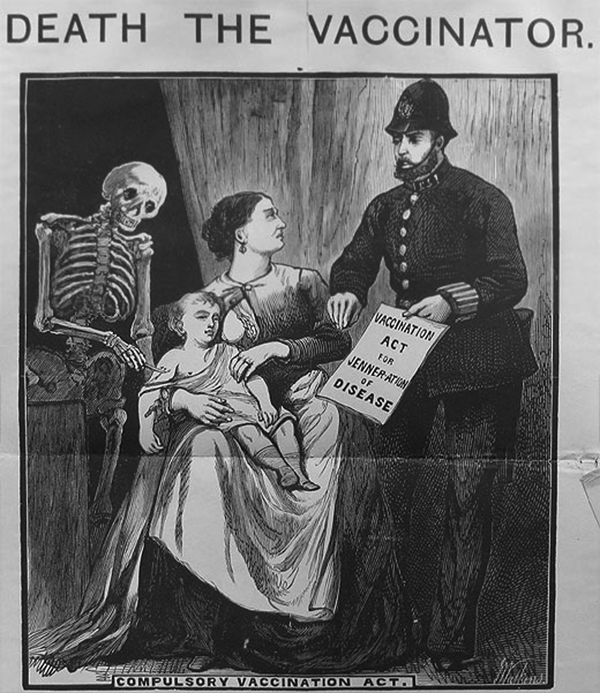
Tebb, a co-founder of the London Society for the Abolition of Compulsory Vaccination, riveted his listeners with accounts of the organizing strategies and tactics the London Society was using in England to overturn the country's compulsory vaccination laws, including publishing Vaccination Inquirer, an anti-vaccination journal with impressively ghoulish cover illustrations (see Figure 1). Tebb claimed that opposition to vaccination was growing in England, where “25,000 children were slaughtered every year by being vaccinated.”Footnote 12
Death the Vaccinator, late 1800s. The London Society for the Abolition of Compulsory Vaccination. Courtesy of the Historical Medical Library of The College of Physicians of Philadelphia.

The audience was galvanized and, on the motion of Dr. Robert Alexander Gunn, voted to organize the Anti-Vaccination League of America to oppose vaccination and “all legislation for its enforcement.” Wilder was elected the League's president, and a layperson named J. R. Nickels was elected secretary. Five of the League's seven officers possessed a medical degree. In 1880 and 1881, the Anti-Vaccination League of America sent representatives to meetings of the Congress of the International Anti-Vaccination League in Paris and in Cologne, Germany.Footnote 13
From 1882 to 1885, the Anti-Vaccination League of America maintained around a hundred members, but in 1885 the League's secretary moved out of town and regular meetings ground to a halt. As the Anti-Vaccination League foundered, former members made common cause with a new group in New York that in 1885 was organizing a national organization under the name The Anti-Vaccination Society of America (AVSA).Footnote 14
The new Anti-Vaccination Society of America incorporated in New York City on December 2, 1885, with physicians Peter M. Barclay as president, Montague R. Leverson as secretary, and Wilder, former president of the now-defunct Anti-Vaccination League, serving on the executive committee. Former Anti-Vaccination League members took up familiar roles in the new organization: Gunn became a vice-president, and Tebb, who had served on the Anti-Vaccination League's Executive Committee, was now an “Honorary Vice-President.”Footnote 15
During the 1880s and 1890s, leaders of both the original Anti-Vaccination League and the new AVSA presented papers and published books questioning the validity of the research on vaccination. In 1882, Gunn published a book explaining that he had come to distrust the efficacy of vaccination during a smallpox epidemic in New York in 1872. A year before that outbreak, the city's health authorities had claimed the city was “thoroughly protected by vaccination,”Footnote 16 and yet many people became ill and died. Others made similar arguments. In 1885, a major outbreak occurred in Montreal, Canada, resulting in over three thousand deaths. At the time, Alexander M. Ross, a member of the British and French associations for the advancement of science who lived Montreal, collected statistics showing that nearly half of those who had died had scars on their arms indicating they had been previously vaccinated. To make the same point, after the Philippine Insurrection (1898–1901), American anti-vaccinationists frequently cited the hundreds of smallpox deaths among vaccinated US soldiers in the Philippines.Footnote 17
Doctors on both sides of the vaccination debate appealed to the scientific method during this period. Historians have commonly portrayed pro-vaccination doctors as more committed to experimental science than their opponents, but the early minutes and records of the AVSA reveal that physicians opposed to vaccination were also eager to put their claims to scientific tests. On June 5, 1895, the AVSA held a conference in New York City to organize a campaign to prevent compulsory vaccination. Of the fifty-three attendees, 55 percent were medical doctors. The majority (58 percent) hailed from New York State, but ten other states also sent representatives. During the meeting, the group decided to propose an experiment to state boards of health across the country to determine the success or failure of vaccination once and for all. After the meeting, Leverson sent a form letter to the state boards suggesting they fund an experiment conducted with ten thousand unvaccinated children between the ages of three months and one year. Of this group, five thousand children would be vaccinated with their parents’ consent and five thousand would remain unvaccinated. All the children would be kept under observation of board-approved physicians, and the children's vital statistics would be published annually. According to Leverson, “The results as shown by such statistics cannot fail to be conclusive as to the advantages or disadvantages of vaccination.”Footnote 18 To Leverson's disappointment, none of the state boards took him up on his offer.
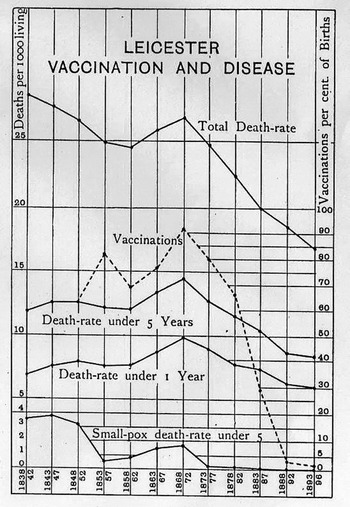
Some British scientists joined the effort to repeal the country's unpopular compulsory vaccination laws, and American anti-vaccinationist leaders like Wilder took care to cite their arguments. During the 1880s and 1890s, Alfred Russel Wallace, celebrated for his codiscovery of natural selection, epidemiologist Charles Creighton, and pathologist Edgar March Crookshank argued that the early nineteenth-century experiments on vaccination were inconclusive. Wallace used evidence from mortality tables to support his claim that vaccination was not responsible for the decline in deaths from smallpox in England. For example, he cited statistics from Leicester, England, where deaths from smallpox had declined dramatically along with a decline in vaccinating infants at birth (see Figure 2).Footnote 19
Vaccination and disease table from Leicester, England, used to support anti-vaccination claims. From Alfred Russel Wallace, The Wonderful Century: Its Successes and Its Failures (New York: Dodd, Mead, 1898), Diagram IX, 423. Courtesy of the Department of Special Collections, Stanford University Libraries.

It is not possible to portray the debates over vaccination in this period as a controversy of science versus anti-science. Neither Wallace nor the physicians in the AVSA rejected science or scientific methods in the 1890s. Wallace's evidence appeared compelling to many at the time, but in the absence of controlled experiments, the statistics he presented could not resolve the issue of vaccine efficacy. The eradication of smallpox in Leicester appears to have been due to what was called the Leicester Method, which included promptly notifying the Medical Officer of Health of any smallpox case, isolating all cases in the hospital, and quarantining all immediate contacts of the original case. Vaccination was also offered to residents during outbreaks, and Wallace's statistics do not include the number of those who chose vaccination, only vaccinations at birth. Nevertheless, the debates did help to highlight the effectiveness of quarantine and sanitation, and they also raised important questions about procedures that might reduce the effectiveness of the smallpox vaccine, including improper preparation or storage.Footnote 20
1885 to 1908: Lay Leaders Predominate in the Anti-vaccination Societies
Physicians continued to dominate the AVSA's messaging and policies up until the mid-1890s, just as they had in the now-defunct Anti-Vaccination League. In 1895, seven of the AVSA's nine executive committee members possessed a medical degree. Members represented affiliated anti-vaccination societies in twenty-three states, England, and Canada (see Figure 3). Of the nine women representing affiliated societies, seven possessed a medical degree.Footnote 21
Affiliated societies in the Anti-Vaccination Society of America, 1895. From the list of officers and affiliates printed on the back of all AVSA stationary in 1895. From Anti-Vaccination Society of America, Medical Library, the College of Physicians of Philadelphia.

The reason some physicians still opposed vaccination near the end of the century lies in the growing division over the germ theory of disease among homeopathic doctors. Some of the physicians in the AVSA practiced osteopathy, which involved drugless forms of healing, but most practiced homeopathy. Homeopathy was based on the theory that disease could be treated with minute doses of drugs believed capable of producing in healthy people the identical symptoms of the disease under treatment. Today, this principle is currently used in exposure therapy for allergies, but the amounts of medicine used in homeopathy were far smaller.Footnote 22
In the 1880s, many homeopaths opposed to vaccination still did not accept the germ theory of disease. Before the acceptance of this theory between 1870 and 1900, physicians, scientists, and health officials explained the incidence and spread of illness without any awareness of the microorganisms that caused disease. In 1850, three main theories predominated: The miasma theory stated that disease was caused by poor climate or bad air or wind. The filth theory stated that unclean living quarters containing decaying matter or feces caused disease. The germ theory stated that miniscule organisms invaded the body and that a specific microorganism, or germ, was responsible for a specific disease. Louis Pasteur first confirmed the germ theory in 1860, and by 1895 most American doctors, including many homeopaths, had come to accept it. This shift reflected the swift pace of discovery in medical science. In 1882, Robert Koch discovered the bacillus that caused tuberculosis and then isolated the cholera bacillus. In 1884, Friedrich Loeffler isolated the diphtheria bacillus and Arthur Nicolaier discovered the toxins that caused tetanus; in 1885, Pasteur successfully vaccinated a boy against rabies. Despite these breakthroughs, some of the homeopathic physicians who remained active in the AVSA refused to accept the germ theory well into the twentieth century.Footnote 23
AVSA secretary Montague R. Leverson is a case in point. Leverson was an English immigrant, onetime Colorado rancher, California state assemblyman, homeopathic doctor, and a leader of the Brooklyn Anti-Compulsory Vaccination League. At the age of 87, he was living in England and still occasionally writing letters and editorials against vaccination. In 1917 he wrote a letter to the editor of Health Culture magazine explaining that he was working on a paper proving that Pasteur was “a plagiarist and charlatan” and that the germ theory of disease was bunk.Footnote 24
As a former state legislator, Leverson understood well the power of effective lobbying. When he was secretary of the AVSA, he urged members to help overturn school vaccination laws: “In every school district efforts should be made to secure the election of trustees, pledged to refuse to carry out the laws of compulsory vaccination.”Footnote 25
In contrast to physicians, who viewed themselves as members of the medical profession and often voiced their opposition through conference papers and books, nonmedical lay members rolled up their sleeves and began organizing with the goal of promoting lawsuits against school districts. Several lay members soon garnered attention for their successes in Wisconsin. According to Leverson, “In great part due to [the] exertions” of “Mr. Piehn, Dr. Clausen, and Mr. Frank D. Blue,” the case of State ex rel. Adams vs. Burdge “has been decided by the Supreme Court of Wisconsin, in which the conduct of the Health Board, and of the School Board … in forcing vaccination upon the children, was declared to be a violation of Constitutional Rights.”Footnote 26
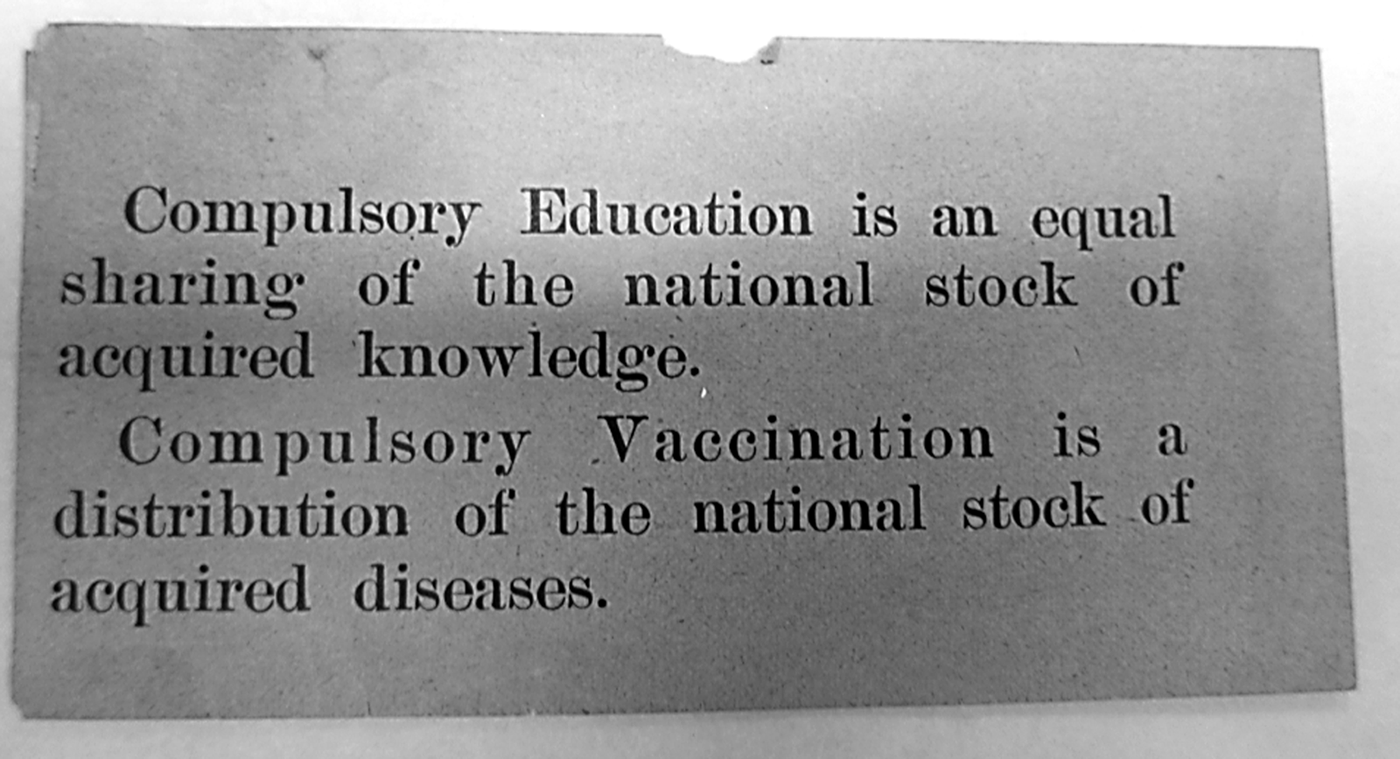
These lay members soon stepped into leadership roles in the AVSA, filling positions doctors formerly held. In 1897, Louis H. Piehn, president of the First National Bank of Iowa, became president. Piehn's daughter Alma Olivia had died after being vaccinated as a requirement for attending public school. Frank D. Blue, a stenographer from Terre Haute, Indiana, became secretary the following year. Under their leadership, a new slogan appeared on the back of the AVSA membership card (see Figure 4).Footnote 27
Card with motto comparing compulsory education with compulsory vaccination. Anti-Vaccination Scrapbook, 1882–1903. Courtesy of the Historical Medical Library of The College of Physicians of Philadelphia.

Blue's rise among the anti-vaccinationists was meteoric, because he took over the management of propaganda for the society. He was an advocate of drugless nature cures, phrenology, and methods of healing with magnets and electricity. After a magazine called Anti-Vaccination News shut down in 1897, AVSA members no longer had a national vehicle in which to express their views. Leverson informed members that “Mr. Tebb and Mr. Wheeler, veterans in the cause of health and liberty in England, have both written expressing regret at the discontinuance of the paper, each stating that they would have been unable to get along at all in England without their paper the ‘Vaccination Inquirer.’ I trust earnest efforts will be made to establish such a paper here.”Footnote 28 In response, Blue established a new journal called Vaccination in Terre Haute, Indiana, in February 1898. Several months later, Leverson stepped down as secretary of the AVSA and Blue succeeded him in the position.Footnote 29
At the time, Blue was a legal reporter and chief clerk in the office of the general counsel of the Vandalia Railroad line in Terre Haute. He was 35 years old when he purchased some typesetting equipment and began printing Vaccination during after-work hours. He and his wife had four children and worshipped in the local Catholic Church. He was a founding member and secretary of the Indiana Anti-Vaccination League. According to the Indiana Daily Tribune, which printed a biographical sketch of Blue in 1903, “[He] is well known by everyone in Terre Haute, both through his reputation as a legal reporter and his prominence in connection with the anti-vaccination movement.”Footnote 30
Blue used his new role as secretary to recruit readers for the journal and members to the cause. In May 1898, he asked Leverson for help:
The blood-poisoners in Pittsburgh, PA have been meeting with a great deal of opposition in their plans of having all the school children poisoned; some of the teachers positively refusing to put the unvaccinated fire-brands out of the schools at their behest. So the Death Board has announced that in the fall all unvaccinated will be rigidly excluded and if any teachers allow them to attend they will prosecute the teachers. What I wish to do is to get some copies of Vaccination in the right hands in that city, especially in the hands of all the public school teachers. … I thought perhaps you would know of a native of the place who could be depended upon to give or to get us lists of all public school teachers and officers.Footnote 31
By the time he began publishing Vaccination, Blue had already filed his own lawsuit that was wending its way through the courts. In 1893, during an outbreak of smallpox in Indiana, the Terre Haute Board of Health and the school board prohibited unvaccinated children from attending the public schools. Blue refused to have his son Kleo vaccinated, and when school authorities refused to admit the boy, he sued teacher Fannie D. Beach and principal Orville E. Conner. Blue was confident of success. At a December 13 meeting of the Indiana Anti-Vaccination League, he proclaimed, “I am going to make Terre Haute doctors take to the woods.”Footnote 32 He had grounds for optimism—several months earlier in Winchester, Indiana, a teacher had refused to compel her students to be vaccinated and a local judge had ruled in favor of the teacher. On December 23, the first circuit court also ruled in Blue's favor, but the ruling was appealed and the case dragged through the circuit court for nearly three years.Footnote 33
Indiana anti-vaccinationists banded together to bear the costs of Blue's lawsuit because they viewed it as an important test case. According to the Indianapolis Journal in 1894, “Every anti-vaccination association society in the State is assessed to bear the burden.” The Journal characterized the case as “highly important to the general public” because it involved both the constitutional rights of citizens and the rights of cities and states to impose on personal liberty in cases of emergency, such as the outbreak of disease.Footnote 34 Ultimately, the case was decided in favor of the defendants and Blue appealed to the Indiana Supreme Court in June of 1896.Footnote 35
As Blue's appeal was pending, the first issue of Vaccination appeared in February 1898, reporting AVSA news and minutes along with snippets of information about the ineffectiveness and hazards of vaccination. In December the journal carried a notice in which the AVSA announced Article 2 of its constitution: “The object of this Society shall be to oppose and prevent the enforcement of compulsory vaccination.”Footnote 36 Blue urged readers to “see that every member of your school board and all principals of schools receive a copy of Vaccination and a few of our tracts.” Since few states had school vaccination laws on the books, “a knowledge of what vaccination is will always defeat them.”Footnote 37
Despite the launch of Vaccination, near the close of the century, the AVSA appeared to be foundering. Blue struggled to drum up subscribers to the new journal. As he described the situation to Leverson: “Anti Vaccination Leagues everywhere to be demoralized, Brooklyn is as bad as Chicago apparently. [The] T[erre] H[aute] League is also practically dead outside of three or four of us.”Footnote 38 In 1901, the Brooklyn Daily Eagle Almanac claimed the AVSA had two hundred members, but this figure may have been exaggerated. That year, a New York Times reporter sent to cover a meeting of the local anti-vaccination league in Brooklyn found “nine men, one boy, and seven reporters were present.”Footnote 39
A decline in the number of physicians opposed to vaccination may have contributed to this trend. By 1900, the proportion of physicians among AVSA officers had fallen to 38 percent. This decline occurred in response to several factors. Rapid advances in technology during the last two decades of the nineteenth century greatly advanced medical knowledge about the ability of vaccines to prevent infectious diseases and about methods of improving the safety of vaccination procedures. By the 1890s, physicians and medical researchers had access to the microscope, spirometer, electrocardiograph, X-ray, and chemical and bacteriological tests that provided detailed data on patients’ physiological conditions. In 1902, the federal government passed the Biologics Control Act, also known as the Virus-Toxin Law, and began regulating vaccine production, which greatly increased the safety of the vaccination procedure. In 1905, laboratory tests could detect the organisms responsible for tuberculosis, cholera, typhoid, pneumonia, diphtheria, gonorrhea, and syphilis, and developments in microbiology facilitated the production of new vaccines against rabies, typhoid, cholera, and plague, along with antitoxins to fight diphtheria and tetanus. These successes measurably reduced outbreaks of disease in the country and increased Americans’ confidence in the authority of medical science.Footnote 40
Moreover, by the century's end, much of the professional hostility between so-called allopathic, or mainstream, physicians and homeopathic physicians had largely subsided. Although some homeopathic physicians continued to deny that germs caused disease well into the twentieth century, in 1894 a writer in The North American Journal of Homeopathy expressed an opinion that many homeopathic doctors had come to accept: “The consensus of opinion to-day undoubtedly is unanimous in adopting the theory of contagion. … Those who years ago stoutly denied the germ theory have had to amend their ideas under the light of scientific investigation.”Footnote 41 In 1903, the American Medical Association (AMA) revised its code of ethics to include physicians who did not base their practice on “an exclusive dogma or sectarian system.”Footnote 42 This ruling allowed many homeopaths to join the AMA.Footnote 43
As physicians left the ranks of the AVSA, Blue's rhetoric in Vaccination became more stridently anti-science. The journal had rejected the germ theory from its very first issue in 1898: “Is Light Coming? The germ theory is getting some hard raps these days. Recently a learned French doctor completely riddled it, and closed his article by saying … ‘We always suspected there was more “scare” than anything else in this theory.’”Footnote 44 Blue's early articles had also included disparaging comments about doctors and medical science:
According to medical monopoly laws, there are only two lawful ways to get out of this world; either by medical assistance or the hangman.Footnote 45
All epidemics prove the doctors are blind leaders of the blind.Footnote 46
Whenever the doctors have considered and accepted a medical theory as true that theory has always been wrong.Footnote 47
Scientific medicine realizes it is bankrupt and it is making a life and death struggle in the vain effort to extend to other diseases the so-called protective vaccination process.Footnote 48
But some of Blue's later issues went further and began recommending nature cures in line with the alternative forms of medicine he preferred. For example, he informed readers of a cure for smallpox “used by the Old Mammies in slavery days”: the treatment involved drinking saffron tea and soaking in a barrel of hot bran mash for an hour or more. Describing one successful case, Blue reported, “Well about two doses cured him and in less than a week he was back at work. Now, I'd like to see some of your cultured, scientific, microbe hunters, beat that.”Footnote 49 In another issue he recommended eating lettuce, onions, and celery as a preventative measure against smallpox.Footnote 50
Blue's rhetoric may have impelled some physicians to leave the AVSA, but it was not the only reason for the society's dwindling membership. By 1900, the tide had turned against the anti-vaccination camp in the courts. Anti-vaccination activists in Alabama and Utah had defeated school vaccination bills, but courts in Illinois, Indiana, West Virginia, Minnesota, North Dakota, Washington, and some southern states had passed laws requiring vaccination as a condition of admission to the public schools. On February 2, 1900, the Indiana Supreme Court ruled against Blue's case.Footnote 51
Five years later, when US Supreme Court Justice John Marshall Harlan ruled in favor of compulsory vaccination, he noted that the anti-vaccinationists were in the minority. The case before the Supreme Court involved Henning Jacobson, a minister living in Cambridge, Massachusetts. In 1902, he had refused to comply with an order to vaccinate members of his family during an outbreak of smallpox in the town. With assistance from the Massachusetts Anti-Compulsory Vaccination Association, Jacobson filed a lawsuit arguing that the Fourteenth Amendment to the US Constitution gave him the right to refuse vaccination. Jacobson's case led the Supreme Court to consider the extent of constitutional liberty in the country. The case involved testimony from those in favor of vaccination and those opposed. Justice Harlan's final ruling in 1905 described the current state of the anti-vaccinationist movement:
It must be conceded that some laymen, both learned and unlearned, and some physicians of great skill and repute, do not believe that vaccination is a preventive of smallpox. The common belief, however, is that it has a decided tendency to prevent the spread of this fearful disease, and to render it less dangerous to those who contract it. While not accepted by all, it is accepted by the mass of the people, as well as by most members of the medical profession.Footnote 52
Legal scholars have noted that Jacobson v. Massachusetts was significant on several levels. The court's ruling both upheld and placed limits on state powers. It also marked the start of a long struggle through the courts to balance Americans’ expectations of personal liberty with the administrative authority and power required to govern a modern, urban society. When Justice Harlan delivered the majority decision, he ruled that personal liberties could be suspended when the general public's safety was at risk, whether from military invasion or disease. He also placed some limitation on the state's police powers, concluding that while the state could impose fines or imprison individuals who refused vaccination, authorities could not forcibly vaccinate them. Additionally, citing testimony from doctors opposed to vaccination, Harlan acknowledged that for some individuals who might suffer adverse reactions, requiring vaccination was an overreach of government power. This part of the ruling created a medical exemption under the Massachusetts health law, an exemption every state in the country adopted by the end of the twentieth century.Footnote 53
The flagging AVSA never really recovered after the 1905 Supreme Court ruling. In July 1905, Blue informed readers, “Now, I find in going over my list of subscribers, a great many have failed to renew their subscriptions.”Footnote 54 The Homeopathic Recorder noted the journal's demise in 1906: “Vaccination, an anti-vaccination journal, edited by Frank D. Blue, has turned up its toes to the daisies.”Footnote 55
1908 to 1929: Anti-vaccinationists Join with Business Interests in the Medical Liberty Movement
Sporadic opposition to school vaccination remained strong in some areas, and in 1908 a new national organization in Philadelphia emerged. Surviving documents in Philadelphia reveal some distinct differences in the demographics and propaganda of the leading anti-vaccinationists after Jacobson v. Massachusetts. These included an ongoing increase in both the number of laypeople among the officers and in the anti-science propaganda opposing the germ theory of disease. There was also a broader commitment to the concept of medical liberty—defined now as the ability to run one's own medical practice or health business and choose one's own doctor, method of disease prevention, and treatment free from any outside interference, regulation, or compulsion.
A new league originated in Philadelphia under lay leadership in 1906. On May 16 of that year, John Pitcairn Jr., a wealthy businessman and co-founder of the Pittsburgh Plate Glass Company, hosted a public meeting on the horrors of vaccination and ways to prevent the spread of compulsory vaccination. A follower of Swedenborgian teachings and homeopathy, Pitcairn believed Pennsylvania's efforts to compel vaccination were unjust. Porter F. Cope, the son of a leading Philadelphia financier, spoke at the meeting and presented a grisly slide show depicting some of the more gruesome adverse effects of vaccination.Footnote 56
The marshaling of evidence about the adverse effects of the smallpox vaccine had a powerful impact because many in the audience no longer viewed the disease as a death sentence. In 1906, there had been over fifteen thousand cases of smallpox in Pennsylvania, but only ninety were fatal. The decline in fatalities was a result of an evolution in the smallpox virus. Scientists now believe that two new mild strains of smallpox appeared near the end of the nineteenth century. In contrast to the variola major strain, which killed around a third of its victims, the new variola minor strains killed between a thousand and twenty thousand per million. This was still a much higher fatality rate than that caused by the vaccine, which killed around fifty people per million, and many of those who recovered from the disease suffered permanent side effects, including severe scarring and blindness in some cases. Nevertheless, to many of the men and women in the audience in Philadelphia, the adverse effects of the vaccine seemed far more menacing than smallpox itself.Footnote 57
In September 1906, Pitcairn, Cope, and other leaders established the Anti-Vaccination League of Pennsylvania. Relatively few physicians joined—receipts show that between 1906 and 1911, doctors represented 16 percent of paid members on average. Women's paid memberships averaged 20 percent.Footnote 58
The Pennsylvania League quickly started work on a campaign against compulsory school vaccination, and they successfully lobbied for a bill in 1907, which passed the Pennsylvania House and Senate. However, they lost the battle when Governor Edwin Stuart vetoed the bill. After that defeat, it became difficult to drum up financial support in the form of paid memberships, and by 1911 the organization had fewer than ten dues-paying members.Footnote 59
Under largely lay leadership, the surviving members of the local Philadelphia League decided to reorganize as a national organization in 1908. In June, Cope produced a ten-page declaration of principles upon which to found a new national society called The Anti-Vaccination League of America (AVLA). Around fifty people attended its first conference at Griffith Hall in Philadelphia that year, including William Lloyd Garrison Jr., son of the famous antislavery leader; ink manufacturer Charles M. Higgins of Brooklyn, New York; and well-known fitness buff Bernarr Macfadden, editor of Physical Culture, an alternative health magazine. Pitcairn was elected League president, Cope became secretary, and Higgins became treasurer.Footnote 60
During subsequent years, the AVLA's leaders published pamphlets and books that continued to highlight vaccination's adverse effects. For example, Higgins often drew from the arguments and statistics of an earlier generation. He published dozens of texts with gripping titles like Open Your Eyes Wide!, The Crime against the School Child, Vaccination and Lockjaw: The Assassins of the Blood, and others. In 1914, during an outbreak of smallpox in New York City, he paid for an advertisement urging parents not to vaccinate their children “through any false panic created by medical individuals or societies, professionally interested in vaccination.”Footnote 61
Although its leaders had intended the AVLA to function as a national confederation of state and local anti-vaccination societies, the organization never became a political entity with a truly national reach. Despite scattered protests over school vaccination policies in local areas, in almost every state after Jacobson v. Massachusetts, the debate was largely over. As historian Karen Walloch has noted, the AVLA's campaigns focused primarily on developments in Pennsylvania and New York. It never attained the same level of national prominence as the British National Anti-Vaccination League, with its long-standing journal, The Vaccination Inquirer, nor did it achieve the reach of the earlier Anti-Vaccination Society of America, with its Terre Haute-based journal, Vaccination. Instead, local anti-vaccination societies arose sporadically here and there across the country in response to local issues, without a national anti-vaccination society to direct or support their protest.Footnote 62
The rise of competing organizations devoted to opposing medical science in general may also have lessened the AVLA's influence. Some anti-vaccination leaders believed a national organization focused solely on mandatory school vaccination was no longer needed. In 1908, activist Lora Cornelia Little wrote to Pitcairn to recommend creating a “National Health Defense League. Otherwise we win upon vaccination only to find ourselves bound hand and foot and subject to other medical rites as foul and superstitious as Jenner's.”Footnote 63 She and her husband lived in Minneapolis, where she edited and published a magazine called The Liberator from 1900 to 1905. The aim of the Liberator was to proclaim the freedom of health from the tyranny of medical science.Footnote 64
Little was a steadfast opponent of vaccination. Her only child, a seven-year-old boy, had died from diphtheria seven months after being vaccinated for smallpox, and she blamed the vaccination for his death. In 1906, she published a booklet called Crimes of the Cowpox Ring: Some Moving Pictures Thrown on the Dead Wall of Official Silence, which documented 336 cases of serious adverse effects from vaccination, many of them fatal. But Little's opposition to allopathic medicine was not restricted solely to vaccination. She promoted phrenology, hydrology, and other forms of alternative medicine and argued against prescription drugs and medical research involving vivisection.Footnote 65 Above all, as one Pennsylvania newspaper reported, she was “thoroughly imbued with the spirit of personal liberty” and opposed to any form of compulsory medical treatment.Footnote 66
Like others who became prominent in the medical liberty movement, Little was also a health entrepreneur. After moving to Portland, Oregon, in 1909, she established a business and placed newspaper advertisements describing herself as a “health expert” and offering nature cures, health coaching, and lessons in how to “be your own doctor.”Footnote 67 From 1915 to 1917, she authored a regular health column in the Mt. Scott Herald, recommending whole grains and vegetables in the diet and consistently opposing all forms of drugs and vaccines. In one column she urged her readers not to worry about the rising incidence of tetanus associated with puncture wounds: “Eat right, live right, and all your injuries, of whatever kind, quickly disappear.” She believed right living could cure everything, including cancer, because “it takes a cancerous constitution to produce a cancer.”Footnote 68
Active members of the AVLA and some former leaders of the now-defunct AVSA soon became involved with two new national organizations: The National League for Medical Freedom, founded in 1910, and the American Medical Liberty League, which Little founded in 1918. For example, in 1914, Cope served as a member of the advisory board of the National League. In 1922, the Journal of the American Medical Association (JAMA) reported that Higgins was treasurer of the AVLA, president of the American Medical Liberty League, and also a “somewhat active member of the National League for Medical Freedom.”Footnote 69 By 1920, Blue, former AVSA secretary, was serving as president of the American Medical Liberty League.Footnote 70
Anti-vaccination activists had used the term “medical liberty” during earlier decades when they advanced constitutional arguments to overturn existing vaccination legislation, but between 1910 and 1929, the term took on a broader meaning. The medical liberty leagues that arose during this period appropriated and expanded the constitutional arguments advanced by the nineteenth-century anti-vaccination societies, arguing that Americans had a constitutional right to choose their own medical treatment and a right to freedom from medical interference, not only in the form of compulsory vaccination, but in all areas of social life.
The National League for Medical Freedom opposed any legislation designed to tighten the government's control over the practice of medicine. B. O. Fowler, president of R. C. Fowler Medicine Company, a mail-order patent medicine business, served as the National League's president. The National League's first report to members in 1910 described its overarching political goal, which was to overturn “a number of bills in Congress, more or less innocent in appearance, but which were designed to put the Government power and prestige behind the ‘regular,’ or Allopathic, school of healing.” According to Fowler, the National League aimed to protect the individual's
right to select the practitioner of his choice in the hour of sickness. It will seek through publicity and education to unmask and oppose any legislation which endeavors to put into power any one system of healing and use the Government prestige, money and machinery to enforce its theories and opinions upon citizens who believe in other forms of healing.Footnote 71
Economist Irving Fisher accused the National League of being funded by patent medicine interests, an accusation supported by the number of League officers involved in mail-order patent businesses.Footnote 72
The American Medical Liberty League had similar goals and interests. Two of the Liberty League's founding members ran a mail-order patent medicine company and thus had a vested business interest in opposing any increased government intervention and regulation. In 1922, W. S. Ensign, president of the Ensign Remedies Company in Battle Creek, Michigan, was a director of the American Medical Liberty League and D. W. Ensign was treasurer. The Ensigns published the Truth-Teller, a homeopathic anti-vaccination magazine devoted to alternative methods of medical treatment that all members of the Liberty League received as part of their membership subscription. Their patent medicine business sold small vials of granules advertised as “cell salts” and guaranteed to “cure all diseases by feeding the tissues.”Footnote 73 Their advertisements claimed that Ensign remedies would cure smallpox and virtually any other ailment, including abscesses, acute appendicitis, asthma, bowlegs, bunions, cancer, cataracts, deafness, diphtheria, disappointed love, dullness and stupidity, eczema, epilepsy, gray hair, irritation, laziness, lack of ambition, lockjaw, paralysis, rheumatism, toothache, tuberculosis, warts, and wrinkles.Footnote 74
A number of historians have explained the persistence of anti-vaccinationism during this period as a populist response to the alliance between law enforcement officials and physicians in enforcing vaccination, citing the local activism of working and middling-class parents opposed to increased medical interference in the public schools. The practice of medical inspections in the schools was not new—local boards of health had frequently conducted inspections during outbreaks of disease during the nineteenth century. But when American cities began to implement regular medical inspections in public schools as an ongoing practice, more parents protested. The first city to implement mandatory inspections was Boston in 1894; by 1898 three other cities had followed, and by 1908 the number had risen to seventy cities. In some areas, the practice of medical inspections in the schools was so unpopular that it sparked school boycotts and protests from parents outraged over the intrusion of medical inspectors into children's health.Footnote 75
Parental activism during the Progressive Era provides support for interpreting anti-vaccination protest as a form of democratic populism, but economic factors were in play as well. Resistance to vaccination—particularly among the national societies organizing opposition to legislation and publishing pamphlets, magazines, and books—did not come solely from middling or working-class parent activists. By 1910, the leaders of the national organizations stoking parents’ fears of vaccination included members of the middle class and wealthy businesspeople. And they no longer focused primarily on developments in local public schools.
An important factor in the persistence of anti-vaccinationism that has received far less attention from historians is the very real threat medical reformers posed to the livelihoods of the men and women practicing homeopathy or drugless forms of medicine, selling mail-order patent cures, or offering alternative health therapies. By March 1905, Blue was the new superintendent of alternative medical therapies at the Kokomo Invalid's Home Sanitarium. He needed to fight for the survival of his new business in an increasingly hostile regulatory environment. That year, the AMA established a Propaganda Department to campaign against quackery and fraud in medicine, and JAMA began a regular column investigating and exposing allegedly fraudulent practitioners, questionable medical schools, and medical organizations promoting unconventional therapies, such as those Blue had recommended in Vaccination. Footnote 76
In a related development, in 1910 the so-called Flexner Report on medical education in the United States appeared. With support from the Carnegie Foundation, Abraham Flexner investigated the state of medical education across the country. After visiting 160 schools, he concluded most of them should be closed because of the poor education they offered. He recommended stricter state laws, tighter standards for medical education, and examinations for certification to practice medicine. Soon after the report appeared, twelve medical schools closed or merged in response to its findings, and another twenty-six schools closed or merged in the following two decades. Many homeopathic colleges obtained poor ratings from Flexner: of twenty-two homeopathic colleges enrolling students in 1900, only two were still open in 1923.Footnote 77
The physicians who practiced alternative medicine, the businesspeople who sold mail-order patent medicines and potions, and those who earned a living by writing and speaking publicly about health culture and alternative medicine had much to lose in an environment of increased regulation. For example, Dr. James Martin Peebles became a well-known anti-vaccinationist in 1900 after publishing the book Vaccination a Curse and a Menace to Personal Liberty: With Statistics Showing Its Dangers and Criminality, which reiterated the arguments of scientists and physicians who had opposed vaccination in the 1870s and 1880s. A Universalist minister, spiritualist, and eclectic physician, in 1902 he founded the Peeble's Institute of Health in Battle Creek, Michigan, and began selling mail-order epilepsy cures; the most popular were Dr. Peebles’ Brain Restorative for Epilepsy and All Diseases of the Brain and Nervous System and Nerv-Tonic for the Blood and Nerves. In 1915, after obtaining samples of his potions and subjecting them to lab analysis, the JAMA denounced his enterprise as quackery—the epilepsy treatment was 8.44 percent alcohol and 15.18 percent bromide, with trace amounts of ammonia, potassium, and chloride. JAMA condemned Peebles's business as fraudulent.Footnote 78
For some anti-vaccinationists during this period, opposing medical science entailed rejecting some of medicine's most significant scientific discoveries. Fowler, president of the National League for Medical Freedom, proclaimed that his organization opposed the distribution “of disputed theories of the dominant medical school.”Footnote 79
Many of the homeopathic physicians who remained members in the leagues remained opposed to the germ theory of disease. Their views were bolstered by a handful of journals, such as the Homeopathic Recorder, whose editor explained: “This is the position The Recorder has held for years, i.e., that the ‘germ’ is not the cause of the disease, but that violation of the immutable law [of nature], on the part of the individual, or his forefathers, is the origin of all disease.” According to the Recorder, doctors needed to pay more attention to “constitution, temperament, heredity, and the like.”Footnote 80
Macfadden and Little denigrated the germ theory with more colorful language. Macfadden, a founding member of the AVLA, referred to Pasteur as “that French quack” and described AMA doctors as liars and phonies who cared more about money than their patients.Footnote 81 According to Macfadden, the chief causes of disease were constipation and lack of exercise: “Smallpox is simply a filth disease; it comes only to those whose internal organism is reeking with the poisons bred by an inactive alimentary canal, want of exercise, and the neglect of external cleanliness. Vaccination does not give protection.”Footnote 82 Little, who served for years as secretary of the Liberty League, portrayed allopathic doctors as fakes and scientific medicine as a scam created to serve their interests:
This is the way of it: Certain doctors having learned that the fluids of diseased animals (including man) contain certain micro-organisms, they jumped to the conclusion that these minute bodies are the cause of disease … they could not retreat from their position without loss, loss of prestige and loss of money. So they got busy and hatched a new theory to account for the phenomenon—a falsity always requiring another to support it, and that another, and so on with the web of lies.”Footnote 83
Rejecting the germ theory of disease also meant dismissing the idea that disease-carrying microorganisms could transmit disease from one person to another. From the standpoint of the Liberty League, quarantine was not only unnecessary, it violated the individual's personal freedom. Little disdainfully described quarantine measures as the “Segregation of Invalids.”Footnote 84
Blue and Little were of one mind when it came to the concept of contagion, and within a few years they were both serving in leadership positions in the Liberty League. In 1920, Little was secretary and Blue was president. After three years as superintendent of the Kokomo Sanitorium, Blue had left Indiana to work as a claim agent for the New Orleans Great Northern Railroad. He continued to support anti-vaccination efforts across the country, and when he was president of the Liberty League, he spoke publicly against the concept of contagion at the American Medical Liberty League's annual meeting in 1923: “The medical profession has gone scrum mad. We believe health is contagious, not disease. Hundreds have died from vaccination.”Footnote 85
Unlike vaccination's nineteenth-century opponents, many of those who denigrated the germ theory in the early twentieth century made no attempt to prove, either through argument or evidence, that the germ theory was invalid. Historians of science generally identify the period from 1890 to 1900 as the time when the theory gained broad acceptance, not only among scientists but also among ordinary citizens. The discourse of some anti-vaccination leaders reflects an understanding of this development. Proponents of medical liberty emphasized their right to believe in alternative forms of medicine. In a 1907 speech, John Pitcairn proclaimed, “One of the foundation principles of our government is absolute freedom from interference in matters of religious faith. Shall we witness unmoved the establishment by that government of a practice that deprives us of freedom in matters of medical faith [emphasis in original]?”Footnote 86
This argument, which aligned freedom of belief in alternative medicine with freedom of religion, became common in state-level and local efforts to win philosophical and religious exemptions from school vaccination requirements. In California, after the legislature abolished compulsory school vaccination in 1911, the Santa Rosa branch of the National League for Medical Freedom publicized the state's new “Exemption Certificate” allowing parents to avoid vaccinating their children due to “conscientious scruples against vaccination.”Footnote 87 In states that maintained compulsory vaccination laws, local affiliates of national leagues stressed the concept of medical liberty in their campaigns to overturn the laws or win exemptions. In 1922, the Bridgeport, Connecticut branch proclaimed that the state's compulsory school vaccination laws interfered with “the right of every child to life, liberty and the pursuit of happiness.”Footnote 88 News reporters soon picked up on the theme: The following year, at its fifth annual meeting in Chicago, the newspapers announced: “Medical liberty on the same basis as religious liberty is the object sought by the American Medical Liberty League according to its officers.”Footnote 89
It is difficult to assess how many members actually attended National League meetings during this era. Newspapers generally reported only the dates of annual conferences, the topics covered, and the names of officers. After its political victories in 1911 and 1912, the National League for Medical Freedom continued to publish a journal and lobby for its interests in government, before it vanished from the national scene by 1920. According to James Colgrove, the Anti-Vaccination League of America dwindled during the 1920s and disappeared after Higgins died in 1929, and the American Medical Liberty League similarly faded away around the time of Little's death in 1931.Footnote 90
Nevertheless, these organizations had a decided impact on school vaccination policies across the country. Although they constantly struggled to recruit members to their cause, their rhetoric received coverage far out of proportion to their low numbers. Newspapers seeking balanced reporting commonly sent reporters to interview league officers when vaccination legislation was pending. Their messaging, coupled with activism at the local level, impelled towns and cities in some areas to add philosophical exemptions to their school attendance laws. As Blue, then a Missouri resident, told a newspaper reporter in 1914: “At every place he has lived since leaving Terre Haute, he made the same determined fight against the vaccination laws … he says he ‘won the right to have his children attend the public schools without being vaccinated.’”Footnote 91
Conclusion
The first Anti-Vaccination League of America arose in 1879 in response to concerns about the safety of the smallpox vaccine and the growing practice of requiring vaccination for admission to the nation's public schools. Some scholars have portrayed the early anti-vaccinationists as misguided cranks, but their opposition to vaccination on the basis of safety and experimental procedure was understandable during a time when batches of vaccine were not always properly prepared and stored, and the doctors performing vaccination did not always sterilize their instruments.
In contrast, the national discourse opposing school vaccination in the early twentieth century was never solely about vaccine safety and efficacy. After Jacobson v. Massachusetts, many anti-vaccination leaders objected to the rise of medical science because they rejected the germ theory of disease, believed strongly in alternative methods of healing, and wanted to run or patronize health businesses free from intervention or regulation. Their political activism highlighted important issues regarding vaccine safety and the overreach of the health inspectors conducting school inspections in some areas. However, they also did great harm in undermining the public's trust in vaccines and antitoxins that were capable of preventing some of the most dangerous diseases of that era.
The leaders of the national anti-vaccination societies understood well the importance of maintaining a messaging campaign through print media, and their arguments were persuasive to many readers for many years. Some of their arguments persist today, including concerns about vaccine safety, a rejection of the germ theory of disease, and a desire for complete freedom from government intervention and regulation in all areas of medicine, including the vaccination of schoolchildren.
Twentieth-century anti-vaccinationists often opposed the individual's right to faith in alternative forms of healing as a positive good and medical science as an unnecessary evil. We live with the legacy of that anti-science today. Now, when scientific discoveries influence almost every aspect of life, it is not uncommon to encounter websites, books, and political pamphlets taking positions that are anti-science: against evolution, human-induced climate change, the germ theory of disease, and vaccines.
Today, some bloggers and print authors still refer to nineteenth-century statistical reports from the era when physicians led opposition to smallpox vaccination in its infancy. This tactic gives the impression such arguments are still valid and based in scientific practice, when they are not. An internet search of the term “anti-vaccination” yields modern-day reprints of hundred-year-old anti-vaccination books, including a new edition of Sanitation versus Vaccination, a 1912 book that reiterates Wallace's Leicester statistics, and new editions of books by Higgins, including Horrors of Vaccination Exposed and Illustrated and Compulsory Vaccination: The Crime Against the School Child.
Anti-vaccinationist sentiment continues in the twenty-first century despite progress in combating some of the worst diseases in the world, thanks to global, collaborative vaccination campaigns involving multiple nations. The last natural outbreak of smallpox in the US occurred in 1949. In 1980, the World Health Organization (WHO) declared smallpox eradicated from the globe. In 2012, WHO declared polio eradicated in India. Today, the disease remains active in only three countries. In 2015, former president Jimmy Carter pointed out the progress made in fighting Guinea worm disease, which fell from 3.5 million cases in 1986 to just 126 that year.Footnote 92
In the United States, the policy of requiring vaccination as a condition of admission to school has stood at the nexus of vaccination controversy for more than 150 years. Today, as vaccination rates in some areas of the country appear to be falling, the issue of school vaccination requirements remains an educational problem in the broadest sense. As parents weigh whether to comply with school vaccination requirements and voters weigh whether to keep or abolish their states’ philosophical or religious exemptions, perhaps the most important question is how they can inoculate themselves against misinformation and science denial.