1. Introduction
Seeley (Reference Seeley1866) described as Macrornis tanaupus what he thought was an incomplete right tibia of a ‘large Struthious bird’ from the Eocene of Hordwell (now spelled ‘Hordle’) Cliff in Hampshire. As Seeley’s description was very brief and not illustrated, subsequent authors have paid little attention to that specimen, and those who did mention it interpreted it in various ways, gastornithid affinities being often suggested. In their review of late Eocene birds from Britain, Harrison & Walker (Reference Harrison and Walker1976) concluded that the bone described by Seeley was not avian, and this conclusion was accepted by most later authors. After revising Seeley’s original specimen, we consider that although Seeley was mistaken in several respects, he was right in assigning it to a large bird. The fragmentary nature of the bone makes its systematic placement difficult. The implications of the presence of such a bird in the upper Eocene of Europe are discussed, notably in relation with other giant birds from Europe and with the occurrence of footprints of large birds in upper Eocene beds in France.
2. Geographical and geological setting
Seeley (Reference Seeley1866) only mentioned that the specimen (Sedgwick Museum of Earth Sciences, Cambridge, C20910) came from Hordwell. Hordle, to use the current spelling, is a village in Hampshire close to the north coast of the Solent, where Eocene sediments are exposed in sea cliffs. Seeley did not specify which geological unit the bone came from. Woods (Reference Woods1891) noted that it was from the Lower Headon Beds. Although the term ‘Lower Headon Beds’ was much used in geological and palaeontological literature throughout the nineteenth and twentieth century, the stratigraphic unit in question is now known as the Totland Bay Formation, itself part of the Solent Group (King et al. Reference King, Gale and Barry2016). The Totland Bay Formation at Hordle Cliff has been known for its fossils since at least the early nineteenth century. Vertebrate remains are abundant and comprise fish, amphibians, reptiles, mammals and birds (Benton & Spencer, Reference Benton and Spencer1995; Benton et al. Reference Benton, Cook and Hooker2005), constituting one of the best late Eocene vertebrate assemblages in Europe.
Stratigraphically, the Totland Bay Formation apparently corresponds to the base of the Priabonian Stage (King et al. Reference King, Gale and Barry2016). The mammal assemblages from the Hordle Cliff locality belong to the Headonian European Land Mammal Age (ELMA) and can be equated with the Mammal Palaeogene Reference Level MP17 (Benton et al. Reference Benton, Cook and Hooker2005), i.e. the lower part of the Headonian. Reference Level MP17, which can be subdivided into MP17a and MP17b (BiochroM’97, Reference Aguilar, Legendre and Michaux1997), corresponds to two European mammal zones, viz. the stehlini–depereti and nanus–vectisensis zones (Benton et al. Reference Benton, Cook and Hooker2005). Several vertebrate-bearing horizons have been reported at Hordle Cliff (Hastings, Reference Hastings1852, Reference Hastings1853; Tawney & Keeping, Reference Tawney and Keeping1883; Benton et al. Reference Benton, Cook and Hooker2005). No details were given by Seeley (Reference Seeley1866) about the exact provenance of the type of Macrornis tanaupus, so it is difficult to determine from which fossiliferous layer it came, all the more so as Hastings (Reference Hastings1852, Reference Hastings1853) reported the occurrence of bird bones in several of the bone-bearing strata (as noted by Benton et al. Reference Benton, Cook and Hooker2005, this is a general problem for bird remains from Hordle Cliff). The matrix preserved in the hollow shaft of the bone, a dark brown clay, may provide some indications as to its provenance. It may correspond to the lower, brownish, layer of the ‘Crocodile bed’ or to the dark-coloured clay of the ‘Rodent bed’ (see Hastings, Reference Hastings1853 and Benton et al. Reference Benton, Cook and Hooker2005 for lithological descriptions of the vertebrate-bearing beds).
The Totland Bay Formation was deposited close to an Eocene shoreline and consists of alternating brackish (lagoonal) and fluvial and lacustrine (floodplain) deposits (Plint, Reference Plint1984; Benton et al. Reference Benton, Cook and Hooker2005).
3. History of previous research
Although many avian remains have been described from the Totland Bay Formation of Hordle Cliff (Harrison & Walker, Reference Harrison and Walker1976; Benton et al. Reference Benton, Cook and Hooker2005), the bone described by Seeley (Reference Seeley1866) is apparently the only record of a giant bird (about the size of an emu according to Seeley) from that locality. Seeley (Reference Seeley1866, p. 110) referred the specimen to ‘a large Struthious bird’ closer to the ostrich than to the emu, but differing from known struthious birds in (unspecified) points reminiscent of ‘some genera of waders and gallinaceous birds’. At the end of his short ‘Note on some new genera of fossil birds in the Woodwardian Museum’, Seeley (Reference Seeley1866) noted that descriptions would appear in an upcoming catalogue of fossil Vertebrata in the Woodwardian Museum, but he never published a fuller description of Macrornis tanaupus. As a result, subsequent authors have mostly relied on Seeley’s very brief and unillustrated note to discuss the systematic position of Macrornis tanaupus. Until the 1970s, Seeley’s identification of the specimen as avian was generally accepted and it appears as such in several catalogues (Woodward & Sherborn, Reference Woodward and Sherborn1890; Woods, Reference Woods1891) without a more accurate placement. Zittel (Reference Zittel1887–1890), following Seeley, placed Macrornis among the suborder Struthionithes of the Ratitae, albeit with a question mark. Nicholson & Lydekker (Reference Nicholson and Lydekker1889) listed it among fossil birds whose affinities had not yet been determined, but probably belonging to the Carinatae. (Lydekker Reference Lydekker1891a, p. viii) considered that Seeley’s description was ‘quite insufficient’ and that nothing could be said about its affinities (Lydekker, Reference Lydekker1891a,b, Reference Lydekker, Newton and Gadow1896). Gadow (Reference Gadow1893) simply repeated Seeley’s conclusion that Macrornis was closer to Struthio than to Dromaeus. Several later authors suggested relationships with other Eocene giant birds, namely the Gastornithidae. After considering it as highly doubtful (Lambrecht, Reference Lambrecht1917), Lambrecht (Reference Lambrecht1921, Reference Lambrecht1933) classified Macrornis tanaupus among the Gastornithidae, while remarking that the description was insufficient. Piveteau (Reference Piveteau and Piveteau1955) also placed it among the Gastornithidae, and so did Dementiev (Reference Dementiev, Rozhdestvenskii and Tatarinov1964), although with a question mark. Fisher (Reference Fisher1966, Reference Fisher, Harland, Holland, House, Hughes, Reynolds, Rudwick, Satterthwaite, Tarlo and Willey1967a) considered Macrornis tanaupus as a gastornithid and the last known representative of that family (Fisher, Reference Fisher, Harland, Holland, House, Hughes, Reynolds, Rudwick, Satterthwaite, Tarlo and Willey1967b). Kuhn (Reference Kuhn1971) also accepted that it belonged to the Gastornithidae.
The first to have re-examined the actual specimen appear to be Harrison & Walker (Reference Harrison and Walker1976, p. 344), who, in their revision of late Eocene birds from Britain, listed it under Gastornithiformes but concluded that it appeared to be the distal end of a reptilian femur and could ‘not be reconciled with any avian material’. Most subsequent authors have followed Harrison & Walker’s interpretation, with the exception of Brodkorb (Reference Brodkorb1978), who, probably unaware of Harrison & Walker’s paper, placed Macrornis tanaupus among Aves incertae sedis. Mlíkovský (Reference Mlíkovský1996, Reference Mlíkovský2002) explicitly followed Harrison & Walker’s opinion, while other authors (e.g. Feduccia, Reference Feduccia1999; Mayr, Reference Mayr2009, Reference Mayr2017) no longer mention Macrornis at all.
Our re-examination of the type specimen of Macrornis tanaupus leads us to conclude that Seeley was fundamentally right, despite some errors in his description, and that the bone is indeed a fragmentary tibiotarsus of a very large bird.
4. Description and mass estimate
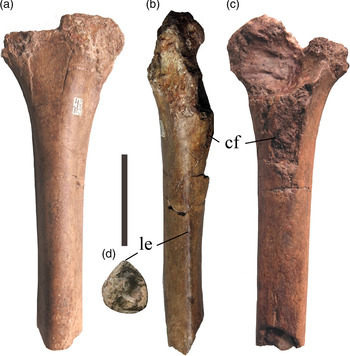
The specimen is the incomplete proximal part of a tibiotarsus (Fig. 1). Seeley (Reference Seeley1866) thought it was from the right side, but we interpret it as a left tibiotarsus. The proximal articular area is not preserved and few details of the most proximal part of the bone are visible, except that its internal structure is cancellous and unlike the spongy bone of mammalian epiphyses. On the posteromedial margin of the distal part of the bone a ridge may correspond to the tuberositas poplitea, but the poor preservation of that area makes that identification uncertain. Very little is left of the cnemial crests. The shaft is slender (22 mm by 25 mm at the level of the distal break) and nearly straight, showing only a very faint mediolateral curvature. At the level of the distal break, it can be seen that the shaft is hollow, with thin bony walls, 2 to 3 mm in thickness. The inner surface of the bony wall is smooth and there is no indication that the shaft was initially filled with subsequently destroyed spongy bone, which would have resulted in a rough inner surface. At this level, the cross-section of the shaft is teardrop-shaped (Fig. 1d) because of the existence of a well-marked sharp ridge, the linea extensoria, on the cranial face of the bone (Fig. 1b), issuing from the region of the crista cnemialis cranialis and extending along the whole preserved length of the shaft. On the lateral face of the shaft, the crista fibularis is broken (Fig. 1b, c), but its inception is clearly visible and indicates that it was relatively short proximodistally but otherwise well pronounced. When complete, the bone may have been at least twice the preserved length (172 mm), perhaps reaching a length of more than 400 mm.
Holotype of Macrornis tanaupus Seeley, left tibiotarsus SM C20910, in (a) medial, (b) cranial, (c) lateral and (d) distal (cross-section of the broken shaft) views. Abbreviations: le – linea extensoria; cf – inception of crista fibularis. Scale bar = 50 mm.

We have estimated the mass of Macrornis tanaupus, using Campbell & Marcus’s (Reference Campbell and Marcus1992) method, which uses the minimum circumference of the shaft of the tibiotarsus (76 mm in the present case) as a starting point. The result is 43 kg, which is in the range of modern emus and cassowaries (Davies, Reference Davies2002; Dunning, Reference Dunning2008; Elphick, Reference Elphick2019). This confirms Seeley’s estimate and shows that Macrornis tanaupus was indeed a very large bird.
5. Identification
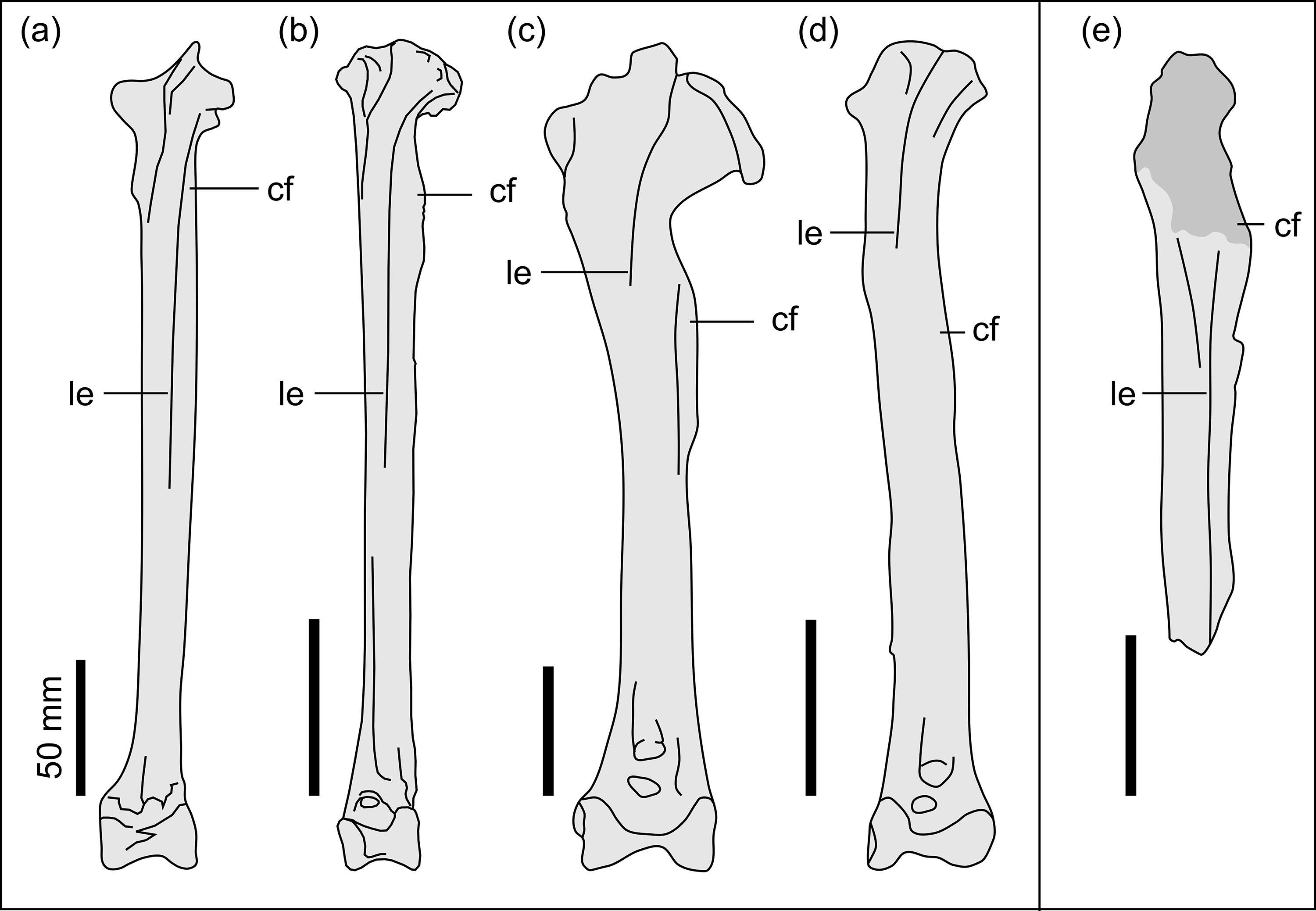
Harrison & Walker’s (Reference Harrison and Walker1976) conclusion that the type of Macrornis tanaupus shows no avian features and may be the distal end of a reptilian femur is certainly unfounded. No Cenozoic reptile has a femur with such a straight shaft, and the thin-walled, hollow bone is certainly indicative of avian affinities. The idea that it might be a reworked Mesozoic bone, possibly belonging to a dinosaur, is unlikely because no such reworking has been reported among the fossils from Hordle Cliff and because the specimen, although broken, shows no evidence of the wear usually associated with reworking; moreover, the matrix inside the bone is not different from the Eocene sediments that occur at Hordle Cliff. The general morphology of the bone and its hollow, thin-walled shaft are unlike mammalian tibiae. We agree with Seeley that it is an avian tibiotarsus, but we think it is from the left side, because of the placement of the linea extensoria and the crista fibularis. A precise systematic identification of C20910 is made difficult by the fragmentary nature of the specimen. The above-mentioned mass estimate (about 43 kg) certainly suggests a flightless bird. However, very large volant birds, belonging to the family Pelagornithidae, are known from the Eocene of Europe (Mayr, Reference Mayr2009), although not from Hordle Cliff (Benton et al. Reference Benton, Cook and Hooker2005), but C20910 differs from the tibiotarsi of pelagornithids, which show a sigmoid curvature (Mayr & Rubilar-Rogers, Reference Mayr and Rubilar-Rogers2010) (Fig. 2d). In addition, pelagornithids have relatively very small hind limbs (Mayr & Rubilar-Rogers, Reference Mayr and Rubilar-Rogers2010); the tibiotarsus of Pelagornis chilensis, from the Miocene of Chile, which is one of the largest known volant birds, is only 242 mm in total length (Mayr & Rubilar-Rogers, Reference Mayr and Rubilar-Rogers2010), and thus significantly shorter than our estimate for the length of C20910. The estimated mass of Pelagornis chilensis, based on the tibiotarsus and using the method of Campbell & Marcus (Reference Campbell and Marcus1992), is only 28.6 kg (Mayr & Rubilar-Rogers, Reference Mayr and Rubilar-Rogers2010), and thus much less than our estimate for C20910. There is therefore no reason to believe that Macrornis tanaupus could be a pelagornithid. We have also considered other very large volant birds, viz. teratornithids, although they are known only from the Neogene and Quaternary of the New World. In Teratornis merriami, from the Pleistocene of North America, the maximum length of the tibiotarsus is 238 mm (Fisher, Reference Fisher1945), significantly shorter than the estimated initial total length of the bone from Hordle Cliff. In the largest known teratornithid, Argentavis magnificens, from the Miocene of Argentina, the tibiotarsus is known only from an incomplete specimen lacking both ends (Campbell & Tonni, Reference Campbell and Tonni1980); although the preserved part is more than 300 mm in length, its morphology differs from that of the specimen from Hordle Cliff in the lack of a prominent linea extensoria. There is therefore nothing to suggest teratornithid affinities, and we have focused our comparisons on flightless birds (Fig. 2).
Comparison of avian left tibiotarsi in cranial view: (a) ratite (Rhea); (b) phorusrhacid (Psilopterus); (c) gastornithid (Gastornis); (d) pelagornithid; (e) Macrornis tanaupus. The darker grey zone on (e) corresponds to a broken area. Abbreviations: le – linea extensoria; cf – inception of crista fibularis.

Seeley’s original suggestion (Seeley, Reference Seeley1866) that Macrornis tanaupus was a ‘struthious bird’ (i.e. a ratite), although with some similarities with waders and gallinaceous birds, is not convincing, notably because ratites, although they may exhibit a prominent linea extensoria, usually have a crista fibularis that may be long proximodistally but is not very prominent (Fig. 2a), unlike that of C20910, which, to judge from the size of its inception, was strongly developed.
As mentioned above, various authors have placed Macrornis tanaupus among the Gastornithidae, without giving any clear reasons for doing so. The rationale behind that attribution may have been mainly geographical and stratigraphical, since the best known large flightless birds from the Eocene of Europe are gastornithids, although Macrornis tanaupus is geologically younger than any other known gastornithid, as was noted by Fisher (Reference Fisher, Harland, Holland, House, Hughes, Reynolds, Rudwick, Satterthwaite, Tarlo and Willey1967b). The latest known gastornithids are from the middle Lutetian (MP 13) of the Geiseltal (Buffetaut & Angst, Reference Buffetaut and Angst2014; Angst & Buffetaut, Reference Angst and Buffetaut2017). However, gastornithids have a tibiotarsus that is much more robust and less straight than C20910 (Matthew & Granger, Reference Matthew and Granger1917; Buffetaut, Reference Buffetaut2008) (Fig. 2c). We therefore do not think that Macrornis tanaupus can be considered as evidence for the survival of gastornithids until late Eocene time.
A further group of large flightless birds that deserves consideration is the family Phorusrhacidae. Angst et al. (Reference Angst, Buffetaut, Lécuyer and Amiot2013) referred to that group various skeletal elements (pelvis, tarsometatarsus, phalanges) from the upper Lutetian (MP 14) of France (Lissieu) and Switzerland (Egerkingen). The available material indicates a middle-sized phorusrhacid for which the name Eleutherornis cotei (Gaillard, Reference Gaillard1936) should be used. Although it was originally referred to the Psilopterinae (Angst et al. Reference Angst, Buffetaut, Lécuyer and Amiot2013), it seems more advisable to consider it as Phorusrhacidae incertae sedis (Angst & Buffetaut, Reference Angst and Buffetaut2017). Mayr (Reference Mayr2017) has doubted the phorusrhacid affinities of Eleutherornis cotei without providing any substantial morphological evidence to support his views, which seem to be based mainly on biogeographical rather than anatomical grounds. C20910 shows similarities with the tibiotarsus of phorusrhacids in the very straight shaft and the strong development of the linea extensoria. The presence of a prominent linea extensoria was noted, in particular, by Andrews (Reference Andrews1899) in Patagornis marshi and by Sinclair & Farr (Reference Sinclair and Farr1932), who referred to it as the ‘linea aspera’, in Psilopterus. In their description of the tibiotarsus of Psilopterus lemoinei, Degrange & Tambussi (Reference Degrange and Tambussi2011, p. 1085) noted that the linea extensoria is distinctive and that ‘the crista fibularis is proximodistally short and craniocaudally wide’. This description fits C20910 fairly well (Fig. 2b). The linea extensoria is conspicuous in the mesembriornithine Llallawavis scagliai according to Degrange et al. (Reference Degrange, Tambussi, Taglioretti, Dondas and Scaglia2015). These similarities may suggest that C20910 could be a phorusrhacid tibiotarsus, although the characters on which this putative attribution is based are admittedly few and that referral must be considered as highly tentative.
Interestingly, Rothschild (Reference Rothschild and Schalow1911), in a review of the ratites, placed Macrornis among the Stereornithes (i.e. Phorusrhacidae), together with other large birds from the Eocene of Europe (including Gastornis, Remiornis and Dasornis). However, he considered that the Stereornithes (as he understood them) were probably ancestral to modern ratites and only noted that the tibia of Macrornis suggested that it was more allied to Dromaius. Moreover, it should be noted that the type specimen of Macrornis tanaupus does not seem to exhibit sufficiently distinctive characters to warrant the erection of a well-defined taxon, and Seeley’s Macrornis tanaupus should probably be considered as a nomen dubium.
6. Discussion
If our highly tentative attribution of the large bird from Hordle Cliff to the Phorusrhacidae is correct, it extends the stratigraphic range of that family in Europe by a few million years. The above-mentioned Eleutherornis cotei from France and Switzerland is late Lutetian in age (MP 14, ∼41 to 42 Ma; Vandenberghe et al. Reference Vandenberghe, Hilgen, Speijer, Ogg, Gradstein, Hammer, Hollis, Hooker, Gradstein, Ogg, Schmitz and Ogg2012), whereas the vertebrate fauna from Hordle Cliff corresponds to the early Priabonian (MP 17, ∼37 Ma). This should of course be confirmed by more complete and unambiguous material. In any case, C20910 unambiguously shows that very large birds, in all likelihood flightless, were present in Europe in late Eocene time.
Whatever its exact systematic position, the giant bird from Hordle Cliff may have a bearing on the interpretation of enigmatic three-toed footprints from the upper Eocene (late Priabonian, MP 19: BiochroM’97, Reference Aguilar, Legendre and Michaux1997) gypsum beds at Montmorency, near Paris that were first reported as long ago as the 1850s by Desnoyers (Reference Desnoyers1859a,b). They were described in some detail by Milne-Edwards (Reference Milne-Edwards1863, Reference Milne-Edwards1869–1871, Reference Milne-Edwards and d’Orbigny1872), but no illustrations have ever been published. As noted by Buffetaut (Reference Buffetaut2004), specimens of these footprints should be at the Muséum National d’Histoire Naturelle in Paris, but it has so far not been possible to locate them. They clearly had been produced by large to very large birds, but no remains of large birds have been reported from the Paris gypsum, and the track-makers have remained elusive. Although the Montmorency footprints are at least 3 Ma younger than Macrornis tanaupus, the latter shows that very large birds were present in Europe in late Eocene time. It has been suggested that the large avian footprints from the gypsum may have been left by gastornithids (Desnoyers, Reference Desnoyers1859b; Milne-Edwards, Reference Milne-Edwards and d’Orbigny1872; McDonald et al. Reference McDonald, White, Lockley and Mustoe2007), but, as noted by Buffetaut & Angst (Reference Buffetaut and Angst2014), there is no record of this group of giant birds from the upper Eocene, the latest known representatives being those from the middle Lutetian of the Geiseltal in Germany, as mentioned above. Moreover, Desnoyers (Reference Desnoyers1859b) mentioned that at least some of the footprints had toes terminating in sharp nails, which is not consistent with an attribution to gastornithids, in which the distal phalanges were somewhat hoof-like (Angst & Buffetaut, Reference Angst and Buffetaut2017). From that point of view, an attribution to phorusrhacids, which had sharp claws, would seem more likely. However, some of the larger footprints from Montmorency, with toes 400 mm in length (Milne-Edwards, Reference Milne-Edwards and d’Orbigny1872), were apparently too large to have been made by a bird the size of Macrornis tanaupus. Be that as it may, the very large bird from Hordle Cliff makes the occurrence of giant bird footprints in the gypsum of the Paris region slightly less puzzling.
7. Conclusions
Our re-examination of the holotype of Macrornis tanaupus shows that, although he was wrong on various points, Seeley (Reference Seeley1866) was right in interpreting it as the tibiotarsus of a very large bird, and that Harrison & Walker’s (Reference Harrison and Walker1976) interpretation as a reptilian femur is unfounded. Although the poor state of preservation of the specimen makes a precise identification difficult, former interpretations as a ratite or a gastornithid are not well supported. We very tentatively suggest that the specimen may belong to a phorusrhacid, which would increase the stratigraphic range of the family in Europe by a few million years, but this attribution should clearly be supported by more complete material. Whether Macrornis tanaupus (a probable nomen dubium) can be linked in any way with the slightly younger puzzling avian footprints from the gypsum of the Paris region is uncertain. However that may be, the specimen from Hordle Cliff shows that very large flightless birds were still present in Europe in late Eocene time, although their fossil record is surprisingly scanty.
Acknowledgements
We thank Dan Pemberton and Matthew Riley for access to the specimen. Special thanks to David Norman for his help and hospitality in Cambridge.