The advent of the Internet saw many commentators espousing its potential for harbouring true participatory democracies (e.g. Rheingold Reference Rheingold1994). Although such utopian thinking eventually faded towards more synoptic visions of online participatory spaces, the recent popularization of social media has prompted something of a revival of techno-utopianism (e.g. Shirky Reference Shirky2008). Commentators have considered social media sites (running on Web 2.0 technologies) to be fundamentally different from the preceding Web 1.0 websites as the former elicit Internet users’ participation in producing and disseminating online content, whereas the latter merely push information to recipients. In this way social media may be vehicles for fostering a more democratic society since they challenge the control over information held by existing sociopolitical elites (e.g. Bruns Reference Bruns2008; Jenkins Reference Jenkins2006). However, Internet theorists are increasingly recognizing the various barriers to equality of Internet access and usage; the Internet is not a utopian space as it cannot transcend existing offline contexts of inequality (e.g. Selwyn Reference Selwyn2006; Van Deursen and Van Dijk Reference Van Deursen and van Dijk2011).
Prior to the emergence of social media, a few archaeologists experimented with the Internet as a tool by which postprocessual tenets, such as multivocality and improved public engagement, could be realized (e.g. Biehl Reference Biehl2004; Hodder Reference Hodder1999; Holtorf Reference Holtorf2004; Joyce and Tringham Reference Joyce and Tringham2007; McDavid Reference McDavid and Merriman2004). In many ways, their claims anticipated the assertion that social media can foster equal participation in society. Social media usage has not achieved ubiquity in archaeology but an ever-increasing number of individual archaeologists, archaeological organizations and institutions are using various social media as tools for professional discussion and networking, research, public outreach and community archaeology (see Bonacchi Reference Bonacchi2012a; Kansa, Kansa and Watrall Reference Kansa, Kansa and Watrall2011; Lake Reference Lake2012). Proponents of social media have particularly pointed towards their potential for transforming the means of networking and communication in archaeology, and challenging traditional disciplinary expertise as archaeologists engage with more diverse and active online publics. All of these claims are consonant with those of more utopian-thinking commentators. However, these positive discourses have tended to prevail at the expense of sustained critical and empirical analyses of the effective impact of social media on the discipline of archaeology and its various publics.Footnote 1 This article surveys the social media currently used by archaeologists and offers an analysis of some of the posited benefits of their use informed by perspectives on social media that have emerged from new media studies and relevant theorization about the nature of the archaeological discipline advanced by public archaeologists. My intention is to point towards some fruitful avenues of future research in this much-discussed but under-studied area of archaeological practice.
Social media for archaeology and its publics
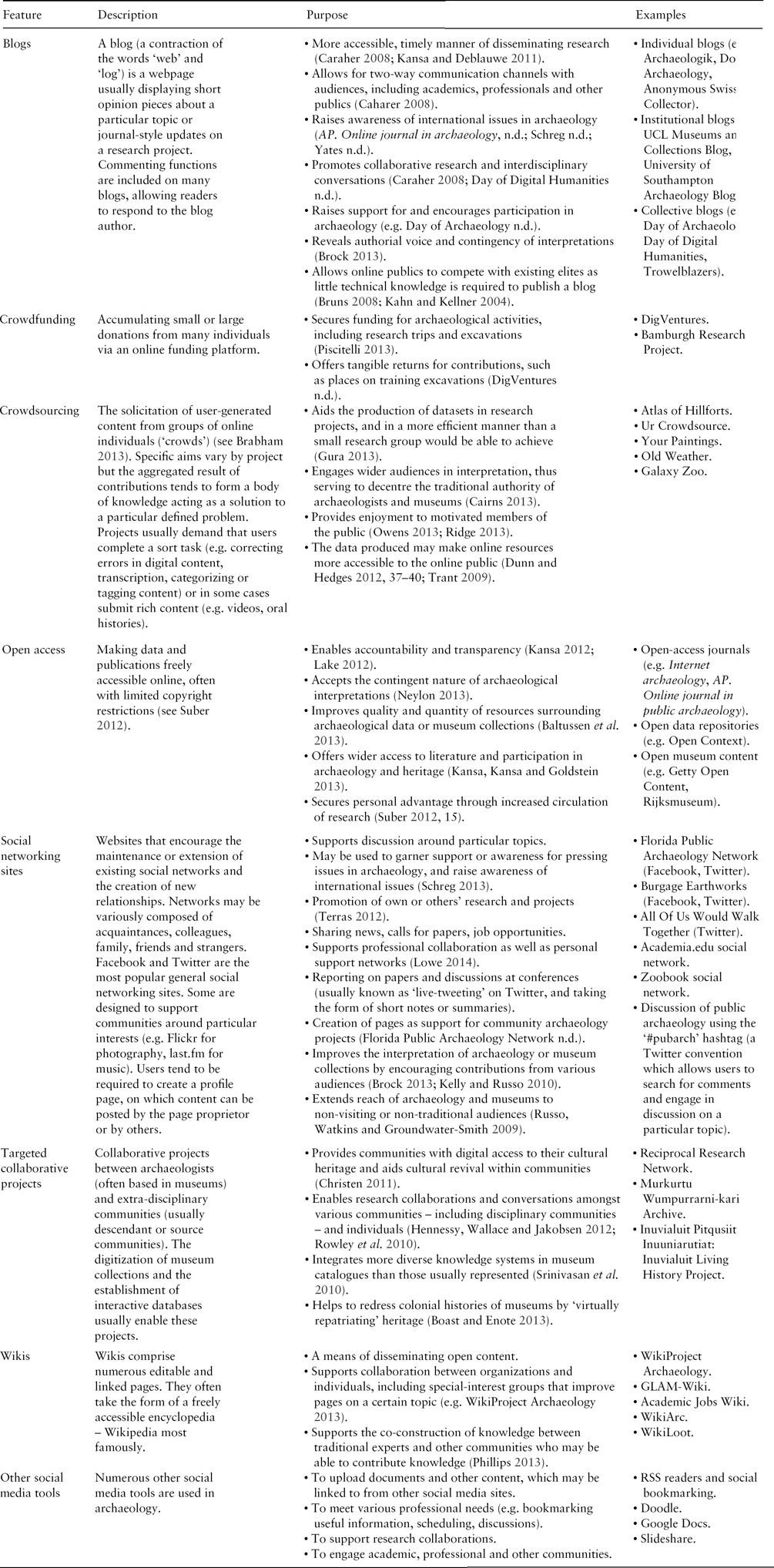
Social media usage in archaeology can be broadly categorized as internally or externally focused, although these are rarely exclusive categories as particular platforms can be used in either or both ways (Table 1). The former tends towards communication within the archaeological discipline, whereas the latter tends towards engaging or collaborating with extra-disciplinary publics. Both categories of use raise a number of common concerns, including how traditional regimes of knowledge production and dissemination in archaeology are impacted, how the advancement of professional careers is affected, whether or not archaeology can further its own standing in society, the extent to which archaeology could include wider and potentially more diverse audiences, and the degree to which the inclusion of extra-disciplinary voices in the interpretation of archaeology is enabled.
Platforms and characteristics of social media in archaeology.

Social media for archaeology
It is difficult to estimate how many archaeologists use social media for professional purposes, although this is likely to be several thousand and increasing.Footnote 2 Furthermore, it is unclear what ‘kind’ of archaeologist is most likely to actively use social networking sites. In archaeology, it has been suggested that students or early-career researchers are more likely to use social networking sites than senior scholars (Kansa and Deblauwe Reference Kansa, Deblauwe, Kansa, Kansa and Watrall2011; Lowe Reference Lowe2014). This is broadly supported by a larger-scale study of academic social media usage, which indicated that academics over the age of 45 were much less likely to use all kinds of social media (Rowlands et al. Reference Rowlands, Nicholas, Russell, Canty and Watkinson2011). It has been further asserted that early-career researchers are more likely to benefit from social networking sites in particular since senior scholars, already embedded within professional networks, are afforded greater access to news and information regardless of social media usage, which might even be considered an unwelcome distraction (Kansa and Deblauwe Reference Kansa, Deblauwe, Kansa, Kansa and Watrall2011).
Social networking sites are seemingly useful for resources such as calls for papers and identifying new or emerging research in various fields of study. This may not appear altogether divergent from earlier technologies, such as email lists or department bulletin boards, but the primary differences are seemingly the greater scale and the potential for diversity. For example, the blogs of numerous professionals, non-professionals and academics (within and without archaeology) may be referenced. Archaeologists may not usually encounter these more informal and perhaps multi- or transdisciplinary sources of information. Thus there is at least the potential for disciplinary boundaries to be revised. Many social media users may also contribute to a heightened awareness of archaeological issues from around the world (e.g. AP. Online journal in archaeology n.d.; Schreg n.d.; Yates n.d.). A further identified benefit of social media usage is the ability to promote one's own research to a much larger audience than exists in traditional channels of dissemination (Dunleavy and Gilson Reference Dunleavy and Gilson2012; Terras Reference Terras2012). The act of ‘following’ (i.e. by creating a list of contacts) individual or organizational accounts on social networking sites also enables researchers to be recipients of information from other selected researchers. In this way, social networking sites may function in a similar manner to traditional journals in their role of filtering academic information, thus acting as a kind of quality check (Daniels Reference Daniels2013; Fenner Reference Fenner2012).
Of potentially greatest disruption to current regimes of research and publishing is the ‘open’ approach to academic research (Kansa Reference Kansa2012; Lake Reference Lake2012). Open-access publishing may secure a degree of personal advantage through the increased circulation of research but what is arguably of most importance is the open ‘state of mind’ (Neylon Reference Neylon2013; also see Suber Reference Suber2012). This refers to an acceptance that one's research can be unpredictably reused and as such may provide crucial insights about data. Moreover, the open approach appears to complement many postprocessualist tenets in its acceptance of the contingent and provisional nature of understandings of data. Social media can enhance this approach by encouraging feedback from other individuals at all stages of research: from the initial formulation of work to its publication and beyond (see Mollett, Moran and Dunleavy Reference Mollett, Moran and Dunleavy2011).
Social media for archaeology's publics
Externally focused uses of social media in archaeology are often accompanied by claims that the authority of archaeologists can be decentred, alongside the various benefits that accrue through participation in archaeology, although such claims are more explicit within the broader heritage and museum studies literature (e.g. Adair, Filene and Koloski, Reference Adair, Filene and Koloski2011; Bonacchi Reference Bonacchi and Bonacchi2012b; Brock Reference Brock2013; Lake Reference Lake2012; Morgan and Eve Reference Morgan and Eve2012; Phillips Reference Phillips2013). A number of projects have been initiated to engage wider audiences with archaeology whilst others have attempted to subvert disciplinary or institutional authority to various democratic ends by encouraging the participation of particular communities or the general public in interpreting cultural heritage (e.g. Brock Reference Brock2013; Phillips Reference Phillips2013). A number of targeted collaborations established between museums (often university museums) and descendant or source communities have particularly recognized the importance of pre-existing sociopolitical contexts and have more fundamentally questioned the primacy of traditional archaeological interpretations (e.g. Christen Reference Christen2011; Rowley et al. Reference Rowley, Schaepe, Sparrow, Sanborn, Radermacher, Wallace, Jakobsen, Turner, Sadofsky and Goffman2010; Srinivasan et al. Reference Srinivasan, Boast, Furner and Becvar2009).
Antisocial media? Impact, inequality and authority in social media usage
Despite the prevalence of discourses about social media reforming the ways in which archaeological research is conducted and disseminated, the permanent effects of social media on archaeology and its publics are unclear. This is likely due to a lack of empirical impact studies and a failure to fully engage with the significant research emerging from the field of new media studies, in addition to theorization about the nature of the archaeological discipline that has particularly emerged from collaborative and indigenous archaeology. In fact, a lack of engagement with pre-existing sociopolitical and sociodemographic contexts and disciplinary cultures may have resulted in the privileging of traditional authorial elites and processes of conducting archaeology. Here, three points of primary concern are raised: (1) the factors that prevent equitable access to and use of the Internet, (2) the transference of pre-existing structures of authority and expertise to online spaces, (3) the disparity in the accrual of resources between disciplinary centres and archaeology's publics.
Throughout all these points of analysis, it should be borne in mind that one of the primary issues with determining the actual impact of social media is a lack of empirical research. This kind of research would, for example, assess the impact of social media on archaeologists’ careers and implicated communities in at least the short and medium term.Footnote 3 In public archaeology, there is a particular need to define measures of online engagement (Bonacchi Reference Bonacchi and Bonacchi2012b). Engagement and impact cannot be easily measured, since many actions on social media sites (e.g. ‘liking’ or ‘retweeting’) rarely have self-evident meanings (Boyd, Golder and Totan, Reference Boyd, Golder and Totan2010). Furthermore, most online activity may not be visible, as non-contribution (e.g. not writing comments) is the overriding norm (Crawford Reference Crawford2009). There are many online research methods available (see Dicks Reference Dicks2012), the use of which would aid a shift away from speculation and reliance on anecdotal evidence and towards empirically informed conclusions about the effects of social media.
Access, skills and motivation
Internet theorists have in recent years begun to put greater emphasis on the importance of situational factors in the extent to which the democratic and participatory potentials of the Internet may be realized (e.g. Gil de Zúñiga, Puig-i-Abril and Rojas, Reference Gil de Zúñiga, Puig-i-Abril and Rojas2009; Van Dijk Reference Van Dijk2012). It is simplest to point to sociodemographic predictors of Internet access and usage: lower educational attainment, greater age, lower income and living with a disability are related to lower levels of access (Van Dijk Reference Van Dijk, Chadwick and Howard2009; White and Selwyn Reference White and Selwyn2013; also see Dutton and Blank Reference Dutton and Blank2013; ONS 2012; 2013; Zickuhr and Smith Reference Zickuhr and Smith2012). However, the ‘digital divide’ is better understood as a series of digital divides as Internet ‘access’ should refer not only to physical access to the Internet but also to the kinds of motivation and skill that determine how effectively individuals use the Internet (Correa Reference Correa2010; Hargittai Reference Hargittai2002; Selwyn Reference Selwyn2006). One study conducted in the Netherlands indicated that older people are less skilled in navigating the Internet, although they are better at evaluating and benefiting from information encountered online. Additionally, people with lower levels of educational attainment are excluded from actual and effective Internet usage (Van Deursen and Van Dijk Reference Van Deursen and van Dijk2011). Such statistics will affect not only which researchers tend to use social media, but also which individuals are likely to be encountered in online public archaeology projects. Thus these inequalities could limit the effectiveness of social media as tools to transform how archaeology is conducted.
There may also be effects caused by differing levels of motivation to participate (e.g. Correa Reference Correa2010; Livingstone and Helsper Reference Livingstone and Helsper2007). One way to approach this issue is to consider the extent to which participants genuinely welcome contributions by others. For instance, the ‘spiral of silence’ may be evident in some social media spaces, meaning that if an individual perceives her- or himself to be part of the majority, she or he will be more likely to express an opinion. Conversely, individuals considering themselves to harbour minority viewpoints may not contribute owing to fears of social isolation (Yun and Park Reference Yun and Park2011; see Noelle-Nuemann Reference Noelle-Nuemann1993). Additionally, researchers have indicated that pre-existing interest in a subject is an important predictor of whether or not individuals engage with online museum resources (Owens Reference Owens2013). The claims of broadening access become problematic when these motivational factors are taken into account. Failing to engage with these issues may lead to archaeologists supporting structural inequality, which occurs when individuals with already inequitable positions in society are prevented from benefiting in another sphere of society (e.g. online public spheres), whilst elites reinforce their position (Van Dijk Reference Van Dijk2012, 205).
Online authority and expertise
There are less immediately apparent ways in which pre-existing structures of disciplinary authority and expertise are maintained. For example, there are currently few incentives in archaeology to adopt an open approach to archaeological research and publication (Limp Reference Limp, Kansa, Kansa and Watrall2011). The currently prevailing disciplinary mindset may be difficult to overcome. This means that, for example, whilst data may be made open for divergent interpretations, not all interpretations may be valued by archaeologists, who refer to a disciplinary canon that defines what counts as ‘expert’ knowledge (Holtorf Reference Holtorf2009; Smith Reference Smith2004). As a result, the online contributions of various publics may have only a temporary impact, if any, upon the discipline. This has been observed in museum contexts, where user-generated content is rarely incorporated into museum catalogues despite the claims of shared interpretive authority between museums and their publics (Cameron Reference Cameron2008; Srinivasan et al. Reference Srinivasan, Becvar, Boast and Enote2010).Footnote 4 Catalogues or archives embody what is actually valued by a discipline; the information included forms an authorized canon, whilst anything excluded is considered not to be valuable (Povinelli Reference Povinelli2011; see Bowker and Star Reference Bowker and Star1999). As a result, well-intentioned projects may result in little change in institutional or disciplinary centres, which define the legitimately archaeological.
The influence of pre-existing structures of authority has been evident on various social media sites. Wikipedia, for example, is based upon the notion of the ‘wisdom of crowds’, a tenet that assigns equal reliability and integrity to the knowledge produced by masses of people compared to that provided by traditional experts (Surowiecki Reference Surowiecki2005). However, disciplinary authority appears to remain a reference point of expertise, as it seems that only by reference to some external source of authority can information on Wikipedia actually be considered ‘expert’ (Sanger Reference Sanger2009). Moreover, Wikipedia may reproduce other societal inequalities which determine which knowledge is considered valuable. For instance, some have argued that feminist viewpoints are dismissed or undervalued on Wikipedia (e.g. Wadewitz Reference Wadewitz2013). Disciplinary structures may in fact influence the people whom archaeologists choose to engage with, and the content that is read and ultimately valued. For instance, museums have seemingly ignored questions about repatriation or illegal antiquities on social networking sites (Rocks-Macqueen Reference Rocks-Macqueen2013). Such instances indicate that offline disciplinary structures may well be replicated in digital environments, and cannot be transcended simply by using social media with an assumption of its inherent democratizing nature. Instead, an active willingness to enact change is required.
Inequitable accrual of resources
Although archaeologists are becoming more aware of the value of using social media, in terms of their own accrual of benefits, less attention has been given to the inequity that may result from this. It should be borne in mind that Web 2.0 technologies were originally lauded in terms of their value to businesses (O’Reilly Reference O’Reilly2005). Social media sites indeed continue to make commercial gains from users’ actions, which has recently led some to theorize about the issues involved in ‘digital labour’ (e.g. Fuchs Reference Fuchs2014; Scholz Reference Scholz and Scholz2013). Similarly, it should be considered that the resources gained by archaeologists, particularly in online collaborative or crowdsourcing projects, may be disproportionally greater than those gained by others.
Crowdsourcing in archaeology has received particularly sparse attention, although an increasing number of museums are utilizing it for various projects. It has been identified as primarily being valuable for completing resource-intensive tasks related to creating or improving content, particularly involving unresearched or undigitized material (Ridge Reference Ridge2013). Although it has been argued that crowdsourcing allows audiences to benefit by developing their own interests or hobbies, as noted above, these audiences seem to be motivated by pre-existing interests. Claiming broader public value is more difficult. The gains for disciplinary and institutional centres are far clearer, including resources that are incorporated into research projects or permanent catalogues, and which may provide employment and career possibilities for researchers. This inequity requires significant attention in order for archaeology to avoid charges of exploiting the altruism of interested publics, and, in some cases, reinforcing appropriative and colonial histories (see Boast Reference Boast2011; Brown and Nicholas Reference Brown and Nicholas2012).
A view from public archaeology
Alongside the observations emerging from new media studies, the experiences of researchers within our own discipline should help to inform our use of social media, particularly the externally focused projects. Public archaeologists, working under labels such as ‘community’, ‘collaborative’ and ‘indigenous archaeology’, have attempted to fundamentally challenge the authority traditionally held by archaeology (e.g. Colwell-Chanthaphonh and Ferguson Reference Colwell-Chanthaphonh and Ferguson2008). This has involved centring concerns that have previously been marginal to archaeology, including various sociopolitical and epistemological issues (Conkey Reference Conkey2005; Wylie Reference Wylie2008). In this way, depending upon the context, archaeology may be conducted with, for or by a community (Nicholas Reference Nicholas and Nicholas2010). This may be difficult work, demanding awareness of sociopolitical situations, ethics and disciplinary norms, and of how they may be shifted (Nicholas et al. Reference Nicholas, Roberts, Schaepe, Watkins, Leader-Elliot and Rowley2011). These practices should serve as a reminder that people and context are of primary importance, not the technology itself. In fact, in many cases as much offline work may be demanded as online work.
Conclusions
Social media have not been problematized in archaeology to the extent that their complexity demands. There are a number of key barriers to equal Internet access and usage, which include less obvious structures of authority. It is unclear what benefits accrue for archaeologists using social media compared to those who do not. Furthermore, in many cases social media seem to have bolstered archaeological authority at the expense of genuinely decentered engagement or collaboration, resulting in disciplinary centres accruing benefits to an extent greater than other participants. Empirical research is particularly necessary to elucidate these problems. Social media should not be used complacently and it should not be assumed that archaeological practice is being fundamentally altered. Social media may be useful tools in many contexts, but they should not be considered harbingers of techno-utopia. This viewpoint can be avoided by an active engagement with the barriers to equitable Internet access and use as well as with the disciplinary and sociopolitical structures of authority that limit the extent to which social media can help to change how research is conducted in archaeology. Failing to do so means we become actively or complicity involved in supporting ineffective and exclusive practices – antisocial by all accounts.
Acknowledgements
Many thanks go to Jennifer French and Katie Hall for their comments on an earlier draft. Thanks also to Robin Boast for supervising the Ph.D. on which this work is based.