Introduction
Exposure to traumatic events is surprisingly common in the USA. Indeed, a recent epidemiological study (Alegria et al. Reference Alegria, Fortuna, Lin, Norris, Gao and Takeuchi2013) examining traumatic events and post-traumatic stress disorder (PTSD) in a large (N = 16 238), nationally representative sample estimated that over 80% of Americans will experience a traumatic event over the course of their lifetimes, with 24% experiencing a horrific event [i.e. one that meets both DSM-IV (Diagnostic and Statistical Manual of Mental Disorders) criteria A1 and A2; American Psychiatric Association, 2000]. African Americans who live in urban areas tend to have even higher rates of trauma exposure, likely the result of living in densely populated, high-crime urban neighborhoods. For example, African Americans are much more likely to be the victims of assault in one form or another (Goldmann et al. Reference Goldmann, Aiello, Uddin, Delva, Koenen and Gant2011) and are far more likely to be murdered than Caucasians (e.g. 2.5% of total deaths v. 0.3% of total deaths, respectively, in 2014, the most recent year for which such data are available; Heron, Reference Heron2016).
Trauma exposure has been linked to a number of negative health behaviors, including substance abuse and dependence, and the risk is elevated in those with PTSD (for reviews, see Ouimette & Reed, Reference Ouimette and Read2014). Notably, substance abuse and dependence, in turn, are reliably associated with steep discounting of the value of future rewards (MacKillop et al. Reference MacKillop, Amlung, Few, Ray, Sweet and Munafò2011), a finding frequently interpreted as reflecting impulsive decision making (Madden & Bickel, Reference Madden and Bickel2010). Little is known about the effects of trauma on decision making when future outcomes are not drug-related, although one study reported that people exposed to a major earthquake increased the extent to which they discounted the value of future rewards (Li et al. Reference Li, Li and Liu2011) and another that older adults exposed to trauma in childhood showed steeper discounting than age-matched controls (Simmen-Janevska et al. Reference Simmen-Janevska, Forstmeier, Krammer and Maercker2015). It is to be noted that major depressive disorder (Pulcu et al. Reference Pulcu, Trotter, Thomas, McFarquhar, Juhasz and Sahakian2014), obesity (Amlung et al. Reference Amlung, Petker, Jackson, Balodis and MacKillop2016), and binge-eating disorder (Mole et al. Reference Mole, Irvine, Worbe, Collins, Mitchell and Bolton2015), as well as prolonged grief after bereavement (Maccallum & Bonanno, Reference Maccallum and Bonanno2016) also have been associated with steep discounting. Indeed, Bickel and colleagues have argued that the occurrence of high rates of delay discounting across a range of disorders suggests that the findings from one disorder may be relevant to other disorders (Bickel et al. Reference Bickel, Jarmolowicz, Mueller, Koffarnus and Gatchalian2012).
Several studies have reported that African Americans tend to discount future rewards more steeply than Caucasian Americans (DeWit et al. Reference DeWit, Adlaf, Offord and Ogborne2000; Dennhardt & Murphy, Reference Dennhardt and Murphy2011), and it is possible that differences in rates of trauma exposure contribute to this finding. Accordingly, we sought to assess the effect of trauma exposure on decision making in a low-income, urban African-American sample using a combination of epidemiological and behavioral economic approaches. The sample was originally recruited for a behavior genetic study of alcohol dependence in African Americans and consisted of equal numbers of participants from treatment centers and non-alcohol-dependent participants from the same neighborhoods. As a result, in the present study, we were able to compare the effects of trauma on those who were alcohol dependent and those who were not.
Previously, we found that alcohol-dependent men in the present sample discounted delayed rewards more steeply than men who were not alcohol dependent (Myerson et al. Reference Myerson, Green, van den Berk-Clark and Grucza2015). Notably, there were no significant differences in discounting among the non-alcohol-dependent men, the alcohol-dependent women, and the non-alcohol-dependent women, suggesting that some variables differentially affect men's and women's decision making. Trauma may be one of those variables that differentially affect men and women. Both Kessler and colleagues (Kessler et al. Reference Kessler, Sonnega, Bromet, Hughes and Nelson1995), who examined data from a large nationally representative sample (the National Comorbidity Survey), and Breslau and colleagues (Breslau et al. Reference Breslau, Kessler, Chilcoat, Schultz, Davis and Andreski1998), who analyzed the data from a large, urban African-American sample (the Detroit Area Survey of Trauma), concluded that the sex differences in PTSD reflect a greater vulnerability to the effects of traumatic experiences in women.
Although men are exposed to more DSM-IV criteria A1 trauma than women, women are more likely than men to endorse the DSM-IV criteria A2 for PTSD, which involves feeling intense fear, helplessness, or horror in response to the traumatic event (Breslau & Kessler, Reference Breslau and Kessler2001). Moreover, women's risk of PTSD following exposure to trauma is approximately twice that of men, and PTSD lasts approximately four times longer in women (Breslau et al. Reference Breslau, Kessler, Chilcoat, Schultz, Davis and Andreski1998). However, men show higher levels of externalizing/substance-abuse symptoms than women following trauma exposure (Kucharska, Reference Kucharska2017). Accordingly, after examining the effects of trauma on the sample as a whole, we then conducted separate analyses of its effects on males and females. Finally, male alcoholics discount delayed rewards more steeply than non-alcoholics, but do not differ in the discounting of delayed payments or probabilistic rewards (Myerson et al. Reference Myerson, Green, van den Berk-Clark and Grucza2015). Therefore, we also analyzed the effects of trauma on the choices of male alcoholics and non-alcoholics on each of the three discounting tasks separately. Such ‘drilling down’ for answers about how best to interpret our results, however, should not distract from their potential generality. For example, while the group under study, low-income African Americans, is of interest in its own right, they also provide a special opportunity to study a truly general phenomenon (i.e. trauma exposure; Alegria et al. Reference Alegria, Fortuna, Lin, Norris, Gao and Takeuchi2013) as well as a process (i.e. steep discounting of delayed outcomes) that is associated with a wide variety of behavioral problems (Bickel et al. Reference Bickel, Jarmolowicz, Mueller, Koffarnus and Gatchalian2012).
Method
Participants
The research protocol was approved by the Washington University Institutional Review Board. A total of 1250 African-American alcoholics, recruited from six treatment centers in the St. Louis metropolitan region, and 1250 non-alcoholic controls, matched on neighborhood and age using the commercially available Merlin cross-directory, were recruited for an ongoing study of the genetic determinants of alcohol dependence in African Americans. 761 of these participants completed three discounting tasks as well as a comprehensive psychiatric interview that included items for assessing substance misuse and dependence, trauma exposure, and PTSD. Using the data from these participants, we established a group of 409 trauma-exposed cases and 287 controls for whom complete data were available, 47% male, mean age 41.7 years (s.d. = 9.6). This was done using DSM-IV criteria A1 (qualifying traumatic event) and A2 (experience of intense fear, helplessness, and horror in response to a criteria A1 traumatic event), which is predictive of PTSD symptom severity and has significant negative predictive power for PTSD diagnosis (for a recent reviw, see Pivovarova et al. Reference Pivovarova, Tanaka, Tang, Bursztajn and First2016).
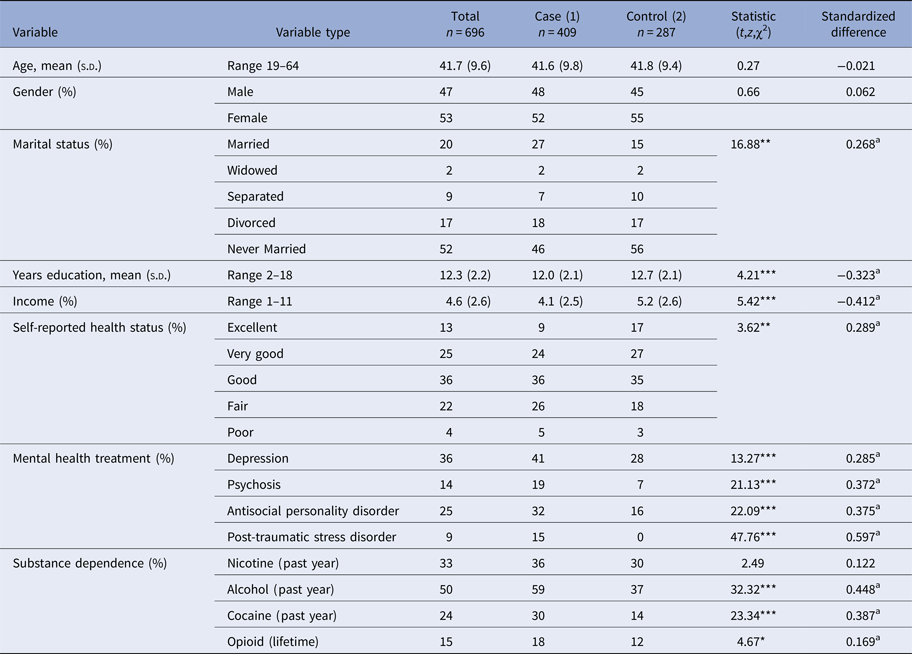
Demographic characteristics of the trauma-exposed cases and controls are provided in Table 1. Mental health and Substance Dependence measures were derived from the Semi-Structured Assessment for the Genetics of Alcoholism II (Hesselbrock et al. Reference Hesselbrock, Easton, Bucholz, Schuckit and Hesselbrock1999) and included measures of treatment for depression, mania, psychosis, and PTSD, and incidence of past year nicotine dependence, alcohol dependence, cocaine dependence, and lifetime opioid dependence. Participants were asked to report their household income using eleven categories, ranging from less than $4 K per year to more than $150 K per year in increasingly larger increments.
Demographic characteristics of the participants

Notes: *p < 0.05, **p < 0.01, ***p < 0.001.
a Significant imbalance exists.
Procedure
Participants completed three adjusting-amount discounting tasks to assess preference for immediate/certain outcomes v. delayed/probabilistic outcomes (Du et al. Reference Du, Green and Myerson2002). On the task assessing discounting of delayed rewards, participants chose between a hypothetical amount of money ($2500) that could be received after a delay and a smaller amount that could be received immediately. The procedure for assessing discounting of delayed payments was the same except that the delayed outcome was a hypothetical $2500 payment due after a specified delay, and the immediate outcome was a smaller payment. On the task assessing discounting of probabilistic rewards, participants chose between a possible $2500 reward and a smaller, certain reward. On all three discounting tasks, participants made a series of six choices at each of six delays (2 weeks, 1 month, 6 months, 1 year, 3 years, or 5 years) or probabilities (95, 80, 60, 40, 20, or 5% chance), with the amount of the immediate/certain outcome of each trial adjusted based on the participant's previous choice. These procedures converged on the amount of immediate/certain outcome that was subjectively equal in value to each of the delayed/probabilistic outcomes (for more details, see Myerson et al. Reference Myerson, Green, van den Berk-Clark and Grucza2015).
Data analysis
The area under the empirical discounting curve (i.e. under the obtained indifference points) was measured using the area-under-the-curve (AuC) measure developed by Myerson et al. (Reference Myerson, Green and Warusawitharana2001). This measure is theoretically neutral and makes no assumptions about the form of the discounting function. AuC measures range between 0.00 and 1.00, with lower values indicating steeper discounting of delayed or probabilistic outcomes.
Propensity-score matching was used to minimize any bias in comparing groups that could result from differences due to potentially confounding variables such as income. As defined by Rosenbaum & Rubin (Reference Rosenbaum and Rubin1983), an individual's propensity score is the likelihood of that person being assigned to a particular treatment condition, given an observed vector of covariates (i.e. scores on the confounding variables). For the present investigation, we used the Stata® statistical software package (StatCorp LP) to estimate participants’ propensity scores and to select matched samples based on those scores (Leuven & Sianesi, Reference Leuven and Sianesi2015). Multiple probit regression with potential confounds as independent variables and trauma exposure as the dichotomous dependent variable was used to determine the regression function that most accurately predicted the likelihood of trauma exposure, and to calculate each participants’ propensity score (i.e. their conditional probability of trauma exposure) based on the potential confounds for that individual. Finally, nearest-neighbor matching (without replacement) of cases and controls based on their propensity scores was performed to create two groups of participants, one consisting of trauma-exposed cases and one consisting of control participants who had the same likelihood of experiencing trauma as the cases, but who had not had that experience.
It should be noted that one consequence of matching the groups is that it tends to make statistical tests more conservative. Consider, for example, the case of matching alcohol-dependent participants and controls on income. This may result in selecting a group of high-functioning alcoholics who might be less likely to show steep discounting. One should be aware of this conservative bias when generalizing to unmatched groups, because it means that one could be under-estimating group differences in decision making. This is not necessarily a weakness of this approach; however, because it also decreases type 1 error and the likelihood of overestimating differences.
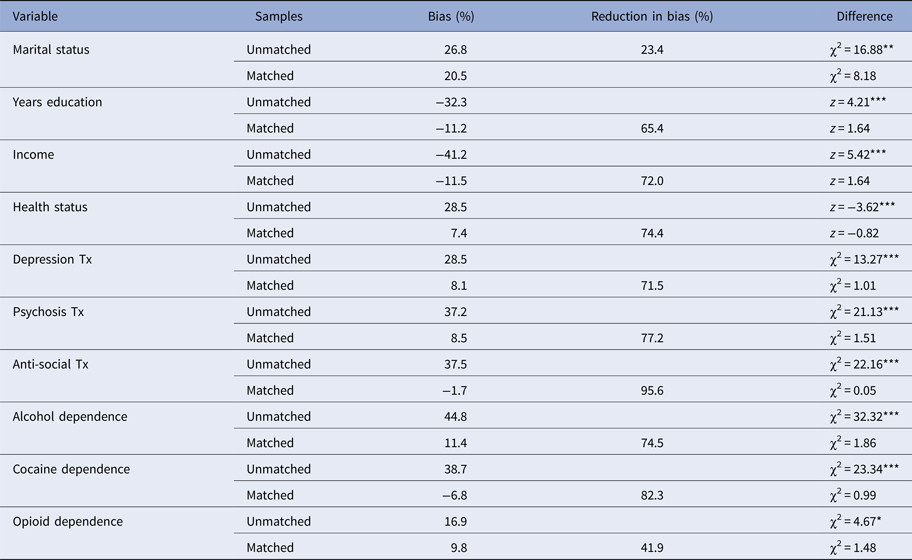
To determine whether matching reduced bias, we used the standardized percentage bias, which represents the difference between the means for the cases and controls as a percentage of the square root of the average of the variances for the two groups. For the continuous variable of age, t tests were used to compare cases and controls; for the ordinal variables of education, income, and health status, the Mann–Whitney Rank-Sum test was used; for percentage of male participants, marital status, and the dichotomous variables mental health treatment and substance dependence, the Chi square (χ2) test was used.
Results
There were significant differences between trauma-exposed cases and controls in marital status, years of education, and income, with cases having significantly lower levels of education and income. We also found that cases were in poorer health and were more likely to be treated for depression, psychosis, anti-social personality disorder, and, as expected, PTSD. Also, as expected, there were significant differences in past-year alcohol dependence, past-year cocaine dependence, and lifetime opioid dependence. Following propensity-score matching, the cases and controls no longer differed significantly on any of these variables (see Table 2).
Differences between trauma-exposed cases and controls before and after propensity-score matching

Notes: *p < 0.05, **p < 0.01, ***p < 0.001. Tx indicates treatment for the condition indicated. Where bias is positive, the mean, median, or percentage is greater for cases than for controls. For the ordinal and count variables education, income, and health status, the Mann–Whitney Rank-Sum test was used to evaluate bias. For marital status, mental health treatment status, and substance dependence status, the χ2 test was used.
Participants showed the usual hyperboloid form of discounting on all three tasks (Green & Myerson, Reference Green and Myerson2004). When the hyperboloid was fit to the group median subjective values of the delayed outcomes plotted as a function of delay, the R 2 and root-mean-square error (RMSE) (expressed as a proportion of $2500) for the delayed rewards were 0.979 and 0.038, respectively; for the delayed payments, they were 0.870 and 0.045. When the group median subjective values of the probabilistic rewards were plotted as a function of the odds against receiving a reward, the R 2 and RMSE were 0.958 and 0.044.
To determine whether trauma-exposed cases differed from controls in the steepness of their discounting, we compared the areas under their empirical discounting curves (AuCs). Trauma-exposed cases discounted both delayed gains and delayed losses, but not probabilistic gains, more steeply than controls, as indicated by their smaller AuCs (see Fig. 1). Specifically; when the delayed outcomes were gains, the median AuCs for cases and controls were 0.242 and 0.312, respectively, U = 36 721.0, p = 0.025; when the outcomes were losses, the median AuCs for cases and controls were 0.502 and 0.585, U = 36 925.5, p = 0.032. In contrast, trauma-exposed cases and controls did not differ in their discounting of probabilistic gains, U = 40 164.0, p = 0.607.
Area-under-the-curve (AuC) measures (Mdns) of the discounting of delayed rewards, delayed payments, and probabilistic rewards by trauma-exposed cases and propensity-score matched controls. Lower AuCs indicate steeper discounting.

As planned, we next examined the effects of trauma on male and female participants separately and discovered that the male cases were primarily responsible for the observed differences in delay discounting between the trauma-exposed and control groups. Male cases (Mdn AuC = 0.207) discounted delayed gains more steeply than controls (Mdn AuC = 0.297), U = 7297.0, p = 011. Although a slightly larger difference was observed in discounting delayed losses, (Mdn AuCs were 0.481 and 0.580, respectively), this difference was not statistically significant, U = 7732.5, p = 0.063. In contrast, female cases and controls did not show a significant difference in their AuCs on either delay discounting task, both Us > 10 905.0, ps > 0.260. It should be noted, however, that there were marked differences in the types of traumas which the male and female participants had experienced that make differences in their discounting difficult to interpret.
For example, the male participants were more likely to have been threatened with a weapon (70.7% v. 41.3%), shot (23.8% v. 5.4%), stabbed (26.2% v. 13.0%), mugged (50.3% v. 31.8%), or to have seen someone seriously injured (58.5% v. 35.0%) or killed (45.6% v. 17.4%). In contrast, female participants were significantly more likely to have been raped or sexually assaulted (33.7% v. 5.5%), or to have been kidnapped (12.8% v. 5.8%). Moreover, male participants were more likely to have engaged in alcohol use at a young age (i.e. before age 14: 30.5% v. 16.3%), and to have been in military combat (4.6% v. 0.3%).
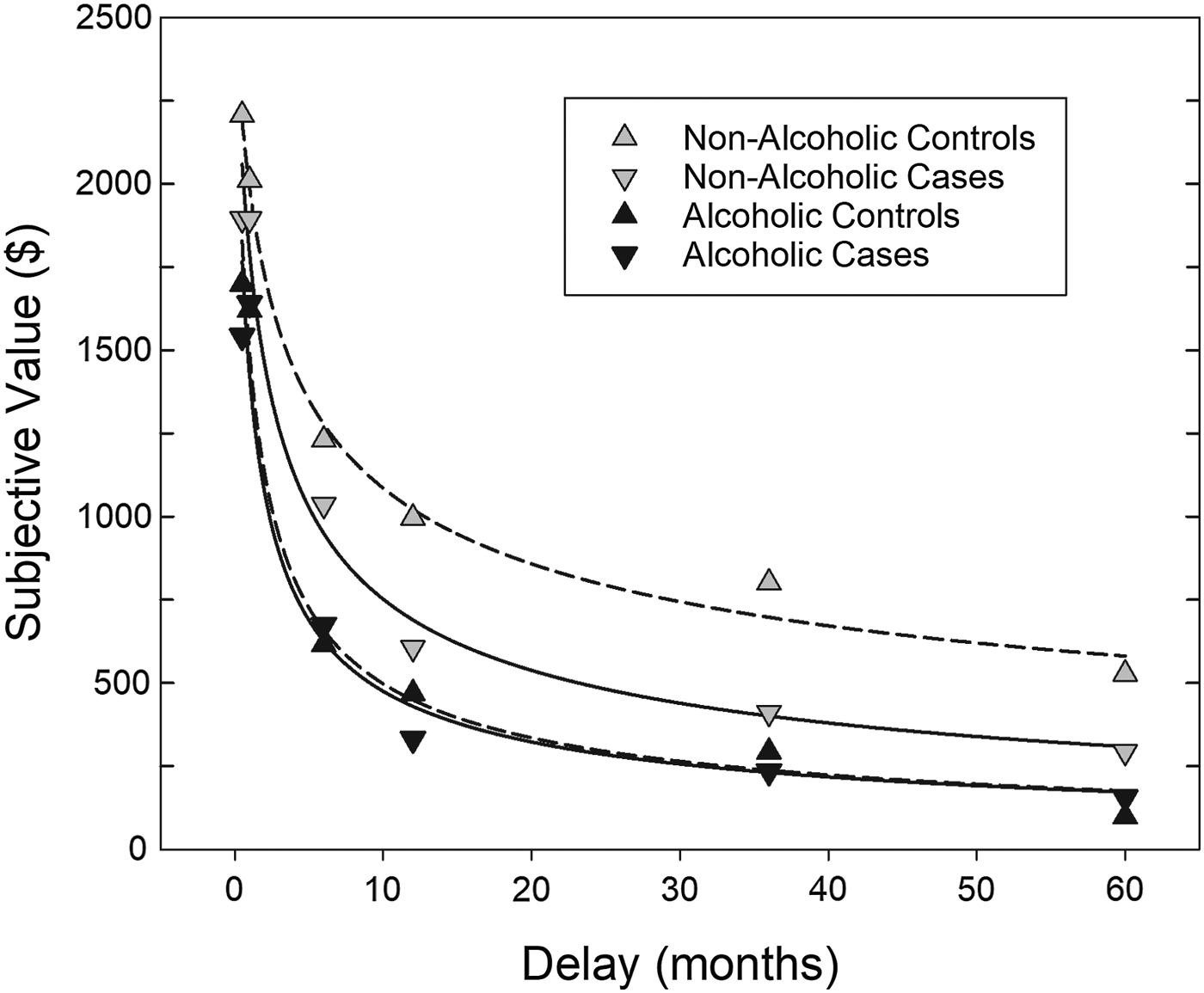
Finally, because previous results showed that male alcoholics differed from non-alcoholics on the discounting of delayed rewards, but not delayed payments or probabilistic rewards (Myerson et al. Reference Myerson, Green, van den Berk-Clark and Grucza2015), we examined the effects of trauma exposure on the discounting of delayed rewards in alcoholic and nonalcoholic males separately. As expected, and as may be clearly seen in Fig. 2, the propensity-matched alcohol-dependent participants (black symbols) discounted delayed rewards more steeply than the non-alcoholic controls (upright gray triangles). However, there was no effect of trauma exposure in alcohol-dependent participants, Mann–Whitney U = 2310.5, p = 0.969. Importantly, among those who were not alcohol-dependent, those who had experienced severe trauma (Mdn AuC = 0.228) showed significantly steeper discounting than those who had not (Mdn AuC = 0.363), U = 1449, p = 0.003.
Group median subjective value (V) of a monetary reward as a function of the delay (D) until its receipt; all data are from male participants. The curves represent the best-fitting hyperboloid functions: V = [A/(1 − kD)]s, where A is the amount of the delayed reward, k is the parameter governing the discount rate, D is the delay, and s is a non-linear scaling parameter (Myerson & Green, Reference Myerson and Green1995). Solid curves are fits to the data from trauma-exposed cases; dashed curves are fits to the data from propensity-score matched controls.

Discussion
Low-income, urban African Americans completed three decision-making tasks designed to assess the extent to which they discounted the value of delayed rewards and payments, as well as the extent to which they discounted probabilistic rewards. Trauma-exposed cases (defined as those who were exposed to trauma and met both DSM-IV A1 and A2 criteria) and controls were propensity-matched on demographic measures (e.g. income, education) and on treatment for mental health problems as well as on substance dependence. Among propensity-matched participants, trauma-exposed cases discounted delayed outcomes, but not probabilistic ones, significantly more steeply than controls. These results are consistent with previous findings of steeper delay discounting in individuals who had experienced a severe earthquake (Li et al. Reference Li, Li and Liu2011), in older adults previously exposed to early childhood trauma (Simmen-Janevska et al. Reference Simmen-Janevska, Forstmeier, Krammer and Maercker2015), and in individuals directly exposed to violence as a result of living near a conflict zone (Imas et al. Reference Imas, Kuhn and Mironova2015), suggesting that the present results have broad generality. Notably, however, when data from female and male participants in the present study were analyzed separately, we found no differences on any of the discounting measures for the propensity-matched female participants. In contrast, the male trauma-exposed cases discounted delayed outcomes, including both rewards and payments, significantly more steeply than controls.
The present results suggest that, rather than women being more vulnerable to the effects of trauma than men as previously suggested, there are gender differences in the effects of trauma that need to be more closely examined. These results supplement previous findings that although men are more likely to meet DSM-IV criteria A1 for PTSD, women are more likely than men to characterize a traumatic event as horrific and satisfy Criteria A2 (Breslau & Kessler, Reference Breslau and Kessler2001) and their risk of PTSD following exposure to trauma is much higher (Kessler et al. Reference Kessler, Sonnega, Bromet, Hughes and Nelson1995; Breslau et al. Reference Breslau, Kessler, Chilcoat, Schultz, Davis and Andreski1998). Notably, however, Danielson et al. (Reference Danielson, Amstadter, Dangelmaier, Resnick, Saunders and Kilpatrick2009) found that type of trauma interacts with sex in determining the likelihood of substance abuse. In Danielson et al.’s analysis of data from the 7–8-year follow-up to the National Survey of Adolescents (Kilpatrick et al. Reference Kilpatrick, Acierno, Saunders, Resnick, Best and Schnurr2000), young men who had been subject to physical abuse were at increased risk for substance abuse, but young women were not, whereas sexual abuse increased the risk among young women more than it did among young men. This is in contrast to the risk for PTSD following trauma exposure, which is greater for women than men even after controlling for type of trauma (Tolin & Foa, Reference Tolin and Foa2006).
The present finding that, contrary to expectation, the male participants’ decision making was affected by trauma whereas female participants’ decision making was not, is particularly interesting in light of the results of our previous study comparing low-income, urban African-American alcoholics with propensity-matched controls (Myerson et al. Reference Myerson, Green, van den Berk-Clark and Grucza2015). In that study, which selected samples from the same database, we found that male, but not female, alcoholics discounted delayed rewards more steeply than controls of the same sex, but neither male nor female alcoholics differed from controls in their discounting of delayed payments. Similarly, in the present study, men's discounting of delayed rewards was affected by trauma exposure, whereas women's discounting was unaffected. Moreover, participants in the present study were propensity-matched on predictors of trauma exposure, which included alcohol and other substance dependence. Thus, the present results represent a separate instance of a sex difference in discounting in a psychologically compromised group where little or no sex difference is observed in uncompromised controls, although as already noted, the differences in the types of trauma experienced by males and females differed, and further research directed at disambiguating the role of sex and type of trauma is clearly needed.
Importantly, the effects of trauma exposure on discounting in males differed depending on both the kind of outcome being discounted and whether or not participants were alcohol dependent. It may be recalled that our reason for dividing the male participants into two groups based on alcohol dependence in the first place was because of previous results showing that decision making by male, low income, urban African Americans differed significantly depending on whether or not they were alcohol dependent (Myerson et al. Reference Myerson, Green, van den Berk-Clark and Grucza2015), and it is useful to compare the present results to those of that study.
As in Myerson et al. (Reference Myerson, Green, van den Berk-Clark and Grucza2015), differences in decision making in the current study were observed in male, but not female, participants, and the pattern of differences depended on the discounting task, with the effects of trauma exposure confined to the discounting of delayed outcomes. When the delayed outcomes were rewards, this effect was further localized in males who were not alcohol dependent (i.e. male controls); that is, exposure to trauma was associated with significantly steeper discounting in this group, whereas trauma had no effect in alcohol-dependent males (see Fig. 2). When the delayed outcomes were payments, however, the effect could not be localized, in that it failed to reach statistical significance in females or males or in any of the subgroups examined. These results, taken together with those of other recent studies of drug-dependent individuals (e.g. Mejía-Cruz et al. Reference Mejía-Cruz, Green, Myerson, Morales-Chainé and Nieto2016) suggest that the discounting of delayed rewards and delayed payments reflect different traits.
It should be noted, moreover, that neither trait appears to be the same as those measured by self-report on personality instruments. As MacKillop et al. (Reference MacKillop, Weafer, Gray, Oshri, Palmer and de Wit2016) recently concluded from the results of their large-scale study of the latent structure of impulsivity, ‘diverse measures of impulsivity can broadly be organized into three categories that are largely distinct from one another,’ more specifically, impulsive action (e.g. Stop Signal Task), impulsive choice (e.g. discounting of delayed rewards), and impulsive personality traits (e.g. Barratt Impulsivity Scale). The latter two were both independently associated with problem drinking in MacKillop et al.’s sample of 1252 young adults, and thus perhaps belong under the same rubric. Nevertheless, they appear to be fundamentally different constructs (Green & Myerson, Reference Green and Myerson2013).
The present study is unique in its combined use of epidemiological and behavioral economic approaches. Within epidemiology, case/control studies are used to compare a population exposed to a specific problem or treatment (i.e. the cases) with a population who is similar to this group but who has not been exposed to the specific problem or treatment (i.e. the controls). The concern when comparing trauma-exposed cases with controls, of course, is that there are often numerous confounding variables that make it difficult to disentangle the effects of multiple causes. One statistical technique that demographic researchers, who typically have data from very large samples, utilize to resolve such problems is propensity-score matching. Because of the relatively large sample from whom discounting data were obtained in the present study, we were able to match trauma-exposed cases and controls on a number of demographic, psychiatric, and substance-use measures.
One important observation in the present study, distinct from the interactive effects of sex, trauma exposure, and alcohol dependence on discounting, was the very high prevalence of trauma in the sample, which was comparable to that in a previous demographic study of the African American population in Detroit (Goldmann et al. Reference Goldmann, Aiello, Uddin, Delva, Koenen and Gant2011). The present study took advantage of these high prevalence rates to examine the relation between trauma exposure and discounting. The current findings may contribute to a fuller understanding of the relation between trauma exposure and its effects on decision making in this community and perhaps more generally. In particular, they shed new light on how trauma exposure affects decisions involving future outcomes, which may be particularly important given that steep discounting appears to be a precursor of addiction. The finding that trauma-exposure increases the tendency in men to discount delayed outcomes could help explain why men may be more likely to respond with substance use and abuse (Kucharska, Reference Kucharska2017). Because of steep discounting, they may be more likely to choose the instant gratification of substance use over the delayed rewards from recovery and the resulting positive life outcomes.
Several mechanisms have been proposed to account for the relation between PTSD and substance abuse. Variations on what may be called the high-risk hypothesis posit that that substance abuse reflects a general tendency toward high-risk behaviors, thereby increasing the likelihood of exposure to traumatic events. Alternatively, variations on what may be called the susceptibility hypothesis posit that substance abuse is a mechanism for coping with stress, and traumatic events lead to stress that may manifest as PTSD, which some people deal with through self-medication or substance abuse (Jacobsen et al. Reference Jacobsen, Southwick and Kosten2001). These hypotheses grapple with the difficult question of causality – does substance abuse lead to traumatic events and PTSD or do traumatic events and PTSD cause substance abuse?
Given that PTSD is associated with increased rates of substance use (for reviews, see Ouimette & Read, Reference Ouimette and Read2014), it may be particularly important to explore the use of delay discounting tasks as diagnostic tests as well as the use of interventions focused on modifying discounting rates in male patients in order to promote more future-oriented decisions in traumatized populations. If the high-risk hypothesis is correct, decreasing discounting rates should decrease both substance abuse and future exposure to traumatic events because both are consequences of risky behavior that results from discounting the future consequences. In contrast, if the susceptibility hypothesis is correct, decreasing discounting rates should not affect substance abuse, at least in those with PTSD, because modifying discounting does not alleviate the stress symptoms that provide the motivation for substance abuse.
The present findings do not distinguish among the three causal mechanisms just described, but they suggest that interventions directed at modifying discount rates, which our findings suggest are needed, may help do so. Importantly, the search for ways to modify discounting rates that could be used in treatment has already begun (Bickel et al. Reference Bickel, MacKillop, Madden, Odum and Yi2015), with several types of interventions showing particular promise. For example, having individuals engage in episodic future thinking in order to reduce delay discounting has already been tried with clinical populations (e.g. Daniel et al. Reference Daniel, Stanton and Epstein2013; Snider et al. Reference Snider, LaConte and Bickel2016) although not yet with individuals with PTSD or as an actual treatment modality outside the laboratory. Although research on actual treatment is in its infancy and is perhaps the best way to address the question of causality, the use of delay discounting tasks or tests for assessment purposes that can help identify those most at risk and predict treatment outcomes is already quite practical. Importantly, such uses of assessment begin to address the question of whether steep discounting is a cause, a consequence, or just a covariate of problem behaviors, and the answer appears to be that, at least in some cases (e.g. cigarette smoking), steep discounting precedes the problem behavior, and thus likely plays a causal role (Audrain-McGovern et al. Reference Audrain-McGovern, Rodriguez, Epstein, Cuevas, Rodgers and Wileyto2009; MacKillop & Kahler, Reference MacKillop and Kahler2009; Sheffer et al. Reference Sheffer, Christensen, Landes, Carter, Jackson and Bickel2014).
Although we do not yet know whether exposure to trauma causes steep discounting or whether steep discounting is a risk factor for trauma exposure, or both, steep discounting is an established risk factor for behavioral problems associated with PTSD (e.g. substance abuse; MacKillop et al. Reference MacKillop, Amlung, Few, Ray, Sweet and Munafò2011). Research on the clinical utility of modifying discounting rates in trauma-exposed individuals is clearly called for, and the present findings highlight the importance of examining its utility for trauma-exposed women and men separately.
Acknowledgement
The authors thank Yu-Hua Yeh for his comments and assistance. This research was supported in part by NIH grant R01AA01744401.
Declaration of Interest
None.
Ethical standards
The authors assert that all procedures contributing to this work comply with the ethical standards of the relevant national and institutional committees on human experimentation and with the Helsinki Declaration of 1975, as revised in 2008.