In recent years, the frequency of foodborne disease outbreaks has increased, which continues to be a major public health issue.Reference Schlundt 1 The annual number of foodborne disease cases reported to many national health authorities has also increased in recent years. The growing infection rate of foodborne illness (caused by consumption of contaminated food, pathogenic bacteria, viruses, or parasites) has resulted in millions of persons infected and has caused many deaths. Each year an estimated 76 million illnesses and 5000 deaths are caused by foodborne disease outbreaks in the United States alone.Reference Lynch, Painter and Woodruff 2 , Reference Rocourt, Moy and Vierk 3 Although this infection rate decreased in 2009-2010 in the United States,Reference Gould, Walsh and Vieira 4 , Reference Portal and Karras 5 foodborne disease outbreaks remain a large threat to public health. Australia records approximately 5.4 million cases of foodborne diseases per year, which costs A$1.2 billion annually.Reference Angulo, Kirk and McKay 6 In England and Wales, there are 2,366,000 cases, 21,138 hospitalizations, and 718 deaths each year due to foodborne disease.Reference Rocourt, Moy and Vierk 3 On the basis of the reported number of cases in the United States, England, and Australia, it is easy to assume that the burden of foodborne disease outbreak is similar or even worse in many other countries in the world.
Detection of Foodborne Disease Outbreaks
Although foodborne diseases often affect people, only a small portion of these infections are formally reported to health authorities. This is primarily because of ineffective outbreak coordination processes and poor participation by the public. As the nature of foodborne disease outbreaks changes over time as the result of changes in food production, consumption, and distribution processes, the surveillance coverage and process of foodborne outbreak detection must continually be developed.Reference Sobel, Griffin and Slutsker 7 This article proposes a hybrid information network model that provides an improved way of coordinating the detection of foodborne disease outbreaks at an earlier stage. Our objectives were to identify formal outbreak coordination processes, the challenges of these processes, and their impact on public health security; to explore potential social media surveillance for early detection of foodborne outbreaks; and finally to understand how an organizational coordination network and a social media–based informal network can act together as a hybrid information network for the detection of foodborne disease outbreak.
Coordination of Detection of Foodborne Disease Outbreaks
Coordination facilitates social interaction with multiple actors working toward a common goal.Reference Uddin and Hossain 8 In broad terms, coordination includes almost everything that happens during all sessions when actors work together, setting goals and performing various activities in order to achieve the goals.Reference Malone and Crowston 9 A unique feature of effective coordination is the ability to focus explicitly on the elements of coordination. In narrow terms, coordination is the act of managing interdependencies among activities accomplished to achieve a goal.Reference Malone and Crowston 9 From an inter-organizational perspective, coordination involves managing the collaborations and relationships that can be found in many forms, including partnerships, alliances, and networks.Reference Uddin and Hossain 8 Effective coordination plays an important role in the monitoring and evaluation of disasters.Reference Li and Sun 10 Coordination also plays an important role in the distribution of disaster relief. Thus, coordination has continuously been an important and heavily discussed issue in the disaster and emergency management literature.Reference Kim, Hossain and Uddin 11
From the perspective of foodborne disease outbreaks, the process of data gathering and information sharing over different networks needs to be effectively coordinated. Marvin et alReference Marvin 12 and SchlundtReference Schlundt 1 note that an effective coordination strategy is lacking in foodborne disease surveillance when a hazard is unknown. Therefore, this lack may result in very weak evidence that may lead to uninformed decisions being made concerning food safety and public health security.Reference Schlundt 1 Because the number of reported cases of foodborne disease outbreaks is gradually increasing and the number of people affected is rapidly growing, it is of great concern for health authorities globally to establish an effective coordination strategy to reduce the rate of infections and protect public health.
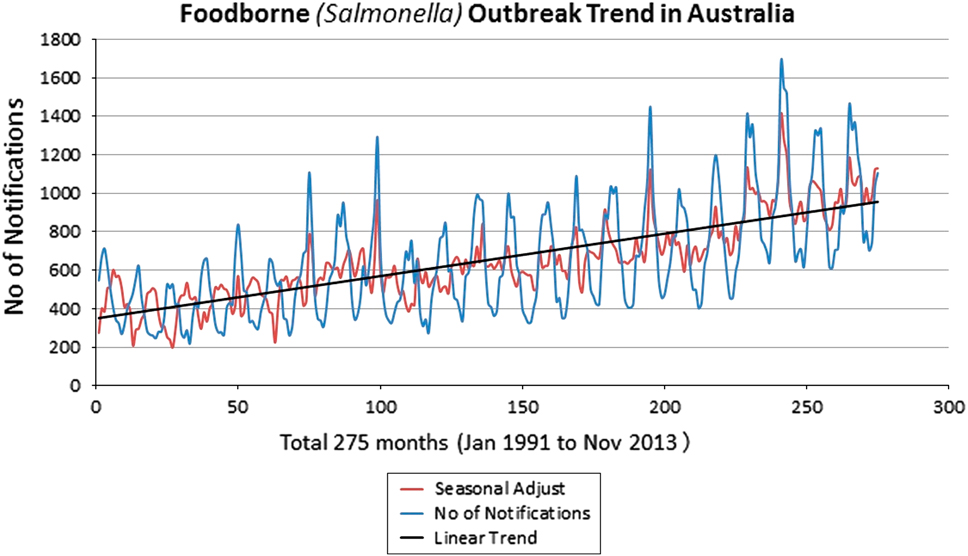
Looking at the foodborne disease outbreak trend in Australia, there has been a gradual increase in Salmonella outbreak (Figure 1) since 1991. These raw data were collected from the National Notifiable Diseases Surveillance System, Australia, and time series analysis was performed. The linear trend indicates a continuous increment in foodborne cases over the decades. Therefore, it is indeed important to have improved and effective coordination for foodborne disease outbreak management.
Foodborne (Salmonella) Outbreak Trend in Australia.

In coordination systems for outbreak detection in the United States, primary data are held when physicians and hospitals as part of surveillance networks collect specific data or submit samples for laboratory tests. Local public health agencies also collect primary data when public health workers examine patients and collect additional information from infected individuals after receiving reports from the clinical health care system. If a single case justifies raising a notification or if multiple cases of disease infections are found, frontline clinicians may perform the functions of outbreak detection. Three other components are also involved in detecting an outbreak: local or state health agencies, academic or professional organizations, and the federal government.Reference Dato, Wagner and Fapohunda 13
At the Centers for Disease Control and Prevention (CDC), disease outbreaks are reported by using the National Outbreak Reporting System (NORS). This reporting includes the date and location of the outbreak, the number of people infected, and the causative pathogen. The data gathered from outbreak investigations are checked, standardized, and analyzed by CDC experts to provide information necessary for decision-making and continuous learning. The coordination processes at NORS start when people are exposed to a pathogen, get sick, and seek treatment. On the basis of information on infections, the health department is notified of a possible outbreak. The health department then conducts an outbreak investigation, followed by the entry of outbreak information into NORS. Next, the CDC checks the data for accuracy and conducts an analysis. Finally, data are summarized and interpreted for decision-making.
Given the massive consequences of a dynamic event called a disease disaster, or more specifically, foodborne disease outbreak, it is a global challenge to apply an appropriate method of coordination in an emergency situation in which public health security is in danger. Evidence from the literature suggests that the burden of foodborne disease outbreak is seriously high in the United States, England, and Australia and that the situation is either similar or worse in other parts of the world.Reference Lynch, Painter and Woodruff 2 , Reference Rocourt, Moy and Vierk 3 , Reference Angulo, Kirk and McKay 6 It is therefore necessary to identify improved ways to reduce the burden of foodborne disease. It is also important to examine how organizations deal with foodborne outbreak investigations; for example, whether organizations have an effective method of coordinating investigation processes and whether coordinating a foodborne outbreak at the organizational level becomes complicated or more complex. Many questions arise when the burden of foodborne disease outbreaks is of global concern and either remains the same or increases over the decades.
Bdeir et alReference Bdeir, Hossain and Crawford 14 studied inter-organizational coordination during disease outbreaks and found that the main problem during disasters or emergency situations is that the coordination is not well controlled. Their study further argued that complexity arises when multiple agents interact with each other in a dynamic environment and that coordination is deemed necessary when a task needs to be completed through interdependent activities.Reference Bdeir, Hossain and Crawford 14 Similar situations occur in health organizations, which face coordination complexity in disease disaster because every disease outbreak seems unique by nature or symptoms or level of complexity. Thus, demand is high for an emergency response system to reduce the complexity in coordination. The question for researchers, practitioners, and policy makers is whether the standard top-down approach with its “hierarchal commands and control structure” successfully deals with high levels of complexity during disease outbreaks,Reference Bdeir, Hossain and Crawford 14 particularly if the outbreaks are caused by food contamination, or whether a new or complementary method (bottom-up approach) of coordinating complexity would have a much better success rate. This question remains almost unanswered in the literature.
In a traditional coordination system, foodborne disease outbreak reporting at state or national levels is based on a number of laboratory-reported cases of a certain group of the population. Many cases of foodborne disease never reach the laboratory tests or health care system. Thus, the number of cases reported at the level of the health care system actually represents a fraction of the total number of infected cases.Reference Schlundt 1 In many cases, individuals do not feel the need to visit a physician and do not report any symptoms of disease. The existing coordination processes cannot effectively provide appropriate surveillance to a majority of the population in a timely manner.Reference Schlundt 1 , Reference Marvin 12 In most cases, a foodborne disease outbreak is reported after laboratory confirmation of a few similar cases is received. PulseNet, FoodNet, and HealthMap surveillance are facing many internal problems such as insufficient funds, staffing shortages, isolated report submission by clinical laboratories, lack of standard communication with partners, limited capacity of coordination and, in the case of PulseNet, only a small percentage (10%) of the population being covered by the surveillance networks.Reference Woteki and Kineman 15 , Reference Boxrud, Monson and Stiles 16 In many countries, the surveillance structure is weak and the dimension of disease outbreak is still unknown.Reference Schlundt 1 In developing countries, the laboratory resources and skills needed to identify foodborne pathogens are not commonly available. Even for developed countries, laboratory-based surveillance is not well developed and simple and reliable laboratory-confirmed reporting is lacking.Reference Schlundt 1 , Reference May, Chretien and Pavlin 17 Therefore, a structure for timely, successful coordination of foodborne disease outbreaks remains undeveloped.
SOCIAL MEDIA AS AN INFORMAL DISEASE SURVEILLANCE METHOD
Social media refers to Internet applications and platforms that allow users to create and share content.Reference Newkirk, Bender and Hedberg 18 The term is also used to refer to a group of Internet-based applications built on ideological and technological foundations of Web 2.0 that allow for the creation and exchange of user-generated content.Reference Ahmed, Scheepers and Stockdale 19 The diverse use of social media has attracted the interest of researchers in both the public and private sectors, particularly in disaster, crisis, and emergency management. In the field of emergency knowledge management, researchers have identified social media as an important knowledge management platform during disaster response.Reference Yates and Paquette 20 Social media can make sense of contextual information availability for responding organizations and for the public during a crisis. Social media in this case facilitates knowledge sharing by increasing knowledge reuse while eliminating reliance on formal approaches. One of the main challenges of social media use is information accuracy, which must be constantly checked and validated. It is sometimes difficult to validate information owing to the small amount of data retrieved through a system. There is an emphasis on how social media contributes to organizations’ decision-making processes for improved understanding of decision-making models in extreme or emergency environments.Reference Yates and Paquette 20
BACKGROUND
From the viewpoint of crisis management, social media analytics, particularly Twitter (a rapidly growing microblogging platform) data, is used to support situational awareness during crisis events. Such analytics have been found to be essential for decision-making in many contexts, ranging from infectious disease monitoring to regional planning and multipurpose campaigning.Reference Bosch 21 , Reference MacEachren 22 The explicit and implicit geographic information in tweets can help to develop place-time themes for understanding user-centric context and thus contributes to decision-making in crisis management.Reference MacEachren 22 Owing to these tremendous benefits, the contributions of social media are highly appreciated in recent literature.Reference Gaspar 23 Health organizations are also grabbing the offerings of social media and evaluating its maximum use for public health security, especially for foodborne disease outbreak surveillance.
Some researchers have already used social media as a platform for retrieving health data. In one study, SchmidtReference Schmidt 24 found that blog and Facebook postings covered 2 environmental health issues. The results from social media data closely matched what appeared in official reports on the same topics. The researcher concluded that what most people were saying on social media was fairly accurate compared with official reports. Many researchers have validated the results of social media data against traditional health reports.Reference Corley, Mikler and Singh 25 - Reference Chunara, Andrews and Brownstein 27 For some popular disease outbreaks such as influenza, dengue, and zoonotic illness, social media applications are being fully utilized to keep track of potential symptoms of outbreak. Influenza surveillance, in this case, uses social media for early detection and outbreak investigation.Reference Bernardo 28 For example, the CDC relies on outpatient reporting and laboratory test results nationwide. Whereas confirmation of outbreaks by the CDC happens about 2 weeks after the outbreak occurs, social media can create immediate concerns and can detect outbreaks earlier than traditional methods.Reference Schmidt 24
To identify flu trends, the CDC collaborates with Google and Google Flu Trends is launched (a website that allows people to find flu-related search activity against reported illness displayed graphically on a map; http://www.google.org/flutrends/). The CDC monitors Google Flu Trends and considers it a potential source for early detection of flu outbreaks. It is important to understand that online search behavior might have no correlation with whether an outbreak is really occurring. Additionally, a potential drawback of the Google Flu Trends system is that it tries to have media bias by modeling a set of search terms over time to see which ones remain frequent and stable.Reference Schmidt 24 In comparison with Google, social media is more open, because users do not use search terms. For example, in Twitter, each tweet is 140 characters long and has more contextual information than what is offered by search terms in the Google Flu Trends site.
Corley and his colleagues conducted a study based on social media surveillance in which blog data were used to identify influenza trends.Reference Corley, Mikler and Singh 25 Blogs are classified into a ranked tier structure based on a specific focus for successful the blog is in terms of creating and spreading an element (eg, video, image, text) over the Internet. The results extracted from blog posts were found to be significantly correlated with the CDC Influenza-like Illness Surveillance Network (ILINet) data.
To date, research with a focus on social media surveillance for foodborne disease outbreak detectionReference Newkirk, Bender and Hedberg 18 and food crisis communication and monitoring is limited.Reference Gaspar 23 One group of researchers specifically highlighted social media as a rich source of foodborne disease surveillance and also emphasized that social media may facilitate the detection of intentional or unintentional food contamination. Additionally, they also presented a framework for evaluating social media surveillance components and urged further research on foodborne disease outbreaks by use of social media.Reference Newkirk, Bender and Hedberg 18 Another group of researchers concentrated on food crisis communication, adding suggestions on where the further application of social media use could help in crisis surveillance and prevention to complement existing epidemiological monitoring procedures.Reference Gaspar 23
For analysis of social media as a component of early foodborne disease outbreak surveillance, researchers have categorized the evaluation framework into three phases.Reference Newkirk, Bender and Hedberg 18 First, from a systems perspective, social media can be used to repeatedly and systematically collect, analyze, and interpret potential foodborne disease outbreak-related data for the purpose of public health decision-making. The stakeholders of the surveillance system include local, state, and federal public health agencies; the Food and Drug Administration; food service agencies; the Federal Bureau of Investigation; and the general public. The system would use user-generated social media content in operation. The data type is electronic and data processing would be performed for statistical and epidemic analysis, interpretation, and investigation.Reference Newkirk, Bender and Hedberg 18 Second, from an outbreak detection perspective, timeliness is one of the main advantages of social media surveillance. Social media data can enable organizations to overcome the time delays related to traditional health care systems. The validity of social media surveillance outcomes currently has some challenges, especially for positive predictive value. Thus, establishing disease baseline and outbreak thresholds would require more research in the field.Reference Newkirk, Bender and Hedberg 18 However, some researchers have already examined the predeicitve power of social media data and have validated the outcome.Reference Corley, Mikler and Singh 25 , Reference Szomszor, Kostkova and De Quincey 29 , Reference Kalampokis, Tambouris and Tarabanis 30 Third, from a systems experience perspective, the potential usefulness of social media in early outbreak detection is significant. The flexibility issue varies and depends on specific social media. Systems acceptability for data collection and analysis depends on relevant authorities, particularly the government. The issues of portability and system stability are not challenged because the portability of social media is continuing to grow and the stability of the system could be appropriately handled by changes to coding for the data collection method. There is no system cost because social media are existing systems; therefore, the only costs incurred would be for data collection and analcysis.Reference Newkirk, Bender and Hedberg 18 Overall, the timeliness of data availability, the size of potential public contributions, and the emphasis from a large number of researchers clearly indicate a demand for social media use as a medium of foodborne disease surveillance.
The present review incorporated all of the available literature on potential social media surveillance of foodborne disease outbreaks to identify current research trends, associated dilemmas, and future research directions. The review scope and questions were prepared on the basis of research interest (in the domain of foodborne surveillance using social media). For example, What are the main topics explored by researchers when examining foodborne disease outbreak and social media use? Which methodology do they employ? What are the key outcomes that may enrich our understanding of the issue and help to reduce the burden of foodborne illness? What future research directions are indicated by the findings? What are the diverse challenges associated with social media–based foodborne surveillance? What are the theoretical and technical implications to minimize the problems? These questions were dealt with broadly in the present review.
Methods
An electronic search strategy was implemented in the Scopus database (general document search) for all available periods (ie, from 1975 to mid-April 2014). The search terms combined social media and foodborne outbreak aspects. The term “social media and foodborne illness” showed 4 relevant documents within the period of 2012-2013, “social network and foodborne illness” showed only 1 document in 2013, “social media and foodborne” showed 7 relevant documents within the period of 2011-2013, and the search term “social media and foodborne outbreak” showed 8 documents within the period of 2004-2013. The document lists obtained by all 4 terms were carefully checked and filtered to eliminate redundancy. Finally, 8 distinct documents were identified and selected for downloading.
During the second phase, all selected documents were closely read and key findings, issues, and scopes were highlighted. Before the final selection of documents for this review, each document was assessed by use of the questions listed in Table 1.
Questions Used for Final Selection of the Documents Reviewed

Results
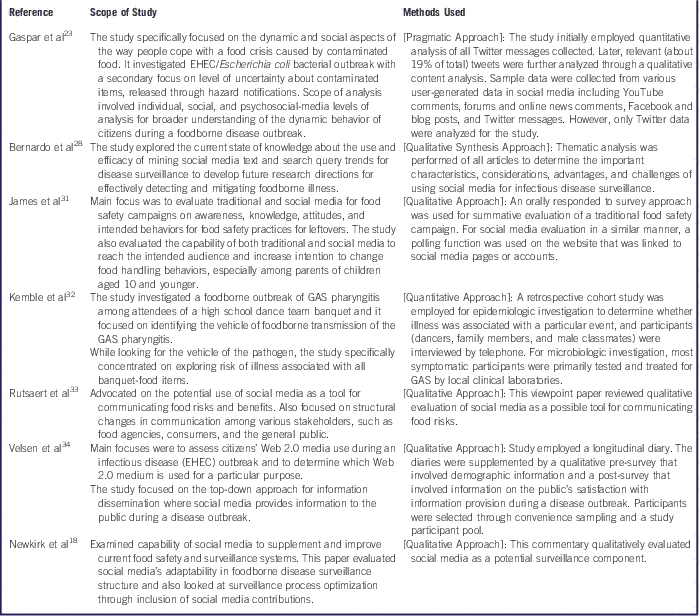
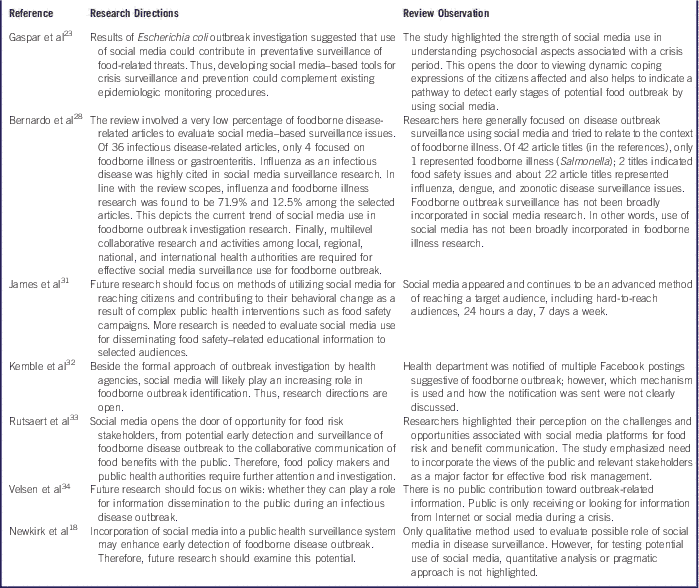
On the basis of the outcome of the matching phase in line with the 3 questions mentioned in Table 1, a total of 7 articles were selected for critical review, with publication dates ranging from 2012 to 2014 (Table 2). The 7 documents included 5 articles, 1 viewpoint, and 1 review article. All were published in reputed journals in the field (Clinical Infectious Disease, Journal of Medical Internet Research (2 documents), Foodborne Pathogens and Disease, Journal of Food Science Education, Trends in Food Science and Technology, and International Journal of Human-Computer Studies). In addition to the Scopus database, the PubMed database and Google Scholar were explored for relevant articles, but no other distinct documents found.
Scope of Study and Methods Used in Recent Literature a

a EHEC indicates enterohemorrhagic Escherichia coli; GAS, Group A Streptococcus.
Some common scopes of research were performed by the different groups of researchers. Bernardo et al, James et al, and Newkirk et al conducted their studies by focusing on evaluating the capability and adaptability of social media in terms of reaching intended audiences,Reference Newkirk, Bender and Hedberg 18 , Reference Bernardo 28 , Reference James, Albrecht and Litchfield 31 being used as a tool for communicating food risks,Reference Rutsaert, Regan and Pieniak 33 and being used for foodborne surveillance.Reference Newkirk, Bender and Hedberg 18 Another important scope of study was to understand dynamic and social aspects of public behavior during contaminated food outbreaks,Reference Gaspar 23 in addition to understanding information-receiving behavior by the public through the use of Web 2.0 media at the time of the crisis.Reference Velsen 34 Furthermore, few researchers used social media surveillance for foodborne outbreak investigation immeditely after incidents.Reference Kemble 32
The methodologies used by the researchers help us to understand which methods could be effectively used in future research on the basis of particular scopes and research objectives. Among the selected 7 groups of researchers, 1 group used a quantitative approach for epidemiologic investigation to determine whether illness was associated with a specific event.Reference Kemble 32 Another group used a pragmatic approach in which they initially used quantitative analysis and later used qualitative exploration.Reference Gaspar 23 The remaining 5 groups used qualitative methods in their studies,Reference Newkirk, Bender and Hedberg 18 , Reference Bernardo 28 , Reference James, Albrecht and Litchfield 31 , Reference Rutsaert, Regan and Pieniak 33 , Reference Velsen 34 including 3 who focused on evaluating the capability of social media.Reference Newkirk, Bender and Hedberg 18 , Reference Bernardo 28 , Reference James, Albrecht and Litchfield 31
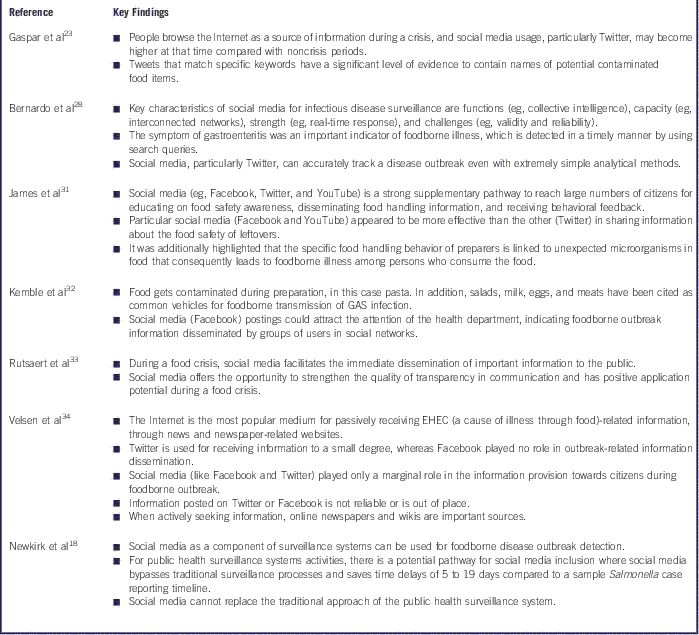
The key findings of the studies are shown in Table 3. An interesting finding was that the usage rate of social media, particularly Twitter, becomes higher during a crisis. In addition, Twitter’s predictability of foodborne illness,Reference Gaspar 23 accuracy for tracking disease outbreaks,Reference Bernardo 28 and capacity to early detect foodborne casesReference Newkirk, Bender and Hedberg 18 are some of the strengths of social media use in foodborne disease surveillance. Some studies found that specific social media sites (eg, Facebook) are more effective than others (Twitter) according to the scope of study performed.Reference James, Albrecht and Litchfield 31 Social media appeared to be a supplementary pathway of reaching the public for creating food-safety awareness,Reference James, Albrecht and Litchfield 31 plays an important role in information provision to citizens during foodborne outbreaks,Reference Rutsaert, Regan and Pieniak 33 , Reference Velsen 34 and remains complementary to traditional approaches to public health surveillance.Reference Newkirk, Bender and Hedberg 18
Key Findings in Recent Literature

Challenges and Future Directions
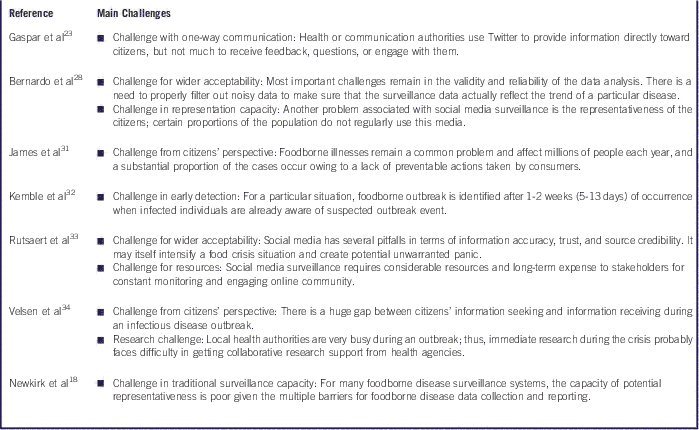
In the discussion of challenges associated with social media (Table 4), it is important to highlight that not all social media platforms or channels are prone to all or the majority of these challenges. Which challenges are relevant depends on specific social media contexts and their capability to engage with specific issues. Twitter in this case emerged as a valuable source of natural, spontaneous, and heterogeneous expressions of individuals in cognitive, affective, and behavioral dimensions.Reference Gaspar 23 The challenges highlighted in very recent social media–based foodborne surveillance literature (2012-2014) are mainly associated with health authorities to citizens and citizens to health authorities in terms of inappropriate communication type (eg, one-way communication),Reference Gaspar 23 ineffective communication medium (eg, no interactive channel), and gap between information seeking and information receiving.Reference Velsen 34 Another common challenge linked to both traditional and social media surveillance strategies was the “representation” issue in which social media surveillance does not represent all citizens owing to inaccessibility to the technology of a sizable proportion of the citizens,Reference Bernardo 28 which is similar to the poor representation capacity of traditional surveillance.Reference Newkirk, Bender and Hedberg 18 Even though social media came into consideration to supplement traditional surveillance, social media still struggles with wider acceptability owing to validity and reliability issues.Reference Bernardo 28 , Reference Rutsaert, Regan and Pieniak 33 It is also notable that people (as main victims) are also accountable for foodborne outbreaks, because a certain proportion of them do not take any preventable action.Reference James, Albrecht and Litchfield 31 Finally, early detection remains a great challenge for which collaborative research engagement during a crisis is also lacking.Reference Kemble 32 , Reference Velsen 34
Collective Challenges Pointed to in Recent Literature

Research directions are highlighted in Table 5. It is indeed necessary to discuss further where appropriate research directions could mitigate the foodborne outbreak surveillance problem. Literature published in 2012, 2013, and 2014 continuously emphasized the need to study the feasibility of using social media for foodborne disease surveillance.Reference Newkirk, Bender and Hedberg 18 , Reference Gaspar 23 , Reference Kemble 32 In the very recent literature, the necessity of developing social media–based tools for crisis surveillance was significantly highlighted; thus, research engagement in foodborne surveillance is also in demand.Reference Gaspar 23 From the scholarly contribution perspective, the very minor use of social media in foodborne disease surveillance research indicates a higher demand of a similar nature of study because foodborne disease remains a common problem globally.Reference Bernardo 28 , Reference James, Albrecht and Litchfield 31 In comparison, other infectious disease research (eg, influenza) has extensively incorporated social media surveillance and has benefited, whereas foodborne surveillance research lacks those advancements. It was also suggested that future research focus on the role of wikis in information dissemination during an infectious disease outbreak.Reference Newkirk, Bender and Hedberg 18 Finally, identifying methods of utilizing social media to reach citizens with food safety information should also be considered in future foodborne disease surveillance research.
Future Research Directions Proposed in Recent Literature

There are a few significant implications of the recent literature on social media–based foodborne disease research. Health organizations may need to keep an eye on and contribute to wikis during an infectious disease outbreak, because many online users seek information on wikis.Reference Velsen 34 Health organizations should also update citizens on the status of the outbreak by releasing information on media such as news websites, printed and electronic newspapers, and television news. Organizations need to provide information to citizens on how to protect themselves from being infected. In addition, the health agencies need to release a firm statement at the end of an outbreak to citizens with a clear description of the causes of the outbreak so that people can act accordingly. Very importantly, health organizations that potentially have to deal with an infectious disease outbreak within their service region need to effectively monitor and provide timely information to the public.Reference Velsen 34
Successful collaboration among public and private health agencies could facilitate the development of a surveillance system that mines social media data to detect signals of foodborne disease outbreak.Reference Newkirk, Bender and Hedberg 18 Another significant initiative that public health agencies could take is to host secure online surveys or web forums where individuals with confirmed pathogen-specific illness could anonymously provide information related to foodborne disease exposures. This would be a cost-effective approach that would save public health funding.Reference Newkirk, Bender and Hedberg 18 Public health practitioners should consider a foodborne route of transmission when they encounter a cluster of patients with symptoms of foodborne disease. Social media in this case can be a useful platform for public health practitioners to find the foodborne route and vehicle.Reference Kemble 32
A HYBRID INFORMATION NETWORK MODEL
A review of surveillance systems for outbreak detection incorporated an analysis of a large group of surveillance systems in the United States and gathered information on the system type, data origin, data type, disease scope, geographic scope, and the main partners of each system.Reference Dato, Wagner and Fapohunda 13 The outcome of that analysis showed how the partners related and depended on each other for outbreak detection. The results identified the following components of a formal coordination network: clinical health care systems, the state, the federal government, professional organizations, and collaborating governmental organizations. The state here includes all of the local public health agencies receiving data from clinical health care systems via phone calls, faxes, or electronic data exchanges. After the data are received by the state, reports are sent to the CDC at the federal level via the National Electronic Telecommunications System for Surveillance (NETSS) for the purpose of data aggregation. The standardization of the process of data collection is done through the National Electronic Disease Surveillance System (NEDSS). The federal government has a role in outbreak detection by providing specialized research facilities, experts, and advanced laboratories.Reference Dato, Wagner and Fapohunda 13 A similar surveillance process is found in developing countries. Indonesia, for example, employs the Early Warning Outbreak Recognition System (EWORS), which requires patients to be presented at hospitals, clinics, or emergency departments. Data are collected through standardized questionnaires and filed in EWORS for daily analysis. The counted signs and symptoms are combined and compared to baseline counts by use of an automated algorithm to see if the infectious disease is of national importance. If an outbreak is suspected, the Ministry of Health takes the initiative for investigation.Reference May, Chretien and Pavlin 17 Germany also employs an electronic surveillance system for infectious disease outbreak. All locally identified notifiable diseases are verified by local health departments on the basis of national case definitions and the case reports are sent electronically through the state health departments to the national surveillance unit.Reference Krause 35
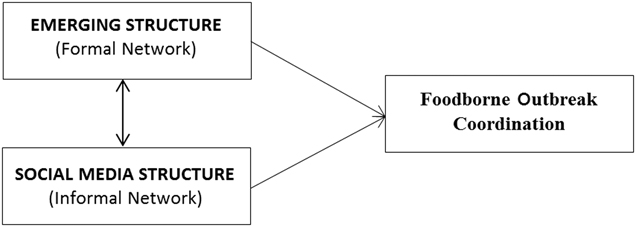
From an improved method perspective, the social media–based approach is considered a part of a new generation of public health surveillance.Reference Schmidt 24 , Reference Freifeld, Mandl and Reis 36 It is a supplementary method to existing public health surveillance networks and focuses on monitoring of infectious diseases by leveraging data from Internet news, blog posts, and other Web and social media.Reference Freifeld, Mandl and Reis 36 - Reference Corley, Cook and Mikler 38 Researchers from Harvard University and the University of California have used social network analysis for flu outbreak prediction and have found that social media can detect outbreaks earlier than traditional tracking methods.Reference Schmidt 24 The researchers found significant correlations between social media data and traditional reporting data when they tested for influenza-like illnesses by use of social media surveillance.Reference Corley, Cook and Mikler 38 The methodology used was to gather blog posts and perform content analysis and data mining to compare with traditional reporting data. Through link extraction, the Web and social media communities were identified and released information on outbreaks. By use of these findings from organizational (formal) and social media (informal) surveillance approaches, the following hybrid information network model for disease outbreak coordination was derived.
In this model, a combination of organizational networks and social media networks is used to work together toward foodborne disease outbreak detection. This model demands to be developed and implemented for greater public health security. At this stage, the hybrid information network for coordinating foodborne disease outbreak seems to be an effective approach, because the model uses both formal and informal networks as equally significant for decision-making and could logically provide better outcomes.
Methodology
As depicted in Figure 2, resilient foodborne outbreak coordination will be tested against organizational and social media network structures. Such a study would also test whether a formal organizational approach influences a social media–based approach and vice versa. Primary (formal) data are collected by physicians, hospitals, and relevant organizations through patients or laboratories. The data gathered are then checked, standardized, and analyzed by specific experts to provide information for outbreak-related decisions.Reference Sobel, Griffin and Slutsker 7 , Reference Dato, Wagner and Fapohunda 13 To get data from a social medium such as Twitter, tweets are collected through the streaming API of Twitter,Reference Rogstadius 39 and similarly for Facebook and other social media data. System administrators need to define filters in the form of key words, set up geographic bounding boxes, and set up a user account for which all matched tweets will be gathered as a stream. Next, all tweets are categorized on the basis of each of the key words, and the rate of occurrence against all those key words is found. If any key word has a higher frequent value than the median value, a certain possibility exists of a disease outbreak occurring at certain levels of confidence. This is one way of exploring the possibility of foodborne outbreak. There may be additional ways to analyze tweets for better prediction, and other approaches might be more appropriate; these need to be examined. There may be a need to implement automated systems to generate an outbreak alert and thus reduce human interference. Finally, after obtaining some prediction outcomes from social media data, experts would compare these outcomes with the traditionally captured data and reach a decision. Overall, data received from formal (organizational) and informal (social media) sources could provide better support for improved decision-making by health authorities.
Proposed Hybrid Network Model for Foodborne Outbreak Coordination.

To implement this model, some principles need to be realized by health agencies at the ground level. It is expected that this model will provide an early detection of disease outbreak; however, providing the appropriate response to the event is important too. Some organizations might think that the impact of a particular disease outbreak may not be that high. Thus, the need for health agencies to be convinced for early alert generation is significant and they should not wait longer to actualize the impact. In the case in which an outbreak is caused by unknown pathogens, it may be difficult to estimate the consequences. Thus, establishing a principle of taking action for any potential outbreak detection would be considered as preparation for implementing this hybrid model. For technical implementation, at the preliminary stage, any of the local health agencies can set up a server to store stream tweets from specific locations (as explained earlier in this section), and an automated system can perform necessary textual data analysis. This is important to ensure that the particular health agency has traditionally reported outbreak data ready at the time of interpreting findings from social media to compare and make sound decisions on potential disease outbreaks.
Preliminary Findings
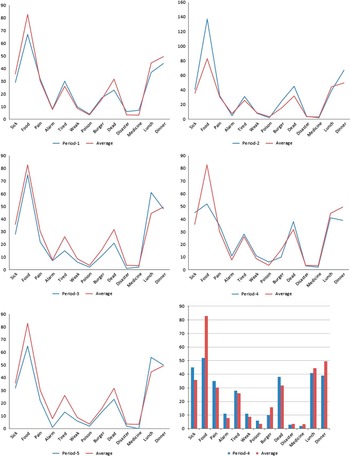
This study incorporated and analyzed data from Twitter to support the feasibility of the proposed model. Five sets of data were collected at different time slots (Figure 3). A total of 53,440 tweets (period 1: 11,350; period 2: 13,776; period 3: 9011; period 4: 10,444; and period 5: 8,859) were analyzed against 13 keywords (sick, food, pain, alarm, tired, weak, poison, dead, disaster, medicine, burger, lunch, dinner). Among those keywords, 5 (sick, pain, alarm, weak, and poison) appeared at the highest rate of occurrence at a particular time (period 4) compared with the other time slots. Interestingly, 7 keywords (sick, pain, alarm, tired, weak, poison, and dead) appeared at a 27.41% greater rate than the average frequency of occurrence in the same period.
Frequency of Keyword Occurrence in Different Time Slots on Twitter.

Similarly, in period 1, 8 keywords (pain, alarm, tired, weak, poison, burger, disaster, medicine) appeared at a 26.34% greater rate than the average frequency of occurrence. In period 2, 7 keywords (sick, food, pain, tired, burger, dead, disaster) appeared at a 26.30% greater rate than the average frequency of occurrence. In period 3, 2 keywords (alarm, lunch) appeared at a 15.92% greater rate than the average frequency of occurrence, and for period 5, 2 keywords (lunch, dinner) appeared at an 8.61% greater rate than the average frequency of occurrence. By comparing the outcomes of the 5 different time slots, it became clear that period 4 was of the most interest to health authorities concerning a potential outbreak-related decision. Because this was a sample study, the method of selecting key words was based on words the researchers logically associated with both food and illness. Other researchers in the disaster and disease crisis domain also formed a set of key words based on their own assumption when they tested social media data for decision-making.Reference Signorini, Segre and Polgreen 40 However, for the main study, an improved method of selecting key words must be used to ensure a better outcome. There is also the challenge of the spelling of key words, because many users in social media use abbreviations or slang and express opinions or feelings by using mixed-language, which may be influenced by their socio-technical culture. Overall, the preliminary findings at least show that social media analytics (in this case, analysis of tweets) has the capability to positively support decision-making for potential disease outbreak alerts.
Discussion
An understanding of foodborne outbreaks, frequencies of occurrence, and their infection rates in some parts of the globe have been briefly discussed here. In the past few decades, foodborne disease outbreaks have remained a top public health issue for governments around the world. Thus, many surveillance systems and approaches exist. However, having a surveillance system does not mean that the number of cases of foodborne illness can be easily reduced; rather, reduction depends on how effective the existing surveillance system is and how timely it can detect a potential outbreak. Taking these questions into consideration, we have tried to identify ways of meaningful coordination for foodborne outbreak detection. As a result, social media–based surveillance came into focus. In social media, every person is an actor in the information dissemination process, and it works very rapidly, because almost all geographic locations are covered by some form of social media. Thus, a hybrid information network is perceived to have high significance, because social media could play a vital role together with formal surveillance networks for effective coordination of foodborne disease outbreaks.
With the successful implementation of a hybrid information network, data related to potential foodborne disease outbreak can be gathered and quickly analyzed. The coordination process, alerts, communication, and feedback for any kind of disease-related outbreak would be faster than traditional methods. Owing to the quick time response, the total number of infections and epidemics could be significantly reduced. The general public could gain more health security and national governments could save millions of dollars from public health support and disease disaster management budgets.
CONCLUSIONS
The first half of this article illustrated the complexity of coordination, especially in the context of discussions about the current coordination processes, and the challenges related to foodborne disease outbreaks. Social media surveillance was then identified, not as an alternative but as a vital complementary tool for reducing complexity in coordination. Finally, we drew public health researchers’ attention to a way to mitigate coordination dilemmas through a potential hybrid information network approach. The overall idea, data evidences, and scenario analysis presented here can support health managers and surveillance specialists in making decisions on the implementation of the proposed hybrid method for improved disease outbreak management. The optimum outcome of this approach in coordinating foodborne disease outbreaks would lie in its effective implementation for receiving and disseminating information before, during, and after an outbreak. The usefulness of this hybrid information network model would not be limited to foodborne outbreak coordination only: it would be wider and could be applied to any type of disaster outbreak management.