Introduction
Headlines regularly remind medical communities about the possibility of catastrophic events; consider the 9/11 terrorist attacks and more recent Boston bombings. The detonation of a nuclear device in a US city would be a catastrophic event unlike any other. It would result in enormous numbers of casualties, thousands of fatalities, and profound psychological, political, social, and economic implications. 1 Health care systems would face an overwhelming surge of activity in the days following such a disaster as people seek treatment for physical trauma, thermal burns, acute radiation exposure, and radioactive contamination. A localized radiological incident would also require substantial medical resources. As the Fukushima accident demonstrated, fear of radiation, even absent actual risk of radioactive contamination, may tax the health care system.Reference Becker 2 In this range of scenarios, the medical community must be able to meet public health needs, including the medical management of radiation injuries. Unfortunately, most members of the US public health and medical communities are insufficiently prepared for responding to a significant radiological or nuclear incident.Reference Coleman, Weinstock and Casagrande 3 - Reference Veenema, Walden, Feinstein and Williams 6 These professionals lack basic knowledge for diagnosing and managing acute exposure to ionizing radiation, identifying the type of radiation emitted from radiological or nuclear devices, or treating combined injuries featuring physical trauma or thermal burns alongside radiation exposure.Reference Vano, Ohno and Cousins 7 , Reference Gonzalez, Akashi and Boice 8
If a radiological or nuclear incident were to occur, individuals throughout the health care delivery system would need some understanding of radiation both to do their jobs properly and to assist the general public. Emergency department physicians, Emergency Medical Services system medics and paramedics, hospital security, and janitorial staff would all be involved if such incidents transpired. All need some level of training to prepare for their roles, though amounts and content should differ. This paper proposes a sustainable, four-tiered training strategy for propagating radiation emergency medicine information by identifying the content needed for the encounters each group of workers can expect to have with casualties and others seeking assistance. This approach is consistent with the US National Health Security Strategy, which defines national health security as when “the Nation and its people are prepared for, protected from, respond effectively to, and able to recover from incidents with potentially negative health consequences”. 9 The recommendations discussed below are informed by medical specialists at the US Department of Energy's Radiation Emergency Assistance Center/Training Site (REAC/TS) and the US Department of Defense's Armed Forces Radiobiology Research Institute (AFRRI) who routinely educate and advise health care providers and support staff.
Report
Given limited and diminishing resources, conventional wisdom might suggest focusing the health care community on the most common or life-threatening health threats. Admittedly, detonation of a nuclear device or dispersal of radioactive material in an American city is a low-probability health risk. Communities may be reluctant to expend funds for low-probability scenarios and hazards even though they may represent high-consequence risks. However, the justification is simple: the costs of unpreparedness are unacceptable while the costs of preparing are relatively low. Misinformation surrounds radiation, fear of radiation is especially high, and radiation injuries can be life threatening. Indeed, according to the Institute for Medicine, the costs of inadequate training could increase the risks of morbidity and mortality following a nuclear incident.Reference Benjamin, McGeary and McCutchen 10 Conventional injuries may also remain untreated or treatment may be delayed by fear of radiation in the medical community after an incident. In combination, this creates a daunting problem for unprepared medical professionals, emergency response workers, and hospital staff that, left unresolved, could lead to unnecessary deaths and illnesses.
Additional time-consuming training is not needed to prepare members of the American health care delivery system to treat radiation injuries and illness; instead, an elegant, tiered training system built into and from existing education programs, expanded to new platforms, and with a just-in-time training capability can serve this purpose. For example, an Emergency Medical Technician (EMT) does not need knowledge about treatment of internal radioactive contamination. These first responders need to understand the difference between radiation exposure and radioactive contamination, that internal contamination is manageable, and how to employ methods for protecting themselves and their patients. Meanwhile, emergency physicians, emergency nurses, public health practitioners, and poison control center personnel need training that includes details on internal contamination diagnosis and treatments. A core principle of the proposed training strategy is connecting radiation training to concepts people already know and use, rather than introducing novel concepts. Rather than lengthy new courses, building just a few hours or days over the span of many years into existing educational programs would help realize significant preparedness gains. For example, health care professionals already learn how to prevent the spread of infection and contagious diseases, and those same practices and personal protective equipment can be used to prevent the spread of radioactive contamination and reduce radiation exposure.
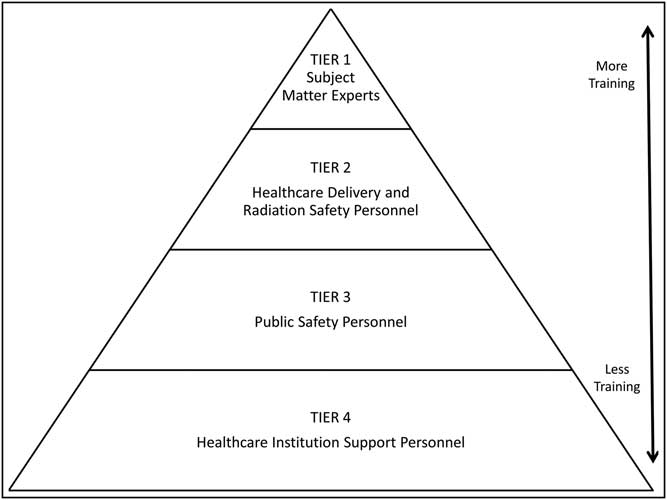
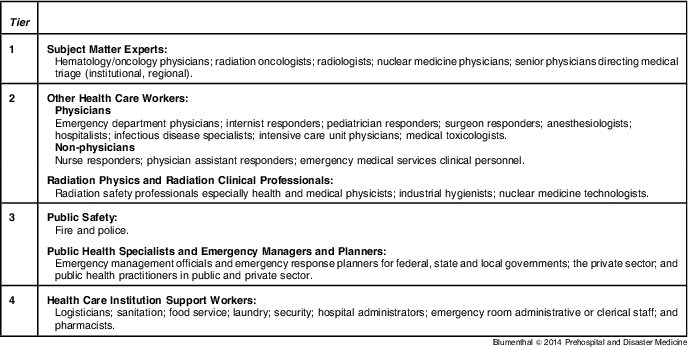
Figure 1 shows the proposed tiered approach for determining the types of personnel who require radiation injury-specific training targeted to their individual response functions. Customized, role-specific training curricula should be required for each of these groups, and a cost effective, efficient system for implementing such training should be established, integrating radiation modules into preexisting mass-casualty baseline and refresher training. Table 1 explains the components of each tier in greater detail.
Tiers of Responders Categorized by Training Needs

Tiers of Responders Grouped by Curricula

Tier 1 consists of subject matter experts (SMEs). They could be drawn from radiation oncologists, nuclear medicine specialists, and other medical professionals who are knowledgeable about and regularly deal with ionizing radiation. Professionals in this tier will serve as a force multiplier, making real time recommendations, including: diagnosing and managing diverse populations with exposure and contamination; managing scarce resources; implementing crisis standards of care; protecting the work force; and helping craft public messages. Subject matter experts may also serve as trainers for personnel in lower tiers and engage in train-the-trainer activities to help spread relevant radiation emergency medicine information, both pre- and post- incident. All combined, SMEs represent the smallest group of medical personnel who would be activated following a radiological or nuclear incident. Their training background should be extensive and complex, allowing them to address the most challenging issues demanding the greatest expertise. Ideally, their expertise would include knowledge of medical countermeasures, medical management of internal and external contamination, detection of exposure and contamination, and any special considerations needed for at-risk populations. As needed, SMEs could cross train one another on specialized topics to ensure wide distribution of key knowledge across Tier 1.
An integral component of this proposed training strategy is ensuring that the right people have the right knowledge. Tier 1 is a small group with substantial expertise. They need to be strategically located. Under the Urban Area Security Initiative (UASI), the Federal Emergency Management Agency (FEMA) developed a model that characterizes the major metropolitan areas in the country that are at the highest risk of terrorist activities, including an improvised nuclear device (IND) detonation. The UASI identified 64 major metropolitan areas at risk, classified ten as highest risk, and considered the remaining 54 areas as a lesser, but still high, risk. Optimally, SMEs should be available within the top UASI cities around the United States to bolster local training and response capabilities, since threats are most likely to target these cities. Should another city or location not among these ten require SME support, those trained could be surged in that direction. Training Tier 1 personnel in UASI cities at highest risk best matches a scarce resource with known threats. Meanwhile, personnel in Tiers 2 through 4 should be located in cities throughout the country, and their training should be designed to reach broadly dispersed groups.
Health care delivery and radiation safety personnel make up Tier 2 and are broken into three subgroups: health care providers, EMTs and paramedics, and radiation safety professionals. Members of Tier 2 are most likely to be the people who make first contact with both casualties and those who fear they were exposed to radiation or those who are contaminated. While each group in Tier 2 requires different types of specific training, they need comparable levels of expertise and should be prepared to work in concert with one another after a major radiological or nuclear incident.
Health care providers in Tier 2 include doctors, nurses, and other medical practitioners who directly treat victims of an incident. They should be able to perform initial diagnoses and management of radiation injuries or illnesses in the immediate post incident period up to 72 hours, after which those with more specialized training are expected to be available. These personnel may be called on to establish medical and surgical priorities for patients with radiation exposure or radioactive contamination. Operating within traditional care facilities and community reception centers, they need to know how to implement radiation protection procedures for staff and patients. Available evidence suggests radiation medicine training improves a physician's comfort level with relevant competencies, such as chelating agent administration and use of radiation detectors.Reference Sheikh, McCormick and Pevear 11
The second subgroup within Tier 2 consists of EMTs and paramedics who work in potentially hazardous environments. These personnel triage and stabilize patients and transport them to health care centers. They need to know how to protect themselves and their patients from the spread of contamination and how to recognize the signs and symptoms of radiation exposure. This group should also have a basic, working knowledge of the medical consequences from radiation exposure and radioactive contamination so that they can assist with planning, preparations, and possible responses.
Radiation safety professionals, including health and medical physicists, industrial hygienists, and nuclear medicine technologists, make up the last subgroup in Tier 2. They are accustomed to dealing with radiation safety and protection issues. After a radiological or nuclear incident, they would play an essential support role to the medical providers by determining levels of radiation exposure and radioactive contamination in casualties. In particular, these professionals need to understand radioactive contamination control procedures, dose assessment techniques, instrumentation, personal protective equipment requirements, radioactive waste management practices, decontamination techniques, and basic radiation biology. If possible, radiation safety professionals should have knowledge of bioassays and appropriate countermeasures. In a catastrophic situation, it is also important that radiation safety professionals understand how to interact with a fearful public and are prepared to communicate that medical treatment takes precedence over radiological decontamination. These professionals may be more accustomed to working in a regulatory environment, so training directed at them should stress the importance of staying focused on health and safety, rather than regulatory compliance, during an incident.
The health care providers and EMTs are the medical front line and should have sufficient knowledge to comfortably deal with ionizing radiation while providing medical treatment, rather than avoiding or delaying treatment. For radiation safety personnel, the educational need is to provide familiarity with medical casualties, including those related to radiation exposure. Doing so would enable these responders to be comfortable with individuals who have experienced physical trauma while screening them for radioactive contamination and providing additional support to the medical teams. All Tier 2 personnel, regardless of the role they fill, should know how to protect themselves and their patients from radiation hazards and be prepared to work in an environment with a highly disrupted, and potentially contaminated, public infrastructure.
Tier 3 contains public safety personnel who are responsible for fire suppression, crowd control, traffic control, and communication with the general public and other workers during an emergency with public health considerations. It also contains emergency management planners, who work directly with public safety personnel after the incident to establish community reception centers and command posts, and address other operational needs. Tier 3 personnel should understand the basics of radiological and nuclear hazards and the principles of radiation protection and radioactive contamination control. They do not treat casualties, but they do operate in the same hazardous environment and need to be comfortable performing their life-saving functions, such as putting out fires and directing crowds. These public safety personnel may be required to explain hazards to the general public and suggest ways to stay safe. Consequently, those in this tier should have instruction in risk communication and the Incident Command System, a well-established structure used at the federal, state, and local level for coordinating personnel during an emergency. Tier 3 training must teach these professionals that radiological issues should never delay immediate life safety operations; any delay could cause inadvertent harm to the public or slow recovery. Providing each tier with the appropriate knowledge builds responder confidence, resilience, and comfort, all of which help them appropriately respond to the challenges of a catastrophe.
Tier 4 consists of health care institution support personnel responsible for facility operations in health care institutions of all kinds (eg, hospitals, nursing homes, ambulatory care facilities). These include food service, sanitation, laundry, and security personnel, hospital administrators, emergency department administrative staff, and many others. Without their efforts, vital health care organizations could not function during a crisis. In particular, personnel in Tier 1 and Tier 2 would be unable to deliver care or manage the potentially large number of casualties. Tier 4 personnel should have a basic understanding about the nature of radiological and nuclear hazards and know how to protect themselves, including distinguishing between radioactive contamination and radiation exposure. The goal is to enable them to effectively perform their jobs in the midst of potentially contaminated or exposed people without endangering their own well-being or being scared to come to work.
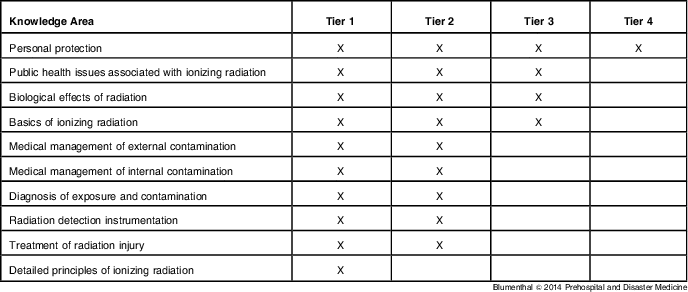
Table 2 suggests the type of radiation-related information that would be appropriate for the four tiers of responders. The detail and depth of the information would vary by subgroups within the tier, and the creation of curriculum specifics requires further study.
Knowledge Areas That Form the Basis of Tier-Specific Curricula

While creating new education modules will be important for building the initial radiation knowledge base in each tier of the health care community, just-in-time education targeted to the individual tiers will also be needed during an actual incident, when a protracted response necessitates surge capacity. This approach provides initial training to additional personnel in the health care delivery system and serves as a refresher for responders for whom prior training occurred years before. Some just-in-time information currently is available on the internet. For example, the Radiation Emergency Medical Management (REMM) website funded by the US Department of Health and Human Services (HHS) is a valuable resource. 12 For an actual incident, however, traditional news media and social media will assist in providing specific messages needed by the general public and responders. 13 The content of the just-in-time education should be congruent with the steady state curriculum used by each tier.
Discussion
Regardless of scale, an adequate reaction to a radiological or nuclear emergency will require responders with specific knowledge and competencies. At least one of the major educational agencies, REAC/TS in Oak Ridge, Tennessee (USA), provides educational activities for just over 2,000 participants per year out of millions of physicians, nurses, nurse practitioners, physician assistants, medics and paramedics who might be called to respond in case of a significant radiological or nuclear incident. Many explanations for lack of training exist for each part of the response community, including competing priorities, absence of any mandate, and uncertainty and fear.Reference Becker and Middleton 14 - Reference Sheikh, McCormick and Pevear 17
Since nuclear or radiological incidents are thought to be unlikely in the United States, many health care providers and senior leaders managing health care support personnel select other areas for spending their limited resources.Reference Curran, Keegan and Parsons 18 , Reference Thompson, Skillman and Johnson 19 Thus, medical professionals are prepared for the most common incidents, but defer training to address injuries resulting from uncommon radiological or nuclear incidents.
Personal fear of radiation exposure also appears to contribute to minimal demand for specific radiation emergency medicine education and training.Reference Becker and Middleton 20 Health care providers appear to believe that if trained, they would be responsible for responding to future radiation emergencies, and they have concerns about filling that role. Studies suggest that health care providers of several disciplines are less likely to volunteer or report to work if they know they may be exposed to radiation or will need to interact with patients who may be radiation victims.Reference Akashi, Kumagaya, Kondo and Hirose 21 , Reference Cone and Cummings 22 Mandated training and preparedness may improve this problem.Reference Hendee 23 Currently, professional emergency response curricula for most health care providers include very little radiation content.Reference Veenema, Walden, Feinstein and Williams 24 , Reference Kaiser, Barnett and Hsu 25 Most existing lesson plans for mass casualty management focus on all-hazard emergency responses and provide little specialized information about the nature of radiation hazards and personal safety.Reference Smith, Levy, Hsu and Lee 26 - Reference Walsh, Subbarao and Gebbie 29 Together, training inadequacies and fear may result in a vicious cycle: fear of radiation leads to little demand for response training, which results in poor preparedness, leading to more fear.
In addition, several misperceptions undermine radiation emergency medicine training. First is a common, albeit erroneous, perception that clinical radiation injury is always very severe, usually irreversible, and that treatment is usually futile. Lack of knowledge about gradations of radiation injury and the existence and availability of potentially effective medical countermeasures contributes to these false beliefs, which create additional disincentives to select radiation training and incentives to select training for trauma or other diseases that are considered more “treatable”.Reference Curran, Keegan and Parsons 30 , Reference Thompson, Skillman and Johnson 31 Second, among medical providers and research professionals, radiation biology and physics are both considered complex topics. This contributes to the under selection of radiation specialties for careers, other than diagnostic radiology. The same perception of radiation as a complex concept may affect the training choices of other health care and public safety personnel. Well crafted and well targeted training materials can overcome this issue.Reference Hendee 32
The radiation science community has its own difficulties; namely, it is shrinking in size and limited funding sources are not dependable or plentiful. Reports indicate a major shortfall in the number of radiation research scientists needed to address research demands relating to cancer as well as radiological or nuclear terrorism.Reference Coleman, Weinstock and Casagrande 33 Recent surveys also suggest that as the population of academics with extensive radiation biology training grows older, there are few properly trained replacements. As a result, those less familiar with radiation sciences are now teaching radiation biology to future scientists and medical practitioners.Reference Rosenstein, Held and Rockwell 34 Meanwhile, fewer new health physicists are currently being trained than in the past, and in a dwindling number of health physics academic programs. 35 Indeed, so few health physicists are being trained that there is more than one job available per health physics graduate. 36 With these human resources challenges in the radiation science community, gaps in preparedness are increasingly apparent.
Finally, physicians tend to focus on mandates when selecting continuing medical education and training. Currently, no mandate for radiation injury training exists, either for initial licensing or continuing certification.Reference Burwick, Schulkin and Cooley 37 , 38 Establishment of a mandate either through professional society licensure, recertification, or Joint Commission on Accreditation of Health care Organizations rules would help encourage training throughout the medical community, but can be a difficult and time-consuming process. With other members of the health care delivery system, a more pervasive problem is the lack of recognition that personnel in Tiers 3 and 4 need radiation related awareness training.
Challenges associated with adequately training medical communities are not simply addressed. However these challenges are also not insurmountable. The tiered approach offers a starting point for a sustainable training strategy for improving health care following a catastrophic radiological or nuclear incident. Importantly, it identifies key public health and medical response stakeholders and provides initial suggestions about the types of activities in which they will engage during an incident. It also identifies the types of knowledge needed to prepare them for those activities. Research shows that radiation medicine education improves provider comfort level with various skills needed during responses, which in turn helps save lives.Reference Sheikh, McCormick and Pevear 39 - Reference Becker and Middleton 41 Broader application of this finding to personnel throughout the health care delivery system and public safety community can, likewise, save lives, improving resiliency in the event of a radiological or nuclear catastrophe. Getting the necessary education to the right people throughout the community is the aim of the tiered training system, as shown in Table 2.
To begin developing the system, SMEs from various disciplines should conduct a systematic study of what specific radiation details each tier of responders must know to carry out its roles during a response. Table 2 provides a useful starting point for this effort and is derived from the diverse experiences of this paper's authors; however, a full study should ultimately guide development of a detailed curriculum for each tier. Coordinating this effort with appropriate professional societies and institutional partners will be necessary to facilitate future dissemination of radiation education curricula.
Once curricula are developed, a well crafted, tiered radiation training system with classroom and online modules customized for responder roles could be easily incorporated into existing all-hazard emergency education programs, new hire training, and other existing educational opportunities. This concept addresses several of the barriers to entry that hamper current radiation emergency medicine training. First, it eases the burden on obtaining the education. Indeed, formal distance learning modules with multimedia elements to teach complex content is one way to enhance student understanding, increase the numbers who have access to vetted materials, and to minimize cost. Other uses of technology also could be explored for sharing training materials, including use of existing internet resources like HHS's REMM website, which would help make the program even more efficient. Second, by plugging into existing all-hazard programs, this system mitigates issues surrounding training levels, mandates, and licensure. In the proposed format, completion of preapproved modules might easily be applied toward continuing medical education (CME) requirements or other certifications. It also eliminates the need for a standalone training series or separate courses, and reduces the time it takes to spread the curriculum to the appropriate audiences. Third, this system provides an opportunity to tie radiation-related medical training back to daily professional practices, which will help give the training relevance. Finally, in this conception, elements of the training could be used for multiple tiers, which would reduce costs and increase efficiency even while the breadth and depth of training would still reflect specific responder categories and roles as shown in Table 1 and Figure 1.
As the program develops, the “tiers of training” strategy could be expanded to include the need-to-know information necessary for addressing a wider range of potential mass casualty incidents, including chemical and biological threats. The same tiers useful for educating the health care community about radiation emergency medicine may also prove useful to those designing training programs focused on special types of chemical and biological hazards that the community often does not see. Efforts to adapt the tiered training concept for major chemical and biological incidents would go a long way in helping solidify this type of training practice by reinforcing many of the common medical techniques useful during each incident.
Radiological and nuclear incidents may be low likelihood, but they may also be extremely high consequence. Detailed federal requirements mandating federal planning for such events and considerable sophisticated national and some local medical response planning for these types of incidents have been developed and implemented since September 11, 2001. 42 - 44 With thoughtful planning and prior training of responders, thousands of lives could be saved, injuries treated, and illness mitigated. 45 This is precisely the goal of the proposed training system. The potential human cost of failing to prepare for a radiological or nuclear incident is unacceptably high, but the financial and organizational costs of preparing are relatively low.
Conclusion
Community resilience after a catastrophe is correlated, in part, with the knowledge, expertise, and judgment of medical responders. This would be especially true following an incident like an IND detonation or other mass casualty radiological incident. This report recommends implementing a four-tiered approach for training specific groups of responders based on their likely roles in an incident involving potential radioactive contamination or radiation exposure. Additional work is needed to further define the educational elements appropriate for the needs of each tier, and the most efficient and effective methods of delivering this educational material before and during an incident. While the proposals suggested in this paper are geared toward the American medical community, they may also provide a useful starting point for other countries considering how to improve their own capabilities. Moreover, employing the proposed training system would also yield lessons learned that are applicable to other mass casualty incidents, including those associated with chemicals or biological agents. This is all the more reason for it to be implemented without delay.
Disclaimer
Neither the United States Government, the US Department of Energy, nor the US Department of Health and Human Services, nor any of their employees, makes any warranty, expressed or implied, or assumes any legal liability or responsibility for the accuracy, completeness, or usefulness of any information, apparatus, product, or process disclosed, or represents that its use would not infringe on privately owned rights. The views and opinions of authors expressed herein do not necessarily state or reflect those of the US Government or any agency thereof.