Introduction
Chronic Obstructive Pulmonary Disease (COPD) is highly prevalent, especially among older people, and it is projected to be the seventh leading cause of years lived with disability by 2030 (Mathers and Loncar, Reference Mathers and Loncar2006). At early grades, COPD is characterized by cough, sputum production, and breathlessness associated with persistent airflow obstruction. However, as the disease progresses, exacerbations and comorbidities severely affect patients’ physical and social dimensions of life (Vestbo et al., Reference Vestbo, Hurd, Agustí, Jones, Vogelmeier and Anzueto2013). The gradual disability experienced by patients contributes toward the dependence on family members assistance, who become central to provide support (Bergs, Reference Bergs2002). COPD has, therefore, the potential to become highly distressing for both patients and family carers. In recent years, negative impacts on the psychological health of patients with COPD have been described (Qian et al., Reference Qian, Simoni-Wastila, Rattinger, Zuckerman, Lehmann and Wei2013), however, limited research has been conducted regarding the psychological health of family carers.
The assumption that a caregiving role impacts on family carers’ psychological health is well documented for other chronic diseases. In family carers of patients with dementia, cancer, or stroke, 40% to 51% experience anxiety (Greenwood and Mackenzie, Reference Greenwood and Mackenzie2010; Mitchell et al., Reference Mitchell, Ferguson, Gill, Paul and Symonds2013) and 18% to 33% depression (Berg et al., Reference Berg, Palomäki, Lönnqvist, Lehtihalmes and Kaste2005; Grov et al., Reference Grov, Dahl, Moum and Fosså2005; Greenwood and Mackenzie, Reference Greenwood and Mackenzie2010; Mitchell et al., Reference Mitchell, Ferguson, Gill, Paul and Symonds2013). The Stress Process Model (Pearlin et al., Reference Pearlin, Mullan, Semple and Skaff1990) is a useful conceptual framework to identify potential predictors of emotional distress among family carers. It helps to understand the complex interaction of the sociodemographic context of care (e.g., age, gender, kin relationship, and living arrangements), care demands (e.g., activities of daily living/instrumental activities of daily living dependencies, number of tasks, and hours of care), carers’ resources (e.g., coping and social support) and carers’ outcomes (physical and psychological health) (Pearlin et al., Reference Pearlin, Mullan, Semple and Skaff1990). The model has been largely tested in the context of different chronic diseases, such as dementia, cancer, or stroke and a number of variables have been found to be associated with family carers’ psychological distress. The most significant are the female gender (Kim et al., Reference Kim, Baker and Spillers2007; Huang et al., Reference Huang, Sousa, Perng, Hwang, Tsai and Huang2009), the hours spent on caregiving tasks (Sorensen et al., Reference Sorensen, Duberstein, Gill and Pinquart2006), the kin relationship with the patient (Kim et al., Reference Kim, Baker and Spillers2007), and patients’ functional dependence (Gaugler et al., Reference Gaugler, Jarrott, Zarit, Stephens, Townsend and Greene2003). These variables are also expected to play a role in the psychological health of family carers of patients with COPD; however, this is still unknown.
Moreover, previous research also suggests that each chronic disease poses distinct caregiving challenges (Molloy et al., Reference Molloy, Johnston and Witham2005). For instance, chronic diseases characterized by cognitive impairments (e.g., Alzheimer's disease) and/or unpredictable courses (e.g., cancer) have been described as more stressful (Kim and Schulz, Reference Kim and Schulz2008, Huang et al., Reference Huang, Sousa, Perng, Hwang, Tsai and Huang2009). However, COPD-specific characteristics, such as the patient's breathlessness and the difficulty in predicting when exacerbations will occur and how they will end, might pose other distinct care demands (Grant et al., Reference Grant, Cavanagh and Yorke2012). Thus, this study aimed to analyze anxiety and depression symptoms in family carers of people with COPD and to identify their predictor variables.
Methods
Study design and participants
A cross-sectional study with a convenience sample of family carers and respective patients with COPD was conducted. The study received full approval from the Institutional Ethics Committee. The sample was recruited from three primary care centers and one district hospital. Family carers were included if they were the person who provided the largest amount of support to patients diagnosed with COPD according to the Global Initiative for Chronic Obstructive Lung Disease (GOLD) criteria (Vestbo et al., Reference Vestbo, Hurd, Agustí, Jones, Vogelmeier and Anzueto2013). Family carers and patients were included if they were (i) ≥ 18 years old; and (ii) able to understand the purpose of the study and voluntarily consent to participate. Family carers and patients were excluded if one of them (i) presented severe psychiatric conditions and/or inability to understand and co-operate or (ii) refused to participate. Eligible patients were identified by General Practitioners. The clinic secretaries contacted via telephone all identified patients, explained the purpose of the study, and asked about their willingness to participate and to identify their primary family carer. If patients and family carers agreed to participate, they were invited to attend to an arranged meeting in their primary care center or hospital where researchers informed, both verbally and in a written form, about the study procedures. A total of 266 dyads of family carers and relatives with COPD were contacted and informed about the study, 33 refused to participate as they did not perceive the relevance of the study, and 30 failed to attend the meeting. The final sample comprised 203 dyads. All participants were included after signing the informed consent.
Data collection procedures
Data of family carers and patients were collected in separate rooms. All instruments were administrated in a face-to-face interview conducted by two trained health professionals, a physiotherapist and a gerontologist.
Family carers
Sociodemographic data, namely gender, age, educational level (measured using standardized categories), occupation situation, and information on the caregiving situation (kin relationship with the patient, caregiving period, and hours of care provided per week) were recorded from family carers. The Portuguese version of the Carers’ Assessment of Difficulties Index (CADI) was used to assess carers’ perceived burden (Brito, Reference Brito2002), since burden has been associated with carers’ global psychological health outcomes (Savundranayagam et al., Reference Savundranayagam, Montgomery and Kosloski2011). CADI consists of 30 items and for each item, participants indicate in a 4-point scale if the statement: “does not apply” (0); “applies, but not stressful” (1); “applies and finds it quite stressful” (2); or “applies and finds it very stressful” (3). The total score ranges between 30 and 90 and higher scores indicate greater subjective burden. The Portuguese version of CADI has shown high internal consistency with a Cronbach's alpha of 0.92 (Brito, Reference Brito2002). In the present study, similar internal consistency was found (Cronbach's alpha coefficient of 0.94).
The Portuguese version of the Hospital Anxiety and Depression Scale (HADS) was used to assess anxiety and depression symptoms (Pais-Ribeiro et al., Reference Pais-Ribeiro, Silva, Ferreira, Martins, Meneses and Baltar2007). This scale has good reliability and validity (Snaith, Reference Snaith2003). The HADS contains 14 items, seven measuring anxiety symptoms (HADS-A) and seven depression symptoms (HADS-D), which are scored separately (Pais-Ribeiro et al., Reference Pais-Ribeiro, Silva, Ferreira, Martins, Meneses and Baltar2007). Each item has a 4-point response category, so the possible scores range from 0 (minimum symptom load) to 21 (maximum symptom load) for HADS-A and for HADS-D. A score ≥8 in the HADS-A/HADS-D was used to consider the presence of clinically significant anxiety and depression symptoms (Pais-Ribeiro et al., Reference Pais-Ribeiro, Silva, Ferreira, Martins, Meneses and Baltar2007). Cronbach's alpha coefficients found in the present study, 0.80 for anxiety and 0.71 for depression, were similar to those described by Pais-Ribeiro et al. (Reference Pais-Ribeiro, Silva, Ferreira, Martins, Meneses and Baltar2007).
Patients
Patients’ sociodemographic data, lung function, activities limitation resulting from breathlessness and psychological health (HADS) were assessed. A spirometric test, using a portable spirometer (MicroLab 3500, CareFusion, Kent, UK), was performed according to the guidelines of lung function testing (Miller et al., Reference Miller, Hankinson, Brusasco, Burgos, Casaburi and Coates2005). The COPD severity was classified as early (mild and moderate) or advanced (severe and very severe) in accordance with the GOLD criteria (Vestbo et al., Reference Vestbo, Hurd, Agustí, Jones, Vogelmeier and Anzueto2013). Activities limitation resulting from breathlessness were assessed by asking patients to select the statement from the Modified British Medical Research Council questionnaire (mMRC) that best described their respiratory limitation (Vestbo et al., Reference Vestbo, Hurd, Agustí, Jones, Vogelmeier and Anzueto2013). The questionnaire comprises five grades in a scale from 0 to 4, with higher grades indicating greater perceived respiratory limitation. This scale is simple and valid to characterize the impact that dyspnea has on activities among patients with COPD (Vestbo et al., Reference Vestbo, Hurd, Agustí, Jones, Vogelmeier and Anzueto2013).
Statistical analysis
Descriptive statistics were used to describe the sociodemographic and clinical characteristics of the sample and to examine the frequency of clinically significant anxiety and depression symptoms in family carers and patients. Sociodemographic and caregiving variables of family carers with clinically significant anxiety and depression symptoms (HADS-A/HADS-D≥8) were compared with family carers without these symptoms (HADS-A/HADS-D<8) using independent t-tests for normally distributed data, Mann–Whitney U-tests for nonnormally distributed data and ordinal data, and Chi-square tests for categorical data. In the case of chi-square tests, when a statistically significant difference was found for a categorical variable with more than two categories, chi-square multiple comparison tests with Bonferroni correction were performed to explore which category(ies) differed from each other. The same statistical tests were performed to compare patients’ characteristics between the two groups (family carers with clinically significant anxiety and depression symptoms vs. family carers without these symptoms). The variables that were statistically different (p < 0.05) between these two groups were used as independent variables in two multivariate logistic regressions using the Enter method. The dependent variable in each multivariate logistic regression was the presence of clinically significant anxiety symptoms (0 = absent, 1 = present) and the presence of clinically significant depression symptoms (0 = absent, 1 = present), considering the cut-off of HADS-A/HADS-D≥8. The level of significance considered was 0.05. Statistical analyses were performed using IBM SPSS Statistics version 20.0 (IBM Corporation, Armonk, NY, USA).
Results
Participants
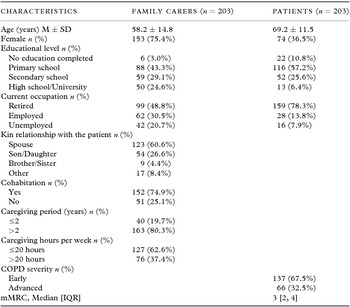
A total of 203 family carers (58.2 ± 14.8 years old; 75.4% female), caring for patients with COPD (69.2 ± 11.5 years old; 36.5% female), were included. Most patients had early COPD (n = 137; 67.5%) and 66 (32.5%) advanced COPD. Table 1 provides the sample characteristics.
Characteristics of the sample

Abbreviations: COPD, Chronic Obstructive Pulmonary Disease; M, mean; IQR, interquartile range; mMRC, Modified British Medical Research Council questionnaire; SD, standard deviation.
Psychological health
The mean anxiety score in family carers was 9 ± 4.5 and mean depression score was 6.4 ± 3.4. Considering a cut-off score ≥8, 63.5% (n = 129) of family carers had clinically significant anxiety and 34% (n = 69) had depression symptoms. A total of 55 (27.1%) family carers had both symptoms. Clinically significant anxiety symptoms were present in 52.7% (n = 107) of patients, depression in 45.3% (n = 92), and both symptoms in 31.5% (n = 64).
Carers’ psychological health and sociodemographic characteristics
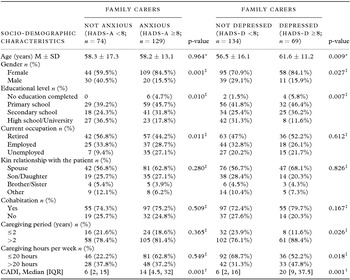
Anxiety and depression symptoms were more frequent in female carers (chi-square tests p = 0.001 and p = 0.027) and in family carers’ with lower educational levels (no education completed, primary school and secondary school; chi square tests p = 0.010 and p = 0.007) (Table 2). Anxiety symptoms were also found to be related with unemployed status (chi-square test p = 0.011) and depression symptoms with an older age (independent t-test p = 0.009).
Psychological health of family carers and sociodemographic/caregiving characteristics (n = 203)

*, independent t-tests; ‡, Chi-square tests; †, Mann–Whitney U-tests. Abbreviations: CADI, Carers’ Assessment of Difficulties Index; HADS-A, Hospital Anxiety and Depression Scale—Anxiety; HADS-D, Hospital Anxiety and Depression Scale—Depression; IQR, interquartile range; M, mean; SD, standard deviation.
Carers’ psychological health and caregiving situation
The presence of anxiety or depression symptoms was not significantly different among the types of kin relationship with the patient (chi-square tests p = 0.280 and p = 0.826) or with cohabitation (chi-square tests p = 0.509 and p = 0.167) (Table 2). However, both were significantly more frequent in family carers with high subjective burden (Mann–Whitney U-tests p = 0.001). Depression symptoms were also found to be more frequent in carers providing care for longer periods (chi-square test p = 0.026) and during more hours per week (chi-square test p = 0.018) (Table 2).
Carers’ psychological health and patients’ characteristics
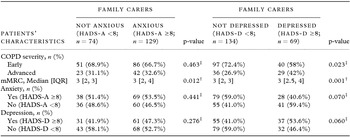
The frequency of depression symptoms was higher in family carers caring for patients with advanced COPD (chi-square test p = 0.023) (Table 3). The frequency of anxiety and depression symptoms was also higher in family carers of patients’ with greater activities limitation resulting from breathlessness (mMRC) (Mann–Whitney U-tests p = 0.012 and p = 0.001). No statistically significant differences were observed for the other characteristics.
Psychological health of family carers and patients’ characteristics

†, Mann-Whitney U-tests; ‡, Chi-square tests.
Abbreviations: COPD, Chronic Obstructive Pulmonary Disease; HADS-A, Hospital Anxiety and Depression Scale—Anxiety; HADS-D, Hospital Anxiety and Depression Scale—Depression; IQR, interquartile range; mMRC, Modified British Medical Research Council questionnaire.
Regression models
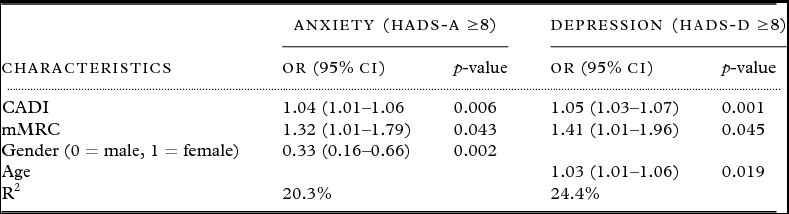
Two multivariate logistic regressions were performed to identify the predictors of clinically significant anxiety and depression symptoms (Table 4). Based on the values of odds ratio (OR), if family carers increased in one point the perceived burden, then the odds of developing anxiety (HADS-A≥8) or depression (HADS-D≥8) symptoms would be 1.04 [95% confidence intervals (CI) = 1.01–1.06] or 1.05 (95% CI = 1.03–1.07) times more. If patients’ activities limitation (mMRC) increased in one point, the probability of family carers developing anxiety would be 1.32 (95% CI = 1.01–1.79) times more and depression would be 1.41 (95% CI = 1.01–1.96). Anxiety symptoms were also predicted by female gender (OR 0.33; 95% CI = 0.16–0.66) and depression by older age (OR 1.03; 95% CI = 1.01–1.06). These logistic regression models predicted 20.3% of total variation of anxiety and 24.4% of total variation of depression symptoms.
Models explaining anxiety or depression symptoms as dependent variables and carers’ perceived burden, gender, age, and patients’ activities limitation as independent variables, using multiple logistic regression analysis with the Enter method.

n = 203.
Abbreviations: 95% CI, 95% confidence interval; CADI, Carers’ Assessment of Difficulties Index;
mMRC, Modified British Medical Research Council questionnaire; OR, odds ratio; R2, Nagelkerke R Square.
Discussion
To the best of our knowledge, this is the first study to analyze anxiety and depression symptoms among family carers of people with all COPD grades and their predictor variables. The main findings were that family carers presented clinically significant anxiety and depression symptoms, and their perceived burden, female gender, older age, and patient's activities limitation were significant predictors of these distressing symptoms.
The frequencies of anxiety (63.5%) and depression (34%) symptoms in family carers of patients with COPD are in line with those observed in family carers of people with dementia, stroke, or cancer (Covinsky et al., Reference Covinsky, Newcomer, Fox, Wood, Sands and Dane2003; Berg et al., Reference Berg, Palomäki, Lönnqvist, Lehtihalmes and Kaste2005; Grov et al., Reference Grov, Dahl, Moum and Fosså2005), highlighting the demanding and stressful nature of the caregiving role in COPD (Pearlin et al., Reference Pearlin, Mullan, Semple and Skaff1990). Statistically significant differences were found for both anxiety and depression symptoms considering gender. Gender was also a significant predictor of anxiety. Research suggests that female carers experience higher levels of physical and emotional stress, subjective burden, and lower levels of physical health when compared to male carers (Perz et al., Reference Perz, Ussher, Butow and Wain2011). A number of reasons might explain these differences. First, women and men may perceive the caregiving process differently, i.e., women might see the caregiving role as an unwanted and resented continuation of their life-job, whereas men often perceive caregiving as a new job or meaningful retirement activity (Dupuis et al., Reference Dupuis, Epp and Smale2004). Second, compared to men, women tend to use more emotion-focused coping strategies, which are related to higher levels of stress (Matud, Reference Matud2004). Third, older male carers tend to receive more formal and informal support compared to female carers. Nevertheless, these gender differences need to be interpreted with caution, since they may not be caregiving-specific, but rather a reflection of the gender differences found in the general population (Altemus, Reference Altemus2006). Low educational levels were also related to a higher frequency of clinically significant anxiety and depression symptoms. This was expected as a high educational level has been shown to be an important contributor to enhance personal resources and use of instrumental coping style (Drageset and Lindstrom, Reference Drageset and Lindstrom2005), helping carers to positively cope with the caregiving demands and contributing to their overall well-being.
Contrarily to previous research (Covinsky et al., Reference Covinsky, Newcomer, Fox, Wood, Sands and Dane2003, Berg et al., Reference Berg, Palomäki, Lönnqvist, Lehtihalmes and Kaste2005), no statistically significant differences were found for both anxiety and depression symptoms considering the kin relationship with the patient. Although spouses have been identified as the highest risk group for distress among all carers (Dupuis et al., Reference Dupuis, Epp and Smale2004), children, particularly adult daughters, are also intensely affected by their caregiving responsibilities. Adult daughters have often to balance several demanding roles at the same time (e.g., spouse, mother, worker, carer, and friend), which can lead to high levels of stress and poor psychological health (Brody, Reference Brody1981). That is why they are often referred to as the “women in the middle” (Brody, Reference Brody1981). In a recent study with carers of people with different chronic illnesses, the stress burden experienced by spouses and adult children was also equivalent (Savundranayagam et al., Reference Savundranayagam, Montgomery and Kosloski2011).
Anxiety and depression symptoms were predicted by family carers’ subjective burden. These findings are consistent with previous research on family caregiving across other chronic diseases (Carretero et al., Reference Carretero, Garcés, Ródenas and Sanjosé2009; Savundranayagam et al., Reference Savundranayagam, Montgomery and Kosloski2011). Subjective burden, defined as the person's appraisals of the caregiving situation, have been considered as an important predictor of carers’ psychological health outcomes (Carretero et al., Reference Carretero, Garcés, Ródenas and Sanjosé2009; Savundranayagam et al., Reference Savundranayagam, Montgomery and Kosloski2011). Family carers who experience higher significant burden often experience poor psychological health, depression, loss of control over the caregiving situation, and heavy workload (Perz et al., Reference Perz, Ussher, Butow and Wain2011).
Family carers’ psychological distress was also predicted by patient's activities limitation. It is well known that functional decline contributes to the development of carers’ subjective burden which, in turn, affects their psychological health (Ng et al., Reference Ng, Niti, Fones, Yap and Tan2009). This is particularly remarkable for depression, since those who were caring for people with advanced COPD presented higher clinically significant depression symptoms. This result was expected since patients at advanced COPD experience a higher degree of physical disability and, thus, an increasing dependence on their family carers. Conversely, no differences on anxiety symptoms between early and advanced COPD were found. This result probably reflects the uncertain and unpredictable nature of the symptoms and the acute exacerbations characteristic of COPD, which are common across the disease course and are one of the most distressing issues faced by families (Boyle, Reference Boyle2009). In this study, however, information on exacerbations was not collected. Since exacerbations may play an important role in carers’ psychological health, and specifically in carers’ anxiety, future studies should explore if the rate of exacerbations and their characteristics also represent a predictor of carers’ psychological distress.
The overall findings suggest that providing care to patients with COPD has a negative impact on family carers’ psychological health and that the predictors of carers’ psychological distress are in line with those described across cancer, stroke, or dementia. Thus, similarly to family carers of these chronic diseases (Selwood et al., Reference Selwood, Johnston, Katona, Lyketsos and Livingston2007), carers of patients with COPD need specific services and supportive interventions (e.g., respite care, psycho-education, and mutual support groups) to adjust to their caregiving role. However, supportive interventions have not yet been investigated in families living with COPD. Pulmonary rehabilitation programs are a recommended standard of care for patients with COPD, combining exercise training with psycho-education (Nici et al., Reference Nici, Donner, Wouters, Zuwallack, Ambrosino and Bourbeau2006). These programs, although involving an active collaboration among the patient and family (Nici et al., Reference Nici, Donner, Wouters, Zuwallack, Ambrosino and Bourbeau2006), do not address the needs of family carers directly. Therefore, it would be relevant to develop a psycho-education component integrating the family carers and to analyze its effects on their psychological health and quality of life.
Certain limitations of the present study should be acknowledged. The HADS is a screening tool for symptoms of anxiety and depression and not an instrument to perform a diagnosis of anxiety or depression. Nevertheless, the HADS has shown to be a reliable and frequently used psychological measurement instrument in COPD (Snaith, Reference Snaith2003). This study focused on the presence of clinically significant anxiety/depression symptoms (HADS-A/HADS-D≥8). Future studies could conduct bivariate analysis between absolute values of HADS-A/HADS-D and carers’ sociodemographic/caregiving characteristics. This would be a starting point to create multiple linear regression equations to predict the HADS-A and HADS-D scores. Due to the cross-sectional design of the study, the relationship between predictors and psychological distress across the progression of COPD could not be established. Longitudinal designs would clarify these relationships. Another limitation was the lack of a control group since some of the relationships found may not be caregiving specific. In future studies, a control group with noncarers with similar sociodemographic characteristics should also be included.
Conclusion
Family carers of people with COPD experience clinically significant anxiety and depression symptoms and their perceived burden, female gender, older age as well as patient's activities limitation are predictors of these distressing symptoms. These characteristics should be considered in the comprehensive assessment of family carers of people with COPD. Longitudinal studies are, however, needed to analyze the relationship between predictors and psychological distress across the progression of COPD. Future research should address these family carers’ needs, particularly through the investigation of the effectiveness of supportive interventions on family's psychological health.
Conflict of interest
None.
Description of authors’ roles
DF and AM were responsible for the study conception and design. RG, CJ, and JC performed the data collection. CJ performed data analysis and was responsible for drafting the manuscript. DF, RG, JC, and AM critically revised the paper for important intellectual content. AM and DF obtained funding.
Acknowledgments
The authors would like to acknowledge all institutions, patients, and carers involved for their participation in this research. This work was funded by Portuguese National Funds through FCT—Foundation for Science and Technology in the context of the project RIPD/CIF/109502/2009.