A fundamental tenet of democratic theory is that citizens possess meaningful beliefs. Even democratic theories that posit a minimalist role for the public maintain some expectation that citizens are able to elect representatives based on mutual interests and preferences.Footnote 1 There is some doubt that citizens meet these expectations. Research shows the political preferences of the public are often unstable.Footnote 2 One reason for the instability is that citizens form their opinions using multiple core values that sometimes come into conflict.Footnote 3 For instance, citizens have been shown to experience opinion instability in response to conflict between values of feminism and religiosity when formulating their opinions toward abortion,Footnote 4 morality and egalitarianism regarding opinions toward GLBT (gay/lesbian/bisexual/transgender) rights,Footnote 5 and individualism and humanitarianism regarding opinions toward welfare.Footnote 6
Value pluralism or an individual’s preference for multiple desired end-states, however, does not necessitate value conflict. Sometimes people are able to make value trade-offs and resolve potential conflicts when expressing their opinions.Footnote 7 For instance, Grant and Rudolph show that citizens can resolve potential conflict between widely held values of free speech and equality when forming their preferences toward campaign finance reform by conditioning on their affect toward groups that would benefit from the policy.Footnote 8 Moreover, some values can be mutually reinforcing, resulting in more stable political choices. For instance, Alvarez and Brehm show that people who value both responsiveness and honesty have less variation in their opinions toward the US Internal Revenue Service.Footnote 9 Although the current state of public opinion research identifies the potential for multiple values to shape opinion responses, there is no clear theoretical statement identifying the conditions under which citizens will experience value conflict, value trade-offs or value reinforcement. Instead, existing studies treat citizens as homogeneous when confronted with a choice between multiple values to form their policy preferences. Any differences in how citizens resolve value pluralism is only across issues. Yet, if there is something we are generally certain of in the realm of politics, it is that people are quite heterogeneous in how they form their political preferences.
Although we imagine a variety of attitudinal and contextual forces might shape how multiple values contribute to response stability, we focus on one such characteristic: political sophistication. Research suggests that sophistication makes it easier for people to connect their values to policy preferences since people who pay more attention to politics are more likely to be aware of elite cues about how values should fit with policy preferences.Footnote 10 We argue that political sophistication may also help citizens minimize internal value conflict either through its association with enhanced cognitive reasoning or contextual information regarding how values might be mutually reinforcing. Political sophistication should condition the relationship between value pluralism and opinion variability, with the most sophisticated citizens being more likely to use multiple values in a way that increases the stability of their political preferences. Without these tools associated with political sophistication, citizens should be more likely to exhibit the common symptoms of response instability such as ambivalence.
We test the sophistication-interaction hypothesis by examining data from a national survey on opinions toward policies aimed at mitigating and adapting to the risks of global warming or climate change. How society deals with the rise in global temperatures is one of the most pressing issues in contemporary global politics. Political leaders have been hesitant to implement policies to mitigate and adapt to the risks of climate change without the support of the mass public. This makes understanding public opinion in this domain vital to the longevity of the planet. The debate also provides a reasonable test for the sophistication-interaction hypothesis since the desire to preserve the environment and the desire for a prosperous economy are featured prominently within debates over the enactment of climate change policies. Thus, there is an expectation that these values structure policy opinions within this domain. But it is unclear if these values are harmonious or lead to conflict among the public.
In addition, we present an alternative statistical model – a heteroskedastic graded item response theory model (HG-IRT) – to estimate each respondent’s latent policy preference across twelve ordinal indicators of different policies aimed at limiting the risks of climate change as well as each respondent’s variation in support for those policies. Existing heteroskedastic choice models (logit/probit, ordered logit/probit) are inefficient because they estimate each individual’s preference for related policies in isolation of each other. Such models also fail to adequately test theories about opinion variability because they estimate each individual’s policy preference and the variation across individuals rather than the variability within an individual, that is, the stability or instability of each person’s expressed opinion. The HG-IRT model provides a better test of theories relating to response variability among individuals because it directly estimates the consistency of policy choices within a specific issue domain for each individual. Instead of estimating the distance between an individual’s expressed policy opinion and the model estimate of where that opinion should be (a model estimate based on the entire sample), it estimates each individual’s latent policy preference from multiple indicators of that preference along with how much variability there is across those indicators for each individual. In this manner, it avoids the problem of making inferences about individual-level value conflict from estimates of sample aggregates.
The results suggest that values about the environment and the economy shape the public’s preferences toward policies aimed at reducing the risks of climate change. Moreover, we find that possession of both values can be mutually reinforcing, reducing the response variability of policy support across the twelve different climate change policies. However, we find only the politically sophisticated reduce their response variability when they possess both values. In fact, valuing both the environment and the economy may increase the response variability among the least sophisticated, that is, result in attitudinal ambivalence. The results also suggest that support for the sophistication-interaction hypothesis is driven more by the benefits of increased cognitive ability associated with higher educational attainment than contextual (factual) knowledge about the causes of climate change. Partisanship and ideology show no relationship with the variability in people’s opinions toward policies aimed at mitigating or adapting to climate change and fail to help citizens minimize potential conflict between the economy and the environment. We discuss the implications of these results for the debate on climate change, public opinion and the ability of citizens to meet various normative expectations of democratic theory in the conclusion.
HOW CITIZENS COPE WITH MULTIPLE VALUES
Conflict over values is an essential part of politics. Political debates occur over whether to permit policies that favor one value over another. Should society protect a woman’s right to choose or the rights of the unborn? Should we promote self-reliance or humanitarianism when solving the nation’s poverty problem? Should the government enact policies that protect the environment at the expense of economic growth? Most political conflicts suggest some degree of value pluralism within society.Footnote 11 The question becomes how citizens resolve the potential conflict among the pluralistic values that structure their political opinions.
In some instances, multiple values do not translate into internal conflict. Jacoby finds evidence that citizens can structure their values in a hierarchy that helps them apply their most coveted value to their policy preference.Footnote 12 When asked to formulate policy preferences on an issue where multiple values are invoked, citizens apply the value of most importance and minimize the weight given to less important values. For instance, a person might value security over liberty and consistently support a policy that restricts freedom to enhance security as long as their value hierarchy remained constant. In this instance, the desire for more than one end-state does not lead to internal conflict. The presence of multiple values also should not exhibit a relationship with the variability in a person’s political preference since the consistent application of the more coveted value should lead to consistent policy preferences.
In other instances, citizens are unable to resolve contention among multiple values. As Alvarez and Brehm write, people often ‘experience strong, internalized conflict over the choices they are asked to make about policy or candidates for office’.Footnote 13 Indeed, political debates over GLBT rights, abortion or school prayer seem to provide little room for compromise among different values. Citizens who support more than a single value that has been invoked within a policy debate often have difficulty weighting each value when formulating their policy preferences. This can lead to internalized conflict regarding what value to apply to a policy preference. This conflict can subsequently manifest itself as variability in a person’s survey response, that is, opinion instability or attitudinal ambivalence.
However, people also have a natural or instinctive desire to reduce states of internalized conflict.Footnote 14 One of the most successful strategies for reducing internal dissonance is through belief integration. Integration involves assimilating a pair of beliefs into a broader perspective that reinterprets potentially conflicting beliefs to make them compatible with one another.Footnote 15 As in the case of ambivalence, people find two or more values mutually desirable and applicable to a policy debate. Yet, in this instance the values are integrated in a manner such that they reinforce each other. The observable implication of value reinforcement is that multiple values ‘leads individuals to have lower response variability, or in other words, to have more firmly fixed survey responses’.Footnote 16 Alvarez and Brehm, for instance, found that potentially competing expectations about the US Internal Revenue Service were coexisting in a manner that led to more stable opinions about tax policies rather than increasing opinion variability as we would typically observe when values are in conflict.Footnote 17 What appeared to be conflicting expectations were being integrated in a manner where each expectation reinforced each other, leading to more stable opinions regarding tax policy.
What determines if citizens are able to reconcile multiple values, engage in a trade-off or experience value conflict? We argue that political sophistication can help moderate how multiple values structure the stability of people’s political preferences. We conceptualize political sophistication as the quantity and organization of an individual’s political cognitions. It consists of the contextual information about an issue. At best, this is information pertaining to facts surrounding an issue rather than generalized knowledge of people and political processes.Footnote 18 Political sophistication also consists of a person’s cognitive ability to organize and store this information. People must have some capacity to conceptualize political ideas and connect them in a systematic manner.Footnote 19
We believe that political sophistication should moderate how citizens resolve potential conflict among multiple values for two reasons. First, belief integration can be quite cumbersome and cognitively demanding. It requires enough cognitive ability and working memory to integrate potentially conflicting beliefs into a new perspective where each belief can coexist.Footnote 20 Second, integration can occur when people encounter new information about how values are mutually reinforcing.Footnote 21 Political sophistication should be associated with greater exposure to information about an issue. This information may help citizens to understand how multiple values can relate to an issue in a less conflictual manner – at least on some issues. Thus, political sophistication provides two potential mechanisms to moderate how multiple values relate to the variability in people’s political preferences. People can learn how values can coexist and/or they may use their existing cognitive abilities to adjust their values into a new coherent perspective.Footnote 22
Subsequently, we expect citizens with greater levels of political sophistication to be more likely to engage in the reconciliation of values. Citizens with greater levels of political sophistication should possess the cognitive ability to unravel the complex relationship among multiple values, but also the contextual knowledge surrounding an issue debate to learn how values might reinforce one another – assuming such reinforcement reflects debate on the issue. Lacking both cognitive ability and contextual knowledge, citizens with lower levels of political sophistication should be less likely to resolve potential conflict among multiple values, thereby exhibiting greater opinion instability or variability. In other words, the least sophisticated citizens who harbor multiple values should be more likely to experience internalized conflict or what is commonly referred to as attitudinal ambivalence.
MULTIPLE VALUES AND CLIMATE CHANGE
We expect core beliefs toward the environment and the economy to structure citizens’ opinions toward policies related to climate change. Research suggests that positive opinions on environmental issues are related to a worldview that recognizes the frailty of the environment and interconnectedness of humans with the ecosystem.Footnote 23 This pro-environmental worldview recognizes the effect of human activity on the environment and the need for mutual coexistence among all species. Given the use of domain-specific values in structuring policy preferences, such a pro-environmental worldview should structure preferences toward policies aimed to mitigate the effects of climate change.
A strong desire for economic prosperity should also shape individual-level preferences toward policies aimed at limiting the risks of climate change. Individuals desire a strong economy as a basic means of sustenance. However, some individuals value economic growth above other goals and values. Layzer terms these individuals ‘cornucopians’ because they believe in limitless development and ‘place a preeminent value on economic growth’.Footnote 24 Consistent with this view, Inglehart finds pro-ecological attitudes and behaviors are more prominent when the economy is not a priority – in particular, in post-materialist societies.Footnote 25 Thus, individuals that value the economy should show less support for climate change policies – assuming they believe climate change policies would have a negative effect on the economy.
We believe that these values regarding the environment and economy are an important part of the structure of people’s opinions regarding policies aimed at limiting the risks of global climate change. We also suspect these values can shape the variability in their opinions. The desire for a clean environment and a growing economy may seem like an apparent conflict for some citizens, leading to greater variability in their opinions toward policies to mitigate and adapt to climate change.Footnote 26 Yet, these dual desires might be integrated into a more harmonious perspective given people’s instinctive need to reduce internal dissonance.Footnote 27 Given the cognitive demands of integration and the need for information on how these desires can be compatible, we expect that political sophistication is associated with traits that should help citizens minimize potential conflict between environmental and economic desires. In other words, political sophistication should moderate how value pluralism influences the variability in people’s opinions toward policies aimed at mitigating and adapting to climate change. Citizens with higher levels of political sophistication should be able to integrate their desire for a clean environment and prosperous economy into a coherent and stable opinion regarding climate change policies. The less sophisticated citizens should have more difficulty reconciling these values and possibly experience attitudinal ambivalence.
DATA AND METHODS
The data for this study come from a national telephone survey using random-digit dialing and computer assisted telephone interviewing. The survey was implemented by the Institute for Science, Technology, and Public Policy at Texas A&M University between 13 July and 10 August 2004. The survey asked respondents about their opinions and behaviors related to global climate change and public policies intended to reduce the risks of global warming.Footnote 28
We conceptualize public policy support as a latent variable that is not directly observable. Instead, we have various indicators of each individual’s latent policy support as determined by their actual responses to twelve specific policy options (details are in the supplementary materials). Each item asks survey respondents to indicate their level of support for a policy to limit the risks of global climate change: market incentives to reduce emissions, taxing individuals to discourage behavior that contributes to climate change, taxing industries to discourage climate change activities, educating the public about climate change, ratification of the Kyoto Protocol, requiring energy efficient technology, developing renewable energy sources, reducing methane in agricultural production, protecting coastal settlements with sea walls, requiring fuel efficient automobiles, adjusting the costs for energy consumption, and increasing the price of gasoline. Response options for each item are on a four-point scale: 1=strongly oppose, 2=oppose, 3=support, and 4=strongly support.
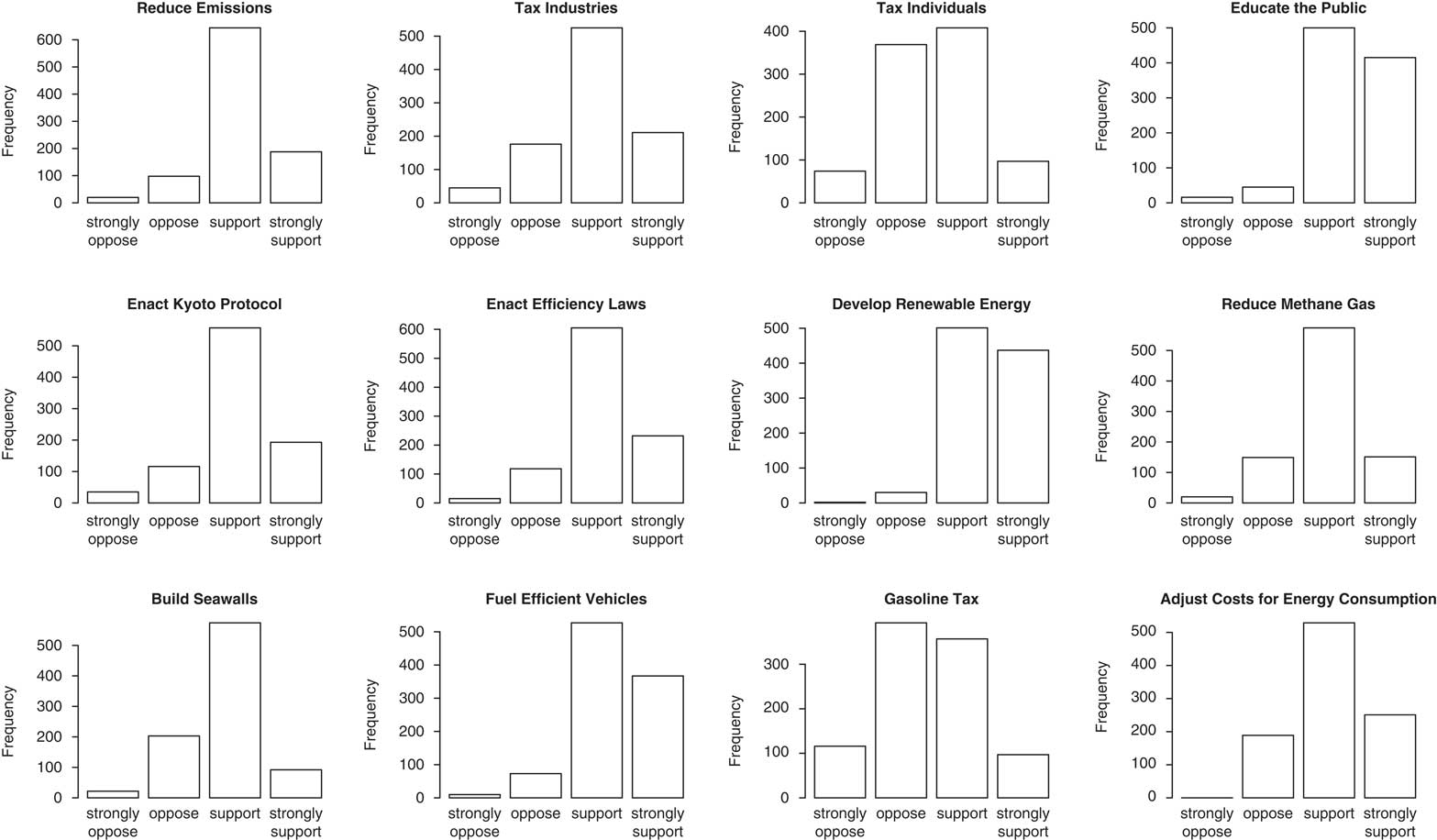
Figure 1 shows bar plots for each indicator of policy support. Overall, the public favors policies to protect the planet from climate change. Respondents are most supportive of government efforts to educate the public about the causes and consequences of climate change, and government initiatives to develop renewable energy sources. Very few respondents ‘strongly oppose’ most of these policies, with the exception of raising the price of fossil fuels (that is, gasoline) where 12 per cent of respondents ‘strongly oppose’ this policy and 40 per cent ‘oppose’ it. Instead, the modal response category for each policy is ‘support’, with the exception of the fossil fuel price increase. Similarly, about 45 per cent of respondents ‘oppose’ or ‘strongly oppose’ taxing individuals for behaviors that contribute to global warming. It appears that Americans support policies to reduce climate change except when it comes to directly paying for the costs of these policies.
Distribution of public preferences for policies to mitigate climate change

Theoretical explanations of support for climate change policies consist of personal and political identities, core values, belief about the risks of climate change and social norms in a person’s environment.Footnote 29 We control for each of these factors in our model specification of people’s preferences toward climate change policies. Demographic variables have been theorized to relate to support for climate change policies more according to their ability to capture people’s personal capabilities in subsuming the costs of ecological disasters rather than to the identities they bring to the processing of political information. In particular, racial minorities and women have been theorized to be more vulnerable populations and therefore more supportive of pro-environmental policies.Footnote 30 We measure gender with a variable coded 0=female and 1=male. We measure race with a variable coded 0=non-white and 1=whites. Since climate change is a politically charged policy issue we also control for ideological and partisan affiliations. We measure political ideology using a seven-point scale ranging from 7=‘strong conservative’ to 1=‘strong liberal’. Partisanship is measured using a three-point scale coded 2=Democrat, 1=no party preference, and 0=Republican.
Values are general desired end-states that develop mostly exogenous to politics albeit they are not completely immune to it.Footnote 31 Subsequently, core values have been shown to be the foundation of people’s preferences toward climate change policies rather than a factor influenced by these policy positions.Footnote 32 Environmental value is measured using the New Ecological Paradigm (NEP) index developed in environmental sociology.Footnote 33 The NEP is a measure of a pro-ecological worldview, and endorsement of the NEP has been shown to be strongly related to a range of environmental attitudes and behaviors.Footnote 34 The NEP is an additive scale of six items from the most recent NEP scale asking respondents to indicate their support of statements regarding the frailty of nature and limitations to growth on the planet.Footnote 35 Higher values indicator a greater pro-ecological worldview. Economic value consists of two items asking respondents the importance of economic growth. The economic value index ranges from 0 to 1 with higher values indicating a higher priority on the economy.
Risk perceptions have also been shown to be one of the most important predictors of support for policies related to climate change.Footnote 36 People that perceive climate change to be a risk are more likely to favor policies that reduce that risk.Footnote 37 However, not everyone that perceives climate change to be a risk necessarily favors a government solution to the issue, with market-based reforms being popular among some segments of the public.Footnote 38 Risk perceptions are measured with a three-item index asking respondents if they perceive climate change as having a negative influence on their health, personal finances and local environment. Higher values indicate a greater perceived risk.
Social networks and the norms that arise from these networks have been shown shape people’s political preferences toward climate change policies.Footnote 39 Citizens with larger environmentally minded social networks should be more pressured to support government action regarding climate change and vice versa. Social network is an index created from four questions regarding personal discussions of climate change. Two items ask respondents if they have communicated with family or friends about global climate change and two items ask respondents if they have offered or have been asked their opinion about climate change.
Our primary concern is how political sophistication interacts with values toward the environment and the economy in shaping the variance of people’s policy preferences. Scholarship has shown that domain-specific knowledge – that is, knowledge pertaining to a specific issue – is preferable to general political knowledge scales asking about public officials and political processes.Footnote 40 Therefore, we constructed a measure of domain-specific knowledge specific to the debate on climate change in order to assess if contextual knowledge about climate change can minimize conflict between a desire for economic growth and a pro-environmental worldview. Specifically, respondents were asked if nitrous oxide, the burning of fossil fuels, aerosol particles and water vapor contribute to the build-up of greenhouse gases. Of course, the use of such items is questionable given that the ‘facts’ surrounding climate change are highly contested. People that are skeptical of climate change might possess contextual information regarding the issue, but fail to view this information as accurate. Therefore, they would be observed in our data as lacking domain-specific information even when they were exposed to it.
To test whether responses to these items were politically charged, we examine the Spearman correlation between the measure of domain-specific knowledge with partisanship and ideological self-identification. The domain-specific knowledge scale shows a positive relationship with partisanship, indicating that Democrats were more likely to score correctly on the items than Independents and Republicans (rho=0.06, p<0.03). Yet, the correlation is relatively small, reducing some concern that these responses are less valid among Republicans and Independents. The domain-specific knowledge scale shows a negative relationship with ideology, indicating that liberals were more likely to score correctly on the items than moderates and conservatives (rho=−0.06, p<0.02). Again, the correlation is small. It is possible that responses to these items are less valid for right-leaning groups, but it might also be the case that those on the left are simply more attuned to climate change as an issue given their greater interests in environmental issues. Regardless, we use the domain-specific knowledge scale with caution since it might be more valid for some groups than others.Footnote 41
In the absence of the common indicator of political sophistication based on people’s knowledge of public officials and political processes, researchers have relied on education as a measure of political sophistication.Footnote 42 We also employ a measure of educational attainment as an indicator of political sophistication given the potential problems of a domain-specific knowledge measure regarding climate change and the lack of a generic knowledge based scale of public affairs (a scale that itself does not ensure knowledge of the debate regarding climate change). Education has been shown to be associated with both greater political interest and the cognitive ability required to engage in more complex political reasoning.Footnote 43 Both of these are important mechanisms of belief integration. We measure education with a five-point ordinal scale ranging from elementary or some high school to high school or trade school to some college to college graduate to post-graduate degree.
Although education has been widely employed as a measure of political sophistication,Footnote 44 it has also been criticized. We recognize that many people with low levels of education are attuned to public affairs, while many people with high levels of educational attainment abstain from the subject. Critics have also shown that education is more of a proxy for variables related to political sophistication than a direct measure (or best predictor) of the concept.Footnote 45 For instance, Price and Zaller show that factual knowledge questions are better at predicting recall of media stories regarding public affairs relative to education.Footnote 46
However, Price and Zaller show that education does maintain a significant and modest relationship with information recall, suggesting education might serve as a proxy measure for political information in the absence of a measure of political knowledge.Footnote 47 This is also consistent with Converse’s claim that education is ‘the prime predictor of dependent variables reflecting political interest, participation, and mobilization’.Footnote 48 Thus, although education may not directly capture political sophistication,Footnote 49 it is associated with key variables that are related to greater interest in public affairs.Footnote 50 In addition, education is associated with cognitive ability, which is a key theoretical mechanism believed to help citizens integrate multiple beliefs into a common perspective. Luskin suggests that education’s influence on political sophistication might be through intelligence and other indicators of cognitive reasoning.Footnote 51 Subsequently, education should provide a reasonable measure of cognitive ability. However, it may be less predictive of contextual political knowledge, which we attempt to capture with the domain-specific knowledge scale.
In addition to modeling the policy preferences of each individual, we expect the variation around those preferences to be a function of multiple values that could potentially lead to internalized value conflict, reinforcement or trade-offs. We use Griffin’s approach to measuring value pluralism where V 1 indicates the pro-environmental value and V 2 indicates a pro-economic value. Formally:
 $${\rm Pluralism}\,{\equals}\,{{V_{1} {\plus}V_{2} } \over 2}\,{\minus}\!\mid\,V_{1} {\minus}V_{2} \,\mid\,$$
We choose this measure since it is the more common approach to measuring value pluralism across social psychology and political science and the measure performs well when values are measured on different scales.Footnote
52
The measure also accounts for the strength with which each value is desired. Respondents that hold each pair of values equally and strongly will have the highest score on the scale,
 ${{1{\plus}1} \over 2}\,{\minus}\!\mid\,1{\minus}1\,\mid\,{\equals}\,1$
. Individuals who are able to make a clear trade-off between the environment and the economy will have the lowest score on the scale,
 $${{1{\plus}0} \over 2}{\minus}\!\mid1{\minus}0\,\mid{\equals}\,{\minus}0.5$$
. If both values are moderately desired, but equally held, the measure provides a score that indicates weak pluralism,
 ${{0.5{\plus}0.5} \over 2}\,{\minus}\mid\,0.5{\minus}0.5\,\mid\!{\equals}\,0.5$
.Footnote
53
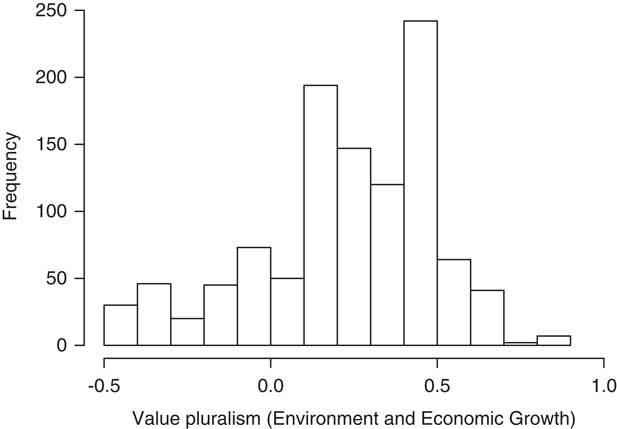
Figure 2 shows the distribution of respondents who value both the environment and the economy. The histogram shows that a large number of respondents in the sample value both the environment and the economy equally. The data do not provide direct tests to determine if citizens are capable of making trade-offs between these beliefs, but relatively few individuals hold one belief without holding another potentially conflicting or reinforcing value. In fact, less than fifty respondents desire one value and not the other.
Distribution of value pluralism (valuing both the environment and economy)

AN ITEM RESPONSE THEORY MODEL FOR ORDINAL INDICATORS
Scholars have shown that survey responses can be thought of as a draw from a sample of considerations over policy choices within a single issue domain.Footnote 54 Survey responses typically force citizens to indicate a specific preference toward a policy when in reality there is a range of policies that are acceptable for each individual. Some individuals have a large range of acceptable policies and are more likely to demonstrate response instability (variance). Others have a small range of acceptable policies and are less likely to demonstrate response instability. Our estimation goal is to estimate each individual’s preference regarding policies to mitigate and adapt to climate change and the instability of each person’s preference, that is, the range of policies they find acceptable or unacceptable.
We use an HG-IRT model to estimate the latent variable of public preferences for policies to mitigate and adapt to global climate change from the measured ordinal indicators.Footnote
55
This model is an attractive alternative to previously used heteroskedastic choice models because it takes into account the measurement error associated with the manifest ordinal indicators that would otherwise attenuate estimates of the standard errors.Footnote
56
Secondly, the model allows the direct estimation of both the properties of the manifest indicators, the latent policy preference of each individual, the structural model of the latent variable and the variance for each individual. The HG-IRT model is also an improvement over aggregation techniques such as factor analytic models (or principal components) when the observable data are measured at the ordinal level of measurement. Treating ordinal indicators as interval measures assumes that moving from category 1 to category 2 on indicator k is the same as moving from category 3 to category 4 on the same indicator. Further, it assumes that movement from category 1 to category 2 on indicator k is the same as moving from category 1 to category 2 on another indicator
 $$k'$$
. Instead, the HG-IRT model estimates the threshold levels for each indicator, providing a direct test of what seems to be an untenable assumption.
The HG-IRT model describes the relationship between the latent personal propensity to favor or oppose policies to mitigate global warming (θ) and responses to the ordinal-scaled indicators of specific policy preferences. The model estimates the propensity that respondent i (i=1 … , n) selects category c (c=1 … , C) on item k (k=1 … , K) given respondent i’s latent propensity to support policies aimed at reducing climate change θ i , the discrimination α of item k, and the threshold levels κ of item k. Formally:
 $$P\left( {y_{{ik}} \,{\equals}\,c\!\mid\,\theta _{i} ,\alpha _{k} ,\kappa _{k} } \right)\,{\equals}\,\Phi \left[ {{{\left( {\alpha _{k} \theta _{i} {\minus}\kappa _{{kc{\minus}1}} } \right)} \over {\sigma _{i} }}} \right]{\minus}\Phi \left[ {{{\left( {\alpha _{k} \theta _{i} {\minus}\kappa _{{kc}} } \right)} \over {\sigma _{i} }}} \right]$$
where Φ is the cumulative normal distribution and the response categories for items are ordered by:
 $${\minus}\infty\,\gt\,\kappa _{{k1}} \geq \kappa _{{k2}} \geq \,\ldots\,\geq \kappa _{k} C_{k} ,$$
with
 $$\kappa _{{k1}} $$
to
 $$\kappa _{k} C_{k} $$
the threshold parameters for categories 1 … C for item k. The model also directly estimates the properties of each indicator. The discrimination parameter α
k
indicates how a change in the latent propensity θ
i
is converted into the manifest categories C
k
. Items with a larger discrimination parameter are better at differentiating between individuals with different propensities to support policies to mitigate global warming.
The latent dependent variable θ i from the measurement model is simultaneously estimated by the structural equation:
 $$\eqalignno{ & \theta _{i} \,{\equals}\,\beta _{1} \!\,^{\asterisk}\!\,\kern0.1pt{\rm Race}{\plus}\beta _{2} \!\,^{\asterisk}\!\,{\rm Gender}{\plus}\beta _{3} \!\,^{\asterisk}\!\,{\rm Education}{\plus}\beta 4\!\,^{\asterisk}\!\,{\rm Ideology}{\plus}\beta _{5} \!\,^{\asterisk}\!\,risk\cr & \quad \,\,\,{\plus} \beta _{6} \!\,^{\asterisk}\!\,{\rm environmental}\,\,{\rm value}{\plus}\beta _{7} \!\,^{\asterisk}\!\,{\rm economic}\,\,{\rm value}{\plus}\beta _{8} \!\,^{\asterisk}\!\,{\rm social}\,\,{\rm network}{\plus}{\epsilon} $$
Finally, the variation around each individual’s preference is estimated using the log square root of the variance to constrain the standard deviation and variance to be positive. We use a similar model specification as Alvarez and Brehm that includes a measure of domain-specific knowledge and education as indicators of political sophistication.Footnote 57 The variance is estimated as the following function:
 $$\eqalignno{ ln\left( {\sqrt {\sigma _{i} } } \right)\,{\equals}\,\gamma _{1} \!\,^{\asterisk}\!\,{\rm Domain}\,\,{\rm Knowledge}{\plus} & \gamma _{2} \!\,^{\asterisk}\!\,{\rm Education}{\plus}\gamma _{3} \!\,^{\asterisk}\!\,{\rm Value}\,\,{\rm Pluralism} \cr & \kern-100pt {\plus}\gamma _{4} \!\,^{\asterisk}\!\,\left( {{\rm Sophistication}{\asterisk}{\rm ValuePluralism}} \right) $$
The model is estimated using GLLAMM in Stata 11.Footnote 58 All estimates show signs of stable convergence.
This estimation technique allows us to test a similar set of predictions as Alvarez and Brehm.Footnote 59 A negative coefficient on either the domain-specific knowledge or education variables indicates a decrease in variance and that opinions toward climate change are characterized by uncertainty, that is, more information reduced this uncertainty or variability. If the coefficient for value pluralism is positive, that indicates holding both values in equal regard leads to value conflict and ambivalence, that is, increases the variability in an individual’s preference. A negative coefficient on the value pluralism measure indicates a decrease in the variance and that people are able to integrate both values into a more consistent opinion. Our key expectation is that the coefficient on the value pluralism variable is negative, but only for those respondents exhibiting either high levels of domain-specific knowledge or a higher educational attainment. We test this expectation by estimating an interaction between sophistication and value pluralism. We estimate separate models, measuring sophistication first with domain-specific knowledge and then with education. A negative coefficient on the interaction term would indicate that the most sophisticated are better able to reconcile multiple values into a more stable preference.
RESULTS
The HG-IRT model estimates all of the parameters simultaneously, but we discuss the results in sections. We first discuss the measurement model (discrimination and threshold estimates) to show how the indicators connect to the latent construct of policy support. Then, we examine the structural estimates that test the primary theoretical expectations regarding the role of multiple values and sophistication on climate change policy preferences and the variation around those preferences.
The discrimination parameter describes how well a policy item can differentiate between individuals with different latent policy preferences. An item with low discrimination means that there is an almost equal probability of selecting category c on item k for individuals that generally oppose policies to limit the risks of climate change and individuals that are generally supportive of such policies. For instance, if an item has low discrimination, the probability that an individual that generally opposes policies to mitigate climate change and an individual that is an activist for policies to mitigate climate change of having the same response to an item is extremely high. In other words, both a climate-change skeptic and a climate-change activist would have the same probability of selecting the same ordinal category (such as ‘support’) to an item with low discrimination. Conversely, an item with high discrimination means that the probability of selecting a category c to item k changes rapidly across different values of the latent policy preference variable. Thus, an item with high discrimination will have the ability to identify those resistant to policies related to climate change and those that support such policies, since the probability that each would choose the same response option when expressing their preference for the same policy option is low.
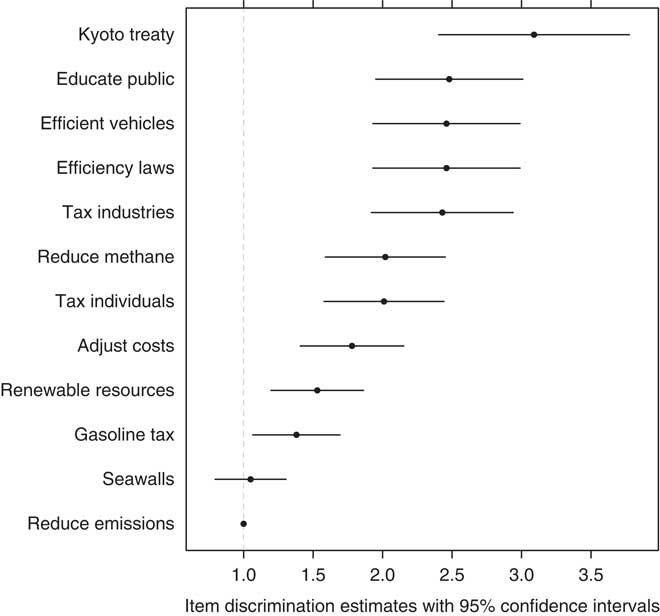
Figure 3 shows the discrimination estimates of the item discrimination parameter (shown by the solid dot) with the solid lines representing the 95 per cent confidence intervals around those estimates. Note that although we might discuss the latent policy support as being dichotomous (high versus low), and the range of latent support on Figure 3 ranges from −4 to +4, the theoretical range of latent policy support is from negative infinity to positive infinity.
Item discrimination estimates with 95 per cent confidence intervals

All of the indicators show a connection to the latent trait. Yet, there is variation in the ability of the items to discriminate among individuals that support climate change policies and those that do not. The questions asking respondents their support to reduce emissions and construct sea walls to protect coastal areas have relatively low discrimination.Footnote 60 Thus, these items are likely to have support among individuals with both high and low levels of policy support, providing little information about a respondent’s latent policy preference. Alternatively, support for the Kyoto Protocol, requiring more fuel-efficient vehicles, programs that will educate the public about climate change, mandatory efficiency laws and taxing industries for activities that contribute to global warming all have relatively large discrimination parameters. This is likely because disagreement with these items provides a great deal of information about people’s preferences, that is, so few disagree with these policies that disagreement strongly relates to opposition to policies related to climate change. Overall, these estimates provide evidence that some items capture the latent trait better than others. Moreover, it seems that even people that generally oppose policies related to climate change might not express opposition to policy options such as building sea walls to protect coastal settlements, generic policies to reduce emissions that do not identify the costs or the development of renewable energy sources.
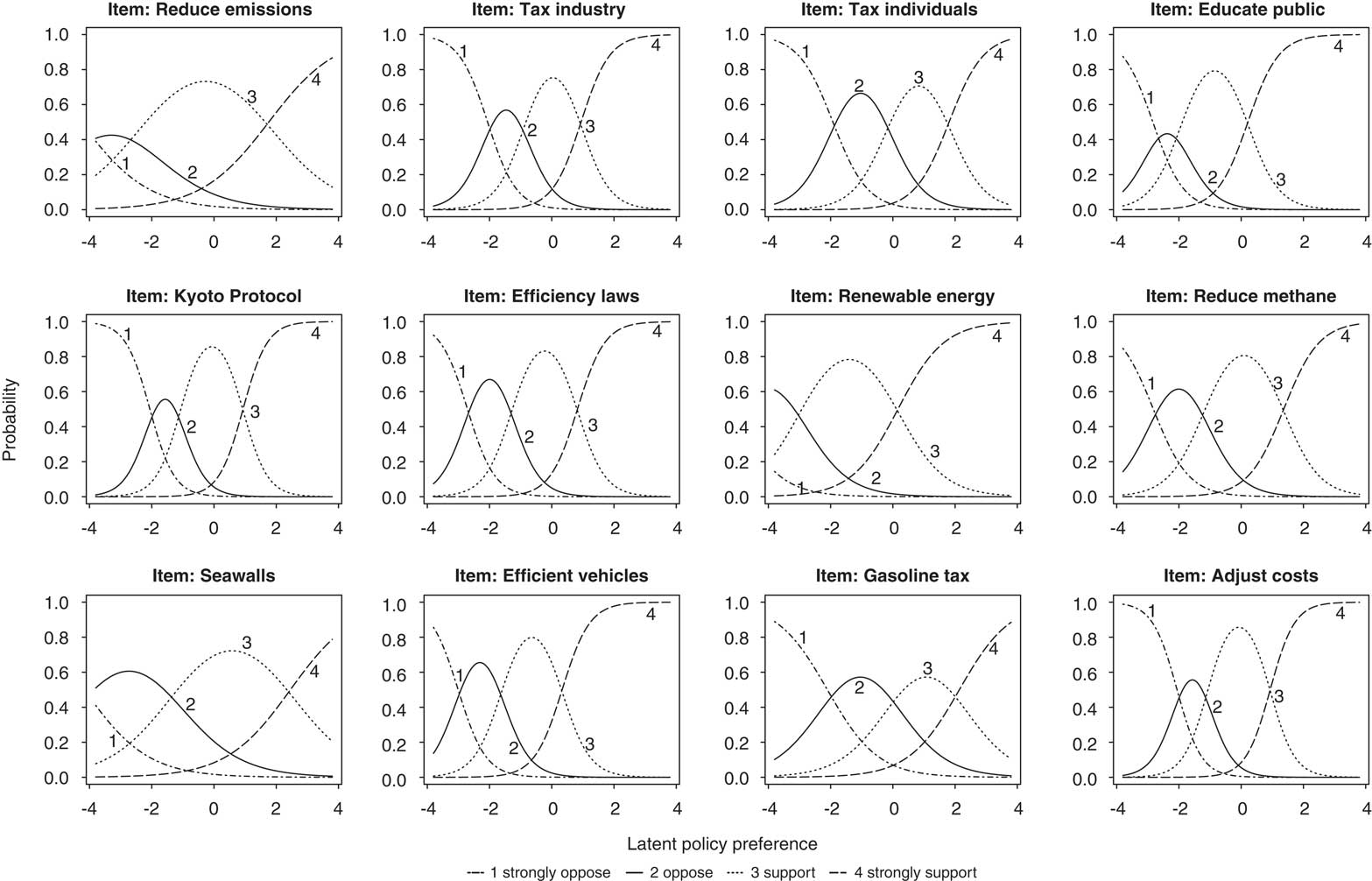
The HG-IRT model also provides estimates of the threshold levels for each item. The threshold level captures how movement along the latent trait of policy support translates into response categories for each item. Since it is difficult to interpret the threshold estimates directly, we present the item category probability curves (ICPC), which visually depict how the latent policy preference translates into a categorical response. Figure 4 shows the ICPC for each of the twelve items. Each item has four response categories: ‘strongly oppose’ (1), ‘oppose’ (2), ‘support’ (3) and ‘strongly support’ (4), which are identified by the four probability curves for each item. The probability of selecting a response category is on the y-axis and the latent policy preference is on the x-axis.
Item category probability curves

The estimates show that there is variation in how the latent policy preference to support policies to mitigate the risks of global warming translates into support for individual policy options. For instance, the probability that someone with a latent policy preference at the low end of the scale (−4) of choosing response category 1 (‘strongly oppose’) when asked if they support policies to reduce emissions is less than 0.4. However, the probability of that same individual with a latent preference at −4 of choosing category 1 (‘strongly oppose’) when asked if they support policies to tax individuals for behaviors that contribute to climate change is over 0.98. In fact, the probability of someone with a latent policy preference at the negative end of the scale selecting the ‘strongly oppose’ category is extremely low for the items on reducing emissions, renewable energy and sea wall construction. The sea walls item is also notable because the probability of selecting category 3 (‘support’) is relatively high across the latent policy preference scale. Thus, almost everyone has a relatively high probability of supporting such policies, which is consistent with existing research.Footnote 61 Also interesting is in responses to only two items – the fossil fuel price increase question and the taxing individuals question – respondents do have an equal probability of selecting category 2 (‘oppose’) or 3 (‘support’) when their latent policy preference is centered on the scale at zero. The latter would indicate an almost ideal measure since as we move away from the middle of the latent policy preference scale, support or opposition is more likely to fall into the appropriate category. Overall, these results show that attempts to create an index from these items using linear models such as factor analysis will result in biased estimates.
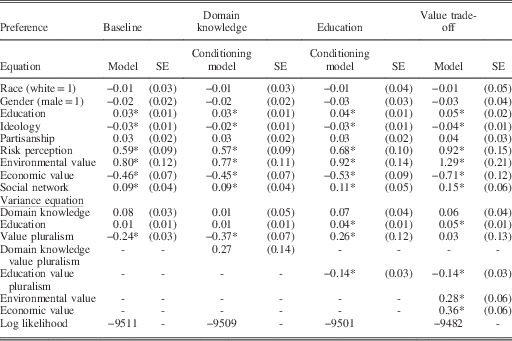
We start by estimating a model similar to previous research with the specification of the preference equation as shown in equation 4, while the variance around those preferences is estimated as a function of domain-specific knowledge, education and value pluralism. In other words, the baseline model reflects our prior knowledge of how value pluralism unconditionally relates to the variability in people’s political preferences. The preference equation estimates are shown at the top of the Table 1 and the variance estimates are shown at the bottom. The primary expectation in the preference model is that environmental and economic values will shape policy opinions. Endorsement of the NEP – a pro-ecological worldview – is associated with greater support for climate change-related policies. Support for the NEP also seems to be the strongest predictor of an individual’s latent policy support as indicated by the coefficient size. The economic values variable also conforms to our expectations. The coefficient is negative and statistically significant. This indicates that higher support for the economy is associated with greater opposition to climate change policies. Although the rhetoric has promoted the coexistence of climate change policies and economic growth, these data suggest that a desire for economic growth is associated with less support for policies that attempt to help humans mitigate the risks of rising temperatures and adapt to global warming.
The model also tests if perceiving climate change as a risk relates to support for policies to mitigate and adapt to climate change. Although risk perceptions and policy support may appear theoretically similar, they are conceptually distinct. Most people that perceive climate change as a risk might want to alleviate that risk through the enactment of new government regulations and preventative measures, but some people may not want the government to implement costly or restrictive policies even in the face of a risk. That said, the risk perception variable shows a positive and statistically significant relationship with policy support. Moreover, the size of the coefficient indicates the relationship is larger than any of the demographic or political variables. Perceiving a risk appears to be a gateway to supporting these climate change related policies.
Similar to past research, we find that education has a positive and statistically significant relationship with policy support. Respondents that report a higher level of education are more likely to support policies aimed at mitigating and adapting to global climate change. Note that the effect here refers to the direction of people’s preferences rather than the variance or stability of those preferences. The race and gender variables are statistically insignificant in the models, but in the expected direction with whites and men having less support for policies related to climate change relative to non-whites and women.
Political ideology shows a negative and statistically significant effect on policy support. Conservatives are less likely than moderates and liberals to support policies aimed at mitigating and adapting to climate change. This could reflect either a principled opposition to government programs or an affective symbolic judgement toward groups associated with climate change policies. The partisanship coefficient is also in the expected direction with Democrats showing higher levels of policy support than Republicans. However, the coefficient is statistically insignificant, suggesting partisan affiliations are less important attachments in this domain than values, risk perceptions and ideology.Footnote 62
Finally, people within social networks that communicate about climate change are predicted to have more support for climate change policies than people without such networks. The coefficient estimate on the social network variable is positive and statistically significant. In other words, discussing climate change with friends and family is associated with greater support for climate change policies. This might suggest that people’s opinions are somewhat driven by a desire for a social consensus or new information about the issue that might be communicated from social networks.
The preference equation estimates demonstrate that core values regarding the environment and the economy are important predictors of people’s preferences toward policies that mitigate and adapt to the risks of climate change. We now turn toward the estimates in the variance equation. The baseline model tests the relationship of domain-specific knowledge, education and value pluralism on the variation around people’s preferences toward climate change policies. The domain-specific knowledge and education variables are statistically insignificant in the model, eliminating uncertainty as an explanation for the variability in people’s policy preferences. It appears that more information is not the answer to increasing the stability and consistency in people’s opinions on this issue. Instead, value pluralism shows a negative and statistically significant relationship in the variance equation for the baseline model. This suggests evidence of value reinforcement or what Alvarez and Brehm refer to as equivocation, that is, respondents who equally value the environment and the economy have more stable preferences, meaning they are less likely to experience conflict among these values on this issue.Footnote 63 People are able to integrate their desires for economic growth and the environment into a perspective that leads to more rather than less stability in their preferences.
The sophistication-interaction hypothesis suggests that greater contextual knowledge about climate change might be required for people to integrate values about the economy and the environment into a coherent perspective that facilitates response stability. The domain-specific conditioning model in Table 1 tests whether domain-specific knowledge about the causes of climate change moderates the relationship between value pluralism and response variability. In contrast to the expectation of the sophistication-interaction hypothesis, the interaction coefficient is positive and statistically insignificant. Respondents that have a better understanding of the causes of climate change are no more likely to experience value reinforcement than respondents with less knowledge about the causes of climate change. The value pluralism coefficient is negative and statistically significant, indicating that even those that did poorly on the knowledge questions are able to resolve potential conflict between the economy and the environment. Of course, knowledge of the causes of climate change do not equate with knowledge of how climate change policies are consistent with economic growth and environmental sustainability. Therefore, we turn to educational attainment as an alternative measure of political sophistication.
Estimation of Public Preferences toward Climate Changes Policies and the Variability in Those Preferences

Notes: *p<0.05. N=982. Estimates are from a heteroskedastic graded item response theory model. The structural model estimates are the relationship between the predictors and the latent policy preference variable. The variance model estimates are the relationship between the predictors and the variance around the latent policy preference. Standard errors, shown in parentheses, are rounded to the second decimal.
The education conditioning model in Table 1 provides a second test of the sophistication-interaction hypothesis. The sophistication-interaction hypothesis suggests that the most educated respondents should have the cognitive ability to reconcile multiple values toward the environment and economy. The results of the education conditioning model support this hypothesis. The interaction term between education and value pluralism is negative and statistically significant. This indicates that education can increase the stability and consistency of people’s preferences toward climate change policies among people that value the economy and the environment. The value pluralism coefficient in the variance equation is now positive and statistically significant. This means that value pluralism is associated with greater instability among respondents with the lowest level of educational attainment.Footnote 64
The next column in Table 1 contains the estimates of the value trade-off model. The variance equation shows a negative statistically significant interaction between value pluralism and education. The highest educated that hold both values are able to provide more consistent responses across each of the policy items. The lowest educated, however, provide more inconsistent responses. If citizens are minimizing their response instability by choosing one value over another even when they value both, there should be a direct negative effect of the dominant value in the variance equation. However, the constituent terms for both the environmental and economic value are positive and statistically significant. This suggests that individual values increase response instability among the lowest educated respondents.
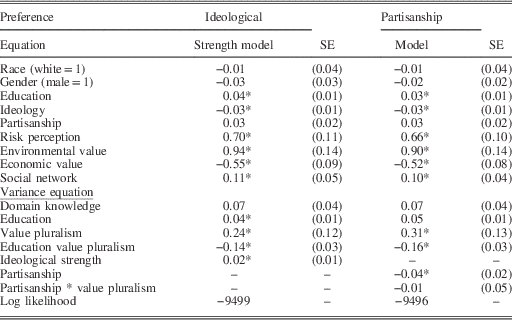
The interaction between holding multiple values and education is robust to alternative model specifications. These are shown in Table 2. First, we test the possibility that stronger ideologues have more hardened or crystallized belief systems, which would decrease the variability within their opinions. This suggests that ideological strength should show a negative association with each respondent’s variance. Including a measure of ideological strength (extreme liberal/conservative to weak liberal/conservative to moderate) shows that ideological strength has no relationship with the variability in respondent’s policy preferences. The coefficient is positive and statistically insignificant. The interaction between education and value pluralism, however, is negative and statistically significant. This supports the expectation that education helps some citizens resolve conflict from holding multiple values.
Estimation of Public Preferences toward Climate Change Policies and the Variability in those Preferences

Notes: *p<0.05. N =982. Estimates are from a heteroskedastic graded item response theory model. The structural model estimates are the relationship between the predictors and the latent policy preference variable. The variance model estimates are the relationship between the predictors and the variance around the latent policy preference. Standard errors, shown in parentheses, are rounded to the second decimal.
Second, we test if partisanship moderates the relationship between value pluralism and response variability. Scholarship shows deep partisan divisions on the issue of climate change,Footnote 65 but have yet to explore how partisanship shapes the variability in people’s political preferences. Given that Democrats have framed the debate over climate change in a manner that attempts to reconcile economic growth with policies that promote environmental values it might be the case that partisanship moderates the effect of value pluralism on policies that aim to mitigate and adapt to climate change. A preference for the Democratic Party might help people reconcile potential conflict between valuing the economy and the environment. The second model of Table 2 shows the results of the baseline model with an interaction between partisanship and value pluralism in the variance equation. The coefficient is negative as expected, but statistically insignificant indicating that partisanship fails to help reduce value conflict between the economy and the environment on this issue. Instead, the education and value pluralism coefficient remains negative and statistically significant as expected by the sophistication-interaction hypothesis.Footnote 66
CONCLUSION
Political conflict is often a competition over the legitimate authority to implement a policy that favors one set of values over another. Often, these competing values are held in high regard by most members of a society, making it difficult for people to consistently apply these values to their policy preferences. Past research has documented the various ways in which value pluralism translates into response stability or instability. However, such research has assumed value pluralism affects all people the same way, arguing the issue domain is what leads to variation in how value pluralism relates to response stability. This research provides evidence that how citizens deal with multiple values is sometimes dependent on their level of political sophistication. The interaction between educational attainment and value pluralism is negative and statistically significant in all four specifications of the variance equation. The reduction of internal conflict should require either cognitive ability, and potentially contextual information, regardless of the issue domain. That said, the ability of people to reconcile multiple values probably does not occur across all issues. Values that represent opposite sides of a single dimension, for instance, should be more difficult to reconcile regardless of a person’s political sophistication.
We were also able to find some evidence that cognitive ability, rather than domain-specific knowledge, is helping people resolve potential conflict between the economy and the environment in this domain. We did not find an interactive effect between value pluralism and domain-specific knowledge, but that might be because the facts of climate change are contested. Instead, we find that education as a proxy for cognitive ability did reduce internal conflict. This suggests that cognitive ability rather than contextual knowledge (and partisanship) is what is helping citizens reduce the potential conflict between the economy and the environment. Moreover, the results suggest that the absence of education can lead to attitudinal ambivalence for citizens with the lowest levels of educational attainment.
Another significant contribution of this study was providing a better understanding of the nature and structure of Americans’ support for policies aimed at mitigating global climate change. As in most policy debates, the disagreement over the enactment of climate change policies stems from the potential economic costs of enacting such policies versus the environmental costs of inaction. Indeed, valuing the environment led to more support for climate change policies and valuing the economy led to less support. Yet, possessing both of these values led to more consistent support (less variability) across a range of policies intended to reduce the risks of climate change. The finding that this occurs among the most educated respondents indicates an important role for education in helping citizens navigate the complexity of the political landscape. But it is not education of domain-specific facts, which has been a long-time goal of climate change scientists.Footnote 67 Instead, it is more likely the critical thinking skills associated with generalized educational advancement that can help citizens form more stable opinions on this issue.
This might appear to be inconsistent with studies showing that people most likely to view climate change as a risk and those most likely to be skeptical of climate change are the most informed in scientific literacy.Footnote 68 In other words, people with the most knowledge about climate change are also likely to be the most polarized in their beliefs about the risks of climate change due to their desire to conform to the values of their immediate social networks. However, these latter findings pertain to risk perceptions, which are conceptually distinct from people’s policy preference. Moreover, preferences are also distinct from the variability or variance of those preferences, which is the focal point of this research. The aforementioned studies are silent about how contextual information might influence the variability in opinions regarding climate change.
That said, we view our results as compatible with the aforementioned research. According to our results, a climate change skeptic who is well educated should still oppose policies that mitigate and adapt to climate change because they have an ideological commitment to limited government and a strong desire for economic growth. However, as education increases, their preferences regarding policies to mitigate and adapt to climate change should become more stable as they are better able to integrate their values regarding the environment and the economy. In this instance, we would suspect that a climate change skeptic would integrate these values in a manner that promoted a view that the environment would not be harmed by more economic growth. Their values would no longer be seen as incompatible and their policy opinions would become more stable. Similarly, a person who perceives climate change as a risk who is also well informed and educated would typically support policies to mitigate and adapt to climate change based on their ideological preferences and their pro-environmental worldview. However, as their education increases, their preferences regarding policies to mitigate and adapt to climate change would become more stable as they integrate their values regarding the environment and the economy. In this instance, we would suspect that a person who perceives climate change as a risk would integrate these values in a manner that promoted a view that the economy would not be harmed by more environmental regulation. This person’s values would no longer be seen as incompatible, but in a different way than the climate change skeptic. In each instance, the direction of a person’s policy preference might become polarized, while the variance around that preference became more stable.
Finally, we should note some limitations of this research. Although we examined the structure of individual preferences, we did not provide evidence on the causes of those preferences. In other words, we did not focus on how the information environment shapes the values citizens use in structuring their preferences. Elite framing can influence how citizens think about issues, particularly what values they use when forming a policy opinion. Proponents of policies to mitigate the risks of climate change have relied on frames focusing on the scientific consensus on the issue, the catastrophic risk that climate change poses for future generations and the economic benefits of such policies. Opponents have tried to induce doubt and uncertainty about the scientific process and focus on the potential negative economic consequences of enacting various policies. Yet, we do not find uncertainty is what characterizes public opinion on this issue. Instead, it is closer to equivocation among the most educated and ambivalence among the least.