Introduction
Consumption of foods rich in saturated fatty acids (SFA) is associated with an increased risk of cardiovascular disease (WHO/FAO, 2003) and development of insulin resistance and dyslipidaemia (Vessby et al., Reference Vessby, Uusitupa, Hermansen, Riccardi, Rivallese, Tapsell, Nalsen, Berglund, Louheranta, Rassmussen, Calvert, Maffetone, Pederson, Gustafsson and Storlien2001). Higher intakes of trans fatty acids (FA) are also associated with increased cardiovascular disease risk (Shingfield et al., Reference Shingfield, Chilliard, Toivonen, Kairenius and Givens2008). Milk and dairy products are an important source of fat, SFA and trans FA in the human diet (Hulshof et al., Reference Hulshof, van Erp-Baart, Anttolainen, Becker, Church, Couet, Hermann-Kunz, Kesteloot, Leth, Martins, Moreiras, Moschandreas, Pizzoferato, Rimestad, Thorgeirsdottir, van Amelsvoort, Aro, Kafatos, Lanzmann-Petitory and van Poppel1999), and therefore there is considerable interest in altering milk FA composition to improve long-term human health.
Numerous studies have examined the impact of oilseeds, plant oils, marine lipids and proportion of forage in the diet on milk fat composition (Givens and Shingfield, Reference Givens and Shingfield2006; Chilliard et al., Reference Chilliard, Glasser, Ferlay, Bernard, Rouel and Doreau2007), but research examining the role of forages in the diet on milk fat composition is relatively limited (Dewhurst et al., Reference Dewhurst, Shingfield, Lee and Scollan2006; Ferlay et al., Reference Ferlay, Martin, Pradel, Coulon and Chilliard2006). In northern Europe, maize silage (MS) and grass silage (GS) are the major conserved forages used for milk production (Wilkinson et al., Reference Wilkinson, Wadephul and Hill1996). It is well established that relative to GS, diets based on MS increase the milk yield and milk protein content (Phipps et al., Reference Phipps, Sutton and Jones1995). Recent studies have reported that these forages also alter milk FA composition (Ferlay et al., Reference Ferlay, Martin, Pradel, Coulon and Chilliard2006; Nielsen et al., Reference Nielsen, Straarup, Vestergaard and Sejrsen2006). Effects on milk FA may, at least in part, reflect inherent variations in the amount and composition of carbohydrate and lipid between GS and MS (Givens et al., Reference Givens, Cottrill, Davies, Lee, Mansbridge and Moss2001; Nielsen et al., Reference Nielsen, Straarup, Vestergaard and Sejrsen2006), which will influence both the rumen environment and biohydrogenation. Chilliard et al. (Reference Chilliard, Ferlay and Doreau2001) concluded that milk from cows fed either MS or GS does not tend to have a significantly different total polyunsaturated fatty acid (PUFA) content. But with the current interest in dietary n-6 : n-3 ratios, this area requires further investigation; Western diets tend to provide a higher ratio of n-6 : n-3 PUFA than is beneficial to long-term human health (Simopoulos, Reference Simopoulos2002).
In practice, both forages are often fed as part of a total mixed ration (TMR). Even though several studies have directly compared the effects of GS and MS on milk FA composition (Ferlay et al., Reference Ferlay, Martin, Pradel, Coulon and Chilliard2006; Nielsen et al., Reference Nielsen, Straarup, Vestergaard and Sejrsen2006), the impact of feeding diets containing variable proportions of these forages as part of a TMR is unclear. The current study was designed to examine changes in milk FA composition following the replacement of GS with incremental amounts of MS in diets containing a constant proportion of forage, typical of rations fed on farms in Europe. This was conducted in order to develop practical nutritional strategies to reduce milk fat SFA content and increase cis-monounsaturated fatty acids (MUFA) or PUFA, without enhancing the levels of trans FA.
Material and methods
Experimental design, animals and management
All experimental procedures used were licensed, regulated and inspected by the UK Home Office under the Animals (Scientific Procedures) Act, 1996. The experiment was conducted as two simultaneous 4 × 4 Latin squares with 28-day experimental periods (Table 1). Eight multiparous Holstein–Friesian cows of mean ± standard error (s.e.) liveweight 669 ± 13.18 kg, parity 3.4 ± 0.18 and 159 ± 5.9 days into lactation were used and initially matched as closely as possible for feed intake and milk yield potential. Treatments consisted of replacing GS with MS (0, 166, 334 and 500 g/kg, on a dry matter (DM) basis). Animals were restrained in individual tie stalls equipped with a rubber mattress and bedded with wood shavings. Clean water and trace mineralised blocks (Rockies (red), Tithebarn Ltd, Cheshire, UK) were available ad libitum. Cows were milked in situ at 0600 and 1645 h.
Allocation of treatments across four periods using a double 4 × 4 Latin square design

aMS000 = forage component of total mixed ration (TMR) was grass silage (GS); MS166 = TMR contained 166 and 334 g/kg DM maize silage (MS) and GS, respectively; MS334 = TMR contained 334 and 166 g/kg DM, MS and GS, respectively; MS500 = forage component of TMR was MS.
Experimental diets
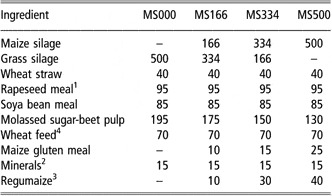
Diets consisted of a TMR (forage : concentrate ratio 54 : 46 on a DM basis; Table 1), formulated to be isonitrogenous and isoenergetic. The diets were prepared fresh daily and offered ad libitum as two meals at 0830 and 1630 h. Refusals were removed and weighed prior to the morning feeding. Changes between treatments were implemented over several days to minimise the impact of diet change.
Experimental sampling
Individual feed components (GS, MS and concentrates) of the four TMRs and feed refusals were sampled daily during the last 6 days of each treatment period and bulked to provide composite samples. The DM content of the offered feeds was determined by oven drying at 100°C for 18 h and the DM content of feed refusals was determined by drying at 60°C for 48 h. Samples of offered feeds and refusals (if appreciable) were retained at −20°C for subsequent chemical analysis.
Milk yields were recorded at each milking during the last 7 days of each treatment period. Samples of milk for the determination of fat, protein and lactose were also collected at this time from each cow at each milking. Additional samples of unpreserved milk were collected during the last 24 h of each experimental period, stored at −20°C until composited according to milk yield, and submitted for FA analysis.
Chemical analysis
Chemical composition of oven-dried (60°C), milled (1 mm screen) samples of forages and concentrates were determined using methods as described by Alderman (Reference Alderman1985) (neutral detergent fibre, NDF) and Ministry of Agriculture, Fisheries and Food (1986) (organic matter, OM; crude protein, CP; water-soluble carbohydrates; and ether extract). Starch was measured by its enzymatic conversion to glucose using amyloglucosidase, glucose then being measured using glucose oxidase. Forage metabolisable energy (ME) values were predicted by near-infrared (IR) reflectance spectroscopy based on the procedure described by Barber et al. (Reference Barber, Offer and Givens1989) (for GS), and calibrated on the neutral detergent-cellulase in vitro digestibility method described by Givens et al. (Reference Givens, Cottyn, Dewey and Steg1995) (for MS). Lipid content and FA composition of forages and concentrates from each period were assessed using an adaptation of the one-step extraction–transesterification procedure of Sukhija and Palmquist (Reference Sukhija and Palmquist1988), using toluene as an extraction solvent, methanolic sulphuric acid (2%, v/v) as the methylating reagent and tritridecanoin (T3882, Sigma–Aldrich Company Ltd, Dorset, UK) in toluene as an internal standard.
Milk fat, protein and lactose were determined in samples treated with potassium dichromate preservative (1 mg/ml; Lactabs, Thomson and Capper, Runcorn, UK) by near-IR spectroscopy (Foss Electric Ltd, York, UK).
Lipid in 1 ml milk was extracted using ethanol, hexane and diethylether (Shingfield et al., Reference Shingfield, Ahvenjärvi, Toivonen, Ärölä, Nurmela, Huhtanen and Griinari2003), and transesterified to FA methyl esters (FAME) using methanolic sodium methoxide (Christie, Reference Christie1982).
FAME were separated using a gas chromatograph (GC, 3400; Varian Inc., Palo Alto, CA, USA) equipped with a flame ionisation detector and a 100 m fused silica capillary column (i.d. 0.25 mm, CP-SIL 88, Varian Inc., Palo Alto, CA, USA) with hydrogen as the carrier gas. Total FAME in a 2 μl sample volume at a split ratio of 1 : 50 was determined using a temperature gradient programme (Shingfield et al., Reference Shingfield, Ahvenjärvi, Toivonen, Ärölä, Nurmela, Huhtanen and Griinari2003). Peaks were identified using authentic standards (GLC463; UC-59-M, Nu-Chek-Prep Inc., Elysian, MN, USA; and P9125, O4754, O9881, E4762, V1381; Sigma–Aldrich Company Ltd, Dorset, UK) and comparison with reference chromatograms in which minor peaks were identified based on gas-chromatography mass spectrometry analysis of 4,4-dimethyloxazoline FA derivatives (Shingfield et al., Reference Shingfield, Reynolds, Hervás, Griinari, Grandison and Beever2006). Milk FAME were corrected for losses during methylation using a milk fat reference standard (CRM 164, Bureau of European Communities). All milk FA results were expressed as g/100 g total FA.
The distribution of conjugated linoleic acid (CLA) isomers in lipid supplements and milk was determined using a high-performance liquid-chromatography system (Model 1090; Hewlett-Packard, Wilmington, DE, USA) equipped with an autosampler, photodiode array detector and four silver impregnated silica columns (ChromSpher 5 Lipids, 250 × 4.6 mm; 5 μm particle size; Varian Ltd, Oxford, UK) coupled in series, using 0.1% (v/v) of acetonitrile in heptane as the mobile phase (Shingfield et al., Reference Shingfield, Ahvenjärvi, Toivonen, Ärölä, Nurmela, Huhtanen and Griinari2003 and Reference Shingfield, Reynolds, Lupoli, Toivonen, Yurawecz, Delmonte, Griinari, Grandison and Beever2005).
Data analysis
Intake, milk production and milk FA composition data were subjected to analysis of variance using the general linear model procedure of Statistical Analysis Systems (Version 8.2; SAS Institute, Cary, NC, USA) with a model that included the random effects of cow and fixed effects of period and treatment. Sums of squares for treatment effects were further separated using orthogonal contrasts into single degree of freedom comparisons to test for the significance of linear and quadratic components of the response to replacing MS with GS in the diet. Least-square means ± s.e. are reported and treatment effects were considered significant at P < 0.05.
Results
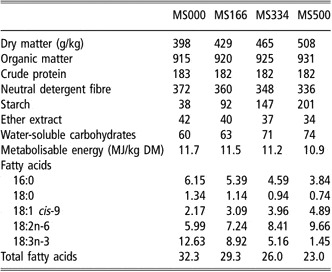
Chemical composition of dietary ingredients and experimental diets is shown in Table 2.
Diet ingredient composition (g/kg DM)

1Solvent-extracted rapeseed meal of low glucosinolate content.
2Proprietary mineral and vitamin supplement (Rockies (Red); Tithebarn Ltd, Cheshire, UK) declared as containing 380 g/kg sodium and (mg/kg) magnesium (5000), iron (1500), cobalt (50), copper (300), iodine (150), manganese (200), zinc (300) and selenium (10).
3Regumaize 44 (SvG Intermol Ltd, Bootle, Merseyside, UK). Declared composition (g/kg dry matter (DM)) crude protein (440), water-soluble carbohydrate (550) and metabolizable energy content (11.8 MJ/kg DM).
4Wheat feed (GP Feeds Ltd, Cheshire, UK). Declared composition (g/kg DM) crude protein (175), neutral detergent fibre (400), starch and sugars (340) and metabolisable energy (11.5 MJ/kg DM).
Replacing GS with MS in the diet resulted in a marginal decrease in ME and NDF concentrations, and an increase in DM, OM and starch content (Table 3). The ME values for GS and MS alone were 12.0 and 10.5 MJ/kg DM, respectively. In diets MS000 and MS166, 18:3n-3 predominated (12.6 and 8.9 g/kg DM, respectively) while 18:2n-6 was the major FA in diets MS334 and MS500 (8.4 and 9.7 g/kg TMR DM, respectively; Table 3). Increasing the proportion of MS at the expense of GS in the diet decreased 16:0, 18:0 and 18:3n-3, and increased cis-9 18:1 and 18:2n-6 contents. Diets MS000 and MS166 had a higher total FA content (Table 3) than diets MS334 and MS500.
Chemical composition of experimental diets (g/kg dry matter (DM) unless otherwise stated)

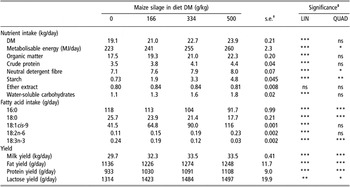
Replacing GS with MS linearly increased (P < 0.001) DM, OM, CP, water-soluble carbohydrate, cis-9 18:1 and 18:2n-6 intakes and daily milk yield (Table 4). Substitution of GS with MS also resulted in a linear decrease in 16:0, 18:0 and 18:3n-3 intakes. There was no significant change in milk fat concentration with increasing MS inclusion but milk protein and lactose concentrations increased, and with the higher daily milk yield this resulted in quadratic and linear increases in each milk constituent.
Effect of replacing grass silage and maize silage in the diet on nutrient intake, milk yield and milk composition

ns = not significant.
†s.e. for n = 32 measurements, 18 error d.f.
‡Refers to the significance of linear (LIN) and quadratic (QUAD) responses to replacing grass silage with maize silage in the diet.
*P < 0.05, **P < 0.01 and ***P < 0.001.
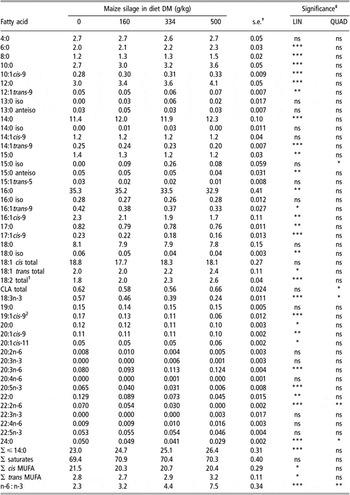
Inclusion of MS in the diet increased linearly (P < 0.05) milk fat 6:0, 8:0, 10:0, 12:0 and 14:0, and decreased trans-9 14:1, 15:0, 16:0, cis-9 16:1, trans-9 16:1, 17:0, cis-9 17:1 and 18:0 iso (Table 5). Substituting GS for MS in the diet also reduced linearly (P < 0.05) the concentrations of several minor FA including cis-7 19:1, 20:0, cis-9 20:1, 22:0, 24:0, 20:5n-3 and 22:2n-6, and increased the cis-11 20:1 content.
Effect of replacing grass silage with maize silage on milk fatty acid composition (g/100 g fatty acids)

ns = not significant.
†s.e. for n = 32 measurements, 18 error d.f.
‡Refers to the significance of linear (LIN) and quadratic (QUAD) responses to replacing grass silage with maize silage in the diet.
1All 18:2 isomers excluding CLA.
2Co-eluted with trans-11, cis-15 18:2.
*P < 0.05, **P < 0.01 and ***P < 0.001.
Including MS in the diet decreased n-3 FA (mainly from 18:3n-3) and increased n-6 FA (mainly from 18:2n-6), so that the n-6:n-3 ratio increased (Table 5).
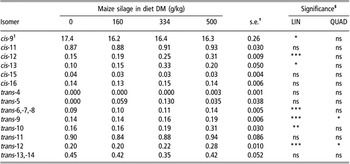
In addition to the effects on total trans FA, replacing GS with MS in the diet altered the trans 18:1 isomer profile in milk. This was characterised by linear increases (P < 0.05) in trans-6/8, 9, 10 and 12 isomers, with increasing MS inclusion (Table 6). The proportion of cis-9 18:1 linearly decreased (P < 0.05) whereas cis-12 and cis-13 18:1 increased.
Effect of replacing grass silage with maize silage on milk 18:1 isomer composition (g/100 g fatty acids)

ns=not significant
†s.e. for n = 32 measurements, 18 error d.f.
‡Refers to the significance of linear (LIN) and quadratic (QUAD) responses to replacing grass silage with maize silage in the diet.
1Also contains 18:1trans-15 as a minor component.
*P < 0.05, **P < 0.01 and ***P < 0.001.
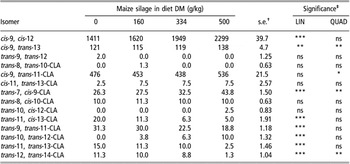
Replacing GS with MS modified the distribution of CLA isomers, characterised by linear increases (P < 0.05) in trans-7 cis-9 CLA, cis-9 trans-11 CLA and trans-10 trans-12 CLA and reductions in trans-12 trans-14 CLA, trans-11 cis-13 CLA, trans-9 trans-11 CLA and trans-11 trans-13 CLA (Table 7).
Effect of replacing grass silage with maize silage on milk 18:2 isomer composition (mg/100 g fatty acids)

ns = not significant.
†s.e. for n = 32 measurements, 18 error d.f.
‡Refers to the significance of linear (LIN) and quadratic (QUAD) responses to replacing grass silage with maize silage in the diet.
*P < 0.05, **P < 0.01 and ***P < 0.001.
Discussion
Previous research has established that nutrition has a major influence on milk FA composition (Givens and Shingfield, Reference Givens and Shingfield2006; Chilliard et al., Reference Chilliard, Glasser, Ferlay, Bernard, Rouel and Doreau2007) and that high forage diets can be used to enhance milk PUFA concentrations (Dewhurst et al., Reference Dewhurst, Shingfield, Lee and Scollan2006). The current study served to extend these findings by providing a detailed assessment of the impact of replacing GS with MS as part of a TMR on animal performance and milk FA composition.
Owing to a lower total lipid content, replacing GS with MS resulted in a reduced FA intake. Maize oil has a higher proportion of 18:2n-6 than grass (Table 2); hence, as MS inclusion increased, the amount of this in the TMR increased at the expense of the main FA in grass, 18:3n-3 (Table 2).
Increasing the amount of MS in the diet significantly increased the DM intake and milk yield, in agreement with previous studies (Phipps et al., Reference Phipps, Sutton and Jones1995; O’Mara et al., Reference O’Mara, Fitzgerald, Murphy and Rath1998). Replacing GS with MS in the diet also linearly increased the milk protein content, consistent with other reports (Lock and Shingfield, Reference Lock and Shingfield2004; Shingfield et al., Reference Shingfield, Reynolds, Lupoli, Toivonen, Yurawecz, Delmonte, Griinari, Grandison and Beever2005), which may reflect the increase in ME intake. An increase in milk protein concentration may also be attributed to microbial protein synthesis being energetically more efficient on MS than on GS-based diets (Givens and Rulquin, Reference Givens and Rulquin2004). Inclusion of MS in the diet had no effect on milk fat content. Typically, increases in starch intake coupled with decreases in NDF ingestion are associated with a reduction in milk fat (Lock and Shingfield, Reference Lock and Shingfield2004; Nielsen et al., Reference Nielsen, Straarup, Vestergaard and Sejrsen2006). A lack of effect on milk fat concentrations in this experiment may reflect a higher intake of NDF on MS-containing diets, in spite of this forage containing lower amounts of this constituent than GS. In addition, the diets containing increasing amounts of MS contained only a moderate total amount of starch plus water-soluble carbohydrates (less than 300 g/kg DM).
There was a significant increase in the proportion of short-chain SFA in milk with increasing MS dietary inclusion. This is in agreement with indirect comparisons made by Chilliard et al. (Reference Chilliard, Ferlay and Doreau2001). Short-chain saturates (<16:0) are synthesised de novo mainly using the precursor acetate (and to a lesser extent, β-hydroxy butyrate) derived from the peripheral circulation. An increase in milk short-chain SFA tends to suggest an increased acetate supply to the mammary gland. However, it is the general view that increasing dietary starch concentration at the expense of fibre alters volatile fatty acids (VFA) molar proportions towards greater propionate and less acetate (Blaxter, Reference Blaxter1962). One possible explanation for this apparent discrepancy could be related to the ruminal fermentation of MS, leading to higher VFA production than GS. In vitro studies have shown that despite the production proportions of VFA from MS leaning towards more propionate (and less acetate) when compared with GS, total acetate synthesis was greater owing to an overall higher VFA production (Calabrò et al., Reference Calabrò, López, Piccolo, Dijkstra, Dhanoa and France2005). However, this VFA production effect has not been observed in other studies (Brown et al., Reference Brown, Rymer, Agnew and Givens2002; Calabrò et al., Reference Calabrò, Williams, Piccolo, Infascelli and Tamminga2004).
Rumen butyrate production may also have contributed to the effects of forages on milk FA composition. Sveinbjörnsson et al. (Reference Sveinbjörnsson, Murphy and Udén2006) found that increasing the starch level during in vitro fermentations resulted in significantly higher molar proportions of butyrate. However, the dietary soluble sugar content was not discussed, and links have been found between diets higher in soluble sugars and butyrate production by protozoa (Chilliard et al., Reference Chilliard, Glasser, Ferlay, Bernard, Rouel and Doreau2007). In this study, the water-soluble carbohydrate intake did increase with increasing MS inclusion.
In addition, more long-chain PUFA in diet MS000 (which decreased linearly with increasing MS inclusion) could have inhibited mammary gland short-chain FA synthesis. Souza and Williamson (Reference Souza and Williamson1993) showed that PUFA were most potent at inhibiting FA synthesis in rat mammary glands compared with MUFA and SFA, and long-chain FA directly inhibit acetyl CoA carboxylase (ACC) (Barber et al., Reference Barber, Clegg, Travers and Vernon1997).
The decrease in the proportion of 16:0 observed with the diets containing more MS could reflect the intake of this FA, as a significant proportion of milk 16:0 is of circulatory origin.
The presence of odd- and branched-chain FA in milk can be used to identify shifts in the rumen microbial population, as most are of bacterial origin. When comparing earlier studies, Vlaeminck et al. (Reference Vlaeminck, Fievez, Cabrita, Fonseca and Dewhurst2006) found that replacing GS with MS in the diet resulted in a reduced milk iso 14:0 and iso 15:0, and suggested these FA originate from cellulolytic bacteria. The present study showed no such changes, perhaps reflecting the fact that although the diets containing progressively more MS had lower NDF contents, the overall amount consumed was greater so that cows on diet MS500 consumed more fibre than those on MS000. There was significantly less 17:0 and cis-9 17:1 in milk from cows fed the higher MS diets. Some 17:0 is synthesised in the mammary gland from propionate (Rigout et al., Reference Rigout, Hurtaud, Lemosquet, Bach and Rulquin2003), and cis-9 17:1 is a product of mammary Δ9-desaturase activity (Fievez et al., Reference Fievez, Vlaeminck, Dhanoa and Dewhurst2003). As rumen fermentation products were not measured in this study, it is difficult to speculate on the lower amount of milk fat 17:0 from diets with increasing MS inclusion.
Inclusion of MS in the diet resulted in a marginal decrease in cis-9 18:1 and increases in cis-12 and cis-13 18:1 concentrations consistent with previous comparisons of these forages (Shingfield et al., Reference Shingfield, Reynolds, Lupoli, Toivonen, Yurawecz, Delmonte, Griinari, Grandison and Beever2005). The decrease in cis-9 18:1 could be explained by the overall decreased intake of 18:0 with increasing MS inclusion. This would lead to a lower rumen outflow of 18:0 and reduced mammary desaturation to cis-9 18:1 (as described by Kinsella, Reference Kinsella1972). Enjalbert et al. (Reference Enjalbert, Nicot, Bayourthe and Moncoulon1998) found that there was a negative relationship between arterial circulation of trans-18:1 isomers and 18:0 desaturation in the mammary gland. However, when taking into account desaturation ratios (by dividing cis-9 10:1 by 10:0 and cis-9 14:1 by 14:0), there was no difference in desaturation activity for each of the diets, possibly due to low variations of circulating trans-18:1 isomers in the blood between diets. The changes in minor cis-18:1 FA may reflect that specific PUFA biohydrogenation – cis-12 18:1 is an intermediate of 18:2n-6 biohydrogenation. However, cis-13 18:1 is thought to be an intermediate of 18:3n-3 biohydrogenation (Jouany et al., Reference Jouany, Lassalas, Doreau and Glasser2007); therefore, it is unclear why this increased.
Increasing MS in the diet increased many of the trans isomers. There are two main reasons for these changes – differences in the starch/NDF ratio in each diet, and FA composition of the forages. Trans 18:1 isomers are formed during the penultimate step of rumen biohydrogenation of dietary 18-carbon PUFA to 18:0, with the isomer profile being dependent on the carbohydrate and lipid composition of the diet (Harfoot and Hazlewood, Reference Harfoot and Hazlewood1997). Kalscheur et al. (Reference Kalscheur, Teter, Piperova and Erdman1997) found that increasing the amount of dietary readily digestible carbohydrates caused an increase in certain milk trans 18:1. More specifically, studies have also found that complete replacement of GS with MS in the diet increases milk trans-10 18:1 concentrations (Shingfield et al., Reference Shingfield, Reynolds, Lupoli, Toivonen, Yurawecz, Delmonte, Griinari, Grandison and Beever2005; Ferlay et al., Reference Ferlay, Martin, Pradel, Coulon and Chilliard2006; Nielsen et al., Reference Nielsen, Straarup, Vestergaard and Sejrsen2006). The effects of ruminant-derived trans FA on human health have yet to be fully clarified – the isomer profile of ruminant products is different from that of industrial trans FA. Recently, Motard-Bélanger et al. (Reference Motard-Bélanger, Charest, Grenier, Paquin, Chouinard, Lemieux, Couture and Lamarche2008) suggested that moderate intakes of ruminant-derived trans FA are unlikely to have negative effects on cardiovascular disease risk factors, but until any isomer-specific effects are documented increased amounts of trans FA in milk should be viewed with caution.
Previous studies have shown that MS-based rations containing no additional lipid supplements increase the milk fat CLA content when compared with GS-based rations (Ferlay et al., Reference Ferlay, Martin, Pradel, Coulon and Chilliard2006; Nielsen et al., Reference Nielsen, Straarup, Vestergaard and Sejrsen2006; Chilliard et al., Reference Chilliard, Glasser, Ferlay, Bernard, Rouel and Doreau2007). In the present study, replacing GS with MS resulted in a quadratic increase in milk fat CLA. Forage source can alter the distribution of specific milk fat CLA isomers depending on FA composition. The increases in trans-10, trans-12 CLA and trans-7, cis-9 CLA observed with increasing MS inclusion could reflect biohydrogenation of the principle FA in MS, 18:2n-6 (Collomb et al., Reference Collomb, Seiber and Bütikofer2004; Roy et al., Reference Roy, Ferlay, Shingfield and Chilliard2006), whereas the decreases in trans-12, trans-14 CLA, trans-11, trans-13 CLA and trans-11, cis-13 CLA can be attributed to the decreased intake of the principle FA in GS (18:3n-3) with increasing MS inclusion (Collomb et al., Reference Collomb, Seiber and Bütikofer2004; Roy et al., Reference Roy, Ferlay, Shingfield and Chilliard2006).
The concentrations of non-conjugated 18:2 isomers in milk also reflect the PUFA composition of the forages. The increase in cis-9, trans-13 18:2 has been observed in studies involving increased intakes of 18:2n-6 (Roy et al., Reference Roy, Ferlay, Shingfield and Chilliard2006). The presence of this isomer in milk is thought to be because of the mammary desaturation of rumen-derived trans-13 18:1 (Loor et al., Reference Loor, Ueda, Ferlay, Chilliard and Doreau2005). However, the present study was unable to distinguish any changes in trans-13 18:1 due to co-elution with a different isomer. Also trans-11, cis-15 18:2 (an intermediate of 18:3n-3 biohydrogenation) co-eluted with cis-7 19:1; therefore, it was impossible to monitor any change in concentration.
Inclusion of MS in the diet decreased total n-3 PUFA, which reflects the differences in dietary composition. Milk fat 18:3n-3 concentrations were within the same range as those of Chilliard et al. (Reference Chilliard, Ferlay and Doreau2001) for GS- and MS-containing diets.
For all diets, the concentrations of each long-chain FA (C20+) were <0.2 g/100 g total FA. Increasing MS in the diet decreased the proportions of milk fat 20:5n-3, 22:0 and 22:2n-6 in agreement with previous studies (Shingfield et al., Reference Shingfield, Ahvenjärvi, Toivonen, Ärölä, Nurmela, Huhtanen and Griinari2003). The presence of more 20:5n-3 in milk from cows fed greater GS/less MS could be in part due to elongation/desaturation at the mammary gland level of 18:3n-3, which has escaped rumen biohydrogenation. This has been noted with diets that supply greater amounts of 18:3n-3 (Loor et al., Reference Loor, Ueda, Ferlay, Chilliard and Doreau2005; Roy et al., Reference Roy, Ferlay, Shingfield and Chilliard2006).
Both 12:0 and 14:0 have traditionally been regarded as hypercholesterolaemic (Williams, Reference Williams2000) and both increased linearly with increase in MS inclusion. However, the recent meta-analysis of Mensink et al. (Reference Mensink, Zock, Kester and Katan2003) concluded that the overall effect of these FA on cardiovascular disease risk is neutral. The same review concluded that 16:0 had an overall negative effect, and in the present study this decreased with increasing MS inclusion. This favourable change in milk fat composition when increasing the MS inclusion in dairy cow diet may be counterbalanced by the observed decrease in milk total cis-MUFA and n-3 PUFA, which goes against human dietary recommendations (Mensink et al., Reference Mensink, Zock, Kester and Katan2003; SACN/COT, 2004). Thus, overall, increasing the MS proportion had little effect on milk FA profile with respect to reducing cardiovascular disease risk.
The impact of forage type on milk FA profile appears to be of greater importance when lipid supplements are included in the diet. Interactions between dietary constituents on ruminal lipid metabolism can result in variable milk FA composition responses to oil supplements for diets containing different forages (Shingfield et al., Reference Shingfield, Reynolds, Lupoli, Toivonen, Yurawecz, Delmonte, Griinari, Grandison and Beever2005; Roy et al., Reference Roy, Ferlay, Shingfield and Chilliard2006). Increases in certain FA (cis-9 trans-11 CLA, trans-11 18:1, trans-10 18:1) have been shown to be more pronounced when supplementing dairy cows with plant oils when fed a basal forage of MS rather than GS (Chilliard et al., Reference Chilliard, Glasser, Ferlay, Bernard, Rouel and Doreau2007). Future attempts at manipulating the dairy cow diet to improve the FA profile without using oil supplements must also consider the effects of altering the basal diet, as this will have some effect on the biohydrogenation of any PUFA consumed.
This research was supported by LIPGENE (www.lipgene.tcd.ie), an EU Sixth Framework Programme Integrated Project (2004–2009). The authors gratefully acknowledge and appreciate the assistance of the late Colin Grayer for statistical support, staff of the Centre for Dairy Research, for care of the experimental animals.