Introduction
The bones of birds have a major impact on eggshell formation, and provide structural support. There are three types of bone tissue, including the cortical, trabecular, and medullary bone, in laying hens. The cortical bone has an intensive structure, while that of trabecular bone is not as intensive. The medullary bone is where the deposition of calcium (Ca) necessary for eggshell formation develops during sexual maturity (Webster, Reference WEBSTER2004; Kim et al., Reference KIM, BLOOMFIELD, SUGIYAMA and RICKE2012). In laying hens, approximately 2-2.5 g Ca is required to produce one egg. The Ca availability requirement for shell formation is met by intestinal absorption from feed. However, the bone is also a good source of Ca, particularly during dark periods when hens do not take in feed. Therefore, this process can lead to weakening of the bones, especially in older hens.
The deterioration of bone quality in laying hens may cause many problems including bone fractures, osteoporosis and economic losses (Whitehead and Fleming, Reference WHITEHEAD and FLEMING2000; Webster, Reference WEBSTER2004; Julian, Reference JULIAN2005). In a review, Kim et al. (Reference KIM, BLOOMFIELD, SUGIYAMA and RICKE2012) concluded that bone problems are directly related to economic parameters such as egg production and eggshell quality. Kim et al. (Reference KIM, DONALSON, HERRERA, KUBENA, NISBET and RICKE2005) showed that eggshell quality parameters were negatively correlated with bone quality. Approximately 30% of hens having osteoporosis are affected by bone fractures (Budgell and Silversides, Reference BUDGELL and SILVERSIDES2004), and these number are not only an extension of the economic problem but reflect a painful process that affects the welfare of birds (Fernandes et al., Reference FERNANDES, MURAKAMI, SCAPINELLO, MOREIRA and VARELA2009).
Bone fractures can be affected by many factors, including housing systems and the treatment of hens (Gregory et al., Reference GREGORY, WILKINS, ELEPERUMA, BALLANTYNE and OVERFIELD1990). On the other hand, breaking strength is an important factor in the prevention of bone fractures (Bishop et al., Reference BISHOP, FLEMING, McCORMACK, FLOCK and WHITEHEAD2000). Bone is a dynamic tissue, and physiological, nutritional and physical factors, such as physical activities and mechanical stress, affect its breaking strength (Rath et al., Reference RATH, HUFF, HUFF and BALOG2000). Bone fracture is not directly affected by nutrition (Rennie et al., Reference RENNIE, FLEMING, McCORMACK, McCORQUODALE and WHITEHEAD1997), though nutritional insufficiency can increase the rate and severity of bone fracture. Trace elements (Swiatkiewicz and Koreleski, Reference SWIATKIEWICZ and KORELESKI2008; Yıldız et al., 2011) and feed additives (Zhou et al., Reference ZHOU, DENG, TAO, HU and HOU2009; Mansoori and Modirsanei, Reference MANSOORI and MODIRSANEI2015; Olgun, in press) as well as good Ca nutrition play an important role in increasing bone breaking strength.
Additionally, the breaking strength of bone has been used as an indicator of good mineral nutrition and bone mineralisation in poultry (Merkley, Reference MERKLEY1981; Ruff and Hughes, Reference RUFF and HUGHES1985). Wilson (Reference WILSON1991) stated that there are positive relationships between breaking strength and bone ash content in laying hens. The mechanical properties (e.g., breaking strength and bone stress) of bone may be used to determine the association of functional characteristics of bone and other nutritional factors (Thomas et al., Reference THOMAS, IBARRA, SOLCHER, WETZEL and SIMMONS1988). Wilson and Ruszler (Reference WILSON and RUSZLER1998) reported that breaking strength and the amount of ash in bone can be used as criteria for the prevention of fracture and for the evaluation of efficacy of various feed ingredients. The purpose of this paper was to review the nutritional factors affecting the breaking strength of bone in laying hens.
Dietary calcium and limestone particle size
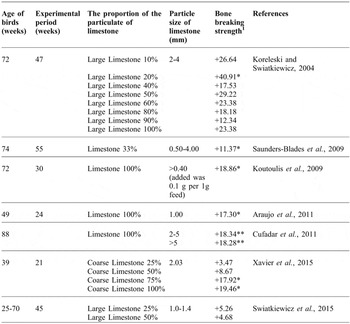
Calcium is the most important mineral in the structure of bone and eggshell, and approximately 99% of the Ca in the body is part of the skeletal system. For this reason, Ca nutrition plays a significant role in the maintenance of bone health and eggshell quality in hens. Furthermore, the particle size of Ca sources, along with the amount in the diet, is important because the large particulate sources stay longer in the gizzard than the powder form, and provide better sources of Ca during the night when the eggshell is formed (Bar et al., Reference BAR, RAZAPHKOVSKY and VAX2002). In this way, the particle size of Ca sources helps to maintain the activity and quality of the bone (Leeson and Summers, Reference LEESON and SUMMERS2005) and increase bone breaking strength (Guinotte and Nys, Reference GUINOTTE and NYS1991; Saunders-Blades et al., Reference SAUNDERS-BLADES, McISAAC, KORVER and ANDERSON2009; Cufadar et al., Reference CUFADAR, OLGUN and YILDIZ2011). The effects of dietary Ca and particle size of limestone on bone breaking strength in laying hens have been investigated by several studies ( Table 1 ). Increasing the dietary Ca concentration resulted in bone strength increasing from 8.27 to 12.52 kg-f/cm2 (Narvaez-Solarte et al., Reference NARVAEZ-SOLARTE, ROSTAGNO and SOARES2006). Similarly, Roland et al. (Reference ROLAND, BRYANT, RABON and SELF1996) demonstrated that increasing dietary Ca concentration linearly increased bone strength. Nascimento et al. (Reference NASCIMENTO, MURAKAMI, GUERRA, OSPINAS-ROJAS, FERREIRA and FANHANI2014) noted that bone strength increased linearly when Ca levels were increased (from 2.85% to 5.28%) in the diets of layers (80 weeks of age). The dietary Ca level which necessary needed for good bone strength can be increased up to 10% of Ca level recommends in management guide of modern layer strain.
Koutoulis et al. (Reference KOUTOULIS, KYRIAZAKIS, PERRY and LEWIS2009) reported that increasing Ca concentrations from 35 to 40 mg/kg and increasing limestone particle size significantly increased tibia breaking strength in brown laying hens at 72 weeks of age, but at first egg age, this effect was insignificant. Oliveira et al. (Reference OLIVEIRA, FREITAS, FILGUEIRA, CRUZ and NASCIMENTO2013) stated that the use of a proportion of 63.3 g of average particle size (0.60 mm) replacing the fine limestone (0.23 mm) per 100 g of total limestone added to the diet improved bone breaking strength in laying hens at 82 weeks of age.
Cheng and Coon (Reference CHENG and COON1990) and Guinotte and Nys (Reference GUINOTTE and NYS1991) showed that tibia bone breaking strength was higher in hens fed with larger limestone particles than in those fed ground limestone, especially during the latter 66 weeks of age. De Witt et al. (Reference DE WITT, KULEILE, VAN DER MERWE and FAIR2009) stated that an increase in limestone particle size resulted in increased tibia breaking strength in laying hens at 70 weeks of age. Saunders-Blades et al. (Reference SAUNDERS-BLADES, McISAAC, KORVER and ANDERSON2009) reported that feeding large-particle Ca sources increased bone breaking strength in laying hens at 74 weeks of age, but this effect was not observed with the different Ca sources. On the other hand, Cufadar et al. (Reference CUFADAR, OLGUN and YILDIZ2011) stated that the breaking strength of bone is not affected by the dietary Ca level or particle size of limestone in moulted laying hens at 88 weeks of age. The reason why no effect of dietary Ca concentration and particle size was observed for breaking strength may be that birds can protect the Ca in their bones when they have absorbed enough Ca via the intestinal route to meet metabolic requirements.
Effect of particle size of limestone on breaking strength of the tibia in laying hens.

1Numbers in columns indicate the percentage change relative to the control group; significant difference found *(P < 0.05), **(P > 0.01).
Phosphorus and phytase
Phosphorus (P) is a structural element of the bones found together with Ca in the form of phosphate ions in bones. Sohail and Roland (Reference SOHAIL and ROLAND2002) reported that non-phytate P had a significantly linear and quadratic effect on bone breaking strength when non-phytate P was increased from 0.1 to 0.3%; bone breaking strength increased linearly from 15.8 to 17.1 kg. Nie et al. (Reference NIE, YANG, YUAN, WANG and GUO2013) showed that the dietary non-phytate P levels (from 0.20% to 0.40%) had no effect on bone breaking strength in Dwarf Pink-Shell laying hens (40 weeks of age).
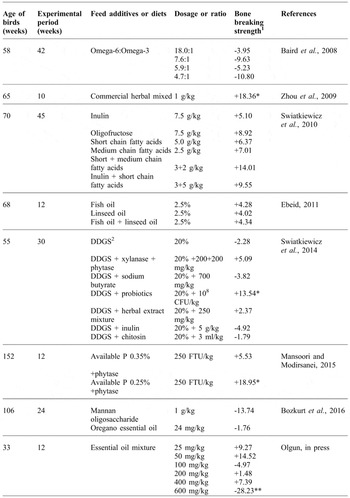
Phytase is an enzyme that enhances the digestion and absorption of P by hydrolysis of phytate to inositol and inorganic phosphate in monogastric animals. Generally, studies have shown that the addition of phytase to the diets of laying hens had no effect on the breaking strength of bone. Gordon and Roland (Reference GORDON and ROLAND1997) and Englmaierova et al. (Reference ENGLMAIEROVA, SKRIVANOVA and SKRIVAN2014) demonstrated that dietary non-phytate P (from 0.10% to 0.50%) levels or supplementation of phytase (150 or 300 FTU/kg) did not affect bone breaking strength in laying hens. Lei et al. (Reference LEI, SHI, ZHANG, DING, BAI and LIU2011) noted that the addition of 300 FTU/kg of phytase to lower concentrations of non-phytate P (0.14%) and Ca (3.30%) had no effect on bone breaking strength in laying hens at 76 weeks of age. Silversides et al. (Reference SILVERSIDES, SCOTT, KORVER, AFSHARMANESH and HRUBY2006) showed that supplementation of xylanase (2000 U/kg) and phytase (300, 500, or 700 ppu/g) to adequate or reduced P diets did not affect bone breaking strength in laying hens at 64 weeks of age. Nevertheless, Mansoori and Modirsanei (Reference MANSOORI and MODIRSANEI2015) reported that the addition of phytase (250 FTU/kg) increased the breaking strength in older laying hens ( Table 2 ).
Effect of some feed additives on breaking strength of the tibia in laying hens.

1Numbers in columns indicate the percentage change relative to the control group; significant difference found *(P < 0.05), **(P > 0.01).
2 Dried distillers’ grains and soluble
Trace elements
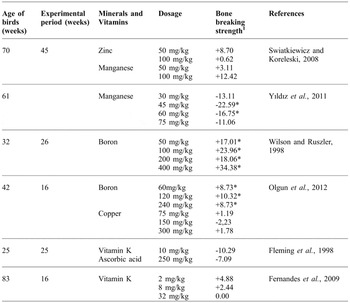
Trace minerals are important in maintaining bone health as the macro minerals such as Ca and P ( Table 3 ). Zinc is a mineral essential for osteoblastic activity, collagen synthesis, and alkaline phosphatase activity (Palacios, Reference PALACIOS2006). Park et al. (Reference PARK, BIRKHOLD, KUBENA, NISBET and RICKE2004) showed that the values of bone breaking strength in hens supplemented with zinc-acetate (1.0%) were higher than those of moulting hens supplemented with zinc-propionate. On the other hand, Swiatkiewicz and Koreleski (Reference SWIATKIEWICZ and KORELESKI2008) indicated that bone biomechanical properties, including breaking strength, were not affected by zinc or manganese supplementation (50 or 100 mg/kg) in laying hens. The form of zinc in the diet may have an impact on bone breaking strength.
Manganese, a cofactor of enzymes such as manganese superoxide dismutase, hydrolase, and transferase, is essential for bone growth (Dermience et al., Reference DERMIENCE, LOGNAY, MATHIEU and GOYENS2015) as it is needed for matrix formation (Palacios, Reference PALACIOS2006). The breaking strength of tibia tended to slightly increase when hens were supplemented with 50 or 100 mg/kg levels of manganese (Swiatkiewicz and Koreleski, Reference SWIATKIEWICZ and KORELESKI2008). Conversely, Yıldız et al. (2011) reported that the shear stress and breaking strength of bone was significantly reduced when the manganese content added to the basal diets increased (from 15 to 75 mg/kg), but dietary manganese sources (manganese-sulphate and manganese-Bioplex) had no simultaneous significant effect on bone properties in laying hens at 49 weeks of age. There is a need for more research for determining the negative effect of increasing manganese dietary levels on bones in laying hens.
Boron is a trace element with a significant impact on mineral metabolism and bone strength through interactions with Ca, P, and magnesium (Armstrong and Spears, Reference ARMSTRONG and SPEARS2001; Naghii et al., Reference NAGHII, TORKAMAN and MOFID2006). Wilson and Ruszler (Reference WILSON and RUSZLER1998) reported that the addition of boron (from 50 to 400 mg/kg) increased the breaking strength of bone at 32 weeks of age, but this effect was not observed at 52 and 72 weeks. Olgun et al. (Reference OLGUN, YAZGAN and CUFADAR2012) indicated that boron supplementation (60, 120, and 240 mg/kg) improved the breaking strength of bone in laying hens at 42 weeks of age. However, the breaking strength of bones from hens fed reduced Ca (3.28%) and available P (034%) diet were significantly lower than for these fed a control diet (Ca 3.94%, and P 0.42%), and was not affected by boron (75 or 100 mg/kg) supplementation (Küçükyılmaz et al., 2014).
The main effect of copper on bone is via its incorporation into the structure of lysyl oxidase, which is essential for cross-linking between collagen and elastin (Beattie and Avenell, Reference BEATTIE and AVENELL1992; Dollwet and Sorenson, Reference DOLLWET and SORENSON1988). Nevertheless, Olgun et al. (Reference OLGUN, YAZGAN and CUFADAR2012) showed no effects on the breaking strength of bone when laying hens were supplemented with 75, 150, and 300 mg/kg levels of copper in laying hens at 49 weeks of age.
Effect of some trace minerals and vitamins on breaking strength of the tibia in laying hens.

1Numbers in columns indicate the percentage change relative to the control group; significant difference found *(P < 0.05).
Vitamins
Vitamin D, which is a crucial nutrient for the maintenance of bone health because it maintains the Ca content of the blood by increasing Ca absorption efficiency, is regularly given with diets in a premix to laying hens. Newman and Leeson (Reference NEWMAN and LEESON1999) indicated that the addition of 5 µg/kg of 1.25 (OH)2 D3 to the diet caused an increase in bone breaking strength after 15 days in 82-week-old laying hens, although no difference was observed after 30 days. Contrarily, Kappeli et al. (Reference KAPPELI, FRÖHLICH, GEBHARDT-HENRICH, PFULG, SCHAUBLIN, ZWEIFEL, WIEDMER and STOFFEL2011) demonstrated that dietary addition of 25 (OH) D3 had no effect on the breaking strength of keel bone of laying hens. Similarly, Nascimento et al. (Reference NASCIMENTO, MURAKAMI, GUERRA, OSPINAS-ROJAS, FERREIRA and FANHANI2014) reported that supplementation of different vitamin D3 forms (2000 IU) had no effect on bone breaking strength in laying hens (80 weeks of age).
Vitamin K is needed for the post-translational modification of osteocalcin, which is required for bone growth (Hauschka et al., Reference HAUSCHKA, LIAN, COLE and GUNDBERG1989). Fernandes et al. (Reference FERNANDES, MURAKAMI, SCAPINELLO, MOREIRA and VARELA2009) noted that supplementation of the diets with vitamin K (from 2 to 32 mg/kg) did not alter bone breaking strength in laying hens (67 weeks of age). Fleming et al. (Reference FLEMING, McCORMACK and WHITEHEAD1998) stated that ascorbic acid (250 mg/kg) and vitamin K (10 mg/kg) had no effect on bone breaking strength in laying hens.
Vitamin C is a cofactor in the hydroxylation of lysine and proline, and is required in the cross-linking of collagen fibrils, stimulation of alkaline phosphatase activity, and formation of osteoblasts in bone (Palacios, Reference PALACIOS2006). Orban et al. (Reference ORBAN, ROLAND, CUMMINS and LOVELL1993) reported that the dietary addition of large quantities of ascorbic acid (from 0 to 3000 ppm) had no effect on bone breaking strength. Newman and Leeson (Reference NEWMAN and LEESON1999) indicated that adding 100 mg/kg of vitamin C to the diet generally had little effect on bone characteristics of older laying hens (82 weeks of age).
Regulation of diet formulation
Diet has an important role in bone health. Hassan et al. (Reference HASSAN, CHOE, JEONG, HWANGBO and RYU2013) reported that feeding 2775 kcal/kg metabolic energy and 16% crude protein numerically increased the bone breaking strength of laying hens (46 weeks of age) over those fed 2750 and 2800 kcal/kg metabolic energy and 17% crude protein. Jiang et al. (Reference JIANG, CUI, SHI, KE, LUO and HOU2013) reported that compared with the control energy diet, high- and middle-energy diets decreased bone breaking strength and stiffness in younger laying hens (27 weeks of age). Nevertheless, Lei et al. (Reference LEI, SHI, ZHANG, DING, BAI and LIU2011) demonstrated that lower concentrations of metabolic energy (reduced by 210 kJ/kg) and crude protein (reduced by 0.3%) had no effect on bone breaking strength in laying hens at 76 weeks of age.
Moulting in laying hens is an important physiological process. However, there are few studies examining the effects of moulting in conjunction with different diets on bone in laying hens. Patwardhan et al. (Reference PATWARDHAN, KING, OBERBAUER and HOLLAND2011) showed that the breaking strength of the tibia was not affected by tomato pomace, safflower meal, or salt-free diets in third-cycle Single Comb White leghorn hens. Similarly, Gongruttananun et al. (Reference GONGRUTTANANUN, GUNTAPA and SAENGKUDRUA2013) stated that the different moult diets (broken rice, corn, or cassava) had no effect on bone breaking strength in laying hens at 95 weeks of age.
Feed supplements
Feed supplements have the power to reduce the pH of the diet and the digesta could have a positive effect on mechanical properties including the breaking strength of bone in aged and/or highly producing laying hens (Swiatkiewicz et al., Reference SWIATKIEWICZ, KORELESKI and ARCZEWSKA2010). Zhou et al. (Reference ZHOU, DENG, TAO, HU and HOU2009) indicated that supplementation with 1 g/kg of a mixture of four Chinese herbs increased the breaking strength of the tibia in older laying hens. Swiatkiewicz et al. (Reference SWIATKIEWICZ, KORELESKI and ARCZEWSKA2010) reported that the dietary addition of oligofructose (7.5 g/kg) and inulin (3.0 g/kg) increased bone breaking strength in laying hens at 70 weeks of age. Swiatkiewicz et al. (Reference SWIATKIEWICZ, ARCZEWSKA-WLOSEK and JOZEFIAK2014) found that the dietary addition of 200 mg/kg of a blend of herbal extracts with high levels of dried distiller grains and minerals increased the breaking strength of the femur and tibia in laying hens. Hens fed a diet containing mannan oligosaccharide (1 g/kg) decreased bone stress and fracture energy in moulted laying hens, but bone breaking strength was not affected by mannan oligosaccharide (1 g/kg) or oregano oil (24 mg/kg) (Bozkurt et al., Reference BOZKURT, BINTAŞ, KIRKAN, AKŞIT, KÜÇÜKYILMAZ, ERBAŞ, ÇABUK, AKŞIT, PARIN, EGE, KOÇER, SEYREK and TÜZÜN2016). Olgun (in press) demonstrated that dietary supplementation with a low or medium (from 25 to 400 mg/kg) concentration of essential oils mixture improved bone parameters, which were adversely affected at high levels (600 mg/kg) in laying hens at 33 weeks of age.
Fatty acids
Swiatkiewicz et al. (Reference SWIATKIEWICZ, KORELESKI and ARCZEWSKA2010) demonstrated that the dietary addition of short-chain fatty acids (5.0 g/kg) and medium-chain fatty acids (2.5 g/kg) increased bone breaking strength in laying hens (70 weeks of age). Tarlton et al. (Reference TARLTON, WILKINS, TOSCANO, AVERY and KNOTT2013) stated that the dietary addition of omega-3 polyunsaturated fatty acids increased the ultimate stress at breaking and energy to break of the tibia in laying hens (70 weeks of age). This improvement in the breaking strength of bone was a result of increases in alkaline phosphatase (a marker osteoblast) and tartrate-resistant acid phosphatase (a marker osteoclast) with increasing dietary omega-3 levels, indicating enhanced bone turnover (Tarlton et al., Reference TARLTON, WILKINS, TOSCANO, AVERY and KNOTT2013). However, Baird et al. (Reference BAIRD, EGGETT and FULLMER2008) reported that the different dietary ratios of omega-6:omega-3 fatty acids had no effect on the breaking strength of the femurs of laying hens (58 weeks of age). Ebeid (Reference EBEID2011) noted that different dietary sources of unsaturated fatty acids (fish oil or/and linseed oil) had no effect on bone breaking strength in laying hens (68 weeks of age).
Conclusions
To ensure good bone quality in laying hens, dietary levels of Ca, P, and vitamin D must be sufficient and the particle size of at least 50% of the Ca source must be 2 mm. In addition, the incorporation of approximately 50 or 100 mg/kg of boron in the diets can increase bone breaking strength in laying hens. The addition of the enzyme phytase to diets, especially when dietary P is low improves bone quality and therefore increases breaking strength. The short and medium chain fatty acids and certain feed supplements, such as essential oils or herbals and inulin, have been found to improve the breaking strength of bone in laying hens.