





Introduction
Cancer is a well-documented global issue and a major cause of mortality worldwide, with approximately 9.7 million deaths and 20 million new cases recorded in 2022 (Bray et al. Reference Bray, Laversanne and Sung2024). The burden is disproportionately high in low- and middle-income countries (LMICs), where limited resources for early detection and treatment often lead to higher mortality rates and late-stage diagnoses (Martinez et al. Reference Martinez, Schmeler and Lajous2024). In Nigeria, the estimated number of new cases in 2022 was 127,763 with a recorded number of mortalities being 79,542 (Ogunniyi et al. Reference Ogunniyi, Fatokun and Isah2025). However, beyond the physical distress and pathology that cancer produces in survivors, it is also known to cause a significant number of sociodemographic and psychological issues, which present as psychosocial distress. These psychological issues reveal themselves as depression and anxiety.
The psychological sequelae of cancer have gained increasing recognition as critical determinants of patient outcomes. Globally, the prevalence of depression among cancer survivors is estimated at 33.16%, while anxiety affects approximately 30.55% of this population (Getie et al. Reference Getie, Ayalneh and Bimerew2025). These rates are even reportedly higher in low-resource settings, where late-stage presentations are common and psychosocial support services remain largely unavailable (Nakie et al. Reference Nakie, Melkam and Takelle2024; Jammalamadugu et al. Reference Jammalamadugu, Luckett and Opondo2026). In Nigeria, studies have documented that psychological distress affects over 76% of cancer patients, with moderate to severe anxiety reported in 56% and depression in 58% of those surveyed (Madu et al. Reference Madu, Nwozichi and Ojewole2018; Eguzo et al. Reference Eguzo, Onwueyi and Laskar2022). The pervasive misconception that cancer is a death sentence or associated with witchcraft further compounds stigma, leading to concealment of diagnosis, delayed treatment-seeking, and feelings of worthlessness.
Pain is among the most prevalent and debilitating symptoms experienced by cancer patients, with global estimates indicating that between 44% and 77% of patients complain of pain. In Nigeria, the prevalence of pain among hospitalized cancer patients has been reported to be between 73.8% and 86% (Nuhu et al. Reference Nuhu, Odejide and Adebayo2009; Makama et al. Reference Makama, Khalid and Garba2014; Joseph et al. Reference Joseph, Salako and Alabi2021). The relationship between pain and psychological distress is known to be bidirectional and self-perpetuating (Khemiri et al. Reference Khemiri, Ben Thabet and Ben Kridis2019; Chen et al. Reference Chen, Ju and Xia2022; Yao et al. Reference Yao, Zhang and Lu2023): chronic pain exacerbates emotional distress, while anxiety and depression heighten pain perception through shared mechanisms involving chronic stress, inflammation, and altered neurotransmitter activity (Sheng et al. Reference Sheng, Liu and Wang2017; Aboushaar and Serrano Reference Aboushaar and Serrano2024). This vicious cycle leads to poorer treatment adherence, increased hospitalizations, and potentially worse survival outcomes.
Beyond general cancer pain, neuropathic pain (NP) – resulting from tumor infiltration of nerves or from chemotherapy-induced peripheral neuropathy – represents a distinct and often under-recognized clinical entity (Varrassi et al. Reference Varrassi, Myrcik and Leoni2026). NP is characterized by burning, shooting, or electric shock-like sensations and is notoriously difficult to manage with conventional analgesics. Among patients with chronic cancer pain, neuropathic features are present in between 30% and 47% of cases, and the prevalence is rising with increased use of neurotoxic chemotherapeutic agents such as platinum compounds, taxanes, and vinca alkaloids (Mulvey et al. Reference Mulvey, Paley and Schuberth2024; D’souza et al. Reference D’souza, Saini and Hussain2025). Chemotherapy-induced peripheral neuropathy can cause not only sensory deficits but also significant psychosocial maladaptation, including anxiety, depression, sleep disorders, and social impairment (Hung et al. Reference Hung, Liu and Chen2021; Selvy et al. Reference Selvy, Kerckhove and Pereira2021; Zhou et al. Reference Zhou, Wang and Ding2022). However, the specific contribution of NP to the psychological burden of cancer patients – particularly in LMICs where diagnostic and therapeutic resources are constrained – has received minimal research attention.
In sub-Saharan Africa, the intersection of cancer, pain, and psychological distress is further complicated by structural barriers to palliative care, limited access to psychotropic medications, and a severe shortage of mental health professionals (Magboh et al. Reference Magboh, Saba and Krause2023). In Uganda, where 73% of cancer patients have severe pain, 48.2% of family caregivers report depressive symptoms and 35.2% report anxiety, with depression associated with cancer pain, underscoring the ripple effects of unmanaged cancer pain on entire support systems (Muliira and Kizza Reference Muliira and Kizza2019). In a more recent study, psychological distress and pain were listed as unmet needs among cancer patients in Uganda (Muliira et al. Reference Muliira, Mayanja and Nandawula2025). Despite these alarming figures, no previous study has specifically examined the relationship between cancer pain in general, NP in particular, anxiety, and depression among cancer patients in Nigeria.
The present study therefore seeks to address this critical gap. The objective is to investigate the relationship between pain – including NP – along with other associated factors and the presence of anxiety and depression in cancer patients receiving care at a teaching hospital in Nigeria. This study is novel in its specific focus on NP as a distinct contributor to psychological morbidity in this population. By delineating these relationships, the findings aim to inform integrated palliative and psychosocial care models that address the full spectrum of suffering – physical, psychological, and social – experienced by Nigerian cancer patients. Such evidence is urgently needed to guide resource allocation, clinician training, and the development of contextually appropriate screening and management protocols for this vulnerable and underserved population.
Methodology
Study design
The study was a descriptive, cross-sectional study designed for oncology patients attending the adult outpatient clinic at the University of Ilorin Teaching Hospital.
Study population
The study was focused on patients at the University of Ilorin Teaching Hospital who had received a pathologically confirmed diagnosis of cancer and were either receiving any treatment or not. The treatment modalities included chemotherapy, radiotherapy, surgery, or a combination of the aforementioned. Sample size was determined based on the workings that the number of samples be at least 5 times the number of the items of the questionnaire and study proforma deployed. Since the total number of items was 22, the sample size was to be at least 5 times the number, which is 110; a total of 126 patients were eventually included in the sample. Patients who met the inclusion criteria were recruited via serial sampling. The inclusion criteria included age ≥18 years, a confirmed medical diagnosis of cancer, and a functional cognitive status to be able to understand and respond to questions appropriately as well as give consent to participate. Patients who did not meet the criteria or did not consent to be part of the study were excluded. Patients signed an informed consent form after explanations about the study were made.
Study instruments
Data were collected primarily using a structured, interviewer-administered questionnaire as well as other validated questionnaires, and thus they were divided into 3 sections. The sociodemographic characteristics of the cancer patients included details such as age, sex, marital status, educational level, occupation, body composition, etc. The clinical information included the type of cancer, various treatment modalities, pain levels and characteristics including NP, and the Karnofsky Performance Status (KPS).
The Hospital Anxiety and Depression Scale (HADS) is a self-report questionnaire that is used to determine psychological distress. It is a common psychological instrument used in oncology. It is made up of 14 items, which are scaled into 7 items for anxiety (HADS-A) and the other 7 for depression (HADS-D). The answers are put in an ordinal format with 4 responses scored between 0 and 3, which ultimately puts the highest score at 21 for each of the anxiety and depression items (Annunziata et al. Reference Annunziata, Muzzatti and Bidoli2020). Each item on the questionnaire was answered based on how the subjects felt over the past 4 weeks. The Cronbach’s alpha for HADS-A and HADS-D is reported to range from 0.87 to 0.93 (Djukanovic et al. Reference Djukanovic, Carlsson and Årestedt2017). For this current study, the Cronbach’s alpha was 0.81 for HADS-A and 0.85 for HADS-D.
Another questionnaire used was the Sheehan Disability Scale (SDS). The SDS is a brief, 5-item self-report tool designed to assess functional impairment in work/school, social life, and family life. Impairment is rated on a 10-point scale (0–30 total score), with higher scores indicating greater dysfunction. The questionnaire is widely used in such conditions as anxiety and depression (Sheehan et al. Reference Sheehan, Mancini and Wang2016). The internal consistency of the SDS is reported as having a Cronbach’s alpha of 0.89 (Arbuckle et al. Reference Arbuckle, Frye and Brecher2009). The Cronbach’s alpha of the SDS in the current study was 0.96.
The painDETECT questionnaire (PD-Q) is a validated, 7-item descriptor of pain, a self-report screening tool used to differentiate nociceptive pain from NP with its components like burning, tingling, etc., in patients with chronic pain. The PD-Q is a reliable screening tool with high sensitivity, specificity, and positive predictive accuracy, which are 85%, 80%, and 83%, respectively (Freynhagen et al. Reference Freynhagen, Baron and Gockel2006). The 7 pain descriptors are listed as questions, and the patient responses are graded on a 5-point Likert scale (never = 0, hardly noticed = 1, slightly = 2, moderately = 3, strongly = 4, very strongly = 5). The highest score on the PD-Q adds up to 38, with a score ≤12 being unlikely for NP (13–18 = possible, 19 and above = likely). The PD-Q has an excellent test–retest reliability with good internal consistency, and Cronbach’s alpha values typically range between 0.74 and 0.86 (De Andrés et al. Reference De Andrés, Pérez-cajaraville and Lopez-alarcón2012; Cappelleri et al. Reference Cappelleri, Bienen and Koduru2014; Rio et al. Reference Rio, Bittencourt and Corrêa2022). The Cronbach’s alpha of the painDETECT in the current study was 0.79.
Definitions
For this current study, anxiety and depression were defined as a score of at least 8 on the respective subscale (≥ 8).
Functional impairment using the SDS was scored as greater than 15 out of 30 on the scale (Memorial Park Psychiatry, n.d.).
On the Numeric Pain Rating Scale, pain intensity was scored as mild (1–3), moderate (4–6), and severe (7–10) (Woo et al. Reference Woo, Lechner and Fu2015).
For body composition, the body mass index (BMI) was used and classified as underweight (BMI < 18.5), normal (BMI: 18.5–24.99), overweight (BMI: 25.0–29.99), and obese (BMI ≥ 30.0) (Izuegbuna et al. Reference Izuegbuna, Olawumi and Agodirin2024).
For this analysis, NP was classed as those without NP (total score ≤12) and those with NP (total score ≥13) (Brandow et al. Reference Brandow, Farley and Panepinto2014).
The types of cancer were divided into solid cancer and non-solid cancer.
The KPS and other indices are listed in the tables.
Data analysis
Data analysis was conducted using SPSS version 27. Cronbach’s alpha was calculated to determine the internal consistency reliability of the scales used for measuring functional impairment, NP, and anxiety and depressive symptoms. Descriptive statistics were employed to analyze the frequencies, percentages, and measures of central tendency for the various variables, including sociodemographic factors, pain measurements, clinical parameters, and symptoms of anxiety and depression. Group comparisons were conducted using either the chi-square test or Fisher’s exact test, and statistical significance was set at p < 0.05. A Pearson correlation was also performed between the descriptors of NP (e.g., burning, tingling) and symptoms of anxiety and depression to identify variables significantly associated with anxiety and depression. To explore the relationship between multiple independent variables and the dependent variable significantly linked to anxiety and depression, a binary logistic regression analysis was conducted. From this analysis, the coefficients, standard errors, p-values, and 95% confidence intervals (CIs) were derived for every variable. Associations with a p-value of less than 0.05 were considered for inclusion in the multivariate model.
Results
A total of 126 patients consented to participate in this observational study. Table 1 shows a summary of the sociodemographic characteristics of the study participants. A large majority of the study participants were female (69.8%), and the majority of the patients had a tertiary education (44.4%). The most common types of cancer that presented in this study were breast (49.2%), myeloma (10.3%), non-Hodgkin’s lymphoma (8.7%), liver (4.8%), and prostate (4.0%).
Sociodemographic characteristics of the cancer patients (N = 126)

Table 1 Long description
Socio-demographic characteristics are summarized for 126 cancer patients using counts and percentages. Age was nearly evenly split: 52 or younger accounted for 66 patients (52.4%) and 53 or older for 60 (47.6%). Females were the majority at 88 (69.8%), compared with 38 males (30.2%). Most participants were married (104, 82.5%); widowed were 16 (12.7%), while single and divorced were 3 each (2.4% each). Education levels ranged from none (14, 11.1%) to tertiary (56, 44.4%), with secondary (34, 27.0%) and primary (22, 17.5%) in between. Occupations were led by traders (49, 38.9%) and civil servants (36, 28.6%), followed by others (19, 15.1%), retirees (14, 11.1%), and artisans (8, 6.3%). Most reported never smoking (121, 96.0%), and alcohol use was mostly never (98, 77.8%), with previous use (19, 15.1%) and occasional use (9, 7.1%). Percentages may not sum to exactly 100 within a category due to rounding.
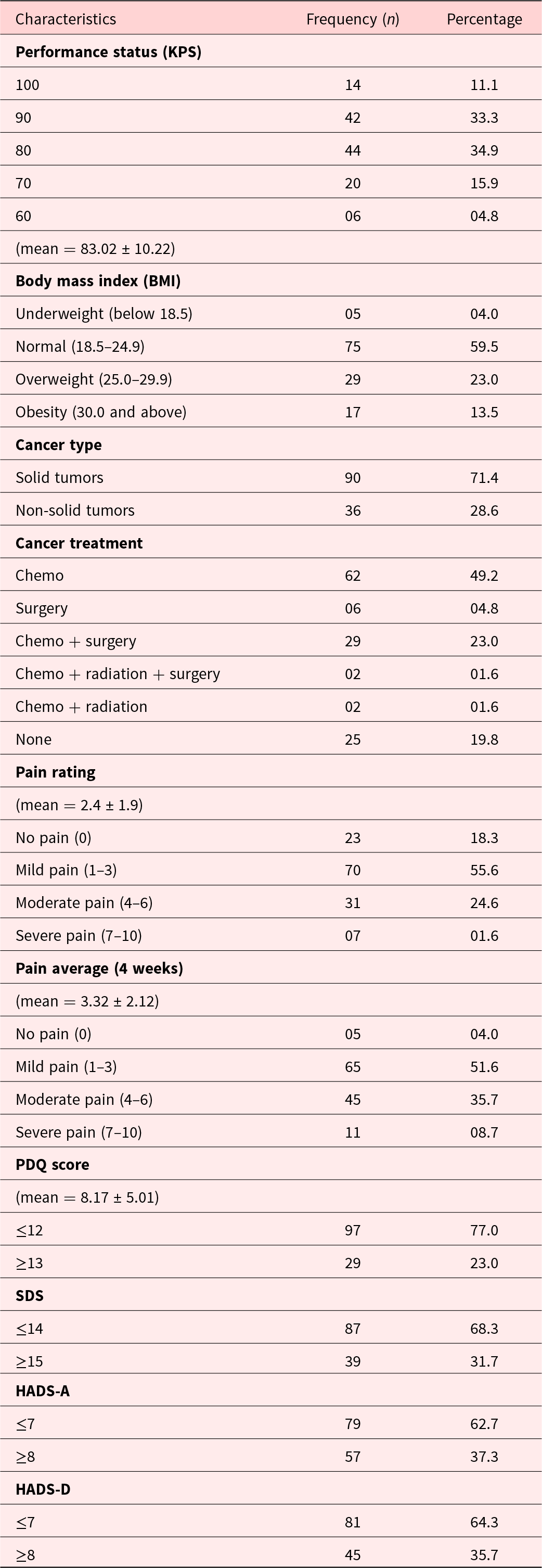
The clinical characteristics of the participants are shown in Table 2. Approximately 80% of the patients were on therapy or had one form of therapy (chemotherapy, surgery, and radiotherapy). Only about a third (33.3%) and a ninth (11.1%) had a KPS of 90% and 100%, respectively.
Clinical characteristics of the cancer patients (N = 126)

Table 2 Long description
Clinical characteristics are summarized for 126 cancer patients, reporting counts and percentages across functional status, body mass index, cancer type, treatment, pain, and symptom scales. Functional status clustered at higher levels, with the largest groups at scores of 80 and 90, and few at 60. Body mass index was most often in the normal range, followed by overweight and obesity, with underweight uncommon. Solid tumours were more frequent than non-solid tumours. Chemotherapy alone was the most common treatment, followed by chemotherapy plus surgery; about one fifth reported no treatment, and combinations including radiation were rare. Current pain was usually mild, with about one quarter reporting moderate pain and very few reporting severe pain; average pain over four weeks shifted toward more moderate and severe pain compared with current pain. Most participants had a PainDETECT score at or below 12, and most had a Sheehan Disability Scale score at or below 14. On anxiety and depression screening, roughly two thirds were at or below 7, while about one third were 8 or higher. Percentages may not sum to exactly 100 within sections due to rounding and category grouping.
HADS = Hospital Anxiety and Distress Scale; KPS = Karnofsky Performance Status; SDS = Sheehan’s Disability Scale; PDQ = painDETECT Questionnaire.
Pain characteristics
According to the Numeric Pain Rating Scale, approximately 82% complained of pain, with 55.6% reporting their pain as mild, 24.6% as moderate, and 1.6% reporting it as severe at presentation. When asked about their average level of pain in the past 4 weeks, 51.6% reported mild pain, 35.7% reported moderate pain, and 8.7% reported severe pain. Less than a quarter (23%) of the patients had evidence of NP with a mean score of 8.17 ± 5.01.
Prevalence and level of psychosocial well-being
The results of the patients’ calculated psychological distress and functional impairment using the HADS and the SDS showed that about 37.3% had anxiety (≥8), 35.7% had depression, and 31.7% had functional impairment (≥15). The mean scores for anxiety and depression symptoms were 6.71 ± 3.88 and 6.42 ± 4.25, respectively. The mean score of functional impairment was 11.30 ± 7.51. The various data are shown in Table 2.
Association between psychosocial distress and pain with other variables
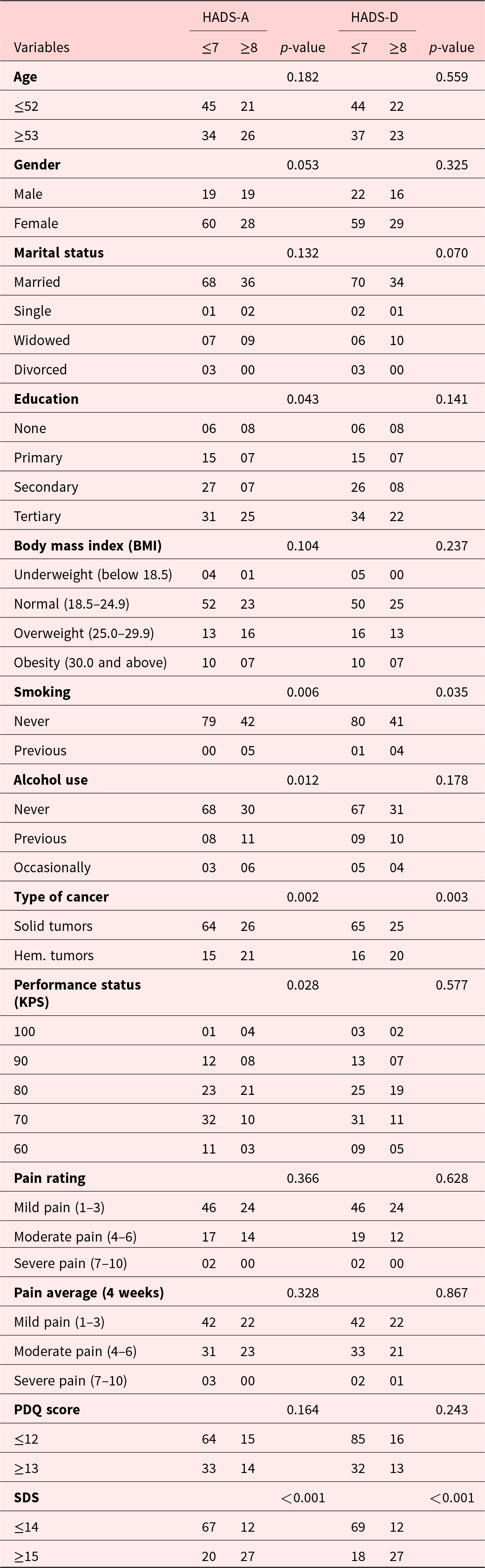
Table 3 shows the association between anxiety and depression and other variables, including pain. Pain, including NP, was not associated with anxiety and depression (p > 0.05). Similarly, some sociodemographic and clinical factors were not associated with anxiety and depression (p > 0.05). However, type of cancer and smoking were significantly associated with depression, while level of education, types of cancer, KPS, smoking, and drinking alcohol were significantly associated with anxiety (p < 0.05). In the correlation study also, pain, including NP, was not significantly associated with anxiety and depression. However, the cold/heat touch symptom was significantly associated with depression, while numbness was significantly associated with anxiety (p < 0.05). The SDS and its items were also significantly correlated with anxiety and depression (p < 0.05) Table 4.
Association between sociodemographic/clinical characteristics and psychological well-being

Table 3 Long description
Counts are split into low versus elevated anxiety and low versus elevated depression, with a p-value for each variable. Disability level shows the strongest association: for anxiety, low disability has 67 low and 12 elevated, while higher disability has 20 low and 27 elevated; depression shows a similar split (69 and 12 versus 18 and 27), both with very small p-values. Smoking differs for both outcomes: never smokers are mostly in the low-symptom groups (anxiety 79 low, 42 elevated; depression 80 low, 41 elevated), while former smokers cluster more in elevated symptoms (anxiety 0 low, 5 elevated; depression 1 low, 4 elevated). Alcohol use is associated with anxiety (never 68 low, 30 elevated; previous 8 low, 11 elevated; occasional 3 low, 6 elevated) but not clearly with depression. Cancer type differs for both outcomes, with hematologic tumors showing relatively more elevated symptoms than solid tumors (anxiety 15 low, 21 elevated versus 64 low, 26 elevated; depression 16 low, 20 elevated versus 65 low, 25 elevated). Education relates to anxiety (notably tertiary 31 low, 25 elevated) but not clearly to depression. Age, marital status, body mass index, pain ratings, pain average over four weeks, PDQ score, and performance status show no clear differences by depression group, and most also show no clear differences by anxiety group. Results are unadjusted group comparisons and do not establish causation; some categories have very small counts, which can limit reliability.
BMI = Body Mass Index; HADS = Hospital Anxiety and Distress Scale; KPS = Karnofsky Performance Study; SDS = Sheehan’s Disability Scale; PDQ = painDETECT Questionnaire.
Correlation between psychological well-being and functional impairment (N = 126)

Table 4 Long description
Correlations compare anxiety and depression scores with overall disability, work or school, social life, family life, and several pain-related symptoms. Depression has strong positive correlations with overall disability and with work or school, social life, and family life impairment, with correlation values around 0.65 to 0.68 and all with very small p-values. Anxiety shows moderate positive correlations with the same disability domains, with correlation values around 0.45 to 0.47 and very small p-values. Cold or heat symptoms show a small association with depression and a non-significant association with anxiety. Numbness shows a small association with anxiety and a non-significant association with depression. Pain rating, average pain over four weeks, and the PainDETECT score show near-zero correlations with both anxiety and depression and are not statistically significant. Overall, functional impairment aligns more closely with depression than anxiety in this sample, while most pain intensity measures do not track with either mood measure.
HADS = Hospital Anxiety and Distress Scale; SDS = Sheehan’s Disability Scale; PDQ = painDETECT Questionnaire.
Binary logistic regression analysis showed that level of education, types of cancer, KPS, and functional impairment were significantly associated with anxiety, while type of cancer and functional impairment were significantly associated with depression Table 5.
Associated factors/predictors of psychological well-being in the cancer patients (N = 126)

Table 5 Long description
Predictors of psychological outcomes are reported separately for anxiety (HADS-A) and depression (HADS-D), using p-values, odds ratios, and 95 percent confidence intervals. For anxiety, significant predictors include education (p 0.017; odds ratio 5.143; 95 percent CI 1.339 to 19.757), cancer type (p 0.003; odds ratio 3.446; 95 percent CI 1.542 to 7.702), performance status (p 0.038; odds ratio 14.667; 95 percent CI 1.161 to 185.235), and disability score (p less than 0.001; odds ratio 7.537; 95 percent CI 3.242 to 17.524). For depression, significant predictors are cancer type (p 0.004; odds ratio 3.250; 95 percent CI 1.456 to 7.255) and disability score (p less than 0.001; odds ratio 8.625; 95 percent CI 3.667 to 20.286). Disability score is the only factor significant for both outcomes and has the smallest p-values, indicating the most consistent association across models. Performance status shows a large odds ratio for anxiety but with a very wide confidence interval, suggesting substantial uncertainty in that estimate. Odds ratios above 1 across all listed predictors indicate higher odds of the outcome for the referenced category or higher score, but direction and clinical meaning depend on how each variable was coded.
HADS = Hospital Anxiety and Distress Scale; KPS = Karnofsky Performance Study; SDS = Sheehan’s Disability Scale.
Discussion
This study represents the first investigation in Nigeria to specifically examine the relationship between cancer pain – including NP – and anxiety and depression among cancer patients receiving care in a teaching hospital setting. The observed prevalence rates of anxiety (37.3%) and depression (35.7%) are broadly consistent with earlier reports from Nigeria and other LMICs, where psychological distress is increasingly recognized as a major component of the cancer burden (Habimana et al. Reference Habimana, Biracyaza and Mpunga2023; Eseadi and Amedu Reference Eseadi and Amedu2024). However, contrary to the well-established bidirectional link between chronic pain and emotional distress described in global literature (Yao et al. Reference Yao, Zhang and Lu2023; Miller-matero Reference Miller-Matero, Scherrer and Ballantyne2024; Liang and Fan Reference Liang and Fan2026), our findings revealed no significant association between either nociceptive pain or NP and the presence of anxiety or depression. In striking contrast, functional impairment as measured by the SDS was strongly and consistently associated with both psychological outcomes. These unexpected findings invite careful reflection and offer important lessons for cancer care in resource-limited settings.
Several possible explanations may account for the absence of a significant relationship between pain and psychological distress in our cohort. First, although over 80% of patients reported pain, the overwhelming majority rated it as mild on the Numeric Pain Rating Scale, with only 1.6% experiencing severe pain at presentation and just 2.3% reporting average severe pain over the preceding 4 weeks. It is plausible that mild pain does not reach the threshold necessary to trigger clinically significant anxiety or depression, particularly if patients have developed adaptive coping strategies. In the Nigerian context, where cancer is often framed within spiritual or fatalistic worldviews, patients may normalize pain as an expected and inevitable part of their illness, thereby diminishing its emotional impact (Yoon et al. Reference Yoon, Scarton and Duckworth2021). Second, the relationship between pain and psychological distress is not direct but is mediated by factors such as pain catastrophizing, self-efficacy, and the availability of social support (Chen et al. Reference Chen, Ju and Xia2022). Nigerian cancer patients frequently draw on religious beliefs, family solidarity, and community networks to reframe suffering as meaningful or temporary, a form of resilience that may uncouple physical symptoms from emotional morbidity (Daniels et al. Reference Daniels, Glover and Kyei2025; Nwozichi et al. Reference Nwozichi, Ojewale and Salako2025). Third, chemotherapy-induced peripheral neuropathy often develops insidiously, and patients may under-report symptoms if they attribute them to ageing or treatment side effects rather than recognizing them as a distinct pain syndrome requiring specific management. In addition, in advanced cancer, patients may shift their focus away from pain itself toward broader existential concerns such as death, family welfare, and financial insecurity. Pain then becomes one of many competing stressors, and its unique contribution to mood may be diluted. In addition, the relationship between pain and mood is inherently dynamic; thus, patients with fluctuating pain may not show stable associations on a one-off survey.
In sharp contrast to the null findings for pain, functional impairment as measured by the SDS was consistently and significantly associated with both anxiety and depression across bivariate and multivariate analyses. This finding is clinically instructive and culturally resonant. Functional impairment directly threatens a patient’s sense of identity, autonomy, and social contribution (Philipp et al. Reference Philipp, Walbaum and Koch2025). In the Nigerian cultural context, where extended family structures and community participation are deeply valued, the inability to perform daily activities, care for children, contribute economically, or attend social and religious gatherings may provoke intense feelings of worthlessness, guilt, and social isolation – all core features of depression. Anxiety, in turn, arises from uncertainty about future functional losses and from the perceived burden placed on already stretched family caregivers. A patient can experience significant pain yet maintain meaningful roles if the pain is intermittent or if effective analgesia is available; conversely, even mild pain that interferes with walking, working, or self-care will produce psychological suffering. The SDS captures this interference directly, whereas pain scales measure only intensity. This distinction is critical: disability is a more proximal and actionable driver of distress than pain itself. Furthermore, the relationship is bidirectional – depression produces fatigue, anhedonia, and psychomotor slowing, all of which reduce functional capacity independent of pain. The significant correlations between individual SDS items and both HADS subscales observed in our study support this reciprocal cycle. Patients with poor KPS had significantly higher anxiety levels, reinforcing the notion that what physically disables also emotionally wounds. The excellent internal consistency of the SDS in this cohort (Cronbach’s alpha 0.96) confirms its reliability, and its brevity and focus on observable, role-based consequences make it particularly suitable for routine use in busy Nigerian oncology clinics where specialist mental health time is scarce.
Taken together, these findings challenge the universal applicability of the Western-derived model that pain is the primary driver of psychological distress in cancer. In our Nigerian teaching hospital population, functional impairment clearly outranks pain as a correlate of anxiety and depression. This does not mean that pain is unimportant – over 80% of patients had pain, and adequate analgesia remains a fundamental right. Rather, it suggests that interventions aimed solely at pain reduction may be insufficient to improve mental health outcomes. Preserving and restoring functional ability – through psychotherapy, physiotherapy, occupational therapy, assistive devices, task modification, and targeted caregiver support – may yield greater psychological benefits than pain-focused treatments alone, especially in settings where opioid access is limited and multidisciplinary palliative care is nascent.
Limitations
This study has several limitations. The cross-sectional design precludes causal inference, so we cannot determine whether functional impairment leads to depression or vice versa. The single-center setting at a teaching hospital may not represent cancer patients in rural areas, primary care clinics, or faith-based treatment centers, where referral patterns and support systems differ significantly. Patients with cognitive impairment were excluded, yet this group may experience the highest levels of unmeasured distress. We did not assess for potentially important confounders such as financial toxicity, caregiver burden, prior history of mental illness, or actual analgesic use and palliative care access, all of which could modify the pain–distress relationship. Social desirability bias may have led to under-reporting of psychological symptoms in a formal teaching hospital environment.
Future research should adopt longitudinal designs to track how changes in pain, functional status, and psychological distress evolve over the cancer treatment trajectory. Mixed-methods studies combining quantitative surveys with in-depth interviews would help illuminate why Nigerian patients appear to dissociate pain from emotional suffering and how functional loss is experienced at the household level. Comparative studies across different geopolitical zones and health system levels – teaching hospitals, general hospitals, and faith-based centers – are urgently needed. Intervention trials testing the impact of functional rehabilitation (e.g., structured psychotherapy, physiotherapy, home modifications, and caregiver training) on anxiety and depression, independent of pain management, would be highly clinically relevant.
Conclusion
This first-of-its-kind study in Nigeria demonstrates that among cancer patients in a teaching hospital, functional impairment – not pain intensity or NP – is the dominant factor associated with anxiety and depression. The finding challenges assumptions imported from high-income settings and redirects clinical attention toward preserving what patients value most: the ability to perform daily roles, maintain social connections, and contribute to family life. Oncologists, nurses, and palliative care teams in resource-limited settings should routinely screen for functional impairment using simple tools like the SDS and integrate functional preservation as a core goal of cancer care. Addressing disability, not only pain, is essential for alleviating the psychological burden of this devastating disease in Nigeria and across sub-Saharan Africa.
Data availability statement
The data supporting the conclusions of this article can be made available by the authors upon reasonable request.
Acknowledgments
We appreciate the patients and the various oncology nurses at the University of Ilorin Teaching Hospital for their assistance and support for this study.
Author contributions
O.I.: Conceptualization, methodology, formal analysis, validation, resources, investigation, writing – original draft, writing – review & editing, project administration. T.A.: Investigation, data curation. O.S.: Investigation, data curation. C.C.A.: Investigation, data curation. I.K.: Conceptualization, methodology, resources, supervision, writing – review & editing, project administration. S.O.: Conceptualization, methodology, resources, supervision, writing – review & editing, project administration.
Funding
None.
Competing interests
The authors have no conflicts of interest to declare.
Ethical approval
This study was performed in line with the principles of the Declaration of Helsinki. Approval was granted by the Ethics Committee of University of Ilorin Teaching Hospital (UITH/CAT/189/21/384).
Ethics and consents
Informed consent was obtained from all individual participants included in the study.



 Open access

