“Satan and a virus will not stop us”
–Rev. Tony Spell (qtd. in Seipel Reference Seipel2020)
At the time of writing, the coronavirus is sweeping the world with over one million cases and hundreds of thousands dead; the United States leads the world in both counts. In the face of the pandemic, some congregations are still meeting in person (or think they should be) with an apparent devil-may-care attitude. In this paper, we ask what drives reactions to the coronavirus, with a focus on one rapidly growing religious belief system—the Prosperity Gospel. This belief system is particularly well-tuned to trigger a strong reaction to the societal response to the spread of the coronavirus. With roots in the “power of positive thinking,” Prosperity Gospel adherents vest power in their beliefs and in the church to achieve earthly goals, like health and wealth. As such, Prosperity Gospelers should react negatively to collective action encouraged by secular authorities and express a desire for the instrumentality of their wellbeing—the church—to remain open, despite the likely consequences (Burke Reference Burke2020).
To assess this, we draw on recent survey data gathered from March 23 to 27, 2020 that gauges public reaction to the coronavirus and includes measures appropriate to capture Prosperity Gospel beliefs (we capitalize Prosperity Gospel throughout the paper only to highlight its usage). We report observational results to highlight how this belief system is central to public reactions to church closings that reflect perceived agency of the church compounded by high barriers to outgroups. By dint of several, interlocking forces, Prosperity Gospelers stand apart from others in a way that indicates much broader effects than an understanding of it as individualism would suggest. We begin with a brief overview of religious belief research before turning to a discussion of the Prosperity Gospel specifically.
RELIGIOUS BELIEFS
Beliefs are understandings of how the world is—they are effectively perceived facts. This helps to categorize and distinguish religious beliefs, which include answers to questions about whether there is evil in the world, what behaviors are sinful, what is the nature of God, what happens after death, and what returns practitioners get for investing in worship. Beliefs pair well with values, which are commandments about how the world should be and how people should act. Together, beliefs and values in conversation constitute worldviews.
Given the influence of omnibus survey instruments in the social sciences, belief measures tend to be quite general and research has focused more on the strength of religious belief than the logic of specific strands of belief (e.g., Ben-Nun Bloom and Arikan Reference Ben-Nun Bloom and Arikan2013). Put another way, investigating specific religious beliefs is less likely to draw on the GSS and ANES and instead is likely to come from special-purpose survey efforts. For instance, Froese and Bader (Reference Froese and Bader2010) examine the political implications of different conceptions of God—as angry, loving, masculine, etc. More loving visions of God drive more benevolent behavior (Johnson et al. Reference Johnson, Li, Cohen and Okun2013; Shepperd et al. Reference Shepperd, Pogge, Lipsey, Miller and Webster2019) and more social trust (Mencken, Bader, and Embry Reference Mencken, Bader and Embry2009), while more angry visions of God drive more punitive and aggressive public policy views (Thomson and Froese Reference Thomson and Froese2016).
In another strand, research has linked religious beliefs in the “end times,” a date at which a judgment process or great battle begins that heralds the end of the world, to environmental attitudes. Those who believe that the end is near have a shorter time horizon and are less likely to want to invest resources in environmental protection (Guth et al. Reference Guth, Green, Kellstedt and Smidt1995; Barker and Bearce Reference Barker and Bearce2012). And, of course, there is considerable work on views of the Bible (e.g., Kellstedt and Smidt Reference Kellstedt, Smidt, Leege and Kellstedt1993), which are often proxies for other concepts—either for more specific beliefs or for the habits of mind implied. For instance, biblical literalism was long used as a proxy for dominion-over-nature beliefs in studies of environmentalism (e.g., Eckberg and Blocker Reference Eckberg and Blocker1989; Guth et al. Reference Guth, Kellstedt, Smidt and Green1993; Sherkat and Ellison Reference Sherkat and Ellison2007). And biblical literalism has long been used as an indicator for dogmatism (Jelen and Wilcox Reference Jelen and Wilcox1990; Reference Jelen and Wilcox1991).
We intend to use Prosperity Gospel beliefs in an orthodox way (despite the irony). Prosperity Gospel beliefs convey a perceived factual basis for how believers are attached to the church and to others. The facts—that to be sick and poor is a sign of sin, that the church and belief are instruments of earthly power—have implications for how believers respond to this public health crisis in dangerous ways. We suspect that Prosperity Gospel is particularly well suited to an outsized reaction to the coronavirus response, but at a suitable point, we will compare the effects to other available measures of religious belief and behavior.
AN OVERVIEW OF THE PROSPERITY GOSPEL
One of the most popular strains of Protestant theology in recent years is the Prosperity Gospel. This belief system rests on the assumption that those who are faithful to God and God's church will not just reap benefits in the afterlife, but will also gain health and wealth during this life, as well. This is succinctly summarized in the title of Joel Osteen's best-selling book, “Your Best Life Now,” which sold over eight million copies in the decade after its release (Johnson Reference Johnson2014). Osteen, along with other international known pastors such as Kenneth Copeland, Creflo Dollar, and T.D. Jakes, reaches tens of millions of followers per week through television broadcasts and a social media presence with a message that is tinged with various levels of Prosperity theology (Dougherty, Neubert, and Park Reference Dougherty, Neubert and Park2019). In fact, there is some data that indicates that half of the largest churches in the United States (over 10,000 attendees) teach theology that is rooted in the Prosperity Gospel (Bowler Reference Bowler2018).
Despite the apparently pervasive nature of Prosperity Gospel theology among American Christians, it has been dramatically understudied in the United States (though see, e.g., McDaniel Reference McDaniel2016). However, there has been a good amount of research in Africa, Asia, and Latin America that indicates that Prosperity beliefs do serve as a catalyst for entrepreneurial attitudes and social mobility (Woodberry Reference Woodberry2006; Marsh and Tonoyan Reference Marsh and Tonoyan2009) as well as political participation (McClendon and Riedl Reference McClendon and Riedl2019). A study in Ghana concluded that women who identified as Pentecostal (a tradition that is often linked with the Prosperity Gospel) were more likely to have higher annual incomes than women who affiliated with mainline Protestantism (Beck and Gundersen Reference Beck and Gundersen2016).
However, that same finding has failed to replicate in the American context (Koch Reference Koch2009). On the contrary, a variety of scholarship has concluded that there is a strong negative cross-sectional relationship between Prosperity beliefs, income, and education (Schieman and Jung Reference Schieman and Jung2012; Burge Reference Burge2017). Journalists have speculated that one of the driving forces of the Great Recession was that those who believed in the Prosperity Gospel went deeply in debt to finance a superficial lifestyle and pursue an entrepreneurial path that did not pay off for most of them (Rosin Reference Rosin2009). In essence, the same worldview that drove Ghanaian women to take risks and start their own businesses led Americans to borrow excessively and chase dreams with a low likelihood of success.
However, the full implications of the Prosperity Gospel and how it orients individuals to the social world are not well understood. For instance, does Prosperity Gospel act to comfort people or to elevate perceived threats? Do believers act individually as if the belief itself is sufficient, or do they react to threats to the collective set of believers?
Prosperity theology teaches that illness is a sign of sinful behavior (Bowler Reference Bowler2018) and that healing can be achieved through faith alone (Brouwer, Gifford, and Rose Reference Brouwer, Gifford and Rose1996). Thus, when confronted with the possibility of a global pandemic such as COVID-19, a faithful believer should have nothing to fear. For instance, R.R. Reno, the editor of the influential Christian magazine First Things, argued that churches should defy government orders and continuing gathering. He wrote, “When we worship, we join the Christian rebellion against the false lordship of the principalities and powers that claim to rule our lives, including sickness and death” (Reno Reference Reno2020). While Reno is no Prosperity theologian, this is one piece of the argument made when many churches remained open in the early weeks of the virus spread in the United States. For instance, Rev. Tony Spell of Life Tabernacle Church in Louisiana told a Baton Rouge newspaper, “When the paramedics can't get there, when the law enforcement can't get there, the Holy Ghost can get there and it will make a difference in someone's life” (Rocha Reference Rocha2020).
However, a crucial aspect of Prosperity theology is the belief that the church becomes the instrumentality of defense. The church enables followers to demonstrate their belief through giving and attendance, serving as a support network to overcome setbacks. Solid Rock Church in OH, one of the megachurches that have gotten considerable attention for remaining open (Kaleem Reference Kaleem2020), prominently displayed the passage from Hebrews (10:25) on their website, “Let us not give up the habit of meeting together, as some are doing. Instead, let us encourage one another all the more, since you see that the Day of the Lord is coming nearer.” As, again, Rev. Spell argued, if a parishioner became sick, pastors serve as first responders: “If that is our command, they shall lay hands on the sick and they shall recover” (Rocha Reference Rocha2020). That is, it is not just the healing power of belief that matters, but the physical connection to the church and its pastorate that will bring the blessings of belief (and a stunning reversal of the Protestant Reformation).
Therefore, from one perspective, belief itself is God's armor and should be sufficient for protection. As one woman in OH driving to Solid Rock Church services put it, “I am covered in Jesus's blood” (CNN 2020). On that basis, we would hypothesize that strong adherents to the Prosperity Gospel profess lower levels of concern about COVID-19. However, where there is smoke, there is likely to be fire. One reason why Prosperity preachers make claims about dominion over death is because of the profound fears that their followers have. But the other reason is that such claims are a priming exercise to elevate those concerns, which serves to maintain reliance on the pastor's services. From this perspective, we hypothesize a greater sense of threat from COVID-19 among Prosperity Gospel believers as well as greater defiance against social distance/gathering size orders.
A central thread to Prosperity Gospel belief systems is not just that belief can cure life's deficiencies, but that unbelief can harm. Put another way, poverty and sickness are signs of sin, a lack of belief, and perhaps even the work of the Devil. The latter is what Paula White was talking about when she called for all “Satanic pregnancies to miscarry right now” (Zaveri and Diaz Reference Zaveri and Diaz2020). Other Prosperity Gospel preachers make the link to the social dimensions of sin. For instance, Joel Osteen explicitly tells followers to avoid the sick and the poor: “You need to be careful about whom you surround yourself with, especially in difficult times. Misery loves company” (Osteen Reference Osteen2018). One implication is the belief that individuals are responsible for social problems, which has a natural affinity with American conservatism (McDaniel Reference McDaniel2016).
It is hard not to see this as a direct attack on the fundamentals of collective action (see also Harris-Lacewell Reference Harris-Lacewell and Wilson2007). Others in similar circumstances are to be avoided, they are untrustworthy by dint of sharing your same concerns. The solution to those problems is not working with others, but the increasing reliance on belief and the church. Such Prosperity Gospel solutions are vertical, individual, and anti-social rather than horizontal, organizational, and social. In particular, we hypothesize that Prosperity Gospelers are more distrustful of others. They seem to take seriously the admonition of St. James who implored Christians “to keep oneself from being polluted by the world” (James 1:27 NIV).
The same logic can be applied on a societal scale, as well. If individual people who are sick and poor are not to be trusted because of their sin, then the widespread existence of poverty and health problems signifies an active, working presence of evil to promote so much sin. As such, we would expect that Prosperity Gospelers would be especially prone to conspiracy theories. We do not quite have the data to test that, except that early in the U.S. outbreak, right-wing commentators, including the President were arguing that the hysteria over the coronavirus was politically motivated. We hypothesize that Prosperity Gospel followers would be more likely to believe that notion.
But this also suggests a potential causal problem—are attitudes and beliefs that we find linked to the Prosperity Gospel actually just a function of being a Republican and being exposed to right-wing ideas? We grant it is possible that conservative commentators are driving these relationships, which is why we test interaction terms between party identification and Prosperity Gospel beliefs. We hypothesize that Prosperity beliefs will have less of an effect on Republicans, who are more frequently exposed to arguments consistent with the Prosperity Gospel. That means that Prosperity beliefs should be linked to a greater movement among Democrats and, to a lesser extent, independents, who are hearing messaging in church that differs from what Democratic elites are communicating.
DATA AND MEASUREMENT
We draw on data collected from March 23 to 27, 2020, which was well before the coronavirus spread peaked in the United States. At this point, many, but not all, states had issued “stay at home” orders. Some states, such as MI, had exempted religious organizations from gathering limits (often 10 people), though they encouraged houses of worship to close voluntarily (as in OH), which most had done (Jenkins Reference Jenkins2009). Only five states in the Great Plains remained holdouts with no state-wide policy by mid-April. In these data, we found that only 12% of respondents reported their congregations to still be worshiping in person. Some high-profile congregations stayed open and, in some cases, defied orders to close—that was the case in Florida (Mazzei Reference Mazzei2020) and Louisiana (Rocha Reference Rocha2020; see also Reuters 2020). This is to say that at the time of data collection there was still a national debate about whether houses of worship should close.
The roughly 3,100 respondents to our survey were supplied by Qualtrics Panels, filled according to quotas that match current Census distributions on age, region, and gender.Footnote 1 The data are not generated by a probability sample, but instead from a set of panelists whose responses were screened for speed (those who took the survey too quickly were kicked out of the sample) and accuracy (we included several attention check questions).
Social science has just begun to operationalize the Prosperity Gospel into survey questions in recent years. As such, there is no widely accepted battery that can be drawn upon. However, the questions that were employed in our survey closely mirror those used by Dougherty, Neubert, and Park (Reference Dougherty, Neubert and Park2019), McDaniel (Reference McDaniel2016), as well as by McClendon and Riedl in their research situated in Africa (McClendon and Riedl Reference McClendon and Riedl2019). Dougherty et al. used a set of three questions which asked respondents to indicate on a five-point scale whether they agreed or disagreed with the following statements: “God promises that those who live out their faith will receive financial success; Believers who succeed in business are evidence of God's blessing; I believe faithful believers in God receive real financial benefits in this life.” For Dougherty et al. the three items had a great deal of construct validity (α = 0.86).
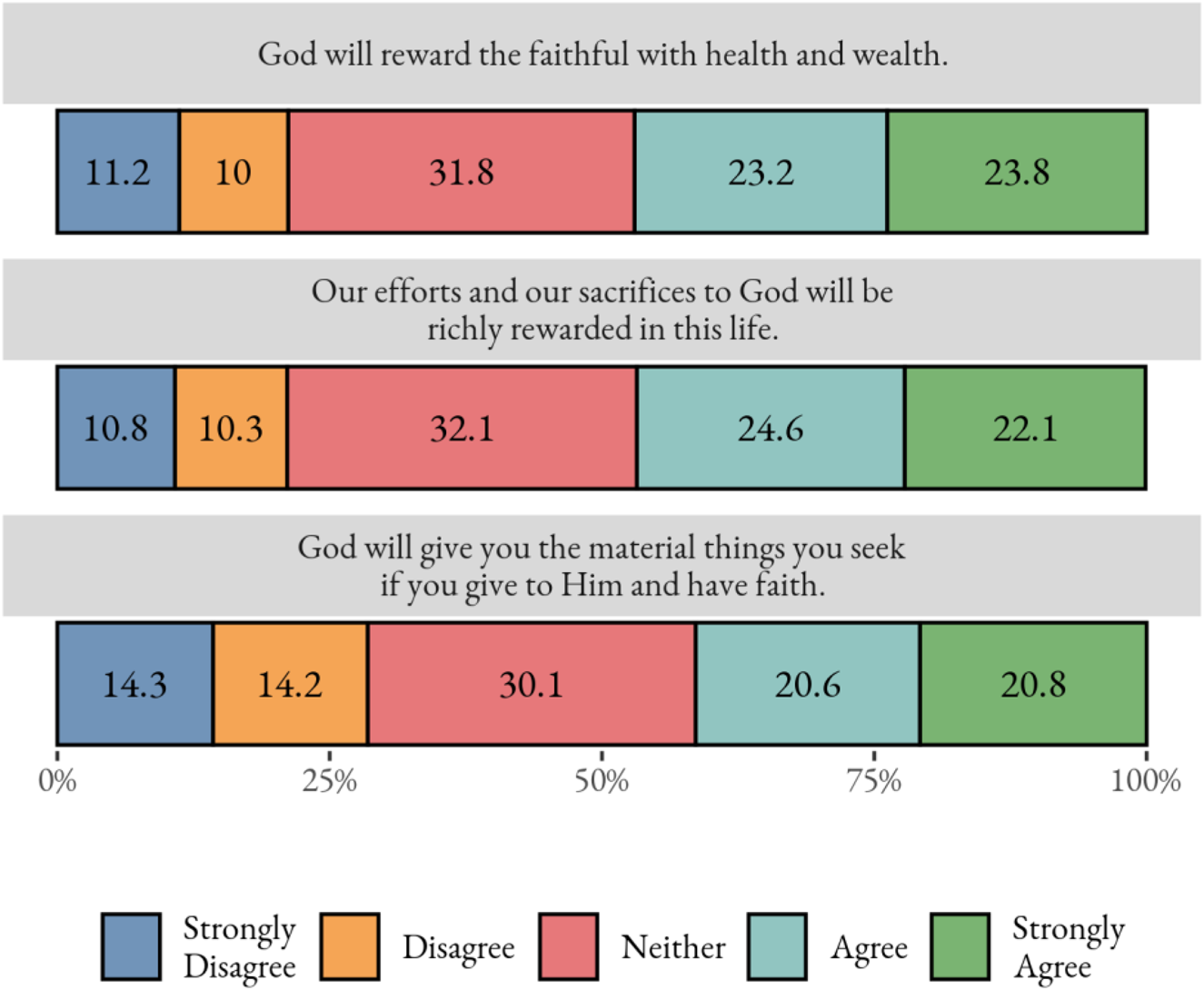
In much the same way, we used a three-question battery, focused on many of the same outcomes, and refined across several survey efforts (α = 0.90).Footnote 2 Shown in Figure 1, we see a substantial agreement with these core Prosperity Gospel beliefs and little rejection of them. Near majorities believe that followers will be rewarded with health and wealth and will be “richly rewarded in this life.” The least agreement is with the belief that God will give you the material things you want—“name it and claim it”—but the notion is still favored by 41% of the sample. Less than 30% of the sample rejects these beliefs. Simply put, the Prosperity Gospel is incredibly popular.
Distribution of Prosperity Gospel beliefs
Source: 2020 Religion and C19 Survey

As Bowler (Reference Bowler2018, 5) has argued, “The prosperity gospel cannot be conflated with fundamentalism, pentecostalism, evangelicalism, the religious right, the so-called black church, or any of the usual suspects (though it certainly overlaps with each).” While it would be easy to assume that the Prosperity Gospel has no place in mainline Protestantism, it is important to note that the Gospel of Wealth had its roots there (Bowler Reference Bowler2018, 31–32). Norman Vincent Peale, the author of “The Power of Positive Thinking,” was himself a pastor of a mainline Presbyterian church (George Reference George2019). We likewise find that Prosperity Gospel beliefs are spread across American religious traditions in relatively high and not terribly distinctive concentrations. The only religious group with demonstrably low values is the religious nones (see Appendix Figure A1).
Moreover, the Prosperity Gospel is spread across American politics as well. As we show in Appendix Figures A2 and A3, Republicans do have a stronger concentration of Prosperity Gospel views (hovering around 0.65 on a 0–1 scale), but Democrats are not far behind (at 0.59) and are indistinguishable from the sample mean. Only independents show less commitment to Prosperity, which is partly a function of the high rate of religious nones among their ranks. Even when we control for religious tradition, though, independents (including partisan leaners) still score lower on the Prosperity Gospel scale.
One key strategy of ours is to assess whether relationships with the Prosperity Gospel are simply masking partisan reactions by interacting partisanship (3-point scale; partisans include leaners) with the Prosperity Gospel scale. We do this for two reasons. First, partisanship appears to be the 800-pound gorilla in American politics, driving everything from economic beliefs (Enns, Kellstedt, and McAvoy Reference Enns, Kellstedt and McAvoy2012) to religious behavior (e.g., Hout and Fischer Reference Hout and C2002; Djupe et al. Reference Djupe, Neiheisel and Sokhey2018; Margolis Reference Margolis2018). The default expectation is that reactions to the coronavirus will simply warp to fit the interests of the parties. Second, public officials and commentators, such as the president and Fox News, have been explicitly claiming that the coronavirus response is the Democrat's “new hoax” and the hysteria is a Democratic ploy to hurt Trump (e.g., Dale Reference Dale2020; Harvey Reference Harvey2020). This view was widely repeated, including by a Virginia pastor who eventually succumbed to the virus (Palmer Reference Palmer2020).
RESULTS
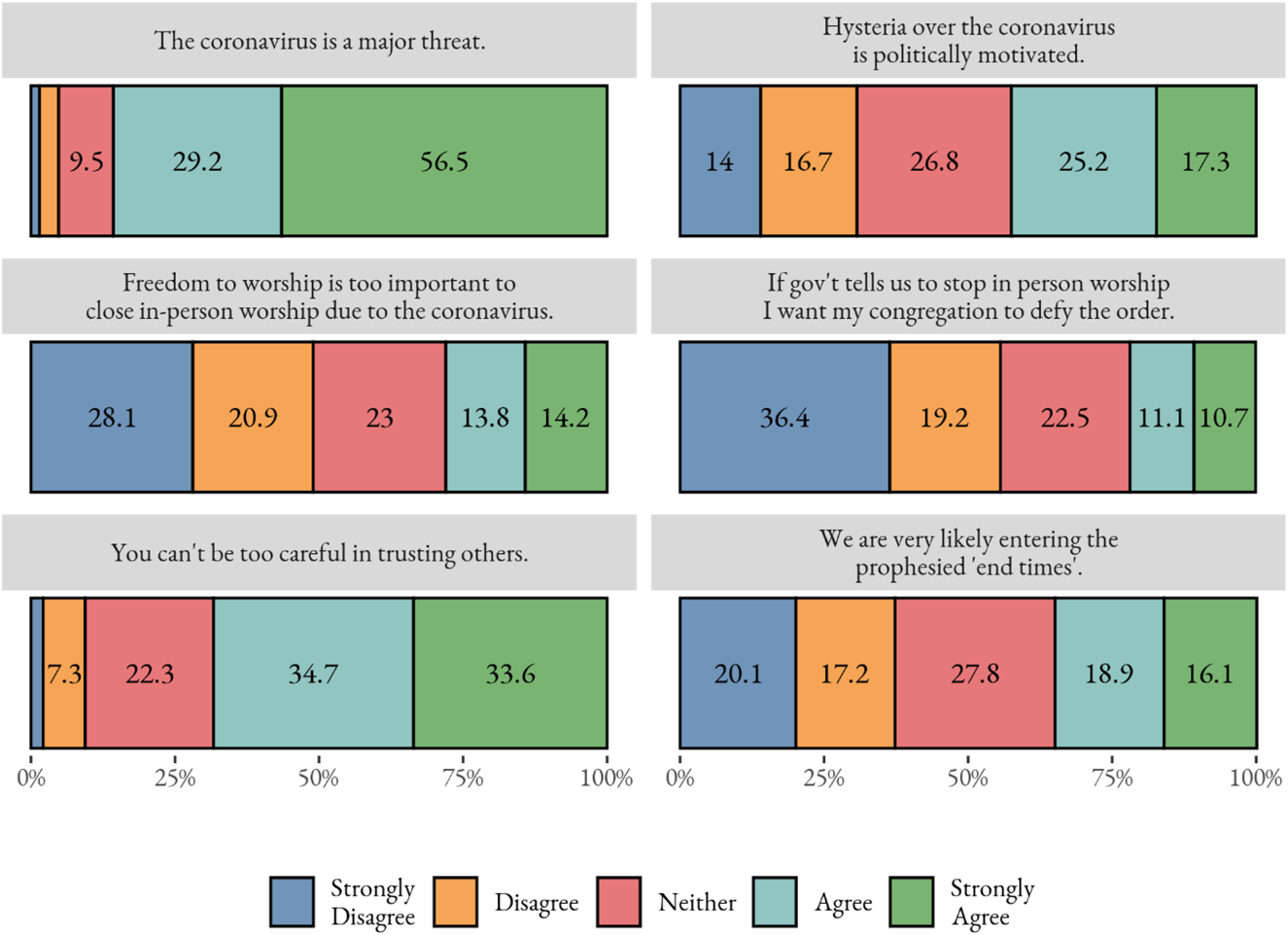
Our dependent variables are depicted in Figure 2. Though there is some variation, most of all respondents (86%) agreed that the coronavirus is a major threat. Even so, many (43%) believe that the hysteria over the pandemic is politically motivated. Given the widespread elite rhetoric making this point, especially early in the spread across the United States, it is no surprise to find it heavily tilted to the right.
Distribution of perceptions of the coronavirus and its potential response
Source: 2020 Religion and C19 Survey

Coronavirus protection measures clashed with First Amendment liberties, with some congregations remaining open because, in the words of one megachurch pastor in LA, “The church is the last force resisting the Antichrist” (Reuters 2020). If evil lurks and people rely on the church as the instrument of their protection, we would expect Prosperity Gospelers to favor staying open and to urge defiance of government orders to close. Figure 2 shows that 28% agree that houses of worship should stay open. A random half of the sample was given the additional words “even if more people die as a result.” While support did drop overall as a result of this treatment, the difference was small and not significant—people appear well aware of the consequences.
The survey went one step further and anticipated the current skirmishes, asking: “If the government tells us to stop gathering in person for worship I would want my congregation to defy the order.” A defiant stance is not common, but neither is it absent—22% agree/strongly agree. We also embedded an experiment here, substituting “The Trump Administration” for “The government” in half the cases, though again it made no difference to support overall.
We also include two measures that we believe are linked closely to pandemic politics—social trust and belief that we are entering the “prophesied ‘end times’.” In many ways, pandemic politics are massive collective action games. The individually rational course of action is to continue on as normal, even though that may greatly help spread the virus through the population. Clearly, government action is a necessity for “flattening the curve,” which could be hampered if there is little trust in government and each other (e.g., see ID—Coyne Reference Coyne2020). Americans have a high level of distrust, as expected, as 68% agreed that, “You can't be too careful in trusting others.” This is may be an increase—though asked differently, the General Social Survey data in 2018 had 59% indicating that people usually or always cann't be trusted. Regardless, we expect that Prosperity Gospelers will be less trusting of others given that their problems are the result of their own sin and unbelief.
Lastly, we asked about a specific aspect of Christian theology regarding the end of the world. Some previous work has found that such beliefs affect how people think about time-dependent policy options, such as environmental protection (Guth et al. Reference Guth, Green, Kellstedt and Smidt1995; Barker and Bearce Reference Barker and Bearce2012). We investigate it here as a way to index how Prosperity Gospelers think about the virus as an existential threat—a mechanism which helps to tie together the other findings. Just over one-third (35%) of respondents agreed that we are entering the “prophesied ‘end times’.” This appears to be higher than other reports of imminent end times belief,Footnote 3 suggesting how context-dependent this belief is.
MODEL RESULTS
In what follows, we estimate each of the four dependent variables using the same model. Our focus of interest is an interaction term between partisanship and Prosperity Gospel beliefs. Again, our intention is to ensure that Prosperity Gospel beliefs cut across partisan lines in equivalent ways, providing greater confidence in the results, and to look for evidence that Prosperity Gospel affects Republicans at lower rates. Figure 3 contains these results. The models (coefficients and fit statistics are available in Appendix Table A1) also include religious traditions, worship attendance, race, age, gender, and education (the Appendix contains full variable coding). We also decided to square the Prosperity Gospel measure, which allows for non-linear relationships to emerge. For instance, it is possible that only at particularly high (or low) levels of belief do differences emerge. It is important to note that this does not change the estimated effect size, it merely allows for different shapes of the slope to emerge and it could return a linear slope.
The interactive effect of Prosperity Gospel beliefs by partisanship on coronavirus threat and responses
Source: 2020 Religion and C19 Survey
Note: Comparison of any two confidence intervals is equivalent of a 90% test of significance at the point of overlap

Coronavirus Threat
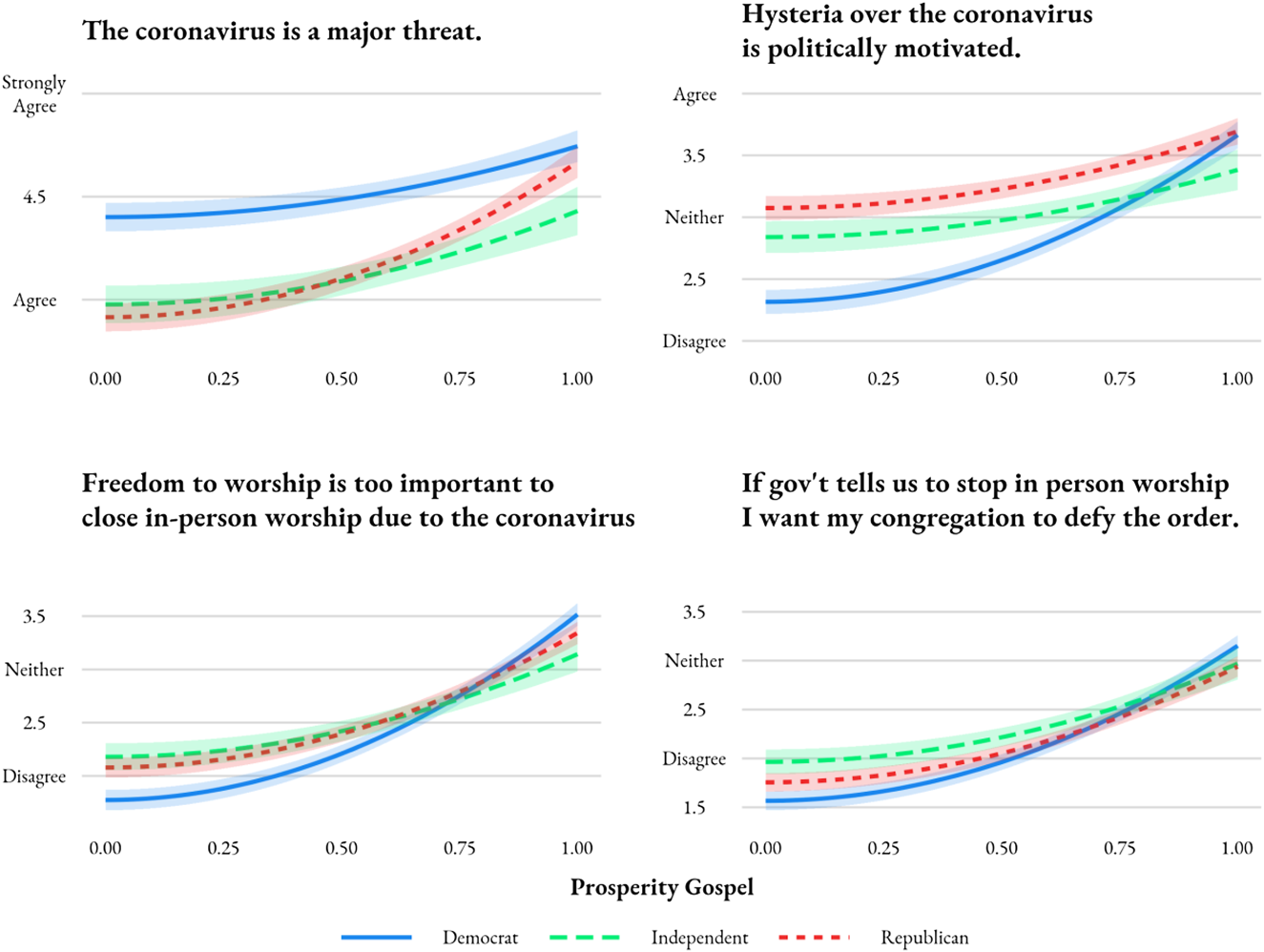
As noted, there is considerable agreement that the coronavirus is a threat, which means the difference is primarily binary—whether the respondent agrees or strongly agrees. Given the messaging from conservatives and inaction from many Republican governors in the early months of the outbreak, it is no surprise that independents and Republicans are less likely to strongly agree that the virus is a threat, though they still average “agree.” Regardless, belief in the Prosperity Gospel boosts a sense of threat from the virus for each partisan group. And our expectation of an accelerating effect with higher Prosperity belief finds support. The effect is insignificant until roughly the midpoint of the scale. Moreover, the effect is greatest among Republicans, whose sense of threat climbs to equal that held by Democratic Prosperity Gospel believers.
Politicized Hysteria
The threat relationships just discussed do not mean that the threat is viewed in the same way. We expect that Prosperity Gospelers will view threats in an agentic way—that is, they see problems as the result of human action and inaction, sins of commission and omission. In this case, we expect that they will see the coronavirus hysteria as politically motivated, which is what Figure 3 shows. Surely as a result of elite communication, Republicans are more likely than Democrats to believe this, but all three partisan groups shift their views based on their Prosperity Gospel beliefs. Higher levels of belief are linked to more agreement that the hysteria was politically motivated. And, again, the effects gain in strength with greater Prosperity Gospel beliefs. It is astounding to see that Democratic Prosperity Gospelers are more likely to agree that the hysteria was politically motivated than many Republicans. Prosperity Gospelers truly stand alone in their degree of agreement with this conspiracy theory.
Keep the Churches Open
The bottom panels of Figure 3 highlight the positive effect that Prosperity beliefs have on support for keeping the churches open. The left panel shows the priority of freedom of worship despite the coronavirus, while the right panel gauges support for defying (potential) government orders to close. Neither of these positions occasions considerable support, but, in both cases, the Prosperity Gospel serves to move people from opposition to support (even if very slim in the case of government defiance). There are minor differences by partisanship. Democrats who completely reject the Prosperity Gospel are more opposed to the idea of keeping churches open, but Prosperity Democrats show the most support for keeping them open. The Democratic Party is quite diverse, perhaps nowhere as diverse as over the role of religion in society.
The rhetoric of the Prosperity Gospel suggests that only belief is necessary to attain the desired benefits. But instead, it is remarkable how believers have come to rely so heavily on intercessory agents in the Prosperity Gospel sector.Footnote 4 If the church is the instrumentality of health and wealth, then it is easy to imagine supporters wanting to keep them open at almost any price. There are a number of potential explanations for this that rely on the experiential nature of Prosperity Gospel services since many are Pentecostal and believe in the necessity of laying on of hands in order to faith-heal believers (for a minority). But perhaps the simplest is that the church serves as a marker of the ingroup where “we” believers stand united against “they” unbelievers who have chosen to be poor and unhealthy by their sin and unbelief.
LIKELY MECHANISMS
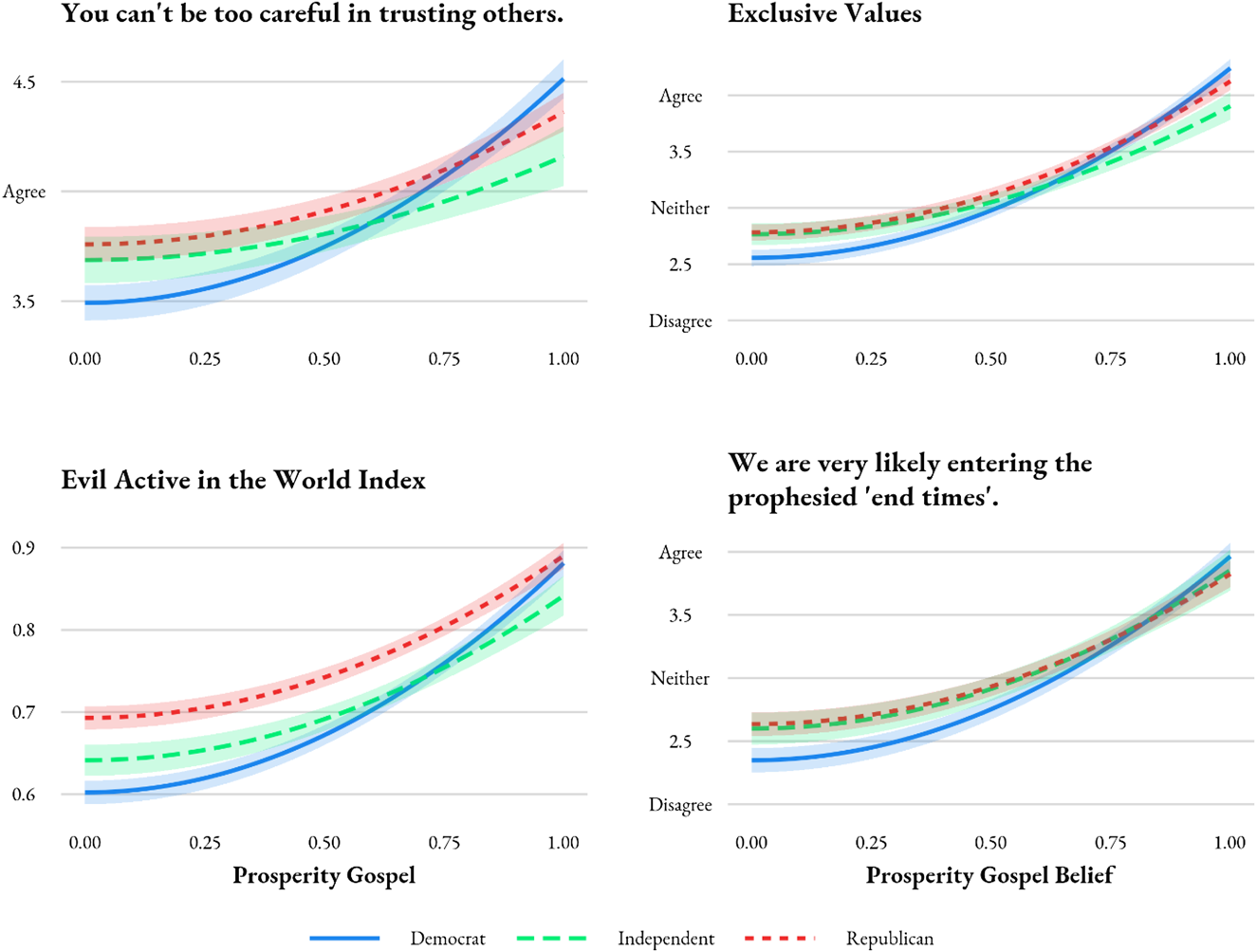
We can find evidence for this interpretation in a variety of other relationships that signal high barriers to those outside the group (full model results are available in Appendix Table A2). For as sunny as are some proponents of the Prosperity Gospel, such as Joel Osteen, the worldviews of adherents shade considerably darker. We included a standard trust question that captures the perceived risk of relying on others, asking whether respondents agree or disagree that “You can't be too careful in trusting others.” The results, shown in Figure 4, indicate the dramatic rise in distrust that accompanies Prosperity beliefs, moving respondents by a maximum of a quarter of the scale. Only among those who reject the Prosperity Gospel are there partisan differences—Democrats are more trusting. Among full-throated supporters, Democrats are almost more distrusting than Republicans, but certainly more than independents.
Some likely mechanisms driving prosperity gospel responses
Source: 2020 Religion and C19 Survey
Note: Comparison of any two confidence intervals is equivalent of a 90% test of significance at the point of overlap.

It is no surprise that the same distrusting orientation finds expression in how to organize social relations with respect to the church. That is, Prosperity Gospelers have much stronger exclusive orientations, which encompass social and economic cloistering with fellow religious identifiers. Exclusivity climbs more than distrust did among all partisans, though again grows the most among Democrats. Together this helps to make sense of the CNN (2020) interview with a woman attending in-person worship at a Prosperity Gospel megachurch outside of Cincinnati. She felt protected not just because she was “covered in Jesus’ blood,” but because she was attending with other “covered” believers.
Generalized distrust and religious exclusivity go hand in hand with a belief that evil exists, that it is embodied, and that it is active in the world. A belief that evil exists is common (index mean = 0.7 on a 0–1 scale) and the only item in the scale that truly shows variation across religious traditions is whether the devil exists. In any event, Prosperity Gospelers occupy the highest end of the scale without much distinction among partisans (Republicans show greater agreement than independents.) Only among those who reject the Prosperity Gospel do partisans cleanly differentiate, with Democrats less likely to believe that evil exists.
Lastly, we examine the eschatological belief that the “end times” are near. There are many shades to beliefs about the end times, also known as judgment day, last things, and the apocalypse. In perhaps the most common form, the end times involve a battle between good and evil—Armageddon. Under this interpretation, it is no surprise to find Prosperity Gospelers much more (up to 40% more) likely to agree that, “We are very likely entering the prophesied ‘end times’.” As noted above, levels of this belief appear to be very high in the population at the moment, surely driven by the spread of the coronavirus. This is critical because it suggests believers expect evil to be on the loose and are on the lookout for signs of the battles between good and evil.
Given these relationships, it is important to point out that Prosperity Gospel beliefs appear to be more than the sum of their parts. Prosperity Gospel beliefs are correlated with other “conservative” religious variables, such as worship attendance, literalism, and belief in evil. It is worth testing to what extent Prosperity Gospel effects can be captured with other religious variables. In Appendix Figure A4, we compare the effect size of Prosperity Gospel beliefs with and without other religious variables (religious tradition dummies were included in both specifications; see Table A3 for full model results). We used the “defy the order” and the “freedom to worship” dependent variables. Prosperity Gospel beliefs have orders of magnitude greater effects than any of the other three variables—three times greater than attendance and literalism. Belief in evil has no effect in one case (freedom to worship) and a marginally significant effect drawing down defiance. Most importantly, Prosperity retains 80% of its effect size once the other variables are added. This is strong evidence that Prosperity Gospel beliefs themselves are doing much of the work that we might otherwise ascribe to religion generally.
DISCUSSION—THE SPECIAL ROLE OF RACE?
While race features prominently in the literature on Prosperity Gospel, up until now we have only included a control in our models for racial identity differences. But race is essential to consider at a deeper level in the public expression of religion. Despite considerable religious similarities with white evangelicals, black Protestants have diametrically opposed politics, at least in terms of partisanship (Burge and Djupe Reference Burge and Djupe2019), if not necessarily on some social issues such as same-sex marriage (e.g., Sherkat, de Vries, and Creek Reference Sherkat, de Vries and Creek2010). As Shelton and Cobb (Reference Shelton and Cobb2018) put it, “differences across Protestant affiliations pale in comparison to structural and cultural similarities resulting from the legacy of racial discrimination and inequality” (see also Shelton and Emerson Reference Shelton and Emerson2012).
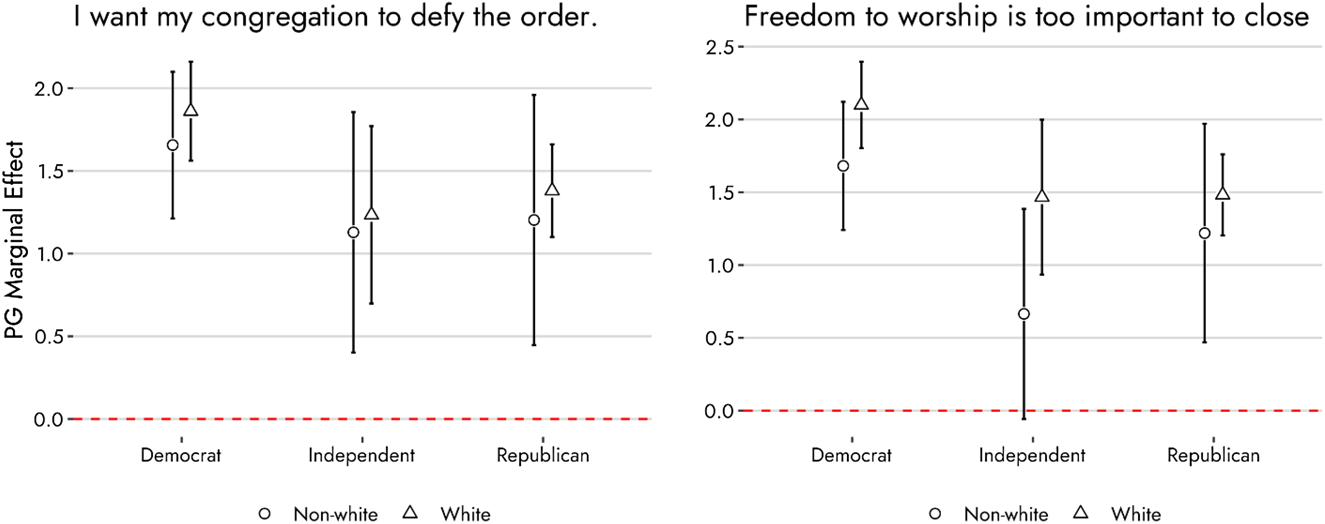
Does race similarly condition the effects of Prosperity Gospel beliefs? We took the same models used above for two dependent variables—government defiance and freedom to worship is too important to close—and interacted Prosperity Gospel, race, and partisanship. Figure 5 shows the marginal effects of Prosperity Gospel beliefs (the full 0–1 effect) for each partisan-racial group. With some minor variation, the effects are not different across groups. That is, non-white Prosperity Gospel believers have the same reaction to stay at home orders as white Prosperity Gospelers. Put another way, in this policy area Prosperity Gospel beliefs function independently of race and partisanship, the two dominant sources of variation in American politics.
Marginal effects of the Prosperity Gospel by race and party
Source: 2020 Religion and C19 Survey

It is also notable that the effects of the Prosperity Gospel are consistently lower for Republicans than Democrats. For non-whites this variation in effect is insignificant. For whites, the effect of Prosperity Gospel beliefs is significantly lower for Republicans than it is for Democrats when predicting “freedom to worship is too important to close.” The difference is reasonably close to significant in the government defiance model as well. While still very large effects, these differences are telling about the communication environment of the parties. Democratic messaging does not loop in arguments that are consistent with the Prosperity Gospel, while Republican “boot straps” economic policy aligns with the individualist Prosperity approach. Moreover, Republicans have clearly aligned with the resistance movement, reinforcing what Prosperity Gospelers are hearing from religious elites.
CONCLUSION
Given its rampant spread around the world (Brouwer, Gifford, and Rose Reference Brouwer, Gifford and Rose1996), including throughout the United States (Bowler Reference Bowler2018), it is surprising that there is not more research on the Prosperity Gospel. Perhaps under the assumption that Prosperity largely colors economic decision-making, previous work has focused on entrepreneurship and other economic questions (e.g., Koch Reference Koch2009; Beck and Gundersen Reference Beck and Gundersen2016; Dougherty, Neubert, and Park Reference Dougherty, Neubert and Park2019; Schieman and Jung Reference Schieman and Jung2012). Researchers have not ignored other attitudes and behaviors (e.g., Harris-Lacewell Reference Harris-Lacewell and Wilson2007; McDaniel Reference McDaniel2016), but the literature is small in the United States, with a special focus on African-Americans. We have attempted to show that the social effects of Prosperity Gospel beliefs are much more encompassing and deserve more of our attention.
Using the coronavirus pandemic as the context, the results suggest that Prosperity Gospel believers have particularly high barriers to working with others that may translate into dangerous behavior when coordinated social distancing is the public policy of the day. Prosperity Gospelers are no more likely to report their congregations are open but were much more likely to indicate that they were still worshiping in person.
It is surprising to find a social force that is not limited by party or race. We did not determine this by simply controlling for racial and party identification differences, but instead looked to compare effect sizes among these groups, and found them to be largely invariant. There are differences in how much each group believes the Prosperity Gospel, but when they do believe their worldview dictates a very similar reaction to the effects of the coronavirus response on their churches.
Personal behavior during the pandemic is tremendously important, given that lives are at stake and simply attending worship in person can mean dozens, even hundreds of new infections as “Patient 31” in South Korea taught us (Shin, Berkowitz, and Kim Reference Shin, Berkowitz and Kim2020). But the relationships seen here suggest the Prosperity Gospel has much broader implications. Given that Prosperity Gospelers have such high rates of distrust, have a high belief in evil, feel religious commands to be rightly exclusionary, and appear to be imminent end times believers, we see little that is encouraging of collective action here. Indeed, the explicit rhetoric parallels the pandemic—remain socially distant from those who may share the same problems. Misery loves company and you sin by working in concert with the poor and those with health problems.
Supplementary material
To view supplementary material for this article, please visit https://doi.org/10.1017/S175504832000053X.