INTRODUCTION
Lernaeocera branchialis (L. 1767) is a parasitic copepod, the mated adult female stage of which impacts a range of gadoids by attaching to the gills and feeding on the blood of its host, causing serious pathogenic effects. The life cycle of L. branchialis is complex as it involves 2 hosts. The initial host is usually a pleuronectiform or other demersal fish (Brooker et al. Reference Brooker, Shinn and Bron2007), whereas the usual host infected by the mated adult female is a gadoid fish, with cod, Gadus morhua, whiting, Merlangius merlangus, haddock, Melanogrammus aeglefinus and pollack, Pollachius pollachius being the most common hosts (Kabata, Reference Kabata1979). Although the life cycle of L. branchialis has been well documented (Scott, Reference Scott1901; Sproston, Reference Sproston1942; Capart, Reference Capart1947, Reference Capart1948; Brooker et al. Reference Brooker, Shinn and Bron2007), the method of host location remains unknown. Both the copepodid and the adult female stages of L. branchialis must locate and identify a suitable fish host to continue the life cycle. It is likely that specific mechanisms are employed to initially locate a host and then to ensure that it is suitable. The adult female spends 3–8 days on the initial host, depending on the number of times a female is inseminated (Anstensrud, Reference Anstensrud1990), suggesting that insemination by a male is the trigger for the female to leave the first host to search for the second host. If a suitable host is not located before the energy reserves of the parasite are depleted, it will die, although there have been instances where a metamorphosed adult female has been found to infect the nominal first host (Schuurmans Stekhoven, Reference Schuurmans Stekhoven1936; Begg and Bruno, Reference Begg and Bruno1999),which may be a decision made by the parasite in the absence of the optimal second host.
It is likely that there are several mechanisms involved in host location and these may include mechano-reception to detect host movement and chemo-reception to recognize host-associated chemical cues. The parasite may also use other physical phenomena in the water column, such as thermoclines and haloclines, to search for likely concentrations of fish hosts. In planktonic organisms, kairomones are known to play a number of roles including prey detection, predator avoidance and host location by parasites. The role of kairomones in plankton was first demonstrated in rotifers (De Beuchamp, 1952) and has since been studied extensively. The use of chemo-reception for host location was originally demonstrated in caligids by Fraile et al. (Reference Fraile, Escoufier and Raibaut1993), where mucus from sea bass, Dicentrarchus labrax, was shown to alter the behaviour of Caligus minimus Otto, 1821. More recently, the salmon louse Lepeophtheirus salmonis, Krøyer, 1837 has been shown to employ chemo-reception to recognize host-associated chemical cues (Devine et al. Reference Devine, Ingvarsdottir, Mordue, Pike, Pickett, Duce and Mordue2000). Lepeophtheirus salmonis demonstrate increased activity and positive rheotaxis when exposed to compounds originating from Atlantic salmon, Salmo salar, but not from turbot, Scophthalmus maximus Rafinesque 1810, demonstrating the use of kairomones for host location by L. salmonis as well as host recognition (Devine et al. Reference Devine, Ingvarsdottir, Mordue, Pike, Pickett, Duce and Mordue2000). Extraction of low molecular weight compounds from salmon-conditioned water using solid-phase extraction techniques has shown that L. salmonis demonstrates a behavioural response and an electrophysiological response in their antennae to the chemicals isophorone and 1-octen-3-ol (Ingvarsdottir et al. Reference Ingvarsdottir, Birkett, Duce, Genna, Mordue, Pickett, Wadhams and Mordue2002). As well as utilizing chemical cues for host location, L. salmonis has also been shown to use mechano-reception to detect host movement (Bron et al. Reference Bron, Sommerville, Rae, Boxshall and Defaye1993; Heuch and Karlsen, Reference Heuch and Karlsen1997) and, in pre-adult and adult stages, a pronounced shadow response to passing fish (J. Bron, personal observation).
The aim of this study was to identify the role of kairomones in host location by adult female L. branchialis by analysing the parasites' behavioural responses to a range of host-derived substances. This was investigated by the use of 2 experimental procedures: (a) response of the parasites in a Y-shaped choice chamber when provided with the option of clean seawater or seawater containing potential sources of kairomones derived from host and non-host fish species; (b) changes in the natural behaviour of the parasites observed in 3 dimensions, when presented with a similar range of potential sources of kairomones.
MATERIALS AND METHODS
Collection of parasites, water and chemical cues
Flounder, Platichthys flesus, infected with L. branchialis were sampled from the catches of commercial demersal trawlers working within the River Forth Estuary at Kincardine, Scotland (56° 02′ 53″ N, 3° 40′ 59″ W). They were collected from the trawlers in dock and transported to the University of Stirling in large plastic bags containing seawater under aeration. The fish were maintained in 100 L static tanks at 10 °C with a bio-filter (6·5 L Eheim canister) to maintain water quality and fed daily using a combination of frozen ragworm, Nereis virens (Seabait Ltd), and sinking trout pellets (Europa 15, Skretting). To collect pre-metamorphosed adult female L. branchialis, a 50 μm mesh was placed over the filter intake pipe to prevent loss of free-swimming parasites and tank water was siphoned daily into an empty 100 L tank through a 50 μm sieve to remove any adult L. branchialis that had left their host. The parasites were then washed into a 500 mL beaker with seawater and maintained at 10 °C until required. Before each experiment, the gender of each parasite was visually checked to ensure that only females were used.
Clean seawater for use in the behaviour experiments was collected from the shore at East Wemyss, Fife, Scotland (56° 09′ 35″ N, 3° 03′ 36″ W). Full salinity (35 Practical Salinity Units, PSU) was verified using a salinometer (Atago S/Mill, Japan) and the water was kept in a 400 L tank with aeration until required. This water was used for all behavioural experiments, including the production of the chemical cues to ensure consistency throughout the experiments.
Four species of fish were selected to test the response of L. branchialis to chemical cues: cod and whiting as second hosts; flounder as the first host; and brown trout (Salmo trutta) as a freshwater non-target species. Whiting, cod and flounder were sampled from the catches of commercial demersal trawlers, transported to the University of Stirling and maintained in tanks, as detailed previously, whereas juvenile brown trout were sampled from a commercial fishery near Stirling, Scotland (56° 04′ 20″ N, 3° 57′ 04″ W). For each species of fish, 4 potential kairomone sources were collected: fish-conditioned water, mucus, flesh and feces, giving a total of 16 different cues plus a seawater control. For the 3 marine species, fish-conditioned water was prepared by maintaining live fish in seawater for 24 h at a ratio of 10 g fish per 1 L of water. Trout were kept in fresh water at the same ratio of fish:water and then the fish were removed before salt was added (Instant Ocean synthetic sea salt) to make full strength seawater (35 PSU). Mucus was collected from several freshly euthanized fish (anaesthetic overdose using 0·5–0·6 ml L−1 2-phenoxyethanol (Sigma-Aldrich) until cessation of respiratory activity, followed by a blow to the head to ensure brain death and rinsing in seawater to remove anaesthetic) by rinsing the fish with 100 mm ammonium bicarbonate (Ross et al. Reference Ross, Firth, Wang, Burka and Johnson2000) and then diluting the resulting liquid in 1 L of seawater. For the flesh cue source, 5 g of skin-free body muscle was homogenized and added to 1 L of seawater. Faeces were collected by maintaining fish in a 30 L tank for 24 h and then filtering the water to remove the feces before adding them to 1 L of seawater. Once the study was complete, all experimental fish were euthanized using an overdose of anaesthetic (0·5–0·6 ml L−1 2-phenoxyethanol (Sigma-Aldrich) until respiratory activity ceased, followed by a blow to the head to ensure brain death. Before commencing, all experiments were approved by the University of Stirling Ethics committee. The Institute of Aquaculture, University of Stirling is licensed to carry out animal experiments under a certificate of designation according to the Animals (Scientific Procedures) Act 1986 and regulated by the UK Home Office.
Experimental setup
To record the behaviour of the parasites, a Sony Handycam DCR-VX2000E-PAL video camera (f = 6–72 mm, 58 mm +2 diopter close-up lens) was mounted on a stand with the camera lens 40 cm above the viewing chamber. The camera was connected to a PC via an S-video cable and digital videos were captured using Adobe Premier software version 7.0 Columbo (Adobe Systems Inc.) at a resolution of 352 × 288 pixels and capture rate of 1 frame s−1 for the choice chamber experiment, and a resolution of 720 × 576 pixels and a capture rate of 5 frames s−1 for the natural behaviour experiment. Video files were stored on a PC hard drive in *.avi format for subsequent analysis.
Four 12 W halogen lights were mounted in a frame surrounding the experimental chamber and a light diffuser, constructed from a cone of thick, white cotton material and fixed around the chamber and camera, ensured that there were no bright spots, eliminating potential directional cues. A rheostat was wired in series to allow the light intensity to be adjusted to a suitably low level. A light meter (Sekonic L398 Studio Deluxe) was used to check that the light levels inside the diffuser were consistent (1000 lux). Experiments were conducted in a darkened room during hours of darkness to ensure that there were no extraneous sources of light.
Choice-chamber experiments
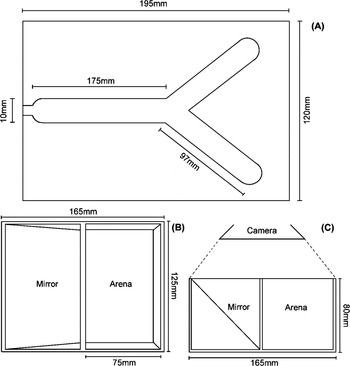
For the choice-chamber experiments, a chamber was constructed from 11 mm thick white acrylic. An 8 mm deep, concave, Y-shaped channel was cut into the acrylic with a drainage channel at the base of the Y-shape to allow water to drain from the chamber (Fig. 1A). A 50 μm nylon mesh across the drain prevented the escape of parasites. A Watson–Marlow 16-channel peristaltic pump (Watson–Marlow Ltd) coupled with Watson–Marlow Marprene manifold tubing (1·85 mm internal diameter) was used to ensure an even flow of water into each arm of the choice chamber. As each channel had a flow rate of 3·33 mL min−1, 3 channels were used for each arm of the choice chamber, giving a flow rate of 10 mL min−1 for each arm.
Schematic diagrams of the behaviour arenas. (A) Choice-chamber plan view. (B) Natural behaviour arena plan view. (C) Natural behaviour arena planar view, showing the position of the camera above the arena.

For each different chemical cue, 2 beakers of seawater, one containing the cue and the other containing clean seawater, were maintained at 10 °C ± 0·5. Water containing the chemical cue was introduced into one arm of the choice chamber and clean seawater was introduced into the other via the peristaltic pump. When switching cues the chamber and pump tubes were cleaned thoroughly by pumping 500 ml of dilute decon (1 g Dri-decon (Decon Laboratories Ltd) in 500 mL of water) through the system followed by 1 L of clean seawater. The subsequent chemical cue was pumped through the system until the choice chamber was full and the drain overflowing before starting the next set of experiments.
For each experiment, a single adult female L. branchialis was introduced into the chamber close to the drain, with the pump running. The parasite was allowed to acclimatize for 1 min, and once a positive orientation to the water flow was seen, the movements of the parasite were recorded using the video camera for 5 min. Thirty replicate individuals were recorded for each chemical cue from each fish species and the seawater control, giving a total of 510 replicates i.e. ((30 × 4) × 4 + 30). As the capture rate was 1 frame s−1, 300 frames were recorded for each replicate. Switching of the cue arm (either left or right) and orientation of the chamber between replicates ensured that other accidental directional cues, such as light, vibration or magnetic fields, would not affect the outcome of the experiments.
Natural behaviour experiments
The natural behaviour arena was constructed from 0·5 cm thick clear acrylic and consisted of 2 equally sized chambers separated by a piece of acrylic (Fig. 1B). In the left chamber, a mirror was set at an angle of 45°, allowing parasite movements in the xy plane and yz plane to be recorded using a single camera positioned above the arena (Chrásková et al. Reference Chrásková, Kaminsky and Krekule1999) (Fig. 1C). Both chambers of the arena were filled with water to prevent diffraction of the image passing from the arena to the mirror. The outside of the arena was spray-painted white to provide parasite contrast against the background.
For each experiment, an adult female L. branchialis was introduced into the arena containing clean seawater at 10 °C ± 0·5. After an acclimatization period of 3 min, the movements of the parasite were recorded for 3 min. The water was then siphoned from the arena leaving the parasite in approximately 1 cm depth of water before the arena was carefully topped up with water containing the chemical cue. After another acclimatization period of 3 min, the parasite was recorded again for a further 3 min. After each replicate the chamber was rinsed with Decon solution (1 g Dri-decon in 500 mL water) and then flushed with clean seawater. Upon analysis of the results from the choice-chamber experiment (see Results section), the decision was made to test only fish-conditioned water from each species of fish. Twenty replicate individuals were recorded for each type of conditioned water and control water, giving a total of 200 replicates. With a capture rate of 5 frames s−1, 1800 frames were captured for each replicate.
Data extraction and analysis
Individual frames were extracted from the video files using Irfanview software (version 3.98, Irfan Skiljan) and saved as a set of bitmap (*.bmp) images. Using a macro in KSRun Macro Execution Environment Rel. 3 (Carl Zeiss, Inc.), the image sets were batch processed using a median filter, shade correction and segmentation analysis. Bespoke tracking software (Paratrack, Brooker, University of Stirling) was used to analyse each image set and extract parasite coordinates for each image, producing a text file of coordinates describing the trajectory for each replicate and a bitmap image of the parasite trajectory. A calibration factor was automatically calculated for each replicate and appended to each text file to allow coordinates to be converted to real distances for analysis. For the choice-chamber experiment, parasite movements were recorded in 2D, whereas in the natural behaviour experiment parasite movements were recorded in 3D with a logarithmic regression correction factor being applied to the coordinates from each plane to correct for perspective viewing effects.
For the choice-chamber experiment, 3 zones were defined within the Y-chamber: control zone (arm with clean seawater), cue zone (arm with seawater containing fish-derived chemicals) and mixed zone (central channel where mixing of the arms occurred). For each replicate, the time spent in each zone was calculated using Paratrack. In order to calculate behaviour parameters, the 2D distances between each subsequent pair of trajectory coordinates d were calculated as:
 $$d = \sqrt {(x_t - x_{t + 1} )^2 + (y_t {\rm -} y_{t + 1} )^2}, $$
where (x t, yt) and (x t + 1, y t + 1) are the parasite coordinates at time t and t + 1, respectively. Total distance travelled D was calculated as:
 $$D = \sum\limits_{t{\rm = 1}}^n d, $$
where n is the total number of time steps (i.e. 300). Mean velocity μ v was calculated as:
 $$\mu _v = \displaystyle{{\sum\limits_{t = 1}^n {\displaystyle{d \over {t_r}}}} \over {t_r n}},$$
where t r is the temporal resolution of the camera (i.e. 1 s). Mean turn rate μ θ was calculated as:
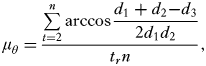 $$\mu _\theta = \displaystyle{{\sum\limits_{t = 2}^n {{\rm arccos}} \displaystyle{{d_1 + d_2 {\rm -} d_3} \over {2d_1 d_2}}} \over {t_r n}},$$
where d 1, d 2, d 3 are the distances between parasite coordinates at time t and t + 1, t + 1 and t + 2, and t and t + 2, respectively. As the choice-chamber data were not normally distributed (Anderson–Darling test), comparisons between each cue source and the control were made using the Wilcoxon Mann–Whitney test (WMW test). Statistical analyses were carried out using Statistica software (Version 7, Statsoft Inc., 2004).
For the natural behaviour experiment, the 3D trajectory of each replicate was analysed in Paratrack. The distances d between each subsequent pair of trajectory coordinates were calculated as:
 $$d = \sqrt {(x_t - x_{t + 1} )^2 + (y_t - y_{t + 1} )^2 + (z_t - z_{t + 1} )^2}, $$
where (x t, yt, zt) and (x t + 1, y t + 1, z t + 1) are the parasite coordinates at time t and t + 1, respectively. Total distance, mean velocity, and mean turn rate were calculated in the same way as for the choice-chamber experiment, with the temporal resolution t r being 0·2 s and the number of time steps n = 900.
In addition, instantaneous velocities v i for each time step were calculated as:
 $$v_i = \displaystyle{d \over {t_r}}. $$
Instantaneous velocities were categorized into 5 behaviour states (Schmitt et al. Reference Schmitt, Seuront, Hwang, Souissi and Tseng2006) as follows: ‘static’ where the velocity was <3 mm s−1 and the parasite remained on the bottom (velocities >0 mm s−1 may be observed when the parasite is static due to turning on its axis), ‘crawl’ where the velocity was >3 mm s−1, but the parasite remained on the bottom (velocities >3 mm s−1 were attributed to linear movement and not static turning), ‘cruise’ where the velocity was <20 mm s−1 and the parasite was in the water column (normal swimming speeds were observed between 8 and 20 mm s−1), ‘fast swimming’ where the velocity was >20 mm s−1 (short bursts of speed were characterized by velocities >20 mm s−1), and ‘sinking’ where the velocity was <8 mm s−1 and the parasite moved in a downward direction (velocities <8 mm s−1 were observed as the sedimentation rate of the parasite).
Instantaneous turn angles θ i were calculated as:
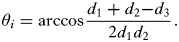 $$\theta _i = {\rm arccos}\displaystyle{{d_1 + d_2 {\rm -} d_3} \over {2d_1 d_2}}. $$
Fractal dimensions were calculated using the ‘box counting’ method (Seuront et al. Reference Seuront, Hwang and Tseng2004; Uttieri et al. Reference Uttieri, Nihongi, Mazzocchi, Strickler and Zambianchi2007). This method finds the number of boxes of length λ required to cover the track by superimposing a regular grid of boxes of length λ onto the image and counting the number of occupied boxes. The procedure is then repeated using different values for λ up to the size of the image. The number of occupied boxes increases with decreasing box size according to the following power law relationship (Loehle, Reference Loehle1990):
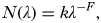 $$N(\lambda ) = k\lambda ^{ - F}, $$
where N(λ) is the number of boxes occupied by the path, k is a constant, and F is the fractal dimension, which can be estimated from the slope of the linear trend of the log–log plot of N(λ) vs λ (Sreenivasan et al. Reference Sreenivasan, Prasad, Menavau, Scholz and Mandelbrot1989; Wijesekera, Reference Wijesekera1996). F gives an estimate of the sinuosity or complexity of the trajectory, with a higher fractal dimension indicating a more complex track. In theory, extreme cases are defined by linear and Brownian movements, giving fractal dimensions of 1 and 2 respectively, and all other examples should fall between these two extremes. In Paratrack, N(λ) was calculated for λ values in a 2n series (Sandau and Kurz, Reference Sandau and Kurz1996), ranging from the length of the parasite (i.e. pre-metamorphosed adult female, 1·6 mm) to the 2n value approximating the arena width (i.e. 75 mm). This range was selected to ensure that an appropriate range of scales was covered to reliably estimate F (Turchin, Reference Turchin1996; Halley et al. Reference Halley, Hartley and Kallimanis2004), as λ values smaller than the size of the parasite may have resulted in errors due to the parasite turning on its axis while stationary.
As the natural behaviour data were not normally distributed (Anderson–Darling test), each pair of datasets, before and after the chemical cue was added, were compared using the Wilcoxon matched pairs test (T-test). Differences in behaviour state frequencies, before and after the cue was added, were compared using Pearson's χ 2 test. Statistical analyses were carried out using Statistica software (Version 7, Statsoft Inc., 2004). In addition, power-law regressions were fitted to the log–log plots of behaviour state duration vs frequency and their regression co-efficients were calculated using Microsoft Excel 2003 SP3.
RESULTS
Choice-chamber experiments
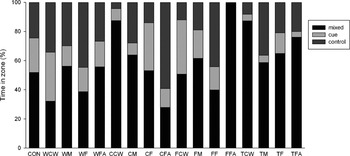
In the seawater control, L. branchialis spent over half of the experimental time (51·8 ± 39·5%) in the mixed zone of the choice chamber (Fig. 2). The other portion of the time was divided approximately equally between the cue zone (23·59 ± 33·07%) and the control zone (24·75 ± 34·89%). Although there were variations in behaviour of L. branchialis when exposed to the various chemical cues, many of these were not significantly different due to the wide variation between replicates.
Time spent in each zone for Lernaeocera branchialis pre-metamorphosed adult females observed in a Y-shaped choice chamber (n = 30). CCW, cod-conditioned water; CF, cod flesh; CFA, cod feces; CM, cod mucus; CON, seawater control; FCW, flounder-conditioned water; FF, flounder flesh; FFA, flounder feces; FM, flounder mucus; TCW, trout-conditioned water; TF, trout flesh; TFA, trout feces; TM, trout mucus; WCW, whiting-conditioned water; WF, whiting flesh; WFA, whiting feces; WM, whiting mucus.

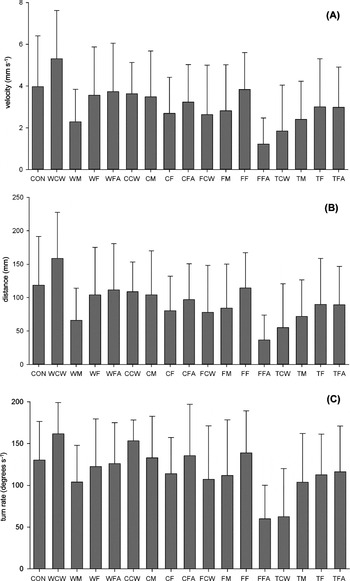
The strongest response was seen from parasites exposed to flounder feces, although their behaviour suggests repulsion to the cue. Parasites exposed to flounder feces spent 99·48 ± 2·27% of their time in the mixed zone, which was significantly different from the control parasites (P = < 0·001) (Fig. 2). Parasites exposed to flounder feces also spent significantly less time in the cue zone (P = 0·0014) and control zone (P = 0·0341). In addition, they had a lower velocity (1·22 ± 1·248 mm s−1), travelled less distance (36·51 ± 37·28 cm) and had a lower turn rate (59·90 ± 40·16 degrees s−1 (P = < 0·001) (Fig. 3). Similarly, the behaviour of parasites exposed to cod feces, trout feces, trout-conditioned water and trout mucus, also suggests repulsion to these cues, albeit less pronounced.
(A) Mean velocity, (B) mean distance travelled and (C) mean turn rate for Lernaeocera branchialis pre-metamorphosed adult females observed in a Y-shaped choice chamber (n = 30, bars = 1 s.d.). CCW, cod-conditioned water; CF, cod flesh; CFA, cod feces; CM, cod mucus; CON, seawater control; FCW, flounder-conditioned water; FF, flounder flesh; FFA, flounder feces; FM, flounder mucus; TCW, trout-conditioned water; TF, trout flesh; TFA, trout feces; TM, trout mucus; WCW, whiting-conditioned water; WF, whiting flesh; WFA, whiting feces; WM, whiting mucus.

Of the definitive host cues, parasites exposed to whiting-conditioned water and cod flesh spent more time in the mixed zone than control parasites, although none of these differences was significant (P >0·05). However, parasites exposed to whiting-conditioned water had a higher velocity (5·31 ± 2·31 mm s−1, P = 0·0428), travelled further (158·74 ± 68·98 cm, P = 0·0428) and had a higher turn rate (161·53 ± 37·52 degrees s−1, P = 0·0042) than control parasites (Fig. 3). This increased activity suggests attraction to whiting-conditioned water.
Natural behaviour experiments
In the seawater control, the behaviour of L. branchialis before and after the water was replaced in the arena was not significantly different (P >0·05 for all parameters) and consequently the data were grouped together to define normal behaviour. Mean distance travelled was 31·1 ± 23·4 cm in 3 min with a velocity of 1·74 ± 1·31 cm s−1. A high turn rate of 71·62 ± 46·7 degrees s−1 was observed, resulting in a number of relatively complex path shapes, giving a mean fractal dimension of 1·38 ± 0·31.
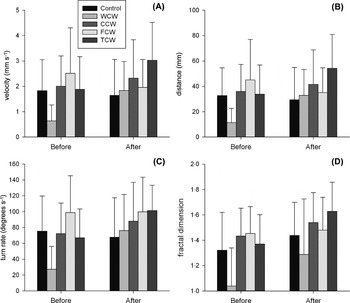
Of the four chemical cues tested, the most significant differences between cue presence and absence were observed for whiting-conditioned and for trout-conditioned water. However, due to the high degree of variability within groups, the levels of significance of differences between groups were low. In whiting-conditioned water, velocity increased from 0·64 ± 0·63 mm s−1 before the cue was added to 1·84 ± 1·14 mm s−1 after the cue was added (P = 0·0012); distance travelled increased from 11·38 ± 11·29 cm to 32·87 ± 20·44 cm (P = 0·0012); turn rate increased from 27·22 ± 28·93 degrees s−1 to 76·17 ± 45·48 degrees s−1 (P = 0·0013); fractal dimension increased from 1·04 ± 0·30 to 1·29 ± 0·44 (P = 0·0304) (Fig. 4). In trout-conditioned water, velocity increased from 1·88 ± 1·28 mm s−1 before the cue was added, to 3·02 ± 1·49 mm s−1 after the cue was added (P = 0·0017); distance travelled increased from 33·89 ± 22·93 cm to 54·22 ± 26·68 cm (P = 0·0017); turn rate increased from 66·99 ± 36·38 degrees s−1 to 101·39 ± 31·90 degrees s−1 (P = 0·0017); fractal dimension increased from 1·37 ± 0·23 to 1·63 ± 0·23 (P = 0·0036) (Fig. 4). The increase in activity after the cue was added indicates that the parasites may be excited by the addition of whiting- and trout-conditioned water. In flounder-conditioned water, velocity decreased from 2·51 ± 1·79 mm s−1 before the cue was added to 1·96 ± 1·10 mm s−1 after the cue was added (P = 0·0366), and distance travelled decreased from 45·08 ± 31·96 cm to 35·08 ± 19·59 cm (P = 0·0366) (Fig. 4). This decrease in activity suggests that flounder-conditioned water did not elicit an attraction response and may be repulsive to the parasites. In cod-conditioned water track complexity increased after the cue was added, with fractal dimension increasing from 1·43 ± 0·22 before the cue source was added to 1·54 ± 0·24 after the cue was added (P = 0·0152). Other behaviour parameters did not change significantly, suggesting that parasites were not excited by the addition of cod-conditioned water (Fig. 4).
Behaviour measurements of Lernaeocera branchialis pre-metamorphosed adult females before and after exposure to fish-conditioned water (n = 20, bars = 1 s.d.). (A) Mean velocity. (B) Mean distance travelled. (C) Mean turn rate. (D) Fractal dimension. CCW, cod-conditioned water; Control, seawater control; FCW, flounder-conditioned water; TCW, trout-conditioned water; WCW, whiting-conditioned water.

Before the cue was added, velocity, distance travelled, turn rate and fractal dimension were significantly lower for the cohort of animals exposed to whiting-conditioned water, than all other cues (P = < 0·01) (Fig. 4). These differences in behaviour before the addition of cues may be a result of different cohorts of L. branchialis having varying levels of fitness and illustrates the dangers of directly comparing behaviour between individuals as opposed to comparing the same individuals before and after adding the chemical cue.
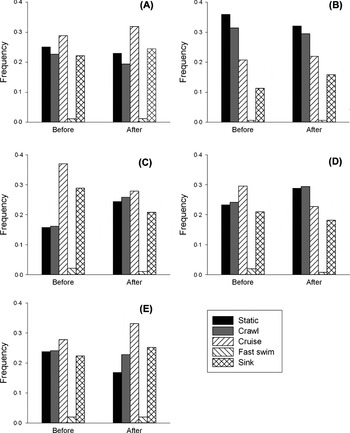
Behaviour state frequencies for the seawater controls were divided approximately equally between static, crawl, cruise and sink states (0·25, 0·23, 0·29 and 0·22, respectively) (Fig. 6A). As the fast swimming state accounted for <2% of the total observations for all cues, it was discounted from subsequent probability density functions and statistical analyses.
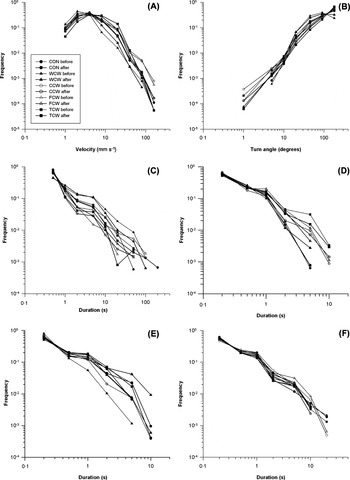
A broad variation in the probability density functions was observed for the static state, with long durations over 100 s recorded for all cues and controls (Fig. 5C). For the other behaviour states (crawl, cruise and sink), maximum duration was limited to <20 s (Fig. 5D-F). For the crawl and cruise states, considerable variation in duration frequency was observed between cues at higher durations, although for the sink state, variation in frequencies between cues was limited for all durations.
Probability density functions for Lernaeocera branchialis pre-metamorphosed adult females before and after exposure to fish-conditioned water. (A) Velocities. (B) Turn angles. (C) Static state. (D) Crawling state. (E) Cruising state. (F) Sinking state. CCW, cod-conditioned water; CON, seawater control; FCW, flounder-conditioned water; TCW, trout-conditioned water; WCW, whiting-conditioned water.

Behaviour state frequencies of Lernaeocera branchialis pre-metamorphosed females (n = 20) before and after exposure to (A) seawater control, (B) whiting-conditioned water, (C) cod-conditioned water, (D) flounder-conditioned water and (E) trout-conditioned water.

Probability density functions for velocities and turn rates were not significantly different after the addition of conditioned water from any of the fish species tested. The most common velocity for all groups was 4 mm s−1, with frequencies of between 0·31 and 0·39 for all cues and controls (Fig. 5A). The frequency of velocities decreased at higher and lower velocities, with velocities over 100 mm s−1 having a frequency of <4 × 10⁻⁴ for all groups. Frequencies of turn rates increased with increasing turn rate, with frequencies ranging from 6 × 10⁻⁵ to 4 × 10⁻⁴ at 1 degree s−1, to 0·23 to 0·67 at 180 degrees s−1 (Fig. 5B). Although the trend was linear for most groups, the control and whiting-conditioned water groups were described by a shallow sigmoid curve.
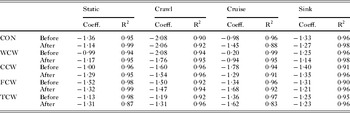
In the whiting-conditioned water group, behaviour state frequencies showed little variation before and after the cue was added (0·36 vs 0·32, 0·31 vs 0·3, 0·21 vs 0·22 and 0·11 vs 0·16 for static, crawl, cruise and sink, respectively) (Fig. 6B). Probability density functions for the crawl and sink states before and after the cue was added were significantly different (P = 0·019 and P = 0·035, respectively) (Fig. 5D,F). However, the differences in the probability density functions for the cruise state before and after the cue was added were highly significant (P = < 0·001), with the regression coefficients for the power-law regressions decreasing from −0·20 to −0·94 (Table 1). This was the largest change in the probability density function for any cue and suggests that the addition of whiting-conditioned water excited the parasites, resulting in an increase in the number of long-duration cruise events.
Regression coefficients and R2 values for power-law regressions calculated for probability density functions of Lernaeocera branchialis pre-metamorphosed adult females before and after exposure to fish-conditioned water

In the cod-conditioned water group, the frequency of the static and crawl states increased and the frequency of the cruise and sink states decreased after the addition of cod-conditioned water (0·16 vs 0·24, 0·16 vs 0·26, 0·37 vs 0·28 and 0·29 vs 0·21, for the static, crawl, cruise and sink states, respectively) (Fig. 6C). Significant differences in the probability density functions after the cue was added were seen for all behaviour states (P = < 0·001) (Fig. 5). Changes in the regression coefficients before and after the cue source was added, however, were low (−1·00 vs −1·29, −1·60 vs −1·54, −1·78 vs − 1·29 and −1·40 vs −1·35 for static, crawl, cruise and sink, respectively) (Table 1). As the addition of cod-conditioned water resulted in a decrease in long-duration events for the crawl, cruise and sink states, and an increase in long-duration events for the static state, this suggests that the parasites were not excited by the addition of cod-conditioned water.
In the flounder-conditioned water group, a similar response to cod-conditioned water was seen, with the frequency of the static and crawl states increasing and the frequency of the cruise and sink states decreasing after the addition of flounder-conditioned water (0·23 vs 0·29, 0·24 vs 0·29, 0·30 vs 0·23 and 0·21 vs 0·18 for static, crawl, cruise and sink states, respectively) (Fig. 6D). While the regression coefficients for the static, crawl and sink states indicated a decrease in the frequency of long duration events after the addition of the cue (−1·52 vs −1·32, −1·50 vs −1·47 and −1·31 vs −1·21, respectively), an increase in the frequency of long duration events was seen for the cruise state (−1·34 vs −1·68, P = 0·011) (Table 1).
In the trout-conditioned water group, the opposite was observed with respect to cod- and flounder-conditioned water, with the frequency of the static and crawl states decreasing and the frequency of the cruise and sink states increasing after the addition of the cue (0·24 vs 0·17, 0·24 vs 0·23, 0·28 vs 0·33 and 0·22 vs 0·25 for static, crawl, cruise and sink states, respectively) (Fig. 6E). Significant differences in the probability density functions were observed for the static and cruise states (P = < 0·001) and the crawl state (P = 0·033) (Fig. 5C-E), with the regression coefficients decreasing after the addition of the cue (−1·13 vs −1·31, −1·19 vs −1·31 and −1·36 vs −1·62 for the static, crawl and cruise states, respectively) (Table 1), indicating an increase in the frequency of long-duration events. A decrease in the frequency of long-duration events was seen for the sink state after the addition of trout-conditioned water, with the regression coefficient increasing from −1·25 to −1·23 (P = 0·032).
DISCUSSION
Behavioural responses
The host-finding behaviour of L. branchialis might be expected to be largely dependent upon the habits of its hosts, allowing the parasite to increase the likelihood of host encounter. The normal behaviour of L. branchialis, as observed in the controls, is indicative of a parasite searching for a demersal host fish. The majority of their time was spent static or crawling on the bottom, with long periods in these states. In comparison, cruise events were shorter and less frequent. This behaviour suggests that the parasites are periodically swimming up in the water column, in order to detect a host, with longer periods on the bottom to conserve energy reserves. Whilst moving, the parasites exhibited a high degree of turning, allowing them to cover an area thoroughly and improve their chance of detecting a host. This high track sinuosity during searching behaviour has also been demonstrated for other copepod species such as Temora longicornis, Müller, 1785 where males swim along more sinuous routes than females to increase the chance of encounter with a mate (Doall et al. Reference Doall, Colin, Strickler and Yen1998).
In comparison with the behaviour of L. branchialis, which predominantly remain on the bottom, L. salmonis parasitizes migratory salmonids, which utilize different depths in the water column. Consequently, the behaviour of L. salmonis is adapted to increase the chance of encounter with their hosts. Copepodids of L. salmonis undergo a diel vertical migration, moving to the surface during the day and deeper water at night (Heuch et al. Reference Heuch, Parsons and Boxaspen1995). As Atlantic salmon (Salmo salar) frequent surface waters at night and occupy deeper water during the day (Holm et al. Reference Holm, Huse, Waatevik, Doving and Aure1982; Westerberg, Reference Westerberg1982; Doving et al. Reference Doving, Westerberg and Johnsen1985; Dutil and Coutu, Reference Dutil and Coutu1988), they cross over as L. salmonis copepodids migrate upwards and salmon move downwards at dawn, allowing infection to take place. Since the flatfish intermediate hosts of L. branchialis are benthic and the definitive hosts are commonly demersal, they have no need to migrate upwards in the water column and this is reflected in their behaviour patterns. Although the arena used in this experiment was only 8 cm deep, the parasites spent the majority of their time in the bottom quarter of the arena. Unlike Atlantic salmon, which are only exposed to L. salmonis for brief periods during their migrations in the water column, the hosts of L. branchialis are continually exposed to the parasite, which may contribute to the high prevalence of infection seen in some areas.
With the addition of some fish-derived odours into the arena, some of the behavioural responses of L. branchialis were exaggerated: velocity increased, they travelled further and turn rate increased, producing more complex tracks. This increased turn rate allows them to explore an area more extensively where a host chemical signal has been detected, whereas the increased velocity and movement increases the chances of encountering the host. This behaviour was induced by the addition of whiting-conditioned water, as may be expected, being derived from a suitable host, but also by trout-conditioned water. However, the response to trout-conditioned water was not as strong as the response to whiting-conditioned water. In addition, a significant increase was seen in the frequency of long duration cruise events after the addition of whiting-conditioned water, which suggests a response to an attractive host kairomone. A similar response to semiochemicals has been observed in other copepods and may be likened to the frequent turning of insects moving upwind in an odour plume (Murlis et al. Reference Murlis, Elkinton and Cardé1992). For example, L. salmonis copepodids increase their speed and change direction frequently in the presence of kairomones in the water derived from Atlantic salmon (Devine et al. Reference Devine, Ingvarsdottir, Mordue, Pike, Pickett, Duce and Mordue2000).
The change in behaviour of L. branchialis in the presence of host-derived kairomones, as demonstrated in this study, is not without cost or risk. The increase in velocity and distance travelled increases the consumption of energy reserves, as well as increasing the chance of encounter with a predator. Moreover, the high turn rates may make the parasites more attractive to predators such as fish (Tiselius and Jonsson, Reference Tiselius and Jonsson1990; Doall et al. Reference Doall, Colin, Strickler and Yen1998).
Contrary to their behaviour when exposed to whiting-conditioned water, the responses of L. branchialis to flounder-derived substances were reversed; average velocity decreased, they travelled less distance and turn rate decreased; the frequency of the static and crawl states increased and the frequency of the cruise and sink states decreased. In the choice chamber experiment, parasites showed a strong aversion to flounder feces by avoiding the chamber arm containing the cue. This behaviour suggests a repulsion response to flounder-derived odours, which is unsurprising, considering that the parasites have recently left their flounder intermediate hosts and are searching for gadoid hosts.
Implications for host preference
Whereas a strong attraction to whiting-derived odours was not unexpected, it was surprising that cod-derived odours did not elicit a similar response. Currently L. branchialis is viewed as a genetically homogeneous population infecting a range of gadoids. Therefore, as both cod and whiting are recorded as definitive hosts (Brooker et al. Reference Brooker, Shinn and Bron2007), a similar response may be expected to odours derived from both species. The different behavioural response to whiting-conditioned water and cod-conditioned water in this study, however, suggests that cod and whiting are not treated in the same way by the parasite. Interestingly, at the field site where the parasites were collected, almost all whiting were infected with L. branchialis, whereas virtually all cod were uninfected. This evidence raises 2 alternative hypotheses: either that there are genetically determined subspecies or host preferences in L. branchialis, or that there is some form of environmental pre-conditioning, either maternally derived or at the egg/nauplius stages, that allows the parasite to preferentially recognize the host species from which it originated.
Genetically determined subspecies have already been demonstrated in several other parasitic copepods. In Caligus elongatus von Nordmann, 1832 analysis of the mtDNA gene CO1 has revealed 2 types of genetic lineages (Øines and Heuch, Reference Øines and Heuch2005). Analysis of the genetic structure of Lepeophtheirus europaensis Zeddam, 1988 has shown polymorphism between those parasitic on brill (Scophthalmus rhombus) and those on flounder (De Meeus et al. Reference De Meeus, Marin and Renaud1992) and is attributed to salinity imparting a strong environmental selective pressure on L. europaensis parasitic on flounder in coastal lagoons. A similar differential preference for different fish hosts was also demonstrated in Lepeophtheirus pectoralis (Boxshall, Reference Boxshall1976). Given that the process of subspeciation has been demonstrated in other parasitic copepods and that L. branchialis show a different behavioural response to whiting- and cod-derived substances, it is possible that this process is also occurring in L. branchialis, although the selective pressures driving such subspeciation are uncertain at this stage.
Implications for host location
Host location mechanisms can be divided into 3 categories: those which bring the parasite into the host's habitat; those which assist the parasite to respond to and come into contact with the host; and those which allow the parasite to recognize a suitable host (Heuch et al. Reference Heuch, Doall and Yen2007). Mechanisms used for the first phase of host location (inhabiting the same waters as the host) have not been investigated in L. branchialis, although Sproston (Reference Sproston1942) suggested that L. branchialis is not a strong swimmer. The results of the natural behaviour experiment, however, suggest that L. branchialis has considerable swimming capabilities and may be able to cover moderate distances to locate a host. The mean distance covered by parasites exposed to whiting-conditioned water in 3 min was 32·87 ± 20·44 cm, which equates to 6·57 m h−1 and gives some idea of the mobility of the parasite and its host-seeking ability. These figures suggest that L. branchialis can cover a moderate distance to locate a host. In comparison, distances covered by L. salmonis when excited by the presence of salmon-conditioned water were 45·2 ± 8·3 cm for a 3-min period, giving a velocity of 9·04 m h−1 (Devine et al. Reference Devine, Ingvarsdottir, Mordue, Pike, Pickett, Duce and Mordue2000). Whether physical phenomena, such as tidal currents, haloclines and thermoclines, are used during this phase, or if location of the host's habitat is purely by chance is not known. Mechanisms involved in this phase of host location may include aggregating in areas where potential hosts are likely to be found or chemo-reception of fish-derived odours. For example, L. salmonis aggregate in steep salinity gradients which may be frequented by feeding salmon (Heuch, Reference Heuch1995). The ability of L. branchialis to utilize kairomones at this scale is dependent on odour landscapes, which are shaped by physical factors such as stirring and mixing in the water body (Moore and Crimaldi, Reference Moore and Crimaldi2004).
As the responses of L. branchialis to host-derived kairomones were not decisive in both the choice chamber and natural behaviour experiments, it is likely that L. branchialis employs a range of mechanisms in the second phase of host location (response to a potential host). In L. branchialis these other cues have yet to be determined, but in L. salmonis physical cues have been shown to play a role in host location. Copepodids of L. salmonis have been shown to react positively to directional light (Lewis, Reference Lewis1963; Bron et al. Reference Bron, Sommerville, Rae, Boxshall and Defaye1993; MacKinnon, Reference MacKinnon1993; Pike et al. Reference Pike, Mordue, Ritchie, Boxshall and Defaye1993) and are sensitive to vibrations and flows, resulting in faster swimming and turning behaviour to attack fish (Bron et al. Reference Bron, Sommerville, Rae, Boxshall and Defaye1993; Heuch and Karlsen, Reference Heuch and Karlsen1997; Heuch et al. Reference Heuch, Doall and Yen2007). Heuch et al. (Reference Heuch, Doall and Yen2007) showed that copepodids of L. salmonis respond positively to hydromechanical signals from fish in the absence of fish-derived odours, and suggested that physical cues are utilized for host detection and kairomones are used for host recognition, once the parasite has attached to the host. Studies have shown that copepodids of L. salmonis will infect species other than salmonids, but will abandon these within hours of contact (Olsen, Reference Olsen2001). However, other workers have demonstrated that L. salmonis copepodids show an attraction response to host-derived chemical cues in choice chamber experiments (Devine et al. Reference Devine, Ingvarsdottir, Mordue, Pike, Pickett, Duce and Mordue2000; Bailey et al. Reference Bailey, Birkett and Ingvarsdottir2006), showing that kairomones have a role to play in locating a host. Similarly, it has been suggested that L. pectoralis uses physical stimuli, such as currents and vibrations, to locate the host and chemical stimuli to recognize a suitable host when in close proximity (Boxshall, Reference Boxshall1976).
The results of this study suggest that in L. branchialis, kairomones are used to locate a host, as the addition of specific kairomone sources in the water elicits a response suggestive of host-seeking behaviour. The variation in behaviour and vague responses of some parasites, however, suggests that kairomones alone are not sufficient to locate and detect a host and it is likely that physical cues also have a role to play in host location. Indeed, in the choice chamber experiment, parasites were sometimes observed swimming in the inflow current of the chamber, indicating that L. branchialis may orientate themselves towards a current, which could have a role to play in host location. Once a host has been located, kairomones must also be utilized to ensure that the species is suitable for infection. Chemical host identification on contact with the host has been demonstrated in L. pectoralis (Boxshall, Reference Boxshall1976), Lernaeenicus sprattae Sowerby, 1806 (Anstensrud and Schram, Reference Anstensrud and Schram1988) and L. salmonis (Bron et al. Reference Bron, Sommerville, Jones and Rae1991, Reference Bron, Sommerville, Rae, Boxshall and Defaye1993). It seems likely, therefore, that L. branchialis may utilize kairomones to both locate a host and ensure that is it suitable for infection.
Although this study has established that conditioned water from some host species induces a host-seeking response in L. branchialis, the specific kairomone compounds in fish-conditioned water that attract L. branchialis to its host were not identified. In other species, however, a great diversity of different attractant compounds has been found. Structure-function studies have shown that neutral amino-acid compounds with a basic carboxyl terminal are commonly used in marine organisms for modifying physiological and behavioural responses (Rittschof and Cohen, Reference Rittschof and Cohen2004). Gas chromatography and mass spectrometry have been used successfully to extract specific compounds from salmon-conditioned water and a number of small molecules have been identified which may play a role in host location in L. salmonis (Ingvarsdottir et al. Reference Ingvarsdottir, Birkett, Duce, Genna, Mordue, Pickett, Wadhams and Mordue2002). Both isophorone and 1-octen-3-ol (low molecular weight components of fish odour) cause activation responses from the lice and induce electrophysiological responses from the antennae. Following on from this study, similar extraction techniques with whiting-conditioned water may be used to determine the specific compounds that elicit an attraction response in L. branchialis.
Conclusions
While the results of this study are interesting, the application of this information may prove to be of greater significance. L. branchialis is regarded as a pathogen that could be potentially devastating to gadoid aquaculture in North Atlantic countries (Khan et al. Reference Khan, Lee and Barker1990; Bricknell et al. Reference Bricknell, Bron and Bowden2006) and given its widespread distribution in the North Atlantic and pathogenicity to its host (Brooker et al. Reference Brooker, Shinn and Bron2007), it must have significant effects on juvenile recruitment to wild gadoid fisheries. By modelling the behaviour of L. branchialis and coupling it with biophysical models of host distributions and current regimes, it may be possible to predict the effects of L. branchialis on wild gadoid populations or farmed gadoids, by modelling their distribution from intermediate host habitats. This type of complex model has recently been achieved by Staaterman et al. (Reference Staaterman, Paris and Helgers2012), who predicted the fate of virtual reef fish larvae and their recruitment to coral reefs. Furthermore, identification of the specific kairomone compounds utilized by L. branchialis may be used to develop targeted control mechanisms in gadoid aquaculture, similar to those suggested by Ingvarsdottir et al. (Reference Ingvarsdottir, Birkett, Duce, Genna, Mordue, Pickett, Wadhams and Mordue2002) for capture of sea lice using slow-release odour traps. These examples illustrate how this type of detailed behavioural information might be applied to ameliorate the effects of this commercially significant pathogen on wild and cultured gadoid populations.
ACKNOWLEDGEMENTS
This project was funded by a NERC studentship awarded to A.J.B.