Introduction
Attention-deficit/hyperactivity disorder (ADHD) is proposed as a risk factor for overweight and obesity (Fliers et al. Reference Fliers, Buitelaar, Maras, Bul, Hohle, Faraone, Franke and Rommelse2013). ADHD is characterised by inattention, hyperactivity and impulsivity (American Psychiatric Association, 2013), and it has an estimated worldwide prevalence of 5.3% in populations under 18 years when using either Diagnostic and Statistical Manual (DSM) or International Classification of Diseases (ICD) criteria (Polanczyk et al. Reference Polanczyk, De Lima, Horta, Biederman and Rohde2007). Associations between ADHD and overweight/obesity are reported in child and adolescent clinical (Erermis et al. Reference Erermis, Cetin, Tamar, Bukusoglu, Akdeniz and Goksen2004; Holtkamp et al. Reference Holtkamp, Konrad, Müller, Heussen, Herpertz, Herpertz-Dahlmann and Hebebrand2004; Agranat-Meged et al. Reference Agranat-Meged, Deitcher, Goldzweig, Leibenson, Stein and Galili-Weisstub2005; Spencer et al. Reference Spencer, Faraone, Biederman, Lerner, Cooper and Zimmerman2006; Swanson et al. Reference Swanson, Greenhill, Wigal, Kollins, Stehli, Davies, Chuang, Vitiello, Skrobala, Posner, Abikoff, Oatis, McCRACKEN, McGOUGH, Riddle, Ghuman, Cunningham and Wigal2006) and general population studies (Anderson et al. Reference Anderson, Cohen, Naumova and Must2006; Lam & Yang, Reference Lam and Yang2007). Cortese et al. (Reference Cortese, Moreira-Maia, St. Fleur, Morcillo-Peñalver, Rohde and Faraone2015) meta-analysed 30 studies involving children and adolescents indicating significant associations between ADHD and obesity [odds ratio (OR) = 1.20].
It is hypothesised that ADHD and overweight/obesity overlap due to shared genetic vulnerabilities (Faith et al. Reference Faith, Carnell and Kral2013; Frazier-Wood et al. Reference Frazier-Wood, Carnell, Pena, Hughes, O’Connor, Asherson and Kuntsi2014) and dysregulation of dopamine reward pathways that are common to both presentations (Cortese & Vincenzi, Reference Cortese, Vincenzi, Stanford and Tannock2011). Sanders (Reference Sanders1983) hypothesised that hypoarousal may explain the behavioural symptoms of ADHD and this notion may also link ADHD with higher BMIs. For instance, individuals with ADHD may use energy-dense foods to maintain adequate arousal levels (Cortese & Vincenzi, Reference Cortese, Vincenzi, Stanford and Tannock2011). Others speculate that the link between ADHD and overweight/obesity might also be mediated by mood disorders, and that consumption of foods high in fat, sugar and salt might temporarily improve mood (Davis et al. Reference Davis, Strachan and Berkson2004).
Deficient attention, response inhibition and planning might lead to poor food choices (i.e. foods high in fat, sugar and salt) and binge eating in the absence of hunger (Cortese & Vincenzi, Reference Cortese, Vincenzi, Stanford and Tannock2011; Nazar et al. Reference Nazar, Bernardes, Peachey, Sergeant, Mattos and Treasure2016). Obesity and ADHD have both been linked with impulsive responding and a tendency to value immediate over delayed rewards (Sonuga-Barke et al. Reference Sonuga-Barke, Taylor, Sembi and Smith1992; Patterson & Newman, Reference Patterson and Newman1993; Appelhans, Reference Appelhans2009). The immediacy of fast food production means there is little-to-no delay between the initial desire for food and its satisfaction, potentially leading to a preference for fast food in this population. This preference may then be reinforced, as consumption of foods high in fat sugar and salt leads to stimulation of dopaminergic reward pathways (Davis et al. Reference Davis, Levitan, Smith, Tweed and Curtis2006; Cortese & Vincenzi, Reference Cortese, Vincenzi, Stanford and Tannock2011). In support of this, Davis et al. (Reference Davis, Levitan, Smith, Tweed and Curtis2006) report that ADHD symptoms, including impulsivity, are predictive of overeating behaviours which are in turn predictive of overweight/obesity.
A related body of research has implicated individual differences in sensitivity to reward, with some studies suggesting a link between obesity and a deficiency in reward systems, associated with hypodopaminergic functioning (e.g. Wang et al. Reference Wang, Volkow, Logan, Pappas, Wong, Zhu, Netussl and Fowler2001, Reference Wang, Volkow, Thanos and Fowler2004). Others claim the reverse – that risk of obesity is linked with heightened sensitivity to reward (e.g. Davis et al. Reference Davis, Strachan and Berkson2004; Franken & Muris, Reference Franken and Muris2005; Davis et al. Reference Davis, Patte, Levitan, Reid, Tweed and Curtis2007). Davis & Fox (Reference Davis and Fox2008) provided an apparent solution to this contradiction by describing an inverted-U shaped relationship between sensitivity to reward and BMI. BMI was positively associated with sensitivity to reward in the normal to overweight range, whereas the relationship was reversed in those in the obese range (BMI > 30). This suggests two possible routes to obesity arising from different levels of sensitivity to reward: those who are relatively sensitive to reward are highly motivated to seek out pleasurable foods and will struggle to resist the temptation of palatable foods that are high in sugar and fat. In contrast, individuals with an underactive dopamine reward pathway may ‘self-medicate’ with pleasurable foods to enhance dopaminergic activation and improve mood (Davis & Fox, Reference Davis and Fox2008). It is this latter pathway which seems most likely to be at play in the ADHD–obesity relationship, as a reduction in sensitivity to reward, and corresponding deficits in dopamine reward pathways, has also been identified in ADHD (Volkow et al. Reference Volkow, Wang, Kollins, Wigal, Newcorn, Telang, Fowler, Zhu, Logan, Ma, Pradhan, Wong and Swanson2009, Reference Volkow, Wang, Newcorn, Kollins, Wigal, Telang, Folwer, Goldstein, Klein, Logan and Wong2011).
While these hypotheses, linking ADHD and overweight/obesity through dopaminergic dysregulation, motivational deficits and mood disorders, appear plausible, the association between ADHD and overweight/obesity may not be so clear-cut, as other clinical and population studies with children and adolescents have not found support for this link (Spencer et al. Reference Spencer, Biederman, Harding, O’Donnell, Faraone and Wilens1996; Biederman et al. Reference Biederman, Faraone, Monuteaux, Plunkett, Gifford and Spencer2003; Mustillo et al. Reference Mustillo, Worthman, Erkanli, Keeler, Angold and Costello2003; Braet et al. Reference Braet, Claus, Verbeken and Van Vlierberghe2007; Nigg et al. Reference Nigg, Johnstone, Musser, Long, Willoughby and Shannon2016).
In a recent population study of almost 45 309 children (10–17-year-olds), Nigg et al. (Reference Nigg, Johnstone, Musser, Long, Willoughby and Shannon2016) found no significant overall association between parental reports of professional diagnoses of ADHD and BMI. Significant associations were only seen in adolescent girls (14– 17 years; OR = 1.73), but the effect was attenuated when adjustments were made for depression (OR = 1.48) and when parental reports of depression and conduct disorder were controlled for, the effect was no longer significant (OR = 1.36). Nigg et al. (Reference Nigg, Johnstone, Musser, Long, Willoughby and Shannon2016) also conducted a meta-analysis of 42 studies and reported that 32.6% of studies found a positive association between ADHD and overweight/obesity. Across these studies, they reported a monotonic increase in effect size as a function of increasing age, and that there was no reliable association between ADHD and overweight/obesity in pre-pubertal children. In addition, the effect was only reliable in adolescent females, not in adolescent males. The authors caution that age, sex and comorbid psychological difficulties may moderate the relationship between ADHD and overweight/obesity.
A host of other demographic and clinical factors relating to children and even their parents may be implicated in the ADHD–BMI link. In terms of child factors, developmental coordination disorder (DCD) is associated with lower levels of physical activity (Rivilis et al. Reference Rivilis, Hay, Cairney, Klentrou, Liu and Faught2011) and has a negative relationship with BMI, whereby poorer motor coordination is associated with higher BMI (Lopes et al. Reference Lopes, Stodden, Bianchi, Maia and Rodrigues2012). Since DCD and ADHD overlap in up to one-third of cases (Fliers et al. Reference Fliers, Rommelse, Vermeulen, Altink, Buschgens, Faraone, Sergeant, Franke and Buitelaar2008), DCD may mediate the link between ADHD and overweight/obesity by reducing the child’s level of physical activity (Fliers et al. Reference Fliers, Buitelaar, Maras, Bul, Hohle, Faraone, Franke and Rommelse2013). Low birth weight is associated with ADHD (Mick et al. Reference Mick, Biederman, Prince, Fischer and Faraone2002), whereas high birth weight is associated with obesity (Yu et al. Reference Yu, Han, Zhu, Zhu, Wang, Cao and Guo2011). This variable may therefore serve as a confound in the relationship (Hanć et al. Reference Hanć, Słopień, Wolańczyk, Dmitrzak-Węglarz, Szwed, Czapla, Durga, Ratajczak and Cieślik2015). Exercise and reduced sedentary behaviours appear to protect against weight gain (Must & Tybor, Reference Must and Tybor2005), but others suggest that this claim does not extend to boys with ADHD (Holtkamp et al. Reference Holtkamp, Konrad, Müller, Heussen, Herpertz, Herpertz-Dahlmann and Hebebrand2004). Depression (Biederman et al. Reference Biederman, Spencer, Monuteaux and Faraone2010) and oppositional defiance (Fliers et al. Reference Fliers, Buitelaar, Maras, Bul, Hohle, Faraone, Franke and Rommelse2013) predict weight status in children and are frequently diagnosed comorbidly with ADHD (Biederman et al. Reference Biederman, Ball, Monuteaux, Mick, Spencer, McCreary, Cote and Faraone2008; Connor & Doerfler, Reference Connor and Doerfler2008); these variables must therefore be considered when evaluating the relationship between ADHD and BMI.
Parental psychosocial factors are also independently associated with both ADHD and overweight/obesity in children, so their impacts on the ADHD–BMI link must be considered. These include low socio-economic status (SES; Layte & McCrory, Reference Layte and McCrory2011; Russell et al. Reference Russell, Ford and Russell2015), parental BMI (Rodriguez, Reference Rodriguez2010), parental depression (Lampard et al. Reference Lampard, Franckle and Davison2014) and prenatal maternal smoking (Langley et al. Reference Langley, Rice, van den Bree and Thapar2005; Behl et al. Reference Behl, Rao, Aagaard, Davidson, Levin, Slotkin, Srinivasan, Wallinga, White, Walker, Thayer and Holloway2012). Prenatal maternal alcohol use is associated with ADHD (Gronimus et al. Reference Gronimus, Ridout, Sandberg and Santosh2009) and low birth weight (McCarthy et al. Reference McCarthy, O‘Keeffe, Khashan, North, Poston, McCowan, Baker, Dekker, Roberts, Walker and Kenny2013), so its impact on BMI is also of interest.
The majority of studies assessing the ADHD–BMI link are cross-sectional in nature, which restricts interpretation of findings. The evidence from longitudinal studies is mixed, warranting additional research. For instance, Cortese et al. (Reference Cortese, Ramos Olazagasti, Klein, Castellanos, Proal and Mannuzza2013) suggested that men with childhood ADHD had significantly higher rates of obesity in adulthood compared to men without childhood ADHD, even after controlling for SES and lifetime mental health problems. In contrast, ADHD was not associated with obesity at annual follow-ups over 8 years (Mustillo et al. Reference Mustillo, Worthman, Erkanli, Keeler, Angold and Costello2003); instead oppositional defiance disorder and depression (in boys) were related to weight status. Similarly, there was no increased risk for overweight in an ADHD sample over 10 years, but females with comorbid depression were at increased risk of weight gain (Biederman et al. Reference Biederman, Spencer, Monuteaux and Faraone2010). Most recently, Nigg et al. (Reference Nigg, Johnstone, Musser, Long, Willoughby and Shannon2016) reported no discernible association between ADHD and BMI in children (7– 13 years) assessed yearly over 2 years. Instead age, household income and stimulant use were significant weight-related factors.
These longitudinal studies hint at important implications, for example, the ADHD-overweight/obesity link may be more pronounced at certain developmental stages (e.g. in adulthood, when individuals may be assumed to have more control over their own health-related behaviours) and when comorbid factors are adjusted for in childhood, the effect appears to reduce. Moreover, the research described above suggests that the association between BMI categories and ADHD may be confounded by a wide range of demographic and psychosocial factors. The present study aims to clarify the nature of this relationship in a large and representative sample of young people. Data were obtained from a large cross-sectional and longitudinal cohort of children recruited to the Growing Up in Ireland (GUI) study. The relationship between ADHD and overweight/obesity was assessed at 9 and 13 years of age, and adjusted for the effects of both child factors (sex, birth weight, DCD, emotional symptoms (ES), conduct problems (CP), hyperactivity–inattention (HI), exercise) and parent factors (parental BMI, parental depression, SES, prenatal smoking, alcohol use). Each of these factors has previously been shown to independently influence body weight and ADHD status, and thus may be implicated in the apparent relationship between ADHD and overweight/obesity.
Research questions
-
1. Is ADHD status associated with BMI category at 9 years and at 13 years of age?
-
2. Is ADHD status at either age associated with BMI category after controlling for child and parent factors?
-
3. What factors at 9 years are associated with BMI category at 13 years?
Method
Participants
This study represents a secondary analysis of data from the GUI project, which examines factors that contribute to or undermine the well-being of Irish children. The GUI study received ethical approval from the Research Ethics Committee of the Health Research Board. Wave 1 data were collected between August 2007 and April 2009 for children aged 9 years. Four years later, wave 2 data were collected for the same children, then aged 13 years.
Children were recruited via a random sample of 1105 public, private or special education schools stratified for county, sex mix, disadvantaged status, religious denomination and size (82.3% school response rate). Information packs with consent and assent forms were dispatched to families. In total, 17 054 children were eligible to participate and consent was secured from 9645 (56.6% response rate). Consenting parents were contacted and 8655 home-based interviews were scheduled (89.7% response rate). Children with suspected or professional diagnoses of intellectual disability (n = 136) were excluded, leaving a maximum of 8432 individuals at wave 1. There were missing data across all variables of interest, so sample sizes vary throughout, but ns are listed where necessary.
Eighty-seven families were excluded from the dataset, either because families requested to be withdrawn from the study or because there was too much missing data. The final dataset included 8568 children, representing about one in seven 9-year-olds resident in Ireland at the time. Data for twins and triplets were collected separately and were not included in this study. At wave 2, data were collected for 7525 individuals (attrition rate of 12.2%).
The majority of children (94.6%) and parents/caregivers (92.6%) were Irish. Respondents were mostly biological parents of study children (95.8%), 3.1% were step-parents and 1% were other parents/caregivers. Respondents were mostly female (98.2%) and 51% of children were female.
Research design
The study was a cross-sectional and longitudinal, between- and within-subjects design. Unadjusted and adjusted logistic regression models were used to examine predictors of BMI categories in children.
Procedure
Field workers interviewed children and parents/caregivers in their homes, and teacher interviews were conducted in schools. Interviews included survey questions, standardised questionnaires and open-ended questions regarding the children’s health, use of health services, diet, exercise, lifestyle, activities, emotional health, well-being, education, attainments, family context, sociodemographics and neighbourhood/community. Key variables were extracted from the GUI dataset based on their comparability with the literature discussed in the introduction section.
Measures
Heights and weights (nearest millimetre and 0.5 kg) of children and their parents were measured by the experimenters during home-based interviews at both waves. BMI was calculated as weight (kilograms) divided by the square of the height (metres).
ADHD and DCD status were determined based on parent/caregivers’ ‘yes/no’ responses about whether these difficulties had been diagnosed by a professional. Thus, categorisation is based on parental reports of professional diagnosis. ADHD symptoms (HI), ES and CP were measured with the Strengths and Difficulties Questionnaire (SDQ; Goodman, Reference Goodman1997), a 25-item measure for youths aged between 3 and 16 years. The SDQ has adequate reliability (α = 0.73; Goodman, Reference Goodman2001) and validity (Becker et al. Reference Becker, Woerner, Hasselhorn, Banaschewski and Rothenberger2004), and the HI subscale predicts parent reports of professional diagnoses of ADHD (Russell et al. Reference Russell, Rodgers and Ford2013). The psychometric properties of the SDQ in the GUI dataset are reported by Nixon (Reference Nixon2012); in the present sample, reliabilities for the SDQ were acceptable (mothers α = 0.79; fathers α = 0.86). Three subscales (ES, CP and HI) are used; scores on each subscale range from 0 to 10, where higher scores reflect greater symptom severity. The total score was highly correlated with the variables of interest (i.e. ES, HI and CP) and was therefore excluded from the regression to avoid issues arising from multicollinearity. Peer problems and pro-social behaviour subscales were not included in the analyses, as these constructs have not been examined in relevant previous literature.
Birth weight (kilograms) was based on parental self-reports. The study child’s engagement with exercise was assessed by asking parents how many times in the past 14 days the child engaged in at least 20 minutes of hard exercise enough to make him/her breathe heavily or for their heart to beat faster [adapted from Godin & Shephard (Reference Godin and Shephard1985)]. Data were collected at both waves using categorical variables (none, 1–2, 3–5, 6–8 and 9–16 times). To facilitate analysis, exercise was recoded as a continuous variable by calculating the average number of times of hard exercise (0, 1.5, 4, 7 and 12.5 times).
Parental occupations were classified as professional/managerial, other non-manual/skilled manual or semi-skilled/unskilled manual (Central Statistics Office, 2006). These categories represent high, medium and low SES classes, respectively. Parents/caregivers completed the 8-item short version of the Centre for Epidemiologic Studies – Depression Scale [CES-D8 (Melchior et al. Reference Melchior, Huba, Brown and Reback1993)], at both waves. This measure screens for depressive symptoms in parents/caregivers over the previous week. Scores range from 0 to 24 (≥7 indicates depression). The CES-D8 correlates highly with the CES-D (r = 0.93), and it also has demonstrable internal reliability (α = 0.86; Melchior et al. Reference Melchior, Huba, Brown and Reback1993). In the present sample, the CES-D8 had adequate internal reliability (mothers α = 0.88; fathers α = 0.80; Nixon, Reference Nixon2012). Mothers were asked how many cigarettes they smoked per day during pregnancy (0, 1–5, 6–10, 11–25 or >26) and for prenatal alcohol use they indicated ‘never’, ‘occasionally’, ‘weekly’ or ‘daily’. Responses for prenatal smoking and alcohol use were collapsed to ‘no’ or ‘yes’.
Statistical analyses
IBM SPSS (Version 20) was used for data analysis. Binary logistic regression was performed to assess the strength of the association between categorical and continuous psychosocial variables and BMI categories. BMI scores for parents/caregivers were categorised as underweight (≤18.49 kg/m2), healthy weight (18.5–24.9 kg/m2) or overweight/obese (≥25 kg/m2). For children and adolescents, BMI categories (underweight, healthy weight, overweight or obese) were calculated using age and sex norms from the International Obesity Task Force (IOTF; Cole & Lobstein, Reference Cole and Lobstein2012). As the obese group was small (n = 589), the overall incidence of ADHD was low (~1%) and a large number of predictor variables were included in the logistic regression analyses described below, the obese group was collapsed with the overweight group (n = 1576) to prevent overspecification of the model. The underweight group (n = 474) was not included in the analyses; the logistic regression thus compared the healthy weight group with the combined overweight/obese group.
Three models were constructed: Model 1 assessed effects of these variables on BMI at 9 years (wave 1), while Model 2 assessed their effects on BMI at 13 years (wave 2). Model 3 evaluated the effects of baseline factors [static variables (e.g. sex, birth weight, maternal prenatal alcohol use, maternal prenatal smoking) and dynamic variables (e.g. ADHD status, DCD status, SDQ HI, SDQ ES, SDQ CP, CES-D8, parental BMI and SES)] at 9 years (wave 1) on BMI category at 13 years (wave 2). Static variables were included in this longitudinal analysis, so that the variance of dynamic variables would not be inflated in significant regression models.
The same procedure was followed for each of the three models. Firstly, unadjusted simple logistic regressions were performed to see if a host of individual factors were associated with BMI category. Secondly, ADHD status as well as all significant factors were subsequently entered into a multiple binary logistic regression (forced entry method). Corrections for multiple comparisons were made for each of the logistic regression models to constrain the family-wise alpha level to 0.05, for example, in all 3 models 13 comparisons were made (testwise α = 0.004). Multicolinearity diagnostics were performed, and variables with tolerance <0.1 and variance inflation factors >10 were excluded from further regression analyses (SDQ-Total). The variables included in each model and the results of the regressions are reported in Tables 3–5. ORs are listed for all predictor variables. An OR greater than 1 indicates that, as the predictor increases, the odds of the outcome occurring increase. In contrast, a value that less than 1 indicates that, as the predictor increases, the odds of the outcome occurring decrease.
Results
Descriptive statistics and demographic details
Based on parental reports of professional ADHD diagnoses, 0.8% (n = 71; n = 8568) of the sample had a diagnosis at wave 1 and 1.2% (n = 87, n = 7525) had a diagnosis at wave 2. Of those with ADHD at wave 2, 43.1% (n = 28) also had ADHD at wave 1. An exact McNemar’s test determined that there was no statistically significant difference in the proportion of children with ADHD across waves 1 and 2 (p = 0.113). Six children with ADHD at wave 1 dropped out by wave 2.
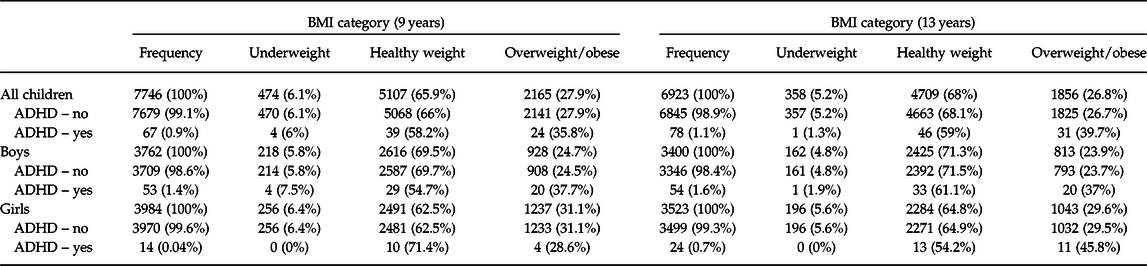
ADHD status was stratified by BMI categories (underweight, healthy weight and overweight/obese) and sex for 9- year-olds and 13-year-olds, and is reported in Table 1.
Frequencies of ADHD by sex, age and BMI category

Descriptive statistics for the underweight group are listed in the interests of completeness, but this group was not included in subsequent regression analyses. In total, 65.6% of children at 9 years were in the healthy BMI range, 6.1% were underweight and 27.9% were overweight/obese. BMI categories were similarly distributed at 13 years (under-weight = 5.2%; healthy weight = 68%; overweight/obese = 26.8%).
At wave 1, boys (77.8%) were more likely than girls (22.2%) to have ADHD [χ 2 (1, n = 7272) = 21.46, p < 0.001]. Similarly, at wave 2, boys (68.8%) were more likely than girls (31.2%) to have ADHD [χ 2 (1, n = 6565) = 11.86, p < 0.01]. In terms of weight status, girls (57.1%) were more likely than boys (42.9%) to be overweight/obese at wave 1 [χ 2 (1, n = 7272) = 42.53, p < 0.001]. Moreover, this sex difference in weight status was maintained at wave 2, again as girls (56.2%) were more likely than boys (43.8%) to be overweight/obese [χ 2 (1, n = 6565) = 31.52, p < 0.001].
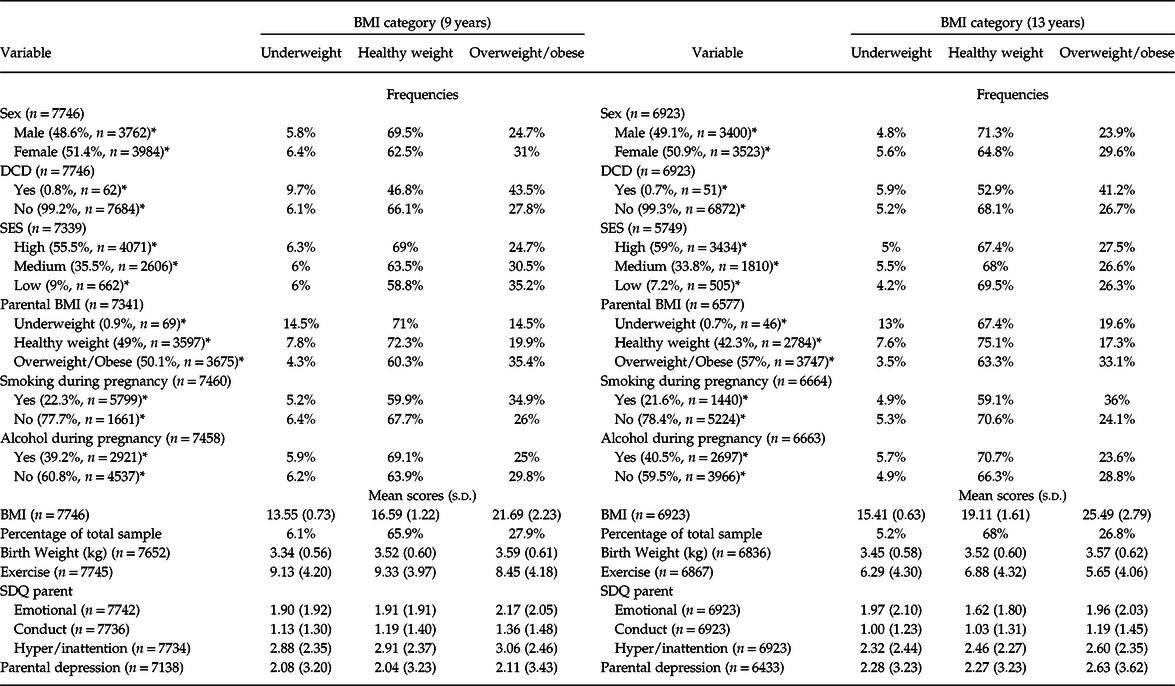
Other demographic and clinical characteristics are presented in Table 2. Less than 1% of children had a parental report of a professional diagnosis of DCD (wave 1 = 0.8% and wave 2 = 0.7%). The majority of children at 9 years came from families classified in the high SES group (55.5%), the remainder were medium SES (35.5%) or low SES (9%). Approximately half of parents were overweight/obese (50.1%), 49% were in the healthy BMI range, while 0.9% were underweight. Average ratings of parental depression were in the normal range (<7). The majority of mothers reported not smoking (77.7%) or drinking alcohol (60.8%) during pregnancy. SES distributions at 13 years were similar to 9 years (high = 59.4%, medium = 33.8% and low = 7.2%). Once again, the majority of parents fell within the overweight/obese range but this saw an increase from 50.1% to 57% at 13 years. Average parental depression was in the normal range.
Frequencies and mean scores of key child and parent factors for underweight, healthy weight and overweight/obese categories

ADHD, attention-deficit/hyperactivity disorder; DCD, developmental coordination disorder; SES, socio-economic status; BMI, body mass index; SDQ, Strengths and Difficulties Questionnaire.
* Denotes column percentages. All other percentages denote percentages of total sample.
Dropout analysis
A total of 1043 children (12.2% of the sample) dropped out between wave 1 and wave 2. Independent t-tests and chi-square tests were used to compare wave 1 outcomes between dropouts and non-dropouts. Children who dropped out had higher BMIs at wave 1 (M = 18.46, s.d. = 3.12) than non-dropouts [M = 18.06, s.d. = 2.77; t (1072.62) = 3.59, p < 0.001]; dropouts had higher scores on the SDQ–hyperactivity–inattention (SDQ–HI) subscale (M = 3.13, s.d. = 2.40) than non-dropouts [M = 2.93, s.d. = 2.40; t (7261) = 2.32, p < 0.05]; dropouts had significantly lower birth weights than non-dropouts [t (1079.43) = −2.35, p < 0.05]; and parental depression (CES-D8) was higher among dropouts than non-dropouts [t (886.17) = 3.42, p < 0.01]. There were no differences between dropouts and non-dropouts in terms of SDQ CP [t (7267) = 0.03, p > 0.05], SDQ ES [t (7261) = 1.93, p > 0.05] and exercise [t (1112.47) = −1.19, p > 0.05]. The prevalence of ADHD between dropouts (1.3%) and non-dropouts (0.8%) was not significantly different [i2 (1, n = 7272) = 1.73, p > 0.05].
Hypothesis 1: Is ADHD status associated with BMI category at 9 and at 13 years of age?
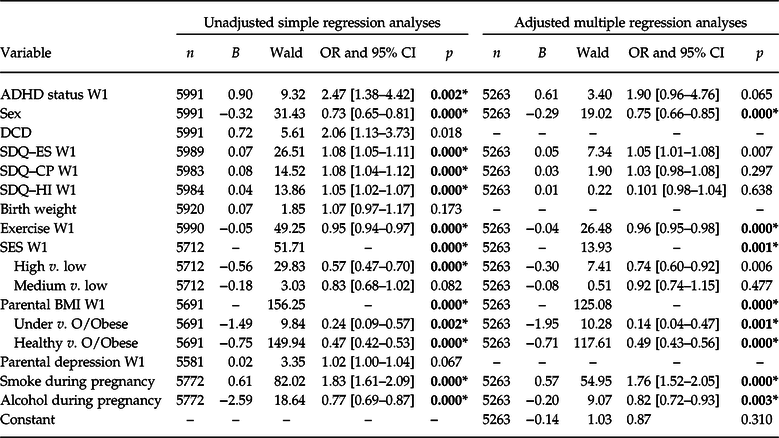
At wave 1, over 35.8% of children with ADHD were in the overweight/obese range, in comparison to 27.9% of children without ADHD (see Table 1). Moreover, 0.8% of those in the healthy weight range and 1.1% of those in the overweight/obese range had a diagnosis of ADHD. However, ADHD status at 9 years was not associated with BMI category. The SDQ–HI scale, a measure of ADHD symptoms, was also not associated with BMI category (see Table 3). Overweight/obesity prevalence among 13-year-olds with ADHD increased to 39.7% at wave 2, but only 26.7% of non-ADHD adolescents were overweight/obese (see Table 1). In addition, 1% of the healthy weight group had ADHD and 1.7% of the overweight/obese group had ADHD. Nevertheless, at 13 years, ADHD status and SDQ–HI were not significantly associated with BMI category (see Table 4).
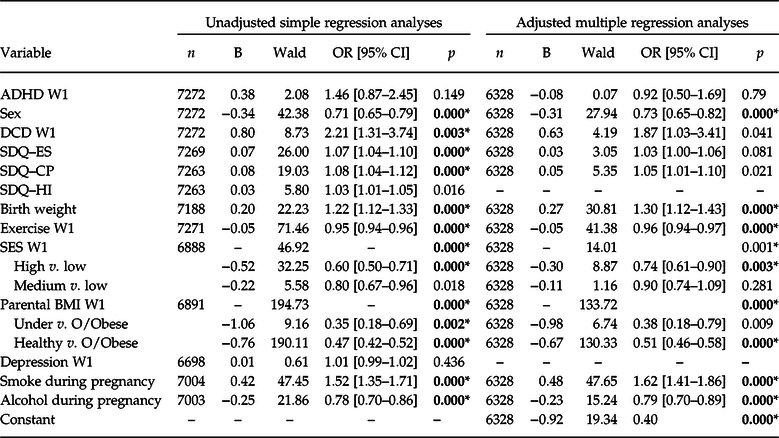
Binary logistic regression for psychosocial variables associated with BMI at 9 years (Model 1)

ADHD, attention-deficit/hyperactivity disorder; DCD, developmental coordination disorder; SDQ, Strengths and Difficulties Questionnaire; ES, emotional symptoms; CP, conduct problems,; HI, hyperactivity–inattention,; SES, socio-economic status; BMI, body mass index; OR, odds ratio; W1, wave 1.
* Corrected α value = 0.004 (13 comparisons in this model and significant effects are highlighted in bold).
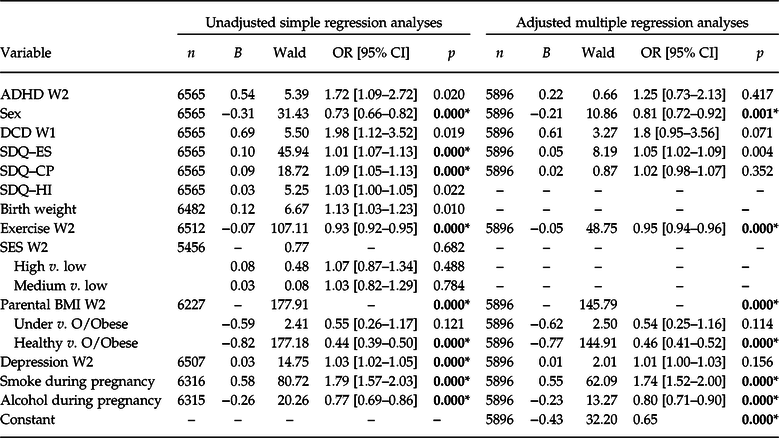
Binary logistic regression for psychosocial variables associated with BMI at 13 years (Model 2)

ADHD, attention-deficit/hyperactivity disorder; DCD, developmental coordination disorder; SDQ, Strengths and Difficulties Questionnaire; ES, emotional symptoms; CP, conduct problems; HI, hyperactivity–inattention; SES, socio-economic status; BMI, body mass index; OR, odds ratio; W2, wave 2.
* Corrected α value = 0.004 (13 comparisons in this model and significant effects are highlighted in bold).
Hypothesis 2: Is ADHD status associated with BMI category after controlling for psychosocial factors?
At wave 1, simple logistic regression indicated that there were significant effects of sex, DCD, SDQ (ES and CP), birth weight, exercise, SES, parental BMI, and maternal prenatal smoking and alcohol use, but not ADHD status. Next, all significant independent variables were entered into a multiple logistic regression to see if there was a combined association with the dependent variable (BMI category at 9 years; Table 3). This resulted in a significant model χ 2 (13) = 383.29, p < 0.001, R 2 = 0.059 (Cox and Snell), 0.084 (Nagelkerke), but there was no significant effect of ADHD status on BMI status. Overweight/obesity was less likely in males than females (OR = 0.73), as birth weight increased the odds of overweight/obesity increased (OR = 1.30), exercise reduced the odds of overweight/obesity (OR = 0.96), overweight/obesity was less likely in high SES versus low SES families (OR = 0.74), healthy weight parents were less likely to have overweight/obese children than overweight/obese parents (OR = 0.51), maternal prenatal smoking increased the odds of overweight/obesity (OR = 1.62) and maternal prenatal alcohol use reduced the likelihood of overweight/obesity (OR = 0.79).
At wave 2, sex, SDQ (ES and CP), exercise, parental BMI, parental depression, prenatal maternal smoking and alcohol use were each independently associated with BMI category in simple logistic regressions (Table 4). Again, all significant independent variables were entered into a multiple logistic regression to see if there was a combined association with the dependent variable (BMI category at 13 years), resulting in a significant model [χ 2 (10) = 375.41, p < 0.001, R 2 = 0.062 (Cox and Snell), 0.089 (Nagelkerke)]. However, there was no significant effect of ADHD status on BMI status. Overweight/obesity was less likely in males than females (OR = 0.81), exercise reduced the odds of overweight/obesity (OR = 0.95), adolescent overweight/obesity was less likely for healthy weight parents than overweight/obese parents (OR = 0.46), maternal prenatal smoking increased the odds of overweight/obesity (OR = 1.74) and maternal prenatal alcohol use reduced the likelihood of overweight/obesity (OR = 0.80).
Hypothesis 3: What factors at 9 years are associated with BMI category at 13 years?
ADHD status, sex, SDQ (ES, CP and HI), exercise, SES, parental BMI, and prenatal maternal smoking and alcohol use recorded at wave 1 were each significantly associated with BMI category at wave 2 in simple logistic regressions (Table 5). All significant factors were entered in the multiple regression, and main effects were seen for sex, exercise, parental BMI, prenatal maternal smoking and alcohol use, χ 2 (12) = 332.73, p < 0.001, (Cox and Snell = 0.06, Nagelkerke = 0.09). No significant effect of ADHD status was observed. ORs for main effects were in the same direction as those described above (see Table 5).
Binary logistic regression for psychosocial variables at 9 years associated with BMI at 13 years (Model 3)

ADHD, attention-deficit/hyperactivity disorder; DCD, developmental coordination disorder; SDQ, Strengths and Difficulties Questionnaire; ES, emotional symptoms; CP, conduct problems; HI, hyperactivity–inattention; SES, socio-economic status; BMI, body mass index; OR, odds ratio; W1, wave 1.
* Corrected α value = 0.004 (13 comparisons in this model and significant are highlighted in bold). Underweight individuals were excluded from waves 1 and 2 for this analysis, which further reduced n values.
Discussion
This study aimed to investigate the relationship between ADHD and overweight/obesity in a large longitudinal and cross-sectional sample of Irish children. ADHD status was not associated with BMI category at 9 or at 13 years, but ADHD at 9 years increased the odds of overweight/obesity at 13 years. However, when key child and parental psychosocial factors were adjusted for, this association weakened and was no longer significant. This suggests that the association between ADHD and overweight/obesity might be due to confounding variables, at least in general populations of children.
Notably, the overall rate of ADHD in this study was about 1%, which is considerably lower than the 5.3% reported elsewhere (Polanczyk et al. Reference Polanczyk, De Lima, Horta, Biederman and Rohde2007) and could potentially affect statistical power. ADHD status in the GUI study is based on parental reports of professional diagnoses rather than an objective diagnostic measure. A large cohort study conducted in the United Kingdom using similar methods reported comparable ADHD rates of 1.4% (Russell et al. Reference Russell, Rodgers, Ukoumunne and Ford2014); however, the reliability and validity of this assessment of ADHD status are undetermined. The low rates of ADHD observed in this sample may be due to a combination of factors thought to linked with underdiagnosis of the condition, including differing diagnostic assessments or diagnostic overshadowing (Taylor, Reference Taylor2017), the conservative culture of ADHD diagnosis in Ireland (Adamis et al. Reference Adamis, Tatlow-Golden, Gavin and McNicholas2019) and parental difficulty in differentiating childhood behavioural disorders (Sayal et al. Reference Sayal, Goodman and Ford2006). Despite this limitation, our findings are comparable to recent empirical and meta-analytic work conducted by Nigg et al. (Reference Nigg, Johnstone, Musser, Long, Willoughby and Shannon2016), who concluded that there was no reliable association between ADHD and overweight/obesity in children. In the present study, factors that were consistently associated with overweight/obesity included female sex, low levels of exercise, parental overweight/obesity and maternal prenatal smoking. At 9 years, high birth weight and low SES were also associated with overweight/obesity.
In addition, females were consistently more likely to be overweight/obese than males at both developmental stages. Fliers et al. (Reference Fliers, Buitelaar, Maras, Bul, Hohle, Faraone, Franke and Rommelse2013) reported that the association between ADHD and weight status varied greatly according to sex and age, whereby middle childhood females (10–12 years) with ADHD were four times as likely to be obese as matched controls without ADHD. Nigg et al. (Reference Nigg, Johnstone, Musser, Long, Willoughby and Shannon2016) reported similar results, but added that when depression and conduct disorder were controlled for, there was no association between ADHD and BMI. Higher levels of exercise consistently reduced the impact of overweight/obesity at 9 and 13 years, and greater exercise at 9 years was associated with reduced BMI at 13 years. This finding is in line with the energy expenditure hypothesis of overweight (Must & Tybor, Reference Must and Tybor2005), which states that reduced levels of exercise lead to the accumulation of adipose tissue. As boys are reported to be more physically active than girls (Layte & McCrory, Reference Layte and McCrory2011), this may explain part of the sex differences observed across weight distributions.
Higher birth weights tend to be predictive of overweight later in life (Yu et al. Reference Yu, Han, Zhu, Zhu, Wang, Cao and Guo2011). In the present study, high birth weight was associated with overweight/obesity at 9 years but this effect attenuated over time. There were trends towards significant associations between CP and overweight/obesity at 9 years (although these did not reach statistical significance following correction for multiple comparisons), and elevations in ES were significantly associated with overweight/obesity at follow-up (13 years). It is interesting that psychological distress appeared to change from externalising to internalising problems between childhood and adolescence. Others have previously described the associations between increased weight and CP (Fliers et al. Reference Fliers, Buitelaar, Maras, Bul, Hohle, Faraone, Franke and Rommelse2013), and depression in females (Biederman et al. Reference Biederman, Spencer, Monuteaux and Faraone2010; Nigg et al. Reference Nigg, Johnstone, Musser, Long, Willoughby and Shannon2016), and a trajectory of increasing internalising symptoms has been associated with risk for subsequent mental health problems (Toumbourou et al. Reference Toumbourou, Williams, Letcher, Sanson and Smart2011).
In a large-scale general population study (van Egmond-Fröhlich et al. Reference van Egmond-Fröhlich, Widhalm and de Zwaan2012), there was no independent relationship between ADHD symptoms and overweight/obesity when SES, parental BMI and parental smoking were controlled for, and this study reports similar findings. Low SES is associated with poor nutrition, increased media use and reduced physical activity (Barkley, Reference Barkley2008), which all have implications for weight status of parents and their children. Additionally, mothers who smoke during pregnancy tend to weigh more, have lower SES and have fewer years of education (Oken et al. Reference Oken, Levitan and Gillman2008; Ino, Reference Ino2010). In this study, low SES was associated with overweight/obesity at 9 years, but this effect diminished during adolescence. It is however important to note that the majority of participants in this sample reported their SES in the high or medium bracket, with only 9% of participants falling in the low SES category. These results therefore require replication in a sample with a more balanced socio-economic profile. Prenatal exposure to alcohol consistently reduced the odds of overweight/obesity, which is likely related to a failure to thrive and should not be interpreted as a protective factor. In sum, it seems then that parental variables are interrelated and their associations with childhood weight status are non-linear.
There are limitations of the GUI study that are noteworthy. Some of the measures were based on retrospective self-report (birth weight, exercise, parental smoking and alcohol use), so their reliability may be compromised. In addition, factors such as psychostimulant treatment (Poulton et al. Reference Poulton, Melzer, Tait, Garnett, Cowell, Baur and Clarke2013), diet (Wilborn et al. Reference Wilborn, Beckham, Campbell, Harvey, Galbreath, La Bounty, Nassar, Bunn and Kreider2005), eating behaviours (Nazar et al. Reference Nazar, Bernardes, Peachey, Sergeant, Mattos and Treasure2016), markers of immune system dysfunction (Lynch et al. Reference Lynch, Hogan, Duquette, Lester, Banks, LeClair, Cohen, Ghosh, Lu, Corrigan, Stevanovic, Maratos-Flier, Drucker, O’Shea and Brenner2017) and comorbid physical health problems (Lam et al. Reference Lam, Mak and Ip2012) were not measured and deserve attention when considering biological confounders of the BMI and ADHD link. Finally, the generalisability of the study is limited by the fact that ADHD symptoms were assessed using the SDQ rather than an ADHD-specific measure. The SDQ has the considerable benefit of being short and easy to administer to large samples of parents and teachers. It is however important to note that it is a brief screening questionnaire for child psychopathology rather than a diagnostic instrument (Goodman et al. Reference Goodman1997), and is not specifically targeted towards the measurement of ADHD symptoms. The accuracy with which ADHD symptoms are measured in the GUI data is thus called into question. Moreover, the baseline differences between dropouts and non-dropouts (e.g. BMI, SDQ–HI, birth weight and parental CES-D8) affect generalisability of findings. Importantly, the present study employed a very large sample, providing adequate power to overcome noisy measures. Nevertheless, future cohort studies like the GUI – and indeed future waves of the GUI itself – should carefully consider the sensitivity and utility of the measures included. It is of course necessary in large cohort studies to balance comprehensiveness with efficiency in order to increase recruitment and sample retention, but future researchers may wish to consider whether the measures included are sufficient to accurately assess the psychological conditions of interest.
Despite these concerns, the GUI study is a large and representative sample of Irish children. Data were collected at two developmental stages, controlling for child and parental psychosocial factors. Previous studies (van Egmond-Fröhlich et al. Reference van Egmond-Fröhlich, Widhalm and de Zwaan2012; Fliers et al. Reference Fliers, Buitelaar, Maras, Bul, Hohle, Faraone, Franke and Rommelse2013) controlled for child and parental factors separately and were cross-sectional in nature. BMI scores for children and parents/caregivers are based on measured weight and height, not self-reports which can underestimate BMI (Merrill & Richardson, Reference Merrill and Richardson2009). In addition, BMI categories for children and adolescents were age and sex-normed using gold standard IOTF criteria.
In conclusion, the results of this population study suggest that ADHD may not be associated with BMI category in a general population of Irish children when other confounding psychosocial factors are controlled for. While ADHD and overweight/obesity can co-occur, the association is weak within a general population, particularly in childhood. Female children appear to be most vulnerable to developing overweight/obesity, suggesting that they require targeted intervention. A family systems approach to treatment might be most suitable since exercise and ES were associated with BMI category, and there is good evidence for the effectiveness of these approaches to childhood obesity intervention (see Sung-Chan et al. Reference Sung-Chan, Sung, Zhao and Brownson2013 for a review). From a prevention perspective, maternal obesity and prenatal smoking and alcohol use should be sensitively addressed through public health and primary care services.
Acknowledgements
This study was not directly funded by any body, but the author SÓD was sponsored by the Health Service Executive of Ireland throughout his clinical psychology training at University College Dublin. The GUI study was funded by the Department of Children and Youth Affairs, the Department of Social Protection and the Central Statistics Office. Researchers at the Economic and Social Research Institute and Trinity College Dublin designed the study (protocol available at growingup.ie). Access to use these data was granted through the Irish Social Science Data Archive.
Conflicts of interest
Authors SÓD, JB and CG have no conflicts of interest to disclose.
Ethical standards
The authors assert that all procedures contributing to this work comply with the ethical standards of the relevant national and institutional committee on human experimentation with the Helsinki Declaration of 1975, as revised in 2008. The Growing Up in Ireland study protocol was approved by the Research Ethics Committee of the Health Research Board of Ireland.
Financial support
This research received no specific grant from any funding agency, commercial or not-for-profit sectors.