Introduction
Needlefish (belonids) are epipelagic teleost marine fish widespread in the world. In the Mediterranean Sea, four species of belonids were reported by Collette (Reference Collette2003). Among these, three species were found off the Tunisian coast: Belone belone gracilis Lowe, 1839, Belone svetovidovi Collette & Parin, Reference Collette and Parin1970 and Tylosurus acus imperialis (Rafinesque, 1810) (see Bradai, Reference Bradai2000). The garfish B. b. gracilis and B. svetovidovi are morphologically very similar and were distinguished by the dentition beak and the number of the gill rakers, whereas T. a. imperialis differs from the other two mainly by its larger size, the absence of gill rakers and the seasonality of capture (Collette & Parin, Reference Collette and Parin1970; Bauchot, Reference Bauchot, Fisher, Bauchot and Scheinder1987).
The digenean parasite fauna of Mediterranean belonids is poorly known. Only four species have been reported from B. b. gracilis. These are: Lecithostaphylus retroflexus (Molin, 1859), Tergestia acantocephala (Stossich, Reference Stossich1887) Stossich, 1899, Aponurus laguncula Looss, 1907 and Condylocotyla pilodora metacercariae Pearson & Prévot, 1985 (Timon-David, Reference Timon-David1937; Pearson & Prévot, 1985; Bray & Mackenzie, Reference Bray and Mackenzie1990; Bartoli et al., Reference Bartoli, Bray and Gibson2003). Two digenean species Lecithostaphylus tylosuri Châari et al., Reference Châari, Derbel and Neifar2013 and Oesophagotrema mediterranea Châari et al., Reference Châari, Derbel and Neifar2011 were recently described from T. a. imperialis. In this paper, we present a list of the digenean parasites in belonid fish off the Tunisian coast. The parasite fauna of these fish is mostly distinct, and that of B. svetovidovi was hitherto unknown. The present study aimed to increase knowledge on the diversity of digenean parasites from belonid fish. Furthermore, we try to use digenean diversity as an indicator of ecological behaviour of hosts. The spatial variation of digenean parasites within belonid hosts species is also discussed.
Materials and methods
During the sampling period between 2004 and 2009; a total of 624 belonid fish belonging to three species – 453 B. b. gracilis, 45 B. svetovidovi and 126 T. a. imperialis – were collected. Fish were caught by local fishermen using gillnets from the eastern Tunisian coast, at the central area (Mahdia (35°30′N; 11°3′E), Sousse (35°50′N; 10°38′E), Monastir (35°46′N; 10°49′E) and Chebba (35°14′N; 11°8′E)) and at the southern area (Sfax (34°47′N; 10°49′E), Kerkennah (34°37′N; 11°6′E), Gabes (33°56′N; 10°4′E), Jerba (33°46′N; 10°44′E) and Zarzis (33°30′N; 11°7′E)).
Specimens were identified using Collette & Parin (Reference Collette and Parin1970) and Bauchot (Reference Bauchot, Fisher, Bauchot and Scheinder1987). These fish were dissected as soon as they had died and examined carefully for Digenea. The site of infection was noted precisely and the alimentary tract was divided into three equal parts: anterior, middle and posterior. Some living parasites were examined using an optical microscope then fixed with 70% alcohol. Some specimens were washed in cold saline then fixed in hot saline and preserved in 5% formalin. All fixed specimens were stained with Semichon's acetic carmine. After dehydration using a graded ethanol series, parasites were cleared in clove oil and mounted in Canada balsam for identification.
Drawings were made using a light microscope equipped with a drawing tube and then scanned and redrawn on a computer with Corel Draw Software (http://www.corel.com). All measurements were given in micrometres (μm), as mean values (included with ranges in size or numbers given in parentheses).
Prevalence (P), mean intensity (MI) and mean abundance (MA) were determined following Margolis et al. (Reference Margolis, Esch, Holmes, Kuris and Schad1982) and Bush et al. (Reference Bush, Lafferty, Lotz and Shostak1997).
Type material and voucher specimens of all digeneans were deposited in the British Museum of Natural History (BMNH), London and in the National Museum of Natural History (MNHN), Paris.
Results and discussion
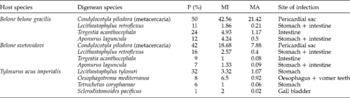
Eight digenean species belonging to families Zoogonidae (three species), Heterophyidae (one species), Fellodistomidae (one species), Lecithasteridae (one species), Accacoeliidae (one species) and Sclerodistomoididae (one species), including six new host records, were found. Data on parameters and site of infection are given in table 1.
The prevalence (%), mean intensity (MI), mean abundance (MA) and infection site of digeneans in belonid fish from Tunisia.

Family Zoogonidae Odhner, 1902
-
Lecithostaphylus retroflexus (Molin, 1859)
-
Hosts. Belone belone gracilis, B. svetovidovi.
-
Voucher specimens deposited. Belone b. gracilis BMNH NHMUK 2015.5.21.4; B. svetovidovi NHMUK 2015.5.21.3.
-
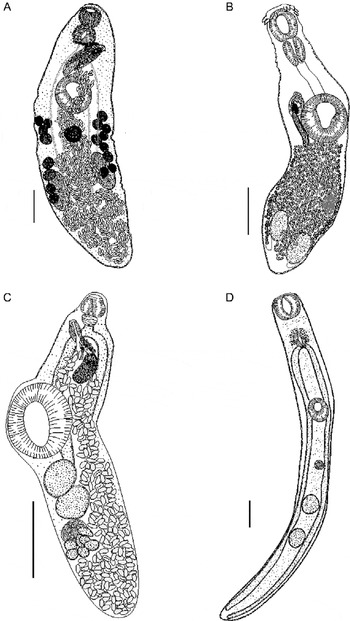
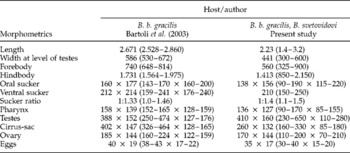
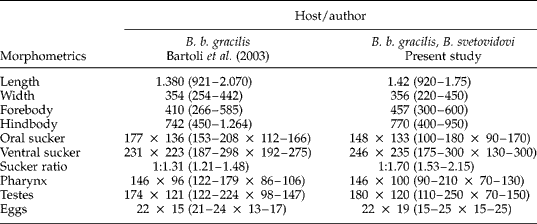
Remarks. Specimens of L. retroflexus studied here (fig. 1A) agree well with morphological features of the detailed description given by Bartoli et al. (Reference Bartoli, Bray and Gibson2003) from the intestine of B. b. gracilis from the Scandola Nature Reserve, Corsica, western Mediterranean Sea. The present material exhibits substantially wider ranges of variations in almost all metrical data, which overlap with those previously reported by Bartoli et al. (Reference Bartoli, Bray and Gibson2003), except for the nearly similar sucker ratio and egg sizes and the smaller length of cirrus sac (table 2).
Entire drawing of (A) Lecithostaphylus retroflexus, dorsal view; (B) Tergestia acanthocephala, ventral view; (C) Aponurus laguncula, sub-lateral view; (D) the metacercaria of Condylocotyla pilodora. Scale bars: 250 μm.

Morphometrics (measurements in μm) of Lecithostaphylus retroflexus (Molin, 1859) from Tunisia for comparison with Bartoli et al. (Reference Bartoli, Bray and Gibson2003); mean values, with ranges in size or numbers given in parentheses.

Lecithostaphylus retroflexus differs with its relatively low prevalence (11% in B. b. gracilis, 16% in B. svetovidovi from the Tunisian coast) compared to that reported by Bartoli et al. (Reference Bartoli, Bray and Gibson2003) (100% in B. b. gracilis from Scandola Nature Reserve, France). This difference could be explained by the fact that the reserve is a protected area where the availability of intermediate hosts (molluscs) allows the successful transmission of Digenea.
Lecithostaphylus retroflexus was found mainly on B. belone. Overall it has been reported from the Mediterranean Sea (15 records), from the Black Sea (two records), from the NE Atlantic (two records) and from South Africa (one record). Most records are from B. belone and some suspicion accompanies records from other hosts, such as those from exocoetid, labrid, scorpaenid and sparid fish (Bartoli et al., Reference Bartoli, Bray and Gibson2003). In the present study, B. svetovidovi is a new host record for L. retroflexus.
Lecithostaphylus tylosuri Châari et al., Reference Châari, Derbel and Neifar2013
-
Host. Tylosurus acus imperialis
-
Material deposited. Holotype MNHN HEL 306, paratypes MNHN HEL 307 and HEL 308; BMNH NHMUK 2012.11.28.1-3.
-
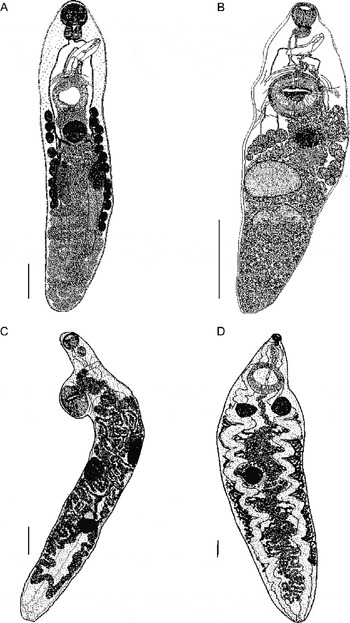
Remarks. Lecithostaphylus tylosuri (fig. 2A) is the most prevalent species in the digenean fauna of T. a. imperialis (table 1). It is very similar to its closest relative L. retroflexus from B. b. gracilis of the Mediterranean Sea but differs by having an extensive vitellarium, with follicles reaching from the posterior margin of the acetabulum and extending beyond the posterior margin of the testes, and a coiled seminal vesicle. It is also similar to L. nitens from belonid hosts (Ablennes hians, Belone platyura, Platybelone argalus, Strongylura marina, Tylosurus acus, T. crocodilus, Xenentodon cancila) of the north-western Atlantic, the Pacific and the Indian Oceans (Châari et al., Reference Châari, Derbel and Neifar2013).
Entire drawing of (A) Lecithostaphylus tylosuri, ventral view; (B) Oesophagotrema mediterranea, ventral view; (C) Tetrochetus coryphaenae, lateral view; (D) Sclerodistomoides pacificus, dorsal view. Scale bars: 500 μm.

Oesophagotrema mediterranea Châari et al., Reference Châari, Derbel and Neifar2011
-
Host. Tylosurus acus imperialis
-
Material deposited. Holotype MNHN HEL 199 Tf 218, Paratypes MNHN HEL 200 Tf 219, HEL 201 Tf 220, HEL 202 Tf 221, HEL 203 Tf 222, HEL 204 Tf 223; BMHN NHMUK 2011.4.4.1-5.
-
Remarks. This species (fig. 2B) has been described separately (for details see Châari et al., Reference Châari, Derbel and Neifar2011). The genus Oesophagotrema was established to accommodate the new species O. mediterranea based on a combination of the following characters: prominent rounded ventral sucker, caeca reaching to the anterior edge of the posterior testis, testes arranged in tandem in the middle third of the hindbody and the vitellarium in symmetrical lateral bunches located between the ovary and anterior testis. Oesophagotrema mediterranea shows a typical specific site of infection within the digestive tract, i.e. the oesophagus and vomer teeth.
Family Fellodistomidae Nicoll, 1909
Tergestia acanthocephala (Stossich, Reference Stossich 1887 ) Stossich, 1899
-
Hosts. Belone belone gracilis, B. svetovidovi.
-
Voucher specimens deposited. Belone b. gracilis BMNH NHMUK 2015.5.21.5; B. svetovidovi NHMUK 2015.5.21.6.
-
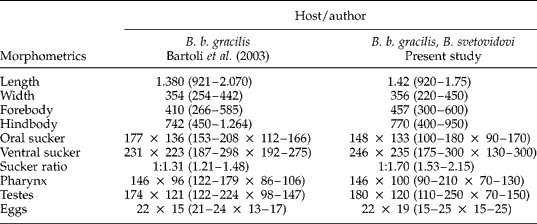
Remarks. The present material (fig. 1B) basically agrees in morphological characters and in metrical data with the description of T. acanthocephala given by Bartoli et al. (Reference Bartoli, Bray and Gibson2003) from the rectum of B. b. gracilis in the Scandola Nature Reserve, Mediterranean Sea (table 3). This species has been recorded several times, mainly from the Mediterranean, the Adriatic Sea, the Atlantic and the Pacific (Stossich, Reference Stossich1887; Stossich, Reference Stossich1898; Odhner, Reference Odhner1911; Nikolaeva & Parukhin, Reference Nikolaeva and Parukhin1969; Kovaleva, Reference Kovaleva1970; Parukhin et al., Reference Parukhin, Naidenova, Nikolaeva and Vodjanichky1971; Parukhin, Reference Parukhin1973; Naidenova & Mordvinova, Reference Naidenova and Mordvinova1997; Bartoli et al., Reference Bartoli, Bray and Gibson2003; Gibson et al., Reference Gibson, Bray and Harris2005; Radujković & Šundić, Reference Radujković and Šundić2014). Most records are from the belonids B. belone (seven records) and B. b. gracilis (one record), and other records are from carangids Trachurus trachurus (one record), Seriola dumerili (one record), an engraulid Engraulis encrasicolus (two records) and a sparid Boops boops (one record). The presence of T. acanthocephala in B. svetovidovi is a new host record for this species.
Morphometrics (measurements in μm) of Tergestia acanthocephala (Stossich, Reference Stossich1887) Stossich, 1899 from Tunisia for comparison with Bartoli et al. (Reference Bartoli, Bray and Gibson2003); mean values, with ranges in size or numbers given in parentheses.
Family Lecithasteridae Odhner, 1905
Aponurus laguncula Looss, 1907
-
Hosts. Belone belone gracilis, B. svetovidovi.
-
Voucher material deposited. Belone b. gracilis BMNH NHMUK 2015.5.21.7; B. svetovidovi NHMUK 2015.5.21.8.
-
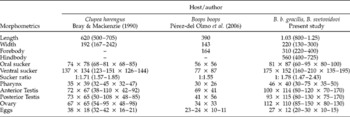
Remarks. Morphologically, specimens from garfish B. b. gracilis and B. svetovidovi agree well with the description of A. laguncula given by Bray & Mackenzie (Reference Bray and Mackenzie1990) from the stomach of the clupeid Clupea harengus in the north-east Atlantic Ocean. However, worms from the present study (fig. 1C) are distinctly greater in length of individuals and smaller in egg sizes. Egg sizes are most similar to those reported by Looss (Reference Looss1908) from the type host, a belonid B. belone in Italy. Moreover, egg sizes of the present specimens more closely resemble those reported by Pérez-del Olmo et al. (Reference Pérez-del Olmo, Gibson, Fernandez, Sanisidro, Raga and Kostadinova2006) from B. boops in the north-east Atlantic (table 4). Egg size and shape may serve as a reliable distinguishing feature for species of Aponurus (Carreras-Aubets et al., Reference Carreras-Aubets, Repullés-Albelda, Kostadinova and Carrasson2011). The egg size of the present worms is similar to that of the cryptic species of Aponurus (A. mulli) described by Carreras-Aubets et al. (Reference Carreras-Aubets, Repullés-Albelda, Kostadinova and Carrasson2011) from Mullus barbatus and Mullus surmuletus off the Spanish Mediterranean coast (27 × 12 vs. 27 × 13, respectively), whereas the distinctive shape of the eggs of the present specimens (narrow with a more or less pointed anopercular end) is close to that of A. laguncula.
Morphometrics (measurements in μm) of Aponurus laguncula Looss, 1907 for comparison with Bray & Mackenzie (Reference Bray and Mackenzie1990) and Pérez-del Olmo et al. (Reference Pérez-del Olmo, Gibson, Fernandez, Sanisidro, Raga and Kostadinova2006); mean values, with ranges in size or numbers given in parentheses.

According to Bray & Mackenzie (Reference Bray and Mackenzie1990), A. laguncula is euryxenic, having a wide variety of hosts. Indeed, it has been reported in almost 60 species of teleost fish. The majority of reports were from members of the family Carangidae (24%). It has also been recorded in other hosts such as Ephippidae, Mullidae, Scombridae, Clupeidae, Belonidae, Theraponidae, Sparidae, Platycephalidae and Trachinidae (Bray & Mackenzie, Reference Bray and Mackenzie1990). Pérez-del Olmo et al. (Reference Pérez-del Olmo, Gibson, Fernandez, Sanisidro, Raga and Kostadinova2006) redescribed a single specimen of A. laguncula from a new host, B. boops, from the Spanish coast of the NE Atlantic and recorded that this is probably an accidental host for A. laguncula. We record for the first time the occurrence of A. laguncula in B. svetovidovi.
Family Heterophyidae Odhner, 1914
Condylocotyla pilodora metacercariae Pearson & Prévot, 1985
-
Hosts. Belone belone gracilis, B. svetovidovi.
-
Voucher specimens deposited. Belone b. gracilis BMNH NHMUK 2015.5.21.10; B. svetovidovi NHMUK 2015.5.21.9.
-
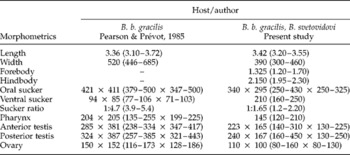
Remarks. Worms of C. pilodora found encysted in the pericardial sac of B. b. gracilis and B. svetovidovi (fig. 1D) agree well with the original description given by Pearson & Prevot (Reference Pearson and Prevot1985) from B. belone in the Gulf of Marseilles, France. Nevertheless, specimens from the present study are smaller in almost all measurements except the total length and the significantly voluminous ventral sucker (see table 5).
Morphometrics (measurements in μm) of the metacercaria of Condylocotyla pilodora Pearson & Prévot, 1985 for comparison with Pearson & Prévot, 1985; mean values, with ranges in size or numbers given in parentheses.

This is the first report of C. pilodora metacercariae in the garfish B. svetovidovi. Adults were described by Pearson & Prevot (Reference Pearson and Prevot1985) from the rectum of the herring gull Larus argentatus (Aves, Laridae). This species was later recorded by Lafuente et al. (Reference Lafuente, Roca and Carbonell1998) in the Audouin's gull, L. audouinii, from the Alboran Sea, south-western Mediterranean Sea. The life cycle of C. pilodora was established by Pearson & Prevot (Reference Pearson and Prevot1985) in two parts; the cercariae parasitizing the digestive gland of a first intermediate host, a snail Cerithium vulgatum, and the metacercariae encysted in the pericardial sac of a second intermediate host, a belonid fish B. belone, and adults in the definitive host L. argentatus. The completion of the life cycle from snail to bird is facilitated through habits of both cercariae and fish host. Positive phototropism takes the swimming cercariae to the surface where the pelagic B. belone feeds, and the surface feeding of the fish renders it liable to predation by the bird host, L. argentatus.
In garfish B. b. gracilis and B. svetovidovi from the Tunisian coast, we found C. pilodora encysted around the heart. This is the first report of this species in the garfish B. svetovidovi. The high number of cysts around the heart, reaching more than 300 in B. b. gracilis and 100 in B. svetovidovi, slow the swimming movement of the fish, making it more vulnerable to predation. The present results showed that C. pilodora is more common in small fish (size classes 20 and 30 cm). Infection with this species is less important in fish in size classes 40 and 50 cm. Pearson & Prevot (Reference Pearson and Prevot1985) also showed that small specimens of B. belone were infected by eating cercariae, whereas the largest fish were strictly piscivorous.
Family Accacoeliidae Odhner, Reference Odhner1911
Tetrochetus coryphaenae Yamaguti, 1934
-
Host. Tylosurus acus imperialis.
-
Voucher specimens deposited. BMNH NHMUK 2015.5.21.1.
-
Remarks. Specimens founded in needlefish T. a. imperialis (fig. 2C) exhibit all characteristic features of T. coryphaenae described in detail by Gibson (Reference Gibson1976) from the dolphin fish Coryphaena sp. (Coryphaenidae, Perciformes) in the South Atlantic Ocean.
This species is cosmopolitan; it has been reported from several hosts and localities: Diodon hystrix off the south-west coast of India (Radhakrishnan & Nair, Reference Radhakrishnan and Nair1981); Coryphaena hippurus in Chile (Oliva, Reference Oliva1984); the dolphin fish C. hippurus in Puerto Rico, North Atlantic Ocean (Dyer et al., Reference Dyer, Bunkley-Williams and Williams1997); the tunny Thunnus albacares in Brazil (Fernandes et al., Reference Fernandes, Kohn and Santos2002); and Boops boops in the Spanish NE Atlantic and the Mediterranean coast (Pérez-del Olmo et al., Reference Pérez-del Olmo, Fernandez, Gibson, Raga and Kostadinova2007).
The report of T. coryphaenae from the belonid T. a. imperialis represents a new host record and the first report of the genus Tetrochetus off the Tunisian coast.
Family Sclerodistomoididae Gibson & Bray, 1979
Sclerodistomoides pacificus Kamegai, Reference Kamegai 1971
-
Host. Tylosurus acus imperialis.
-
Voucher specimens deposited. BMNH NHMUK 2015.5.21.2.
-
Remarks. Worms collected from the gall bladder of T. a. imperialis (fig. 2D) were similar to the only species of this family, S. pacificus (Kamegai, Reference Kamegai1971), from the gall bladder of the flying fish Cypselurus pinnatibarbatus japponicus in Japan, Pacific coast (Gibson, Reference Gibson, Gibson, Jones and Bray2002).
The present record extends the distributional known range of S. pacificus to the Mediterranean Sea. This is the second recording of this species, after the original description. Tylosurus acus imperialis is a new host record. We collected only two worms in one host individual of 126 examined (an immature male of total length 76.7 cm). Moreover, the similarity of the pelagic life style of Belonidae and Exocoetidae and their close phylogenetic relationship, advocate this infestation.
Digenean diversity
The belonid fish studied (B. b. gracilis, B. svetovidovi and T. a. imperialis) were infected with a total of eight species of digenean parasites (table 1). The diversity of Digenea infecting belonids may be attributed to the variety of intermediate hosts ingested. Indeed, needlefish are carnivorous, feeding primarily on small fish (Collette, Reference Collette2003). Piscivorous fish occupy the top of the food web and may have a greater chance of infection (Machado et al., Reference Machado, Pavanelli and Takemoto1996; Martins et al., Reference Martins, Pereira, De Chambrier and Yamashita2009) compared to omnivorous fish, which present a lower risk of infection because they are primary consumers in the food web (Feltran et al., Reference Feltran, Marçal-Júnior, Pinese and Takemoto2004; Takemoto et al., Reference Takemoto, Pavanelli, Lizama, Lacerda, Yamada, Moreira, Ceschini and Bellay2009).
Belone belone gracilis was parasitized by four species of Digenea: L. retroflexus (fig. 1A), T. acanthocephala (fig. 1B) and A. laguncula (fig. 1C) from the digestive tract, and C. pilodora metacercariae (fig. 1D) from the pericardial sac. Belone svetovidovi harboured the same species of Digenea. Nevertheless, variations in infection parameters of these digenean species were found among hosts (table 1). Having the same digenean parasites can indicate that the garfish B. b. gracilis and B. svetovidovi have similar food habits. In the Mediterranean area, the composition of the diet of B. belone has not been studied (Stergiou & Karpouzi, Reference Stergiou and Karpouzi2002). In the north-east Atlantic, Dorman (Reference Dorman1987) stated that B. svetovidovi has a similar diet to that of B. belone.
Among digenean species found in both hosts B. b. gracilis and B. svetovidovi, C. pilodora metacercariae were the most prevalent and abundant species. This could be related to the longevity of encysted parasites, which may be greater than that of intestinal parasites. Indeed, encysted parasites, mainly in muscles and the abdominal cavity, cannot be released from the host and are therefore accumulated in the organism (Muñoz & Cribb, Reference Muñoz and Cribb2006).
Tylosurus acus imperialis also hosted four digenean species: L. tylosuri (fig. 2A), O. mediterranea (fig. 2B), T. coryphaenae (fig. 2C) and S. pacificus (fig. 2D). Lecithostaphylus tylosuri was the digenean species most frequently found in T. a. imperialis off the Tunisian coast (table 1).
Different taxa of Digenea were reported previously in T. acus from other areas. In T. a. acus from off the Brazilian coast, Tavares et al. (Reference Tavares, Bicudo and Luque2004) reported Rhipidocotyle sp., didymoizoid metacercariae, Schikhobalotrema acuta (Linton, 1910) and Parahemiurus merus (Linton, 1910). Similarly, in T. a. melanotus from off the Japanese coast, Machida & Kuramochi (Reference Machida and Kuramochi2000) found Bucephalopsis karvei Bhalerao, 1937 and Prolecitha obesa Manter, 1961. Later, Liu et al. (2010) found Hurleytrema hainanse Shen, 1990 and Prosorhynchoides obpyriformis (Gu & Shen, 1976) from T. a. melanotus of the South China Sea. Variations in infection with Digenea could be influenced by different geographical distributions of these different host subspecies. Indeed, T. a. imperialis, T. a. acus and T. a. melanotus were recognized as different subspecies that live in completely different and separate ecosystems (Collette, Reference Collette2003).
In the present study, the digenean fauna of T. a. imperialis differs from that of B. b. gracilis and B. svetovidovi. This difference can be explained by the distinctly different feeding behaviour of these species. Tylosurus a. imperialis inhabits offshore waters but can be found in coastal waters during the period between spring and summer (Froese & Pauly, Reference Froese and Pauly2011). Consequently, this migratory behaviour induces a change in diet by varying the intermediate hosts ingested. As stated by Williams et al. (Reference Williams, MacKenzie and McCarthy1992) and Arthur (Reference Arthur, Flegel and MacRae1997), the parasite species composition of distinct fish species reflects differences in the food sources, feeding preferences and habitats.
Spatial variation of digeneans
In both the hosts B. b. gracilis and B. svetovidovi, L. retroflexus was distributed along the digestive tract except the rectum, whereas T. acanthocephala was found exclusively on the rectum and C. pilodora metacercariae were encysted on the pericardial sac. The spatial distribution of these digenean species coincides with that reported from B. b. gracilis by Bartoli et al. (Reference Bartoli, Bray and Gibson2003) in the Scandola Nature Reserve, Corsica, France (western Mediterranean) and with that reported by Pearson & Prévot (1985) for the metacercariae of C. pilodora on the pericardial sac. The distribution of helminths in the intestine of vertebrates is related to the different conditions in different parts of the tract, to the effect of digestion and to the nature of the diet. Digenean parasites feed mainly on mucosa and epithelial tissue. Therefore, they will be browsing in the intestine in places where the epithelial turnover rate is high (Crompton, Reference Crompton1973).
The spatial distribution of digenean species within the digestive tract of T. a. imperialis showed that O. mediterranea was restricted to the oesophagus and vomer teeth, L. tylosuri and T. coryphaenae were restricted to the anterior third of the intestine and S. pacificus was found only in the gall bladder. The distribution of digenean species in the digestive tract of T. a. imperialis appears to exhibit preferences for microhabitat and niche specialization, thus reducing the overall intensity of competition. A niche restriction is well known from other parasite–host systems (reviewed by Holmes, Reference Holmes1990). However, this phenomenon is not easily explained. Apart from the physico-chemical gradient in the intestine, factors such as specialization, reproductive efficiency, competition and host immune mechanisms have been suggested to influence site selection (Holmes, Reference Holmes1990).
Acknowledgements
We are grateful to Dr R.A. Bray from the Natural History Museum, London for useful comments and linguistic revision of the manuscript.
Conflict of interest
None.