


1. INTRODUCTION
In recent years, considerable attention has been given to the study of parametric instabilities of surface plasma waves (SPWs) on bounded plasma systems due to vast applications in fast ignition fusion, high harmonic generation, ion acceleration, laser ablation of materials, etc. (Sajal & Tripathi, Reference Sajal and Tripathi2004; Baeva et al., Reference Baeva, Gordienko and Pukhov2006; Sajal et al., Reference Sajal, Dahiya and Tripathi2007; Verma & Sharma, Reference Verma and Sharma2009; Kumar et al., Reference Kumar and Tripathi2010; Hao et al., Reference Hao, Liu, Hu and Zheng2013). SPW is an electromagnetic wave that propagates at the boundary between two media with different conductivities and dielectric properties, such as a conductor-free space boundary and its amplitude falls off exponentially away from the interface in both media (Kretschmann & Reather, Reference Kretschmann and Reather1968; Lindgren et al., Reference Lindgren, Larsson and Stenlo1982; Prakash et al., Reference Prakash, Sharma and Gupta2013). Excitation of SPWs over the smooth surfaces by lasers is an issue of importance as the SPW wave number is greater than the component of the laser wave vector along the interface. At low laser powers, one cannot do it unless one creates a density ripple on the metal surface or employs ATR configuration (Otto and Kretschmann geometry) to attain phase-matching conditions (Reather, Reference Raether1988). At high powers, non-linear effects open up new possibilities. The excitation of a SPW occurs at the interface of vacuum overdense plasma, which can be created during the interaction of an intense laser pulse with a solid metal target (Rozmus & Tikhonchuk, Reference Rozmus and Tikhonchuk1990; Price et al., Reference Price, More, Walling, Guethlein, Shepherd, Stewart and White1995; Shoucri et al., Reference Shoucri and Afeyan2010). The laser pulse can penetrate into the surface of overdense plasma up to a distance comparable with the skin depth. The surface-wave modes couple parametrically through the incident pump wave and decay instability of the surface waves is expected to occur under suitable conditions.
There have been growing efforts in the direction of parametric generation of a SPW by a laser pulse. Lee and Cho (Reference Lee and Cho1999) investigated the parametric decay of a high-frequency light wave into two daughter surface waves of low-frequency. They derived the mode-coupling equations and solved them in the parametric approximation to obtain the threshold and growth rate. Macchi et al. (Reference Macchi, Battaglini, Cornolti, Lisseikina, Pegoraro, Ruhl and Vshivkov2002) have proposed a non-linear mechanism of electron surface oscillations in overdense plasma using two-dimensional (2D) particle-in-cell simulations. The normally incident laser pulse interacts with the overdense plasma resulting in generation of two counter propagating SPWs in the plasma. The mechanism of SPW generation was termed as a two surface wave decay process (TSWD) in an analogy with the well-known process of two plasmon decay in laser–plasma interaction. Kumar and Tripathi (Reference Kumar and Tripathi2007) used different field of the TSWD process to study the parametric decay of the light wave into two SPW by a high-power laser obliquely incident on a vacuum–plasma interface. The generation of SPW by the parametric process leads to the surface plasma oscillations or rippling at the laser frequency or half of it. The growth rate of the (TSWD) process is maximum for the normal incidence of the laser pulse. Goel et al. (Reference Goel, Chauhan, Varshney, Singh and Sajal2015) studied the stimulated Compton scattering of SPW excited over the metallic surface by a laser. Growth rate of the Compton process increases with the pump wave frequency, width of the metal layer, laser amplitude, and its spot size.
Early studies (Zoboronkova et al., Reference Zoboronkova, Kondratev and Petrov1976; Lindgren et al., Reference Lindgren, Larsson and Stenlo1982) suggest that surface waves can be excited by parametric decay of a laser into two surface waves. Also, the non-linear theories of SPW excitation in an unmagnetiszed as well as in magnetized plasma have been developed (Gradov & Stenflo, Reference Gradov and Stenflo1980; Stenflo, Reference Stenflo1996; Parashar et al., Reference Parashar, Pandey and Tripathi1998).
Singh and Tripathi (Reference Singh and Tripathi2007) gave a theoretical model to excite SPW at frequency ω = ω1 − ω2 by beating of two coplanar laser beams of frequencies ω1 and ω2 impinged on a metal surface. Brodin and Lundberg (Reference Brodin and Lundberg1991) theoretically investigated the parametric excitation of surface waves in inhomogeneous plasma and calculated the growth rate and threshold value for the instability process.
The purpose of the present work is to study the effects of magnetic field on the parametric excitation of SPW by a laser incident on the metal-free space interface. The applied magnetic field is parallel to the surface and perpendicular to the SPW propagation vector. The laser field (ω0, k 0z ) inside the metal acts as a pump wave and excites a pair of waves, viz a quasi-electrostatic plasma wave of frequency (ω, k z) having phase velocity v F and a SPW (ω1, k 1z ) at the phase-matching conditions ω1 = ω − ω0 and wave number k 1z = k z − k 0z . The pump and the surface wave exert a beat-frequency ponderomotive force on the electrons at (ω, k z) which drives a heavily damped quasi-mode inside the skin layer. The oscillating metal electrons under the influence of ponderomotive force and quasi-mode give rise to a non-linear density perturbation, which couples with the oscillatory motion of metal electrons due to the pump to produce a non-linear current that drives the surface wave. Growth rate equation is obtained on the basis of three wave parametric coupling at resonance. The parametric coupling of a pump wave, plasma wave, and SPW in the presence of external magnetic field is presented in Section 2. A discussion of results and conclusions are given in Section 3.
2. PARAMETRIC EXCITATION OF SPW
Consider the metal-free space interface at x = 0 with half-space x < 0 is the free space and x > 0 is the metal of equilibrium electron density n
0. The external magnetic field
 $({\vec B_{\rm s}})$
is applied in the
 $\hat y$
-direction, that is, magnetic field is parallel to the surface and perpendicular to the SPW propagation. A high-power laser
 $({{\rm \omega} _0},{\vec k_0};{\vec k_0} = {k_{0x}}\hat x + {k_{0z}}\hat z)$
is obliquely incident on the interface from the free space at an angle of incidence θ as shown in Figure 1. The field of the incident laser is given by
 $${\vec E}_{0l} = A\left( {{\hat z} - \displaystyle{{k_{0z}} \over {k_{0x}}}{\hat x}} \right) e ^{- i({{\rm \omega}_0}t - {k_{0z}} z - {k_{0x}}x)},$$
where k 0x = ω0 cos θ/c and k 0z = ω0 sin θ/c
Schematic diagram of parametric excitation of SPW at the metal-free space interface

The electric field of the laser inside the metal can be written as follows (Jackson, Reference Jackson1975):
 $${\vec E_0} = ({E_{0x}}\hat x + {E_{0z}}\hat z){e^{{{\rm \alpha} _0}x}}e{}^{ - i({{\rm \omega} _0}t - {k_{0z}}z)}.$$
Appling the condition
 $\nabla. { \tilde{\rm \varepsilon}} {E_0} = 0$
at the interface x = 0, we obtained
 $${E_{0x}} = \displaystyle{{i{k_{0z}}{{\rm \varepsilon} _{xx}} - {{\rm \alpha} _0}{{\rm \varepsilon} _{xz}}} \over {{{\rm \alpha} _0}{{\rm \varepsilon} _{xx}} + i{k_{0z}}{{\rm \varepsilon} _{xz}}}}{E_{0z}},$$
where
 ${\rm \alpha} _0^2 = k_{0z}^2 - {{({\rm \omega} _0^2} / {{c^2})}}{{\rm \varepsilon} _v}$
,
 ${{\rm \varepsilon} _v} = {{\rm \varepsilon} _{xx}} + {\rm \varepsilon} _{xz}^2 /{{\rm \varepsilon} _{xx}}$
,
 ${{\rm \varepsilon} _{xx}} ={{\rm \varepsilon} _{\rm L}}[1 - $
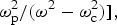 ${\rm \omega} _{\rm p}^2 /({{\rm \omega} ^2} - {\rm \omega} _{\rm c}^2 )],$
and
 ${{\rm \varepsilon} _{xz}} = - i{{\rm \varepsilon} _{\rm L}}{{\rm \omega} _{\rm c}}{\rm \omega} _{\rm p}^2 /{\rm \omega} ({{\rm \omega} ^2} - {\rm \omega} _{\rm c}^2 )$
·εL is the lattice permittivity. −e, m,
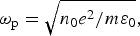 ${{\rm \omega} _{\rm p}} = \sqrt {{n_0}{e^2}/m{{\rm \varepsilon} _0}}, $
and ωc = eB
s/m are the charge, effective mass of electron, electron plasma frequency, and electron cyclotron frequency, respectively. The condition of continuity, that is,
 ${\tilde{\rm \varepsilon}} E_{0x}$
and E
0z
at x = 0, gives
 $${E_{0z}} = \displaystyle{{2A} \over {[(1 - ({k_{0x}}/{k_{0z})}({{\rm \varepsilon} _{xx}}(i{k_{0z}}{{\rm \varepsilon} _{xx}} - {{\rm \alpha} _0}{{\rm \varepsilon} _{xz}})/({{\rm \alpha} _0}{{\rm \varepsilon} _{xx}} + i{k_{0z}}{{\rm \varepsilon} _{xz}}) + {{\rm \varepsilon} _{xz}})]}}.$$
On substituting the value from the above expression in Eq. (2), we obtained the transmitted field of laser inside the metal as
 $$\eqalign{{{\vec E}_0} & = \displaystyle{{2A{\kern 1pt} [\hat x(i{k_{0z}}{{\rm \varepsilon} _{xx}} - {{\rm \alpha} _0}{{\rm \varepsilon} _{xz}})/({{\rm \alpha} _0}{{\rm \varepsilon} _{xx}} + i{k_{0z}}{{\rm \varepsilon} _{xz}}) + \hat z]} \over {[1 - {k_{0x}}/{k_{0z}}({{\rm \varepsilon} _{xx}}(i{k_{0z}}{{\rm \varepsilon} _{xx}} - {{\rm \alpha} _0}{{\rm \varepsilon} _{xz}})/({{\rm \alpha} _0}{{\rm \varepsilon} _{xx}} + i{k_{0z}}{{\rm \varepsilon} _{xz}}) + {{\rm \varepsilon} _{xz}})]}} \cr & \quad \times {e^{{{\rm \alpha} _0}x}}e{}^{ - i({{\rm \omega} _0}t - {k_{0z}}z)}.}$$
The transmitted laser field imparts oscillatory velocity to electrons in the skin layer
 $${v_{0x}} = \displaystyle{e \over m}(i{{\rm \omega} _0}{E_{0x}} - {{\rm \omega} _{\rm c}}{E_{0z}}){({\rm \omega} _{\rm c}^2 - {\rm \omega} _0^2 )^{ - 1}},$$
 $${v_{0z}} = \displaystyle{e \over m}({{\rm \omega} _{\rm c}}{E_{0x}} + i{{\rm \omega} _0}{E_{0z}}){({\rm \omega} _{\rm c}^2 - {\rm \omega} _0^2 )^{ - 1}},$$
which parametrically excite a SPW
 $({{\rm \omega} _1},{\vec k_{1z}},{\vec k_1},{k_{1z}}\hat z - i{{\rm \alpha} _1}\hat x)$
of the electric field
 $${\vec E_1} = ({E_{1x}}\hat x + {E_{1z}}\hat z){e^{ - {{\rm \alpha} _1}x}}{e^{ - ({{\rm \omega} _1}t - {k_{1z}}z)}},$$
and lower-frequency space charge quasi-mode
 $({\rm \omega}, \vec k)$
of potential of ϕ, given by
 $${\rm \phi} = {\rm \phi} (x){e^{ - ({\rm \omega} t - {k_z}z)}},$$
where
 ${\rm \alpha} _1^2 = k_{1z}^2 - ({\rm \omega} _1^2 /{c^2}){{\rm \varepsilon} _{1{\rm v}}}$
,
 ${{\rm \varepsilon} _{1{\rm v}}} = {{\rm \varepsilon} _{1xx}} + {\rm \varepsilon} _{1xz}^2 /{{\rm \varepsilon} _{1xx}}$
,
 ${{\rm \varepsilon} _{1{\rm xx}}} =$
 ${{\rm \varepsilon} _{\rm L}}[1 - {\rm \omega} _{\rm p}^2 /({{\rm \omega} _1}^2 - {\rm \omega} _{\rm c}^2 )],$
and
 ${{\rm \varepsilon} _{1xz}} = - i{{\rm \varepsilon} _{\rm L}}{{\rm \omega} _{\rm c}}{\rm \omega} _{\rm p}^2 /{\rm \omega} {}_1({\rm \omega} _1^2 - {\rm \omega} _{\rm c}^2 )$
. The phase-matching conditions for the parametric decay are k
z
= k
0z
+ k
1z
and ω = ω0 + ω1. The surface wave provides an oscillatory velocity to plasma electrons.
 $${v_{1x}} = \displaystyle{e \over m}(i{{\rm \omega} _1}{E_{1x}} - {{\rm \omega} _{\rm c}}{E_{1z}}){({\rm \omega} _{\rm c}^2 - {\rm \omega} _1^2 )^{ - 1}},$$
 $${v_{1z}} = \displaystyle{e \over m}({{\rm \omega} _{\rm c}}{E_{1x}} + i{{\rm \omega} _1}{E_{1z}}){({\rm \omega} _{\rm c}^2 - {\rm \omega} _1^2 )^{ - 1}}.$$
The pump and surface wave exert a ponderomotive force
 $({\vec F_{\rm p}} = {F_{{\rm p}x}}\hat x + {F_{{\rm p}z}}\hat z)$
on the electrons at frequency ω, which is obtained as follows:
 $${\overrightarrow F _{\rm p}} = - m[\overrightarrow v\cdot \nabla \overrightarrow v ] - e[\overrightarrow v \times \overrightarrow B ].$$
In the above equation,
 $\vec v$
and
 $\overrightarrow B $
are replaced by
 ${\vec v_0} + {\vec v_1}$
and
 ${\vec B_0} + {\vec B_1}$
, respectively, due to the combined effect of the pump and the SPW. Here,
 ${\vec B_0} = i{\vec k_0} \times {\vec E_0}/i{{\rm \omega} _0}$
and
 ${\vec B_1} = i{\vec k_1} \times {\vec E_1}/i{{\rm \omega} _1}$
are the magnetic field for the pump and SPW, respectively. On substituting these values into Eq. (7), we obtained
 $$\eqalign{{F_{{\rm p}x}} & = \displaystyle{{ - {e^2}} \over {2m}}{E_{0z}}{E_{1z}}[ - ({{\rm \alpha} _0} + {{\rm \alpha} _1}){c_1}{c_3} + i{k_{0z}}{c_1}{c_4} \cr & \quad + i{k_{1z}}{c_2}{c_3} + \displaystyle{1 \over {i{{\rm \omega} _1}}}( - {{\rm \alpha} _1}{c_2} - i{k_{1z}}{c_2}{d_1}) \cr & \quad + \displaystyle{1 \over {i{{\rm \omega} _0}}}( - {{\rm \alpha} _0}{c_4} - i{k_{0z}}{c_4}{d_0})],} $$
 $$\eqalign{{F_{{\rm p}z}} & = \displaystyle{{ - {e^2}} \over {2m}}{E_{0z}}{E_{1z}}[ - {{\rm \alpha} _0}{c_2}{c_3} - {{\rm \alpha} _1}{c_1}{c_4} \cr & \quad + (i{k_{0z}} + i{k_{1z}}){c_2}{c_4} + \displaystyle{1 \over {i{{\rm \omega} _1}}}({{\rm \alpha} _1}{c_1} + i{k_{1z}}{c_1}{d_1}) \cr & \quad + \displaystyle{1 \over {i{{\rm \omega} _0}}}({{\rm \alpha} _0}{c_3} + i{k_{0z}}{c_3}{d_0})],} $$
where
 ${c_1} = i{{\rm \omega} _0}{d_0} - {{\rm \omega} _{\rm c}}/{\rm \omega} _{\rm c}^2 - {\rm \omega} _0^2 $
,
 ${c_2} = {d_0}{{\rm \omega} _{\rm c}} + i{{\rm \omega} _0}/{\rm \omega} _{\rm c}^2 - {\rm \omega} _0^2 $
,
 ${c_3} = i{{\rm \omega} _1}{d_1} - {{\rm \omega} _{\rm c}}/{\rm \omega} _{\rm c}^2 - {\rm \omega} _1^2 $
,
 ${c_4} = {d_1}{{\rm \omega} _{\rm c}} + i{{\rm \omega} _1}/{\rm \omega} _{\rm c}^2 - {\rm \omega} _1^2 $
, d
0 = −α0ε
xz
+ ik
0z
ε
xx
/α0ε
xx
+ ik
0z
ε
xz
, and d
1 = −α1ε1xz
+ ik
1z
ε1xx
/α1ε1xx
+ ik
1z
ε1xz
.
Now, metal electrons oscillate under the influence of both ponderomotive force and self-consistent low-frequency field at frequency ω and causes perturbation in density. By solving equation of motion, the oscillatory velocity of the electron at frequency ω is obtained
 $$\eqalign{{v_{{\rm \omega} x}} & = \displaystyle{1 \over {m({{\rm \omega} ^2} - {\rm \omega} _{\rm c}^2 )}} \cr & \quad \times \left[ {i{\rm \omega} {F_{{\rm p}x}} - ({F_{{\rm p}z}} + e\nabla {\phi} - \displaystyle{{{T_{\rm e}}} \over {{n_0}}}\nabla {n_{1{\rm e}}}){{\rm \omega} _{\rm c}}} \right],} $$
 $$\eqalign{{v_{{\rm \omega} z}} & = \displaystyle{1 \over {m({{\rm \omega} ^2} - {\rm \omega} _{\rm c}^2 )}} \cr & \quad \times \left[ {{{\rm \omega} _{\rm c}}{F_{{\rm p}x}} + ({F_{{\rm p}z}} + e\nabla {\phi} - \displaystyle{{{T_{\rm e}}} \over {{n_0}}}\nabla {n_{1{\rm e}}})i{\rm \omega}} \right].} $$
 $v_{\rm F}^2 = 2{T_{\rm e}}/m$
is the electron Fermi velocity and Fermi temperature of electrons. Substituting the value of oscillatory velocity from Eqs (10) and (11) into continuity equation
 $[\partial n/\partial t + \nabla\cdot ({n_0}{\vec v_{\rm \omega}} ) = 0]$
, we obtain the density perturbation (n) due to oscillatory motion of the metal electrons and ions, given by
 $$\eqalign{{n_{1{\rm e}}} & = \displaystyle{{k_z^2 {\phi}} \over {4{\rm \pi} e}}{{\rm \chi} _{\rm e}} + \displaystyle{{{n_0}{k_z}} \over {m{\rm \omega} ({{\rm \omega} ^2} - {\rm \omega} _c^2 - k_z^2 v_{\rm F}^2 /2)}} \cr & \quad \times \left[ {{F_{{\rm p}x}}{{\rm \omega} _{\rm c}} + {F_{{\rm p}z}}i{\rm \omega}} \right] = n_{1{\rm e}}^{\rm L} + n_{1{\rm e}}^{{\rm NL}}} $$
 $${n_{1i}} = \displaystyle{{k_z^2 {\phi}} \over {4{\rm \pi} e}}{{\rm \chi} _{\rm i}},$$
where
 $n_{1{\rm e}}^{\rm L} $
and
 $n_{1{\rm e}}^{{\rm NL}} $
are the linear and non-linear part of the electron density perturbation.
 ${{\rm \chi} _{\rm e}} = - {\rm \omega} _{\rm p}^2 /[({{\rm \omega} ^2} - {\rm \omega} _{\rm c}^2 ) - k_z^2 v_{\rm F}^2 /2]$
and
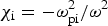 ${{\rm \chi} _{\rm i}} = - {\rm \omega} _{{\rm pi}}^2 /{{\rm \omega} ^2}$
are the electron and ion susceptibilities, respectively. ωpi is the ion plasma frequency and n
0 is the equilibrium electron density inside the skin layer of the metal. Using the density perturbation (n) in Poisson's equation
 ${\nabla ^2}{\rm \phi} = 4{\rm \pi} ({n_{1{\rm e}}} - {n_{1{\rm i}}})e$
, we obtain
 $${\rm \phi} = - 4{\rm \pi} en_{1{\rm e}}^{{\rm NL}} /{\rm \varepsilon} k_z^2, $$
 $${\rm \varepsilon} {\rm \phi} = \displaystyle{{{{\rm \chi} _{\rm e}}} \over {{k_z}}}\left( {\displaystyle{{{{\rm \omega} _{\rm c}}} \over {\rm \omega}} {F_{{\rm p}x}} + i{F_{{\rm p}z}}} \right),$$
where ε = 1 + χe + χi. On substituting Eq. (14) into Eq. (12), we obtain
 $${n_{{\rm 1e}}} = \left( {1 - \displaystyle{{{{\rm \chi} _{\rm e}}} \over {\rm \varepsilon}}} \right)n_{1{\rm e}}^{{\rm NL}}. $$
The density perturbation couples with oscillatory movement of metal electrons at frequency (ω0) and excites a non-linear current density
 $(\overrightarrow J _1^{{\rm NL}} )$
at (ω1, k
1z
), which is given by
 $$\vec J_1^{{\,\rm NL}} = - \displaystyle{1 \over 2}e{n_{1{\rm e}}}v_0^* $$
On substituting values of n 1e from Eq. (16), the non-linear current density is given by
 $$\vec J_1^{{\,\rm NL}} = \displaystyle{{{\rm \varepsilon} k_z^2} \over {8{\rm \pi}}} \left( {1 - \displaystyle{{{{\rm \chi} _{\rm e}}} \over {\rm \varepsilon}}} \right)v_0^* {\rm \phi}. $$
At resonance, this non-linear current density
 $(\vec J_1^{{\rm NL}} )$
is responsible for the growth of SPW whose characteristic equation can be derived by solving wave equation. The wave equation governing electric field of SPW at the frequency (ω1) can be written as
 $${\nabla ^2}{\vec E_1} - \nabla (\nabla\cdot {\vec E_1}) = \displaystyle{{4{\rm \pi}} \over {{c^2}}}\displaystyle{{\partial \vec J_1^{{\,\,\rm NL}}} \over {\partial t}} + \displaystyle{{{{\rm \varepsilon} _1}} \over {{c^2}}}\displaystyle{{{\partial ^2}{{\vec E}_1}} \over {\partial {t^2}}}.$$
The longitudinal and transverse components of the SPW are obtained by simplifying Eq. (18). Both components are correlated by the following equations:
 $$\eqalign{& \left( {k_{1z}^2 - \displaystyle{{{\rm \omega} _1^2} \over {{c^2}}}{{\rm \varepsilon} _{1xx}}} \right){E_{1x}} + \left( {i{k_{1z}}\displaystyle{{\partial {E_{1z}}} \over {\partial x}} - \displaystyle{{{\rm \omega} _1^2} \over {{c^2}}}{{\rm \varepsilon} _{1xz}}{E_{1z}}} \right) = \displaystyle{{4{\rm \pi} i{{\rm \omega} _1}} \over {{c^2}}}J_{1x}^{{\rm NL}},} $$
 $$\eqalign{& \left( {i{k_{1z}}\displaystyle{{\partial {E_{1x}}} \over {\partial x}} + \displaystyle{{{\rm \omega} _1^2} \over {{c^2}}}{{\rm \varepsilon} _{1xz}}{E_{1x}}} \right) - \left( {\displaystyle{{{\partial ^2}{E_{1z}}} \over {\partial {x^2}}} + \displaystyle{{{\rm \omega} _1^2} \over {{c^2}}}{{\rm \varepsilon} _{1xx}}{E_{1z}}} \right) = \displaystyle{{4{\rm \pi} i{{\rm \omega} _1}} \over {{c^2}}}J_{1z}^{{\rm NL}}.} $$
On solving Eqs (19) and (20), we obtained
 $$\eqalign{\displaystyle{{{\partial ^2}{E_{1z}}} \over {\partial {x^2}}} - {\rm \alpha} _1^2 {E_{1z}} & = \displaystyle{{4{\rm \pi} i} \over {{{\rm \omega} _1}{{\rm \varepsilon} _{1xx}}}}\left\{ {J_{1z}^{{\rm NL}} \left( {k_{1z}^2 - \displaystyle{{{\rm \omega} _1^2} \over {{c^2}}}{{\rm \varepsilon} _{1xx}}} \right)} \right\} - \displaystyle{{{\rm \omega} _1^2} \over {{c^2}}}{{\rm \varepsilon} _{1xz}}J_{1x}^{{\rm NL}}.} $$
Equation (21) is linearized by substituting ∂/∂x = −α1 to obtain the characteristic equation of SPW.
 $$\eqalign{& D^{\prime}{E_{1z}} = \displaystyle{{4{\rm \pi} i{{\rm \omega} _1}} \over {{c^2}}} \left[ {J_{1z}^{{\rm NL}} (k_{1z}^2 - \displaystyle{{{\rm \omega} _1^2} \over {{c^2}}}{{\rm \varepsilon} _{1xz}}) - J_{1x}^{{\rm NL}} (i{k_{1z}}{{\rm \alpha} _1} + \displaystyle{{{\rm \omega} _1^2} \over {{c^2}}}{{\rm \varepsilon} _{1xz}})} \right],} $$
where
 $$\eqalign{D^{\prime} & = \displaystyle{{{\rm \omega} _1^4} \over {{c^4}}}{\rm \varepsilon} _{1xz}^2 + \displaystyle{{{\rm \omega} _1^2} \over {{c^2}}}{{\rm \varepsilon} _{1xz}}{\rm \alpha} _1^2 - \displaystyle{{{\rm \omega} _1^2} \over {{c^2}}}{{\rm \varepsilon} _{1xx}}k_{1z}^2 + \displaystyle{{{\rm \omega} _1^4} \over {{c^4}}}{{\rm \varepsilon} _{1xz}}{{\rm \varepsilon} _{1xx}}.} $$
In the absence of the non-linear coupling, the solution of Eq. (22) can be written as
 $${E_1} = {A_1}{{\rm \psi} _1},$$
 $${{\rm \psi} _1} = \left( {\hat z + \displaystyle{{( - {{\rm \alpha} _1}{{\rm \varepsilon} _{1xz}} + i{k_{1z}}{{\rm \varepsilon} _{1xx}})} \over {({{\rm \alpha} _1}{{\rm \varepsilon} _{1xx}} + i{k_{1z}}{{\rm \varepsilon} _{1xz}})}}\hat x} \right){e^{ - {{\rm \alpha} _1}x}},\quad \; {\rm for}\quad x \gt 0,$$
 $${{\rm \psi} _1} = \left( {\hat z - \displaystyle{{i{k_{1z}}} \over {{\rm \alpha} _1^{\prime}}} \hat x} \right){e^{ {\rm \alpha} ^{\prime}_1 x}},\quad \; {\rm for}\quad x \lt 0,$$
where
 ${\rm \alpha} _1^2 = k_{1z}^2 - ({\rm \omega} _1^2 /{c^2}){{\rm \varepsilon} _{1v}}$
and
 ${\rm \alpha '}_1^2 = k_{1z}^2 - ({{{\rm \omega} _1^2} / {{c^2}}}).$
The dispersion relation for the SPW in the presence of a magnetic field (Wallis et al., Reference Wallis, Brion, Burstein and Hartstein1974) is
 $${{\rm \alpha} _1} + {\rm \alpha ^{\prime}}{{\rm \varepsilon} _{1v}} + i{k_{1z}}\displaystyle{{{{\rm \varepsilon} _{1xz}}} \over {{{\rm \varepsilon} _{1xx}}}} = 0.$$
On multiply Eqs (15) and (22), we obtain the equation governing the stimulated Compton scattering.
 $$\eqalign{& {\rm \varepsilon} D^{\prime} = \displaystyle{{ie{{\rm \omega} _1}{k_z}} \over {4m{c^2}}}{{\rm \chi} _{\rm e}}(1 + {{\rm \chi} _{\rm i}})\left( {\displaystyle{{{{\rm \omega} _{\rm c}}} \over {\rm \omega}} F_{{\rm p}x}^{\prime} + iF_{{\rm p}z}^{\prime}} \right) \cr & \qquad\times \left( {v_{0z}^{\ast} \left( {k_{1z}^2 - \displaystyle{{{\rm \omega} _1^2} \over {{c^2}}}{{\rm \varepsilon} _{1xz}}} \right) - v_{0x}^{\ast} \left( { - i{k_{1z}}{{\rm \alpha} _1} + \displaystyle{{{\rm \omega} _1^2} \over {{c^2}}}{{\rm \varepsilon} _{1xz}}} \right)} \right),} $$
where
 $$\eqalign{F_{{\rm p}x}^{\prime} & = - ({{\rm \alpha} _0} + {{\rm \alpha} _1}){c_1}{c_3} + i{k_{0z}}{c_1}{c_4} + i{k_{1z}}{c_2}{c_3} \cr & \quad + \displaystyle{1 \over {i{{\rm \omega} _1}}}( - {{\rm \alpha} _1}{c_2} - i{k_{1z}}{c_2}{d_1}) \cr & \quad + \displaystyle{1 \over {i{{\rm \omega} _0}}}( - {{\rm \alpha} _0}{c_4} - i{k_{0z}}{c_4}{d_0}),} $$
 $$\eqalign{F_{{\rm p}z}^{\prime} & = - {{\rm \alpha} _0}{c_2}{c_3} - {{\rm \alpha} _1}{c_1}{c_4} + (i{k_{0z}} + i{k_{1z}}){c_2}{c_4} \cr & \quad + \displaystyle{1 \over {i{{\rm \omega} _1}}}({{\rm \alpha} _1}{c_1} + i{k_{1z}}{c_1}{d_1}) \cr & \quad + \displaystyle{1 \over {i{{\rm \omega} _0}}}({{\rm \alpha} _0}{c_3} + i{k_{0z}}{c_3}{d_0}).} $$
In the absence of non-linear coupling, frequency of the plasma wave and the SPW are ω ≅ k
z
v
F = ωr and ω1 ≅ ω1r, respectively, which are obtained by ε = 0 and D′ = 0. In the presence of non-linear coupling (i.e.,
 $v_{0x}^{\ast} \ne 0$
and
 $v_{0z}^{\ast} \ne 0$
), frequencies are modified and given by ω = ωr + iγ, ω1 = ω1r + iγ, where γ is the growth rate of the stimulated Compton process. By using Taylor expansion ε and D′ are expanded around ωr and ω1r, respectively and Eq. (24) is solved numerically to calculate the growth rate of the Compton process for different values of incident angle θ, pump wave frequency ω0, and magnetic field B
s. Variation of SPW frequency (ω1/ωp) is plotted with angle of incidence (θ) and normalized frequency (ω0/ωp) of pump laser in Figures 2a, 2b, respectively. The SPW frequency increases with θ and ω0/ωp. Normalized growth rate (γ/ωp) of the Compton process is plotted as a function of incident laser frequency (ω0/ωp) and angle of incidence (θ) for different values normalized cyclotron frequency (ωc/ωp) in Figures 3 and 4, respectively. The applied magnetic field turns out to be 12, 18, and 24 MG corresponding to ωc/ωp = 0.1, 0.15, and 0.2 respectively, using ωc = eB
s/m. The magnetic field strength of the order of 100 T has been observed experimentally by using pulsed magnet technology (Lagutin et al., Reference Lagutin, Rosseel, Herlach, Vanacken and Bruynseraede2003; Zherlitsyn et al., Reference Zherlitsyn, Herrmannsdorfer, Wustmann and Wosnitza2010). The other parameters are εL = 1, T
e = 300 K and ωp = 2.17 × 10¹⁵ rad/s. For fixed (ωc/ωp), growth rate of the Compton process first increases with the incident laser frequency upto a particular value and saturates at higher values of incident laser frequency. To study the effect of incident angle variation on growth rate, normalized transmitted field of the laser and normalized ponderomotive force is plotted with angle of incidence of the laser in Figures 5 and 6, respectively. The maximum growth rate is achieved ~42° angle.
Variation of the normalized frequency of SPW (ω1/ωp) with (a) the angle of incidence of laser at (ω0/ωp) = 0.9 and (ωc/ωp) = 0.1 and (b) normalized pump wave frequency (ω0/ωp) for θ = 42° and (ωc/ωp) = 0.1.

Plot of normalized growth rate (γ/ωp) with the frequency of incidence laser on varying normalized cyclotron frequency (ωc/ωp) for θ = 42°. Subplot shows the variation of (γ/ωp) verses frequency for (ωc/ωp) = 0.

Plot of normalized growth rate (γ/ωp) with the angle of incidence of laser on varying normalized cyclotron frequency (ωc/ωp) for (ω0/ωp) = 0.9. Subplot shows the variation of (γ/ωp) verses angle for (ωc/ωp) = 0.

3. DISCUSSION
SPW may be parametrically excited by a laser beam incident obliquely on the metal free-space interface via the stimulated Compton process. The parametric decay of the laser into SPW may be realized via quasi-static mode in metals. This process takes place at resonance given by phase-matching conditions. Figure 2 shows that the frequency of the SPW (ω1/ωp) increases with both the frequency (ω0/ωp) and angle (θ) of the incident laser corresponding to phase-matching conditions ω = ω0 + ω1 and k z = k 0z + k 1z (where k z = ω/v F). Here, v F is the Fermi velocity of the metal.
Figure 3 shows that the growth rate of the SPW increases with the laser frequency due to enhanced skin depth and higher magnitude of the transmitted field of laser in the metal. In the absence of magnetic field, the obtained results are in agreement with the results obtained by Lee and Cho (Reference Lee and Cho1999) and Drake et al. (Reference Drake, Baldis, Kruer, Williams, Estabrook, Johnston and Young1990) theoretically as well as experimentally.
Apart from this, the skin depth and transmitted field of the laser at metal-free space interface further increase by applying a transverse static magnetic field, which results in higher growth rate as shown in Figure 3. In the static magnetic field, the oscillatory motion of metal electrons is superimposed with cyclotron motion, which imparts an extra transverse component of the non-linear ponderomotive force along with longitudinal component of the ponderomotive force. Due to this, the characteristic equation for SPW [Eq. (22)] gets modified in the presence of an applied magnetic field, resulting in growth of transverse and longitudinal components of the nonlinear currents that further enhances the growth rate of the SPW in the presence of the magnetic field. The growth rate saturates at higher values of (ω0/ωp).
Figure 4 shows that the growth rate of the SPW first increases with the angle of incidence maximizes at ~42° and then starts decreasing at higher angles. This result can be explained in the light of Figures 5 and 6, which exhibit that the transmitted field of the laser and the inward (
 $ - \hat x$
direction) ponderomotive force (F
px
) at the metal-free space interface also increases linearly for lower values of incidence angle (θ), maximizes at a particular value of θ and then starts decreasing. The maximum growth of the present process (≅1.5 × 10¹² s−1) is achieved at incident angle θ = 42° for laser frequency ω0 = 2 × 10¹⁵ rad/s. Growth of SPW enhances from 1.62 × 10¹¹ to ≅1.5 × 10¹² s−1 as the magnetic field changes from 12 to 24 MG.
Normalized transmitted field of laser verses angle of incidence of laser for (ω0/ωp) = 0.9.

Plot of normalized ponderomotive force along the
 $ - \hat x$
direction (F
px
) with the angle of incidence of laser for (ωc/ωp) = 0.9.

In conclusion, the excitation of SPWs via stimulated Compton scattering of laser is sensitive to angle and frequency of the incidence laser, along with magnetic field strength. One can obtain the efficient growth of SPWs by optimizing these parameters. In this work, growth rate of the order of ≅1012 s−1 is obtained by using Nd: glass laser of intensity ≅1016 W/cm2. The Compton process can produce energetic electrons traveling along the plasma boundary. Zhaoquan et al. (Reference Zhaoquan, Guangqing, Minghai, Yelin, Xiaoliang, Ping, Qiyan and Xiwei2012) diagnosed the plasma parameters of SPWs by resonant excitation of surface plasmon polaritons. The measured experimental results show that the plasma near the heating layer is excited by surface waves and electron beams of energy about 10 eV can be obtained. Giulietti and Gizzi (Reference Giulietti and Gizzi1998) discussed the laser interaction with matter and reported that the laser energy can be converted into hot electrons. As the laser intensity is varied from 1015 to 1019 W/cm2, electrons of energy 200 eV–0.6 MeV can be produced (Giulietti & Gizzi, Reference Giulietti and Gizzi1998). These electrons in turn can give rise to stronger X-ray emission, which can be utilized for various purposes along with the plasma diagnostics.



