Herbivorous insects comprise an important fraction of global biodiversity (Lewinsohn & Roslin Reference LEWINSOHN and ROSLIN2008). Just like their hosts, they are especially diverse in the tropics. Larval stages of the species-rich insect order Lepidoptera (moths and butterflies) have emerged as a key group in studies on tropical herbivore assemblages (Dyer et al. Reference DYER, SINGER, LILL, STIREMAN, GENTRY, MARQUIS, RICKLEFS, GREENEY, WAGNER, MORAIS, DINIZ, KURSAR and COLEY2007, Novotny et al. Reference NOVOTNY, MILLER, BASSET, CIZEK, DROZD, DARROW and LEPS2002). Novotny et al. (Reference NOVOTNY, DROZD, MILLER, KULFAN, JANDA, BASSET and WEIBLEN2006) found immature Lepidoptera to be more abundant than any other taxon in their large dataset on herbivores from tropical forests in Papua New Guinea and temperate forests in central Europe. However, while studies on insect assemblages often distinguish between different feeding guilds in other orders, e.g. Coleoptera (Basset et al. Reference NOVOTNY, MILLER, BASSET, CIZEK, DROZD, DARROW and LEPS2008), immature Lepidoptera are usually only considered in their role as herbivores. Consequently, feeding tests have mainly addressed whether or not a caterpillar would feed on the plant species it had been sampled from. While it has long been known that caterpillars utilize a variety of resources aside from living plant biomass, including other insects, lichens and dead leaves (Powell et al. Reference POWELL, MITTER, FARRELL and Kristensen1998), the contribution of these guilds to caterpillar assemblages has to date received far less attention, except for special fractions such as leaf-litter dwellers (Dugdale Reference DUGDALE1996). Cross-faunal studies typically imply that only a small proportion of lepidopteran species are not herbivorous (Müller et al. Reference MÜLLER, STADLER, JARZABEK-MÜLLER, HACKER, BRAAK and BRANDL2011). Here we report unexpectedly high contributions of detritivores, lichenivores and epiphyll grazers to assemblages of caterpillars on shrubs in the tropical montane forest zone of southern Ecuador. These guilds are further referred to as ‘alternative feeders’, as opposed to herbivores of the focal plant species the samples were taken from, further simply referred to as ‘herbivores’.
Data for this study were collected in the Reserva Biológica San Francisco (RBSF), a global hotspot of moth diversity (Brehm et al. Reference BREHM, PITKIN, HILT and FIEDLER2005) in southern Ecuador (3°58′S, 79°05′W). The vegetation of RBSF ranges from nearly pristine montane rain forest to various stages of forest disturbance and secondary succession (Homeier et al. Reference HOMEIER, WERNER, GRADSTEIN, BRECKLE, RICHTER, Beck, Bendix, Kottke, Makeschin and Mosandl2008). We investigated caterpillar assemblages on shrubs belonging to two abundant plant families: Asteraceae in heavily disturbed, open areas and Piperaceae in near natural forest. Caterpillar sampling was performed between 1800 and 2100 m asl in the years 2007–2009. In total we surveyed 194 shrub individuals belonging to 16 plant species (three species of Asteraceae, 13 species of Piperaceae: Piper; Bodner et al. Reference BODNER, STRUTZENBERGER, BREHM and FIEDLER2012). Exposed and concealed feeding immature Lepidoptera were collected by means of a two-staged standardized sampling approach consisting of hand collecting and branch beating (Bodner et al. Reference BODNER, MAHAL, REUTER and FIEDLER2010). Larvae were reared in the laboratory and their trophic affiliations confirmed in feeding trials by offering flowers, green leaves, dead leaves, epiphylls (including lichen, algae and bryophytes) and foliose lichens. Vascular epiphytes were generally not encountered on the focal plants and therefore not included in feeding trials. Caterpillars were aggregated into two major groups: ‘herbivores’ (i.e. those feeding on living organs of the shrub species they were collected from), and ‘alternative feeders’ (i.e. detritivores, lichenivores, epiphyll grazers and bryophyte feeders). If no trophic association with any of the tested resources could be established – either directly or derived from conspecifics – larvae were excluded from further analysis as likely strays. In species that lay large egg clutches and whose caterpillars live gregariously, individual numbers were down-weighted to their cube root for statistical analysis. The reasoning for this was (1) their overrepresentation and (2) raw numbers were overstating their apparent ecological importance as later instars of these species were not nearly as prevalent. This applied almost exclusively to Altinote dicaeus albofasciata Hewitson (Nymphalidae) on Erato polymnioides DC. (Asteraceae) shrubs. After exclusion of strays (477 individuals) and downweighting, the dataset consisted of 4356 individuals. Abundances of immature Lepidoptera were then compared across plant families and species in ANCOVA analyses with shrub volume as a covariate representing available plant biomass. For graphical display, caterpillar densities per unit shrub volume were calculated for every shrub individual.
The encountered herbivorous caterpillars comprised mainly exposed (67.3%) and some (6.0%) concealed feeding folivores (i.e. feeding in leaf rolls or folds). Florivores were only found on Asteraceae and contributed a mere 2.3%. Alternative feeders made up a surprisingly large fraction of 22.5% of individuals, with a maximum of up to 80% on individual plant species (e.g. Piper sp. XV). They included all Noctuidae (sensu Zahiri et al. Reference ZAHIRI, KITCHING, LAFONTAINE, MUTANEN, KAILA, HOLLOWAY and WAHLBERG2011) encountered on Piper, most of the Erebidae from both plant families, and also a substantial number of Geometridae. With the exception of bryophyte feeders, which were rare (0.4% of all individuals), individual feeding guilds within the alternative feeders overlapped to a large degree. Caterpillars that consumed dead leaves accounted for 9.1%. However, the majority of them (7.7%) represented species that also accepted epiphylls or foliose lichens. They were mostly Geometridae (3.7%, particularly one species complex of Isochromodes), various species of Noctuidae (2.8%) and Erebidae (2.4%, mostly Herminiinae). Another 8.2% of all caterpillars were found to feed on foliose lichens, most of them also accepting epiphylls. These were mainly Geometridae (3.9%, representing two species of Physocleora), and Erebidae: Arctiinae: Lithosiini (2.7%; particularly the genus Agylla). A further 4.7% were only found to feed on epiphylls (lichen and algae), these were mostly Psychidae (1.8%) and Erebidae: Arctiinae (1.5%). In most cases it was not clear to what extent epiphyll grazers consumed lichen or algae. It appears likely, however, that caterpillars consuming foliose lichens mostly feed on lichens also when epiphyll grazing. Those species feeding on dead leaves additionally to epiphylls or foliose lichen are possibly either very unspecific feeders, e.g. some Herminiinae (Wagner et al. Reference WAGNER, SCHWEITZER, SULLIVAN and REARDON2011), or feed primarily on fungal biomass, which is likely present to a considerable degree in dead leaves. The overlap between these guilds may well increase even further with additional data becoming available. A further 1.9% of caterpillars were found to feed on epiphylls and foliose lichens in their early instars, but switched to feeding on leaves of vascular plants in later instars. Insectivorous or ant-associated caterpillars (Pierce Reference PIERCE1995) were not encountered in this study.
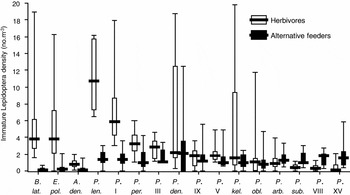
Total caterpillar densities varied strongly between individual plant species, especially within the genus Piper (Bodner et al. Reference BODNER, STRUTZENBERGER, BREHM and FIEDLER2012), but did not differ significantly (P > 0.41, one-way ANCOVA) between the two plant families. This pattern is driven almost entirely by herbivorous caterpillars. Two Piper species (P. lenticellosum C. DC., P. sp. I) in particular had far higher herbivore densities than most other congeners, whereas Piper subscutatum (Miq.) C. DC., as well as Piper sp. VIII and P. sp. XV were rarely attacked by herbivorous caterpillars. Within the Asteraceae, Baccharis latifolia (Ruiz & Pav.) Pers. and E. polymnioides had much higher herbivore densities than Ageratina dendroides (Spreng.) R.M.King & H.Rob. Density of alternative feeders, to the contrary, differed strongly between shrub families, but was rather constant across different shrub species within each family. Their median density across all Piper shrubs was as much as 5.8 times greater than that for all Asteraceae. While on Asteraceae herbivores always clearly outranked alternative feeders, their densities were often similar on Piper. In several cases alternative feeders were even much more abundant than herbivores, accounting for up to 80% of the caterpillars retrieved from some Piper species (Figure 1).
Caterpillar densities per unit shrub volume for the different shrub species sampled in southern Ecuador, segregated into feeding guilds. Shown are median values (bars), second and third quartiles (boxes) and whole ranges (whiskers). Alternative feeders: no significant differences in densities between plant species within either Asteraceae (P = 0.66) or Piperaceae (P = 0.83), but strong differences between families (P < 0.0001). Herbivores of focal shrubs: strong differences between plant species within each family (both P < 0.0001), but weak effects between families (P = 0.011). B. lat.: Baccharis latifolia; E. pol.: Erato polymnioides; A. den.: Ageratina dendroides; P. len.: Piper lenticellosum; P. per.: P. perareolatum C. DC.; P. den.: P. densiciliatum Yunck.; P. kel.: P. kelleyi Tepe; P. obl.: P. obliquum Ruiz & Pav.; P. arb.: P. arboreum Aubl.; P. sub.: P. subscutatum (Miq.) C. DC.; P. I–XV: Piper sp. I–XV.

This leads us to conclude that plant species identity is not directly relevant for the alternative feeders. Instead, we expect their abundance to be linked to factors such as a favourable microclimate for epiphyll and fungal growth, and/or to differences in leaf longevity allowing for an accumulation of higher epiphyll loads. Additionally, permanently moist conditions in closed forest keep dead leaves soft. In feeding trials this seemed advantageous for consumption by detritivorous caterpillars. The higher prevalence of alternative-feeding caterpillars on Piperaceae relative to Asteraceae is therefore possibly explained by a combination of their preference for microclimatic conditions in closed forest and higher leaf turnover rates in the early succession Asteraceae as compared with Piper shrubs (F. Bodner, pers. obs.).
Feeding associations grouped here as ‘alternative feeders’ have long been known in the taxonomic literature on the Lepidoptera. Most of the taxa reported here are well known for these associations, e.g. Lithosiinae and Herminiinae. Despite this, we could not find any reports of a similarly large fraction of these guilds in caterpillar assemblages throughout the ecological literature. Studies on arthropod assemblages and food webs frequently include non-herbivorous guilds such as fungivores and detritivores (Novotny et al. Reference NOVOTNY, MILLER, BAJE, BALAGAWI, BASSET, CIZEK, CRAFT, DEM, DREW, HULCR, LEPS, LEWIS, POKON, STEWART, SAMUELSON and WEIBLEN2010), but these do not usually include immature Lepidoptera. This might be partially explained by the difficulties in rearing these caterpillars to adulthood in captivity. Accordingly, such specimens may have been excluded as ‘strays’ in other studies, after feeding trials with green leaves had been unsuccessful. While alternative feeding associations may not be a chief concern for community studies focusing exclusively on caterpillars as herbivores, the results presented here underline that caterpillars also fulfil different ecological roles. In some plant species, like Piper sp. XV with 80% of caterpillars being alternative feeders, antagonistic host herbivore interactions were even an exception. Here, most caterpillars would rather have to be seen as commensals of their host plant. It remains to be tested if the high contribution of alternative feeders observed in our study is a specific feature of montane tropical forest (characterized by a very high abundance of lichens and other epiphylls and an almost constantly perhumid climate), or whether a targeted search would reveal similar fractions in tropical lowland forests as well.
ACKNOWLEDGEMENTS
Genoveva Rodríguez-Castañeda, Christian H. Schulze and Patrick Strutzenberger gave valuable comments and helped to improve the manuscript. Lisamarie Lehner, Melanie Tista and Christine Truxa assisted with sample preparation, and Jürgen Homeier, Eric Tepe and Gerardo Lamas with species identifications. Two anonymous reviewers provided many helpful suggestions for improvement. Arthur Broadbent proofread the manuscript. We thank all of them for their support. The Deutsche Forschungsgemeinschaft financed our project (FOR 816; Fi 547/10–1 & 10–2). The Ministerio del Medio Ambiente del Ecuador issued research permits. The foundation Nature and Culture International (Loja, Ecuador) and the Universidad Técnica Particular de Loja gave logistic support.