

Improvement of child health is a great concern in Korea since epidemiological evidence has indicated increases of inappropriate eating habits and health risks such as obesity. Obesity among children has increased dramatically in Korea, presenting 2–3 % in the 1970s and 15–20 % in the 2000s1, Reference Park, Lee, Choi, Kang and Kim2.
Lifestyle factors are well known to be important in the development of obesity besides genetic and other biological factors. One of these lifestyle factors is diet. A number of studies have examined relationships of obesity and diet, mainly focusing on individual nutrients and foods (i.e. energy, fat, milk, vegetables, etc)Reference Choi and Seo3–Reference Willett6, fewer attempts have been made to identify dietary patterns in this regard for children.
Dietary-pattern analysis is useful for dietary recommendation as it allows studying the effect of many foods and their combinations simultaneously. One of the methods that can be used to study dietary patterns is factor analysis. Factor analysis reduces foods into patterns (factors) based on correlations between foods, and each individual receives a factor score for all derived factorsReference Cody and Smith7.
Several studies on dietary patterns have shown associations of child obesity with specific dietary patterns such as sweet foods, meats, low-quality foods, snacks, dairy foods, fruit and vegetables, although the results are not consistentReference Epstein, Gordy, Raynor, Beddomme, Kilanowski and Paluch8–Reference Togo, Osler, Sørensen and Heitmann12. However, these findings have some limitations to be applicable to Koreans since culturally specific dietary patterns are likely to play a role in this matter. Like many other countries, nutrition transition is an ongoing phenomenon in Korea, yet fat intake is still lower and vegetable intake still higher than children from other Asian countries and most Western countriesReference Kim and Popkin13. The unique aspects of diet transition in Korea may exert an influence to some extent in terms of dietary patterns and their association with obesity in children. The present study was an attempt to identify prevailing dietary patterns among Korean young children and to examine their associations with overweight.
Subjects and methods
Subjects
As part of the Practical Approach for Better Maternal and Child Nutrition and Health Study conducted in Korea from June 2001 to June 2005Reference Park, Kim, Chang, Kim, Oh and Lee14, a sample of 1724 Korean preschool-age children was selected by multiple-step sampling. In brief, two districts (Gu) in Seoul and two districts in Uijeongbu city were randomly selected, in which eleven preschools chosen by convenience sampling agreed to participate in the study. At each selected preschool, children were recruited if their caretakers accepted the informed consent. The number of children recruited from each centre ranged from 53 to 251. The present study included 1441 preschool children who had all records on dietary intake, weight and height. Mean age of the children was 5·2 (sd 0·89) years.
Dietary assessment
Usual dietary intake was assessed by a modified version of a semi-quantitative FFQ developed by one of the investigators (S.-Y. O.). Respective correlation coefficients for reproducibility and validity of this instrument ranged 0·6–0·8 and 0·3–0·6 depending upon nutrientsReference Lim15. The FFQ contains 100 food items with nine non-overlapping frequency response categories, ranging from ‘rarely use’ to ‘have three or more times per d.’ For all foods, the possibility of specifying the use of a small, average or large portion was offered, where a small portion was a portion 50 % smaller than the average, and a large one was 50 % larger. The caretaker was asked to indicate his/her child's average frequency and portion of consuming foods in reference to the preceding month. Using the Computer Aided Nutritional Analysis Program II (CAN PRO II) developed by the Korean Nutrition Society (Seoul, South Korea), the amount of each food item included in the FFQ was converted into g, from which the daily intakes of nutrients were calculated.
Other relevant variables
Trained nutrition major graduate students measured children's height and weight following standard recommended procedures16. BMI was calculated using height and weight measures. Respective cut-off points of overweight were the 85th percentile of BMI for specific age and sex group for Korean children17.
Similar to the variable used in the Korean National Healthy and Nutrition Survey1, caretakers' perception of peer-compared child general health status was assessed by a question using a five-point Likert scale ranging from 1 for ‘relatively very bad’ to 5 for ‘relatively very good’. For the multiple logistic analyses, the health status variable was dichotomized as ‘better than’ v. ‘inferior or similar to’ as compared with health status of other children of similar ages in general. The proportion of children whose health status was evaluated as ‘inferior or similar to’ their peers was 40·5 %.
Nutrition attitude of caretakers was measured by six items to assess degrees of attitude toward serving balanced meals to their families as suggestedReference Nam and Kim18. Each question used a five-point Likert scale (1 = ‘strongly disagree’; 5 = ‘strongly agree’). The mean of the six items was used as a measure of nutrition attitude in further analyses. The questionnaire also included a monthly household income question from which respondents had to choose one of the following monthly income ranges: (1) < 1 000 000 Korean won (KRW) (1 000 000 KRW = about US$1000 or €800); (2) ≥ 1 000 000 and < 2 000 000 KRW; (3) ≥ 2 000 000 and < 3 000 000 KRW; (4) ≥ 3 000 000 and < 5 000 000 KRW; (5) ≥ 5 000 000 KRW. In addition, we assessed monthly food expenditure and duration of television watching as continuous variables.
Data collection
The survey instrument had been pre-tested between May and July 2001 and was revised with minor modification. Data for the present study were collected between November 2001 and July 2003. Self-administered questionnaires were distributed to caretakers of the children by mail. As an incentive, a small gift was provided.
Statistical analysis
In order to assess dietary patterns, first, 100 food items were classified into thirty-three food or food groups based on the nutrient profiles of each food item (Table 1). Factor analysis with values of intake frequencies of thirty-three food groups was used to derive dietary patterns with the option of orthogonal rotation to derive factors. Principal component analysis was used to extract factors. In determining the number of factors to retain, we ran factor solution ranging from two to ten, including food group components with an eigenvalue >1 and examined both the scree plots and interpretability of factors. From these analyses, the three-factor solution was selected. These three factors explained 27·4 % of the total variance of thirty-three food-group variables. Factor loadings were calculated for each food group across the three factors. A factor score was calculated for each subject for each of the three factors, in which intakes of thirty-three food groups were weighted by their factor loadings and summed. The analyses were conducted by using the FACTOR PROCEDURE in SAS (version 8.2; SAS Institute Inc., Cary, NC, USA). The dietary patterns that we used were named according to the food groups loaded most positively on the factor.
Food groups used in the factor analysis

The associations of each dietary pattern with overweight and health status were evaluated by multiple logistic regression analysisReference Cody and Smith7, via the PROC LOGISTIC procedure of SAS (version 8.2, SAS Institute Inc.). Multiple logistic regression models were adjusted for preschool location, household monthly income, and child's age and sex variables. Total energy intake was further controlled for because associations between intakes and outcome variables cannot be considered as primary effects of dietary patterns if they were the results of differences in total energy intake between quintile groupsReference Willett, Stampfer and Willett19. Duration of television watching, an indirect measure of activity level, was also controlled for in the logistic regression analysis in the case of overweight. OR and their 95 % CI were computed to assess the strength of the associations between dietary patterns and outcome measuresReference Cody and Smith7.
Results
Table 2 lists factor-loading matrices for the three major dietary patterns. The larger the loading of a given food item to the factor means the greater contribution of that food item to a specific factor. Dietary pattern 1 was identified by higher intakes of vegetables, kimchi (spicy raw vegetables), seaweeds, beans, fruits, milk and dairy products, and was labelled as the ‘Korean healthy’ pattern. Dietary pattern 2, named as the ‘animal foods’ pattern, was characterized by high intakes of animal foods such as beef, pork, poultry and fish as well as fast food including hamburgers and pizza. Dietary pattern 3 labelled as the ‘sweets’ pattern showed high intakes of ice cream, sweet drinks, chocolate, sweet baked goods and sugary foods.
Factor-loading matrix for the three dietary patterns and their food or food groups identified in 1441 Korean preschool children*

* Absolute values < 0·20 are not presented in the table for simplicity.
The background characteristics of children according to the quintiles of dietary pattern scores are presented in Table 3. Children with a higher Korean healthy dietary pattern score were more likely to be from the households with higher income and food expenditure, and had mothers with better nutrition attitude. Participants with a higher animal foods pattern score tended to be older and overweight and their households spent more money on buying food. Children with a higher sweets pattern score were from the households with more food expenditure.
Simple characteristics across quintiles (Q) of three dietary patterns in 1441 Korean preschool children
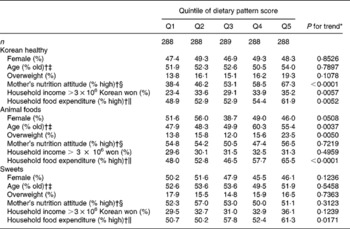
* Mantel–Haenszel χ2 test.
† Subjects were divided into two, high and low, groups based on their scores.
‡ Cut-off point was 5·4 years.
§ High means more positive attitude.
∥ Cut-off point was 5 × 10⁵ Korean won.
The Korean healthy dietary pattern was associated positively with energy, protein, fibre and micronutrient intakes, but not with fat consumption (Table 4). The animal foods pattern showed positive correlations with energy-generating nutrients, a negative relationship to Ca, and no associations with Fe and antioxidant nutrients. The sweets pattern was correlated positively with energy and fat consumption, but negatively with protein and micronutrients such as Fe, fibre, Ca and antioxidant nutrients.
Total energy and energy-adjusted nutrient intakes across quintiles (Q) of three dietary patterns in 1441 Korean preschool children (Mean values with their standard errors)

* For these variables, there was a significant group difference (P < 0·05). Otherwise, there was no statistically significant group difference.
† Adjusted for age and sex for energy and age, sex and total energy for other nutrients.
There was a positive association between the Korean healthy pattern and health status after controlling for potential confounders. Children with the highest quintile had a lower risk of having health status inferior or similar to their peers (OR 0·59 (95 % CI 0·42, 0·84)). Neither the animal foods nor the sweets pattern showed a significant association with health status. Likelihood of being overweight was higher among those in the highest quintile v. the lowest quintile (OR 1·77 (95 % CI 1·06, 2·94)) in the animal foods pattern. Overweight risk did not differ by degree of intake in both the Korean healthy and the sweets dietary patterns (Table 5).
Comparison of quintiles (Q) with lowest quintile (Q1) for each dietary pattern by overweight and health characteristics in 1441 Korean preschool children* (Adjusted odds ratios and 95 % confidence intervals)

* OR adjusted for household income, preschool location, and child's age, sex and total energy intake, and duration of television watching (only for overweight).
† n 288 in Q1.
‡ 40·5 % Children's health status was inferior or similar to their peers.
Discussion
The dietary pattern approach can summarize complex dietary data into more practical and meaningful information; thus, it is useful in nutrition intervention planning. The present study identified three distinct dietary patterns: the Korean healthy pattern, an animal foods pattern, and a sweets pattern. The sweets pattern identified in the present study was similar to the snack pattern characterized by a higher consumption of bakery products, sweets, salted snacks and soft drinks in Spanish childrenReference Aranceta, Perez-Rodrigo, Ribas and Serra-Majem20. The Korean healthy pattern in the present study, however, differed to some extent from the healthy dietary pattern among children in Western countries although it was similar to the wellbeing diet for Korean adultsReference Oh, Lee and Kim21.
One of the differences of dietary patterns between Korean and Western populations appeared to be fish intake. Fish consumption in general was related more positively to the animal foods pattern among Koreans for both children (see Table 2) and adultsReference Oh, Lee and Kim21. Fresh fish, however, also showed a strong association with the Korean healthy pattern (factor loading 0·45), while no such association was found in other types of fish. Higher fresh fish intake was identified only in the healthy or prudent pattern in Western populationsReference Adebamowo, Hu, Cho, Spiegelman, Holmes and Willett22–Reference Northstone and Emmett24.
Overweight is a public health concern due to its magnitude and increasing trend in Korea. The proportion of overweight ranged 12–24 % depending upon the levels of intake regarding dietary patterns (see Table 3), which corresponds to other reports for Korean children1, Reference Park, Lee, Choi, Kang and Kim2. Even though the absolute proportion of either overweight or obese is still lower among Korean children than children in most Western countriesReference Nicklas, Yang, Baranowski, Zakeri and Berenson10, Reference Serra-Majem, Bartrina, Pérez-Rodrigo, Ribas-Barba and Delgado-Rubio11, Reference Veugelers and Fitzgerald25, the Korean government will launch the national obesity prevention programme from 2007 due to a rapid increase of obesity incidence. Lee et al. Reference Lee, Lee, Kim, Chang and Kim26 estimated a doubled child obesity incidence in 2010 in Korea.
High animal food consumption had been identified as a determinant of overweight in the present study. The high animal foods pattern comprised of more energy and less or similar levels of micronutrients, that is, it represented a less-nutrient-dense diet. A nationwide study in Korea also showed an inverse association of nutrient density with overweight or obesity statusReference Lee, Lee, Kim, Chang and Kim26. Low-nutrient-dense foods appeared to favour the development of central nervous system insulin resistance that might in part be responsible for leptin resistance, accordingly, promoting pleasurable responses to foodsReference Isganaitis and Lustig27. However, the association between dietary patterns and overweight cannot be fully explained by the nutrient-density issue in the present study. Nutrient density was relatively low in the high sweets dietary pattern, yet no association was found regarding overweight status.
Determinants of obesity in previous studies conducted in Western countries included high consumption of sweet drinks and fruit juices, meats, and a low-quality diet as well as low intakes of fruit and vegetablesReference Epstein, Gordy, Raynor, Beddomme, Kilanowski and Paluch8–Reference Togo, Osler, Sørensen and Heitmann12. Among those determinants, sweet foods were likely to be the most frequently notedReference Epstein, Gordy, Raynor, Beddomme, Kilanowski and Paluch8–Reference Togo, Osler, Sørensen and Heitmann12, although the relationships between intake patterns and obesity were not consistent. One of the reasons for the conflicting findings would be that dietary patterns are not mutually exclusive, as shown in the factor-loading matrices of dietary patterns in the present study (Table 2). Combinations of dietary patterns may influence overweight status.
The Korean healthy dietary pattern presented a positive association with the caretakers' perception of peer-compared child general health status. It suggests that the empirically derived healthy dietary pattern in the present study was meaningful. The relationships between dietary patterns and measures of health status may need further research since we are not aware of any studies that have examined the association between dietary patterns derived by factor analysis with general health status.
The present study results should be interpreted in consideration of the following limitations. First, foods provided by childcare centres may not have been considered by the dietary intake assessment done by caretakers. Second, the factor analysis method has the limitation that investigators must make subjective decisions. This method is data specific; thus, results may not be replicated across populations. The present study used duration of television watching as a proxy for activity, which may not fully represent the activity level of children. Nutrient intakes of children estimated by a semi-quantitative FFQ may not represent their absolute intakes since it was developed for the use of assessing relative intake levels. Moreover, the aetiology of overweight is complex; thus, the dietary-pattern models used in the present study may not have considered other confounding factors that might be responsible for the study results. Finally, the fact that the present study was based in a convenience sample recruited from urban areas may preclude generalizing the results of the study to children in rural areas in Korea.
Nevertheless, the dietary-pattern analysis of the present study on the basis of a considerable number of children from a homogeneous age group is meaningful since no other studies have examined the issue of dietary patterns in relation to health outcomes among children in Korea. Consequently, these results have important implications for overweight prevention nutrition education targeting children.
Acknowledgements
The present study was supported by a grant of the Ministry of Health & Welfare, Korea in 2001–5 (number 01-PJ1-pG1-01CH15-009).



