1. Laryngeal contrasts in stops
Following the research of Kim (Reference Kim1970) it has been known that fortis/lenis distinctions among stops traditionally cast in terms of [voice] may be encoded either in terms of a true voicing contrast or in terms of an aspiration contrast (see Iverson & Salmons Reference Iverson and Salmons1995, Jessen & Ringen Reference Jessen and Ringen2002, Honeybone Reference Honeybone, van Oostendorp and van de Weijer2005, Vaux & Samuels Reference Vaux and Samuels2005, Beckman, Jessen & Ringen Reference Beckman, Jessen and Ringen2009 for discussion). This paper reports on the results of experiments designed to test the different phonetic predictions made by two such distinct phonological analyses of obstruent neutralization, recently discussed in terms of voice onset time (VOT) differences by Beckman, Jessen & Ringen (Reference Beckman, Jessen and Ringen2013). There is a longstanding debate about the extent to which two-way laryngeal contrasts should be encoded in terms of a single opposition in [voice]. Proponents of the ‘laryngeal realism’ approach (e.g. Iverson & Salmons Reference Iverson and Salmons1995, Honeybone Reference Honeybone, van Oostendorp and van de Weijer2005, Backley Reference Backley2011, Beckman et al. Reference Beckman, Jessen and Ringen2013), many coming from vastly different representational camps, contend that there is a difference between ‘true voice’ languages, which oppose [voice] with an unmarked counterpart (such as Russian and Dutch), and ‘aspirating’ languages, which oppose [spread glottis] with an unmarked counterpart (such as English and German). For the purposes of the current discussion, we employ the features [voice] and [spread glottis] noting, however, that authors such as Harris (Reference Harris1994) and Backley (Reference Backley2011) use ǀLǀ and ǀHǀ respectively for these laryngeal properties.
In the present paper, we focus on the laryngeal oppositions in Turkish, which we argue shows the properties of an aspirating language, and compare it directly with Russian, a clear-cut case of a true voice language. The novelty of the present investigation is the examination of the properties of fricatives in aspirating vs. true voice languages. When looking at stops alone, the laryngeal neutralization in word-final position has led some authors to posit different accounts for the phonological contrast in the language. For example, based on the results of an experimental study indicating that stops undergo complete neutralization in word-final positions, Kopkallı (Reference Kopkallı1993) concluded that Turkish has a devoicing process similar to the loss of [voice] in languages such as Russian.
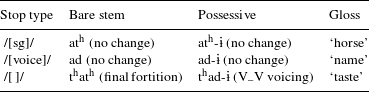
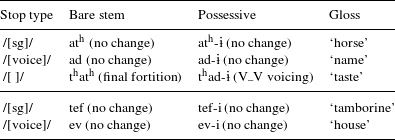
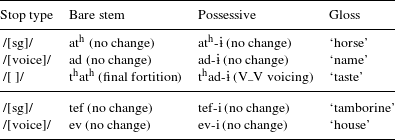
However, subsequent phonological analyses (Avery Reference Avery1996, Kallestinova Reference Kallestinova2004, Petrova et al. Reference Petrova, Plapp, Ringen and Szentgyörgyi2006) have proposed that Turkish stops should be analyzed as having underlying representations specified for both the [voice] and [spread glottis] features, suggesting that in fact there is a three-way voicing contrast between aspirated voiceless stops, voiced stops, and alternating stops. Under this analysis, what seems to be final devoicing under Kopkallı’s analysis is in fact due either to the effect of final fortition (Iverson & Salmons Reference Iverson and Salmons2007) or intervocalic voicing of the unspecified items. The three-way contrast in stops can be observed in the examples and derivations provided in Table 1, where [spread glottis] (henceforth [sg]) is a privative feature representing aspiration (we take the laryngeal features [voice] and [spread glottis] to be privative – whereby there is simply presence of a monovalued feature, and no negative value – following Mester & Itô Reference Mester and Itô1989, Lombardi Reference Lombardi1991, Harris Reference Harris1994, Beckman et al. Reference Beckman, Jessen and Ringen2013).
Specifications and neutralizations in Turkish root-final stops.
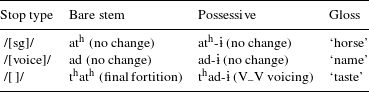
Under this analysis, Turkish nouns such as ad ‘name’, often classified as exceptions to final devoicing, can instead be understood as falling outside of the structural description of the rules mentioned above, since they are inherently [voice]-final (Inkelas & Orgun Reference Inkelas and Orgun1995, Avery Reference Avery1996). Such [voice]-final nouns never alternate, nor do [spread glottis]-final nouns such as  $\mathit{at}^{h}$ ‘horse’. As the feature combination [sg, voice] is banned in Turkish, underlying [spread glottis] segments cannot gain [voice] through intervocalic voicing and underlying [voice] segments cannot gain [spread glottis] through final fortition. On the other hand, laryngeally unspecified nouns such as
 $t^{h}$at ‘taste’ undergo intervocalic voicing when suffixed with a vowel, and final fortition otherwise. On these analyses, therefore, the three-way possibility of specifications becomes crucial to understanding the patterns of neutralization and alternation. Due to the neutralizations induced by final fortition and intervocalic voicing, this three-way contrast is not found in a single position, but rather in the patterns of alternation: there are non-alternating voiceless stops, non-alternating voiced stops, and a series of alternating stops that pattern with the voiceless stops word-finally but with the voiced stops intervocalically, as in Table 1.
Taking as a starting point the extant analyses of Turkish stops as involving a three-way contrast between [spread glottis], [voice], and unmarked, the question arises about what underlying laryngeal features distinguish the fricatives. Beckman et al. (Reference Beckman, Jessen and Ringen2009) argue that the two-way fricative contrasts in German can be set up as [spread glottis] (fortis) and [voice] (lenis), based on Vaux’s (Reference Vaux1998) typological evidence for a laryngeal specification of fricatives requiring a [spread glottis] node for all voiceless fricatives in certain languages.Footnote [2] If this prediction is correct for Turkish as well, then there should be no laryngeal neutralization among the fricatives: voiced fricatives should not neutralize in coda position in Turkish, since they cannot undergo final fortition, and voiceless [spread glottis] fricatives should not neutralize either, since they cannot undergo intervocalic voicing.
The present study offers phonetic evidence that Turkish fricatives maintain their voicing contrast without neutralization by replicating the methodology that Kopkallı (Reference Kopkallı1993) used to find neutralization for the stops, and demonstrating a clear difference between the two members of the fricative opposition. We then present two additional studies, in which Turkish and Russian are compared with respect to the impact of fricatives on subsequent sonorants. By conducting a comparison with Russian, a language which does not employ the use of [spread glottis] in the laryngeal specification of its fricatives and stops, we provide further support for analyses of Turkish that appeal to both [voice] and [spread glottis] in the specification of its fricatives, and more broadly for the distinction in Beckman et al. (Reference Beckman, Jessen and Ringen2013) and the work they build on in distinguishing aspirating vs. true voice languages.
2. Laryngeal specifications among Turkish stops and fricatives
For the stop system of a language such as Turkish with a three-way contrast, the proposed underlying representations of /d/, /th/, /t/ are such that only the voiced and aspirated stops have underlying laryngeal specifications, with [voice] for /d/ and [spread glottis] for /th/. This view that Turkish is a three-way system like Thai or like Armenian (Hacopian Reference Hacopian2003) finds phonetic support in the study of Kallestinova (Reference Kallestinova2004), who reports that Turkish voiceless stops (whether plain or non-alternating) have a long-lag VOT characteristic of aspiration. Under this account we expect both [voice] and [spread glottis] to be active in the phonology, as depicted in Table 1 above. Turkish has stops at four places of articulation: bilabial, coronal, velar, and palatal, where the palatal series – in fact affricates – pattern with the stops with respect to laryngeal alternations (Lombardi Reference Lombardi1990).
Turning to the fricatives, Kaisse (Reference Kaisse1985) and Rice (Reference Rice1993), among others, have described the Turkish system as involving a two-way contrast, with no alternations or neutralizations, as illustrated in (1):
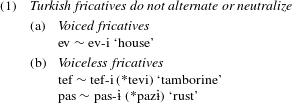
Turkish has fricatives at the labiodental, coronal, and post-alveolar places of articulation. The descriptive generalization arising from examples such as (1) is that fricatives maintain their voicing word-finally, as well as intervocalically – where no voicing alternation is observed. However, these patterns have not been phonetically verified before, which is what we investigate in Section 3.1 below.
Crosslinguistically, two-way contrasts among fricatives have traditionally been described in terms of [voice], with voiced fricatives being specified for [voice] and voiceless ones unspecified. Vaux (Reference Vaux1998), however, has shown that for a number of languages the unmarked state of voiceless fricatives is [spread glottis], a phonetic property which has consequences for the phonological representation as well. For the languages Vaux studied, voiceless fricatives pattern together with aspirated stops in that they induce assimilation of [spread glottis] onto surrounding obstruents. A classic example is found in the pattern of consonant clusters in New Julfa, an Armenian dialect which has a four-way laryngeal contrast in its stop system. In featural terms, New Julfa Armenian allows the free combination of the presence or absence of [voice] and [spread glottis], thereby resulting in four possible laryngeal specifications. In this dialect, the future tense is formed by prefixing /k-/ to the present subjunctive, with the prefix assimilating in laryngeal features to the following consonant. The examples in (2) (Vaux Reference Vaux1998: 498) illustrate how voiceless fricatives pattern together with aspirated stops with respect to their ability to spread [spread glottis] to the prefix /k-/.
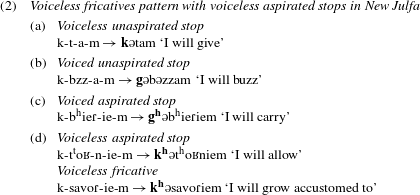
We take Vaux’s (Reference Vaux1998) analysis as the basis for our proposal that voiceless fricatives may be specified for [spread glottis] and voiced fricatives for [voice], and claim that Turkish instantiates this set of specifications for its fricatives. The pattern of voiceless fricatives bearing a [spread glottis] feature can be found across many languages, including Mongolian (Svantesson et al. Reference Svantesson, Tsendina, Karlsson and Franzen2005), in which the fricatives participate in a Grassmann’s Law type of dissimilation with aspirated stops. Recognizing that the specification of fricatives may sometimes diverge from that of the stops (see Rice Reference Rice1994, Iverson & Salmons Reference Iverson and Salmons2003, Beckman et al. Reference Beckman, Jessen and Ringen2009 for discussion), we hypothesize that fortis fricatives are [spread glottis] in languages such as Turkish in which the feature [spread glottis] is already activated among the stops, and that the lenis fricatives are [voice]. As such, the three-way contrast in stops is polarized to a two-way contrast among fricatives.
On the other hand, in a [voice]-only language such as Russian (Halle Reference Halle1959, Padgett Reference Padgett2002), which has an uncontroversial two-way contrast in both its stop and fricative inventories, [voice] is the only feature that distinguishes the two types of stops. Since [spread glottis] is not invoked in the stop inventory and the fricatives have only a two-way contrast, [voice] turns out to be the only laryngeal specification required. There is thus a difference between Turkish and Russian in the specification of their fricatives: the feature [voice] is phonologically active in both Russian and Turkish, while [spread glottis] is only active in Turkish and inert in Russian, since it does not enter into alternations or neutralizations in the latter. Therefore Russian, unlike Turkish, does not belong to the subset of languages that phonologically mark their voiceless fricatives as [spread glottis]. We contend that voiceless fricatives such as /s/ will not be [spread glottis] in ‘true voice’ languages (see also Kristoffersen Reference Kristoffersen2007 and Beckman & Ringen Reference Beckman and Ringen2009), and that phonetic evidence for the difference between the aspirating vs. true voice languages can be found in the patterning of fricatives in these languages as well.Footnote [3] The following section presents three production experiments intended to provide support for these claims.
3. Phonetic analyses of Turkish and Russian fricatives
3.1 Study I: Turkish fricatives do not neutralize word-finally
In most languages in which stops devoice, fricatives undergo devoicing as well (van Oostendorp Reference van Oostendorp, van de Weijer and Jan van der Torre2007). While Kaisse (Reference Kaisse1985) and others claim that fricatives do not devoice in Turkish, Barıs¸ Kabak (personal communication) has expressed doubts about whether neutralization actually occurs or not. Despite the thorough testing of stops to show neutralization (Kopkallı Reference Kopkallı1993, Wilson Reference Wilson2003), Turkish fricatives have never been measured, which is what we report on in the next section.
3.1.1 Materials and methods
In order to test whether Turkish fricatives undergo word-final neutralization or not, eight native speakers of Standard Turkish, four male and four female participants, were recorded in a sound-attenuated booth. The participants were graduate students in North America and had lived in Turkey for the first 20 years of their lives. None of the subjects had a known speech or hearing impairment. Two of the participants had background in linguistics, but neither was aware of the purpose of this study.
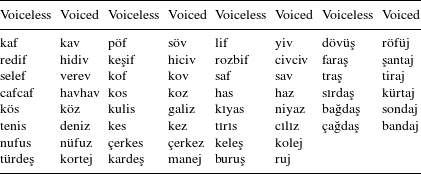
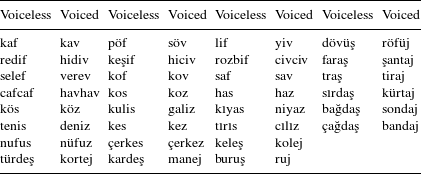
The test words consisted of 30 pairs of words ending in a fricative consonant (10 labiodental {f, v}, 10 alveolar {s, z}, 10 post-alveolar {ʃ, ʒ}). Since Turkish has minimal pairs that involve the final fricative, most of the monosyllabic words tested were exact minimal pairs. In cases where exact pairs could not be obtained, specifically for disyllabic words, the pairs were compiled in such a way as to minimize the acoustic differences within them. The vowel preceding the target fricative was always held constant, with each vowel from the language’s inventory appearing at least once when possible. Furthermore, the penultimate consonants within each pair were chosen so as to agree in their place of articulation. All the words were non-inflected nouns used in Turkish. When compiling this list, the stress, etymology and usage of the words were controlled for with the help of native speakers of the standard dialect of Turkish; none of the words were obvious borrowings, none were of a frequency too low to be known to native speakers, and all disyllabic tokens had final stress. In addition to the 60 test words (presented in Appendix A), 60 filler words were included; the fillers were of the same format, generally stop-final.
The experiment was divided into two parts. For the first part, the participants read two randomizations of the 120-word list in isolation. For the second part, they were asked to put the words in one of two contexts, with each word produced once in each of the contexts. The carrier sentences used are listed below; in the first context the word following the target item was vowel-initial (henceforth, a prevocalic frame) and in the second the target was followed by a voiceless obstruent (henceforth, a preconsonantal frame):
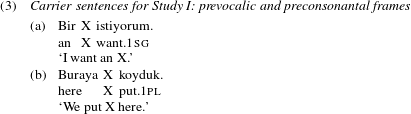
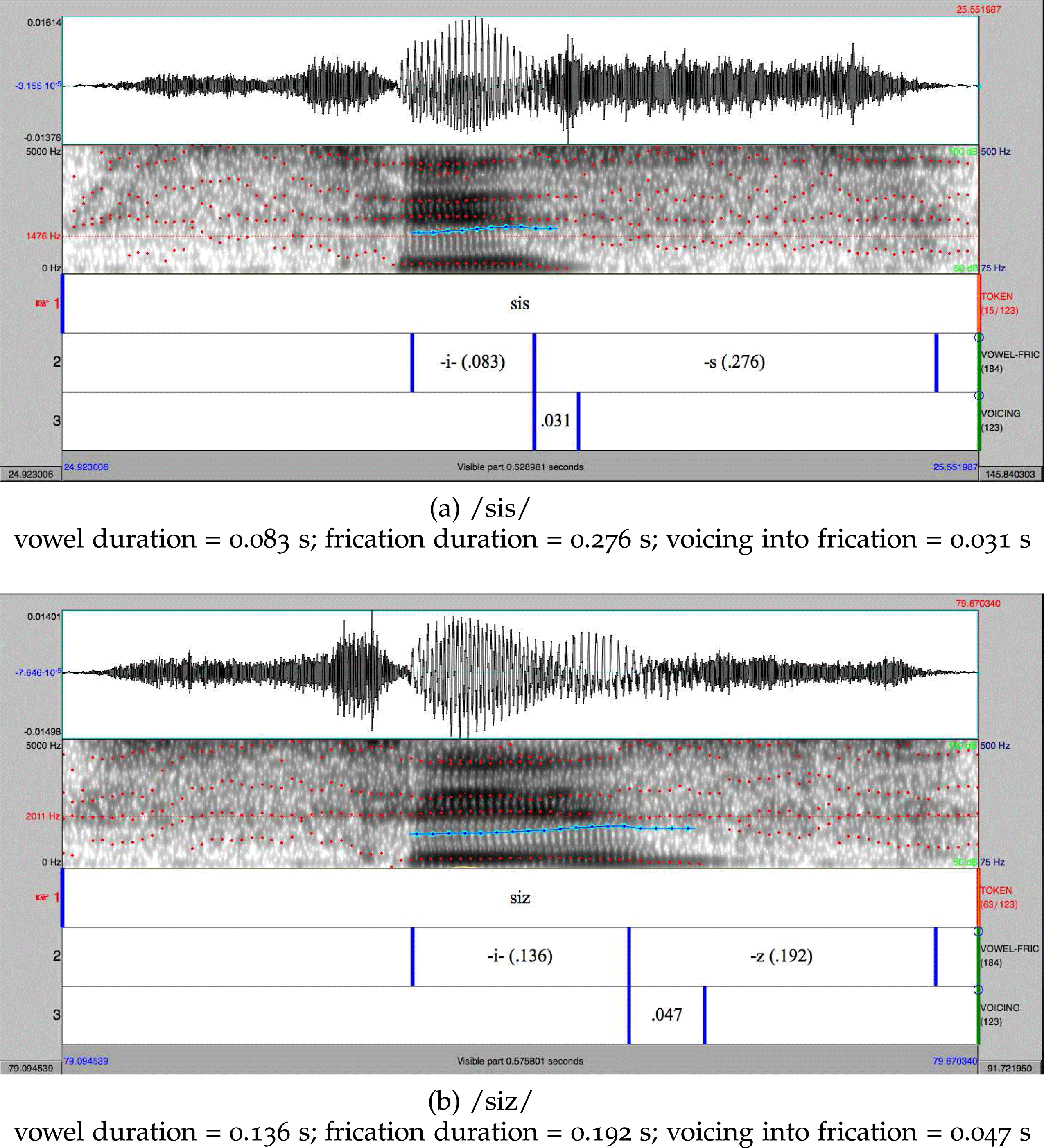
The tokens were analyzed using Praat (Boersma & Weenink Reference Boersma and Weenink2008). Cho & Giavazzi (Reference Cho and Giavazzi2008) provide experimental evidence to suggest that surrounding vowels and fricative duration provide important cues to voicing distinctions in fricatives. Based on their observations, measurements of the following acoustic events were performed: vowel duration, frication duration, and voicing into frication, which represents the interval from the beginning of frication to the end of voicing periodicity. These landmarks are shown in Figure 1 below for the pair /sis/ ‘fog’ and /siz/ ‘you (pl)’.
Spectrogram measurements for Turkish fricatives.

In Stevens (Reference Stevens1999) the acoustic properties of voiced and voiceless fricatives are described as follows: the vowel preceding the fricative is longer for voiced fricatives, and voiced fricatives have shorter durations than voiceless fricatives. In the measurements conducted, we examined vowel duration, fricative duration, and voicing percentage, as recorded across the three contexts of isolation, a preconsonantal frame, or a prevocalic frame.
3.1.2 Results
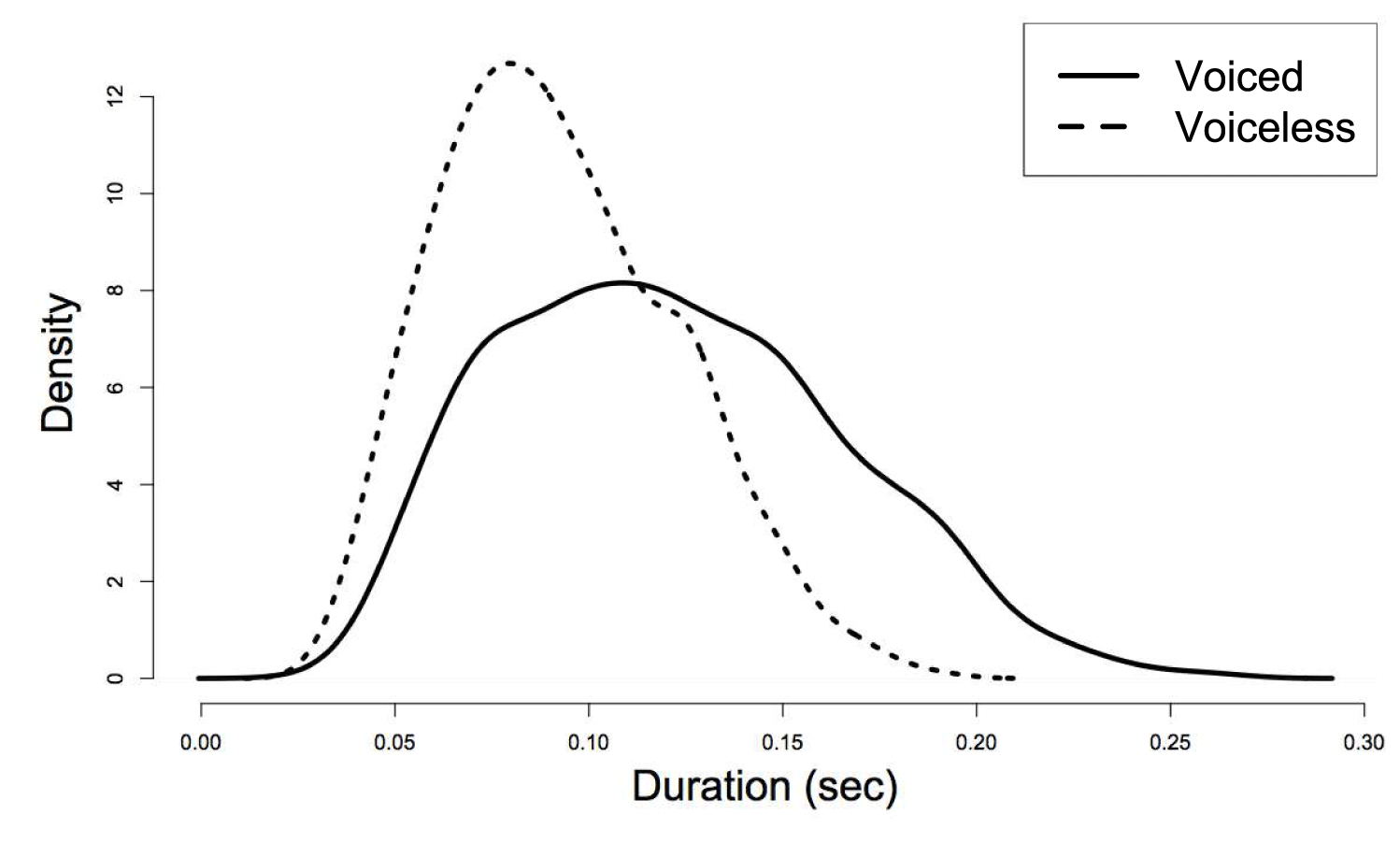
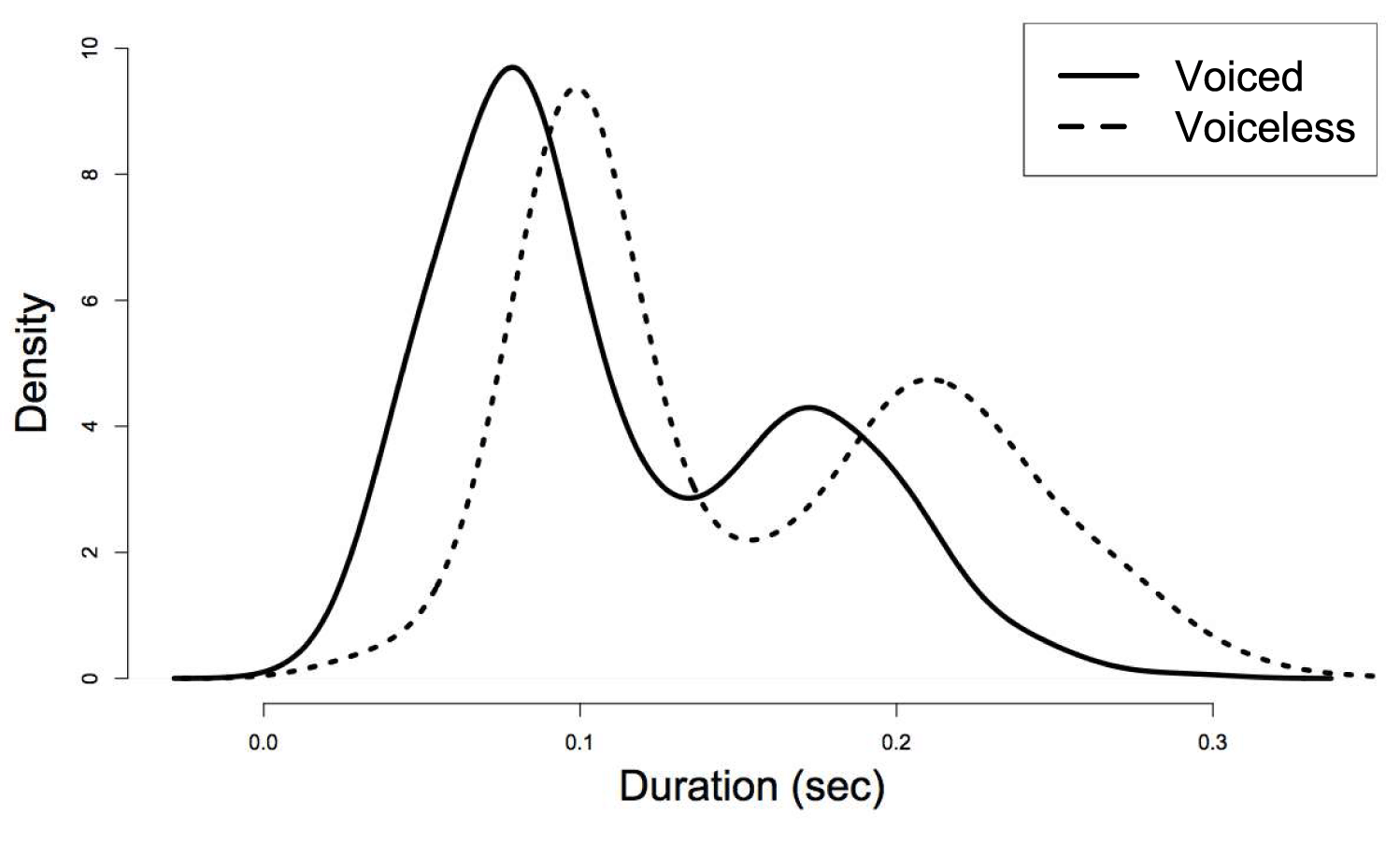
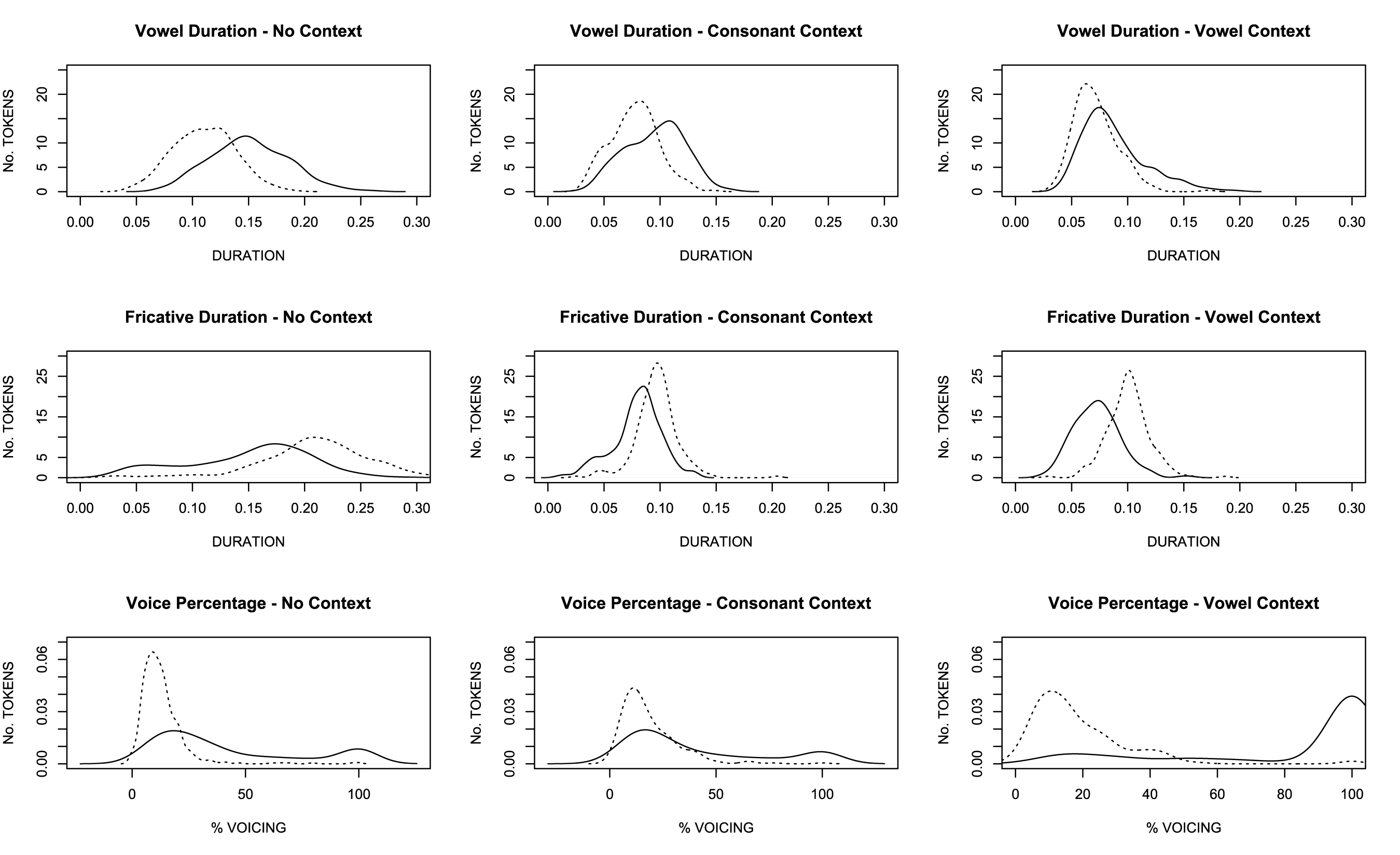
In the statistical analysis a mixed-effects regression model was used (Baayen Reference Baayen2008), with random effects for participant and item, and fixed effects for voicing (voiced, voiceless), place of articulation (labiodental, alveolar, post-alveolar), and context (spoken in isolation, or prevocalic frame, or preconsonantal frame). A model was considered for each of the three measurements: duration of the fricative, duration of the preceding vowel, and voicing percentage, with the latter defined as the percentage of voicing duration relative to the total duration of the fricative (Beckman et al. (Reference Beckman, Jessen and Ringen2009) independently use this same procedure of measuring voicing percentage for their acoustic measurements testing German fricative voicing). We report the results of the models which take into account the interaction between the voicing of the fricative and its environment, as this provides a significantly better fit to the data than one without interactions; we take voiceless and spoken in isolation as our base levels. In Figures 2–4 below we also provide the density plots for the three measurements taken across both voicing conditions, averaged across all three environments.Footnote [4]
Density plots for Turkish fricatives: vowel duration.
Density plots for Turkish fricatives: fricative duration.
Density plots for Turkish fricatives: voicing percentage.
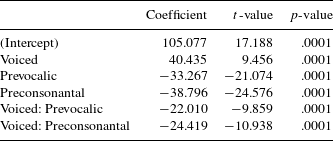
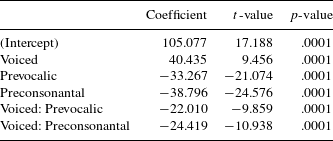
As expected under the hypothesis that voicing is not neutralized for Turkish fricatives, vowels preceding underlying voiced fricatives are significantly longer than vowels preceding voiceless fricatives in all three environments. Table 2 below reports the results of a linear mixed-effects model. A positive coefficient means that the factor is likely to increase vowel duration; thus vowels before voiced fricatives have a longer duration in Table 2. Similarly, while both non-isolation frame environments reduced the length of the vowel compared to isolation (as indicated by a negative coefficient), the effect is much smaller before voiced fricatives (these coefficients are smaller when the frame type is crossed with the fricative being voiced), again confirming a durational difference conditioned by the laryngeal properties of the following fricative. In Tables 2–4, the t-value can be interpreted as reflecting the strength of the effect statistically, while the p-value represents the significance level of the effect.
Mixed model results for durations of vowels preceding the Turkish fricatives in Study I.
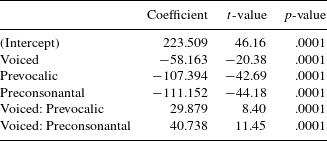
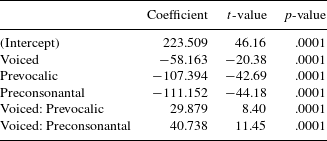
Mixed model results for durations of the Turkish fricatives in Study I.
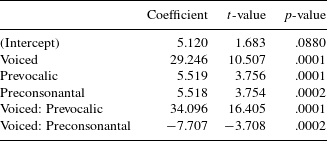
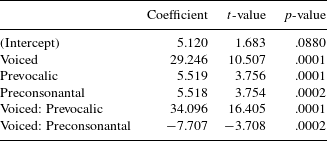
Mixed model results for voicing percentages of the Turkish fricatives in Study I.
The duration of the fricative itself was significantly different between the voiced and voiceless segments as well, with the voiced fricatives being shorter than their voiceless counterparts. Note that the bimodal peaks observed in Figure 3 are a consequence of utterance-final pronunciation, with fricatives produced in isolation (224 ms voiceless and 165 ms voiced) being on average longer than when produced in contextual frames, be it prevocalic (116 ms voiceless and 87 ms voiced) or preconsonantal (112 ms voiceless and 94 ms voiced). The difference between voiced and voiceless was significant for all three environments, as shown in Table 3.
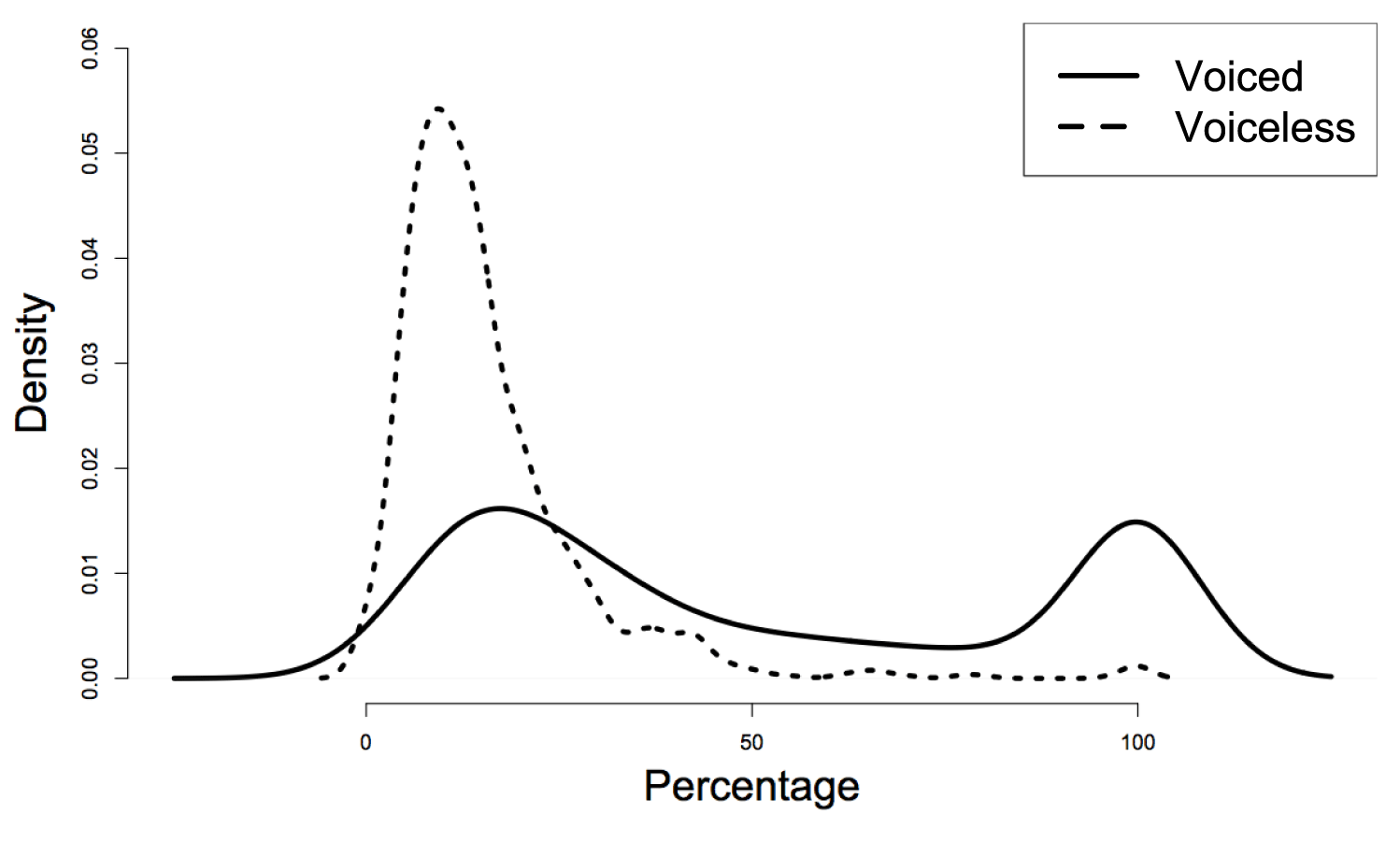
Finally, we observed a clear separation between voiced and voiceless fricatives with respect to voicing percentages, as illustrated in Figure 4. In particular, all participants produced their voiceless fricatives with an average of 15% voicing. The voiced fricatives show a bimodal distribution, with a great degree of voicing at one end of the spectrum and much less at the other, and an overall average of 40% voicing across participants. We attribute the bimodal effect partly to a slight tendency for devoicing in preconsonantal context, but more likely to the fact that in isolation contexts some of the participants did not fully voice these underlyingly voiced fricatives, an effect of being in phrase-final positions.Footnote [5] Nonetheless, we report this devoicing as being non-neutralizing since these participants still produced longer vowels and maintained shorter durations for the voiced fricatives. As Table 4 shows, there is a clear difference in voicing percentages for the two classes of fricatives, and an effect of preconsonantal frames, which induced assimilatory effects from the following fortis stop.
Finally, we point out that these statistical differences also held when looking at fricatives individually for each of the three places of articulation. The alveolars and post-alveolars were statistically indistinguishable with respect to their neutralizing patterns, while /v/ was significantly more voiced than /z/ or /ʒ/, confirming a longstanding observation that word-finally, Turkish voiced /v/ patterns more like approximant /w/ than like a fricative.Footnote [6]
3.1.3 Interim conclusion
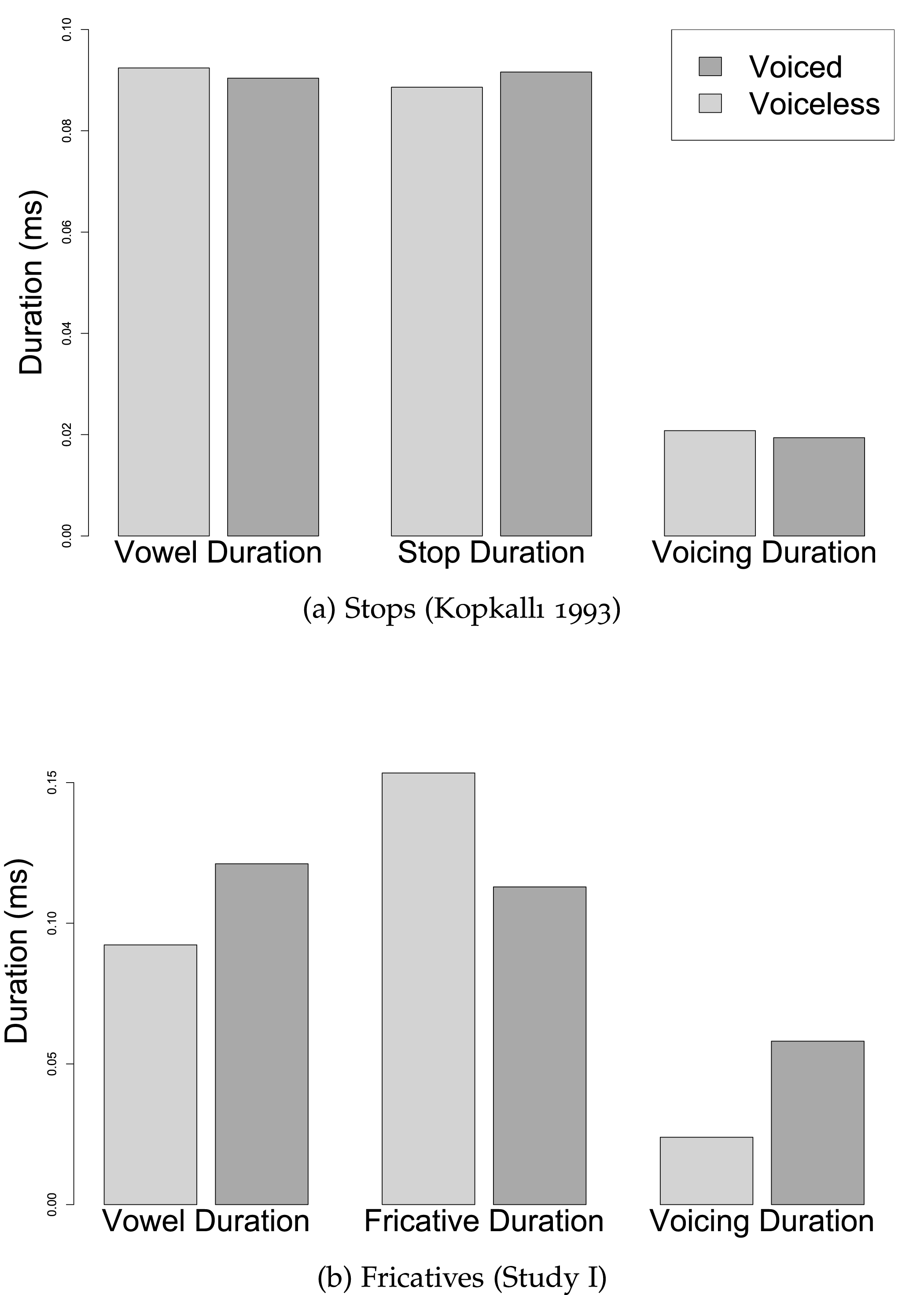
Based on the results of the above study, there is no laryngeal neutralization among fricatives in word-final positions in Turkish. In Figure 5 below we provide a side-by-side illustration of the mean durations for all three parameters for the stops (based on data from the experiment conducted by Kopkallı (Reference Kopkallı1993), which in our terms, would include a neutralization between plain and aspirated voiceless stops in final position) and fricatives, aggregated data from Study I. As the reader can see, in Kopkallı’s (Reference Kopkallı1993) study, the values for voiceless versus voiced stops in final position are virtually indistinguishable for all three phonetic parameters, while in our present study, the voiceless versus voiced fricatives show consistent differences.
Mean durations for word-final stops and fricatives in Turkish.
The data confirm the claims made in the phonological literature that fricatives are not neutralized, and in particular, do not neutralize either word-finally or intervocalically. However, these acoustic data on their own do not necessarily bring us closer to clarifying the fricatives’ phonological representations. We have modified Kopkallı’s (Reference Kopkallı1993) claim that there is a general process of final devoicing in the language, by showing a radical difference in the neutralization patterns of stops and fricatives – findings that offer indirect support for an analysis of Turkish fricatives as having both [voice] and [spread glottis] in the laryngeal representations, neither of which can be neutralized. However, the exact nature of laryngeal specification for Turkish fricatives must be further elucidated by other types of evidence, such as the pattern of post-voiceless fricative sonorants in Turkish, which we take on in Study II.
3.2 Study II: Turkish fricatives spread [spread glottis] to sonorants
The first study demonstrated that there is no word-final neutralization for fricatives, a fact that would follow straightforwardly given the view that the fortis fricatives are [sg] and the lenis fricatives are [voice]: final fortition, responsible for final neutralization occurring with the unmarked stops, cannot apply to the [voice] fricatives, akin to the ‘exceptional’ lack of final devoicing in words such as ad ‘name’. This explanation for the lack of final devoicing or final fortition for the fricatives in this specific kind of two-way system should in turn predict that there is identifiable phonetic evidence for the [spread glottis] specification of the fortis fricatives. We therefore examined whether sonorants occurring after the voiceless fricative [s] in Turkish undergo a process of sonorant devoicing of the kind that is found in [spread glottis] languages such as English. We present the experimental verification of this prediction below.
3.2.1 Materials and methods
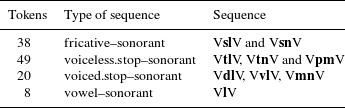
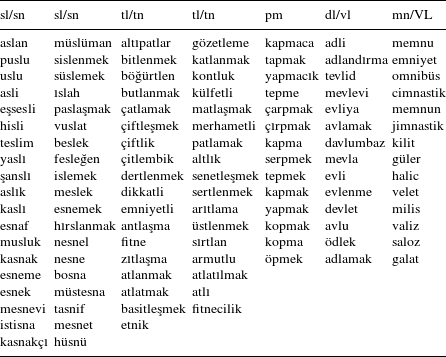
Five native speakers of standard Turkish were asked to produce words that contained either fricative–sonorant sequences, stop–sonorant sequences, or intervocalic sonorants. In the present study we employed only stimuli with the coronal fricative /s/, leaving a comparison with other voiceless fricatives for potential future research. Given the morpheme-internal phonotactic sequences of Turkish roots, the majority of such sequences were heteromorphemic. A breakdown of the 115 stimuli that were presented is shown in Table 5. The participants were asked to read the words embedded in the carrier sentence ʃimdi X diyorum ‘I say X now’.
Study II: Turkish sonorant devoicing (types and numbers per condition).
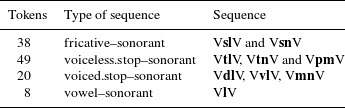
Following Beckman & Ringen (Reference Beckman and Ringen2009), the effect of sonorant devoicing was measured by looking at the average voicing percentage: the duration of voicing relative to the total duration of sonorant.
3.2.2 Results
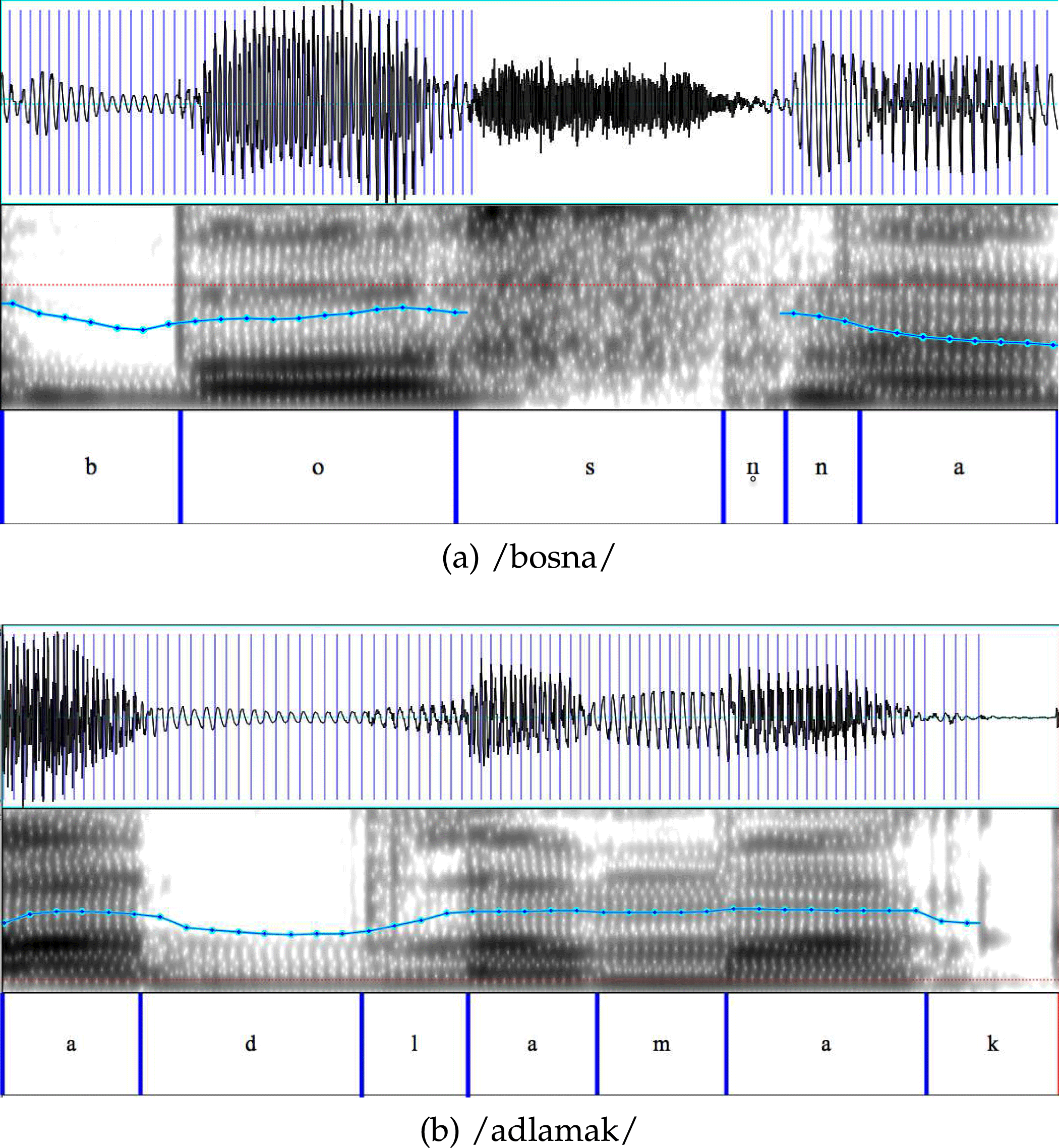
The sonorant duration and its voicing duration were measured across these four environments using Praat. In Figure 6 we provide a sample illustration of the segmentation into sonorant duration and the voiced portions for representative forms with a nasal and a lateral and following a fricative vs. a voiced stop in /bosna/ ‘Bosnia’ and /adlamak/ ‘to name something’.
Segmentation of Turkish sonorants.
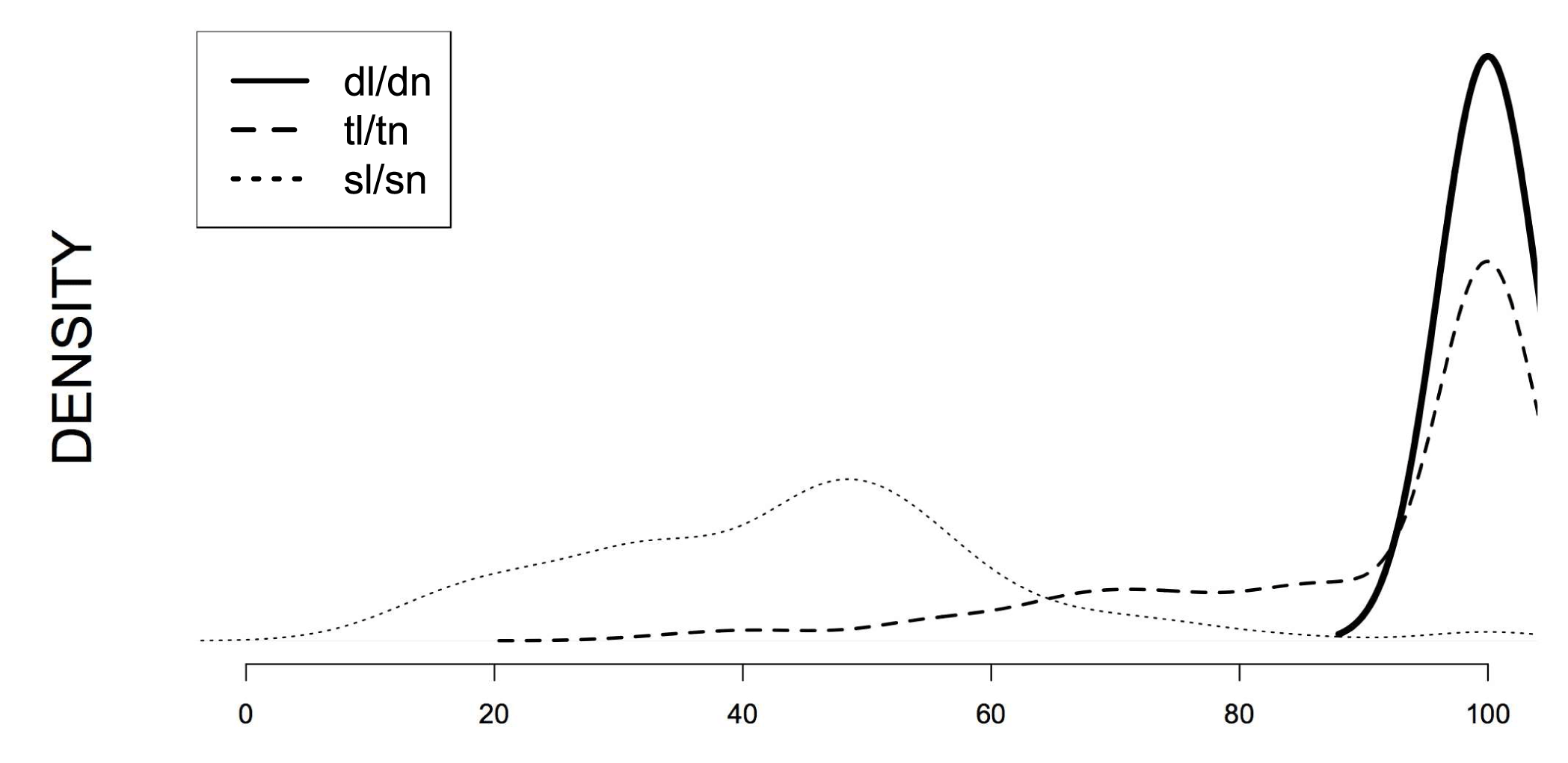
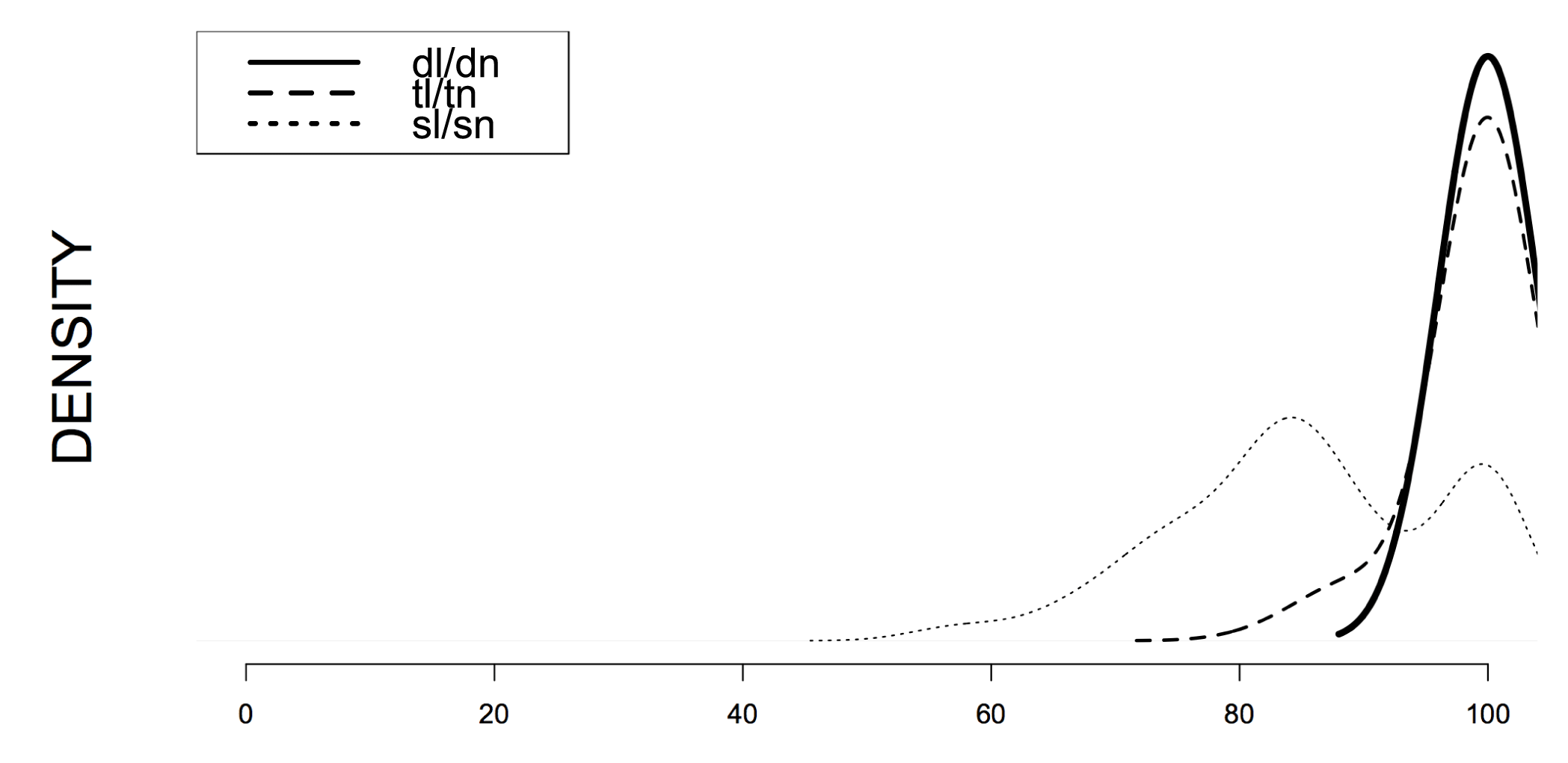
In Figure 7 we present density plots for three sequences. The results indicate that while sonorants remain fully voiced (100%) following voiced stops and vowels (labeled dl/dn below), in post-voiceless fricative positions Turkish sonorants are on average 43.5% voiced (labeled sl/sn), while in post-voiceless stop positions they are 90% voiced (labeled tl/tn). The differences between average voicing percentage following voiceless fricatives was significant in a linear mixed-effects model comparison with voiceless stops ( $t$ = 20.77,
 $p<.001$) and voiced stops (
 $t$ = 26.67,
 $p<.001$).
Voicing percentage for sl/sn vs. tl/tn vs. dl/dn in Turkish.
The density plots illustrate the large degree of devoicing (in our terms, assimilation of [spread glottis]) undergone by sonorants in post-fricative sequences. While this devoicing of the sonorants is not 100% complete in the results, the same is true of English post-/s/ devoicing – both cases can be interpreted as the phonetic implementation of a categorical phonological rule, as argued in Tsuchida, Cohn & Kumada (Reference Tsuchida, Cohn and Kumada2000). The pattern of devoicing found after Turkish /s/ is to be directly contrasted with the minimal amount of devoicing that occurs following voiced and voiceless stops (naturally, there is negligible devoicing when following a vowel). These results are expected given the phonological representations of fricatives in Turkish, as proposed in Section 2 above: the voiceless fricative is specified for [spread glottis] and as such, when it precedes a sonorant, the laryngeal properties of the fricative spread over to the sonorant.Footnote [7]
In other words, the fricatives in Turkish not only fail to undergo laryngeal alternations in a manner parallel to the stops; they also consistently induce a process of sonorant devoicing (in our terms, [spread glottis] assimilation) to the following laterals/nasals. As Iverson & Salmons (1995: 373–374) argue about the difference between sonorant devoicing of this sort in English (where it occurs) vs. Spanish (where it does not), ‘this difference now derives not from the presence of a sonorant devoicing rule in English vs. its absence in Spanish, but rather from the general dynamics of [spread glottis] realization, a feature which simply is not represented in Spanish’.
It is worth emphasizing the interest of the fact that the fortis fricatives pattern differently from both the voiced stops and the voiceless stops with respect to their effect on following sonorants. Recall from our discussion in Section 1 that word-final voiceless stops in Turkish may correspond to two phonologically-specified variants: either underlyingly unspecified – those that undergo alternations – or underlyingly aspirated. In the present study, the presonorant stops overwhelmingly patterned like the unspecified ones, in not triggering sonorant devoicing. This result is perhaps to be expected: as presonorant stops in words like atlanmak ‘skipped’ would not, by definition, undergo either final fortition or intervocalic voicing, and since the orthography makes no distinction between these two types of stops, it is likely that unmarked, laryngeally unspecified representations are more likely for speakers to posit in such forms (in fact, regardless of whether the stop in question is root-final or not). We therefore conjecture that the /tl/ sequences contained, for the most part, underlyingly unspecified stops, with no ability to trigger [spread glottis] assimilation.
In summary, the results of the present study demonstrate that, alongside better-studied [spread glottis] languages like English, Turkish is also a language in which the fortis fricatives induce sonorant devoicing, confirming the hypothesis that the fricatives, unlike the stops, undergo no laryngeal alternations, as both fricatives are laryngeally specified. In other words, in languages like Turkish, one expects that if voiceless fricatives do not undergo voicing neutralization, then they will cause sonorant devoicing. By contrast, languages in which fricatives undergo laryngeal alternations completely parallel to the stops, e.g. final devoicing and voicing assimilation within clusters, as in Russian, evince a series of laryngeally unspecified fricatives, which will not trigger sonorant devoicing. We turn to such a comparison in the next study.
3.3 Study III: Russian fricatives do not spread voicelessness to sonorants
Turkish and Russian, from a distance, appear to have similar patterning, in that both show what is descriptively called final devoicing. However, recall the discussion in Section 1: Turkish does not have final devoicing of one set of its stops (the ones specified [voice], such as ad ‘name’), demonstrates a long-lag VOT system characteristic of a [spread glottis] specification, and does not final-devoice any of its fricatives, as shown in Study I above. Given these differences, while Turkish is a more complex system with a three-way specification in the stops and a two-way specification in the fricatives (neither of the latter of which is unspecified), Russian is a traditional two-way system of [voice] vs. unspecified in both the stops and the fricatives. We therefore expect Russian voiceless fricatives to remain inert in terms of sonorant devoicing, as its system, unlike Turkish, does not possess [spread glottis] specification in the fricatives. The aim of the present study is to directly compare the Turkish results in Study II with those of Russian.
3.3.1 Materials and methods
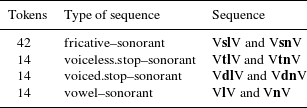
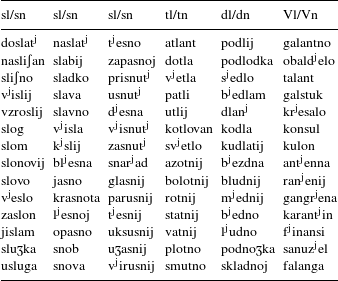
Four native speakers of standard Russian were recorded in a sound-attenuated booth. Since the purpose of this experiment was to test the effect of fricatives (/s/) on following sonorants (/l, n/), the target words were selected so as to include fricative–sonorant sequences word-medially. In the present study we employed only stimuli with the coronal fricative /s/, leaving a comparison with other voiceless fricatives for potential future research. In addition, the stimuli included words containing stop–sonorant sequences and words with intervocalic sonorants. In Table 6 the numerical breakdown of the stimuli is presented, which totals 84 items. We note that the total number of stimuli slightly differed from the those in Study II, but not in a way likely to impact the qualitative pattern of results. The words were presented in Cyrillic orthography and the participants were asked to read them embedded in the carrier sentence Ja govorju X u menja ‘I say I have X’.
Study III: Russian sonorant devoicing (types and numbers per condition).
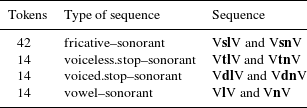
The tokens were analyzed using Praat, following the same measurement points in Study II: sonorant duration and voicing duration.
3.3.2 Results
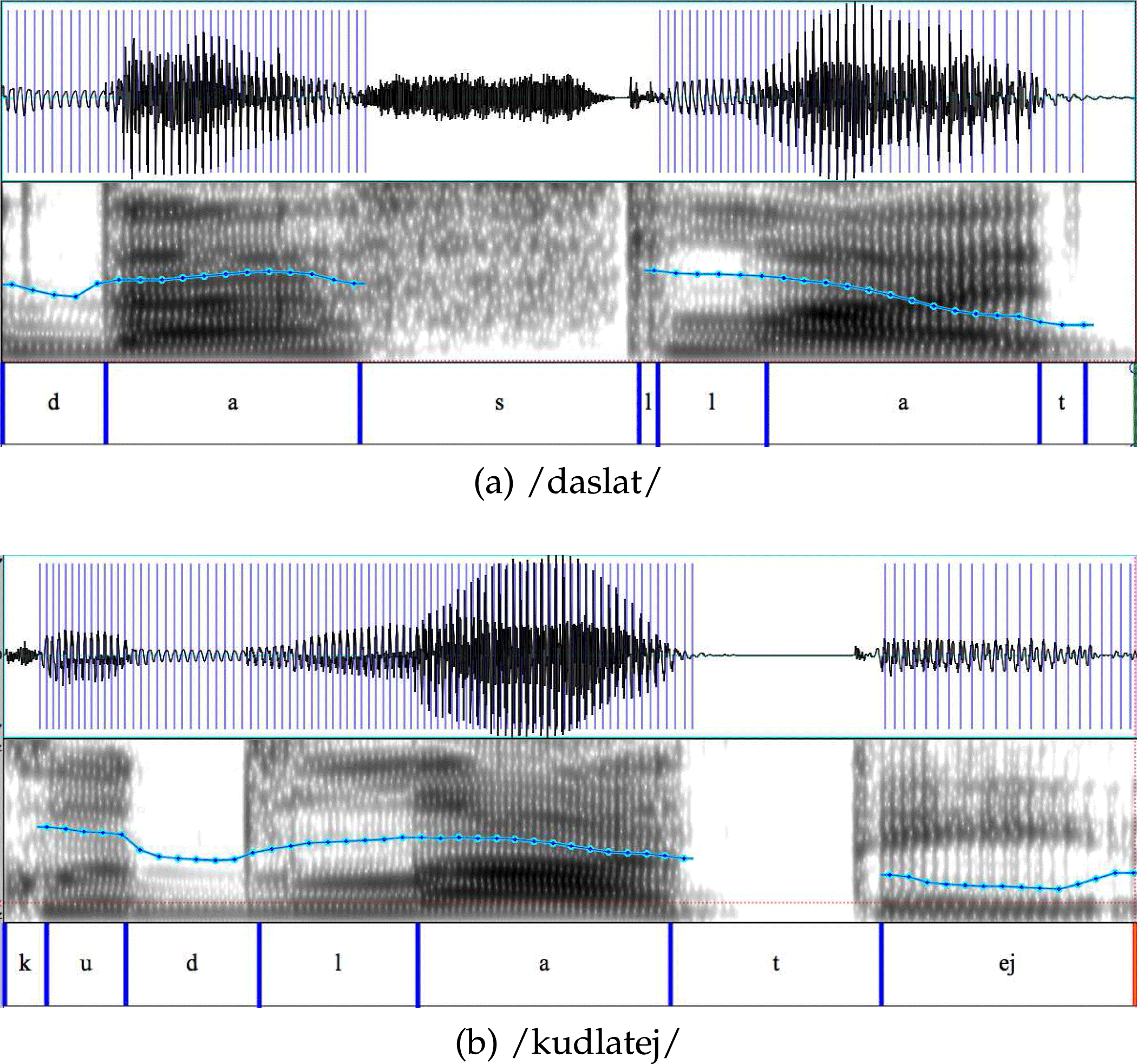
In order to measure the effect of the fricative on the following sonorant, we took the following two measurements: total duration of the sonorant and duration of voicing within the sonorant. In Figure 8 below we provide a side-by-side illustration of this segmentation for /daslat/ ‘addendum’ and /kudlatej/ ‘shaggy’.
Segmentation of Russian sonorants.
Voicing percentage for sl/sn vs. tl/tn vs. dl/dn in Russian.
All 84 items were analyzed in the same manner, and the average voicing percentage (duration of voicing relative to total duration of sonorant) was compared across all four types of sequences. The results indicate that sonorants are 85.7% voiced when following voiceless fricatives, versus 98.7% voiced when following voiceless stops and completely voiced if following either voiced stops or vowels. Figure 9 presents density plots illustrating these results. While it may appear that voiceless fricatives induce slight devoicing on following sonorants, we take this to be a gradient articulatory effect related to the production of voiceless fricatives; many tokens have fully voiced sonorants, and even those that are somewhat devoiced remain more than 80% voiced. In fact, in Study III, of the 168 tokens of Russian sonorants following a fricative, 120 (71%) showed over 80% voicing. By contrast, in Study II, of the 226 tokens following a fricative, only 7 (3%) showed over 80% voicing. While the differences between average voicing percentage following voiceless fricatives in Russian was significant in a linear mixed-model comparison with voiceless stops ( $t$ = 1.12,
 $p<.001$) and voiced stops (
 $t$ = 12.59,
 $p<.001$), there were observably smaller effect sizes (as indicated in the
 $t$-values) than the corresponding comparisons in Turkish. Looking at the differences in means (15% devoicing in Russian following fortis fricatives, versus 56% in Turkish), we conclude that the phonological specification of voiceless fricatives in Russian does not consistently display a devoicing effect on following sonorants.
We take the results of this experiment to indicate that Russian voiceless fricatives do not cause following sonorants to devoice. This is an expected outcome under an analysis of Russian fricatives where the contrast is, like with stops, simply one of [voice]; that is, that voiced fricatives are specified for [voice] while voiceless ones are unspecified, and hence have no [spread glottis] specification in which to induce sonorant devoicing, quite differently from Turkish.
4. Conclusions
The phonetic findings of these three studies support distinct phonological representations for Turkish stops versus Turkish fricatives, as well as for Turkish fricatives versus Russian fricatives. Based on studies such as Avery (Reference Avery1996), Kallestinova (Reference Kallestinova2004), and Petrova et al. (Reference Petrova, Plapp, Ringen and Szentgyörgyi2006), the Turkish laryngeal system shows a three-way contrast for stops, using a combination of [voice] and [spread glottis] specifications alongside an unspecified plain stop, which is the one that undergoes laryngeal alternations.
Up until the present paper, there has been little discussion of the phonological specification of Turkish fricatives. We have demonstrated that neither the fortis nor the lenis fricatives show alternations, and thereby concluded that both are specified for one of the laryngeal features, either [voice] or [spread glottis]. In order to demonstrate that the fortis fricatives are indeed [spread glottis] even in a two-way contrast, we compared the behavior of Turkish fricatives to that of Russian fricatives – whose two-way contrast is one of [voice], with the voiceless fricative being unmarked. The results of Studies II and III showed that with respect to the effect of voiceless fricatives on following sonorants (/l, n/), Turkish and Russian behave drastically differently. Where sonorants were at most 15% devoiced in Russian, they were at least 56% devoiced in Turkish.
Although Turkish has sometimes been characterized as a final devoicing language (e.g. Inkelas & Orgun Reference Inkelas and Orgun1995), we believe that the set of results collected here strongly points towards a specification in terms of [spread glottis], not only for the stops but also for the fricatives. The emerging consensus that there are ‘true voice’ versus ‘aspirating’ languages (Iverson & Salmons Reference Iverson and Salmons1995, Honeybone Reference Honeybone, van Oostendorp and van de Weijer2005, Backley Reference Backley2011, Beckman et al. Reference Beckman, Jessen and Ringen2013) not only in terms of phonetic realization but also in terms of phonological processes has focused more on stop consonants, and in the present work we have extended this hypothesis to fricatives. In other words, the two-way contrast among the fricatives is ‘overspecified’ in the sense of Beckman et al. (Reference Beckman, Helgason, McMurray and Ringen2011), who find that the two-way contrast among Swedish stops is also one between [voice] and [spread glottis], with no use of an unmarked pole of opposition. The phonological patterning of non-neutralization in the fricatives and of sonorant devoicing caused by the fortis fricatives thus leads to the overall set of specifications for Turkish illustrated in Table 7.
Specifications and neutralizations in Turkish stops and fricatives.
The two-way laryngeal specification on Turkish fricatives renders them immune to alternations, and enables [spread glottis] spreading to adjacent sonorants. By contrast, in Russian, a pure final devoicing language, no such activity of [spread glottis] is found, and the fricatives alternate just like the stops. In sum, not all two-way contrasts are created equal: apparently, the presence of a three-way contrast elsewhere in the obstruent system has ramifications for both neutralization and assimilation processes even in a manner of articulation with only a two-way contrast.
Appendix A
Experimental items
Study I: Turkish fricatives.
Study II: Turkish sonorants.
Study III: Russian sonorants.
Appendix B
Additional figures
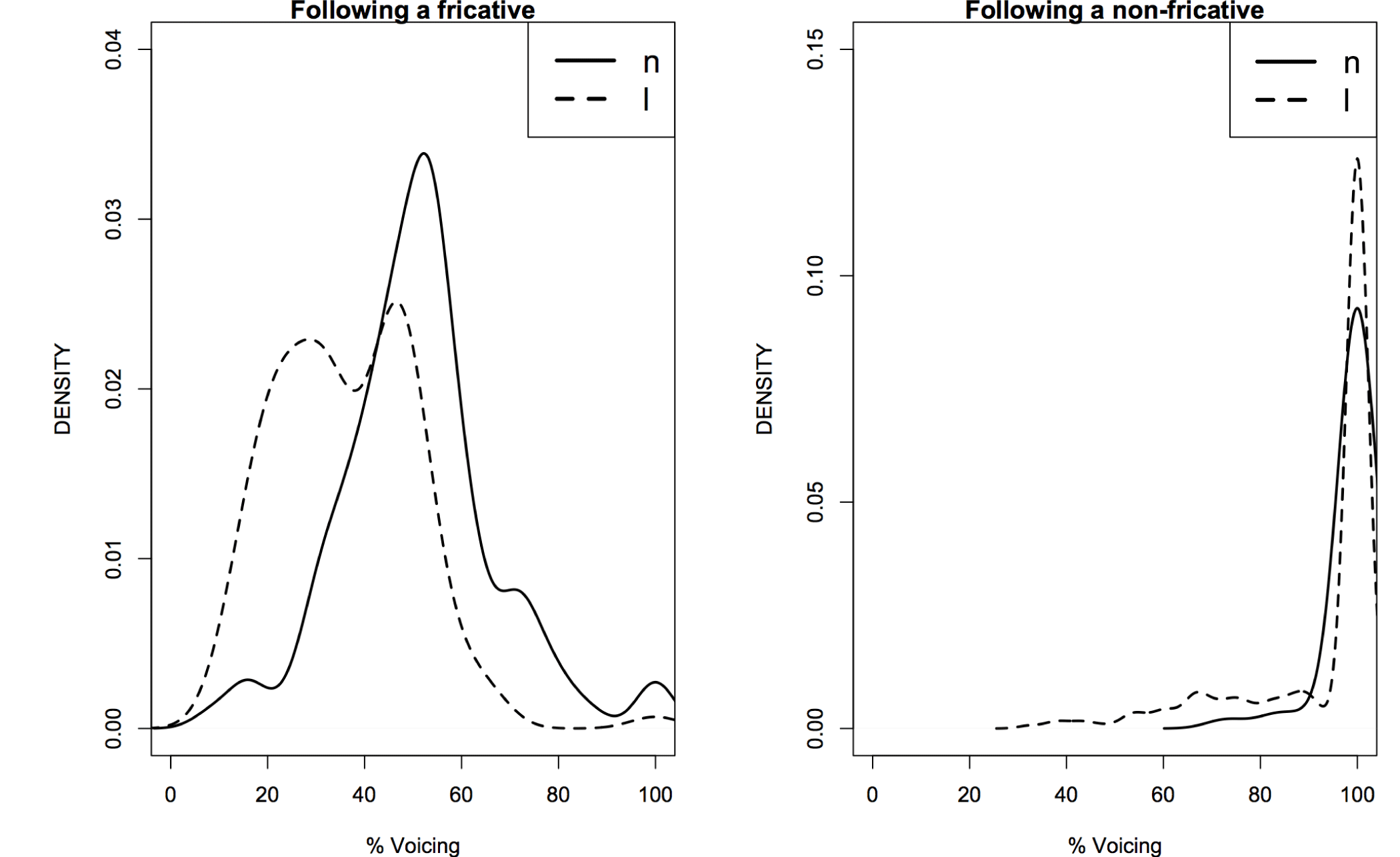
Turkish fricatives (Study I): phonetic measurements across the three carrier frame environments (dotted line = voiceless; solid line = voiced).
Turkish sonorant devoicing (Study II): voicing percentages for l and n following voiceless fricatives versus all other preceding sounds.