Introduction
For elderly over the age of 85 years, a hospital stay is perceived as a predictor to be admitted to a nursing home (Gaugler et al., Reference Gaugler, Duval, Anderson and Kane2007). Approximately 43% of older adults living in Swiss nursing homes were admitted directly following a hospital stay (Swiss Federal Statistical Office, 2013), compared to 19% in Germany (Federal Ministry for Families Senior Citizens Women and Youths, 2006) and 32.5% in the USA (Buie et al., Reference Buie, Owings, DeFrances and Golosinskiy2010). Wilson (Reference Wilson1997) defined admissions to nursing homes directly after a hospital stay as “unplanned.” Such unplanned admissions to nursing homes often result in severe health consequences for the elderly, for example, anxiety, emotional distress, increased confusion, depression, and feelings of loneliness (North American Nursing Diagnosis Association, 1992).
A crucial strategy to cope with the relocation is to ensure continuity (Atchley, Reference Atchley1989). Older adults strive to maintain continuity in their activities, behaviors, habits, thinking, relationships, values, and attitudes. They continue to use the adaptive strategies they developed throughout their lives to interpret what is happening and adjust to current changes (Atchley, Reference Atchley1989, Reference Atchley2000; Cooney, Reference Cooney2012). Continuity also refers to maintaining an ongoing relationship with the same people or care staff, which fosters feelings of attentiveness and familiarity, while inspiring confidence in daily life (Waibel et al., Reference Waibel, Henao, Aller, Vargas and Vazquez2012).
Although continuity was seen as most important, older adults use a variety of other coping strategies to manage the transition arising from an unplanned nursing home admission. Brandburg (Reference Brandburg, Symes, Mastel-Smith, Hersch and Walsh2013a) reported that personal resilience was particularly important for a successful transition, characterized by a sense of feeling “at home” in the new place of residence (Cooney, Reference Cooney2012). Further factors such as preserving personal identity, establishing a sense of belonging, and being actively engaged in daily life were found to be vital (Cooney, Reference Cooney2012). The sense of feeling “at home” is constituted by a person's attachment to place and space in and out of an institution and the concrete circumstances in which older adults can establish new relationships (Falk et al., Reference Falk, Wijk, Persson and Falk2013). Apart from these coping strategies to master everyday life in a nursing home, elderly people also need to be provided with an opportunity to manage the move themselves (Brandburg et al., Reference Brandburg, Symes, Mastel-Smith, Hersch and Walsh2013a).
Another point of concern is the increased tendency of falls during the first three months of institutional residence. However, it cannot be explained solely by a fragile state of health and has been found to be associated with unplanned or involuntary admissions to nursing homes (Capezuti et al., Reference Capezuti, Boltz, Renz, Hoffman and Norman2006).
Therefore, it can be assumed that older adults who experience an unplanned admission have more difficulties in adapting to a nursing home. Brandburg (Reference Brandburg, Symes, Mastel-Smith, Hersch and Walsh2013b) reported that older adults with limited decision-making participation were often resentful about being in the nursing home and unhappy with their day-to-day life. Therefore, this study aimed to explore the experiences of older adults with regard to an unplanned admission to a nursing home.
The aim of the study was to examine the process of an unplanned admission into a nursing home for older adults in Switzerland and its impact on the individuals’ adaptation.
Methods
The research reported in this paper was part of a larger, two-phase, retrospective, descriptive study entitled “SANS (Swiss Admission to Nursing home Study).” In stage 1, a factor analysis of the Geriatric Psychosocial Adaptation Scale (Chao et al., Reference Chao, Lan, Tso, Chung, Neim and Clark2008) was carried out (Altherr, Reference Altherr2013). However, this paper presents the findings from the second phase, where narrative interviews (n = 31) with older adults were conducted. The interviews were used to explore the relevant, in-depth experiences of older adults who were confronted with unplanned admission and were analyzed using Mayring's qualitative content analysis (2010). Analysis was conducted according to a standard protocol where codes were developed from the data, and arranged into main categories. Reporting was made according to consolidated criteria for reporting qualitative research (COREQ) (Tong et al., Reference Tong, Sainsbury and Craig2007).
Participants and settings
Participants were recruited in four nursing homes in urban and rural areas of the Canton of Zurich, Switzerland. The size of the nursing homes ranged from 47 to 110 beds, the number of nurses employed in these facilities ranged from 42 to 100 and the nursing staff had a wide range of different qualifications. Older adults were asked to consent participation in the study by the primary nurse. According to Wilson (Reference Wilson1997), nursing home admission after a hospital stay is unplanned. Older adults were included, therefore, if they were over the age of 65 years, had been living in the nursing home for over two weeks and up to 93 months after a hospital stay, and were fluent in German. The interviews took place in the older adults’ private rooms at the nursing home.
Data collection
Face-to-face interviews with the older adults were conducted from an MScN-candidate. Using semi-structured individual interviews, the older adults were asked about experiences of the admission, their coping strategies and the associated adoption processes in their daily life. Interview questions began with “What is your daily routine now?, What things/people do you really miss?” followed by “In which way were you included in the decision making for entry into this nursing home?” and “How would you evaluate your time here?.” The interviews were digitally recorded and transcribed verbatim. The interviews were conducted between January and March 2013 and lasted on average 39 minutes (SD ± 5.7). Extensive field notes were taken to collect as much information as possible about the experiences pertaining to the admission (Lincoln and Guba, Reference Lincoln and Guba1985). Data collection was deemed completed when no new additional information transpired and a replication of the analysis was guaranteed (Elo et al., Reference Elo, Kääriäinen, Kanste, Pölkki, Utriainen and Kyngäs2014).
Ethical consideration
The study was approved by the Zurich Ethics Committee (KEK-ZH no.: 2012-0467). It is registered under number DRKS00006278.
Data analysis
The interviews were analyzed using Mayring's approach of content analysis (Mayring, Reference Mayring and Mayring2010) and processed with the Atlas.ti ® software program (Version 7.1.6) based on verbatim transcript records. The SPSS statistical software program (Version 20) was used to provide a descriptive analysis of the socio-demographic data of all participants, such as frequencies, central tendencies, standard deviations.
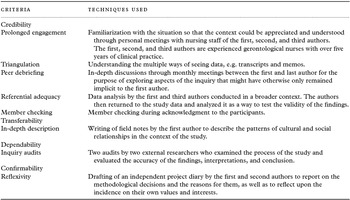
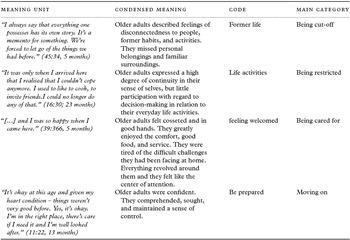
The accuracy of these records was double-checked by the first and second authors. Coding of text material was done line by line. The categories were defined and supported with key examples. In a second step, the categories were checked to ensure that there was no overlapping. Referential adequacy was achieved by conducting data analysis of the first 20 interviews for preliminary findings, while returning to the other 11 interviews and analyzing the data to test the validity and maintain credibility (Lincoln and Guba, Reference Lincoln and Guba1985; Morrow, Reference Morrow2005). Interpretations were substantiated by reasoning, while taking the situations of the individual older adults into consideration (Mayring, Reference Mayring and Mayring2010). These situations were illustrated with relevant quotes from the interviews. Once the final category system was created, sections in the text were allocated to the relevant coding categories. In a member check, all the findings were presented in the nursing homes and discussed with the older adults (Lincoln and Guba, Reference Lincoln and Guba1985). Analyses was conducted by the research group (ALK, GB, and JD) and discussed within the entire authoring team to support dependability and confirmability as well as foster reflexivity (Lincoln and Guba, Reference Lincoln and Guba1985). In order to ensure the credibility and quality of the analysis, memos were used to document the research process (Creswell and Clark, Reference Creswell and Clark2007; Charmaz, Reference Charmaz2014). The consistency of data analysis was achieved by the consensus of all authors. An overview of how trustworthiness was achieved is presented in Table 1. Examples of category development are shown in Table 2.
Trustworthiness criteria

Examples of category development

Findings
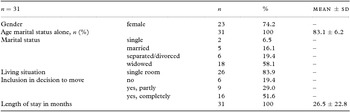
A total of 31 older adults with a mean age of 83.1 years (SD ± 6.2) participated in the study. Participants’ characteristics are presented in Table 3 below. The time between the admission to the nursing home and the interview ranged from 1 to 93 months (mean 26.5 ± 22.8).
Demographic characteristics

The way older adults experience an unplanned admission to a nursing home may be contextualized under the guiding principles of continuity and participation. These principles are important factors for the success of adaptation to the nursing home.
Guiding principle of relocation # 1: continuity
Continuity is described by older adults as having stability and consistency in their everyday habits and social relationships. Because of this permanent change in the older adults’ physical, social, and emotional environment, they may lose their life sense of purpose.
The older adults’ experiences of continuity after an unplanned admission were characterized as instable, complex, and disappointing. The way that continuity or discontinuity affected the adaptation to the nursing home was illustrated in examples highlighting how relationships were experienced during and after relocation. The opportunities for contact, the forms of contact, and the intensity of the relationships changed after the unplanned move. The older adults engaged in fewer talks with people with whom they previously had regular contact. This increased the feeling of dislocation. The older adults were disappointed, regretted the reduction in interactions, and felt alone. One of the participants said, “They never call me. Well, ‘never’ is probably a bit much, I shouldn't say that. But sometimes I think a short phone call would do me good.” (14:19, 34 months).
Continuity means that the older adults can maintain their relationships in their new environment. The older people noticed that such continuity in relationships helped their adaptation to the nursing home. “They always come to visit and if something happens, they come and get me. They don't leave me behind.” (2:30, 10 months).
Guiding principle of relocation # 2: participation
After an unplanned decision, participation is defined by the older adult as taking part in the decision-making, the situation being assessed by all parties involved as a group. Such a process supports the active implementation and integration of the resulting decisions into everyday life in the nursing home, not just for the exchange of information, but also as a matter of personal agency to determine daily routine and, by extension, the course of life.
The perceived level of participation was evident in the decision to move into the nursing home. Some of the older adults were confronted with the fact that they had not or only partially been included in the decision-making regarding the unplanned admission and the parallel process of understanding a new health situation. They felt left out and forced to face a decision they would not have made at all, or at least not at that time. They struggled to accept not having been involved. This feeling of ostracism hindered the adaptation in the nursing home. “If it were up to me, I wouldn't be here, not even now. A nursing home is the last thing I wanted.” (19:10, 20 months).
Others appreciated having the right to participate and being given a choice allowing them to carry out their own decisions. For them, it was a key to successful adaptation. “They really let the decision be completely up to me.” (11:19, 17 months). Having the older adults themselves make the decision to move contributed to a more successful adaptation.
Four patterns of adaptation
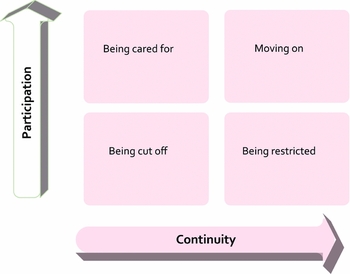
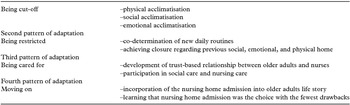
Consistent with the two guiding principles of continuity and participation, four patterns of adaptation to the nursing home emerged after an unplanned admission. Figure 1 depicts the analysis matrix showing the guiding principles – continuity and participation – and the four patterns of adaptation to a nursing home: “Being cut-off,” “being restricted,” “being cared for,” and “moving on.”
Four patterns of adaptation to the nursing home.

Pattern 1: being cut-off
Feelings of being cut-off from their previous life after being admitted to the nursing home affected the older adults who had been relocated without sufficient planning, who had not had enough time to participate in the decision-making process, whose decision making was conducted without participation, who had not any say where to go or who had not had any say in the decision. By “cut-off,” these older adults meant that they experienced neither continuity nor participation during their unplanned admission.
Relocation from an apartment or a house to a single room and the associated reduction in personal belongings was still deemed problematic. They described what they were missing in these terms, even long after admission, up to 17 months later: “Small things, various things that I could have taken with me, like books or so, I really miss those a little bit. They're gone. . . but I can do without them.” (11:13, 17 months). After the often overhasty and ill-prepared relocation to a nursing home, the older adults felt cut-off from their former surroundings, which they missed tremendously. They associated many objects in their homes with specific memories: “I always say that everything one possesses has its own story. It's a momento of something. We're forced to let go of the things we had before.” (45:34, 5 months).
The older adults also expressed feelings of loss and discontinuity regarding their social environment and former identity. The relocation was perceived as a discontinuity in their usual routine. After admission to the nursing home, these older adults realized they had to adjust to their new setting by changing their habits and reorganizing their lives. They felt alienated from their entire life history, to which they found they could no longer relate to, and felt the absence of activities that had previously defined their everyday lives and social contacts. They experienced little or no participation in the new life: “You're no longer challenged. When you're in your own apartment [. . .] then you've got something to do, and that makes you think. But at the old folks home, you start to go crazy, because you've got nothing to do.” (19:28, 20 months).
These older adults felt a void. They had left their former home and everything that was attached to it, yet they could not claim their new place of residence as their own: “Whenever I go to my son's or daughter's, for example, ‘Take me home’ isn't something I can say. I really can't bring myself to say it like that." (35:37–41, 23 months). In some cases, the feeling of being cut-off remained even some 93 months after the unplanned admission.
Pattern 2: being restricted
When the older adults were being restricted, they expressed little participation in decision-making within nursing home structures. Some were confronted in various ways with institutional boundaries that restricted them. They felt uneasy, even 30 months after the unplanned admission: “The change was so difficult. Overall, it was okay, but to always be here now, that's the worst.” (18:17, 30 months). The older adults were less able to decide for themselves, having restricted input as to what they could do, how, and when. They became aware of their physical limitations and had great difficulty in pursuing new activities and occupations. When older adults can less participate within the nursing home they will be less adopt to their new home.
“It was only when I arrived here that I realised that I couldn't cope anymore. I used to like to cook, to invite friends. I could no longer do any of that.” (16:30; 23 months)
The older adults sensed that the activities in the nursing home were carried out following standardized procedures. Even though they had previously accomplished many of these activities on their own, once at the nursing home, they allowed these activities to fall outside their realm of responsibility. They did not see the possibility of exerting influence on the issue. Even 17 months after her unplanned admission, an older adult still took issue with the change in responsibility around medications. She was rattled by her loss of control, yet she respected the need for the nurses to exert it: “I was also a bit shocked, because they took my medications from me. I used to take all of my medications by myself. And then I thought, ‘They are taking everything away from me [. . .] they have to be in control’. I do understand that, really. But it's just that (pause). . . It's not just the incapacitation, but somehow. . . If only I could still be independent and hadn't been ill. . . I know I can't do these things anymore. . . and sometimes I'm even happy about that.” (11:35-36, 17 months).
Pattern 3: being cared for
“Being cared for” means that the older adults felt well surrounded in their new situation. They were able to bridge the gap. This involved visitors and telephone calls from friends and relatives to sustain relationships. When stating they were being cared for, the older adults expressed a high degree of participation with regard to decision-making by nurses, but little continuity with their previous daily activities. They felt that the nursing home offered them the support and security they sorely missed at home. These older adults participated to a great extent, in that they were able to decide what to do on their own. Although the admission to the nursing home had been unplanned, the relocation was perceived as a great relief: “I was so happy when I came here.” (39:366, 5 months).
These older adults felt cosseted and in good hands. They greatly enjoyed the comfort, good food, and service. They were rid of the difficult challenges they had been facing at home. Everything revolved around them and they felt like the center of attention. “They provide the meals and we get to choose what we want. . . I would give the meals four stars.” (1: 11; 10 months).
The older adults valued the suggestions that were specifically made for all of them. They found new activities to spend their time. They could choose whether or not to take part and to what degree they wanted to get involved. They experienced a high degree of participation in sensible activities. “We used to be four at this table, but now we have a fifth person who wants to play cards with us, so we've arranged it like this: We all take turns sitting out a game, and it works great, it's wonderful.” (18: 26; 30 months).
The older adults made it clear they had their own ideas on how to pass the time and spend their days. “It's so simple. You can't just sit there threading beads [. . .] tie the ends together and there you are, you've got a necklace. I just think it's stupid.” (19:19, 20 months). This participant openly stated that what was offered in the nursing home did not always appeal to her. Yet, she was still in a position to decline a particular activity that did not match her skills or interests and organize her own activities instead.
Pattern 4: moving on
For the older adults that managed to move on, it was clear that they valued being able or enabled to plan and make decisions for themselves. They felt confident and they understood, sought, and maintained a sense of control, a pattern synonymous with a high level of participation. They had also established a high degree of continuity with their former lives. Feeling at home is linked to having confidence in oneself and the nursing home staff. This pattern of adaptation was characterized by having a major say in the decision-making process when organizing the relocation; from the first moment, this concept had been suggested up to the present. It was important to these older adults that their former lifestyles should be maintained as smoothly as possible, even though they were aware of their increased dependency. “It's okay at this age and given my heart condition – things weren't very good before. Yes, it's okay. I'm in the right place, there's care if I need it and I'm well looked after.” (11:22, 13 months).
Suddenly, the day of reckoning was there and the move imminent. “It all happened very quickly. I had to make a decision, because this room became available and, well, that was the situation.” (14:31, 34 months). In these cases, the decision was still sudden, but the move was underscored by a desire for security and round-the-clock assistance. These older adults felt relieved of a burden, they could carry out their own plans and had more energy to take part in other activities.
They also found new ways to pass the time. But even though the nursing home offered various activities and ways to keep busy, not all the older adults exhibited the initiative and self-confidence to participate. “I think one should give it a try and do at least something independently. I try.” (14:36, 34 months).
Discussion
The findings of our study showed that unplanned admission to a nursing home after a hospital stay is synonymous with a loss of independence. The four patterns of adaption (“being cut-off,” “being restricted,” “being cared for,” and “moving on”) evaluate the relocation into nursing homes and provide an opportunity to appraise the stages of adaption.The decision on relocation often has to be taken under stressful conditions (Johnson et al., Reference Johnson, Popejoy and Radina2010). It is particularly stressful if the older adults are not involved in the decision or have to move against their will. Various authors consider the extent of involvement in decision-making to be important (Lee, Reference Lee2010; Lee et al., Reference Lee, Simpson and Froggatt2013). Discontinuity and limited new choices within the nursing home have been described as the main factors for an unhealthy transition process (Schumacher et al., Reference Schumacher, Jones, Meleis, Swanson and Tripp-Reimer1999). The decision to move into a nursing home can, however, be very emotional for many older adults (Johnson et al., Reference Johnson, Popejoy and Radina2010). In this study, the older adults complained about anxiety and loss, the loss of friendships, and, as a result, loneliness. When older adults reach the “moving on” phase, they have confidence in themselves and in the nursing staff. Moreover, they comprehend the impact of relocation. This allows them to successfully manage the perception, cognition, content, and meaning of the relocation. This translates into a positive adaptation.
Unplanned admission
By nature, an unplanned admission means the older adults have no or limited time to prepare themselves for the new life and their challenges. Eldh et al. (Reference Eldh, Ehnfors and Ekman2004) describe participation as “being confident,” “comprehending,” as well as “seeking and maintaining a sense of control” (page 241). Having a sense of participation is essential for the older adults. They bring up different stages of participation. When they have or get more control over the new life situation, the older adults feel like they are more participating. Maintaining a sense of integrity is seen as an essential indicator of healthy transitions (Schumacher et al., Reference Schumacher, Jones, Meleis, Swanson and Tripp-Reimer1999). Making one's own decisions and being integrated are equally important for a successful adaptation to the nursing home even when the admission was unplanned.
Our findings illustrated that the older adults acknowledged the necessity of a move to a nursing home. Taking a decision in a state of frailty could result in the pattern of “being cut-off” and later showing little participation. Our findings confirmed that gaining control over the new situation is paramount. The older adults are challenged to deal with the move in a very short period of time during which they play no active role. With the dislocation linked to the move, the older persons may lack adequate coping skills or not yet have developed them. Participation by the older adults in that decision-making process has a considerable impact on whether they subsequently settle into the nursing home. Various other authors also consider the extent of involvement in decision-making to be important (Lee, Reference Lee2010; Cooney, Reference Cooney2012; Lee et al., Reference Lee, Simpson and Froggatt2013).
The “being cared for” pattern shows a high level of participation and stands for a healthy transition process. The findings show that those older adults felt cosseted and well cared for. They realized that they had many activities at their disposal to stay busy in the nursing home. They appreciated the variety of this offer, the good food, and their own room. However, they had to make or be involved in making the decisions. The older adults also had to be prepared to handle activities that impacted their daily routine in the nursing home. The negotiation process was emphasized by Levasseur et al. (Reference Levasseur, Richard, Gauvin and Raymond2010). It does not limit itself to social activities, but comprises all aspects encompassed by the person's daily life. Participation not only supports the fulfillment of valued life activities, but also the aspects of identity and social roles, which are indicated as important by the older adults (Hermsen et al., Reference Hermsen2013). These have to be redefined and adapted in a new way after the relocation. The issue of how the person is included, with whom, in what, and for what purpose is as a key factor in healthy aging (Holmes and Joseph, Reference Holmes and Joseph2011).
“Moving on” entails a high level of participation and continuity to cope with the discrepancies between former life conditions and newly experienced fragility.
The older adults are aware of the situations and make their own decisions. This study showed that the older adults generally took part in the various activities offered by the nursing homes. They have chosen activities that mattered to them. Having a positive attitude toward the nursing home can also help improve the quality of life and facilitate a new way of living, which is confirmed by several authors (Lee et al., Reference Lee, Simpson and Froggatt2013; Brandburg et al., Reference Brandburg, Symes, Mastel-Smith, Hersch and Walsh2013b). The extent of the involvement in the decision to move is identified as a determining factor in being able to feel at home in the new place of residence and hence experience successful adaptation (Lee, Reference Lee2010; Cooney, Reference Cooney2012). Such participation is thought to be important in terms of feeling at home (Cooney, Reference Cooney2012; Brownie et al., Reference Brownie, Horstmanshof and Garbutt2014). Engaging in enjoyable activities is one of the successful facilitative strategies in the adaptation process (Levasseur et al., Reference Levasseur, Richard, Gauvin and Raymond2010; Brandburg et al., Reference Brandburg, Symes, Mastel-Smith, Hersch and Walsh2013b).
Acknowledging the necessity of the move and a positive attitude toward the nursing home can help to improve the quality of life and make it easier to become accustomed to the new way of living (Brandburg et al., Reference Brandburg, Symes, Mastel-Smith, Hersch and Walsh2013a; Lee et al., Reference Lee, Simpson and Froggatt2013). Hertz et al. (Reference Hertz, Koren, Rossetti and Robertson2008) recommended avoiding sudden, unexpected relocation to a nursing home by identifying the risk of deterioration in health in good time. This allows the move to be planned early enough, so as to let the person be involved in the decision-making process as much as possible. The criteria for successful adaptation given by these authors are that: older adults are satisfied with the relocation; they cultivate a social network and activities; they show stability or improvement in the state of health; and they realize that their physical and psychosocial needs are being met (Hertz et al., Reference Hertz, Koren, Rossetti and Robertson2008).
Several authors have identified the extent of the involvement in the decision to move as a determining factor in consequently feeling at home in the new place of residence and hence complete adaptation (Lee, Reference Lee2010; Cooney, Reference Cooney2012).
Older adults experiencing “being cut-off” clearly do not feel at home, as they endure great difficulty in keeping former customs and activities as well as organizing the room in the nursing home as a personal retreat (Falk et al., Reference Falk, Wijk, Persson and Falk2013). Brownie et al. (Reference Brownie, Horstmanshof and Garbutt2014) described the characteristics of feeling at home as a process allowing each person to take control of everyday issues and thereby having the option to make decisions. Falk et al. (Reference Falk, Wijk, Persson and Falk2013) described three types of attachment that are relevant to the new beginning: attachment to place, space, and beyond the institution. Attachment to place entails ownership of the room, filling it with personal possessions so that it becomes a familiar and intimate retreat, a place where the older adult is in charge. Attachment to space means participating in activities with others, where older adults can be themselves and form friendships. Attachment beyond the institution is building the bridge between the past and the present, which also applies to the notion that home is somewhere else. Bridging this gap involves visits, telephone calls, and letters from friends and relatives. But it is not just a bridge between then and now, it is also a support in coping with the discrepancies between the former lifestyle and momentary fragility. Feeling at home somewhere else has also been described as a strategy for bridging this gap. The nursing home becomes the place where the older adults eat and sleep, although it is never thought of as home. It is never considered to be the ultimate new beginning in life.
The lack of continuity is evident in the cases where the older adults feel “cut-off” after their unplanned move to the nursing home. They experience discontinuity with regard to their personal possessions. They miss their belongings, which makes it more difficult to adapt to the new surroundings. They have to give up some of the activities associated with the items that are no longer in their possession.
Cooney (Reference Cooney2012) emphasized that institutional routines impede the customary course of events for older adults. Brandburg et al. (Reference Brandburg, Symes, Mastel-Smith, Hersch and Walsh2013a) highlight the importance of the strategy of getting to understand the system in an institution and knowing how to use it to get what one wants or needs. These older adults take strategic action that is in line with the institution rules. The results of this study show that older adults value the convenient services of the nursing home. They enjoy round-the-clock support and assistance should they need it. But they also talk about home being somewhere else. Older adults view the nursing home as a temporary residence, seeing no need to settle in.
In particular, the pattern of “being restricted” has a considerable impact on whether older adults subsequently settle in the nursing home. However, “being restricted” is the feeling by many older adults of having to less space and ability to decide for themselves within the confines of the institution. In those cases, they sense continuity, but not a high degree of participation. Our findings show the dilemma in which the older adults found themselves when they went against their instincts and followed institutional rules that interrupted their continuity. These older adults truly restricted their own actions by saying they were actually allowed to do something yet opting not do it.
As the interviews highlighted, experiencing continuity depends not only on privacy and independence, but also on the ability to achieve closure with respect to the previous social, emotional, and physical home. This study found that the older adults who could perceive the nursing home admission as a state of “being cared for” valued the convenient services of the nursing home. They enjoyed round-the-clock support and assistance when they needed it.
For Waibel et al. (Reference Waibel, Henao, Aller, Vargas and Vazquez2012), factors that foster successful change in life include: development and maintenance of social relationships, ongoing information about the new everyday routine, and the ability to cope with the unknown. Having help in bridging it has been identified by Falk (Reference Falk, Wijk, Persson and Falk2013) as a strategy to reinforce attachment to place and space. “Moving on” is synonymous with feeling at home in the new surroundings, which serve not only as a bridge between then and now, but also provide support in coping with the discrepancies between former lifestyle and newly experienced fragility (Falk et al., Reference Falk, Wijk, Persson and Falk2013; Brownie et al., Reference Brownie, Horstmanshof and Garbutt2014). Home is seen as a physical, imaginative, and affective place of belonging. Furthermore, older adults acknowledge that retaining personal possessions and establishing new relationships within the facility helps them to adjust to their new living situation (Brownie et al., Reference Brownie, Horstmanshof and Garbutt2014).
Adaptation
A successful adaptation to the nursing home is the outcome parameter of the transition process. Indicators of a successful transition include feelings of connectedness as well as a sense of empowerment and integrity (Schumacher et al., Reference Schumacher, Jones, Meleis, Swanson and Tripp-Reimer1999). The transition process is multidimensional, continuous, and can last a very long time (Meleis et al., Reference Meleis, Sawyer, Im, Hilfinger Messias and Schumacher2000, p. 423). The findings of this study showed that some older adults had not yet reached closure with regard to the transition process. Successful adaptation did not limit itself to the “moving on” pattern, instead the patterns of “being cared for” and “being restricted” were also parts of it. Yet, up to 93 months after admission, the older adults still brought up the disruption of the domesticity to which they had previously been accustomed. Not all older adults go through all stages of adoption. Some of the older adults still did not feel connected nor did they experience continuity, as evidenced by the “being cut-off” pattern. Based on our findings, it remains unclear whether the process of adaptation can ever be complete. Hertz et al. (Reference Hertz, Rossetti, Koren and Robertson2007) pointed out that there is evidence of some older adults still not feeling at home seven years into the adaptation process.
Adaptation to the nursing home is also accompanied by the knowledge that it is the final phase of life. Not all older adults come to terms with this view of life fact. With the relocation to the nursing home, the older adults can no longer deny that the end of their life is near. This realization is experienced in a physical and emotional way. Initially, the last move in a person's life evokes its end rather than a new beginning, even though the person is still alive.
Strengths and limitations of the study
The strength of the study is a model of analysis to evaluate patterns of adaptation following an unplanned admission to a nursing home after hospital discharge. The coping processes of the older adults interviewed were not always completed although some had been living in the nursing home for a long time, up to 100 months. For others, given how much time had passed since their admission, the adaptation was already a thing of the past and had been overtaken by other concerns.
One limiting factor was the length of the interviews. Given the advanced age and the self-perceived frailty of the interviewed older adults, it is very difficult to keep them engaged in a way that they can continuously provide valuable narrative.
Conclusion and relevance to practice
Being aware of the situation will give health professionals the power to assess, discuss, and plan the necessary steps during hospital or home care. Time is needed to perceive, recognize, contextualize, and make sense of the new life situation, because it is challenging for the older adult to cope with a lack of control. Transparency of the admission reasons is crucial. To support the process of continuity and participation, health professionals need knowledge about past life events and individual life trajectories, but also an approach to manage symptoms of relocation and health status, including the older adults’ needs. Two-way communication about the admission process and meaning is necessary. After admission, it is up to the nurses via their scope of practice to observe signs of relocation stress syndrome. This helps to assess and evaluate the individual's process of adaptation. The amount of time required for the adaptation process can vary considerably. Staff should assess the current needs of the older adults and offer tailored intervention to support adaption.
For the older adults, moving into a nursing home means living with serious health problems in an entirely new social, emotional, and physical environment. Because of the unplanned admission to the nursing home, the residents do not get to deal with the issues regarding the end of life in a proper manner. As a consequence, staff must develop further advanced care plans. They have to address the topics of living wills and powers of attorney to make sure that the goals of care are clarified.
Further research is needed to develop clinical quality indicators during admission for patient safety, patient well-being, family involvement, and finally supportive structure factors.
Table 4 shows tips for clinical practice to support older adults adaptation process after nursing home admission.
Tips for clinicians first pattern of adaptation

Conflict of interest
None.
Description of authors’ role
A. Koppitz and L. Imhof designed the study. A. Koppitz carried out, supervised the data collection and analysis, and wrote the paper. J. Altherr collected the data. J. Dreizler analyzed the data and assisted with the writing of the paper. G. Bosshard and R. Naef assisted with the writing as well.
Acknowledgments
We would like to thank the participating nursing homes, along with Erika Fröhlicher, Emeritus Professor at the University of California, San Francisco, USA, Romy Mahrer Imhof, Professor at Zurich University of Applied Science, Valerie Fleming, Professor at Zurich University of Applied Science and Uta Grosse, PhD at Zurich University of Applied Science for their advices during the writing of the paper. This research received a grant from Age Foundation, Zurich, Switzerland.