Emerging infectious diseases have repeatedly resulted in public health threats that have stressed emergency health care systems around the world. Emergency departments (EDs) are routinely at the center of identifying and caring for patients who acquire these highly infectious pathogens. EDs in areas impacted by SARS, MERS-CoV, enterovirus D-68, and the 2009 H1N1 pandemic have all needed to rapidly adapt their operations to safely and effectively care for these patients. The 2014 West African Ebola outbreak is a dramatic example of the threat from these emerging infectious diseases and the need for EDs to prepare for their management.
Currently, the Ebola outbreak remains the largest and most deadly in history with over 25,800 cases and 10,700 reported deaths. 1 The World Health Organization (WHO) declared a Public Health Emergency of International Concern on August 8, 2014, owing to the magnitude of the outbreak. 2 In addition, the WHO urged countries involved in the emergency to actively pursue screening, investigation, and preventative strategies to contain further spread of the disease.Reference Briand, Bertherat and Cox 3
EDs are more likely to come into contact with potential Ebola virus disease (EVD) patients, especially as health care workers return home from West Africa.Reference Meyers, Frawley and Goss 4 To date, the United States has had 2 imported (eg, diagnosed in the United States but acquired abroad) cases of EVD and 2 cases from local transmission. As seen in Texas, the risk of transmission to health care workers is a reality.Reference McCarthy 5 This underscores the need for US EDs to bolster preparedness, including strict adherence to screening and infection control standards to prevent the further spread of disease to the community and hospital staff. To this end, EDs across the country have been working to ensure EVD readiness, as defined by providing appropriate and effective screening and developing processes for isolation and the care of patients with suspected EVD.
To date, there has been no formal assessment of the challenges to achieving EVD readiness among US EDs. The ability of the health care system to rapidly and effectively contain an epidemic will be in large part related to its ability to quickly determine the presence of an epidemic and then to swiftly implement a preparedness plan. An in-depth understanding of the complexities, any barriers to, and the resource needs of EVD preparedness will be instructive in preparing for future epidemics. Therefore, the purpose of this survey was to understand the perceived challenges experienced by Washington State ED medical directors in EVD preparedness and to explore their perceptions toward the general approach to EVD care. The secondary aim was to use EVD preparedness in Washington State to improve understanding of the challenges faced by ED leaders in rapidly and effectively responding to a highly infectious disease outbreak that threatens the general public health and welfare.
Methods
Survey
We performed an anonymous survey of a convenience sample of ED medical directors in the state of Washington in the midst of EVD preparations from November 2014 to February 2015. Contact information was obtained through a statewide medical directors subscribed e-mail list provided by the Washington chapter of the American College of Emergency Physicians as well as through online searches and direct phone calls to hospitals. Medical directors were initially contacted via e-mail, which included an explanation of the study and a link to the questionnaire. Nonrespondents were e-mailed again and contacted via telephone to encourage participation. Study data were collected and managed by using REDCap (Research Electronic Data Capture) electronic data capture tools hosted at the University of Washington. REDCap is a secure, web-based application designed to support data capture for research studies.Reference Harris, Taylor and Thielke 6 The data were blinded and the protocol was deemed exempt by our institutional review board.
The survey included 4 sections. The first section covered ED and hospital demographics. The second section covered EVD training practices and used multiple-choice questions with branching logic. The third section sought to understand specific challenges encountered using a 7-point Likert scale. The fourth section focused on evaluating overall attitudes toward EVD preparedness also using a Likert scale. The survey underwent an initial pilot-testing phase via 3 emergency medicine physicians who were not involved in the project design to ensure clarity of questions.
Analysis
Descriptive statistics were used to analyze the survey data. Because branching logic was utilized for some of the question stems, final analysis of survey responses did not include those who left the question blank or were filtered out from previous questions. This was reflected in the n value in the tables. Likert scales were stratified within each question section and data were reported as proportions. In section 3, the respondents were asked to rate on a 7-point Likert scale, ranging from not challenging (value of 1) to extremely challenging (value of 7), different aspects involved in EVD readiness. A cutoff of greater than or equal to 5 was used to stratify elements deemed to be “very challenging.” The fourth section focused on evaluating overall attitudes toward EVD preparedness in order to understand underlying opinions and prioritization by using a 7-point Likert scale between “strongly disagree” with a score of 1, neutral with a score of 4, and “strongly agree” with a score of 7. A cutoff of 1 to 2 represented the cohort of “moderately and strongly disagree” and a cutoff of 6 to 7 represented the cohort of “moderately and strongly agree.”
Results
Survey Characteristics
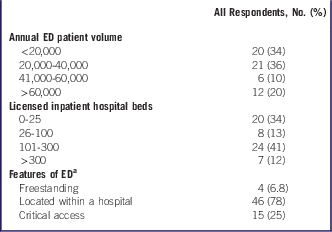
Of 93 EDs in Washington State, according to the Washington State Hospital Association, contact information was available for 85 medical directors (91%). 7 From the 85 directors contacted, 59 responses (69%) were received. EDs of various annual patient volumes were represented: <20,000 (n=20, 34%), 20,000 to 40,000 (n=21, 36%), 41,000 to 60,000 (n=4, 6.8%), and >60,000 (n=12, 20%). There are a total of 39 critical access hospitals in the state and contact information was available for 35. 8 Fifteen (25% total response rate) critical access EDs were included (Table 1). The size of the hospitals varied with 24 (41%) having 101 to 300 inpatient beds and 20 (34%) having 25 or fewer beds. Washington State has 36 counties with EDs, and 26 counties (72%) were represented in the survey. Seven of the counties not included in the survey have one critical access hospital each. Given the spectrum of annual ED patient volumes, the number of inpatient hospital beds, and the number of counties included, this cohort of responses likely represents an urban, suburban, and rural distribution of hospital settings across the state.
Emergency Department (ED) Characteristics

a Responses include “all that apply.”
Preparedness Activities
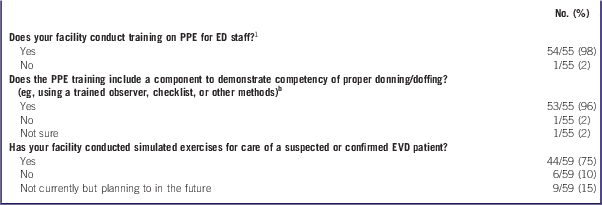
Approximately 47% of hospitals (27/58, 95% confidence interval [CI]: 14-40) used a predesignated team, defined as a predesignated group of physicians and nurses who will care for suspected EVD patients. Regardless of whether hospitals used this system, 98% of all facilities (54/55, 95% CI: 51-57) conducted training of some kind on personal protective equipment or PPE (Table 2). Four hospitals were removed from this section of the survey because their predesignated EVD team included only inpatient physicians and not emergency physicians. Ninety-eight percent of hospitals (53/54, 95% CI: 49-57) included a demonstration of competency for donning and doffing PPE by using a trained observer or a checklist, as recommended by the CDC. 9 At EDs without a predesignated EVD team, only 36% (11/31, 95% CI: 6-28) trained >75% of their emergency physicians as compared to 48% (11/23, 95% CI: 9-31) of hospitals with EVD teams. The rates for nurses were similar at 68% (21/31, 95% CI: 5-37) versus 65% (15/23, 95% CI: 4-34), respectively.
EVD Training CharacteristicsFootnote a

a Abbreviations: ED, emergency department; EVD, Ebola virus disease; PPE, personal protective equipment.
b Does not include facilities that do not have ED physicians on EVD team.
At the time of this survey, 75% of facilities (44/59, 95% CI: 33-55) had conducted simulation exercises of a suspected EVD patient being evaluated in the ED, and another 15% (9/59, 95% CI: 0-18) were planning to hold one in the near future. Medical directors were also asked to rate their personal level of confidence in their facility’s plan to care for suspected EVD patients. Nearly half at 47% (27/58, 95% CI: 14-40) responded that they had “complete” or “near complete” confidence in the plan (correlating with a Likert score of 6 to 7), whereas 5% (3/58, 95% CI: 2-8) responded that they had “none” or “low confidence” (Likert score of 1 to 2) in the plan. Interestingly, of the 44 facilities that conducted simulation exercises, 24 medical directors (55%, 95% CI: 9-39) responded that they had “complete” or “near complete” confidence (Likert score 6 to 7) in their EVD plan. No medical directors (0/44) responded with “none” or “low confidence” if they had conducted a simulation exercise. At the facilities that had not completed simulation exercises, only 13% (2/15, 95% CI: 15-19) of medical directors reported “complete” or “near complete” confidence in their EVD preparedness and 20% (3/15, 95% CI: 15-23) reported “none” to “low confidence” in the EVD plan (Likert score 0 to 1).
Challenges to Achieving Preparedness
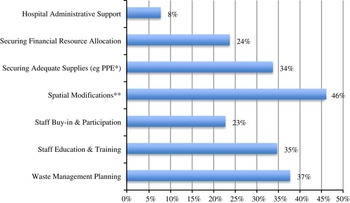
Medical directors were asked to rate on a 7-point Likert scale ranging from not challenging (value of 1) to extremely challenging (value of 7) different aspects involved in EVD readiness (Figure 1). The most challenging aspect was performing spatial modifications (eg, building an anteroom) with 46% of respondents (27/59, 95% CI: 14-40) indicating that this was “very challenging.” The 3 other areas with the highest degree of challenge were obtaining supplies (including PPE) at 34% (20/59, 95% CI: 8-32), staff education and training at 35% (21/59, 95% CI: 9-33), and waste management at 37% (22/59, 95% CI: 10-34). Obtaining hospital administrative support was deemed “very challenging” by only 8% (5/59, 95% CI: 1.9-12) of respondents.
Proportion of ED Medical Directors Who Perceived Specific EVD Preparations as “Very Challenging” on a 7-Point Likert Scale (≥5). Abbreviations: ED, emergency department; EVD, Ebola virus disease; *PPE, personal protective equipment. **For example, building an anteroom for donning and doffing PPE.

Attitudes and Perceptions Toward EVD Preparedness
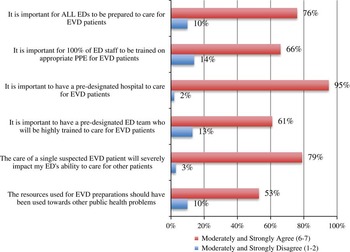
We assessed medical directors’ perceptions of the impact that EVD preparation had on the system, as well as the potential impact that the care of these patients in the ED may have on the emergency department itself. Ninety-five percent (56/59) of all respondents moderately and strongly agreed that having a predesignated hospital is necessary (95% CI: 51-64.5; Figure 2). Consistent with this, 79% (46/58) of medical directors indicated that the care of a single patient will severely impact the care of other patients in a negative manner (46/58, 95% CI: 35-57). Fifty-three percent (53%) strongly agreed with the statement that resources invested on EVD preparedness could have been better utilized for other public health concerns (31/59, 95% CI: 18-44), for example, influenza. Seventy-six percent (45/59, 95% CI: 32-57) of medical directors moderately and strongly agreed that all EDs should be prepared to care for suspected EVD patients, whereas 10% (6/59, 95% CI: 1.6-14) moderately and strongly disagreed.
Attitudes of ED Medical Directors Toward EVD Preparedness on a 7-Point Likert Scale. Abbreviations: ED, emergency department; EVD, Ebola virus disease; PPE, personal protective equipment.

Discussion
Care of the patient with suspected or confirmed EVD, and other emerging infectious diseases, is a rare but high-risk concern for ED medical directors and their staff.Reference Doughton 10 , 11 Data from the current study indicate that EDs overall achieved high rates of training on PPE and usage of a trained observer. Most facilities have conducted simulation exercises to allow for more in-depth training and trouble-shooting. The medical directors at these facilities reported overall higher confidence in their EVD preparations and plans. Comprehensive training on PPE, the use of experienced observers, and conducting operational drills are essential to deliver high-quality and safe patient care.Reference Bogucki and Isakov 12 When asked to quantify the percentage of physicians and nurses who have been through the training process, hospitals with designated EVD teams generally achieved higher rates of physician training, although statistical significance could be not assessed owing to the studies being underpowered. Confidence in proper usage of PPE also seemed to be higher in facilities with predesignated EVD teams than in those without (89% vs 61% on a Likert scale with score ≥5). This may suggest that hospitals with predesignated EVD teams have adopted more intensive and structured training in the care of patients with suspected EVD for all staff.
The results of this survey suggest that there seems to be a discrepancy between the preparedness activities as stated above and overall confidence from medical directors in the execution of the plan. One might suggest that despite high rates of PPE training and simulation exercises, Washington State EDs have achieved variable levels of confidence in their respective EVD preparations, as indicated by 19% of medical directors with “low confidence” in their facility’s EVD preparedness versus 47% with complete or near complete confidence. This variability could be attributed to the overall complexity and lack of familiarity in treating viral hemorrhagic fevers (like EVD), where a significant portion of infection management and containment require strict adherence to international standards. 9 These standards include establishing an environment that allows for the transit of patients and staff in a safe manner, the building of anterooms, designated areas for PPE donning and doffing, and proper waste management plans.Reference Fox, Bornstein and Grant 13 This may also include the challenge of providing emergency care in PPE for patients with a high volume of contaminated waste.Reference Lyon, Mehta and Varkey 14 The complexity of these tasks make physician and staff training, with adherence to CDC guidelines, of utmost importance.Reference Millard 15
In a 2011 national survey of American College of Emergency Physicians Disaster Medicine Section members on pandemic influenza preparedness in US EDs, 2 of the major barriers identified were lack of funding and administrative support.Reference Morton, Hsu and Shah 16 Interestingly, this study found that securing administrative support was proportionately the least challenging barrier encountered. Even securing adequate funding was not perceived as being as challenging as other more systems-based problems. For example, the building of anterooms for PPE, establishing appropriate waste management plans, and even obtaining a facility’s preferred PPE were all perceived as proportionately more challenging aspects to EVD preparedness. Although this reinforces the complexity of ED preparedness, it may also signal an increased sense of risk to the economic well-being of hospitals after witnessing the impacts of EVD transmission to hospital staff in the Dallas experience.Reference McCabe and Weaver 17
This study found an overwhelming affirmation (95%) of the importance of having Ebola treatment facilities or predesignated hospitals to care for suspected or confirmed EVD patients as many have advised.Reference Millard 18 The CDC has adopted a three-tiered approach for health care facilities with the following designations: frontline health care facility, Ebola assessment hospitals, and Ebola treatment centers. EDs, urgent care centers, and critical access hospitals all constitute “frontline health care facilities” and must be prepared to receive and provide a high level of care to suspected EVD patients while implementing sound infection control practices. 19 As demonstrated in a European Ebola survey on admission and practice trends, hospitals with prearrangements to admit EVD patients typically had more stringent adherence to infection control and laboratory standards than did hospitals with a plan to transfer these patients.Reference de Jong, Reusken and Horby 20
In a press release on November 17, 2014, Washington State Department of Health announced the designation of 8 hospitals as Ebola treatment facilities. 21 This announcement was the first attempt to organize a regional approach to EVD care in Washington State. Although this would be of interest in examining our cohort, this survey went live a week after the announcement by the Washington State Department of Health. It would be premature to draw meaningful conclusions on the differences between the preparations of predesignated Ebola treatment centers and nondesignated hospitals. However, it is a potential future direction to explore.
Inherent to the role of emergency physicians is being on the frontline of community preparedness. The ED is a main entry point into the US health care system, in particular for patients with acute illness. Therefore, it is more likely to encounter patients with or at high risk for EVD than other health care system portals. The ED also has an obligation to care for all patients under EMTALA (or the Emergency Medical Treatment and Labor Act). In a recent article that focused on the ethics of providing care to EVD patients, the authors emphasized the ethical statements from multiple organizations on the duty and mission to provide unprejudiced, expeditious care to the community, including suspected EVD patients.Reference Venkat, Asher and Wolf 22 , 23 Hence, many advocate that emergency physicians must be knowledgeable about EVD in order to appropriately screen and identify persons at risk and contain potential spread of the disease. Additionally, some suggest that emergency physicians act as educators within the community and thereby help to reduce the risk of disease transmission through education as well as to mitigate unwarranted fear and misunderstanding.Reference Meyers, Frawley and Goss 4 This is not necessarily a perspective shared by all ED medical directors. Ten percent of survey respondents moderately and strongly disagreed with the notion that all EDs should be prepared to care for EVD patients (Figure 2). In addition, nearly half of the respondents felt like time and resources spent on EVD should have been utilized on other more pressing public health concerns, for example, influenza. This survey helps give insight into the attitudes and prioritization of ED medical directors.
As of the writing of this paper, Ebola has not become a major domestic public health crisis in the United States. In a recent editorial in the New England Journal of Medicine, Farrar and Piot suggest that the global community has been collectively “lucky” that emerging infectious diseases like H1N1, SARS, and H5N1 have not become more widespread epidemics.Reference Farrar and Piot 24 However, the global response to Ebola was sluggish and poorly funded, underscoring the need to bolster surveillance, reporting, and sharing of information. In an article by Koenig et al, the authors suggest that the approach to preparedness should not focus on a single disease entity or yield to media influence.Reference Koenig, Majestic and Burns 25 Rather, EDs should be prepared to respond to any number of emerging infectious diseases that affect the United States annually with special considerations toward early identification of EVD.
Limitations
There were several limitations to this study. First, the survey response rate was 69%. However, we believe that this represents a meaningful cross-section in Washington State given the diversity of facilities represented as well as the geographic spread. There is a possibility that the 31% who did not respond may represent a group of medical directors who lacked a sense of adequate preparedness or did not identify EVD preparedness as important. Therefore, our data may overestimate the level of preparedness across the state.
Second, the survey data were collected over a 4-month period. Ideally, assessing the level of readiness and practice patterns at a single moment in time would create a better understanding of statewide trends. With a relatively prolonged study window, there are more chances for interventions and programmatic changes to evolve, thus limiting and potentially biasing initial insight into practice trends. Finally, ED medical directors as a group were chosen to directly respond to the EVD preparations. In some institutions, however, ED medical directors might have more limited involvement in the actual preparedness planning, with risk management or infectious disease experts driving hospital and ED preparedness activities.
Third, this study was not designed to measure preparedness activities for other key hospital services such as environmental services and waste management, which are crucial components of infection control and logistical planning. Future research should focus on a more comprehensive evaluation of hospital-wide preparedness activities, because care for these patients impacts all operational areas of a hospital.
Conclusion
Washington State ED medical directors have faced significant challenges in ensuring their EDs are prepared to safely care for suspected EVD patients. Although the majority of EDs have achieved high rates of training on PPE, attitudes toward EVD preparations are mixed. Varying levels of perceived importance may represent an additional barrier to statewide EVD preparedness and an opportunity for outreach and education. Importantly, the survey demonstrates that even with perceived adequate administrative and financial support from the hospital, EPs identify significant practical barriers to achieving appropriate EVD preparedness. The focus of this survey was on EVD preparations; however, it underscores the significant undertaking by EDs to prepare for unanticipated public health emergencies from emerging infectious diseases. These data provide a window into what challenges exist for hospitals in Washington State and will inform future disaster planning systems.
Acknowledgments
We thank the Washington State ACEP Board of Directors for their assistance in making this survey possible.