By the middle of the nineteenth century, in virtually every city and much of the countryside in the United States, one’s likeness could be rendered in a wide variety of forms. After 1839, photographic images supplemented older types of portraits, such as oil paintings, watercolor miniatures on ivory, and silhouettes. Daguerreotypes—cased photographic images on silvered copper supports (Figure 1)—required different methods, materials, choices, time commitments, and aesthetics from other graphic forms, as well as altered business strategies. First introduced in France in 1839, daguerreotypes were quickly taken up in New York, Philadelphia, Boston, and other cities in the United States. In Philadelphia in the early 1840s, members of the city’s amateur and scientific communities refined techniques for taking daguerreotypes, drawing on their knowledge of fields such as chemistry and optics. The city became a major center for the production and consumption of photographic images, with numerous galleries.Footnote 1 These early daguerreotype firms ushered in technologies that recast how people saw and recorded the world around them. Subsequent inventions, such as photographic processes that used negatives, provided the capacity for reproduction that would dramatically change visual culture and print media—which, in turn, transformed how people viewed, read, perceived current events, and were introduced to new products.
D.C. and T.P. Collins, Elisha Bassett. One-half plate daguerreotype, c. 1852. Courtesy of Friends Historical Library of Swarthmore College.

When the small family-owned firm of T.P. and D.C. Collins opened a daguerreotype gallery in Philadelphia in 1845, it embarked on an endeavor for which there were no direct business models. Instead, the Collinses incorporated knowledge from past pursuits, modeled some of their practices on those of other studios, and employed novel strategies to appeal to clients. Their central challenge was to attract customers (they had about 21,000 over ten years) and distinguish themselves from other studios. In 1846, there were approximately sixteen businesses that produced daguerreotypes in the city. A decade later, however, about 113 galleries sold daguerreotypes, ambrotypes (cased, negative images on glass supports), and, in some cases, paper photographs.Footnote 2 To compete with other firms and secure a living, the Collinses rebuilt an older studio, installed an innovative skylight, garnered income from other jobs, and sublet space to different businesses. Their decisions, both large and small—such as the introduction of innovative photographic processes and the pricing of their daguerreotypes—were critical to their success and, ultimately, their failure. The strengths and weaknesses of individual family members involved in the business also had significant effects on the firm. This constellation of factors, some within their ability to control—such as the quality of their daguerreotypes and their location—and some beyond their control—other firms’ innovations, reputations, and skills—had an impact on the family’s livelihood. Analyzing the Collinses’ entrepreneurial and marketing strategies allows us to better understand how a small, urban business that employed limited technical improvements operated in an environment in which consumers increasingly prized innovation.
Although the Collins firm helps fill the lacunae of the small-scale businesses that have not received much scholarly attention, it shares a number of attributes with urban and rural businesses of varied sizes. Businesses of all scales benefited from expanded transportation and distribution systems during the middle decades of the nineteenth century. In the case of the Collinses, steamboats, trolleys, and railroads brought customers to Philadelphia, and materials for making daguerreotypes arrived from as far away as France.Footnote 3 Skilled labor provided a slightly different problem for them than for many other businesses. The Collinses required employees to conduct very specific tasks, such as taking photographic images, which required knowledge and skills that were not readily transferred from different fields.Footnote 4 They needed to either hire operators from other firms or teach new employees, and they risked having staff hired away by competitors or set out on their own. As the Collinses never employed more than a handful of people, including family members, their scale was more akin to those the small stores and artisans’ shops of earlier decades. They depended heavily on individual employees and needed to pay particular attention to wages, income, and expenditures. However, they and other antebellum firms that remained modest in size shared many of the same risks with the businesses that developed into large manufacturing firms. In their efforts to meet and create demand for a novel product, the daguerreotype, the Collinses’ livelihood depended in part on the introduction and timing of innovative methods and materials and corresponding capital expenditures.Footnote 5
The Collins firm provides a useful counter-narrative to the large, urban daguerreotype firms and the rural, often itinerant, practitioners in the United States, Britain, and Europe.Footnote 6 Far more is known about the high-end firms in Paris, London, New York City, and Boston than the small firms that were the mainstays of the business in the United States. The majority of work on French daguerreotypes has focused on the timing and circumstances of discovery, with limited attention to work outside Paris.Footnote 7 Much of the scholarship on early British photography centers on Henry Fox Talbot’s development of paper-based images roughly concurrently with the advancement of daguerreotypes in France. His talbotypes (calotypes) were paper photographic images that could be produced in multiples from paper negatives. Daguerreotypes were singular images on silvered copper supports. Whether a result of Richard Beard’s control of the patent for daguerreotypes in Britain or citizens’ interest in the paper images developed by their countryman, Talbot, there were relatively few daguerreotypists in Britain compared with the number in the United States.Footnote 8 By contrast, early practitioners in New York and Philadelphia and the initial reception of daguerreotypes are well documented.Footnote 9 Research on individual daguerreotype firms in Philadelphia after the initial years shows that they varied in scale and trajectory. Some were short lived, others more enduring. Some daguerreotypists went to work in other cities, then returned to Philadelphia. Partnerships were created, then broken. Knowledge of how these firms operated over time remains elusive, however, as the surviving data, other than for the Collinses, are limited.Footnote 10 The cultural studies that have examined the ongoing reception and use of the medium in the United States, such as the substantial analyses of two large urban firms—Mathew Brady and Southworth & Hawes in Boston—offer a framework for understanding the goals of the Collins firm.Footnote 11 Finally, the substantial literature on inventions and improvements in photographic equipment and materials provides a context for the Collinses’ access to and use of new products.Footnote 12
In this analysis of the Collinses’ business decisions and strategies, I will briefly examine why the Collinses saw daguerreotypy as a potentially fruitful endeavor and how they learned to take images and run a gallery. Their marketing efforts, particularly through newspapers, explain many of their business strategies and demonstrate how they changed over time. An examination of family members’ interests in the anti-slavery and temperance movements, as well as individuals’ skills and limitations, further explains the trajectory of their business. The firm’s difficulties in attracting and retaining daguerreotypists point to the challenges faced by all businesses that relied on skilled labor. Last, innovations—primarily others, but also theirs—in techniques and materials had an impact on the firm. Although the Collinses operated in an environment in which they had ready access to the materials and knowledge needed for taking daguerreotypes and a significant, largely local and regional, clientele, their business ultimately failed. The attributes of their successes and failures contribute to an understanding of the roles of entrepreneurship, innovation, and marketing in small businesses in the middle years of the nineteenth century.
Beginnings
Before starting their daguerreotype business, members of the Collins family were involved in the book trade, and this field sustained some family members well past their years in the daguerreotype business. Simeon Collins (1786–1866), from Westfield, Massachusetts, knew Philadelphia from his book-peddling days in the late 1830s and settled there by 1840.Footnote 13 Thomas Collins (1823–1873), with his father’s encouragement and connections, moved to Philadelphia to work in the book business shortly thereafter.Footnote 14 Simeon also urged his son David (1825–1909) to come to Philadelphia; he probably arrived in 1841 and also may have been employed in the book trade.Footnote 15 Several practices that characterized the family’s later daguerreotype business, such as careful record keeping, were probably derived from this early work in the book trade.
The Collinses arrived in Philadelphia soon after the introduction of the daguerreotype in 1839, but did not immediately become involved in the field.Footnote 16 In 1844 and 1845, the brothers worked with other daguerreotypists before starting their own firm. David worked with Marcus A. Root, who operated a firm that employed numerous daguerreotypists and frequently won awards at fairs. Root, who would become the Collinses’ nemesis, went on to open studios in New York, Washington, DC, and other cities.Footnote 17 One can speculate that David learned how to take daguerreotypes from Root, whose gallery he soon left.
By 1845, Thomas entered into a partnership with Montgomery P. Simons, who had an establishment at 100 Chestnut Street. They recorded their first daguerreotype in their business register in September of that year, but by December, the two had separate establishments on the same block of Chestnut Street.Footnote 18 Thomas used Simons’s former space until the summer of 1846, when he moved the gallery across the street while 100 Chestnut Street was rebuilt. In October 1846, the brothers reopened the studio under the name of T.P. and D.C. Collins (Figure 2).Footnote 19 There, Thomas considered himself to be the senior partner, and records make it clear that he was more skilled and more stable than David.Footnote 20 Between 1840 and 1855, Simeon resided chiefly in Philadelphia. His vocations included bookselling, helping run a mercantile institute, and working at—and monitoring—the gallery that bore his sons’ names.
George O. Bartlett and William French, South Side of Chestnut Street, Above Third. Albumen print, c. 1868. Courtesy of The Library Company of Philadelphia, (7)1322.F.69K. The second building from the left originally housed the Collinses’ studio.
When the firm of T.P. and D.C. Collins opened in Philadelphia in 1845, daguerreotypes were still novel, but their production had moved from an experimental phase to a more established one. By that time, patrons and critics tried to discern which galleries produced daguerreotypes of the highest caliber in Philadelphia and other cities. Firms jockeyed for positions within an evolving hierarchy that evaluated the quality of the images and ranked the location, ambiance, novel improvements, and displays of daguerreotypes at each gallery.
Despite the growth of the field, there were few models for this new business, limited written sources of instruction, and no formal training in either taking daguerreotypes or running such a venture. In the Collinses’ case, Simeon’s book selling and teaching appear to have established some norms for record keeping and gauging their business. We must assume that his sons’ work with Root and Simons provided training in preparing, taking, and processing photographic plates. The rise of industries that provided many of the materials needed for daguerreotypes, which were then conveyed via expanding transportation networks, buttressed daguerreotype firms.Footnote 21 The silvered copper plates that the Collinses required for their daguerreotypes came from Connecticut, New York City, and France. Other materials were local—the iodide and bromide that the Collinses required may well have been produced in Philadelphia.Footnote 22
In addition to technical skills and access to materials, running a successful gallery entailed attracting a steady stream of patrons. Like other firms, the Collinses approached business development through newspaper advertisements, entries in competitions, and a well-trafficked location. Price, at least at first, was another factor. In an early advertisement, the Collinses implied that they were as skilled as more expensive daguerreotypists.Footnote 23 Location and signage were important, as customers often did not make an appointment but simply walked into a gallery.Footnote 24 In its early years, the Collinses’ gallery straddled the divide between commercial and residential structures on Chestnut Street, then a prime location for daguerreotype firms.Footnote 25 Chestnut Street was a central site for shopping in antebellum Philadelphia, in part because it offered opportunities to view the displays in shop windows, attend cultural events, and look at other people promenading.Footnote 26 Enticing clients to their gallery also required creating an appealing space where patrons could wait, and where they and visitors (who were potential patrons) could view daguerreotypes of famous sitters. As Katherine Grier and Shirley Wajda have shown, having an appropriate space for viewing and waiting meant creating a setting similar to a parlor at home.Footnote 27 At this time, and in the decades that followed, photographic studios, like steamboats, hotels, and department stores, were quasi-public spaces. The layouts of such places were well known through prints in nationally distributed publications, such as Gleason’s Pictorial Drawing-Room Companion (Figure 3).Footnote 28
Ball’s Gallery, Cincinnati. Gleason’s Pictorial Drawing-Room Companion, April 1, 1854. Courtesy of The Library Company of Philadelphia, 9944.F.
In 1846, the Collinses made substantial changes to Simons’s former gallery space in the building they rented.Footnote 29 In the initial configuration at 100 Chestnut Street, an “operating room” and a “general reception room” shared the same space. After the 1846 renovation, the Collinses occupied the first, second, and fifth stories of the building, subletting the third and fourth floors.Footnote 30 They advertised, “All are invited, whether desiring Portraits or not, to view our Picture gallery, occupying the Saloon, 72 feet in length, upon the first floor, and graced with gems of the new and wonderful art.”Footnote 31 They probably followed the model that Marcus A. Root would codify six years later. Root suggested that in addition to parlor furniture, paintings, and sculpture, one should include books, prints, and curiosities for people to look at while waiting to produce “a genial, elevated tone of sentiment.”Footnote 32 The Collinses built, likely on the second floor, “three distinct operating rooms, whereby Ladies can be enabled to sit without fear of intrusion.” They set apart a portion of the rooms “exclusively for Ladies,” attended by a woman, where they “will be enabled the duties of the Toilette in perfect retiracy.”Footnote 33 This combination of shared public rooms and areas restricted to women reinforced period norms about gendered spaces. In addition, multiple rooms enabled several daguerreotypists to work at once, and individual practitioners may have been assigned to specific rooms.Footnote 34
Installing an overhead skylight in the roof in 1846, “an exceedingly heavy expense,” was the Collinses’ most marked innovation and would stimulate a controversy and rivalry with Root.Footnote 35 Others used sidelights, although over time studios in Philadelphia and elsewhere would add skylights. More light meant shorter exposure times, but risked a reduction in artistic shading from overexposure.Footnote 36 The Collinses included the skylight prominently in their advertisements immediately after its installation and during subsequent years; the linings of their daguerreotype cases also trumpeted the skylight (see Figure 1).Footnote 37
The skylight controversy with Marcus Root provides further insights about the business of daguerreotypy. In December 1846, Root’s newspaper advertisement noted that daguerreotypes taken under the skylight produced “white, bald-headed pictures” with “downward shadows” on the face. He added that the skylight put sitters “to the inconvenience and danger of going to the top of a high building.” Immediately below, the Collinses commented “ANOTHER GROSS MISREPRESENTATION” on the part of Root.Footnote 38 By January 1847, the dispute about the skylight and the caliber of the Collinses’ daguerreotypes had heightened, and they challenged Root to a contest with a $100 prize. The Collinses proposed that the judges, who would not know who produced which daguerreotypes, would consist of members of the artistic community, including Thomas Sully, John Sartain, and Albert Newsam. Root counterproposed that daguerreotypists be added to the list of judges: Langenheim from Philadelphia and Anthony & Clark from New York. By doing so, Root inferred that talented daguerreotypists from Philadelphia and elsewhere would deem his work better than the Collinses’. Root noted further conditions: Each firm would choose six men; the same twelve men would be daguerreotyped under identical circumstances (between 12 o’clock and 2 o’clock on a clear day) at each firm; and only one attempt would be allowed. The twelve individual half plates, and one or two plates of the men together, would be judged on their “style, tone, and character,” the time occupied at each sitting in the aggregate, and the “artistical arrangement of all the pictures.” Root suggested that the Collinses required multiple attempts to take a satisfactory image, and that the skylight produced a lack of contrast, especially on bright days.Footnote 39
The Collinses countered Root’s assertions by remarking on the difficulty in taking images without a skylight at places such as Root’s on a cloudy day. They emphasized the options they gave sitters, noting “every description of light, skylight, north side light, and south side light can be used in the different rooms so as all tastes can be suited.” Regarding their skylight, they added that “persons having a light eye should, however, choose our upper light, which is the first and only one constructed in this city on artistical principles.”Footnote 40 Although the Collinses later refer to an unspecified counterproposal, the contest appears to have been tabled, but the debate was not.Footnote 41 In March 1847, their advertisements invoked “scientific Skylight principles,” a phrase that was likely well received by the scientifically minded portions of Philadelphia’s populace.Footnote 42 Root noted that his portraits of “distinguished personages,” including Edwin Forrest, were “a fair test over our superiority over ‘Sky-Light’ pretensions, we ask attention to both the portraits themselves now at my rooms, and in the unbiased opinion” of the Philadelphia Inquirer and three other local newspapers.Footnote 43 Root specifically advertised “no sky light” immediately above the Collinses’ notice in September 1847, in which the Collinses remarked, “A person can now sit at our rooms with the same ease as in their own houses, without any of the strong glare of light upon the face, which has heretofore produced distorted and frowning countenances.”Footnote 44 The output of Root’s Philadelphia studio is not known but, judging from his advertisements, Root took the competition spurred by the installation of the skylight seriously. David Collins’s training under Root may have contributed to the competition between the two firms.
Daguerreotypists competed for the privilege of taking images of famous men and women. Displaying daguerreotypes that a firm had taken of celebrities was an important tactic that many establishments employed to draw in potential customers in Philadelphia and elsewhere.Footnote 45 In 1847, the Collinses touted “a beautiful picture … of the Thumb family” and mentioned “[t]he accomplished little General himself, his fine looking mother, noble featured protector, Mr. Barnum, his tiny carriage, footman, driver, and prancing ponies.” They added their hope that the image of Tom Thumb would stay permanently, and, in doing so, implied some urgency in coming to view it among the “large collection” in their “spacious and elegant saloon.”Footnote 46 Thumb was daguerreotyped by many others, including the Langenheims in Philadelphia and Mathew Brady and E. and H.T. Anthony in New York.Footnote 47 As we know from the skylight controversy, Root was particularly proud of his image of Edwin Forrest. Thomas Collins relayed the intensity of some daguerreotypists’ pursuit of celebrities. He wrote to David, “[Mexican War] Col. May arrived in town last eve and [stayed] at the L Hotel. Father went over by my request to get him to come and sit but he was at breakfast so he left a note for him. [Simons?] was sitting there waiting to catch him but I think it probable that Root will get him very likely having written to him before he came to the City.”Footnote 48
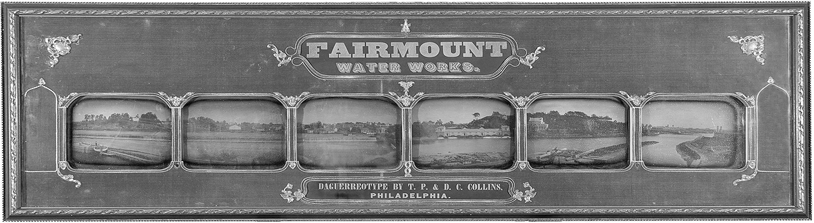
The Collinses outfitted their galleries with a range of images to attract visitors. At 97 Chestnut Street, their temporary space during the summer of 1846, they exhibited “numerous collections of Portraits”Footnote 49 and city views, including “A Panorama of Fairmount” (probably Figure 4), as well as daguerreotypes of seven other sites.Footnote 50 In their 100 Chestnut Street saloon, they displayed portraits of nationally known personalities, such as Tom Thumb and Sam Houston, and those of more local interest, such as Reverend Thomas M. Clark, the former rector of St. Andrew’s Church in Philadelphia.Footnote 51
T.P. and D.C. Collins, Panoramic View of the Fairmount Water Works. Six half-plate daguerreotypes, c. 1846. Overall size, 13 1/16″ x 41 ¾″. From the Historical and Interpretive Collections of the Franklin Institute, Philadelphia, PA, acc. 1939.58.
The practice of producing printed or daguerreotypic copies of daguerreotypes of famous sitters, undertaken in Philadelphia and elsewhere, provided further publicity for the firm and the sitter, along with increased income. Anti-slavery advocate and politician Cassius Marcellus Clay deemed Thomas’s “daguerreotype likeness of me the best taken of me in Philadelphia;” it was reproduced as a print by Albert Newsam.Footnote 52 The Collinses’ daguerreotype of Dr. Jehu Justis Clay, the rector of Old Swedes Church, served as the basis for a mezzotint by Welch and Walters.Footnote 53 These images, like the daguerreotypes of Thumb and May, speak to the public’s fascination with famous figures and the ability of daguerreotypists to provide quick, relatively inexpensive, and seemingly accurate images for duplication. At least one of the Collinses’ cityscapes, of the Pennsylvania Institution for the Deaf and Dumb (Library Company of Philadelphia, Reference Cary1851), was produced as a lithograph. Whether bound in a book, kept loosely in a portfolio, or hung on a wall, prints from daguerreotypes fed short-term public demand for images of circus performers, politicians, war heroes, and area sites. Although few of the sitters remained prominent even a few decades later, their prints make clear the local and, in some cases, national interest in and availability of images of a wide variety of figures as well as daguerreotypists’ role in producing and marketing them. These prints also highlight the reproductive capabilities and interrelationships among Philadelphia’s daguerreotypists, artists, engravers, and publishers.Footnote 54
A daguerreotype of Louis A. Godey, the publisher of the widely read Godey’s Lady’s Book, serves as another example of the multiple ways in which an image was used. Godey, whose business was a few blocks away, was the first customer listed in the registers of Simons and (Thomas) Collins in 1845. In June, 1846, the Collins brothers touted a United States Gazette remark about the “very large and exquisitely finished daguerreotype” of Godey just taken by T.P. Collins.Footnote 55 That same month, Godey published a short puff piece about T.P. Collins’s gallery, commenting on the “familiar faces” there as well as his reasonable prices and speed.Footnote 56 Seeing Godey’s approbation as a significant boon to their business, the Collinses included this remark, as well as a similarly positive later one, in advertisements.Footnote 57 The amount of press a studio garnered, who commissioned a given firm’s daguerreotypes, and a firm’s ability to promote various accolades contributed to its success.
The Collinses, like their competitors in Philadelphia and daguerreotypists in other cities, used newspaper notices to attract clients. Just prior to leaving Philadelphia, Thomas noted that he had placed advertisements in two papers, adding, “It is absolutely necessary I think for the Establishment to keep up a running fire in the advertising line.”Footnote 58 The Collinses advertised about twice a month in Philadelphia papers; the notices for Root’s, M.P. Simons, the Langenheims, and others appear in the same places. Over time, all invoked seasonality, price, and quality, and noted the images that could be viewed in their saloons. Although their language had much in common, their emphases varied. Some made implicit comparisons to one another, others explicit ones. The close placement of their notices invited comparisons and evaluations.
Daguerreotypists’ advertisements provide a window into their marketing strategies. The September 24, 1846, notices in The North American are typical: Several firms appear on the same page, often one immediately after another. The Collinses noted their low price (“one dollar and a half while others charge three”), that they took images on both clear and cloudy days, and their daguerreotypes were “guaranteed satifactory or no charge.” Their advertisement appeared below that of M.P. Simons, who announced his new location, its superior light that enabled him to take images in all weather, and his first medal at the Franklin Institute. Root emphasized his gallery’s quality and speed, whereas John Plumbe focused on his prizes and low prices.Footnote 59
As the number of commercial daguerreotypists increased in the mid-1840s, people attempted to create a hierarchy based on newly defined characteristics of quality. The degree of clarity of the image, the amount of contrast among elements, the depth of field, and the smoothness of the surface of the daguerreotype plate were determinants of merit.Footnote 60 Judges in competitions at mechanics’ fairs in Boston, New York, Philadelphia, and elsewhere, as well as critics in journals and newspapers, applied these criteria. Early on, when no firm truly dominated the market in Philadelphia, the Collinses met these criteria, but over time, they had increasing difficulty meeting the standards of the field.
Highlighting awards from mechanics’ fairs in New York, Philadelphia, and Boston was a standard strategy. These fairs displayed new equipment, devices, and examples of processes from a wide variety of fields. By the early 1840s, the fairs included photographic images, generally in fine arts sections. Local daguerreotypists comprised most of the entrants in any given city, although the fairs drew competitors from across the nation. Thus daguerreotypists were judged against an array of local, regional, and national peers. The Collinses won two silver medals—the highest honor—one at the New York Mechanics Fair in 1845 and the other at the Franklin Institute in 1846. Newspaper commentary on the 1845 Franklin Institute fair stated, “Collins makes a fine and large display of views of public places, in and near the city; and full length portraits, which are excellent likenesses.” Other galleries’ submissions were noted; Langenheim and Root received slightly more generous accolades.Footnote 61 Newspaper commentary on the 1846 exhibition complimented the work, but again, Langeheim and Root were more highly praised.Footnote 62 In 1848, the Collinses referred to their earlier prizes, publicized Thomas’s recent trip to London and Paris, and the improvements that he reaped from his visits with the “first artists” in those cities.Footnote 63 At the same time, Root spoke of more recent medals at the New York, Boston, and Philadelphia fairs.Footnote 64 The Collinses touted their two awards year after year, while other firms made it clear that their prizes were more current.Footnote 65
The Collinses also targeted clients by advertising their daguerreotypes of individuals related to the benevolent and other causes that they supported. As Stuart Blumin has noted, firms of all types in the United States during this period sometimes used their associations with temperance and anti-slavery movements to increase business.Footnote 66 Simeon was involved in anti-slavery activities on local and national levels.Footnote 67 The Collinses advertised in the Pennsylvania Freeman, the organ of Pennsylvania’s anti-slavery society, as well as other local papers.Footnote 68 An advertisement in the Boston-published anti-slavery newspaper The Liberator noted the availability of a lithograph from Thomas’s daguerreotype of Cassius Clay in that city.Footnote 69 Other commissions were related to the temperance movement. Simeon’s wife Cynthia (1791–1880) and their Philadelphia-based daughter, Frances, were officers in the Ladies Temperance Union.Footnote 70 In 1847, the Collinses advertised that their portrait of temperance advocate Philip S. White had been published as a print.Footnote 71 They took two daguerreotypes of lecturer John B. Gough in 1846, and their image of Thomas Hunt was reproduced as a print in an 1851 gift book, A National Temperance Offering.Footnote 72 Both the Collinses and Root directed their advertisements to the Sons of Temperance when that organization met in Philadelphia in 1847.Footnote 73 Simeon was involved in other benevolent organizations, such as the New House of Industry and the Southern Christian Home Missionary Society (SCHMS).Footnote 74 Although Sam Houston’s fame alone may have induced the Collinses to seek out the commission for his daguerreotype, his association with the SCHMS was another draw. Houston came to Philadelphia to speak at the SCHMS convention on a Saturday evening in 1846, and the Collinses opened their studio on a Sunday (when it was normally closed) to take his daguerreotype.Footnote 75 By taking daguerreotypes of Houston, Clay, and others, the Collinses parlayed their support of temperance, anti-slavery, and benevolent causes into specific commissions. Their involvement with the temperance movement dovetailed with the interests of members of faiths who were devoted to the cause, such as Methodists, and the Collinses’ anti-slavery advocacy may have drawn Quakers as visitors or subjects. Through their support of various causes and their alliances with printers, they expanded their business.
Seasonal advertising was another tactic the Collinses and their competitiors used. When the Collinses sought patrons during the days surrounding Christmas, they advertised that they had “refilled their rooms in the most complete style, for the purpose of accomodating the daily throng of visitors.”Footnote 76 They also promoted the taking of daguerreotypes on the fourth of July, a day of particular celebration on the streets of Philadelphia.Footnote 77 One of their notices, in the form of a twenty-four-line iambic pentameter poem, encouraged readers to “preserve your heart’s best treasure from the grave” as a way of participating in the fascination with death during the period.Footnote 78 Their advertisements appealed to a wide range of impulses, such as period emotions regarding sentimentality and death, ideas about celebratory national holidays, and the desire for gift-giving at Christmas.
Who had their daguerreotypes taken at the Collinses’ studio besides celebrities? Over the nine years that the Collinses recorded their patrons, Philadelphians predominated among their sitters. However, on any given day, up to a third of their customers were regional, rather than local, residents, from places such as Wilmington, Delaware, and Burlington, New Jersey. As many as a third of their clients came from farther away—New York, Baltimore, and South Carolina.Footnote 79 The breadth of sitters’ places of residence, like the distance that supplies for daguerreotypes traversed, reminds us of the economic impact of improved regional and inter-regional transportation networks in the United States during this period.Footnote 80 Railroads, steamboats, and carriages were among the conveyances that brought both people and goods to Philadelphia.
Individuals from a variety of wealth levels patronized the Collinses and other studios. Area Quakers were drawn to daguerreotypes for many of the same reasons as other citizens: They captured an exact likeness, were a novel form, and were relatively inexpensive in contrast to painted portraits. For many Friends, the physical attributes of daguerreotypes and the perceived lack of interpretation by an artist had much to do with their acceptance of the medium. Quakers’ ability, as sitters, to manipulate their images through their choices of clothing, pose, added color (or not), size, and casing also contributed to their positive reception of daguerreotypes and was a factor in their preference for the medium. Many of the Collinses’ Quaker sitters were well-to-do, and most came from either Philadelphia or the Delaware Valley. The relative wealth of this segment of the Collinses’—and other Philadelphia daguerreotypists’—patrons contrasts with the patterns of middle-class consumption of daguerreotypes elsewhere.Footnote 81
The Collinses’ ability to attract more than 21,000 sitters from diverse locations and wealth levels through advertisements and, presumably, word-of-mouth recommendations, masks the problems faced by the firm. By the late 1840s, the landscape of daguerreotypy had changed in Philadelphia. There were many more firms and the standards for daguerreotypes were increasing. The relative success of Root—and other award-winning firms—was one of the challenges the Collinses faced. Thomas, in an 1848 letter to his brother, noted that a gentleman had just come from Root’s, “having got tired of waiting there. He says he saw twenty taken while he was there and he should think there was as many more waiting. D[am]n Root.” That day, Thomas had only a handful of commissions that morning, yielding $11, and “Not a single customer the whole afternoon.” The letter also remarked on the tardiness and absence of an employee and its effect on the business.Footnote 82 Judging from the newspaper notices around the installation of the skylight and comments such as Thomas’s, they saw Root as their primary rival in the 1840s.Footnote 83
By the late 1840s, the business of T.P. and D.C. Collins had begun to decline for reasons related to personnel, the timing and introduction of talbotypes, and, perhaps, capitalization. David Collins was a central part of the firm’s problems. Frail since childhood, he developed significant hearing issues, which led him to consult specialists and quacks alike.Footnote 84 Family members’ references to his behavior suggest poor judgment, tardiness, the sowing of wild oats, alcoholism, mental health issues, or some combination of these factors.Footnote 85 Writing to him during his stay at “Campbell’s water cure,” in New Lebanon, New York, about 1847, his mother remarked, “hope you will take lodging in Mr. Campbells family and attend to all the rules which your physician thinks best for you. … I know it will require the most thorough treatment and remember that life or death depends on it. If you give up entirely for a suitable length of time you may be able to live and do something for yourself and others for many years to come.”Footnote 86 In June 1849, Simon referred to his son as a “crazy boy,” noting, “It would be the height of folly for [David] to return before Sept[ember] unless he wishes to loan his life or bankrupt our establishment.” Simon added that “every dollar that can be obtained must be saved to pay on debts due Thomas and others.”Footnote 87 David did return, but his lackluster receipts when Thomas and Simeon were absent were repeatedly mentioned in Simeon’s correspondence with his wife.Footnote 88
Throughout Simeon’s participation in the daguerreotype business, as well as his later bookselling and peddling endeavors, his wife, Cynthia Painter Collins, lived primarily in her family’s ancestral home in West Haven, Connecticut. She moved there from Westfield, Massachusetts, in about 1841, shortly after Simeon settled in Philadelphia. Family members regularly returned to this base in Connecticut for short stays. Cynthia occasionally resided in Philadelphia, and one daughter, Frances, lived there for extended periods.Footnote 89 Despite the distance, Cynthia had a hand in the business. Simeon wrote her at least once a week during the many times when they were separated. Few of her letters survive, and virtually all of them center on queries about family members in Philadelphia or updates regarding those in New Haven. Her concern for David’s well-being and his effects on family relations are frequent refrains. When David sought a water cure, probably in 1847, she remarked, “I am ready to spend and be spent for my children, and now I seem to be in between two, and shall do for both according to the best of my ability.”Footnote 90 Simeon regularly reported tallies of income to her, and she commented on aspects of the daguerreotype business as well as his later work as a peddler.Footnote 91 Simeon’s remark, “Mr. Mitchell paid the notes this morning, calculating interest as you directed,” makes it clear that his wife understood and participated in the financial aspects of the business.Footnote 92 The Philadelphia daguerreotype business appears to have not only supported but also involved the Collins family both there and in West Haven.
Cynthia urged Simeon to embrace a new process, the talbotype, which others had invented and perfected. She wrote in 1849, “I should not think you would have much to do, as Lagenheim [sic] and Root are making so much noise with their new [talbo]types, and I do not see any advertisement or notices of yours at all. I hope they will not run your establishment entirely down, for I hope to spend next winter in Philadelphia.”Footnote 93 The timing and fervor of these remarks are significant. She clearly had access to Philadelphia newspapers in New Haven and had scanned them for references to her family’s business, as well as those of their rivals. Cynthia was aware of two major firms’ introduction of talbotypes, and also chastised her husband for not doing sufficient advertising. As we shall see, 1849 was one of the worst years for the Collinses’ gallery and their overall lack of innovation contributed to their downfall. Cynthia thus took on the intertwined roles of mother, wife, and business woman, concerned about family members’ health, relationships, and financial security.
During 1849 and 1850, the management of the gallery changed, despite Simeon’s comments that the income each May from 1848 to 1850 had remained steady, and his belief that their reputation was strong.Footnote 94 In 1849 his sons debated whether to pursue other careers. Thomas contemplated going to working in a wholesale store or a telegraph office, or going to California, “taking his wife and baby with him,” to participate in the Gold Rush.”Footnote 95 David considered joining him. Several months later, David suggested that Thomas learn the business of a healer, Mr. Fisk, to whom they appear to have sublet space.Footnote 96 Thomas chose none of these paths, instead becoming an itinerant daguerreotypist.Footnote 97 In January 1850, both David and Thomas took images itinerantly, apparently in the South. Later that year, Simeon noted, “If Thomas gets another Carriage, I think he had better make an arrangement with David to travel with one, or to attend his room. We can get on very well without his help at present.”Footnote 98 Simeon, who apparently did not take daguerreotypes initially, did so by 1849—the year Thomas left the business and very likely the moment when Simeon assumed a more transparent role as senior partner.Footnote 99 By October of that year the firm went by the name “D.C. Collins and Co.,” making it clear that David Collins was to be viewed as the proprietor of the business.Footnote 100
In addition to the challenges that David brought to the firm and the family, the Collinses had difficulties hiring and keeping daguerreotypists at this time. Sylvanus Wainwright was an employee about whose absenteeism Simeon and Thomas remarked; we know he buffed the metal plates, a necessary step in making a good daguerreotype.Footnote 101 In June 1849, when the business was not faring well, Simeon suggested that he might have to let a daguerreotypist go.Footnote 102 Howard Peale, the grandson of artist James Peale, worked there intermittently in 1849, 1850, 1855, and perhaps other years.Footnote 103 Shortly after Thomas’s departure in 1849, Peale announced he was going to work for Root in New York; Root apparently made David the same offer. David stayed, however, and inquired whether a man by the name of Hopson might fill Peale’s place.Footnote 104 By July 1850, Peale had returned; Peale and David were again offered work by Root. A man by the name of Green briefly covered for Peale, and another, Williams, worked there in 1855.Footnote 105 In 1855, five months before the business closed, Simeon noted, “David sleeps below. Mr. Peale has left, I have discharged Mr. Rose, Mr. Hall is with me for a short time. I expect Mr. Long to return soon. The Frenchman is with David.”Footnote 106 Amid the work of these more transient employees, the precise responsibilities of family members are uncertain. However, the practice of an owner taking on the roles of supervisor, worker, and marketer in a small shops was not uncommon at the time.Footnote 107
During this period, the Collinses at last tried an innovative technology: the talbotype. The Collinses did not record using talbotypes until three years after Cynthia’s plea, when Simeon wrote of increased demand and profits, and said that he was selling both daguerreotypes and talbotypes.Footnote 108 In August 1852, he noted, “Talbotypes are in demand, one gentleman paid me $50 this morning for two copies of a deceased wife, and I think he shall order three more, for other friends. I sent your fathers to David, I should think each of his children, and some of his grand children, would secure a copy, the price is only $25.”Footnote 109 However, talbotypes ultimately accounted for less than 10 percent of their commissions. As the Collinses presumably paid a fee to the Langenheims, who held the United States patent for the process, and needed different materials and equipment to produce these images, one must consider whether these expenses contributed to the firm’s financial woes.Footnote 110
The challenges faced by the Langenheims during this period provide some context for the Collinses’ efforts. David Hanlon contends that the Langenheims insufficiently promoted the new technique, one that was difficult to communicate in newspaper advertisements, and that their purchase of the patent may have contributed to their (temporary) undoing in 1851. These same factors may have hurt the Collinses’ ability to draw sufficient customers and they, too, may have expended funds that they were unable to recoup.Footnote 111 Although Simeon Collins introduced a daguerreotype case with a mirror, the family did not undertake experimentation and technical innovation to the extent of other firms.Footnote 112 In the case of the talbotype, they introduced a novel product later than their competitors and did not succeed in generating much business from it.
In 1855, Simeon and David Collins took on a variety of employment and, by the end of the year, they had dissolved the daguerreotype firm. That year, David continued to be involved with daguerreotypy, both with his father and, later, “some way in connection with [daguerreotypist] Frank Hook.”Footnote 113 During the second half of 1855, Simeon returned to his earlier job of peddling, this time working for Philadelphian Apollos Harrison. He plied his trade in the mid-Atlantic and New England, returning occasionally to Philadelphia.Footnote 114 Amid these varied ventures, Simeon noted on November 30, 1855, that “David is well, Mr. Williams took $35.99 in my absence I took yesterday afternoon $10.50. Business has been well attended to in my absence.”Footnote 115 R.G. Dun’s agent told a different story, noting that the business had “not improved any since last report, are considerably in debt, and their affairs are in an unsettled state. Their means are limited.”Footnote 116 In November 1855, Simeon and David dissolved the firm.Footnote 117 Dun’s agent blamed David for the failure of the business: “S.C. succeeds D.C.C. & Co. of which he was the senior partner. His connection with this Co. placed him under no small embarrassment, the result of D.C.C., his son’s reckless extravagence. ... He will need some time to recover.”Footnote 118 Using West Haven, Connecticut, as his base by early 1856, Simeon traveled to Massachusetts, Maine, and Vermont by carriage, selling goods produced by Harrison’s firm, primarily his Columbian ink and perfumery. In addition, he sold books during these forays in New England.Footnote 119
Thomas continued to work itinerantly at this time, although whether as a daguerreotypist, a peddler, or both is uncertain.Footnote 120 He was based briefly in New Haven and ultimately moved to Westfield, Massachusetts, from where he and his parents came, to take photographic images there though the 1870s. He undertook several partnerships with other daguerreotypists in western Massachusetts and may have traveled elsewhere in New England in pursuit of clients.Footnote 121 David worked in New Haven, Connecticut, taking daguerreotypes and photographs for much of the rest of his life.Footnote 122 Hundreds of negatives survive from his time in New Haven, suggesting that he was successful there. Both he and Thomas embraced new, paper-based photographic media in their businesses. Thomas, Simeon, and David undertook separate ventures after their exit from the Philadelphia firm, relying on previously acquired photographic, bookselling, and other skills.Footnote 123
Understanding the Failure of the Collins Firm
In 1856, based presumably on an earlier visit, The Photographic and Fine Art Journal described the Collins gallery as producing “Daguerreotypes, nothing worthy of notice. The specimens are mostly muddy and dim, and show great want of care and taste.”Footnote 124 This evaluation asks one to reconsider the caliber of the firm’s images and individual family members’ roles in the trajectory of the business. The tale told here suggests that Thomas was the talented daguerreotypist, and, perhaps more so than his father, an astute businessman. Did the caliber of the firm’s daguerreotypes decline after Thomas’ departure? If one compares the work of the Collinses post-1850 with that of the Langenheims and Root, one sees few differences among themFootnote 125 The daguerreotype of Margaret Griscom McCord Smith (Figure 5) was probably taken about 1854 by the Collins gallery; it shows comparable clarity, contrast among elements, and depth of field to the Langenheims’ Juliana Randolph Wood (Figure 6) and Root’s Kate Richardson (Figure 7). Smith’s portrait is arguably the liveliest of the three, given the variety and sheen of her clothing and the presence of a patterned cloth on the table. Wood’s choice to wear a dress of relatively subdued fabric gives the image a sense of less contrast among elements. The pink highlights on Wood’s cheeks, which add considerable interest and depth to the daguerreotype, were an extra expense for the patron.Footnote 126 Wood’s frontal pose contrasts with the more lifelike, turned body of Richardson, taken at about the same time by Root.
Collins Gallery, Margaret Griscom McCord Smith. One-half plate daguerreotype, c. 1854. Courtesy of The Library Company of Philadelphia, P.9421.
William and Frederick Langenheim, Julianna Randolph Wood. One-sixth plate daguerreotype, May 1, 1846. Courtesy of The Library Company of Philadelphia, P.8926.7.
Marcus A. Root, Kate Richardson. One-sixth plate daguerreotype, c. 1847. Courtesy of The Library Company of Philadelphia, P.9562.4.
Both the Collins studio (Figure 1) and the Langenheims (Figure 8) took images that, at least to modern eyes, appear less skillful than the other daguerreotypes illustrated here. Both Elisha Bassett and an unknown man are shown in half-length poses wearing wear dark coats, white shirts, and dark stocks. The man taken by Langenheim is slightly more turned away and at a greater distance from the viewer, giving the portrait a more three-dimensional feel than the others. The chair in which he sits is more prominent than the one in Bassett’s, providing a greater sense of depth. The visual evidence suggests that the products of the Langenheim firm, like that of the Collinses’, varied considerably. One is left to wonder whether these firms’ marketing efforts, including their choice of images to display at fairs, influenced opinions of their work.
W. & F. Langenheim, Unidentified Man. c. 1850. One-half plate daguerreotype. Courtesy of The Library Company of Philadelphia, P. 9643.2.
As important, Thomas was not the only skilled daguerreotypist in the Collins firm, despite the earlier associations of his name with the firm’s most prominent sitters. David took a portrait of his sister about 1850 (Figure 9). In the image, we again see significant contrast among elements of her clothing, the carpet, and the background.Footnote 127 In addition to the patterned carpet, the diagonal created by the chair adds a degree of complexity to the portrait. David’s documented Philadelphia work, then, compares favorably with the earlier daguerreotypes taken at the studio. The sheer volume and longevity of David’s business in New Haven also suggests that he had the ability to operate a successful photographic business.Footnote 128 It is also worth noting that Thomas’ daguerreotypes are described by a northwestern Massachusetts newspaper in 1853 as merely “good enough.”Footnote 129 Individual family members’ skill in taking daguerreotypes, then, does not appear to have been the central factor in the demise of the business.
David C. Collins, Portrait of Frances Amelia [Collins] Mitchell, c. 1850. One-half plate daguerreotype, image size 5 ½″ x 4 ½″. The Nelson Atkins Museum of Art, Kansas City, Missouri. Gift of the Hall Family Foundation, 2010.35.43. © Nelson Gallery Foundation. The handwritten note attached to the daguerreotype states, “Taken by D.C. Collins, Phil and in the Franklin Institute and as I was there one Evening I heard some people looking at it say ‘Half past nine, + fast asleep.’ F.A. Mitchell.”
The failure of the Collins firm was not due to a lack of record keeping. The Collinses kept careful records of their business, noting each sitter in their registers. In correspondence, Cynthia Collins implied that when they were absent from the business, David and Thomas habitually sent one another “the ledger,” presumably a tally of daily receipts. Simeon sent Cynthia summations of income between 1850 and 1853 showing that the firm earned $12 to $26 a day.Footnote 130 These practices may have been rooted in Simeon’s bookselling early in his career, which required careful record keeping to ensure payments from buyers and his commissions.Footnote 131 In his mercantile institute employment, Simeon taught bookkeeping to future counting house employees. During his final working years in New England, Simeon continued to keep careful records of his expenses as well as the commissions he was due.
The Collinses undertook substantial capital expenditures to improve their business. They reconfigured their building the year after M.P. Simons moved his business (and separated from Thomas) to create a gallery and other spaces. Their introduction of the overhead skylight in 1846 was their second change to the space. These structural changes were intended to entice customers, and the Collinses made their improvements known through the most public forum at the time, the newspaper. Later alterations, such as the introduction of glass partitions in 1850, “a great improvement to the whole establishment,” were not touted in the press, but Simeon believed that his son “would hardly recognize the place.”Footnote 132 Collectively, the changes to the building were expensive, and it may have been difficult to recoup these investments through the family’s business activities. Other firms, such as Root’s, probably had more talented daguerreotypists—and more of them—and were better capitalized.Footnote 133 Moreover, as the Collinses operated a family business, they may have had unclear lines of authority, less adept individuals making choices, and a greater need for compromise in decision making than single-owner firms.Footnote 134
Allowing Fisk, the healer, to use their space in 1849 was just one creative opportunity that the Collinses employed in the late 1840s and early 1850s to provide additional income. In 1847, Simeon ran his bookselling business from 100 Chestnut Street.Footnote 135 From 1848 to 1850, he and the other joint proprietors of their mercantile institute (which trained future counting house employees) ran that business at the same location.Footnote 136 Beginning in 1851, Bristow’s Gallery of Fine Arts occupied some part of the building.Footnote 137 That same year, the Collinses advertised that Edward R. Johnson, an agent for T. Gilbert & Company, displayed one of their pianos at the gallery.Footnote 138 Another agent showed his mothproof beehive there in 1851.Footnote 139 Subletting space, bookselling, and running a mercantile institute enabled the Collinses to augment their income from the daguerreotype business and may have helped them attract clients.
Family members coupled entrepreneurial activities such as itinerant book selling, teaching at a mercantile institute, and choosing specific tenants with other business strategies. They knew when to fold the Philadelphia daguerreotype business (albeit a bit too late), peddled again, and took photographic images in less saturated markets. These choices suggest that for the Collinses, entrepreneurship followed the pattern that David Jaffee found in New England for many sorts of businesses: It was sometimes a product of chance, borne of a need to earn a living, rather than part of a “sustained plan for innovation.”Footnote 140 The Collinses’ references to other positions, whether traditional (telegraphist) or fanciful (seer, the Gold Rush) suggest that there was an element of chance, or perhaps even folly, in their professional lives.
The Collinses’ business achievements were mixed. The firm garnered substantial business at a well-trafficked location and had the ability to take daguerreotypes that were generally adequate or better, and available at a modest price. They won occasional prizes at competitions, but far fewer than those earned by the major firms in Philadelphia. The Collinses attracted some famous clients whose daguerreotypes they could display to entice visitors, but they had less success with this approach than other establishments did. They relied on staff members (often family members) to convince prospective customers to have their daguerreotypes taken, establish a rapport with clients, and take good images; the results were varied. Occasionally clients returned for additional images, and repeat business from extended family groups on different days suggests that the Collinses provided enough satisfaction for clients to recommend the firm to family members.Footnote 141 They tried to compete with an innovative skylight, going head-to-head in advertisements with a major firm, that of Marcus A. Root. The firm employed family members’ causes, such as anti-slavery and temperance advocacy, to appeal to clients. They were willing to embrace at least one new process, the talbotype, which others had invented and perfected. Yet their investment in the technology and the license to use it may have contributed to their financial troubles.
The Collins firm did not stand up well to the added competition and increasing standards of the photographic field in their final years in Philadelphia. The Collinses’ limited ability to win prizes at the later manufacturers’ fairs suggests that they did not produce daguerreotypes of high quality or artistic sensibility, an expectation that increased over time. As important, family members’ problems, primarily David Collins’ conduct, hurt the firm. A combination of individual behavior, family dynamics, and market forces contributed to the demise of the business. Simeon, David, and Thomas Collins each created viable businesses after the demise of the Philadelphia daguerreotype firm, however, suggesting that their individual entrepreneurial abilities enabled them to find businesses for which they were better suited, discover markets that were more lucrative, and, perhaps, learn from their mistakes.Footnote 142