In death, as in life, the figure of the Persian dynast Rostam b. Farrokh-Hormozd has towered over the Battle of al-Qādisiyyah (mid-630s), an early engagement in Iraq during the Arab-Islamic conquest of Iran. A scion of one of the leading Iranian noble families, Rostam served as the power behind the throne in the last years of the Sāsānian empire. We can surmise the impact of his assassination on the battlefield at al-Qādisiyyah from the preservation of its report in virtually all accounts of the engagement, even in brief references to it in Armenian and Georgian texts.Footnote 1 Such was the momentousness of the occasion that some tradents even referred to the Battle of al-Qādisiyyah as the “Battle-Day of Rostam (Yawm Rustam)”Footnote 2—a distinction awarded to no other Muslim opponent in the Arab-Islamic conquests (Ar. futūh). The spotlight on Rostam stems no doubt from his high position in the Sāsānian political and military hierarchy and the significance of his presence at al-Qādisiyyah. Given its consequence, it is unsurprising that the story-tellers (Ar. quṣṣāṣ) recounting the killing of the powerful Sāsānian nobleman embellished their accounts of the most important dramatis persona in the Qādisiyyah narrative. Much of the content of the various annals focuses on the behavior and speech of the Iranian general and attempts to detail at length the inner workings of his mind. To the extent that we can peel back the layers of added material, almost nothing can be discovered about the kernel of historical truth regarding the circumstances of his death. With little equivocation, one can conclude that the bulk of the narrative surrounding the demise of Rostam is largely a fictional, literary creation.
Nevertheless, much as his assassination disheartened the Sāsānian Iranian army and triggered—according to the traditional narrative—the mass flight of the soldiers under his command in a chaotic and desperate defeat, the memory of his death inspired numerous ranks of story-tellers, traditionists, historians, and poets to record the legend of his death and the military encounter in which he fell. These narrative accounts that emerged in the historical and epic literature preserve, even within the common framework of Islamic civilization, an element of the tension of the battle array and represent differing mind-sets towards this Iranian commander-in-chief and the cause for which he gave his life. In this article, I examine the various literary representations of Rostam’s death, from both the Conquest narratives of early Islamic historiography and the Persian epic tradition canonized by Abū ol-Qāsem Ferdowsī in the Shāh-nāmeh, and highlight how they reflect distinct attitudes regarding Iran and Islam. As an inquiry into cultural memory, this study focuses on how Iranians were represented and represented themselves and is thus less concerned with Rankean pursuits of “what really happened”; nevertheless, I hope that my use of the Iranian poetic epic alongside the traditional Islamic historiographical texts will add to the fruitful scholarly approach promoted recently by the late Zeʾev Rubin and Parvaneh Pourshariati.Footnote 3
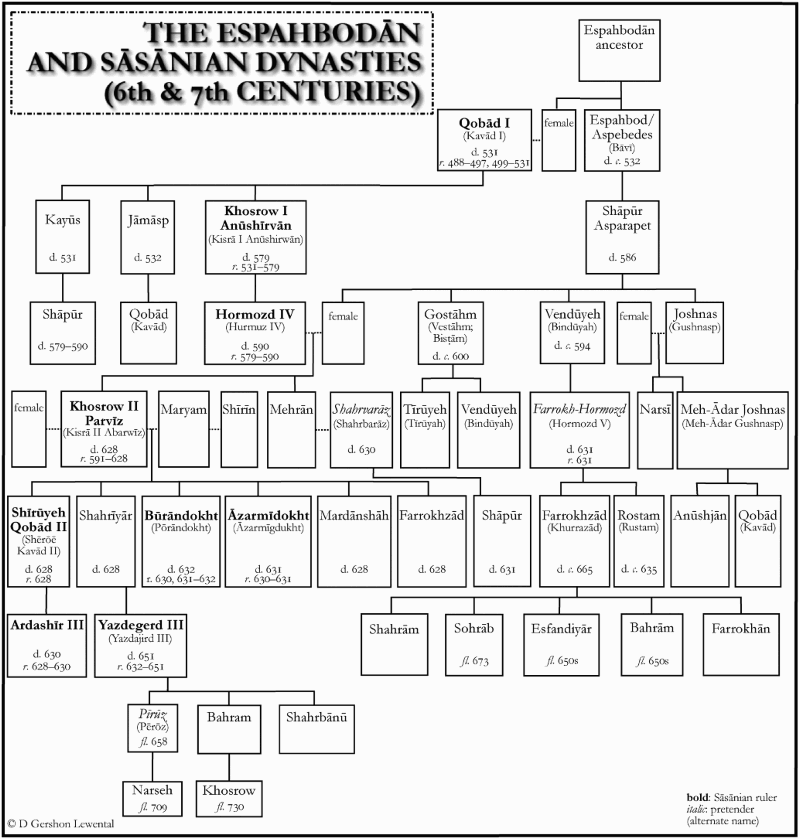
As stated, Rostam b. Farrokh-Hormozd belonged to one of the pre-eminent Sāsānian noble families, known as the Espahbodān, or the Pahlav Espahbodān.Footnote 4 That name, literally “sepahbods,” evolved as a gentilitious appellation used to describe the descendants of the first Sāsānian military marshals (Pers. sepahbods).Footnote 5 Throughout most of its history, the Espahbodān family held important administrative and military positions in the Sāsānian empire and allied themselves closely with the reigning dynasty. After the ruling family, the House of Espahbodān was arguably the second-most influential family in the empire.Footnote 6 The headgear worn by Rostam—permitted only to members of the seven noble families—points to his aristocratic background.Footnote 7 Evidence of the family’s stature can be found in the recurring familial ties between the Espahbodān and the Sāsānian houses; as Pourshariati has noted, recurring instances of intermarriage during the sixth and seventh centuries meant that reigning emperors were often the brothers-in-law or cousins of leading Espahbodān dynasts (see Figure 1).Footnote 8 One nobleman reportedly flattered the Espahbodān Gostāhm (also Vestāhm or Besṭām, d. c. 600), an uncle of Khosrow II Parvīz: “Verily, you are the brothers of the Sasanians and their partners in rule.”Footnote 9 When Gostāhm revolted against his nephew, he mocked the inferior lineage of the Sāsānian family, reminding Khosrow that the Espahbodān descended from Darius and Alexander, while “your father Sāsān was (merely) a herder of sheep.”Footnote 10
The Espahbodān and Sāsānian Dynasties (Sixth and Seventh Centuries) Sources: Pourshariati, Sasanian Empire, 471; al-Ṭabarī, History, XI: xxxi‒xxxii; Justi, Iranisches namenbuch, 429; Patkanov, “Dynstie des Sassanides,” 129‒31.

The Parthian (MP Pahlav) heritage of the Espahbodān, as contrasted with the Persian (MP Pārsīg) background of the Sāsānians, is an important consideration.Footnote 11 The Espahbodān family originated in the Parthian northeastern part of the empire—Khorāsān. The dynasty maintained its links to this region throughout its long history, and Khorāsān served as the base of operations for Gostāhm during his revolt from 590 to 596.Footnote 12 Over time, the family extended its reach to include the northwestern province of Āźarbāyjān.Footnote 13 As a result, different historians claimed that Rostam was from Armenia, Āźarbāyjān, Hamadān, or Rayy.Footnote 14 Espahbodān dynasts bore titles reflecting their esteemed position in their regions and in the empire as a whole. Armenian writers titled Rostam and his father Farrokh-Hormozd (d. 631) “princes” (Arm. ishkan) of Āźarbāyjān (Arm. Atrpatakan), most likely referring to their position as sepahbods of the “region of Āźarbāyjān” (MP kūst ī Ādurbādagān).Footnote 15 In the last decades of the Sāsānian empire, Farrokh-Hormozd achieved exalted status, “so close to Khusrow II that none dared to approach him without his permission.”Footnote 16
In 631, amidst the turmoil following the regicide of Khosrow II and a few years prior to the Battle of al-Qādisiyyah, the Espahbodān family reached the apex of its power, when Farrokh-Hormozd claimed the throne of the Sāsānians, minting coins under the regnal name of Hormozd V (r. 631), posing a greater challenge to their authority than his uncle Gostāhm, who had merely seceded from the empire. Numismatic evidence suggests that his power stretched beyond the Parthian heartland into the Persian territories of Khūzestān and Pārs.Footnote 17 He reigned only briefly, and survives in the sources through a muddled story that reduces his political ambitions to sexual lust for the Sāsānian queen whom he sought to unseat.Footnote 18 In any event, Farrokh-Hormozd appears to have ruled simultaneously with Āzarmīdokht (r. 630–31), a weak empress beholden to Pārsīg dynasts, for more than a year.Footnote 19 His ambition led to his downfall at the hands of his factional rivals, who stood behind the puppet monarch, but provoked his son Rostam to lead an army from Khorāsān, which captured the capital city of al-Madāʾin and set up another daughter of Khosrow II, Būrāndokht (or Pōrāndokht, r. 630, 631–32), on the throne.
By 632, the Espahbodān controlled the Sāsānian dynasty through the person of Rostam, who remained the dominant figure in the entire empire until his death at al-Qādisiyyah. Mīr-Khvānd described his military and administrative position as “the amīr of amīrs [Ar. amīr al-umarāʾ] [and] commander-general [Pers. farmān-farmā] of the kingdom of Persia.”Footnote 20 Rostam’s powers are said to have extended far beyond those of even the ruling empress herself. According to al-Ṭabarī:
[Būrāndokht] invited him to manage the affairs of the Persians … on condition that she would entrust him with the rule for ten years, then sovereignty would belong to the family of [the Sāsānians], if they found any of their male offspring, and if not, then to their women. … [Būrāndokht] summoned the governors (marāzibān) of Persia and wrote for [Rostam], “You are in charge of the armed forces of Persia. There is no one above you save God, be He Mighty and Majestic, according to our pleasure and in submission to your judgment. … ” At this, she crowned him and commanded the Persians to hear and obey him.Footnote 21
At the outset of his reign, Yazdegerd III (r. 632–51)—a child king, thus likely a literary personification of a court faction—entrusted Rostam with the defense of the empire, telling him (according to al-Ṭabarī’s sources), “Today you are the [most prominent] man among the Persians (wa-anta rajal ahl Fāris al-yawm).”Footnote 22
The court selected Rostam to confront the invading army precisely because of the nobleman’s powerful reputation, arguing that “[o]ne must make preparations for an affair according to its magnitude.”Footnote 23 Indeed, the presence of the Espahbodān dynast on the battlefield at al-Qādisiyyah is a telling sign that an Iranian army of no small significance was involved. According to al-Ṭabarī, Rostam himself understood this. He argued with “Yazdegerd” against leading a force himself, insisting that other generals wear down the invading army in a succession of battles: “In war, patience is superior to haste, and the order of the day is now patience.”Footnote 24 Rostam contended that the Arabs “dread my name more than [any other general]” and feared that he alone held the Iranians together and kept the Arab-Muslim army from encroaching further:
The people of Persia still look up to me. As long as I am not defeated, they will act eagerly. I am also all this time dreaded by the Arabs; they dread to move forward as long as I do not confront them. But once I do confront them, they will, at last, take heart, and the people of Persia, will, in the end, be defeated.Footnote 25
Even if Rostam’s prophetic prognostication was simply a vaticinatio post eventum of a later historian, these lines betray the magnitude of his stature and of the setback to Iran that his demise presented. Indeed, following his death and the total defeat of his army at al-Qādisiyyah, the Arab-Muslim warriors captured and sacked the Sāsānian capital of Ctesiphon/al-Madāʾin. The emperor fled with his retinue, embarking on what would become a nearly twenty-year saga of refuge and escape across Iran, until he met a lonesome death at the hands of a lowly miller in Marv. During those years, despite stubborn resistance and at least two major battles with invading Arab armies at Jalūlāʾ and Nehāvand, the Sāsānians failed to establish a leader around whom the imperial nation could rally. Thus, Rostam remained in collective memory the last figure to command respect and recognition from the population—and the enemy—as a personification of Sāsānian unity and resistance.
Such regard explains the prominent position that Rostam occupies in the historical literature and it is in the accounts of his death that he, or his image, continued to thrive. One can easily imagine an early story-teller recounting the details of the encounter between Rostam and his killer before an enraptured audience, infusing the story with elements to both entertain and instruct regarding the fall of a once-mighty figure. The versions that have come down to us demonstrate this poignantly.Footnote 26 Consider the following lengthy pericope from a report by the tradent Sayf b. ᶜUmar:
At noon a gap was opened in the center [of the Persian army] and dust covered them. A violent gale, which was the westerly wind (dabūr),Footnote 27 blew away the sunshade (tayyārah) from Rustam’s throne (sarīr), and it fell into al-ᶜAtīq.Footnote 28 The dust blew against the Persians.
Al-QaᶜqāᶜFootnote 29 and his companions reached Rustam’s throne and toppled it. Rustam [had] vacated it when the wind had blown the sunshade away and transferred to some mules which had brought to him certain possessions on that day and were standing [nearby], taking shelter in the shade of one of the mules and of its litter. Hilāl b. ᶜUllafah hit the litter under which Rustam was (hiding) and cut its ropes. One of the half-loads fell on Rustam, so that Hilāl did not see him and did not notice him. The load hit Rustam and displaced a vertebra in his spine. His [sleeves] diffused scent. He moved toward al-ᶜAtīq and threw himself into it, but without any hesitation, Hilāl went after him and caught him after Rustam had already started to swim. Hilāl stood upright, seized Rustam’s leg, and dragged him out to the river’s bank, and then struck his forehead with the sword and killed him. Then he dragged him farther and threw him at the feet of the mules. He seated himself on Rustam’s throne and exclaimed: “By the Lord of the Kaᶜbah, I have killed Rustam! Come to me!” Men gathered around him without noticing or seeing the throne, proclaiming “God is most great!” and calling out to each other.
At this point the polytheists lost heart and were defeated.Footnote 30
This passage (and the others like it) contains several features that suggest editorial invention and manipulation. The first hint is the wind and dust storm that topples the parasol above Rostam’s throne, an obvious foreshadowing of his imminent demise.Footnote 31 Most prominent is the comic element, whereby the haughty Sāsānian dynast falls (physically and figuratively) from his raised throne (above the din of the battle) and hides amongst the saddlebags and underneath a pack animal. In an almost slapstick encounter, a Muslim fighter innocently swats his sword, causing a heavy sack to fall upon Rostam, displacing a vertebra and impelling the general to attempt a desperate escape into the water, only to be dragged out by his feet and beheaded. The humorous portrayal underscores a didactic message regarding the fall from glory and the overturning of the existing world order through the rise of Islam. This reversal becomes clearest in the juxtaposition of the image of Rostam’s body hurled “at the feet of the mules” with Hilāl’s mounting of Rostam’s golden throne to announce the deed, a seventh-century Islamic version of “Le Roi est mort, vive le Roi!”
The internal logic of the story reinforces the impression that the description of Rostam’s death was a literary concoction invented by later writers. First, the text states that, as Hilāl passed by Rostam’s refuge, he just happened to swing his sword in that direction, although “he did not see him and did not notice him.” Yet, as Rostam attempted to flee into the ᶜAtīq, Hilāl pursued him “without any hesitation.” Likewise, the heavy load fell onto Rostam’s back, injuring his spine—although apparently not enough to prevent him from swimming. As for the ᶜAtīq itself: the nearly-dry river bed, which was also dammed by the Sāsānian army on the eve of the battle, cannot have posed as much of an obstacle for Rostam’s flight as the narrative would have us imagine.Footnote 32 Finally, although the passage commences by informing us that the Muslim fighters overturned Rostam’s throne, it concludes by relating that Hilāl “seated himself on Rustam’s throne” to announce his accomplishment.Footnote 33
An element of tribal glorification permeates the Arabic tradition; when it comes to credit for the beheading of Rostam, quot capita tot sensus. Al-Balādhurī listed seven claimants, including ᶜAmr b. Maᶜdī-Karib, Ṭulayḥah b. Khuwaylid, Qurṭ b. Jammāḥ al-ᶜAbdī, Ḍirār b. al-Azwar al-Asadī (d. between 632 and 637), Zuhayr b. ᶜAbd-Shams al-Bajalī, ᶜAwwām b. ᶜAbd Shams, and Hilāl b. ᶜUllafah al-Taymī (d. 658)—although he emphasized that the Muslims found Rostam’s body with so many blows and stabs that it was impossible to attribute the coup de grâce.Footnote 34 Likewise, al-Masᶜūdī conceded that one could not determine the precise hand by which Rostam met his death, noting that the most regarded claim is that of Hilāl b. ᶜAlqamah al-ᶜUqaylī, although others ascribed it to the Banū Asad.Footnote 35 According to the Baṣran historian Khalīfah b. Khayyāṭ al-ᶜUṣfurī (d. 854), al-Madāʾinī accredited the deed to Zuhrah b. Ḥawiyyah al-Tamīmī, Hilāl b. ᶜUllafah, or ᶜAmr b. Maᶜdī-Karib (along with the fourth possibility that Rostam perished of thirst).Footnote 36 Similarly, al-Maqdisī acknowledged disagreement over the slaying of Rostam, suggesting either Hilāl b. ᶜUllafah or ᶜAmr b. Maᶜdī-Karib (mentioning also the option that he drowned in al-ᶜAtīq).Footnote 37 Even the bacchanalian poet Abū Miḥjan, both censured and glorified at al-Qādisiyyah, allegedly sought out Rostam amid the pandemonium of the Sāsānian collapse.Footnote 38 One modern scholar has suggested that the Persian general may have met his death at the hands of his own soldiers, who resented him for the killing of the Queen Āzarmīdokht.Footnote 39 One tradition plausibly reflects the chaotic reality of the battle, in which Rostam may have been killed by any number of known or unknown individuals, who sought an opportunity to stab at the dynast and thereby claim a share of the credit:
A group of Christians (al-ᶜibād) came to SaᶜdFootnote 40 and said: “O commander, we have seen the body of Rustam near the gate of your castle, but he had the head of another man; the blows have disfigured him [beyond recognition].” At this, Saᶜd laughed.Footnote 41
The fact that nearly every prominent tribe proposed a candidate for the slaying of Rostam should not surprise us, given the glory involved in the act. The numerous references to Hilāl b. ᶜUllafah in this regard may stem from the fact that he and his brothers became important Khārijī leaders;Footnote 42 the claim to have killed such a great enemy of Islam may have endowed him with increased legitimacy in the eyes of his followers.Footnote 43 Observing the frequency of cases in which multiple claimants receive credit for the deaths of Muslim opponents, Noth drew attention to the exaggerated focus on the genealogies of those who killed or captured great enemies, “pushed into the foreground, as if [they] were the essence of the matter.”Footnote 44 The narrative provides an occasion for such emphasis, as the subject of the story shifts from the deceased Rostam to the heroic figure who mounts his throne and announces the deed.Footnote 45
Even the ensuing flight of the Persian soldiers, one of the most believable aspects of the Rostam narrative, is not entirely above suspicion. We may continue Sayf’s passage above:
At this point [Hilāl’s proclamation of the death of Rostam] the polytheists lost heart and were defeated. Al-Jālnūs stood on the barrier (al-radm) and called upon the Persians to cross it. The dust settled. As for those who were chained together, they panicked and threw themselves, one after the other, into al-ᶜAtīq. The Muslims stabbed them with their spears and none of them escaped to tell the story. They numbered thirty thousand. … The Muslims killed in the battle ten thousand men, over and above those whom they had killed on the previous day.Footnote 46
Several elements of this narrative echo the description of the single Muslim loss during the conquest of Iran (and virtually the entire Futūḥ) at the Battle of the Bridge.Footnote 47 One might even view the text as literary response to that engagement, in which the earlier Muslim rout resulted from the death of their leader, Abū ᶜUbayd:
[W]hen Abū ᶜUbayd was hit … the Muslims fled and then continued in flight. The Persians rode down on them. A man from the Thaqīf, getting to the bridge first, cut it. The troops then reached it, while the swords were taking them from behind, and fell into the Euphrates. [The Persians] struck down four thousand of the Muslims on that day between those drowned and killed.Footnote 48
In both of these pericopes, the death of a leader provides a catalyst for the collapse of his army. Both losing forces attempted to retreat across a body of water, both faced grave difficulties while doing so; in both episodes, the opposing soldiers set upon them, stabbing them from behind, and both victors committed mass slaughter during the botched river crossing. Finally—and significantly—both reports include the element of a fighter standing on a water-crossing structureFootnote 49 and preventing or facilitating the traversing of the water by his own soldiers. The similarities between the two accounts suggests that story-tellers or historians modeled one on the other, perhaps a literary form of “an eye for an eye,” where the later Muslim victory abrogated and superseded the earlier defeat.Footnote 50 Where 4,000 Muslims perished, 40,000 Persians lost their lives; what had been a humiliating loss for the young Islamic polity became a devastating defeat for the powerful Sāsānian empire. At the same time, barring the discovery of heretofore undiscovered eye-witness sources for either encounter, an unequivocal determination cannot be reached. Both passages might be formulaic conclusions to a battle, a schema of topoi strung together to produce what later historians imagined as the consequence of the death of one side’s leaders.Footnote 51
Among the numerous literary representations of the death of Rostam, one presents a very different description of the dynast’s last minutes. In this version, Rostam and the Arab commander Saᶜd b. Abī Waqqāṣ fight each other in a single combat that personifies the clash between Sāsānian Iran and the new Arab-Islamic state. Narrowly, Saᶜd emerges unscathed from a nearly-fatal thrust by Rostam—which fails only because a cloud of dust had blinded the Persian commander. In the end, Saᶜd overcomes his opponent, cleaving the latter’s head in two. Curiously, this—the only narrative which attributes any martial activity to the Arab general Saᶜd b. Abī Waqqāṣ (let alone credit for dispatching Rostam)—is in the Shāh-nāmeh tradition.Footnote 52 Dick Davis’ prose translation provides a useful summary of the account:
A cloud of dust (gard) rose up, and there was such a din of war cries that the sharpest ears were deafened. … The battle continued for three days; then thirst made [the Persians’] blows grow weaker and their horses too faint to fight. Rostam’s lips were dry as dust; his mouth was parched and his tongue swollen and split. Both men and horses were so tormented by thirst (teshnegī) that they ate damp clay. A cry like thunder went up, from Rostam on the one side and from Saʾd on the other: the two of them rode out from the body of their men and faced each other alone beneath a tall cypress tree. Rostam gave another thunderous cry and struck a sword blow against Saʾd’s horse: the horse collapsed beneath him, and as Saʾd disentangled himself, Rostam lunged at him with his sharp sword, to prevent him from rising. He intended to sever Saʾd’s head from his body, but the dust of the battlefield hid Saʾd from his sight. He jumped down from his leopard-skin saddle and tied his horse’s bridle to his belt, but while he was blinded by dust, Saʾd attacked and struck Rostam’s helmet a mighty blow with his sword. Blood poured from Rostam’s head, filling his eyes, and the ambitious Arab triumphed over him. Saʾd thrust his sword into Rostam’s chest and neck and hurled his warlike body into the dust.Footnote 53
The fact that this portrayal emanates from the oral narratives of the Iranian national epic presents a clue as to the origins of this imagined alternate scenario. The Iranian story-tellers who conveyed the tales of their ancient history no doubt sought to infuse some dignity into the death of their last great hero.Footnote 54 Viewing the passage in this light explains the discrepancies with other versions. Rostam falls to the chief of the invading force, not an anonymous Arab warrior. The Persian commander dies while engaged in brave single combat with a fierce opponent—despite his astrological knowledge that he was destined to fall—not while attempting to escape ignobly.Footnote 55 Before he perishes, Rostam threatens Saᶜd’s life—a dramatic touch that must have piqued the attention of the audience of these oral tales. Here, Rostam’s attack fails when a dust storm (Pers. gard) blinds and torments the Persian soldiers, enabling the Arab general to gain the upper hand; the Iranian commander does not fall due to the skill of his opposite number.
The language of the passage bolsters this alibi through repeated mentions of key words that shift the blame for the defeat from the Persian soldiers (or the credit from the Muslim fighters) onto uncontrollable natural elements. The account of the battle commences with the gard, or dust storm, which resurfaces again, together with the word “dust” (Pers. khāk), throughout the short selection.Footnote 56 Another recurring theme is the thirst of the Persian soldiers, which dovetails with the dust storm and reinforces the perception that non-human forces weakened the imperial army, which (under normal circumstances) could easily have dispatched the invading host. Fatigue affected both man and horse alike, debilitating them in the face of their opponents. Nor was Rostam exempt: in one verse, Ferdowsī wrote that “from thirst, the lips of Rostam had become [dry] as dust (lab-e Rostam az teshnegī shod chow khāk)”; only in death did the blood gushing down his forehead slake (figuratively) his thirst.Footnote 57 The imagery of this passage mirrors another momentous event of early Islamic history: the Battle of Karbalāʾ (680), where the Umayyad forces of Yazīd I (r. 680–683) prevented al-Ḥusayn b. ᶜAlī and his followers from camping near the Euphrates River, depriving them of water before the attack. Likewise, al-Ḥusayn (who, according to Shīᶜī lore, had married a daughter of YazdegerdFootnote 58) knew in advance of his impending death, but persisted anyway in martyring himself, while the opposing general ᶜUmar (the son of Saᶜd b. Abī Waqqāṣ!) dispatched a subordinate to block al-Ḥusayn and his party from reaching the river. The thirst of Rostam and his men parallels the experience of the Shīᶜī martyrs at Karbalāʾ—or, at the least, draws upon its recognizable imagery.Footnote 59
A literary postscript to the Rostam saga can be found in the references to his brother Farrokhzād b. Farrokh-Hormozd (d. c. 665), which—by design or coincidence—provide a fitting coda to the episode.Footnote 60 Yazdegerd is said to have placed Farrokhzād in charge, first, of al-Madāʾin, and then of the Persian forces, and he sent the dynast to lead his army at the next major engagement at Jalūlāʾ (c. 637).Footnote 61 Hearing that the Sāsānians were amassing an army, Saᶜd dispatched his nephew Hāshim b. ᶜUtbah b. Abī Waqqāṣ with a sizable force. The Muslims encountered a gathering Persian army in a well-fortified position surrounded by ditches (khandaqs). The Muslims managed to draw them out of their encampment and then used the Iranians’ own defenses to defeat them.
Some interesting parallels between the two engagements of al-Qādisiyyah and Jalūlāʾ point to the hidden hand of a later story-teller or writer. At both battles, a Waqqāṣī (Saᶜd/Hāshim) faced and defeated an Espahbod (Rostam/Farrokhzād). At al-Qādisiyyah, the Muslims installed themselves in well-fortified trenches and waterways and refused to budge; at Jalūlāʾ, the Persians entrenched themselves in a sound location, but allowed themselves to be drawn out into the open. At al-Qādisiyyah, thousands of Iranians perished while attempting to retreat over the makeshift dam that they had constructed; at Jalūlāʾ, thousands of Persians died as they retreated into the defensive fortifications that they had built.
A crucial variation on the Qādisiyyah theme is found in the ensuing battle in which Farrokhzād took part, at Rayy (651). According to al-Balādhurī, the Arab forces besieged the fortress of Farrokhzād, who, after some resistance, surrendered to the invaders.Footnote 62 However, Farrokhzād did not merely lay down his arms and conclude peace with the Muslim conquerors. Instead, he offered to assist his former opponents in seizing Rayy by sneaking them into the town and facilitating a successful joint attack from both within and without.Footnote 63 Thus, some fifteen-odd years after Rostam laid down his life for his sovereign, his brother facilitated the destruction of the empire.Footnote 64 Farrokhān’s alliance with the Arab-Muslim armies brings full circle the Rostam theme: the family of the noble opponent whose death enchanted the early Muslim community accepted the divinely-ordained mission and joined forces with the Muslim believers. Although there is good reason to believe that Farrokhān existed and that the accounts of his defection are veracious, the later narratives present the events in a manner that mirrors the account of Rostam.
A careful examination of the narratives of early Islamic history teaches us much about the mindset of those living in the first centuries following the momentous events of the seventh century. By removing the layers of literary embellishment and moralistic exegesis, we can understand better the impact upon the early Muslims of the death of this Sāsānian dynast. In addition, by comparing the Arabic and Persian narrative traditions (even from within the framework of Islam), we can uncover valuable testimony regarding not only Islamic self-awareness, but also the early development of what might later be described as an Islamic Iranian identity.
Accounts of the demise of Rostam provide a useful point of analysis, given, as stated above, his symbolic role in collective memory, for both Muslims and Iranians. Not only did no figure rise to fill the vacuum left by his death, but the fact that the empire collapsed shortly thereafter prevented another leader from overshadowing him later. In this way, Rostam became the ultimate martyr of pre-Islamic Iran and the personification of the collapse of the Sāsānian empire.Footnote 65 Rostam’s brother eulogized the fallen commander in superlative, idolizing terms (“[t]here was no knight in all the world like Rostam, no wise man had ever heard of his equal”) and contrasted him with the lowly Arabs (“crows”) who took his life and seized the Sāsānian realms.Footnote 66 Through the mouth of Yazdegerd, Ferdowsī lamented the loss of the powerful dignitary “at the hands of one Saᶜd b. Waqqāṣ, a man who has no country, no lineage, no knowledge, and no wealth.”Footnote 67 Given the subsequent destruction of the empire and loss of Iranian sovereignty for several hundred years, until the emergence of Iranian kingdoms in the ninth and tenth centuries, Rostam’s death became a symbol for the changing order. Pourshariati has addressed this perception of his death:
It is probably no exaggeration to argue that the death of no other figure in the long course of Sasanian history has acquired such poignant symbolism. Rustam’s death at the battle of Qādisiya signals the end of Sasanian history. The Shāhnāma, together with the Iranian national historical memory, mourns the defeat and murder of this heroic figure.Footnote 68
In the Arabic texts, the accounts of Rostam’s demise contain both ominous symbolism and humorous elements, augmenting an overall humiliating tone that seeks to legitimate the success of Islam in usurping the ultimate supremacy of its predecessors. This theme, which permeates the Conquest literature, explains the need to respond to the only case of Muslim defeat in the Arab-Islamic conquests. Thus, as noted earlier, the portrayal of the rout of the Iranian army following the slaying of Rostam at al-Qādisiyyah appears to have been fashioned as a mirror to the earlier Arab-Muslim disaster at the Battle of the Bridge.
This symbolic account of Rostam’s humiliating death certainly reflects the imagination of the quṣṣāṣ, who served both entertainment and didactic functions.Footnote 69 Nor is this the only such description of the demise of a Muslim enemy. Abū Yūsuf and al-Balādhurī presented degrading reports of the death of the Sāsānian general Bahman Jādūyeh (referred to as Dhū al-Ḥājibayn) at the Battle of Nehāvand, who “fell from his grey mule and his belly was cleft.”Footnote 70 The contrived origin of this account is underscored by the fact that this figure died at no fewer than three engagements, including the subsequent (and most believable) one at Eṣfahān.
Another example is the demise of the Sāsānian “King of Kings” Yazdegerd, which Arab annals depict in a most dishonorable fashion. Following a cowardly flight across Iran in which he was forced frequently to rely upon lowly officials whose loyalty is often in doubt, Yazdegerd meets his death at the hands of commoners; first, he is despoiled of his possessions, then he begs desperately for his life, and after the deed, his body is flung ignominiously into a river. Al-Ṭabarī presented a number of versions: a millstone cutter kills Yazdegerd while he sleeps; a stonecutter kills and robs him when he becomes “heedless,” then tosses him into the river; a miller crushes his head with a stone and then decapitates him (as if one form of death was insufficient), before flinging his body in the river; soldiers seal him in a sack, strangle him with a bowstring, and then throw him in a river, where his body becomes caught by a branch; and a mill-owner attacks and beheads him with an axe, despoils him, and hurls his body into the river—and then slits open his belly in order to fill it with tamarisk roots so as to weigh the body down.Footnote 71 In one report, Yazdegerd complains that he has been “‘reduced to eating cat food,’” while in another he pleads with his killers to “‘send me off to the Arabs, for they will spare the life of a king like me.’”Footnote 72 Apparently, he reached the depths of such despair as to make of the invading Arabs an object of hope.
All of these individuals perish following fateful decisions that essentially excuse their killers by blaming the victims. Both Rostam and Bahman Jādūyeh die after rejecting Muslim embassies offering peace in exchange for conversion to Islam or payment of a tribute.Footnote 73 Yazdegerd incites the population of a number of subjugated provinces to revolt against the Muslims; al-Ṭabarī explained that “[t]his … induced [the caliph] ᶜUmar to permit the Muslims to penetrate farther.”Footnote 74 Furthermore, during his flight, Yazdegerd makes several poor decisions, ultimately (according to the reports) placing his trust in a most disloyal subordinate. Ultimately, the picture that develops in each case is that of a “righteous kill”—a haughty and heedless enemy who received his due comeuppance for neglecting to acknowledge the virtue of Islam and its early proponents.
By contrast, the Shāh-nāmeh tradition transforms the humiliating accounts of the deaths of Iran’s leaders into sympathetic and meaningful events. Thus, the slaying of Yazdegerd by a common miller in Marv, who stabbed the emperor as he was eating stale barley bread and herbs while seated atop a bale of straw, takes on new meaning in the Iranian national epic. His kingdom reduced from the “land of Iran (Īrānshahr)” to a simple mill (“now a water-mill had become his lot”), Yazdegerd suffered the caprice of fate, which inspired Ferdowsī to interpret the message of the tale: “Such is the habit of this deceptive abode, one’s rise high and his descent steep.”Footnote 75 El-Hibri has argued that there is much symbolism to be found in the details of Yazdegerd’s death; in particular, its situation at a mill alludes to the turning cycle of Iranian fortune.Footnote 76
Likewise, the Shāh-nāmeh recasts the death of Rostam in a heroic light. He is not killed by an anonymous Arab fighter in an embarrassing situation, but falls in single combat with the commander of the Arab-Muslim army, in an embodiment of the clash between the established, imperial Sāsānian order and the nascent, potent Islamic movement. Furthermore, Rostam’s death is not attributed to the direct actions of his opponent but to the appearance of a dust storm that makes possible the success of the opposing Arab leader. The fact that a (super)natural phenomenon, and not human ability, caused the death of the superlative Sāsānian leader underscores the message present throughout the final section of the Shāh-nāmeh: fate had decreed the fall of the empire and fortune no longer smiled upon the land of Iran and its rulers.Footnote 77 Rostam became the ultimate martyr of pre-Islamic Iran and the personification of the collapse of the Sāsānian empire.
Yet, in death, Rostam found himself integrated into an Islamic framework. Hints of alternative, more ambiguous perspectives with respect to Rostam appear even in the Conquest literature.Footnote 78 According to al-Ṭabarī, Rostam responded favorably to the propaganda of the envoys (“Excellent!” “Have you ever heard a statement more lucid and more honorable that [sic] the statement of this [Muslim] man?”) and censored his soldiers (“the Arabs treat our people better than you do. God would have given you victory over the enemy and strengthened your position in the land if your behavior had been upright”).Footnote 79 El-Hibri has also discussed the role of Rostam as a literary representative of “Islamic principles” among the Persians, “acting out the role of victim and historical commentator.”Footnote 80 In the Shāh-nāmeh, we also find, as mentioned above, what is perhaps a subtle allusion to the martyrdom of al-Ḥusayn in the description of Rostam’s parched lips. The Shīᶜī Imām’s alleged familial connection to the imperial Sāsānian dynasty and the kinship of one of his chief oppressors with Saᶜd, the Arab general at al-Qādisiyyah, further enhance this metaphor.
The death of Rostam thus presents us with competing streams of thought regarding the fall of the Sāsānian empire and the rise of Islam. On the one hand, the Conquest narratives sought to justify and legitimate the success of Islam as proof of its divine truth. The victory over this significant Iranian leader—despite all odds—confirms the veracity of the new faith. On the other hand, a mindset we might term “Islamic Iranian” attempted to reinforce the value of Iranianness, while explaining the destruction of the imperial state and the new Arab-Islamic hegemony. The deaths of Rostam and Yazdegerd thus become a matter of tragic fate, the turning of the wheel of fortune. Both of these lines of thought converge in their similar emphasis on divine will. In the early Islamic worldview, this meant the triumph of Islam at the hands of the Arab-Muslim warriors; in the competing Islamic Iranian outlook, the wretched whim of fate, epitomized by the role played by supernatural forces, was responsible for the disaster.
In al-Ṭabarī’s account of Yazdegerd’s final days, the Sāsānian emperor decides in desperation to leave the land of Iran for that of the Turks. His people caution him against abandoning his people, encouraging him to make peace with the Muslims and arguing that “[a]n enemy ruling over Persians in their own land was a better political arrangement than an enemy ruling over them in his own land.”Footnote 81 Although this story is no doubt apocryphal, it appears that, in the end, the Iranians living under Islam resigned themselves to this approach, accepting Arab overlordship and the religion of Islam, while continuing to cherish the memory and symbols of Iran—like their ultimate and final hero, Rostam.
 i, 112–13. According to Ferdowsī, who did not include an account of Jalūlāʾ, Farrokhzād raced from al-Madāʾin towards al-Qādisiyyah, encountering a Muslim force on the way at Karkh; Ferdowsī, Shahnameh, VIII: 432–3.