It is more profitable and more advantageous [for the trader]… to export his products to a distant land and take a dangerous route. In this way, the distance and the risk incurred will give a rare quality to his merchandise, and thereby increase its value … This is why the wealthiest and most prosperous merchants are those who dare to go to the Sudan [meaning Africa to the south of north Africa] … Now, honest (traders) are few. It is unavoidable that there should be cheating, tampering with the merchandise which may ruin it, and delay in payment which may ruin the profit, since (such delay), while it lasts, prevents any activity that could bring profit. There will also be non-acknowledgement or denial of obligations, which may prove destructive to one's capital unless (the obligation) had been stated in writing and properly witnessed. (Ibn Khaldūn)Footnote 1
In the late nineteenth century a trader from Tīshīt (Mauritania) entrusted merchandise, by way of an agency contract, to a caravanner travelling to the commercial centre of Guelmīm in the Wād Nūn region (present-day southern Morocco). When he finally returned to Tīshīt after an absence of four years, the caravanner denied having been entrusted with some of the goods, and he declared that a qā ī (judge) of Guelmīm had taken possession of one portion. As for the rest of the merchandise, he claimed that it got ‘lost along the way’ (ā‘a fī al-
 arīq).Footnote 2 The original owner of the merchandise asked a qāī of Tīshīt to mediate the dispute but he found no proof that the caravanner had lied to, or otherwise cheated, him. So he called upon the services of a muftī (jurist), Mu
 ammad b. Ibrāhīm of the Awlād Bū al-Sibā‘ clan who was probably from Wād Nūn himself, for the issuance of a fatwā or legal opinion. He was to deliberate whether the caravanner should ‘be fined for what he claimed was lost because of his apparent betrayal, or is he to be believed because of his trustworthiness (amānatihi)?’Footnote 3
In a brilliantly crafted fatwa discussing the obligations of Muslim legal experts and the challenge of bringing betrayers to justice, the muftī reasoned that the caravanner was innocent until proven guilty. Here he applied the Islamic legal dictum that the claimant produces the testimonial evidence while the defendant takes the oath (al-bayyina ‘ala al-mudda‘ī wa al-yamīn ‘ala man ankar). In accordance with the rules of contractual agreements, the agent was not responsible for the loss of the principal in the event of an accident such as a runaway or stolen camel. The muftī concluded that it was up to the claimant, the local trader, to find proof of the wrongdoing or supposed betrayal of the defendant, the caravanning agent. Moreover, he advised that the former was hindering the law by rallying the public against the caravanner.
The commercial world of trans-Saharan caravanners was typically governed by Islamic and customary norms of behaviour that facilitated the conduct of long-distance trade. But trustworthy partners who shared commercial risks were not always successful in overcoming certain fundamental problems such as the temptation to cheat or the hazards of the road. The complicated feat of organizing camel caravans, involving the coordination of multiple deals from multiple parties in multiple locations, was rendered more efficient through a reliance on literacy in Arabic and on an Islamic legal framework. Moreover, in cases of uncertainty and disputes, such as the one examined above, long-distance traders had recourse to the services of local and regional experts of Islamic law, who acted as arbitrators. Beyond upholding rules and enforcing contractual agreements, these legal professionals were also in charge of defining terms of trade, clarifying standard valuations and equivalencies, and negotiating local practice, including the behavioural norms of merchants and traders.
Like long-distance trade throughout the world in the early modern period, organizing camel caravans required a careful combination of several basic factors. These included faith and trust in people, capital, international networking, navigational expertise, and stamina, as well as a great deal of luck. Religious faith, in this case Islam, was an important feature of trans-Saharan traders’ ‘mental make-up’, for it shaped their decisions and actions as well as those of their correspondents. Clearly, caravanners were remarkable men with extraordinary skills and strength of character, fearless adventurers ‘who dared to go to the Sudan’, as the fourteenth-century historian Ibn Khaldūn declared, or, inversely, who dared to go to the Maghrib (north-western Africa) because they were motivated by the lure of big gains. Such risk-takers stood to generate great profits from caravan trade if they managed to avoid incurring losses due to vicissitudes of the market. To be sure, trans-Saharan caravanning was a dangerous undertaking fraught with potentially life-threatening encounters, from towering sandstorms and wild animals to trigger-happy bandits. The western Sahara was a theatre of chronic warfare throughout most of the nineteenth century and violence was the regular backdrop to the activities of these long-distance travellers.
For centuries trans-Saharan trade in this part of western Africa revolved primarily around the transportation of slabs or bars of rock-salt from Saharan salt-pans sold further south in exchange for gold nuggets and enslaved Africans.Footnote 4 In the nineteenth century, two types of caravans circulated in the region. The first were trans-Saharan caravans carrying North African products (namely metal goods, foodstuffs, books, and textiles), as well as salt bars, to west African markets such as Shinqīi, Tīshīt, Walāta and Timbuktu. Inversely, they would return with slaves, but also local fabrics, gold, spices, foodstuffs, gum Arabic, and wood products. Many of the caravanners involved in this international trade were originally from the region of Wād Nūn, where the market of Guelmīm assumed an important position as a north-western caravan terminus. There the Tikna, a clan of so-called ‘Berber’ origin, which is well represented in the documents examined below, assumed a dominant position in outfitting international caravans. Another prominent group involved in this trade was the Awlād Bū al-Sibā‘ clan, which also had long-term interests in the Wād Nūn.
The second type were interregional caravans operated by Saharans who exchanged salt and other products for food supplies, especially millet, in the markets of the southern-desert edge. In fact, caravanning was a necessary occupation for these oasis dwellers whose limited animal husbandry and date-palm cultivation did not meet all of their needs. They depended on the movement of camel caravans not only for basic supplies but also for enslaved labourers employed in all areas of the economy, from shepherds to well-diggers and wet nurses.Footnote 5 With the nineteenth-century intensification of European commerce on the Atlantic coast, new products such as industrial cotton cloth, green tea, sugar, and firearms featured with growing regularity on caravans that circulated in all directions in the African interior. Mainly French and British merchants imported such merchandise in places such as the Moroccan port of Mogador (Al- waira) in the north and further south in the Senegalese port of Saint-Louis (Ndar). The rise in the demand for both slaves in North Africa and European merchandise in the interior contributed to increasing the volume of trans-Saharan traffic in the nineteenth century. At the same time, the spread of Islam, together with literacy in Arabic, as well as the increased availability of paper, caused many more commercial entrepreneurs to document their economic activities in writing.Footnote 6
This article discusses the contractual world of the trans-Saharan caravans that circulated throughout the nineteenth and early twentieth centuries in a large part of Africa, comprising what is today Mauritania, Mali, southern Morocco, and northern Senegal. It is based on an examination of commercial and legal records as well as the oral testimonies of retired caravanners and their descendants. Oral evidence, gathered in the late twentieth century, documents the internal workings of caravans and sheds light on the identity and itineraries of traders mentioned in the archival record. I examine how caravans were organized from the point of view of contracts and partnership agreements to argue that legal and institutional mechanisms favoured commercial exchange in this part of Africa. I focus in particular on how trans-Saharan traders attempted to solve fundamental problems of exchange by drafting written agreements with their associates and having recourse to the intermediation of legal experts. In so doing, I discuss the nature of caravanning contracts between principal merchants and traders; that is to say, between sedentary financiers and their itinerant agents, who embarked on camel caravans to trade on their behalf. Moreover, while commercial caravans tended to be dominated by men, it does not follow that women were not involved in the caravanning business. Data reveals to what extent women participated via proxy as shareholders, contractors, and financiers. Information on partnerships and business contracts is derived from commercial records preserved in the private family archives of the descendants of caravanners, as well as from the opinions of nineteenth-century Saharan jurists.
The ‘paper economy’ of caravanning
It is often thought that little if any technological change occurred in the organization of camel caravans across the centuries.Footnote 7 Since few had access to Arabic source material, many scholars were not in a position to recognize how literacy and legal institutions, which flourished in and around the Sahara in the nineteenth century, promoted efficiencies in caravanning.Footnote 8 Indeed, just as literacy in the Hebrew script and legal codes based on the Torah, the Mishna, and the Talmud gave Jews a comparative advantage in economic efficiency (as Maristella Botticini and Zvi Eckstein have argued), so too did similar institutions favour Muslim entrepreneurship.Footnote 9 Several historians have made important contributions to African commercial history based on Arabic source material. Anders Bjørkelo is one of the rare historians of Africa to have studied contractual agreements, based on his case study of the nineteenth-century Sudanese merchant ‘Abd Allah Bey Hamza.Footnote 10 On the history of Timbuktu (Mali), Ismaël Diadié Haïdara published a collection of the nineteenth-century documents of Jewish traders, and John Hunwick has worked with contracts.Footnote 11 For Morocco, Mohamed Ennaji and Paul Pascon translated nineteenth-century trade records from Illigh, and Ann McDougall has examined the Guelmīm commercial archives.Footnote 12 Moreover, Ulrich Harmann published a discussion of nineteenth-century Libyan trans-Saharan trade based on published records from Ghadāmis.Footnote 13 But, aside from these works, the commercial papers of trans-Saharan traders remain largely untapped by historians.
Throughout the Muslim world, long-distance traders mitigated the logistical challenges of long-distance trade by relying on what I have termed elsewhere a ‘paper economy of faith.’Footnote 14 This commercial environment was not unlike the medieval Mediterranean economy documented in the records of Christian and Jewish traders published by Robert Lopez and Irving Raymond, and Shelomo Goitein.Footnote 15 By drawing contractual agreements and dispatching commercial correspondence, they generated commercial efficiencies that reduced the overall cost and risks involved in transacting in foreign markets. Concurrently, Muslim traders relied upon an Islamic legal and institutional framework for the purposes of accounting and accountability, while Muslim scholars defined legal norms and acted as mediators in commercial disputes. Possessing written records was vital to the efficiency and transparency of commerce even for traders who belonged to a specific trade network that provided added institutional support for monitoring caravan trade.
The volume of commercial records of prominent and not so prominent trans-Saharan traders from the nineteenth and early twentieth centuries demonstrates to what extent they operated in a paper economy. Paper was not manufactured locally, and so traders went to great lengths to secure a regular paper supply.Footnote 16 While it added significantly to transaction costs, the price of paper was obviously necessary for running their businesses. It enabled information flows across long distances and the recording and enforcement of transactions, including contractual agreements. Saharans took seriously the Qur’ānic verses enjoining Muslims to put contracts in writing.Footnote 17 Families of trans-Saharan traders, therefore, tended to possess bundles of ‘uqūd (sing. ‘aqd), a term literally meaning ‘contracts’ used generically in the south-western Sahara for commercial documentation.
Clearly not every contract or partnership agreement was recorded in writing. Several cases deliberated by Saharan jurists, including some examined here, deal with disputes concerning oral contracts. Furthermore, not everyone possessed sufficient levels of literacy or the resources to operate fully in a paper economy. Yet the Saharan evidence leaves little doubt that written agreements were preferred, especially for drafting commercial contracts. The well-known eleventh-century ānafī jurist Al-Sarakhsī described best the advantages of this strategy: ‘The purpose then of a document is reliance and precaution … Partnership is a contract that extends (into the future). The recording of a deed is, thus, recommended in such a contract so that it becomes a decisive proof between them in case of dispute.’Footnote 18 By writing and making multiple copies of specific contracts, partners could eliminate ambiguity in deals and potential disagreements, and clarify the obligations and claims of business partners or their inheritors. Moreover, long-distance traders could engage in complicated multi-party financial operations.Through letter-writing and the use of messengers, merchants monitored the activities of agents, put pressure on defaulting parties, and otherwise exchanged market information. Contracts between sedentary investors and associates, travelling merchants, and trade agents were always drafted in the presence of at least two male witnesses. While they could not be used as legal evidence in court, in accordance to Islamic legal practice, which placed value on testimonial evidence, contracts did carry weight as decisive informational instruments, proof of transactions between partners, and as records witnessed by third parties who were known members of the community.Footnote 19 Moreover, traders and legal experts could authenticate the handwriting of their partners and agents, an important element that guaranteed contractual validity. In fact, contracts at times were so specifically drawn that small slips of the pen, crossings-out, or deletions were acknowledged in-text to ensure accuracy.Footnote 20 Whether written in person or by a scribe serving as notary and witness, contracts contained stipulations about purposes and due dates. A copy would remain in the hands of the principal contracting party and another travelled with the itinerant trade partner, which is why several such contracts bore the signs of having been carried for long periods of time, stained by the indigo dye of Saharan cotton clothing. At other times, contracts were embedded in multi-purpose commercial letters dispatched via agents to partners in trade.
Historians have paid little attention to the use of written contracts by women. This is partially explained by the androcentric paradigm that dominates the literature, and that assumes early modern long-distance trade to be an exclusively male occupation.Footnote 21 While the Saharan women who physically embarked on commercial caravans were rare, this does not mean that they were not involved. They did engage in trade through the intermediation of family members and hired agents, drafting contracts even with their husbands who traded on their behalf. Indeed, it is arguably thanks to the paper economy that they could participate in caravanning.
The western Saharan commercial record for the nineteenth and early twentieth centuries reveals a variety of contractual arrangements between trans-Saharan traders. The most common were joint-liability contracts, mixed debt and equity contracts, and agency contracts for sales or purchases on commission. Some Saharan private libraries contain copies of contractual formularies or templates used as models for drafting various deeds. One such model, entitled ‘shipment via agency’ (risāla bil-wakāla), states:
This is to inform the observer of the document and whomever reads it attentively that so and so (fulān b. fulān), May God facilitate his affairs, commissioned as his representative his brother,Footnote 22 the industrious so and so, the helper of God. And he was entrusted with his property in the proper manner, and he abides by the agreed upon entrustment of such and such by the strength of the agency (al-wakāla) and the representation (al-niyāba), in principle and in practice (‘alan wa far‘an), by force and by law, and so on this day of this year this was witnessed by so and so, and so on …Footnote 23
Not all contractual agreements followed this model. Often key information went unrecorded, seemingly taken for granted, including specific responsibilities and conditions. Another peculiarity is that contracts rarely disclosed profit-sharing arrangements, commissions, or wages. These omissions were probably due to the fact that there were set commission rates for certain routes and trade goods and established wages or interest rates that required no mention on paper. We now turn to Islamic partnerships and an examination of their use in trans-Saharan trade based on our translations of original sources collected in private Saharan libraries.
Islamic partnerships
Economic historians have long recognized the extent to which partnership agreements facilitated long-distance trade. A partnership is a contract ‘whereby two or more persons consent to combine assets or labor to realize common profits’.Footnote 24 Dean Williamson argues for the case of early modern maritime trade – which is applicable to trans-Saharan trade – that contracting agents enabled investors to operate in geographically dispersed markets so as to ‘manage risk by diversifying their investments across a portfolio of ventures’.Footnote 25 What Naomi Lamoreaux explains for the case of nineteenth-century American business history is equally valid in the Saharan context, namely that contracts enabled entrepreneurs to raise capital, although mainly with a ‘short term horizon’.Footnote 26
Avner Greif made important contributions to our understanding of agency relations, based on his case study of Maghribi Jewish traders in the medieval period.Footnote 27 He discussed how partnerships and other trade relations were most efficient between members of a commercial coalition or trade network. It provided the necessary institutional support for multilateral reputation mechanisms to control opportunistic behaviour. Discussing the advantages of various partnership formulae negotiated between Muslim investors and traders, or ‘Islamic partnerships’, Timur Kuran recognized that these agreements not only reduced transaction costs, but that they also ‘were designed to strengthen, if not to create, mutual trust among individuals who could not necessarily rely on pre-existing trust grounded in kinship’.Footnote 28 The observations of both Greif and Kuran are especially relevant when considering that many of the Saharan partnership agreements discussed below were negotiated between family members, such as husbands and wives, and also between members of a specific trade network. The remarkable scholarship of Abraham Udovitch on Islamic partnerships, based on the classic sources of the four Sunni doctrines of Islamic law, best documents the patterns and rules governing these types of agreements.Footnote 29 But, while the modalities are known, few have consulted the archival record to assess how Muslims adhered to Islamic contractual law in any given historical setting.Footnote 30
Since at least the beginning of the Muslim era, partnership agreements for investment opportunities and access to credit became prime institutional tools for organizing overseas trade. The Mālikī legal doctrine prevailing in North and West Africa provides the most elaborate discussion of Islamic partnerships, including limited-liability and joint-liability arrangements. The first is the classic qirā partnership, defined as ‘when a man takes money from his colleague in order to work with it without liability to himself’.Footnote 31 Stemming from the word for ‘loan’, this partnership agreement was occasionally referred to as qirā al-muāraba, and sometimes described as a silent partnership, derived from an expression found in the Qur’ān to describe the act of ‘travelling about the land’ (arb fī al-ar).Footnote 32 The qirā or muāraba is thought to be the origin of the commenda, which was a limited-liability contract negotiated between a sedentary merchant and a travelling associate, to whom the merchant extended capital on a profit-sharing basis, prevalent in western Europe from the tenth century onwards.Footnote 33 The first risked his or her capital while the second, who faced the perils of the journey, was theoretically not liable for any losses.Footnote 34 According to the Prophetic sayings, it was on such a basis that Khadīja contracted trade agents, including her husband-to-be Muammad, to conduct her caravanning business in seventh-century Arabia.Footnote 35
The second type of partnership discussed in the literature is the mufāwaa. This was an arrangement whereby partners pooled their investments, with one partner commissioned with the ‘discretionary authority to conduct trade with each other's capital’.Footnote 36 Profits and losses were commensurate with a partner's investment-share on the basis of the ‘proportional shares of the capital, labor and equipment a partner contributes’.Footnote 37 The rules governing mufāwaa partnerships were more flexible in the Mālikī law than in other Islamic legal schools, since partners could have varying financial contributions in cash or in kind. For example, one partner could supply the camels, equipment, travel supplies, and labour, while the other contributed the salt bars for sale.
The obligations and responsibilities of both principal and agent, as well as the mandated rules, were detailed in Mālikī legal manuals.Footnote 38 They pre-empted myriad problems that could arise in such partnerships, from assessing losses incurred because of market shifts to dealing with the deceptive actions of agents.Footnote 39 One rule stipulated that the contract was cancelled upon the death of a principal merchant. If the agent died, then the contract could either be annulled immediately from the time of death or upon receiving the news. The fact that the Mālikī tradition recognized ‘the validity of a partnership investment in the form of goods’, and not simply cash investments, sets it apart from other Islamic legal traditions.Footnote 40 Moreover, partnerships involving labour were treated just as those involving goods or cash.Footnote 41 The flexibility of Mālikī law made it very adaptable to the long-distance trading environment of western Africa. Still, it is important to note that, when it came to matters pertaining to interfaith relations, Mālikī law was more intransigent. Indeed, the three Sunni legal doctrines recognized ‘partnerships between Muslims and non-Muslims’, and there are even reports of qāīs entering into partnerships with non-Muslims.Footnote 42 While Mālikī law sanctioned on-the-spot exchanges between traders of different religions, it considered interfaith partnerships to be potentially usurious and therefore reprehensible.Footnote 43 Yet, in Saharan context, where Jews and Muslims had enduring commercial relations, trans-Saharan traders obviously found it best to ignore these prescriptions.Footnote 44
Saharan partnership agreements
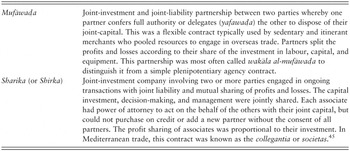
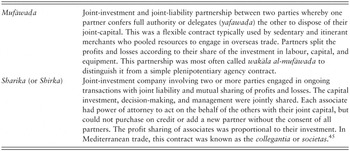
To finance and invest in both international and interregional caravanning, nineteenth- and early twentieth-century trans-Saharan traders relied on several partnerships, with a tendency toward sharing liability among partners. The two most important contracts were the mufāwaa mentioned above and the joint-liability or sharika contract. No trade records or legal discussions of commenda-type limited-liability contracts were found, which may suggest that such contractual agreements were uncommon. The following table summarizes the two basic partnership agreements based on what was encountered in private legal and commercial records.
Mufāwa a contracts
Often called wakāla al-mufāwaa, this partnership agreement was most commonly used on international as opposed to regional caravan expeditions. It was apparently best suited for commerce involving long-term travel from one desert-edge to the other. As noted above, it was a joint-liability contract whereby one of the investors travelled with the joint-capital and plenipotentiary rights to engage in trade. Following Williamson, this contract choice is explained by the context of trans-Saharan trade, where transactions were less transparent across time and space, information asymmetries were high, and the conduct of trade was fraught with danger. Consequently, mufāwaa or ‘pooling contracts’ were ‘applied in environments that featured extreme physical hazards … [and] in which agents’ survival was particularly threatened’.Footnote 46 By pooling capital, camels, expertise, and labour, itinerant traders could finance and sedentary merchants could invest in commercial caravan expeditions. Profits were shared in accordance with investment shares or a prearranged understanding.
In the late 1870s, Amad b. Bāba and his brother Sīdi from Tīshīt (a former caravan crossroads in present-day central Mauritania), contracted a mufāwaa partnership with their father-in-law. He was to work with their capital, namely twenty camels to transport salt for millet, from the oasis town of Shinqīi. For the period of the contract, they were to share the proceeds of ‘twenty camels for nine years each carrying five salt bars to the Sūdān and each one returning carrying loads of standard millet (zar‘a mutawasi)’.Footnote 47 In the nine years that had expired since drawing up the partnership, the brothers had not received their share of the profits, so they sought a legal opinion from a muftī in Tīshīt. They argued that their original agreement stipulated that their partner was responsible for ‘the fodder for the camels during the travel’, and so, in their current calculation, they were owed a total of 10 camels and 110 bars of salt.
Saharan partnership agreements.
In his reply, the muftī began with a statement acknowledging the confusion that could arise in contracts negotiated orally especially between family members. He stated that ‘it was because they were one family and one house and all lend to one another and they all borrow each other's money by way of agency contracts for varying amounts and lengths of time’.Footnote 48 Then the muftī stressed the importance of recording deeds, after determining that, in this case, the partners had no written record of the contractual agreement. In the absence of written contracts, he argued, people had to rely on ‘the fraternity (al-ikhā’), the act of entrusting (al-waī‘a)and the closeness (al-aqrāba)’ between them to solve disputes, because: ‘If the thing was entrusted or taken by contract, time passed between them and it was not written by the owner and the debtor, then the judgment for this is to believe the claimant if he swears … Just like when the owner of the goods makes a statement declaring that he received what was entrusted.’Footnote 49 Based on various Mālikī legal references, including Sanūn's Mudawwana, the muftī ruled in favour of the two brothers by concluding that the partner was responsible for returning the property entrusted to him and their share of the profits.
A more straightforward example of a mufāwaa, and this time a written contract, was negotiated between Mūlāy al-Mahdī and another caravanner, Ibrāhīm wuld ‘Amāra, in the first decades of the twentieth century. Both were traders of the Tikna clan, originally from the Wād Nūn region of the western Sahara. In a pro-forma contract, the first extended to the second a sum of 57 Spanish silver coins (reales) on the basis of a joint-liability/joint-investment contract (wakāla tāma mufāwaa), for the express purpose of purchasing ostrich lard (zihām). The travelling partner, who contributed the camels and other transportation costs, was instructed to resell the lard (typically used in cooking as well as cosmetics) at a profit.Footnote 50
Sharika partnerships
The second type of partnership for which we have evidence was a long-term contract involving the pooling of multi-party investments. Called a company or partnership (shirka, also sharika), this was a joint-investment contract whereby each associate gave and received the right to exchange or otherwise manage their common investment.Footnote 51 Such a partnership was first and most explicitly described in Mālikī sources as a ‘joint investment with joint sharing of profits and risks’.Footnote 52 Typically, one or more investors pooled their capital for a specific venture in which they shared in the profits or losses. Unlike the mufāwaa contract, where the partner had full authority to trade on the behalf of the partnership, in a sharika there was no delegation and all investors had to agree about decisions. Although oral sources maintain that such agreements were not uncommon, little evidence of unlimited company agreements was found in the private commercial record.Footnote 53 Given the logistics of trans-Saharan trade and the non-delegated nature of these companies, it is not surprising that long-distance traders preferred other contractual arrangements.
An early twentieth-century fatwa concerning a multi-party company sheds some light on the use of such partnerships. ‘Abdallah b. Dāddāh, a jurisconsult of the south-western Mauritanian region of Trārza, was asked to rule on the following question concerning a partnership company or sharika: ‘Can company associates allow for one partner to participate but only pay his investment share three months after the drawing of the contract?’Footnote 54 Referring to various sources, from Sīdī Khalīl's Mukhtaar to the Qur’ān, the muftī explained that there was disagreement about this in the legal arena. He concluded with a variation of the oft-quoted Qur’ānic verse, ‘those who believe do not eat each others’ wealth falsely because commerce should be undertaken only by mutual agreement between you (‘an tarā minkum)’.Footnote 55 In other words, the partner could pay his dues later if this was considered fair and if all the other company associates agreed.
A document officially putting an end to a sharika partnership was found in the archives of Mūlāy al-Mahdī, a Tikna who moved from Guelmīm to Shinqīi in the 1880s. The contract states that two trans-Saharan traders ‘disassociated (tafāala) from the partnership (sharika) that was between them and that nothing remains between either one or the other (la naqīra wa lā qamira)’.Footnote 56 No other information is provided to indicate what had been the purpose of the original partnership.
Saharan agency and commission contracts
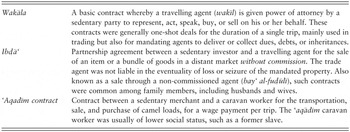
Aside from the investment-pooling partnerships, a great variety of agency contracts and labour contracts for commission trading prevailed between long-distance sedentary merchants, travelling caravanners, and the public at large. Common to both international and interregional caravans, such contracts were used to mandate a person to act on behalf of a principal agent in all kinds of situations, such as the collection of money or the engagement in commerce on commission. Unlike the partnerships discussed above, these contracts tended to be one-shot deals intended to give power of attorney for a specific transaction on a single voyage. Evidence from Saharan archives shows that such arrangements between merchants and traders, women and men, and family members writ large, were commonplace.
Agency contracts (wakāla)
The basic agreement was the shipment-via-agency contract of the kind detailed in the aforementioned legal formula. It consisted of hiring a trade representative or an agent (wakīl) whose specific task it was to collect loans or to sell goods on the principal's behalf. The stationary merchant or party gave power of attorney to the agent to act on his or her behalf and best interest, but the delegation service was on commission. A late nineteenth-century legal opinion concerning a contested agreement between a man and woman for the commissioned sale of goats makes mention of the rate of ‘one-third current rate (darājihi) of the mandate (tawkīl) for the receipt of sale’.Footnote 57 Oral sources indicate that, for what appears to have been a long period of time, one-third of the value of the mandated property was the prevailing commission rate.Footnote 58
Saharan agency and commission contracts.
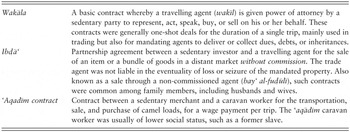
Saharan women made great use of agency contracts, as the following examples illustrate. In 1250 AH (1834 CE), a Tikna woman living in Guelmīm hired her cousin, to whom she gave ‘full and absolute power of attorney’ to collect her father's inheritance, including his written contracts (‘uqūd).Footnote 59 Similarly, in 1292 AH (1875 CE), another Tikna hired her brother to collect a debt of 142 gold mithqāl that she was owed, as well as some unspecified quantity of silver, some cloth, and her camels.Footnote 60 In the year 1322 AH (1904 CE), the Tikna widow Maryam mint Amayda sent her son, ‘Abd al-Qādir wuld ‘Abāba, to collect a debt for an bundle of merchandise of Moroccan origin owed to her father.Footnote 61 Another early twentieth-century agency contract was drafted between a wife and her husband to collect a debt owed to her. The partnership agreement states that ‘she (Azīza mint Muammad b. Bayrūk) commissioned and delegated by the Might and the Power of God, and her agent (wakīl) and her representative (na'ib) is her husband al-usayn b. Mbārak al-Mu‘tī … on the condition that he obtain for her fourteen Moroccan Reál (riyāla asaniya) from the hands of Shaykh Damān b. ‘Abidīn b. Bayrūk.’Footnote 62 As noted earlier, the practice of contracts within families – in this case, between husband and wife – is an indication that trust between family members may not have been sufficient to overcome problems of commitment in long-distance transactions.
Merchants often hired agents to settle long-distance debts. For example, a contract was negotiated between a sedentary Tikna merchant in Guelmīm, Ibrāhīm b. amād ‘Umār, and his paternal cousin Muammad al-Shilī b. Bayrūk in 1307 AH (1889–90 CE). It was written by a Tikna scribe, dated, and certified by two witnesses. The purpose of this agency contract was the collection of a debt totalling 175 Spanish silver coins (reales) owed to the principal contractor by another Tikna trader who had just passed away in Timbuktu.Footnote 63 In an informative twist of events, which took place in 1330 AH (1912 CE), two trade agents reported on the outcome of their mandated mission in a statement intended for the Tikna merchant who hired them, Mūlāy al-‘Arabī wuld Mūlāy ‘Aly, located in the town of ‘Aār (northern Mauritania).Footnote 64 They swore on paper to having buried fifty salt bars in a hiding place in the oasis town of Walāta, located some fifteen camel-days away to the south-east, because of the fear of losing their capital at the hands of Saharan raiders. The document was drafted to ensure the liability of the trade agents, who would have to produce the salt at a later date because they still were accountable, since the capital was not technically lost.
On the other hand, some evidence suggests that agency contracts were not always respected and that the strategy to trade or correspond via proxies could fail. This may have been the case for the late nineteenth-century Tikna woman who wrote to a relative named Limām wuld Arwīlī, inquiring about the whereabouts of her wakīl.Footnote 65 This was also apparently the case in the fatwā mentioned at the beginning of this paper, concerning a trans-Saharan trader who travelled from Tīshīt to Wād Nūn with entrusted merchandise based on a wakāla contractual arrangement for the purpose of trading a portion of it and delivering the rest.Footnote 66 But some merchandise was apparently lost en route and another portion he apparently denied ever receiving. As this case makes clear, the trade agent was not responsible or liable for mandated property in the event of an accident such as a sandstorm or a caravan raid. But, admittedly, in this unusual legal contest, the circumstances of the loss were not sufficiently documented, which is why the wakīl's trustworthiness came into question. Indeed, this case is a reminder that, given the circumstances of long distances, time lapses, and the precariousness of caravanning, written contracts were never full guarantees against the opportunistic behaviour of traders, as Ibn Khaldūn warned, cited at the beginning of this article.
Trade without commission (ibā‘)
Commission-free contractual agreements were common between Saharan family members. They were known as ibā‘ contracts or simply a sale without commission (bay‘ al-fuūlī). In this case, a trade agent was mandated to sell or purchase an item or bundle of goods without commission or profit-sharing, as a service to the principal investor. While Udovitch makes brief mention of it, this type of partnership agreement is not discussed in the literature on Islamic partnerships, but evidently it was common in the nineteenth-century Sahara.Footnote 67 Such agreements resemble the flexible ‘formal friendship relationships’ prevailing between medieval Maghribis, where partners simply exchanged services without financial compensation, as discussed by Greif.Footnote 68
Several nineteenth-century Saharan fatwās discuss the commission-free contract and especially problems arising from prices of mandated goods. In particular, jurists wrote on the difficulties of determining payment amounts when long-distance traders were engaged in multiple transactions and property rights were blurred.Footnote 69 The early nineteenth-century legal expert Sīdi ‘Abdallah b. al-ājj Ibrāhīm deliberated the case of a man who was so commissioned by another to sell salt in exchange for a slave. The contractor had engaged in various intermediary transactions, including the purchase of several male slaves, rendering it difficult to ascertain which particular slave was to be handed over to the investor.Footnote 70
Sometimes these contracts were drafted by women who hired their husbands to trade on their behalf. It was no coincidence that they made extensive use of such contractual agreements to invest in caravans since, as previously noted, few women went on caravans. In a letter of complaint concerning the revocation of the sale of a young female slave, the aggrieved trader described the status of his interlocutor in the following terms: ‘I was informed that he is the purchaser for his wife (mushtarī li-zawjatihi) and that [is how] he earns his living (yatakasib) and thank God. He is her trade agent (wakīlihā) for this [transaction] and this sale is without commission (yakūn al-bai‘ fuūliyan). This kind of sale without commission is common place in this area.’Footnote 71 Although the letter-writer provided no more details about the identity of his commercial correspondent, he is explicit about the fact that he was working in partnership and without commission for his wife's account and that this was the nature of his employment.
‘Aqādīm labour contract
Saharan societies of the nineteenth century used a variety of labour contracts to administer their agricultural and pastoral activities as well as the management of water. In the Wād Nūn region, individuals drew up contracts to manage labour on oasis canalization systems and well maintenance. Moreover, labour contracts were negotiated between date-palm cultivation owners and the workers who tended the trees, for a share of the proceeds. Such contracts were also drawn up to hire caravan workers. Contractual agreements existed between sedentary caravan organizers and the caravan workers known as ‘aqādīm.Footnote 72 Copies of such contracts were not found, perhaps because they were mainly oral in nature. However, two most informative mid-nineteenth-century fatwās shed light on contractual arrangements for the hiring of caravan workers servicing interregional trade.
The first deals with the rights and obligations of the employer when his ‘aqādīm perishes on a caravan expedition. What was particularly at stake here was the deceased worker's compensation and his inheritance. In his response, the muftī cited sources from several Islamic legal doctrines, including the anafī school, to argue that if ‘the ‘aqādīm dies in the course of journey, this nullifies the hiring (al-kirā’) whether he was hired or in limited partnership (muaraban) for the stipulated journey’.Footnote 73 Comparing this to the case of the death of a hired transportation animal or a slave, the muftī concluded that such a death was unfortunate, but that the employer was not responsible to pay an inheritance to the family of the caravan worker, since the contract was necessarily cancelled with the death of the employee.
The second fatwā, dating from the first half of the nineteenth century, similarly addresses the agreements between merchant and ‘aqādīm, especially the question of wages. It had to do with ‘whomever employed an ‘aqādīm who transported [merchandise] for him to the south and sells it there for a determined wage (ujra)’.Footnote 74 The targeted market destination was not determined with precision, but the caravan worker was not to go beyond the market of Nyamina, along the Niger River, considered the limit of travel for Tīshīt caravans.Footnote 75 Evidently the hired caravanner travelled farther and longer than expected. The muftī deliberated whether in this case the contract was invalidated and, if not, how to determine the caravanner's wage accordingly, since ‘for the agreement with the ‘aqādīm, the custom (al-‘urf) is that it [the salary] varies between four and five mudds [of millet]’. Clearly, the sedentary merchant who requested the fatwā was trying to find a way to reduce the wage paid to the caravanner since the latter had failed to find a good market for his merchandise.
In his answer, the muftī argued that such contracts should precisely stipulate limits, including caravan destinations, deadlines, and desired prices. But in case of confusion, it was customary in Tīshīt for both employer and employee to accommodate one another, since ‘both stand to benefit from the additional distance covered … because they share the common aim to maximize profit’. Quoting a number of legal references, the muftī discussed the law on the detours (al-tiwāf) made to obtain better prices in different markets. Citing Sanūn's Mudawwana, he concluded that the ‘aqādīm should be paid the customary wage and should not be penalized for travelling farther or delaying his return.
Other contractual agreements
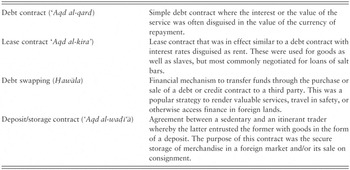
To trade and transfer funds across long distances, trans-Saharan traders made use of a variety of financial instruments. Some of these included the traveller's check (suftāja), and the money order (awāla). Moreover, caravanners made extensive use of forward purchases (bay‘ al-salam), sometimes to finance entire expeditions, as I have discussed elsewhere.Footnote 76 Indeed, receiving payments in advance for future caravan purchases, while debated by nineteenth-century Saharan scholars, was an efficient contractual arrangement to guarantee sales as well as to finance expeditions. But other contractual arrangements prevailed, starting with debt contracts. Table 3 summarizes the types of contracts discussed in this section.
Other Saharan contracts.
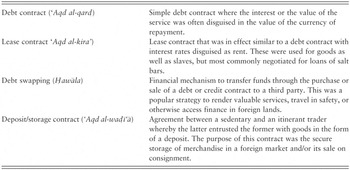
Debt contracts (‘aqd al-qar)
One of the most common types of contract between merchants and traders operating caravans was the basic debt contract. Saharan jurists dealt with so many legal questions concerning loans that they devoted entire chapters to the subject in their legal treatises.Footnote 77 Debt contracts documenting loans in cash or in kind usually stated due dates linked to seasonal events such as fairs. Despite the interdict on usury, rates of interest were often embedded in the value and currency of loan repayments in order to conceal usurious transactions.
An example of a debt contract was drawn up in 1244 AH (1829 CE) between two men and Shaykh Bayrūk, the notorious nineteenth-century leader of Guelmīm. The contract, properly witnessed and dated, concerned six male and six female camels loaned for the purpose of caravan transportation.Footnote 78 The price of the loan was not recorded, but the two travelling partners were to return the camels by the next summer fair. Typical debt contracts for either cash or goods were expressed in gold mithqāl, a weight of approximately 4.25 grams of gold which was current in most of North and West Africa until the early twentieth century. In one such transaction, drawn up in 1281 AH (1864 CE), an Awlād Bū Sibā‘ contracted a loan of 100 mithqāl with a Tikna and ‘the term of this debt is six months’.Footnote 79 Similarly, in 1288 AH (1881 CE), a debt contract was negotiated between Muammad b. ‘Abdallah b. Arwīlī and another Tikna, Muammad al-aritānī, for 65 mithqāl worth of cloth.Footnote 80 Once the creditor had been reimbursed, the written contract was crossed out, and sometimes the conclusion of the contract was witnessed by a third party.
Lease contracts
Another common contractual agreement, which was used predominantly in interregional caravans, was the practice of ‘leasing’ goods. This kind of arrangement was a form of loan with interest disguised as rent. The literature on Islamic finance is oddly silent about such contractual agreements.Footnote 81 Yet, manifestly, these contracts, used primarily for loans in salt, were mechanisms for engaging in covert usury by calling loans with interest by a different name. In other words, by using the term ‘lease’ instead of ‘loan’, Muslim merchants bypassed, at least on paper, the technicality of engaging in usurious finance.
In the late nineteenth and early twentieth centuries, interest rates on salt lease contracts were evidently very high, varying from one-third to half of the value of the salt. As noted earlier, it was the prevailing commercial practice (‘urf al-tujjār) not to record interest or commission rates in contracts.Footnote 82 Oral evidence suggests that salt bars were leased at a standard rate of one-third the price of a salt bar.Footnote 83 So, for instance, traders leased three salt bars from a merchant in exchange for the value of four salt bars. Contracts dating from the early twentieth century, however, reveal interest rates could be higher than 50%.
Commercial correspondence dating from 1329 AH (1911 CE), describing a salt caravan, contains a leasing contractual agreement specifying the interest rate for loaned salt: 60% per load, or three out of five salt bars, were to be given to the proprietors of the camels transporting the salt. On the one hand, the document reveals the arrangements between the owners who leased their camels for transportation. On the other, it informs us about the contractual culture prevailing between caravanning merchants. The letter states:
I am dispatching to amallah b. Amad b. Idda 113 salt bars on lease for 50% (bil-khamsīn) to amallah and three-fifths for the camel owners … If amallah is presently in Tīshīt (God be praised), and the trade agent (wakīl) for it [the camel loads of salt] is you, Abubakar [b. al-Mukhtār al-Sharīf], then the stipulations for the camel owners are that if some salt gets lost along the way it will be taken from their share and not from amallah's share, as per these conditions on the lease contract.Footnote 84
At the average rate of 5 bars per camel, approximately 23 camels were required to transport the 113 salt bars. So the camel owners were to be paid with the sale of 69 salt bars, while amallah, who was responsible for selling the lot, was entitled to 50% of the sale of the remaining 44 bars. This group would most probably have joined a larger interregional salt caravan to travel between Shinqīi and Tīshīt.
Besides salt, there is evidence of other commodities and merchandise leased on specific routes. For example, in a letter by a trader in Nioro (Mali) reporting on loads of dates entrusted to his correspondent in Tīshīt, he explains that he ‘took two baya and twenty dar‘a (lengths of cotton cloth) on lease (bil-kira‘) from Akanbu to Nioro’.Footnote 85 As was often the case with other contractual or even partnership agreements, the termination of a lease contract could be put in writing so as to formally register it and avoid further claims between partners. And so, in 1864, Amad wuld Muammad wuld Idda ‘freed himself from liability from all the salt that he had leased during his stay in Shinqīi … [which] he transported to Walāta and the amount was 124 salt bars’.Footnote 86
Debt swapping and storage contracts
To transfer funds or exchange credit and debt obligations across long distances, merchants typically engaged in debt swapping. In other words, they reimbursed their obligations by finding indebted intermediaries located in the right markets in order to transfer their debt obligations through third parties. This type of financial contract, generically called awāla, was recognized and defined in Mālikī law and was commonly discussed by Saharan jurists.Footnote 87 In one example dating from 1340 AH (1922 CE), ‘Abdallah wuld Labīb wuld Bayrūk, the grandson of the nineteenth-century ruler of Guelmīm, settled his debt of 675 five-franc pieces that he owed to Al-‘Arabī wuld Mūlāy ‘Aly, the son of a prominent nineteenth-century Tikna merchant, by instructing him to collect his dues with a third party who had a debt to him.Footnote 88 By accessing information about the market of indebtedness, traders found additional means to engage in long-distance finance while reducing transaction costs.
Negotiating storage space for the temporary deposit of merchandise was of critical importance to long-distance traders. Trans-Saharan caravanners required trusted lodgers and commercial correspondents to secure the safekeeping of their precious camel loads during their sojourns in foreign markets. The question of storage is one that too few historians have examined, yet it was of vital importance to the success of long-distance trade.Footnote 89 Merchandise could be placed on deposit in a merchant's home on consignment or for temporary storage. Consignment sales were not always profitable, especially when the market went sour, as was the case in an early twentieth-century letter detailing the sale of ‘entrusted’ silver coins, cloth, and dates.Footnote 90 At other times, deposit contracts (‘aqd al-waī‘a) were negotiated for temporary storage of goods with an option to sell at a price mentioned in the contract.Footnote 91 The majority of such contracts were for deposit only, to be retrieved directly or through an intermediary at a later date.
Ledgers, lists, and letters
All of the contractual arrangements discussed above could only exist in a paper economy favouring reliable information flows, transparency, and accountability. As noted above, much information, including contractual agreements, was contained in commercial correspondence. Letter writing, shopping lists, waybills, and the use of account books or commercial ledgers facilitated record-keeping of contractual obligations and communication between long-distance traders.
Before the late nineteenth and early twentieth centuries, it was rare to find trans-Saharan commercial entrepreneurs who made use of account ledgers (kunnāsh) to register their checks and balances. One example was Limām wuld Arwīlī's ledger listing his financial transactions in gold mithqāl, millet, and salt.Footnote 92 Another Tikna trader, Sīdī Muammad wuld al-‘Arabī b. Mūlāy ‘Aly, kept an account-book until his untimely death while on pilgrimage in the 1930s.Footnote 93 His widow, Khadayja mint amad ‘Umar, then continued holding his ledger, recording commercial transactions, providing financial services mainly in the form of short-term loans, and drawing up written contractual agreements with trade agents.Footnote 94 In both ledgers, dues were simply crossed out to indicate payment or contract termination.
Camel owners and their families would place orders and send commercial agents on caravan expeditions equipped with waybills or reminder notes (tadhkīra al-nisyān) detailing goods and terms of trade. Such documents could sometime serve as passports to be presented to potential interceptors and caravan raiders.Footnote 95 The reputation of certain important traders listed therein would often ‘protect’ the caravan from being ransacked by unscrupulous ‘road-stoppers’. The following extract from one of these documents illustrates the types of commercial arrangements prevailing between caravanners. Judging from the mint condition of the paper, this document is, in all likelihood, a copy of the original that travelled with the caravanner. Like most such lists, this one is not dated but, based on genealogical inference, it was written in the first half of the nineteenth century.
Reminder note (ta kira al-nisyān) regarding what the writer can at least expect to receive from his salt … he gives to you (the caravan leader) on behalf of ‘Abdarramān b. al-Ghāsī one mithqāl for the purchase of a good-looking unmarried slave girl (ama jaīda wa ‘uzba) or an ugly but very young one. And six salt bars and one half for the writer and the salt must be sold for gold at the rate of one mithqāl per one and a half salt bars … If millet can be found at the price of four mudd, Footnote 96 then buy the equivalent of five camel loads and five bars (or a total of thirty-five bars). And if millet is less than that then buy three camel loads for whatever price you find.Footnote 97
This interregional caravan was organized by traders of the Laghlāl, the second most important clan in Shinqīi. What is interesting here is the process whereby the caravan shareholders commissioned their trades. The salt loads were to be exchanged for millet depending on current market prices. Orders were at times quite explicit, such as the one to purchase a young slave girl, either nice-looking or very young.
Shopping lists of this kind were also common among international traders such as the Awlād Bū al-Sibā’ and the Tikna, who tended to be professional slave traders. For example, amād b. Muammad b. Bayrūk dispatched a cargo of three enslaved girls and one enslaved boy from Shinqīi via his wakīl to his cousin in Guelmīm.Footnote 98 The letter explains the delivery was delayed due to ‘fear of the road’ (khawf al-arīq). Because they were of little value to subsequent generations, such shopping lists are even less commonly preserved than commercial correspondence.
To better coordinate their activities, trans-Saharan traders actively engaged in letter-writing with family and network members, requesting and supplying information about current prices and market trends, the movements of caravans, the activities of other traders, the latest political news, and so forth. Indeed, letter-writing was the most efficient way to coordinate information flows. Correspondence between traders served a multitude of functions. As seen above, shopping lists in the form of letters often accompanied expedited cargo. To confirm reception of debts sent via a wakīl, a follow-up letter could be initiated.Footnote 99 Letter-writing enabled merchants to monitor their trade agents, settling debts via debt swapping through intermediaries as well as putting pressure on debtors. To enforce contractual compliance, a common strategy was to write to the defaulting party and other members of the community. Writing to the most reputable trader, to a family or clan member, or to the head member of a trade network residing in a distant market, was a common strategy to deal with the problem of enforcement. Sometimes letters were addressed directly to legal service providers such as qāis. Alternatively, directing letters to the widest membership possible, including the debtors, guaranteed that a particular claim became known to the community and to the wider public. Indeed, the use of correspondence relayed by messengers for long-distance debt settlements, including the menace of collective punishment, was a popular strategy in nineteenth- and early twentieth-century Sahara.
A series of letters exchanged in the 1870s between two Tikna brothers living in Shinqīi and Timbuktu was typical in this regard. In the first letter, the writer informed his brother about the outcome on the sale of the cloth that the latter had forwarded. He also provided information about the political climate, before turning to a discussion of price changes, starting with the price of the female slave, which rose from five to seven bales (bayas) of cloth or the equivalent of 56 mudd of Walāta.Footnote 100 A second letter contains similar market information but also details recent debt settlements and the activities of other partners.
Conclusion
Correspondence, written contracts, and trade records were critical to the conduct of trans-Saharan trade. By relying on a variety of contractual and partnership agreements, merchants could not only invest in caravanning but these arrangements also allowed them to engage in profit-seeking by extending credit. Based on his readings of the classic Islamic legal sources, Udovitch recognized (and the Saharan record of financial transactions supports this) that credit was both a form of investment for the provider and a means to access capital for the travelling associate.Footnote 101 But, arguably, there were additional advantages for investors to draft such contracts.
A second advantage was that, by extending credit to trustworthy partners a sedentary merchant invested in his reputation as a generous and trusting partner. Since reputation, trust, and creditworthiness were framed by God-fearing Muslims through the currency of religion, then investing in people was a means of acquiring or reinforcing one's symbolic capital. In this sense, as Kuran points out, contractual agreements were not necessarily founded upon but actually contributed to ‘creating mutual trust’.Footnote 102 Thirdly, finance contracts constituted, in effect, opportunities for merchants to ‘save’ capital by transferring it temporarily to trustworthy partners. This was especially critical when considering the environment of nineteenth-century Sahara, where social obligations and religious practice made hoarding and avarice unacceptable behaviour. Finally, in situations where violence and raiding were imminent threats, rendering risky the engagement in large-scale capital accumulation, then extending credit was a safer means to engage in long- and medium-term savings. This third function of credit, as a savings mechanism in situations of political instability, was perhaps a non-negligible incentive for merchants to extend loans.
The world of trans-Saharan caravanning in the nineteenth century was highly organized. It was reliant upon written documents and principles of Islamic law for the purposes of accounting and accountability. Women as well as men operated in a paper economy through the use of contractual agreements. But, as demonstrated in the case with which I began this article, religious and institutional mechanisms did not preclude trust being broken, partnerships failing or an expedition being ruined because of the dangers encountered along the way. Indeed, as Ibn Khaldūn noted centuries before the nineteenth century, the physical perils involved were only braved by remarkable men who dared to embark on caravan crossings. By the beginning of the twentieth century, the encroachment of colonizing European powers would influence the nature of caravanning.Footnote 103 But further research is needed in order to document and ascertain how the colonial economy transformed the contractual environment of trans-Saharan trade.