‘My Dear Lord Provost’, Lord Rosebery wrote from the Foreign Office on 19 May 1886, ‘The Marquis Tseng, who has just resigned the post of Chinese Minister at this Court, is about to visit Edinburgh with a view to seeing the manufacturing establishments and other objects of interest in your city.’Footnote 1 Tseng's credentials were impressive: seven years as an ambassador to Britain and France; signatory to an opium treaty with the British government in 1885 and Chinese negotiator at the Treaty of St Petersburg when disputed territory was regained from Russia.Footnote 2 Rosebery understandably requested that ‘every attention shall be paid to him’.
Over the next few days, Tseng and the Chinese delegation enjoyed a ‘sight-seeing’ tour that included Holyrood Palace, Edinburgh Castle, Parliament House, the Law Courts, General Assemblies of both the Church of Scotland and the Free Church, the University's new Medical Building, the Museum of Science and Art and an excursion to the Forth Bridge construction site. Lawyers, ministers, professors, military and civic personnel greeted the Chinese party; pipe bands played, and crowds cheered. Industrial Edinburgh was not entirely overlooked. Tseng visited Thomas Nelson's Parkside printing works, and was impressed by ‘the largest lithographic machine in the world’ at the Edina Works of map-makers W. and A.K. Johnston. Though the Chinese party visited the International Industrial Exhibition, most of their time was spent at the recreated ‘Old Edinburgh’ street scene. Despite his own considerable business interests as a publisher, Lord Provost Clark, Tseng's host, commented that ‘in Edinburgh they had not very much in the way of manufacture’.Footnote 3 Industry was marginalized; the image the city sought to project was of castle and kirk, pomp and circumstance, and was intended to promote Edinburgh within the hierarchy of cities on the emerging international exhibition circuit.Footnote 4 Resplendent in their national costume, Tseng and his entourage were received by town councillors wearing shining new civic chains, symbols of a recently minted modernity and a carefully constructed civic identity.Footnote 5 No one captured the historical and downplayed the industrial more than Henry Cockburn: ‘Weavers and calico printers, power-looms and steam engines, sugar-houses and foundries in Edinburgh! These nuisances might increase our population and our pauperism, our wealth and our bankruptcies, but they would leave it Edinburgh no more.’Footnote 6 Lord Cockburn's scathing ‘Letter to the Lord Provost on the Ways of Spoiling the Beauty of Edinburgh’ (1849) elevated the picturesque and romantic and denigrated the functional and utilitarian in the built environment.Footnote 7 His assault on modernity created the conditions for the foundation of a ‘vociferous amenity society’,Footnote 8 the Cockburn Society (1875), and led indirectly to the popularity of R.L. Stevenson's widely read and frequently reprinted Picturesque Notes (1879) on Edinburgh.Footnote 9 Not long before Tseng's visit, the romanticized refurbishment of the High Kirk of St Giles (1881–83) and of Edinburgh Castle (1886) were substantially completed, sponsored by the publishers William Chambers and William Nelson, respectively.Footnote 10 So the gaze of the Victorian visitor focused on the ancient, as represented on the High Street spine of Edinburgh, and on voyeurism associated with the ‘dingy picturesqueness’ of the Cowgate. This ‘invention of a tradition’Footnote 11 denied the wealth created by industry and was downplayed by the city, and its influential citizens.
No doubt civic ceremonies played a part in Tseng's tour of other British cities – Birmingham, Sheffield, Newcastle, Glasgow, Manchester and Liverpool – and these cities lost no opportunity to impress upon the Chinese visitors the modernity of their local industries.Footnote 12 In this ‘Age of Great Cities’,Footnote 13 civic esteem was often synonymous with the wealth generated through industry: ‘cottonopolis’, ‘juteopolis’, ‘worstedopolis’ and ‘coal metropolis’ defined Manchester, Dundee, Bradford and Cardiff more precisely than historic buildings. Elsewhere in the British urban hierarchy, towns were firmly identified by a single industrial product – Sheffield steel, Stoke pottery, Burton brewing. Even the football teams gloried in the dominant local industry, as with Northampton ‘Cobblers’, Luton ‘Hatters’, Walsall ‘Saddlers’ and Yeovil ‘Glovers’.
While specialization contributed to income and wealth in towns and cities, it also exposed them to the vagaries of the markets, and especially to international competition. The dearth of raw cotton from the American South during the Civil War interrupted the prosperity of Manchester and its satellite cotton spinning and weaving towns. Reliance on the ‘staple’ industries – iron and steel, cotton and shipbuilding – skewed the urban structure of production locally, as did a spate of business mergers in the 40 years before World War I.Footnote 14 Edinburgh sought to strengthen its existing capital city status at the apex of distinctive Scottish legal, educational, financial and religious frameworks, as guaranteed by the Act of Union, 1707, and in an era of unionist-nationalism emphasized this through pomp and ceremony, as in the case of Tseng's tour of the city.Footnote 15 These capital city functions, with their superior courts, national assemblies and institutional headquarters became deeply embedded in the city and influenced fundamentally its economic structure and social ecology.Footnote 16 By the mid-nineteenth century, Edinburgh had become a high-ranking international financial centre ‘engrossing all the top legal and much of the top financial business’Footnote 17 of Scotland, and possessed a status that far outstripped the functions of Glasgow and most English regional cities.Footnote 18 Just how significant these information-oriented professionals were has been demonstrated in a study which claims that knowledge-based human capital exerted a systematic and positive influence on the long-run growth of British cities generally: ‘the talk of the bourgeoisie, not the smoke of the factory, was the defining characteristic of the modern city economy’.Footnote 19
The balanced urban economy
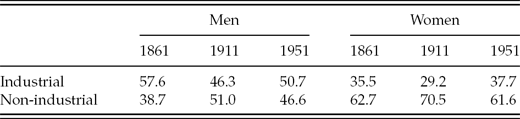
The income, wealth and employment of nineteenth- and much of twentieth-century Edinburgh was generated through a portfolio of professional, financial, commercial, industrial and service activities (see Table 1). Complementarity in the occupational profile provided a considerable measure of stability to patterns of consumption; it reduced the risk of cyclical peaks and troughs experienced in many towns and cities where there was a heavy reliance on a dominant source of income generation. As one contemporary account explained, ‘in a city like Edinburgh there is probably a steadier demand for a certain number of working men than there is in any other city in the kingdom’.Footnote 20 Professional employment accounted for one worker in six in Victorian Edinburgh – more than twice the national average – and provided a steady demand for furniture and fine art, prints and pianos, and generally underpinned the consumption-based industries in the city.Footnote 21 In turn, this supported highly skilled, craft-based firms and sustained a substantial labour aristocracy. Edinburgh in the late nineteenth century was described as ‘the greatest retail shop-keeping centre out of London’Footnote 22 and so ‘small-scale crafts, catering for a “luxury” market, constituted an important component of this employment’.Footnote 23 So, too, were printing, lithography, book-binding, precious metal-working, scientific-instrument making, bespoke clothing and a host of other highly specific activities each heavily dependent upon the consumption patterns of Edinburgh middle-class families. ‘[I]n no other city’, the poet Alexander Smith announced, ‘will you find so general an appreciation of books, art, music and objects of antiquarian interest’. ‘Edinburgh’, he continued, ‘counts great men against millionaires.’Footnote 24 The result, as a contemporary observed, was that ‘the city has a calm, steady character in keeping with the predominance of legal, educational, literary and artistic pursuits, from which it derives its chief maintenance, and contrasts boldly with the fluctuations, excitements and mercantile convulsions which produce so much vicissitude in manufacturing towns’.Footnote 25 ‘There can be no doubt’, according to a modern analysis of the character and composition of employment, that well into the twentieth century ‘it was the metropolitan role of Edinburgh which gave the Lothian economy its structural similarity to the south east of England.’Footnote 26
Employment by sector, Edinburgh, 1861–1951 (%)
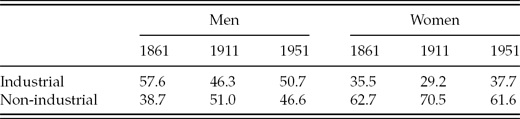
Notes: Industrial includes engineering; machine building; shipbuilding; foundry and metal-working; scientific, optical and precision instruments; coach-making; brick, cement, glass manufacture; pottery; chemicals, including soaps, oils, paints and grease; furniture; milling and food processing; drinks; paper- and box-making; boots, shoes and other leather items; textiles and clothing, construction and gas, water and electricity industries.
Source: Census of Population, 1861, 1911 and 1951. For further details see D. Reeder and R. Rodger, ‘Industrialisation and the city economy’, in M.J. Daunton (ed.), Cambridge Urban History of Britain, vol. III: 1840–1950 (Cambridge, 2000), 553–92.
More generally, the internal structure of the local economy was a conditioning factor in the ‘vicissitudes’ that affected manufacturing towns, and in Edinburgh the density of the national bodies, and the extent of professional employment, presence of military personnel and an army of annuitants, provided a predictability to purchasing power that insulated the local economy against all but the worst of trade cycle fluctuations.Footnote 27 The salary bargain provided more stable terms of engagement in the labour market than waged employment, and in Edinburgh by 1911 ‘commercial clerk’ was the most common occupation for men and, for women, clerical work was second only to domestic service.Footnote 28
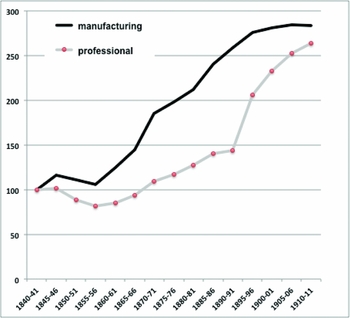
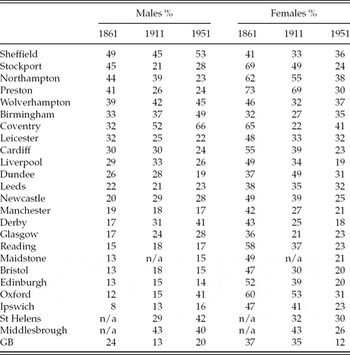
The mixed or balanced economy of Edinburgh was sustained for over a century. What is also striking is the ongoing significance of an industrial sector that accounted for about half the male workforce throughout the 1861 to 1951 period (see also Table 1), and that for most of the nineteenth century the number of manufacturers’ addresses expanded more quickly than those of professional employment (Figure 1). Another feature of the Edinburgh economy was the occupational spread (Table 2) since for over a century only 13–15 per cent of male employment was concentrated in a single industry – one of the lowest percentages in the country. Edinburgh was not alone in having limited exposure to economic fluctuations; Oxford, Cardiff, Maidstone and Ipswich also enjoyed a diversified industrial base. By contrast, in Sheffield, Preston, Stockport, Northampton and Wolverhampton approximately 40–50 per cent of industrial employment was concentrated in a single industry, though where there was a strong engineering emphasis and a multiplicity of small firms the risk of abrupt fluctuations in the local economy was lessened.Footnote 29 These local disparities in the sources and nature of employment merit greater attention in urban history since they conditioned to a considerable degree how citizens lived, worked and played.
Manufacturing and professional employment: Edinburgh, 1840–1911 (Index 100 = 1910)
Source: Edinburgh and Leith Post Office Directories, 1840–1910.

Index of industrial concentration: proportion of males and females employed in the largest single occupational category, 1861–1951

Note: Though this table shows that, for example, 41 per cent of male employment in Preston in 1861 was in a single sector, it does not follow – and was not the case – that the figures for subsequent dates refer to the same sector, but simply that this was the largest concentration of employment in any census category.
Sources: As for Table 1.
Industry downplayed
By manipulating its own image, and continually emphasizing the historic and picturesque, the myth of Edinburgh as a non-industrial city was invented and nurtured. Tseng's tour of Edinburgh, like those for visiting dignitaries and tourists generally, centred on what in 1910 Patrick Geddes termed ‘the dramatic contrast of the picturesque castle and hill town with the regular and utilitarian modern new town’.Footnote 30 It was these panoramic features of Edinburgh, Geddes claimed, that were ‘a great factor in the Romantic movement, of which Sir Walter Scott made Edinburgh for a time the veritable capital’.Footnote 31 Geddes was not misled by this romanticism, far less by nineteenth-century guide books which proclaimed ‘that manufactures are few and on a limited scale’ in Edinburgh.Footnote 32 Quite the reverse: Geddes recognized that James Craig's New Town plan had:
omitted from consideration any provision for anything so vulgar as workshops, for any industry whatsoever; and, consequently the formal beauty for which they had laboured was soon broken in upon and at many places destroyed by the necessary and inevitable filling up of any and every vacant space with any and every sort of irregular and utilitarian factory and workshop.Footnote 33
A listing of employers in the printing trades in 1923 showed a continuing dense cluster of their members in the city centre, and echoed the findings of a study half a century earlier that identified nine metal-working factories and seventeen printworks in the upper New Town district alone.Footnote 34 It was this intermixing of land use, not unlike Charles Booth's London Survey, that Geddes identified in his Municipal Report (1908) with its blue zones linking disease and poverty.Footnote 35 In such respects, Edinburgh was ‘an ordinary manufacturing town . . . able to match Dundee, Glasgow or Lancashire towns in their characteristic perspective of squalor and dreariness of homes, of monotonous confusion of mean streets’, particularly in the Dalry, Holyrood West Port and Fountainbridge areas.Footnote 36 Census enumerators’ schedules for occupations, statutory pollution notices issued as early as 1855 to 112 industrialists and press coverage given to leading firms such as chloroform manufacturer, Duncan Flockhart, and brewers – Younger, Jeffrey, Drybrough, Campbell, Usher and McEwan ‘known in every quarter in the world’ that employed 49 per cent of all Scots in the sector in 1914 – gave industry in Edinburgh a very public presence.Footnote 37 Yet industry in Edinburgh continued to be downplayed after World War I. The Merchant Company set up a Special Committee but their Report reproduced the conventional view, stating that
Edinburgh has no serious claim at present to be considered as an industrial or commercial centre . . . Its striking picturesqueness and historical associations attract visitors from all countries. Its qualifications used to be summarised as Beauty, Beer and Bibles. [Edinburgh] prints and brews, and builds, and works in rubber and metals, but it has no great key industries.Footnote 38
Geddes was exceptional in his realization that Edinburgh was an industrial centre, though he was not an entirely lone voice. In 1936, a lecturer in economics, Nora Milnes, observed that ‘most people who visit Edinburgh are so occupied with its history that they seldom stop to ask themselves the most important question – how do the people live here, what actually are their ways of earning their livelihood?’.Footnote 39 Her subsequent study, based on insured workers, confirmed the continuing significance of the inter-war industrial economy to the capital city. Of a total 125,270 insured workers, 24.5 per cent were employed in the distributive trades, and 24.9 per cent in services – defined as local and national government, professions, entertainment, commerce, banking, insurance, transport and communication, hotels, laundries and the utilities. The remaining 63,317 individuals, equivalent to 50.5 per cent of insured Edinburgh workers aged 16 to 65, were employed in 86 different industrial groupings.Footnote 40 In 1936, Milnes concluded: ‘the welfare of many is bound to depend very largely upon its [Edinburgh's] industrial prosperity’.Footnote 41
The industrial character of the city's economy remained under-acknowledged, and according to Councillor Robertson in a speech during his re-election campaign in 1923 for the industrial Dalry ward to the west of central Edinburgh:
It was not sufficiently realized, he said, that Edinburgh had got the potentiality of being a great industrial centre. The people of the United Kingdom and Europe did not generally realise that they had great industries in Edinburgh. Glasgow dominated Edinburgh industrially. The Town Council ought to do what it could to make it known that Edinburgh had great industries.Footnote 42
Robertson identified the importance of industry to the city as a whole, and proposed that the city council should be more pro-active in addressing the industrial recession of the early 1920s, specifically recommending that it should promote an international industrial exhibition. Far from doing so, or taking direct action to support industry, Edinburgh City Council remained confident that levels of local taxation that were 20 per cent lower than in Dundee, Aberdeen and Greenock, and 33 per cent lower than in Glasgow, would be a sufficient stimulus to local industry in conjunction with its sponsorship of the Edinburgh Society for the Promotion of Trade to ‘disseminate intelligence’ regarding import and export trades, and to identify new sources of raw materials.Footnote 43 By contrast, a number of councils on both sides of the border promoted policies after 1919 to assist industrialists directly. Wigan, Bolton, Coventry and Derby, for example, each formed Special Industries Committees to attract firms mainly through publicity initiatives. In Manchester, through agreements negotiated with utility companies, energy charges were waived or reduced temporarily for new enterprises. Liverpool, Bootle and Wallasey co-operated in their efforts to attract, but not compete for, potential employers, while Hull Council laid out new streets to form trading estates, and Dundee Corporation advertised factory sites and shipbuilding yards free of rent and rates for a limited period.Footnote 44
Just as with Tseng's itinerary in 1886, Edinburgh officials sought to project the city and its capital status and so downgraded the industrial. The political will was weak, and the response to the problems facing the local economy in the 1930s was lacklustre, as exemplified by the projected Sighthill industrial estate on the western edge that remained undeveloped until 1952. In stark contrast, Coventry employers supported technical education in the 1930s through probationer apprenticeships; new arterial roads built in the inter-war years aided industrial development in Leeds, Manchester and London; and Slough Borough Council converted a government war depot into a trading estate in 1926 on which the Slough Estates Company then invested heavily in transport and power infrastructures to attract new companies.Footnote 45 Elsewhere, in Leicester and Northampton, successive generations and business dynasties continued to act as senior political figures and so demonstrated a form of town patriotism in an effort to counter the impact of inter-war depression. Indeed, in Bristol it was precisely this density of and respect for business networks that was instrumental in a metamorphosis in the local economy. The new lines of manufacturing that resulted in the inter-war years, notably in transport and aero-engineering, produced an upward trajectory for the Bristol economy that differed significantly from that of Edinburgh, which it had most closely resembled in the nineteenth century.
The industrial legacy and the post-1945 planning framework
Only with wartime reconstruction planning was the broad-based nature of industry recognized when in 1943 Lord Clyde's advisory committee on city development reported on ‘The Future of Edinburgh’. This document noted that there were ‘205 factories in Edinburgh employing 50 or more employees, and a very much larger number employing less than 50 workpeople’ and so concluded that ‘the industrial life of Edinburgh has always made a substantial contribution towards its progress’ and ‘must not be allowed to decline’.Footnote 46 The Clyde committee's 19 recommendationsFootnote 47 rested firmly on town planning principles that had emerged from an earlier phase of council housing and private residential construction on the urban fringe by firms such as Miller, and Mactaggart and Mickel.Footnote 48 With this informal zoning, ‘fear of an industrial invasion of the city and its residential areas’ was a more remote possibility.Footnote 49 A further restriction on land use was the entrenched power of ‘historical associations’ in Edinburgh and, as Stevenson noted, ‘to make the most of these in an adequate manner would probably be more worthwhile than the introduction of a dozen small industries’.Footnote 50 It was precisely these ‘historical associations’ that underpinned the council's approach to urban renewal based on ‘conservative surgery’ in the city centre.Footnote 51 Thus, for almost a century the myth of the non-industrial persisted until challenged by changing priorities associated with the post-1945 planning framework.
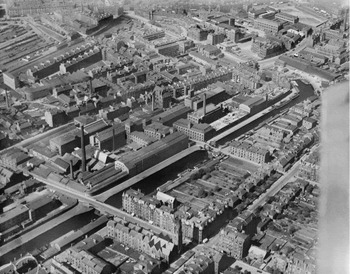
Abercrombie and Plumstead's impressive Civic Survey in 1949 was part of a wider post-war obligation placed on local councils to prepare development plans. While the Civic Survey reiterated that ‘Edinburgh is not an ‘Industrial City’ it also recognized that: ‘The redevelopment of the congested area should not primarily be done to encourage new industries, but rather for the rehabilitation of existing industries.’Footnote 52 After decades of denial, industry could no longer be ignored (see Figure 2). Nor could it be treated in isolation. Traffic, housing, open space, services, educational and cultural quarters became the strategic priorities but their development was constrained by ‘The City's astonishing topography, which with the enrichment of its historic buildings, makes it one of the romantic cities of the world, curbs the exuberance of the reformer, who can use none of the clichés of civic art: Edinburgh binds the designer to her rock-bound site.’Footnote 53 Unlike other cities, the contemporaries claimed that ‘it was not possible to foist upon it [Edinburgh] the blueprint for urban development or redevelopment adequate for the normal city’.Footnote 54 Not only were there physical constraints but also a need to placate pressure groups intent on the defence of historic landmarks.Footnote 55 As Abercrombie recognized: ‘nothing is so likely to arouse controversy and opposition as change or destruction of any of the ancient human landmarks of this city. This cherishing of the heritage of the past is laudable but it makes the work of the planner more perilous.’Footnote 56
Aerial view of Fountainbridge and Union Canal showing North British Rubber Company and Fountain Brewery, 30 May 1929
Reproduced by permission of Royal Commission on the Ancient and Historical Monuments of Scotland, 0006–017–000 405C (Aerofilms 27139).

Like reconstruction plans elsewhere,Footnote 57 Abercrombie's plan was aspirational – beyond the reach and resources of the city in the immediate post-war years. Eventually, in 1957, a more realistic two-stage plan to be implemented over 20 years was agreed by the city council, and reviewed in 1965.Footnote 58 Within this formalized planning framework, the myth of the non-industrial city remained, and even though the industrial workforce constituted 50.2 per cent of total insured employment in 1962, and was more heavily concentrated in expanding sectors than in Britain as a whole, industry came ninth in a list of priorities in the 1965 Review.Footnote 59 With space at a premium, industry was required to compete with alternative uses and successive plans eroded the extent of land designated for industrial use. In 1968, 11 years after the first development plan, there was ‘an acute shortage for industrial development in Edinburgh’.Footnote 60 As the plans and reports identified, the mix of industrial, commercial, service and professional remained a dynamic force in the economy of Edinburgh even into the 1970s. The balanced economy that had served Edinburgh well for a century as an insulation against business fluctuations remained in place. What had changed was the disjuncture between the city council's statements concerning the desirability of the industrial sector and its actions over land-use allocations to ensure it had a continuing role. Reconciling economic development with the historic character of the city was a constant challenge for the local authorities, as recognized by Abercrombie and Plumstead, if ‘preserving the city's present character as the administrative capital of Scotland is to be achieved’.Footnote 61
While the mix of industries sheltered Edinburgh from some of the fluctuations in world markets, the city was not immune to external factors such as national and regional decisions in the 1960s. For example, the planned 199-acre expansion of the Sighthill Industrial Estate was halted by the decision of the secretary of state in 1968 to ‘delete this site from the industrial zoning proposed, and to show it as agricultural land within the green belt’.Footnote 62 Similarly, the decision by the government in 1966 to exclude Edinburgh from Development Area status ensured that investment grants for ‘footloose capital’ rewarded firms that relocated beyond the city's boundaries with subsidies at double the rate available in the capital city.Footnote 63 Furthermore, the Regional Employment Premium introduced during the 1960s to foster industry in depressed areas also disadvantaged Edinburgh since it favoured labour-intensive firms with a large payroll – features uncharacteristic of the industrial economy of Edinburgh.Footnote 64 The result of these institutional arrangements was that by 1972 new manufacturing jobs created just outside the city boundaries exceeded those within Edinburgh by a ratio of more than 3:1.Footnote 65 There were, of course, closures to industrial plants and engineering workshops, such as the Edinburgh Corporation Transport Depot at West Tollcross, the Scottish Motor Traction Sales and Service Co. Ltd and the Fountain Brewery. Some closures were relocations, forced upon companies because city planners favoured other uses for land and thus limited space for expansion. These national and regional decisions stifled the regenerative vigour of the city, and reinforced the drift away from industrial land usage.
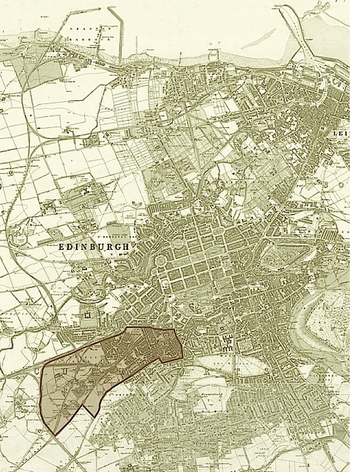
Commissioned research from two business specialists at Edinburgh University and from the city's planning officer, T.T. Hewitson, was published by Edinburgh City Council in 1968 and 1972. These experts questioned the sustainability of the Edinburgh economy and forecasted a 17 per cent contraction in manufacturing employment between 1966 and 1991.Footnote 66 This predicted decline was based not on the collapse of British industry as a whole, as elsewhere, but on the lack of locally available land for industrial expansion. That industrial development was constrained by a land-use policy that privileged incoming investment in office, leisure and retail uses over existing industrial employment can be seen in examples drawn from west-central Edinburgh. This area, formed by the level lands of Fountainbridge, Dalry, Tollcross and latterly Gorgie provided one of the mainstays of the city's nineteenth-century industrial expansion based on canal access and the complex spaghetti of railway lines that brought freight into and out of the city in connection with major capital-intensive plants for brewing, bread and biscuit-making, and rubber products (Figure 3). These in turn were also supported by a multitude of iron-founding, wood-working and engineering firms.
Industrial suburbs: the west-central areas of Dalry, Tollcross and Fountainbridge. 1875
Reproduced from the OS 6” Town Plans by Permission of the National Library of Scotland.

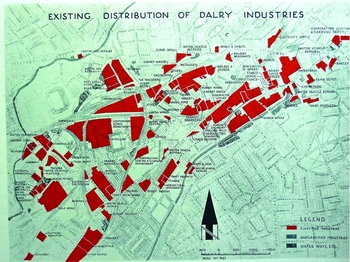
For all its former activity and diversity (see Figure 4), the west-central area experienced a profound spatial and functional change in each era of urban planning from the 1950s to the 1990s, and illustrates the impact of a restrictive land-use policy on economic and industrial development. Where previously factories and a transport hub existed to service the matrix of industrial interests, a new business quarter located at the edge of the World Heritage site materialized by the 1990s and illustrates the transition from industrial to deindustrial to post-industrial and ultimately to the non-industrial city between 1950 and 1990. Manufacturing was replaced by the service sector. Between the Development Plan of 1957 and the Review in 1965, Fountainbridge itself was both geographically redefined from ‘west-central’ to ‘central’, as part of the wider initiative to foster office development on former industrial land, and functionally reclassified from an area of industrial and commercial use to one of ‘general business’ use. At a stroke, the area was re-designated from warehousing and workshops to a locus for ‘office purposes by professional persons, by local authority and government departments and by private business’.Footnote 67 Warehousing was still an option; it was just not the preferred option. Within the post-war planning framework, the aim to retain centrally located industries was compromised by the concentration on the office sector. City planners consciously prioritized office development with 2.4 million square feet of office space completed in Edinburgh in the quarter century 1945 to 1969, with another 0.5 million square feet ‘to be developed in the central area and same outwith the central area’.Footnote 68
The distribution of industry in Dalry, Edinburgh, 1949
Source: P. Abercrombie and D. Plumstead, A Civic Survey and Plan for the City and Royal Burgh of Edinburgh (Edinburgh, 1949), 47.

Marginalization of, rather than support for, industry was again evident in 1966 in the traffic plans for the Comprehensive Development Area at Tollcross. This area, adjacent to Fountainbridge, contained ‘23 firms occupying 27 industrial and storage properties and employed 695 people’ – almost a third of the people within the area.Footnote 69 Primarily an industrial area and at odds with the city's plans, Tollcross and central land nearby was identified as ‘attractive’ as a transport hub and interchange.Footnote 70 Rather than maintain industry within a central area, as stated by the planning documents of 1957 and 1965, by the redefinition of the areas themselves and of the functions of these areas, the position of industry was consistently undermined in favour of office and transport uses.
Far from encouraging industrial development in Edinburgh, land-use policy in the 1970s turned to the promotion of housing, retail, offices, culture and tourism; in fact, anything but industry. This was because in compliance with the Town and Country Planning Act (Scotland), 1969, the city council was obliged to formulate and implement structure and local plans.Footnote 71 The emphasis shifted as a result from the city to the neighbourhood. Specific plans were developed for Leith (1979) Dalry (1980), Tollcross (1982) and Central (1997)Footnote 72 as attention focused on smaller areas. Despite the reference in the local Gorgie–Dalry plan to ‘270 employers who provide 9,500 jobs, mainly in the manufacturing, service and construction sectors’,Footnote 73 the council identified only one site of 2.7 acres that could be redeveloped for industrial purposes in the first five years of the plan.Footnote 74 The effect was that in line with the Inner Cities White Paper (1977) and regional recommendations to ‘stop the outward movement of population’Footnote 75 the Gorgie–Dalry local plan focused on residential rather than industrial needs. This was consistent with a policy that since 1957 prioritized housing, shopping, office, transport and culture above industry.
These priorities, reiterated in the Tollcross Local Plan, 1982, stated that the city council ‘recognises the importance of retaining established firms and encouraging their growth if possible because of their contribution to the local economy’.Footnote 76 However, the main objectives to which the Tollcross Local Plan were directed were to develop housing, to maintain and encourage shopping and, crucially, ‘to promote the early development of the major vacant sites primarily in a manner which will enhance the city's cultural and tourist attractions’.Footnote 77 By consciously encouraging non-industrial uses, land values, and thus rents and local taxation, were increased beyond the capacity of hard-pressed local industries to pay. This was explicitly recognized in 1997 in the Central Edinburgh Local Plan (CELP): ‘High urban land values meant that there was virtually no replacement of industrial development in prospect and vacant sites in previously industrial/commercial use are under development pressure for alternative uses.’Footnote 78
The impact of restrictive land-use planning on this process was eventually acknowledged in 1997 by the Central Edinburgh Local Plan:
The significance of this local plan area for manufacturing has diminished over the last 10 to 15 years and there has been a steady loss of industrial and commercial land to other uses, such as housing and retailing. There is now a limited amount of land in commercial use including storage areas, bonds, depots as well as industrial plants.Footnote 79
The demise of centrally located industry was not just in ‘the last 10 to 15 years’, as identified by the CELP, but as the Development Plan (1957), Review (1965), expert Reports (1966, 1972) and local plans of the 1980s showed, this loss was part of a much longer trajectory which ensured that the myth became reality. Edinburgh was no longer an industrial city.
The collapse of the balanced economy
Industrial employment in Edinburgh peaked in 1951 when it accounted for 51 per cent of the total insured workforce. In 1982, this figure stood at 17 per cent, and by 2001 was just 7 per cent. This dramatic decline was predicted in the reports in 1968 and 1972 by Hunt and Nicholls, and by Hewitson. These experts explicitly stated that, because of its balanced local economy, economic decline in Edinburgh was not inevitable but would be accelerated by the loss of central land for industrial purposes. Therefore, they pressed the city council to release land for industrial expansion in an effort to arrest the loss of employment. Hunt and Nicholls stated: ‘Industrial development in and around Edinburgh should not be regarded as an undesirable encroachment upon the city's amenities, but as something to be encouraged quite deliberately so as to avoid Edinburgh's becoming a museum piece with a colourful past but no very vital future.’Footnote 80 Hewitson reinforced the point, predicting economic decline ‘unless industrial growth in the Edinburgh area was deliberately planned and provisions (e.g. in terms of land) made for it’.Footnote 81 As was evident in the local plans for Gorgie–Dalry and Tollcross, planning policy in the 1980s continued to discriminate against central land for industrial purposes and the myth of the non-industrial city gradually became a reality. By 2001, there were 86 per cent fewer industrial workers in Edinburgh than in 1951. The industrial decline of Edinburgh, though not unconnected to the wider restructuring of the British economy during the 1960s, 1970s and 1980s, was substantially determined by local plans to limit land available for industrial uses.
No longer cushioned by its balanced economy with a significant industrial component, Edinburgh experienced severe levels of unemployment on a par with other British cities. Between 1981 and 1996, the city shed just under half (49 per cent) of its manufacturing jobs; only Merseyside, Greater London, Coventry and Bristol experienced greater losses in percentage terms. Edinburgh lost more jobs than Clydeside, South Yorkshire, Wigan, Hull, Stoke-on-Trent, Hull and Sunderland, places normally associated with deindustrialization.Footnote 82 Yet the industrial decline of Edinburgh was not halted in 1996. Figures for 1995 to 2008 show a continued decline in Edinburgh with a further 63 per cent loss of manufacturing jobs compared to 58 per cent in Manchester and 49 per cent in Glasgow.Footnote 83 The evidence from this double dip in job losses demolishes the myth that Edinburgh was not an industrial city, and demonstrates the painful adjustments to deindustrialization shared with other towns and cities. Regional employment premiums, Development Area subsidies, enterprise zone status and European Union regional aid each, and sometimes successively, eased the adjustment process and ameliorated the impact of deindustrialization in many British cities, though not in the case of Edinburgh. A planning committee member commented, ‘Edinburgh has never had money to be able to pump prime any of these things, unlike Glasgow. It's never had any European money.’Footnote 84 The myth had taken on another dimension: it had permeated regional, national and international thinking to such an extent that agencies at each of these levels believed Edinburgh was not an industrial city and so did not need the financial assistance afforded to such areas.
The localized human consequences of employment loss gave the problem of deindustrialization a specifically inner-city dimension. When the city-wide figures are localized, then the spatial effects of deindustrialization become more apparent. The central locations of Haymarket and Tollcross endured unemployment rates of respectively 14.2 per cent and 13.2 per cent in 1990–91, and male unemployment figures recorded 20.1 per cent and 17.8 per cent unemployment levels.Footnote 85 By 1997 and the formulation of the City Centre Local Plan, unemployment remained high in the central area at 9.8 per cent, and accounted for one third of total unemployment in Edinburgh.Footnote 86 The impact of deindustrialization on the inner city and the cumulative effects of repeated decisions to reduce land available in west-central Edinburgh for industrial purposes were thus profound and prolonged. Yet the myth of a non-industrial city endured, reinforced by Edinburgh City Council's latest marketing slogan: ‘Inspiring Capital’.
One reason for the persistent nature of the myth lies with the relative invisibility of deindustrialization in Edinburgh. The socio-economic problems of industrial decline were masked both by the continued creation of jobs in the professional and service sectors, and by unemployment that was spatially constrained to particular localities. Overall, employment change in Edinburgh during the period 1981 to 1996 enjoyed a 10 per cent growth – double the rate of Edinburgh's nearest competitors, Hull and Cardiff.Footnote 87 Figures for socio-economic groupings show that the rate at which new professional and managerial jobs were created in Edinburgh was exceeded between 1981 and 1991 only by Nottingham and Sunderland. However, this expansion was accompanied in Edinburgh by a loss in unskilled workers between 1981 and 1991 on a scale experienced only by Wigan and Doncaster.Footnote 88 The loss of unskilled workers revealed the gulf between jobs lost and jobs created, as noted by Hewitson who in 1972 doubted whether the growth in Edinburgh's service sector would ‘actually alleviate the severe pockets of unemployment which mainly consists of unskilled workers’.Footnote 89 ‘Inspiring Capital’ was thus a marketing slogan without even the pretence of addressing the structural nature of unskilled unemployment.
The dangers of myths for urban development
Edinburgh has consistently constructed an identity that downplays the industrial. A refined capital city image of culture, class and castle was favoured over one that emphasized an industrial base that lacked the strong identity associated with a single dominant industry. As Ashworth and Voogd noted, ‘a place can only be commodified by means of rigorous selection from its many characteristics’Footnote 90 and even though approximately half the Edinburgh male workforce was employed in industry before 1960, the city had no need to concede its capital city branding by joining a lengthy list of industrial places.
Myths are never designed to reveal truth but are contextual.Footnote 91 Thus, consistent with the process of ‘selling cities’, myths are constructed selectively from an array of existing elements. Within this process, forgetting can be as important as remembering. Forgetting the industrial was not just evident in the external image projected by Edinburgh during the nineteenth century and in the inertia demonstrated during the inter-war years, but it also pervaded official post-1945 planning policies to such an extent that land for industrial consolidation and expansion was consistently denied over a 50-year period. Deindustrialization took place, not, as Morris claims, with ‘relatively good grace’,Footnote 92 but as a conscious series of decommissioning decisions by planners. Denying the existence of industry as part of a marketing strategy is less serious than denying industry land on which to develop, as a number of observers noted from the 1940s to the 2000s; Clyde, Abercrombie, Hunt, Nicholls and Hewitson each implored the city council to release land in the city centre for industrial consolidation and expansion. However, as the examples in west-central Edinburgh showed, land released for industrial purposes was insufficient and caused the city council in 1997 to lament the collapse of the balanced economy and to acknowledge the dangers of this: ‘There has been evidence in recent times of job losses with the financial services industry. This serves as a reminder of the dangers of focussing the employment structure of an area on one industry.’Footnote 93
The long-run consequences of allowing a myth to influence planning policy are still unfolding in Edinburgh. Self-perception and the projection of an external image or brand is an under-acknowledged dimension of urban history but is, as seen in Edinburgh, crucial to policies concerning urban redevelopment. Elsewhere, this has also been the case. In Lincoln, church interests dominated industrial ones until the cathedral united them as part of the heritage industry.Footnote 94 The self-perception of Buxton as a spa and leisure town was sufficiently embedded locally and nationally to deter council housebuilding after World War I for fear of damaging the brand image, and in Nottingham, too, the city's ‘intrinsic view of itself’ was also significant in the policy process with regard to housing.Footnote 95 These examples from the nineteenth and twentieth centuries illustrate the link between promotion and planning. Manchester, like Edinburgh, also suffered from a planning strategy in the 1970s that constrained industrial development.Footnote 96 The collapse of industry in Manchester led to a succession of marketing strategies designed to lessen the severity of deindustrialization, and again like Edinburgh, these strategies conditioned the land-use planning policies. Specific areas were assigned a role within the city: Castlefield became a tourist attraction; the Northern Quarter was home to the cultural and creative industries; Exchange Square and Arndale focused on retail; and Piccadilly for housing and offices. ‘Newcastle Gateshead is Buzzin’, but like Edinburgh's ‘Inspiring Capital’ or ‘Glasgow's Miles Better’ these are marketing devices loosely framed on future expectations of development and have, as the Edinburgh evidence shows, subverted resources and planning strategies in the process.
Buxton, Manchester and Edinburgh, to name only a few, have reconfigured the built environment to align within a specific and narrow conception of the city. Slogans and myths, therefore, are designed with the intention of ‘selling places’ and in doing so they oversimplify the city.Footnote 97 The Edinburgh brand, developed in the nineteenth and reinforced in the twentieth century, demonstrates the risks that such a practice holds. Spreading risk through the diversification of the local economy and the environment is a policy that Cambridge has pursued since the late twentieth century. The pattern of economic development and external imagery replicates that of Edinburgh whereby the university, history and the professions dominate. Land-use policy supported this image. However, in April 2011 and much like Hunt, Nicholls and Hewitson in Edinburgh in the 1960s and 1970s, an evaluation of Cambridge forewarned of the dangers of this narrowly focused policy: ‘over the past twenty years, planning permission for new business space in the Cambridge area has been restricted to research and development and related uses, when permissions should have been granted to a wider range of business uses’.Footnote 98 This policy ‘discriminates against large-scale, high-value manufacturing’ and is proposed to ‘stop the net loss of manufacturing land and remove the cap on the scale of high value manufacturing facilities that can be developed’.Footnote 99 The Cambridge report then warned of the dangers of this restrictive land-use policy, something that Edinburgh City Council only recognized in 1997, a quarter century after such warnings had been issued by Hunt, Nicholls and Hewitson. Prescriptive land-use management contributed to the collapse of the once balanced Edinburgh economy, and if Cambridge is to avoid the large-scale job losses that Edinburgh suffered in the 1980s, 1990s and 2000s then promotion, myth and planning need to be separated.Footnote 100
The landscape of the city, mental and physical, has been redefined as a result of planning policies predicated on an image of the city that differs appreciably from the reality. Place identification with its principal product may trap towns and cities in their historical past, saddling them with myths derived from centuries earlier and conditioning planning and conservation policies according to an embellished, if not fabricated, version of their past. Edinburgh traded on the reality of its knowledge-based professional classes, and on its striking historic environment. This was, however, a partial account and was built on the denial of its industrial record. A more detailed knowledge of the internal economic structure of the local economy is thus a prerequisite for a more accurate understanding of the dynamics of urban redevelopment.