1. Introduction and geological setting
The Pyrenees, the orogenic belt that runs parallel to the natural E–W French–Spanish border, were raised in response to the convergence of the Iberian and European plates in Alpine times. A relevant feature of this belt is its asymmetric fan-shape with opposed vergence of the principal Alpine structures. The Axial Zone of the Pyrenees, a central domain mainly comprising metasedimentary Palaeozoic rocks, is bounded by the North and South Pyrenean zones, where sedimentary rocks of Mesozoic and Cenozoic age predominate. The Axial Zone includes several domes with high-temperature/low-pressure (HT/LP) metamorphism and preserves Variscan structures that allow the recognition of a vertical variation in the tectonic style from the so-called suprastructure at shallow levels to the infrastructure at deeper crustal levels (Zwart, Reference Zwart1963; Carreras & Capella, Reference Carreras and Capella1994). In addition, the Axial Zone contains numerous plutons that range from granitic to gabbroic in composition. These Variscan plutons are distinguished according to their composition, facies distribution or links with their country rocks (Autran, Fonteilles & Guitard, Reference Autran, Fonteilles and Guitard1970; Zwart, Reference Zwart1979; Wickham, Reference Wickham1987; Bickle et al. Reference Bickle, Wickham, Chapman and Taylor1988; Pouget et al. Reference Pouget, Lamouroux, Dahmani, Debat, Driouch, Mercier, Soula and Vezat1989). Taking into account the emplacement level, Autran, Fonteilles & Guitard (Reference Autran, Fonteilles and Guitard1970) classified the plutons into upper, middle and lower massifs. However, it is now widely accepted that there are two main groups of plutons, depending on whether they reached infrastructural or suprastructural levels (Arranz & Lago, Reference Arranz, Lago and Vera2004). While the suprastructure plutons led to wide metamorphic aureoles, the infrastructure plutons lack them, which is consistent with magma ascent to epizonal or mesozonal crustal levels, respectively.
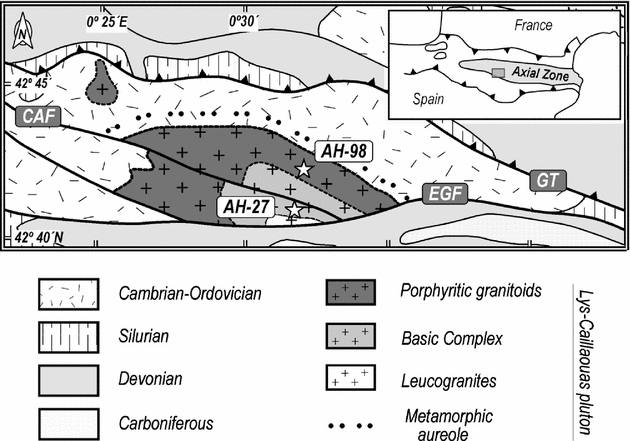
The Lys-Caillaouas zone conforms to one of the metamorphic gneiss domes of the Axial Zone (Fig. 1). It is an ESE–WNW-striking elliptical dome that is flanked to the south by a subvertical and E–W-trending fault, the Esera–Gistain fault (EGF), and is bounded to the north and west mainly by a Cambrian–Ordovician metasedimentary envelope and the Gavarnie thrust (Fig. 1). The envelope consists of a monotonous sequence of schists, quartzites and locally migmatites that is affected by an outward downgrading late Variscan HT/LP metamorphism. It is mainly concordant with the structure of the Lys-Caillaouas pluton (Hilario et al. Reference Hilario, Aranguren, Tubía and Pinotti2003), which crops out in the core of the dome. A narrow contact aureole (Fig. 1) is well developed to the north of the pluton (A. Hilario, unpub. Ph.D. thesis, Univ. Basque Country, 2004), which attests that the emplacement post-dates the regional metamorphism. The age of the widespread Variscan HT/LP metamorphism has been dated to c. 305±5 Ma (Vielzeuf, Reference Vielzeuf, Barnolas and Chiron1996). The country rocks show an ESE–WNW-trending foliation (S2) that dips moderately (35–65°) to the south. This foliation is parallel to the axial plane of the N-verging isoclinal folds, which according to A. Hilario (unpub. Ph.D. thesis, Univ. Basque Country, 2004) represent the main deformation event (D2) associated with dextral transpression.
Schematic geological map of the Lys-Caillaouas massif (modified from Clin et al. Reference Clin, Taillfer, Pouchan and Muller1989) with the location of the dated samples. The metamorphic aureole was drawn according to A. Hilario (unpub. Ph.D. thesis, Univ. Basque Country, 2004). EGF – Esera–Gistain Fault; CAF – Caillaouas Fault; GT – Gavarnie Thrust. The inset shows the location of the study zone in the Pyrenean Belt.

The Lys-Caillaouas pluton is a sheeted intrusion synkinematically emplaced during the long-lasting Variscan deformation. It consists of three main facies: (a) a basic complex (gabbro, diorite, tonalite and quartz diorite), (b) porphyritic granitoids (granite and granodiorite) and (c) leucogranites (Fig. 1), and contains ESE–WNW-elongated xenoliths that preserve the S2 foliation of the country rocks. All of these facies are intruded by late subvertical NE–SW-striking basic dykes, which are called ‘the green dykes’ by Majoor (Reference Majoor1988). The central basic complex, located towards the south of the pluton, is surrounded by porphyritic granitoids. Their primary contacts present a clear magmatic character that is evidenced by mingling and mixing structures and confirm a coeval emplacement. The leucogranite forms a complex dyke swarm that cuts previous facies. The emplacement age of this pluton is not well constrained. Two Rb–Sr isochron ages for the porphyritic granitoids and leucogranites and a K–Ar age for basic dykes were obtained by Majoor (Reference Majoor1988). The obtained ages are 350±14 Ma, 291±6 Ma and 281±7 Ma, which suggests that the igneous complex consists of non-coeval Variscan magmatic rocks intruded into the Palaeozoic metasediments (Majoor, Reference Majoor1988). However, these data disagree with most of the recent ages, which constrain a time span that is still broad, 315 to 300 Ma, for the emplacement of plutons in the Pyrenees (e.g. Romer & Soler, Reference Romer and Soler1995; Paquette et al. Reference Paquette, Gleizes, Leblanc and Bouchez1997; Roberts et al. Reference Roberts, Pin, Clemens and Paquette2000; Ternet et al. Reference Ternet, Majesté-Menjoulàs, Canérot, Baudin, Cochérie, Guerrot and Rossi2004; Gleizes et al. Reference Gleizes, Crevon, Asrat and Barbey2006; Olivier et al. Reference Olivier, Gleizes, Paquette and Muñoz Sáez2008; Denèle et al. Reference Denèle, Laumonier, Paquette, Olivier, Gleizes, Barbey, Schulmann, Catalán, Lardeaux, Janousek and Oggiano2014) and the HT/LP metamorphism at 305±5 Ma (Vielzeuf, Reference Vielzeuf, Barnolas and Chiron1996).
In this work, we present new U–Pb Sensitive High Resolution Ion Microprobe (SHRIMP) analyses of zircons from two different facies of the Lys-Caillaouas pluton. In addition to determining a precise age for the emplacement of the pluton, this work intends to address the temporal relationship between the regional metamorphism and the emplacement of plutons and helps to elucidate the evolution of these concatenated processes during the Variscan Orogeny in the Pyrenees.
2. U–Pb SIMS SHRIMP dating
Two samples, one from the basic complex (AH-27: 42°40ʹ52.17ʺN 0°31ʹ50.13ʺE) and the other from the porphyritic granite (AH-98: 42°42ʹ01.32ʺN 0°32ʹ17.60ʺE), were processed according to routine zircon mineral separation at the University of the Basque Country to date the emplacement of the Lys-Caillaouas pluton. The sample locations are displayed in Figure 1. The selected zircons were mounted in epoxy resin together with the TEMORA 1 and 91500 reference zircons, sectioned approximately in half, polished and analysed on a SHRIMP-II secondary ion mass spectrometer (SIMS) at the Centre of Isotopic Research (CIR) at VSEGEI (Saint Petersburg). The results were obtained following the procedure described by Larionov, Andreichev & Gee (Reference Larionov, Andreichev, Gee, Gee and Pease2004). The obtained U–Pb ion microprobe data were processed with the SQUID 1.02 (Ludwig, Reference Ludwig2001) and Isoplot/Ex 3.00 (Ludwig, Reference Ludwig2003) software using the decay constants of Steiger & Jäger (Reference Steiger and Jäger1977) and are presented in Table S1 in the online Supplementary Material (available at http://journals.cambridge.org/geo).
The morphology of zircons of granite rocks has been used for decades to establish their petrogenesis, the classification of the granite host rock or even to determine the crystallization temperature of the granite magma (Pupin, Reference Pupin1980). The morphology of the zircons combined with cathodoluminescence (CL) and electron back-scattering images were used in the present study to select target areas for analysis. In both samples, the studied zircons mainly display bipyramidal and long prismatic habits.
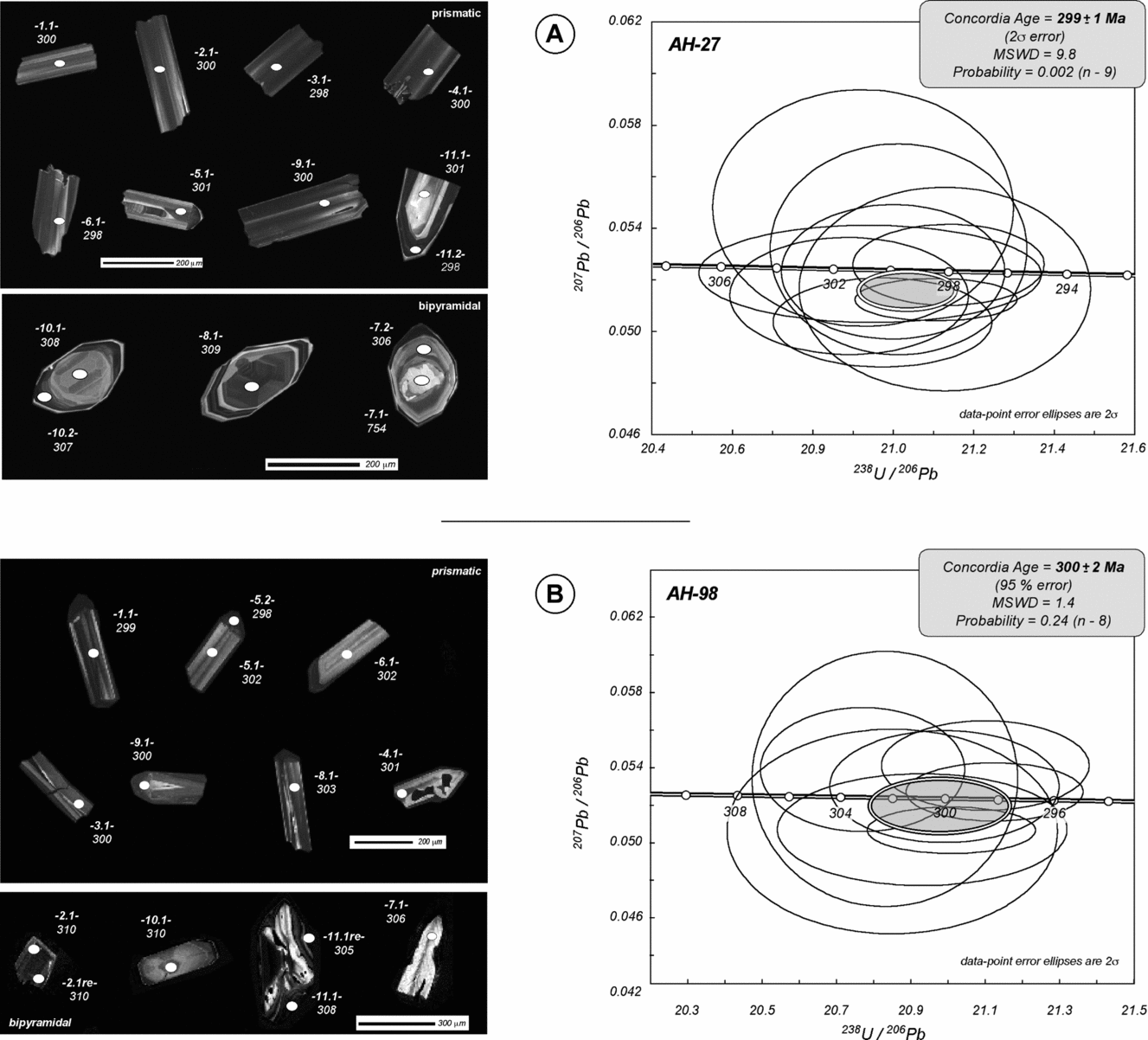
Prismatic zircons present common igneous features (Fig. 2a, b) such as: (1) euhedral morphology, (2) concentric undisturbed oscillatory growth zoning, sometimes with progressively U-rich low luminescent rims, (3) lack of inherited xenomorphic cores and (4) high Th/U ratios, which are scattered between 0.69 and 0.98, except for a single analysis with Th/U = 0.07 (spot AH-98–5.2; Table S1 in the online Supplementary Material available at http://journals.cambridge.org/geo). The frequent presence of (100) prism faces in these zircon grains is consistent with zircon crystallization from low-temperature melts (Pupin, Reference Pupin1980). Nine (AH-27) and eight (AH-98) local analyses were carried out (Table S1 in the online Supplementary Material available at http://journals.cambridge.org/geo; Fig. 2) and yielded 206Pb–238U Concordia ages of 299±1 (2σ) and 300±2 (2σ) Ma, respectively. A high probability of age coherence in both samples is indicated by the overlapping of the concordant data from the samples that define a weighted average 206Pb–238U age of 300±2 (2σ) Ma and are interpreted as the coetaneous timing of the emplacement of the igneous rocks.
Cathodoluminescence images and Tera-Wasserburg plots of the studied prismatic and bipyramidal zircons; (a) sample AH-27 and (b) sample AH-98.

Bipyramidal zircon grains commonly display compositional zoning and structures that contrast with the above described zircons. These zircons (Fig. 2a, b) usually have rounded, possibly corroded cores where weak, sector, fir-tree, convoluted or even patched zoning is observed. A 206Pb–238U age of 754 Ma (Table S1 in the online Supplementary Material available at http://journals.cambridge.org/geo) was obtained from a xenomorphic core. Some of the cores are surrounded by CL-darker oscillatory or weak zoning overgrowth. In some cases, the bipyramidal zircons display oscillatory and sector zoning and sometimes a lack of inherited cores. Four (AH-27) and six (AH-98) local analyses were carried out on some of these bipyramidal zircons areas (Table S1 in the online Supplementary Material available at http://journals.cambridge.org/geo; Fig. 2), avoiding older xenomorphic and mechanically abraded rounded cores of probably metasedimentary origin. Although they do not give concordant ages, both samples yield weighted mean 206Pb–238U ages of 307±2 Ma (95% confidence level). Th/U values for these analyses range broadly from 0.08 to 1. The Th/U contents of sample AH-27 (Th/U < 0.08) are consistent with a metamorphic nature, while the scattered distribution for sample AH-98 (1 > Th/U > 0,04) could imply several sources (metamorphic and igneous) for the bipyramidal zircons. Therefore, because (a) both samples record the same zircon crystallization event at the age of 307 Ma, (b) the Lys-Caillaouas pluton is linked to a gneiss dome formation and (c) is interlayered with metamorphic xenoliths of the Cambrian–Ordovician rocks, we interpret that the age of c. 307 Ma could mark the temperature peak of the Variscan HT/LP metamorphism linked to the formation of the metamorphic dome in Westphalian times, which was prior to the emplacement of the pluton at c. 300 Ma.
3. REE LA-ICP-MS analysis
Trace and rare earth elements (REEs) on zircons were analysed by laser ablation inductively coupled plasma mass spectrometry (LA-ICP-MS) at the University of the Basque Country (SGIker) using a 213 nm New Wave Nd:YAG laser with a pulse energy of ~ 0.1 mJ and a frequency of 10 Hz coupled to a Thermo Fisher XSeries-2 quadrupole ICP-MS. The analytical spot size was 30 μm in diameter, and in most cases the zircons were completely pierced through. The external calibration was performed to NIST SRM 612, and the internal standard was stoichiometry-calculated Zr (Zr = 49.76%). The laboratory staff reduced the data using the Iolite 2.4 software package (Paton et al. Reference Paton, Hellstrom, Paul, Woodhead and Hergt2011; Paul et al. Reference Paul, Paton, Norris, Woodhead, Hellstrom, Hergt and Greig2012).
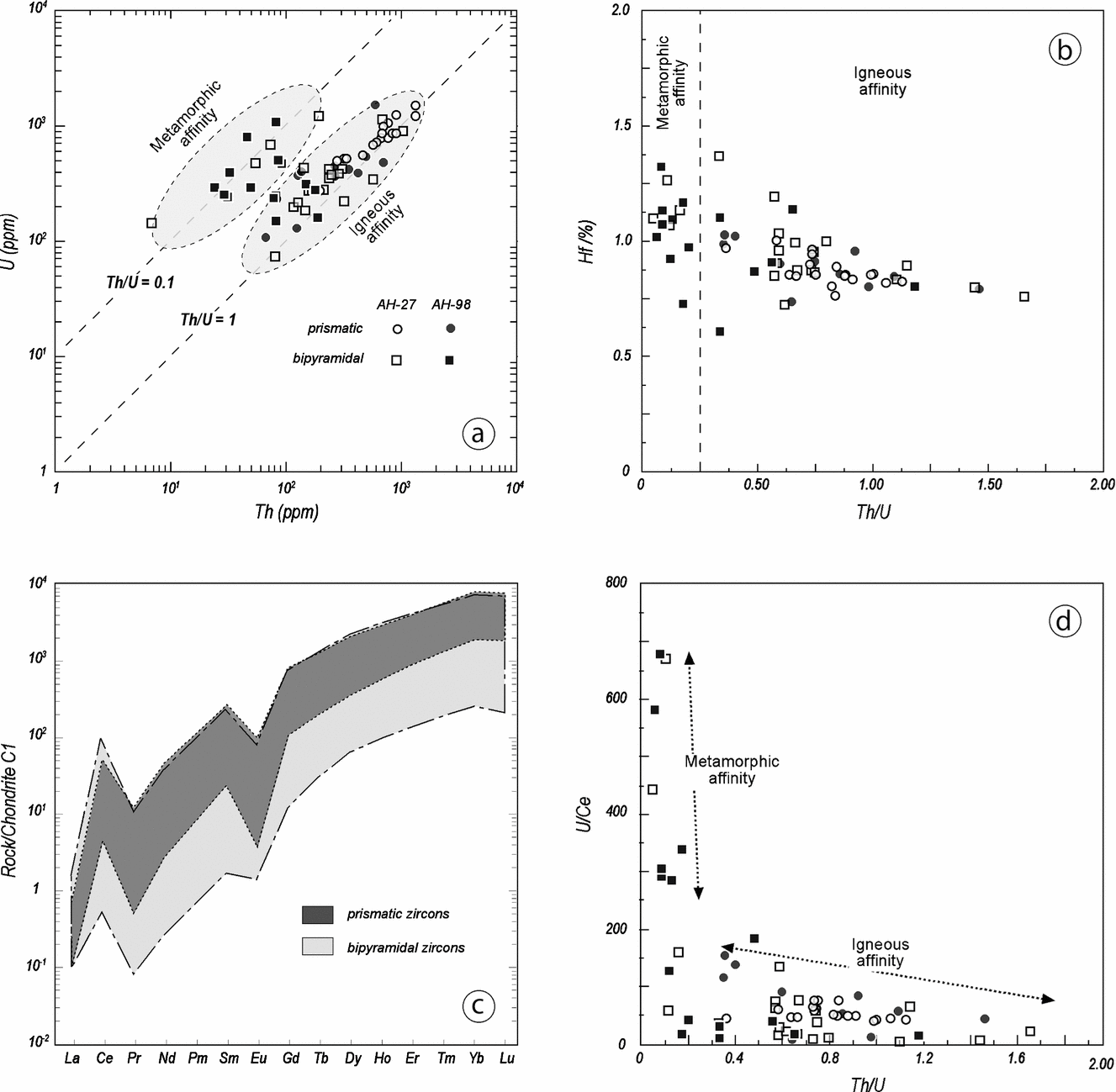
Following the acquisition of the electron backscattered images, more than 100 zircon crystals from samples AH-98 and AH-27 were analysed by LA-ICP-MS. Some of the samples were rejected owing to the presence of inclusions, fractures or compositional zoning. The selected zircon data are presented in Tables S2 and S3 in the online Supplementary Material (available at http://journals.cambridge.org/geo) according to the above defined zircon morphology. The prismatic crystals have higher U and Th contents than the bipyramidal ones and mean Th/U ratios around 1 (Fig. 3a), which contrasts with the wide spread of Th/U values in the bipyramidal grains (c. 1.7–0.05). It is well known that magmatic and metamorphic zircons can be distinguished by their growth zoning and Th/U ratios (e.g. Hoskin & Schaltegger, Reference Hoskin and Schaltegger2003). In this work, the Th/U ratios and observed growth zoning are correlated with a homogeneous population of igneous zircons in the case of the prismatic zircons and with a heterogeneous (igneous and/or metamorphic) population in the case of the bipyramidal grains. In the Th/U versus Hf plot (Fig. 3b), the Hf concentration decreases as Th/U increases, which traces the metamorphic to magmatic zircon trend as the crystallization progressed.
Compositional diagrams of the analysed zircons according to the zircons’ morphology. (a) U versus Th; (b) Hf versus Th/U; (c) chondrite-normalized (Sun & McDonough, Reference Sun, McDonough, Sun and McDonough1989) rare earth element patterns; (d) U/Ce versus Th/U.

Chondrite-normalized REE patterns (Sun & McDonough, Reference Sun, McDonough, Sun and McDonough1989) from the analysed zircons (Fig. 3c) are strongly enriched in heavy REEs relative to light REEs, which depicts a moderate fractionation from La to Yb, with two prominent anomalies in Ce (positive) and Eu (negative). The range of the normalized patterns for both of the zircon populations overlaps, but the prismatic zircons show a narrower and better defined range than that of the bipyramidal grains. The best differentiation parameters and petrogenetic information from zircons are obtained by using several element/ratios (Th, Hf, Th/U, U/Ce, Yb/Gd) in combination with discrimination diagrams, the latter of which are sometimes questionable (Grimes et al. Reference Grimes, John, Kelemen, Mazdab, Wooden, Cheadle, Kanghoj and Schwarth2007). The results of the application of the Grimes et al. (Reference Grimes, John, Kelemen, Mazdab, Wooden, Cheadle, Kanghoj and Schwarth2007) diagrams (Fig. S1a, b in the online Supplementary Material available at http://journals.cambridge.org/geo) are in agreement with the evolution of the zircons from a continental crust. The U/Ce versus Th/U plot has been seen (Fig. 3d) as a potential indicator of the role of water as zircon crystallizes from a parent melt because magmatic melts show little variation in U/Ce as the Th/U concentration varies, while the anatectic/metamorphic melts are enriched in U owing to an increase in the water content (Castiñeiras et al. Reference Castiñeiras, Navidad, Casas, Liesa and Carreras2011). The analysed zircons display a gentle positive slope that is common for magmatic zircons, whereas those zircons that have low Th/U contents fit within the anatectic/metamorphic zircons field. In the Th/U versus Yb/Gd plot (Fig. S1c in the online Supplementary Material available at http://journals.cambridge.org/geo) two main different trends are observed: (a) a well-defined asymptotic trend for zircons that crystallized from an evolving magma (Wooden et al. Reference Wooden, Mazdab, Barth, Miller and Lowery2006) and (b) a vertical trend for zircons grown under metamorphic or anatectic conditions. All of the evidence points to the presence of at least two different populations of zircons of metamorphic/anatectic and igneous origins.
The Ti-in-zircon content was used to calculate the crystallization temperatures of the prismatic zircons by the equation of Ferry & Watson (Reference Ferry and Watson2007). It is well known that the activity of TiO2 and SiO2, or even other parameters such as the pressure, fugacity of H2O and O2 (Fu et al. Reference Fu, Page, Cavosie, Fournelle, Kita, Lackey, Wilde and Valley2008), must be known to obtain accurate and realistic crystallization temperature estimates. Because the study samples are saturated in SiO2 (aSiO2 = 1), rutile is absent (aTiO2 < 1), but ilmenite and sphene are present (aTiO2 > 0.5), we have applied values of aSiO2 = 1 and aTiO2 = 0.5 to calculate the crystallization temperatures. In this approach the temperature will be overestimated by no more than 50°C if the aTiO2 value is higher. All of the zircons from both samples contain comparable Ti average contents (c. 2–4 ppm) and therefore yield similar mean temperatures of 681±13 and 671±9°C for samples AH-27 and AH-98, respectively.
4. Discussion
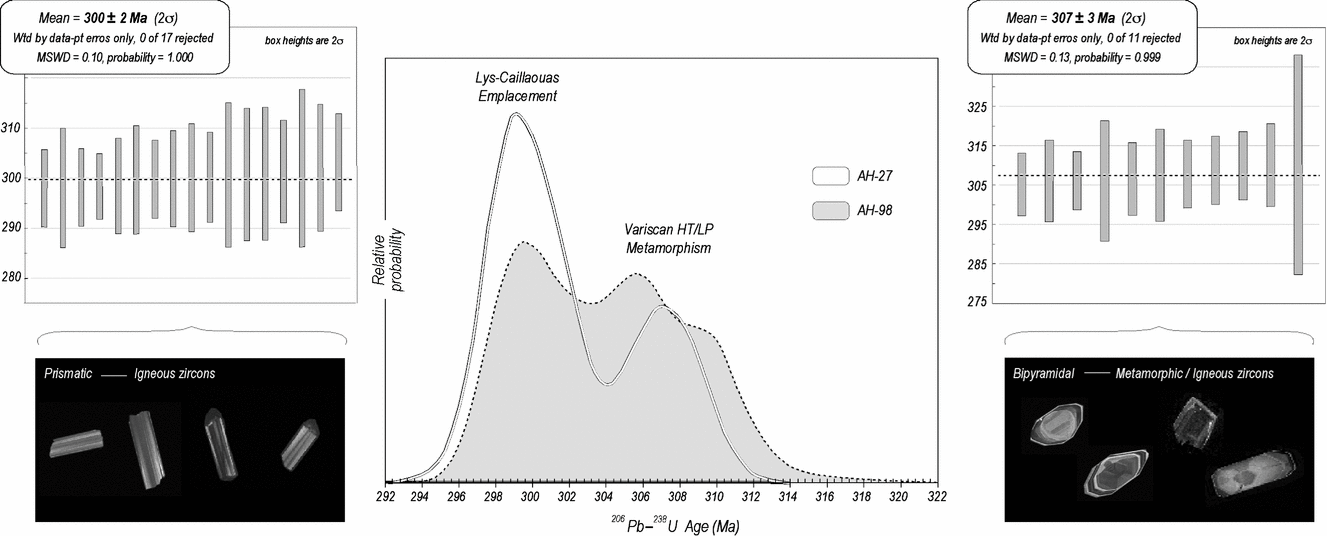
The zircons that were extracted from the Lys-Caillaouas pluton have not been yet reported in other Pyrenean granites and yield uncommon SHRIMP results compared to zircons from granites around the world. These new data aid in the understanding of the tectonic evolution of the Lys-Caillaouas pluton. The following results stand out (Fig. 4): (a) two topologically different zircon families (prismatic and bipyramidal) with different geochemical signatures and (b) a bimodal age distribution in the two end-members, 307±3 and 300±2 Ma, that could imply their different natures.
Bimodal 206Pb–238U age distribution of the analysed samples (note that both of the samples show the same distribution) and the weighted mean ages of the prismatic and bipyramidal zircons.

The Lys-Caillaouas pluton is a sheeted intrusion located in the core of a metamorphic and structural dome (den Brok, Reference Den Brok1989; Hilario et al. Reference Hilario, Aranguren, Tubía and Pinotti2003). From the presence of metamorphic xenoliths bearing S2 and because of the widespread ductile deformation of the igneous rocks (A. Hilario, unpub. Ph.D. thesis, Univ. Basque Country, 2004), the Lys-Caillaouas pluton can be classified as a syn- to late-D2 pluton. The age of 300±2 Ma from the prismatic zircons dates the emplacement of the Lys-Caillaouas pluton and, therefore, the vanishing stages of D2. In this regard, it is important to note that both of the analysed samples yield similar ages that support their simultaneous emplacement. The cooling age of 299.7±1.4 Ma obtained by 40Ar–39Ar analyses on muscovite for the Lys-Caillaouas massif (Metcalf et al. Reference Metcalf, Fitzgerald, Baldwin, Muñoz, Perry and Feinberg2009) supports a fast cooling of the massif. Such fast cooling is consistent with the overall transpressional tectonics that has been proposed for the formation of the Lys-Caillaouas dome (A. Hilario, unpub. Ph.D. thesis, Univ. Basque Country, 2004), as large-scale transpression is an efficient process of crustal exhumation. Other massifs such as the Mont-Louis pluton show cooling rates of approximately 30°C Ma−1 for a period extending from 305 to 290 Ma (Maurel et al. Reference Maurel, Respaut, Monié, Arnaud and Brunel2004). Recent works (Denèle et al. Reference Denèle, Laumonier, Paquette, Olivier, Gleizes, Barbey, Schulmann, Catalán, Lardeaux, Janousek and Oggiano2014) have shown that the doming stage in the Pyrenees for pre- and post-doming facies from the Mont-Louis pluton probably occurred at c. 304 Ma, after the crustal flow and HT/LP metamorphism of the Variscan crust at c. 306 Ma. Regarding the metamorphism, the Lys-Caillaouas pluton developed a narrow contact metamorphic aureole, which overprints the regional HT/LP isogrades and is characterized by the growth of andalusite and the partial replacement of previous-andalusite and biotite by sillimanite (Aerden, Reference Aerden1995). The development of such a metamorphic aureole contrasts with the classical definition of granitoids that are intruded within the infrastructure where no metamorphic aureole is predicted. Therefore, a review of Pyrenean granitoid classification is suggested. In this regard, we think that the age of 307±3 Ma that was obtained from the bipyramidal zircons is mostly related to a metamorphic event and could represent the age of the HT/LP Variscan metamorphism. The obtained ages agree with previously published ages for the HT/LP metamorphism (Vielzeuf, Reference Vielzeuf, Barnolas and Chiron1996). The obtained ages, although coincident within their error limits with those obtained by Denèle et al. (Reference Denèle, Laumonier, Paquette, Olivier, Gleizes, Barbey, Schulmann, Catalán, Lardeaux, Janousek and Oggiano2014), allow us to establish a better age range for the Variscan HT/LP metamorphism and the doming stage of the Central Pyrenees of c. 308–306 and c. 304–300 Ma, respectively.
Age breaks of less than 10 Ma between the emplacement of syntectonic granites and regional metamorphism have previously been reported in other orogenic domains. Although the temporal relationships between the two processes differ from orogen to orogen, very often the magmatism pre-dates or is coeval with the metamorphic event. For example, in the Shuswap metamorphic core complex of British Columbia, the migmatization event is c. 5 Ma younger than the crystallization of the syntectonic Ladybird leucogranite (Vanderhaeghe, Teyssier & Wysoczanski, Reference Vanderhaeghe, Teyssier and Wysoczanski1999), while in the Nigde massif of the Central Anatolian Crystalline Complex (Turkey) crustal melting and granite crystallization was syn- to post-peak metamorphism (Whitney et al. Reference Whitney, Teyssier, Fayon, Hamilton and Heizler2003). Keay, Lister & Buick (Reference Keay, Lister and Buick2001) conducted a geochronological study from the island of Naxos (Greece) that presents many parallels with our study because the main period of magmatism there post-dates the peak of the Miocene metamorphism by at least 5 Ma. Such a separation in age summarizes the zircon differences from four granites and nine migmatite samples from the Naxos metamorphic core complex (Keay, Lister & Buick, Reference Keay, Lister and Buick2001). The singularity of the present study derives from the fact that it demonstrates that zircons extracted from only one pluton may suffice to detect timing gaps between the peaks of the metamorphism and the magmatic activity in the internal domains of orogenic belts.
5. Conclusions
-
(1) The Lys-Caillaouas pluton was emplaced in the Axial Zone of the Pyrenees at 300±2 Ma (Late Carboniferous – Early Permian).
-
(2) The same Concordia ages that were obtained for the basic complex, 299±1 (2σ) Ma, and porphyritic granites, 300±2 (2σ) Ma, confirms their simultaneous emplacement.
-
(3) Ti-in-Zircon geothermometry yields temperatures of c. 680°C for the emplacement.
-
(4) The presence of zircons with metamorphic affinities in both of the study samples suggests the incomplete assimilation of the zircons that were derived from the granite protoliths and opens an opportunity to study the timing of the HT/LP metamorphism or even the gneiss dome formation. The average 206Pb–238U age of c. 307 Ma can be considered to be a good approximation for the thermal peak of the HT/LP Variscan metamorphism prior to the emplacement of the pluton.
-
(5) A short time span of 7 Ma has been established between the metamorphic climax of the high-grade Variscan HT/LP metamorphism (Late Carboniferous) and the final emplacement of the pluton (Late Carboniferous – Early Permian) at middle crustal levels.
Acknowledgements
This work has been supported by grants EHUA13/03 from the University of the Basque Country (UPV/EHU) and CGL2010–14869 and CGL2011–23755 from the Ministerio de Ciencia e Innovación (Spain). The reviews of Drs Gutiérrez-Alonso and Román-Berdiel and the editorial work of Dr Allen contributed to the improvement of the final manuscript.
Supplementary material
To view supplementary material for this article, please visit http://dx.doi.org/10.1017/S001675681500014X.