1. Introduction.
If there is any one characteristic that unifies the texts in the Old High German (OHG) corpus, it must be that they exhibit significant variation in their phonological, morphological, and syntactic structures. One seemingly minor example of morphological variation can be found in the case of the second person singular suffix: While the oldest OHG sources show the inherited -s ending (< PIE +-s), by the ninth century, second person singular forms, even within a single text, oscillate between the original ending and a new composite ending -st. The Franconian texts of Tatian and Otfrid von Weissenburg provide clear examples of this phenomenon.
(1)

(2)
a.
b.

To date, two works, Sihler 1986 and Braune & Reiffenstein 2004 (in the Althochdeutsche Grammatik), have offered accounts of the source and extension of the -t in OHG. Braune & Reiffenstein (2004:261) argue that -t is introduced into the paradigm through processes of cliticization and subsequent reanalysis, a sequence that has been widely accepted by germanists.Footnote 1 A crucial component in this argument is the attestation of forms such as in 3.
- (3)
a.
b.
Though Braune & Reiffenstein do not explicitly discuss the actual mechanics of the process, I assume, for the time being, that the production of these clitic groups creates a phonologically ambiguous situation for the language learner, who ultimately concludes that the alveolar stop belongs to both the verbal inflection and the pronoun. Hence, I characterize Braune & Reiffenstein'saccount of the introduction of the -t into the second person singular verbal paradigm as a case of grammaticalization in that an independent word, thü ‘you’, has become part of a new inflectional suffix -st by way of cliticization.
Sihler (1986:194–195), on the other hand, finds the traditional story deficient in significant ways. He maintains that a cliticization and reanalysis approach does not account for certain “peculiarities” that characterize the historical development of -t in Germanic. The most problematic aspects of this approach are the following: First, the second person singular optative maintains the original ending after the innovative -t is widely attested in the indicative. Second, second person singular verb forms in Old Saxon (OS) show only the -is suffix, despite the fact that the innovative ending is attested in the verb to be, OS bist. Based on these observations, Sihler rejects the traditional cliticization and reanalysis approach and instead argues that analogy to the preterit-present verbs, for example, weist ‘(you) know’, kanst ‘(you) are able to’, tarst ‘(you) dare’, and muost ‘(you) must’, is responsible for the introduction of -st and its extension throughout the second person singular paradigm.
In the current article, I present a data-driven account of the introduction and extension of the -st suffix that relies on both cliticization and analogy to explain patterns of attestation in certain OHG texts. More specifically, I argue that the innovative and original endings correlate with different syntactic environments, namely, verb-first/-second and verb-final, respectively. This claim implies the central role played by cliticization in the extension of -st. I also show, however, that looking at the formal shape of the inflectional ending can elucidate attestation patterns, that is, that analogy is also part of the story. In presenting a comprehensive account of the development of -st in OHG, I also draw conclusions regarding the broader question of how clitics become (part of) inflection. These conclusions have implications for the theories scholars use to describe and explain language change, specifically that of grammaticalization: As the present article shows, the treatment of clitics within a grammaticalization framework does little to help us account for the facts of the extension of -st throughout the verbal paradigm.
2. The Diachrony of -st: Facts and Theories.
I begin this analysis by relating the basic facts of the development of -st, insofar as they have been discussed in the scholarship to date. However, during the course of this presentation, I also provide full descriptions of the two competing accounts of the suffix'sintroduction and extension. Additional care is taken to situate these analyses within the relevant theoretical frameworks, a discussion that is absent in the original works themselves. Finally, I present two alternate ways of viewing the OHG data: one focuses on -st within the framework of what I call form fossilization, while the other looks at the analogical dimensions of this morphosyntactic development.
2.1. Competing Accounts: Cliticization versus Analogy.
Though there is much about the diachrony of -st that does not receive direct treatment in the Althochdeutsche Grammatik, Braune & Reiffenstein are explicit about what they see as the source of the non-etymological -t—it stems from the pronoun thü, which had attached to the preceding verb through encliticization. Left implicit in this conclusion is the idea that, at some point, part of the pronoun must have been grammaticalized and subsequently integrated into the verbal suffix. Within the grammaticalization framework then, one might account for the development of -st by making reference to the grammaticalization cline, which is an adapted version of the one from Zwicky 1977 and Klavans 1982:Footnote 2
(4)
Adoption of such a sequence requires the following assumptions: first, that the cliticization process occurs early enough so that, by the ninth century, the -t of the pronoun has already had enough time to work its way rightward along the continuum, and second, that the process has occurred frequently enough to have made grammaticalization possible in the first place.
Braune & Reiffenstein (2004:261) address the first point by noting that there is relatively early evidence of cliticization among the OHG sources, citing the Frankish baptismal vows, which date to the reign of Charlemagne. The data in 5 are from Braune & Ebbinghaus 1994:38.
(5)
Cliticization of a pronoun onto a preceding verb can be traced even further back in Germanic. In Runic, two forms of the first person nominative singular are attested, a clitic and non-clitic variant, -eka, -ika and ek, ik, respectively (Antonsen 1975:22). Examples in 6 are both from Antonsen 1975.
- (6)
a.
b.
Considering the Runic evidence in conjunction with the early OHG data, it is not unreasonable to conclude that pronominal encliticization as a process begins to occur early enough in Germanic to be consistent with a putative grammaticalization timeline. Regarding the issue of frequency Braune & Reiffenstein remain silent. However, one can begin to fill this gap by first noting that pronominal encliticization of this sort is not unique to OHG and can be found in other historical dialects of Germanic. For example, in Old English (OE) forms such as rītstu (< rīdes(t) þu ‘you ride’) and berestu (< beres(t) þu ‘you bear’) are attested (Campbell 1959:193, 297). Note that textual evidence of the same process in OS is absent, an observation to which I return below. With respect to the most substantial extant OHG text, Otfrid'sEvangelienbuch, Somers Wicka (2009) shows that pronominal encliticization is robustly attested throughout the entire work, not just for the second person singular, which often cliticizes onto the preceding verb, but also in the case of the other personal pronouns, for example, ih, ‘I’, er ‘he’, iz ‘it’.Footnote 3 Though frequency, as a crucial part of the story of -st'sdevelopment, is discussed throughout this article, the larger point to be made now is that the data seem to support Braune & Reiffenstein'simplicit assumption that personal pronouns often cliticized onto preceding verbs, and that this process had been occurring in Germanic centuries before the emergence of OHG.
The traditional account of -st, as it is presented in Braune & Reiffenstein, however, does not discount the role of analogy entirely. Indeed, the authors cite the preterit-present verbs as having “perhaps contributed” (p. 261) to the emergence of the innovative suffix.Footnote 4 In particular, they allow for the possibility of an analogical extension of -t in the case of the verb to be, attested as bist over bis even in some of the earliest OHG sources. Perhaps it is not a coincidence that to be was the first lexical item to show this innovation. Hence, the emergence and extension of -t, as it is characterized in Braune & Reiffenstein, progresses as follows. First, -t appears only in the verb to be. This state of affairs can be observed in texts such as the Hildebrandslied, where bist and pist are attested alongside sis ‘(you) may be’, fortos ‘(you) perpetrated’, spenis ‘(you) goad’, and habes ‘(you) have’. Next, -st begins to replace -s in all present indicative forms. It is only later that -st spreads to the present optative and preterit indicative and optative. Attestation patterns in Otfrid'sEvangelienbuch, according to the authors, corroborate this story in that -t is attested most frequently in the present indicative, but less so in the other three inflectional categories, that is, the present optative, preterit indicative, and preterit optative. In order to investigate these claims, one must turn to the text itself, where one finds the following inflectional distribution of all the second person singular forms.
Inflectional distribution of second person singular forms.

Not included in the 268 tokens are any forms that, for varying reasons, always exhibit the innovative suffix, for example, scalt ‘(you) should’, maht ‘(you) are able to’, bist ‘(you) are’, wizist ‘(you) may know’, as we are interested only in those cases in which we find an oscillation between the innovative and original suffix.Footnote 7 Returning to the data in table 1, note that they are not entirely inconsistent with Braune & Reiffenstein'saccount of -st'sextension—the majority of the second person present indicative forms do show the innovative ending, whereas the majority of forms in the three remaining groups favor the t-less inflection. However, this majority is not always so overwhelming so as to definitively prove their case. In any event, the data indicate that, not surprisingly, the story of -st is more complicated than the handbook account suggests.
Furthermore, Braune & Reiffenstein'sanalysis leaves two important questions unanswered: First, how can one explain the pattern of distribution of the -t in the present indicative, where nearly 38% of the attested forms surface with the original ending? Second, why might the innovative ending surface first in the present indicative and, one assumes, later extend to the other inflectional categories?
This apparent trajectory of -st'sdevelopment is one of the primary reasons why Sihler (1986:194–195) does not subscribe to the traditional explanation that the -t originates from enclitic thü. In his view, the cliticization approach neither accounts for the fact that the new suffix surfaces first with the verb bist (< bis), nor does it explain the later stages of its extension. The account presented in Braune & Reiffenstein also does not address two additional, potentially problematic observations: First, -t becomes a characteristic of monosyllabic verbs and then spreads from there. Second, though the -t is attested in OS bist, it makes no inroads whatever into the general verb paradigm. Instead, Sihler treats the -t in forms such as OE berest ‘(you) bear’, OHG bist ‘(you) are’ or OHG fíndist ‘(you) find’, not as a “fragment of” thü (p. 196), but rather as an analogical extension of the ending found in the second person singular form of those preterit present verbs that happen to end in -st, for example, +waist ‘(you) know’. In other words, the emergence and extension of the -st ending in Germanic is strictly analogical and had nothing to do with a process of (phonological) cliticization, assimilation, and reanalysis.
Leaving aside for the moment the merits of Sihler'soverall argument, his discussion of -st does highlight notable lacunae in Braune & Reiffenstein'saccount. These include their lack of clarity on the actual mechanics of the introduction and extension of the ending, and their failure to differentiate between the effects of what are, presumably, two separate phenomena—cliticization and analogy. These gaps are most evident in their treatment of the first lexical item to show -st, bist. On the one hand, the authors state that the original source of the -t is the pronoun thü, that is, that -t is introduced through cliticization. On the other hand, they advance the argument that the form develops as a result of assimilation, that is, bist assimilated to the group of preterit present verbs that end in -st: uueist ‘(you) know’, kanst ‘(you) are able to’, tarst ‘(you) dare’, and muost ‘(you) must’.
Certainly, this latter statement should have been accompanied by the observation that bis(t) shares a number of formal and functional characteristics with the preterit present verbs in general and the aforementioned group of preterit present verbs in particular. First, as Sihler notes (p. 205), bis, a monosyllabic form, is formally similar to verbs such as uueist, especially when both appear within a clitic group, that is, as bistu and uueistu. In addition, bis(t) is functionally comparable to preterit present forms, in that it is a present tense verb with stative meaning. Another possible point of functional similarity, which Sihler does not mention, is that during the OHG period, the verb to be begins to appear in periphrastic constructions coupled with a nonfinite verb, as shown in 7.
- (7)
a.
b.
c.
These constructions, where bist occurs in conjunction with a non-finite verb, show the same syntactic distribution of verbal elements as the preterit present forms.
Finally, one might also add to Sihler'sargument that similar analogical extension, from the inflectional repertoire of the preterit present verbs to the verb to be, occurred in other parts of this verb'sparadigm: In OHG, the first person plural form birum ‘(we) are’ and the second person plural birut ‘(you-pl.) are’ are both attested. These endings differ from the first and second person inflectional suffixes found in the general verbal paradigm (-umês/-êm and -et, respectively), but are identical to the those of the preterit presents, as seen in wizzum ‘we know’ and wizzut ‘(you-pl.) know’. This evidence clearly indicates that speakers associated the verb to be with the class of preterit presents.
Crucially, however, Sihler still relies on the production of clitic groups such as uueistu and bistu in order to make his analogy argument work, as it is within the clitic group bistu that the verb bis really exhibits the formal similarity to uueist (see p. 205 in particular). Certainly, one should not deny the possibility that the preterit presents exerted analogical pressure, most particularly, on the verb to be. Yet, there is also a good reason to argue that phonological cliticization, assimilation, and subsequent morphological reanalysis have also taken place. For evidence in favor of this viewpoint one might consider dialectal data from Germanic. In certain central and southern Bavarian dialects, for example, the second person plural ending undergoes an evolution similar to the more general process attested in the second person singular. As described in Pfalz 1918:217, 231–233 and Schirmunski 1962:523–524 an innovative, composite suffix has developed out of the original second personal plural -t and -s, a remnant of ees/ös, the old dual pronoun which had replaced ir in these dialects.Footnote 8
- (8)
a.
b.
c.
Pfalz argues that the -ts suffix is formed by way of a phonological cliticization of the pronoun ees onto the preceding verb, which was then followed by assimilation and reanalysis. Thus, the examples in 8 provide evidence of the exact same type of grammaticalization process that occurred in the second person singular in OHG. Moreover, the analogical argument that Sihler puts forth for -st would not explain the emergence and spread of -ts in Bavarian, as it is unclear which formally and functionally similar group of lexical items would be exerting analogical pressure to effect this new inflection in the second person plural.
Data from other Germanic dialects show evidence that the exact same processes of pronoun-onto-verb cliticization, assimilation, and reanalysis have occurred, only with a slightly different outcome. For example, in most Upper German dialects, the pronoun wir ‘we’ has been replaced by mir, a change that was initially prompted by cliticization. Schirmunski (1962:453) proposes the following sequence: gēn wir > gēmər > gē(n) mir ‘we go’. He believes that analogy likely also played a role in the development of the mir pronoun, that is, wir was analogically leveled along the lines of the other first person pronouns mir ‘I.dat’ and mich ‘I.acc’. However, it would be difficult to argue that phonological cliticization and assimilation were in no way involved in the creation of mir, as the pronoun takes the additional step and becomes inflection in certain lower Bavarian dialects, as illustrated in 9. This process generally involves some intermediary cliticization stage.Footnote 9
(9)
One could not fully account for the existence of forms such as wemma and the emergence of the mir pronoun simply by making reference to analogy.
An additional piece of evidence in support of the conclusion that the emergence and the spread of -st are necessarily linked to a process of cliticization comes from the fact that bist is attested in OS, but the original -is is retained everywhere else. Sihler cites this peculiar feature of the development of the ending to bolster his analogical argument. It is interesting to note that, unlike OHG, OS does not show evidence of widespread cliticization. In particular, in the case of the second person singular, out of 62 tokens in which a finite verb is followed by thu, cliticization occurred only five times, and only with a preterit present or optative present verb as the clitic'shost: scaltu ‘you should’, mahtu ‘you are able to’, muosthu ‘you must’, willthu ‘you want’.Footnote 10
Suzuki (2004:11, 330–335) addresses the issue of cliticization and argues that it occurs far less frequently in the Hêliand because of the overall weakening of stress in OS, a process which itself leads to a relative leveling of stressed and unstressed syllables.Footnote 11 Whatever it was that enabled OS pronouns to resist integration into their preceding prosodic word, the data clearly indicate that they were able to do exactly that, and, therefore, it is not unreasonable to assume a link between the lack of cliticization and the failure of -st to spread beyond bist.
Let us now return to the larger argument. The dialectal data show that phonological cliticization, assimilation, and subsequent reanalysis were not confined to the second person singular suffix. Furthermore, by the time of OHG, pronominal encliticization was a well-established, widely attested process. Considering all this, it is impossible to deny the link between cliticization and the emergence of the innovative suffix. It is equally untenable to discount the role of analogy, particularly in the case of the transition from bis to bist and, as I explicitly argue below, wizis to wizist.
However, with regard to Sihler'sclaim that a cliticization approach cannot account for the pattern of the extension of -st throughout the paradigm, I show that the relevant facts can be fully explained only if one assumes pronominal encliticization. In addition, I present a more accurate depiction of the suffix'sdevelopment. In this regard, the current analysis allows for a far more principled account of morphological change—an account that also makes reference to analogical processes. In other words, a closer examination of the cliticization process in the case of -st helps shed some light on how analogical change might unfold, and thus lend the rather mysterious notion of analogy more in the way of explanatory power.
2.2. Grammaticalization or Form Fossilization?
This section draws primarily on the notion of form fossilization introduced in Somers Wicka 2009:31–36. I use this study to enhance the grammaticalization framework and establish clear theoretical parameters within which the -st data can be analyzed. As mentioned in the previous section, the link between clitics and inflection is usually discussed within the framework of grammaticalization theory. In this framework, the following cline is proposed to represent the development of an independent lexical item into a bound affix:Footnote 12
(10)
The unidirectional process represented in 10 assumes that the various elements along the cline differ in degree of their grammaticalization—the bound affix is more grammaticalized than the special clitic, which is itself more grammaticalized than the simple clitic, and so on. As a term, grammaticalization first and foremost makes reference to syntax. In other words, the placement of an independent word within a clause is dictated by syntactic rules. Yet, as that word becomes increasingly grammaticalized and, through cliticization, attaches to other words, its position within the utterance becomes increasingly fixed. Finally, when the originally independent word becomes a bound affix, its placement within the clause becomes determined by the syntactic restrictions on its host (now the stem).
Regarding this diachronic process, however, Somers Wicka (2009) argues that the crucial difference between the independent word on the leftmost end of the continuum and the affix on its rightmost end is not the degree of grammaticalization. Instead, what is significant is that independent words are ordered postlexically, according to the rules of syntax, whereas bound affixes are stored lexically and produced alongside their stem as one syntagm. Applying this approach to clitic groups, the critical stage in the development of a clitic is when a syntactically governed system is added to the lexicon and is “accessed by the speaker as one fixed unit” (p. 33). Somers Wicka refers to this process as form fossilization:
(11)
In arguing for the significance of form fossilization in the diachrony of clitic groups, Somers Wicka'smain goal is to distinguish clearly between grammaticalization as a broad descriptive term referring to a host of individual phenomena, on one hand, and the individual phenomena themselves, on the other. More specifically, form fossilization exposes the fossilized clitic to a number of potential changes, including semantic bleaching and the development of idiosyncratic syntax. Thus, form fossilization is the necessary first step that opens the door for the processes that generally fall under the rubric of grammaticalization. Building on this analysis, I propose a new continuum that reflects changes in terms of degree of syntagm fossilization, as in 12.
(12)
According to 12, the independent word and the actively produced clitic group would both be ordered within the clause by the rules of syntax. One can differentiate between the two by referring to their prosodic status: while the independent word comprises its own prosodic word, the clitic in an actively produced clitic group has been integrated postlexically into the prosodic word of its host.Footnote 13 Unlike the clitic in an actively produced clitic group, the fossilized clitic group and the bound affix are both lexically listed, rather than actively produced. In the case of the affix, the original clitic has undergone a change in function, and possibly a change in semantics if lexicalization occurred.Footnote 14
However, the question remains how to translate the categorizations represented in 12 into identifiable features in the current dataset. Somers Wicka (2009) highlights two characteristics of the fossilized syntagm that can be connected to concrete patterns in data. First, in order for a host and a clitic to become fused into a single lexical unit this particular sequence should be frequently produced by speakers. Translating this requirement into useful historicallinguistics terms one could say that a fossilized form should be one that is frequently attested in the texts under examination. However, “frequently” is a relative term, and the question of whether a construction occurs frequently or not can be difficult to answer when working with historical data. For example, one could be limited to one text based on which it is hard to determine how often a construction surfaced in the spoken language.
Given the restrictions associated with historical data, I assume that, just like in Modern German, verb+thü constructions were fairly regular in OHG. In establishing the presence or absence of form fossilization I rely primarily on the second characteristic, which, according to Somers Wicka (2009:36) “must be equated with fossilized syntax.” If one views form fossilization in this way, that is, as a fixing of a particular syntactic structure, then one would expect the constituent parts of the fossilized syntagm to show some degree of syntactic unity.
Before applying this approach to the -st data, I assume the following. First, the sequence of second person singular verb forms followed by the pronoun thü is frequently produced, with the latter often cliticizing onto the former. As a result of these frequent cliticizations, language learners reanalyze the t as belonging to both verb and pronoun. Second, and most importantly, I assume that the innovative -t, as a fossilized remnant of the pronoun, retains the distributional characteristics of that original pronoun. This means that in transitional texts such as Otfrid, the -st suffix is expected to surface more regularly in those syntactic environments where [verb+thü] clitic groups are also found, that is, in verb-early constructions. In contrast, in verb-final constructions this suffix is expected to surface less regularly.
2.3. The Role of Shape in the Development of -st.
Having established some syntactic parameters that will guide this analysis of the -st data, let us also take a more in-depth look at the role of analogy in the introduction and development of the innovative suffix. As already discussed in section 2.1, Sihler (1986) maintains that the source of the -t was the preterit present verbs (for example, weist ‘(you) know’, kanst ‘(you) are able to’, and muost ‘(you) must’, and that the -t was then analogically extended to the regular verb paradigm, by way of the verb to be, that is, bist ‘(you) are’. Certainly, the fact that bist is fully fossilized in the Otfrid text, that is, the form is always attested as bist, never as bis, speaks in favor of Sihler'sclaim.
However, bist is not the only lexical item that shows signs of fossilization in the Evangelienbuch. The t-ending in the second person singular present optative form of the verb to know, wizist, also seems to have already fossilized by this point: Every one of the 27 attestations exhibits the new suffix.Footnote 5 This could be seen as a minor wrinkle in the analogy argument: wizist, unlike bist, is neither a monosyllabic nor an indicative form, though obviously, it still belongs to the class of preterit presents that always exerted a certain degree of analogical pressure on one another (as discussed in section 2.1). For that matter, a fossilized wizist could also be seen as problematic for Braune & Reiffenstein (2004), who state that extension of the -t occurs in the present indicative first and then spreads to the optative. The fact that other optative forms of the preterit presents do not exhibit the same early adoption of the t—for example, thu mohtis ‘you would have been able to’ (II 14, 43) and wolles ‘(you) may want’ (II 20, 2; III 13, 24; IV 15, 17)—does not help their case. Clearly, the pattern of -st'sdevelopment is more complex than the way in which it is characterized in Braune & Reiffenstein 2004 and, hopefully, more systematic than Sihler's(1986) account implies, even if one does rely on analogy as a means of explicating the data.
In an effort to better understand the Otfrid data let us briefly consider a different, slightly earlier text: the OHG translation of the Tatian gospel harmony.Footnote 16 This text shows a much more limited encroachment of -t in its verbal paradigm. Clearly, despite the dialectal similarities between the two texts it would be a mistake to interpret the Tatian as an earlier form or a direct ancestor of the idiolect in Otfrid.Footnote 17 However, the former text can be used as a point of comparison, that is, as a means of establishing what the earlier stages of -st'sdevelopment might have looked like. For example, the second person singular form of the verb to be in the Tatian is attested as both bis and bist. Exact figures are shown in table 2. The fact that bist is favored over bis is notable, as t-less forms are still favored overall. Out of 281 second person singular forms, only 69 tokens, or about one quarter of the verbs, show the innovative inflection. These data suggest that the extension of the -t began with this particular lexical item and later spread to other verbs.
The verb to be in Tatian (present indicative).

The attestation patterns of -st in the Tatian are revealing for another reason. The verbs that do show the innovative ending tend to bear some sort of formal resemblance to bis(t); that is, the modified inflectional ending generally exhibits an i (long or short).Footnote 18
- (13)
a.
b.
In fact, of the 69 attested forms with the innovative ending, 59 conform to the pattern illustrated in 13a, rather than that in 13b. Given this pattern, let us now consider the second person singular paradigm in its entirety, as presented in Braune & Reiffenstein 2004:ß304 for the Otfrid text.
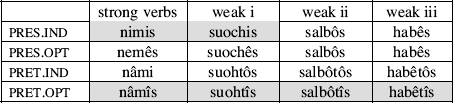
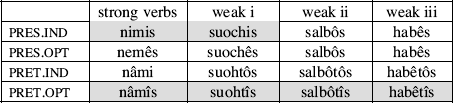
Based on the various shapes of the inflectional endings in table 3, one might expect that the -st ending would be most frequently attested in the present indicative of the strong and class one weak verbs as their suffixes are formally identical to the nucleus and coda of bis(t). Assuming further that in rapid speech, the long i of the preterit optative suffix has the potential to shorten, one might also anticipate the -st ending surfacing in the preterit optative, though probably not with the same degree of frequency as in the previous case. The innovative suffix would be least likely to appear in the unshaded parts of the verbal paradigm. Therefore, in order to test the hypothesis that formal analogy plays a role in the development of -st, Therefore, in order to test the hypothesis that formal analogy plays a role in the development of -st, I look for the following patterns. First, I expect to find the most occurrences of -st in the present indicative of the strong and class one weak verbs. Second, the preterit optatives should exhibit fewer occurrences of the innovative suffix than seen in the previous category. Finally, the rate of the occurrence of -st in the remaining inflections in table 3 should be the lowest.
Second person singular verbal paradigm.
3. Analyzing the Data.
The data that underpin the analysis presented in this article have been drawn from Otfrid'sEvangelienbuch, a unique text within the OHG corpus in that it is an extensive work composed directly in the vernacular. Regarding the development of -st, the Otfrid text shows a seemingly random mixture of both the original and innovative endings. It is also the work that Braune & Reiffenstein (2004) cite when they claim that the -st ending begins in the present indicative and spreads from there (p. 261, as well as the strong and weak verb paradigms presented in the attachment to ß304). As such, it is the ideal text for this examination, as it has the potential for providing a synchronic snapshot of the diachronic process through which -st is introduced and extended.
Before beginning the analysis, however, it is worth dedicating a bit of prose to the direct treatment of two important questions. First, how is the second person singular attested across OHG texts generally? Second, why have I chosen to base my analysis on data drawn from just one of these texts? Analyzing many of the linguistic OHG structures tends to be challenging because the extant corpus is relatively small and also exceedingly limited with respect to text type. Not even considering the interlinear glosses and translations, which could never be suitable for any linguistic analysis with a syntactic component, most of the prose texts are translations into OHG, whereas the poetic texts, as one certainly expects, adhere to some type of metrical structure. In both cases, one must draw syntactic generalizations paying careful attention to the ways in which the source text or the meter might be affecting linguistic forms.
With respect to the attestation of the second person singular in particular, one is restricted in the number of tokens relevant to this investigation simply because instances of direct discourse are rare in OHG texts, thereby limiting the number of second person forms. Further curtailing the size of the dataset is the fact that this study is interested only in those OHG works that show a mixture of the innovative and original endings. Texts from the early and late OHG period, such as the OHG Isidor and the works of Notker, respectively, show one or the other—in the case of the former only the original ending, in the case of the latter only the innovative. Given the lack of inflectional variation, the second person singular forms from these nontransitional texts tell us next to nothing about how -st develops, beyond the tentative conclusion that the change itself seems to not yet have begun by the end of the eighth century and was likely already completed by the year 1000.Footnote 19 To include tokens from nontransitional texts in the dataset would be to include forms that are irrelevant to the questions at hand: This article is interested in a particular process of diachronic change, while texts such as the OHG Isidor and Notker'sPsalms show no evidence of this change.Footnote 20
Thus, the question remains as to when and in which texts oscillation between innovative and original morphology can be observed. Among the major texts that fall chronologically between the Isidor translation and the works of Notker one finds the East Franconian Tatian, the Hildebrandslied, which evinces a mixture of Bavarian and Low German, the South Rhenish Franconian Evangelienbuch and the Rhenish Franconian Ludwigslied. Not included in this list are the syntactically suspect interlinear glosses and translations, the most notable example of which is the early ninth century, Alemannic Benediktinerregel, as well as texts such as the Bavarian Muspilli and the Middle Franconian Trierer Capitulare, both of which have no occurrences of the second person singular.
Among the texts listed above, patterns of attestation may be described as follows. The Ludwigslied has only one token that is of interest: Dôt ni rette mir iz, Al thaz thü gibiudist (line 26) ‘Death will not snatch it away from me, all that you command’. The Hildebrandslied has a few more tokens, eight in total: du sis ‘you may be’ (line 10), du…sages ‘you tell’ (line 11), du…gileitos ‘you have conducted’ (lines 31–32), du bist ‘you are’ (line 39), spenis ‘(you) entice’ (line 40), pist ‘(you) are’ (line 41), du…fortos ‘you perpetrated’ (line 41), du habes ‘you have’ (line 47). Patterns of attestation in the Tatian were discussed above in section 2.3. To wit, only about one quarter of the total relevant forms shows the innovative inflection, though bist is preferred over bis. Finally, the Evangelienbuch, from which I was able to draw a healthy number of tokens—133 in the present indicative alone—and in which oscillation in ending type can be seen—74 of those present indicative forms occur with the t, 33 without—are discussed in detail below.
At this point, one may ask why I did not include all tokens—those from Otfrid, the Tatian, the Ludwigslied and the Hildebrandslied—in one larger database for analysis. The reason is that I treat each OHG text as representing its own discrete synchronic system. In other words, I assume that there is no unified synchronic OHG system, as can be the case for many modern languages that have a standard. Therefore, just as it would be incorrect to assume that differences between the Tatian and Otfrid represent diachronic developments in some imaginary OHG language, it would be erroneous to treat both gospel harmonies as members of one synchronic system just because they are dialectally similar and originate in the same century.
There are, of course, implications for adopting this viewpoint and allowing it to inform one'sresearch methods. Most notably, one must understand and analyze each OHG text in a relatively narrow fashion. In this project, it prevented me from including in the same dataset all the relevant tokens I could isolate in the broader OHG because by doing so I would be treating the four texts as constituents of one linguistic system.Footnote 21
3.1. Placement of the Finite Verb in the OHG Clause.
Taking as a point of departure the framework laid out in section 2.2, this section seeks to highlight distributional patterns in the Otfrid data by linking the innovative ending and the original ending to two separate syntactic environments. Specifically, the goal of this section is to establish the following: (i) whether the putative fossilized suffix -st is more prevalent in verb-early constructions (that is, in the environments where cliticization would or could have occurred, V1/V2), and (ii) whether the original -s is more prevalent in verb-final (Vfinal) position. However, before I focus on the main task, I briefly digress and consider some basic features of the OHG clause.
For the purposes of this analysis, I assume that the finite verb in Otfrid can surface in one of three positions: verb-first (V1), verb-second (V2) and verb-final (Vfinal). Examples of its possible placement are shown in 14.
- (14)
a.
b.
c.
As is the case in many of the older Germanic texts, the underlying position of the finite verb can be obscured by the frequent extraposition of constituents to the right of the verbal bracket.Footnote 23 The phenomenon of extraposition and the resulting clausal ambiguity is demonstrated in 15, in which the verb marks the rightmost edge of the verbal bracket and is bolded, whereas the extraposed constituents are underlined:
- (15)
a.
b.
c.
Following Axel 2007, this analysis assumes that, though the data are variable on the surface, OHG provides only two underlying syntactic locations for the finite verb—Vfinal (the head of the tense/inflection phrase, TP/IP) and V2 (the head of the complementizer phrase, CP).Footnote 24 In 14b and 15b, I treat the finite verbs quati and was as occupying the same structural slot. Similarly, though 14a and 15a on the one hand and 14c and 15c on the other hand can be characterized as V1 and V2, respectively, I assume that the finite verb in all four clauses is located in the head of the CP. In other words, with regard to the position of the finite verb, these clauses are underlyingly the same.Footnote 25
3.2 The Gathering and Categorization of Data.
The dataset upon which this study is based comprises every occurrence of the second person singular attested in the Evangelienbuch (260 total tokens), with the following exceptions.Footnote 26 Not included in the statistical analysis were lexical items with -t that apparently had already been fossilized, such as bist and wizist. Furthermore, the preterit (and optative) present verbs in the present indicative, such as weist, kanst, scalt, wil, and so on. Essentially, I excluded any lexical item whose second person singular ending did not oscillate between -s and -st because this change either had already happened or never happened. Note that optative forms of the verb to be and certain inflectional categories of the preterit presents were included in the database. For example, the present optative of the verb to be is attested as both sis and sist in the text.
Tokens were categorized along formal lines, that is, if the inflection contained an i (î only in the case of the preterit optative) or ô/ê—and syntactic lines—that is, if the verb occurred in V1, V2 or Vfinal position. For the purposes of the statistical analysis, V1 and V2 were collapsed into one category, as both refer to the same structural slot. Tokens were additionally placed into one of four groups reflecting the four inflectional categories of the verb: present indicative, present optative, preterit indicative, and preterit optative. I initially grouped the data in this manner because of Braune & Reiffenstein's(2004) assumption that -st was first attested in the present indicative and then spread to the other inflectional forms.
As I proceeded with the data gathering process and formulated the hypothesis that the occurrence of -st correlated with V1/V2 and the -is suffix with Vfinal, it became clear that, in order to test for the effect of position and shape on ending type I would have to control for inflectional category as well, since certain categories are strongly associated with one type of inflectional shape and, notably, one syntactic position. Specifically, I refer to the present optative verb form, which surfaces in Vfinal position in an overwhelming majority of instances. Recall also that among all the strong and weak verbs, -ês and -ôs are the only possible suffix shape for the present optative, though this inflection form of the verb to be, sîs(t), presents an interesting exception to this generalization. This form is discussed in section 4 below. First, however, let us look at the syntactic distribution of the present optative verbs in the second person singular and the other forms in the verbal paradigm as shown in tables 4 and 5, respectively.
Syntactic distribution in the present optative— 2nd person singular.

Syntactic distribution in the present optative— not 2nd person singular.Footnote 27
Table 4 shows that the present optative verb form strongly correlates to one syntactic position: Vfinal. This trend holds not only for the second person singular but seems also to describe the present optative'soverall distributional patterns as shown in table 5.
Table 6 below shows the distribution of V1/V2 versus Vfinal across the other verb types. Here it is immediately apparent that the preterit indicative, which exhibits only one category of ending, -ês/-ôs, skews fairly heavily in the direction of Vfinal as well, though the overall number of tokens is woefully small. Also showing a limited number of tokens, but a more even syntactic distribution, is the preterit optative. In the case of the preterit optative, though, only one type of ending is attested, -îs. It is unclear to what extent the shape of this suffix is similar to -is when phonetically realized.
V1/V2 and Vfinal clauses in the other verb parts— 2nd person singular.
Finally, note that the present indicative shows the most even syntactic distribution of all the verb parts, that is, it is not associated strongly with either the V1/V2 or Vfinal syntactic position. Furthermore, it exhibits both categories of endings, -is and -ês/-ôs. Also, it has the largest number of tokens. For these reasons, the main focus of the descriptive and statistical analyses is on the present indicative.
4. Syntactic and Analogical Patterns.
4.1. Descriptive Analysis—Present Indicative.
Applying the theoretical assumptions outlined in section 2 to the current dataset, in this section I connect the innovative -st to the V1/V2 syntactic environment, the -s to the Vfinal environment, the -is suffix to the presence of -t, and the -ês/-ôs suffixes to the absence of -t. The predicted patterns are given in table 7.
Predicted patterns.
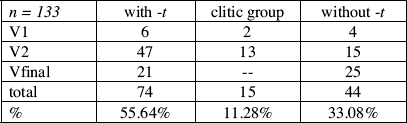
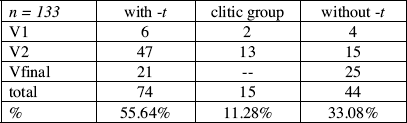
As discussed in the previous section, to avoid any potentially confounding influence that the inflectional category may have on ending type I limit this initial analysis to the second person singular present indicative. As a result, the conclusions are drawn based on a fairly uniform dataset. Beginning with the link between suffix type, -s or -st, and syntactic position, table 8 shows how many tokens appear in the relevant structural slots, while table 9 presents those same numbers in percentages. As is evident in table 9, the expected pattern described at the end of section 2 holds for the second person singular in the present indicative—the -st suffix is preferred in V1/V2, whereas the inherited ending correlates with Vfinal.
Syntactic environment, present indicative—number of tokens.
Syntactic environment, present indicative—percentages.

Now let us see if the patterns discussed in section 2.3 hold for this dataset as well. Again, this analysis focuses only on the distribution of two shape types, that is, -is and -ês/-ôs, in the present indicative. The numbers break down as shown in tables 10 and 11. According to these tables, the verbs with an ending shape formally most similar to the nucleus and coda of bis(t) also tend to exhibit the t. In contrast, the -ês/-ôs shapes associate more frequently with the t-less suffix. In other words, the predictions made in section 2.3 appear to be borne out by these data.
Shape of suffix, present indicative—number of tokens.

Shape of suffix, present indicative—percentages.

Before continuing with the statistical analysis of the present indicative, I must mention the following caveat about the data in tables 7 through 11. The Evangelienbuch does adhere to an endrhyme scheme, which affects the final syllables of the two half lines that comprise one long line. The question is then to what extent those 44 Vfinal second person singular forms are susceptible to alteration due to the dictates of the poetic meter. The verses in 16 illustrate how the metrical structure of the verse can exert influence on the verb'smorphological ending.
- (16)
a.
b.
In 16, the long lines show the possible influence of the meter on the type of suffix that is attested. In both cases, the presence or absence of the -t is likely to have been motivated by the other lexical item that appears verse-finally, Kríst and wís. Note, however, that there exist other Vfinal examples which cannot be analyzed in the same way:
- (17)
a.
b.
In 17a, extraposition of the NP and PP constituents has, in a sense, shielded the verb from verse-final position, where the shape of the inflectional ending could have been affected by the end-rhyme scheme. In 17b, both verbs occur verse-finally, and so in this case one cannot argue that forms yield to pressure from the meter. With regard to all 44 Vfinal clauses, the effect of the meter on attestation patterns is summarized in table 12.
Present indicative—effect of the meter on Vfinal.

Given the total number of verses potentially affected by the end rhyme scheme, it is possible that the data in tables 7–11 are slightly skewed and show higher numbers for the innovative ending -st in Vfinal position than one might expect in a prose text. After looking at the effects of the rhyme on attestation patterns, I had two options with regard to my statistical analysis. On the one hand, I could exclude the clauses where the meter obviously affected ending type. However, this would reduce the total number of tokens in a study that already has a limited dataset and thus compromise the validity of the statistical conclusions. On the other hand, I could include those tokens, in which case the results of the statistical analysis would show a weaker correlation between Vfinal and the t-less suffix.
I opted for the latter approach because the effect of the end-rhyme scheme ultimately affects the analysis in a way that works against my hypothesis. Note that the end-rhyme scheme ultimately bolsters the numbers of -st Vfinally. According to the framework laid out in section 2, this outcome is not favored or expected. If, despite this outcome, I can still show a statistically significant correlation between ending type and syntactic position, on the one hand, or ending type and shape on the other hand, then my final conclusions would be sound.
4.2. Statistical Analysis—Present Indicative.
A Cochran-Mantel-Haenszel test was used to determine the effect of position and shape on ending type within the present indicative dataset. More specifically, it was used to determine if ending type is conditionally independent of shape when controlling for position, and if ending type is conditionally independent of position when controlling for shape. The two possible outcomes for ending type included -st or -s.Footnote 28 Ending shape -is has two variants: -is and -ôs/-ês. There are two possible positions as well: V1/V2 and Vfinal. A p-value smaller than 0.05 indicates that ending and variable X are not conditionally independent when controlling for condition Y. The results are presented in table 13. In both cases, the null hypothesis can be rejected. Based on the results of the test, it can be stated that shape significantly affects ending type when adjusted for position, and vice-versa. More specifically, both the -ôs/-ês shapes and Vfinal position of the verb correspond to the inherited ending, while -is and V1/V2 syntax correspond to the innovative suffix.
Statistical results for the present indicative.

Next, a logistic regression model was used to determine whether any one factor—shape or position—affects which type of ending is attested more than the other. This test can explain the probability that a certain feature—in this case, the presence of the original suffix—would occur as a function of a set of explanatory variables, those variables being shape and position.Footnote 1 I start with the full logistic regression, which reveals that the interaction between the two factors-shape and position—is not significant. Therefore, the interaction term is dropped, and the final regression analysis model contains only the main effects.
The test yields the following findings. Shape and position both are significant factors in determining outcome. Given the same shape, if syntactic position changes from Vfinal to V1/V2, the chances of the -s surface form decrease by 73.8% (=1 −0.263). Given the same syntactic position, if shape changes from -ôs/-ês to -is, the chances of the -s surface form would decrease by 78.4% (=1 − 0.216). As is evident from these numbers, the change of shape has a slightly larger impact on ending type than change of position. Based on the results of the logistic regression, I also calculate the probabilities of the occurrence for each possible shape and syntactic position in table 14.
Probabilities of the original ending surfacing in the present indicative.

Most notably, the probability of the original ending in V1/V2 with the -is shape is about 1 in 5, whereas the probability of the same ending in Vfinal with the -ôs/-ês shape is about 4 in 5. It can be concluded that in the present indicative, the formal shape of the ending and the syntactic position of the verb are discrete, independent factors that determine the occurrence of the innovative ending. Thus, the predictions made in section 2 are born out, and the results are statistically significant.
4.3 Toward an Account of the Extension of -st.
In an effort to piece together a comprehensive story of the development of -st, I now consider the second principle part of the verb, for which I have a fairly large number of tokens. Note that the dataset for the present optative is a slightly more varied group of forms as the statistical analysis includes the present optative form of the verb to be in addition to all the strong and weak verbs. Therefore, this section begins with a basic presentation and statistical analysis of the data.
Distribution of shape and position in the present optative—all verbs.
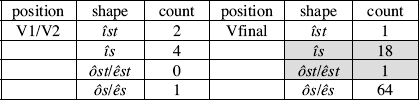
As described in section 4.2, a Cochran-Mantel-Haenszel test was used to determine if, in the present optative, ending type is conditionally independent of shape when controlling for position, and if ending type is conditionally independent of position when controlling for shape. In contrast to the present indicative, however, I found no statistically significant association between shape and outcome when controlling for position. When testing for an association between position and ending while controlling for shape I found that the p-value comes closer to the 0.05 threshold, but it still falls short of statistical significance.
Statistical results for the present indicative.

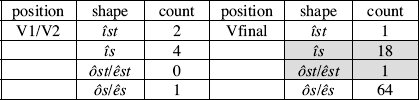
Based on these results, I conclude that the numbers for the present optative add little to the discussion of the development of -st. Yet, if the group of strong verbs is separated from the attestations of the verb to be, one can see that formal analogy and syntactic position also play a role in attestation patterns in this inflectional category. Let us first note that among the strong and weak present optative verbs with the -ôs/-ês ending, the innovative -t is attested only once. This form is highlighted in table 15 and the line itself is presented in 18.
(18)
Interestingly enough, in this single example, the -t occurs with a verb in Vfinal position, an outcome that would not be predicted by the arguments in this article. Of course, one can hardly draw any conclusions based on a single token.
In the rest of the present optative dataset, the innovative ending is attested with the verb to be, which with respect to its shape and function is similar to the apparently fully fossilized bist and wizîst. The breakdown of the present optative for the verb to be is given in table 17.
Distribution of the verb to be in the present optative.

The tokens in table 17 account for every attestation of the îs inflectional shape in the present optative, except for two tokens, namely, two occurrences of the îs shape in Vfinal position (the relevant cells in table 15 are also shaded). One of these tokens is the present optative of the preterit present verb muaz, attested as muazîs (II 24, 38). The other token is the present optative form of the verb rusten ‘to equip (oneself)’.Footnote 30
(19)
The form rustîs should have surfaced as rustês, but under the influence of the meter the present tense form was modified so it would rhyme with the preterit structure in the preceding line. Since this token is influenced by the end rhyme scheme it is not included in the larger analysis of the present optative.
I offer the following interpretation of the data in tables 15 through 17, and in example 18. In the present optative of the strong and weak verbs, the -t has made few inroads into the verbal paradigm. In fact, only one verb that exhibits the -ôs/-ês shape in its inflection also has the innovative -t. The 65 remaining forms (see table 15) are t-less. This state of affairs is not surprising, given the fact that all of these verbs have inflectional shapes most dissimilar to the source of -st, that is, bis(t); all but one occur in Vfinal position–the syntactic position never associated with cliticization. The -t is attested in the present optative in various forms of the verb to be, which has two counts of sîst in V1/V2 and one count in Vfinal position. Though a sizable majority of forms maintain their original form, the -st suffix is making its way into the paradigm, likely through analogy to the fossilized bist.
I would also like to discuss in more detail a group of forms briefly mentioned in section 2: the present optative of the preterit present verb to know. All 27 attestations in this group show the -t, not counting the two cases in which the pronoun thü has cliticized onto the preceding verb. What is particularly notable about this form (beside the fact that it also exhibits the -îs suffix) is that it always occurs in V1/V2 position in the text, never Vfinally.Footnote 1 Moreover, it is frequently contained within a formulaic interjection that Otfrid consistently employs throughout the text as a means of attesting the veracity of his stories and also augmenting half lines that would otherwise be too short.
- (20)
a.
b.
c.
Given the fact that this verb appears in a frequently produced collocation, and that it always appears in C (that is, V1/V2) where it is followed by the pronoun, this form looks like a paradigmatic example of form fossilization, as defined in section 2. In addition, wizîst exhibits an ending formally similar to -is, and it is a preterit present, that is, it belongs to a class of verbs that originally served to introduce and reinforce the use of the -t in the second person singular. All this considered, the fossilization of -st in this case seems almost inevitable.
Finally, I briefly discuss the preterit indicative and the optative. Both types of forms are much less frequent in the text, and as a result one can draw only limited conclusions about them. Note that the final two inflectional categories are different from the first in that the shape of the inflectional ending does not play a role in the statistical analysis: The preterit indicative shows only the -ôs/-ês ending, and the preterit optative only shows the -îs ending.
According to the predictions in section 2, there should be few attestations of t in the preterit indicative, but perhaps more in the preterit optative. The basic data breakdown for the preterit indicative and optative is presented in tables 18 and 19. Both sets of data (the preterit indicative and the optative) were analyzed using a Fisher'sexact test, which is valid for counts less than five. The goal was to determine if there is a link between the syntactic position and the ending type, that is, the presence or absence of -t.
Distribution of shape and position in the preterit indicative.

Distribution of shape and position in the preterit optative.Footnote 33

The results of the statistical analysis are shown in table 20. The predictions offered in section 2 are borne out to a certain extent. First, the association between position and ending type in the preterit indicative is significant: The original ending appears more often in Vfinal than in V1/V2. Taking into consideration the shape of the inflectional ending and the fact that most occurrences are Vfinal, this result is not surprising.
Statistical results for the preterit indicative and optative.

In contrast, the association between syntactic position and ending type in the preterit optative is not significant. I believe that this lack of statistical significance can be explained as follows. First, as I have mentioned before, the actual phonetic quality of the long i in this part of the verb is difficult, if not impossible, to discern. Second, unlike the case of wizîst, most of the preterit optative forms attested in the text (except two) do not belong to the class of preterit present verbs. Therefore, they do not have the same association with the -t suffix that wizîst does. Finally, one could also point to the fact that the majority of preterit optative forms surface in Vfinal position (12 tokens to 6, or 66.67%), which might ex-plain why the original ending is preferred.
5. Conclusion.
In this article, I have characterized the introduction and extension of the second person singular -st suffix in OHG as follows: First, -t spreads to the present indicative form of the verb to be by analogy to the preterit present verbs. The idea that formal and functional analogy is the primary force behind -t'sinitial extension to bis is supported by the Old Saxon data that show a fossilized bist but no evidence of widespread pronominal encliticization. However, beyond this initial analogical extension, the introduction of -t into the general verbal paradigms begins to show signs of syntactically driven morphological change. Specifically, there is clear evidence that two equally important factors—shape and syntactic position—play an important role in extending the innovative ending beyond the source form.
With respect to shape, those verbs whose inflectional suffixes bear a stronger formal resemblance to the source form bis(t) are more likely to exhibit the -t. With respect to syntax, those verbs that appear in a syntactic position in which cliticization of a subsequent pronoun is possible—V1/V2—are more likely to show the new composite ending. Hence, I argue that Sihler's(1986) emphasis on analogy is warranted. However, his account fails to capture the fact that the distribution of -st in the data clearly maintains traces of the syntactic restrictions that limit the distribution of the pronoun thü. Since the distribution of -st is syntactically determined, form fossilization as described in section 2 is a more suitable framework for the treatment of OHG clitics than grammaticalization. Furthermore, the -t extension beyond the verb to be is sensitive to both inflectional shape and syntactic position. It has been determined that in the current dataset -st most frequently occurs with verbs in the present indicative, the inflectional category where one also finds the is shape for the strong and class one weak verbs, as well as an even distribution of V1/V2 clauses (vis-à-vis Vfinal).
In contrast, the innovative suffix is attested only once in the present optative of the strong and weak verbs. Such a low count is expected given that its inflectional shapes, either ôs or ês, are dissimilar to the source form bis(t), and that there is a preponderance of forms that surface in Vfinal position. To varying extents, the preterit indicative and the optative exhibit the same patterns. Also, when one examines individual lexical items such as sîs(t) or, most notably wizîst (a present optative form that nonetheless exhibits a fossilized -t), these patterns hold as well.
If these synchronic observations are translated into diachronic terms, Braune & Reiffenstein's(2004) chronology is certainly accurate in that -st begins in the present indicative and spreads to the other inflectional categories, that is, present optative, preterit indicative, and preterit optative. However, this progression is most accurately described as one that is determined by the syntactic distribution of the second person singular verb forms and the formal shape of their endings, not by the inflectional category itself.