INTRODUCTION
Dactylogyrus, one of the most important monogeneans, mostly parasitizes the gills of cyprinid fish (Reed et al. Reference Reed, Francis-Floyd, Klinger and Petty2012). Clinical signs of heavy infected fish include lethargy, anorexia and respiratory difficulties, as a consequence of gill damage and necrosis (Alvarez-Pellitero, Reference Alvarez-Pellitero2004). Moreover, secondary bacterial or fungal infection is common on tissue with Dactylogyrus damage (Klinger and Floyd, Reference Klinger and Floyd2013). Morbidity and mortality in heavy infections are common in cultured fish (Alvarez-Pellitero, Reference Alvarez-Pellitero2004) and result in great economic losses in aquaculture.
The most widely used anthelmintics against Dactylogyrus infections are praziquantel (Schmahl and Mehlhorn, Reference Schmahl and Mehlhorn1985), mebendazole (Treves-Brown, Reference Treves-Brown1999) and trichlorphon (Prost and Studnicka, Reference Prost and Studnicka1966). However, these anthelmintics are restricted in many countries due to drug residue, drug resistance and contamination (Goven et al. Reference Goven, Gilbert and Gratzek1980). Owing to demonstrable efficacy and low environmental risk, there have been increasing interests in the utilization of phytotherapy to control monogenean infections in fish. Some herbal crude extracts have demonstrated antiparasitic activity against Dactylogyrus intermedius in goldfish, for instance, Fructus arctii (Wang et al. Reference Wang, Han, Feng, Li and Zhu2009), Macleaya microcarpa (Wang et al. Reference Wang, Jiang, Li, Han, Liu and Liu2010) and Radix angelicae pubescentis (Liu et al. Reference Liu, Wang, Wang, Han, Wang and Wang2010).
Cortex cinnamon, the dried stem bark of Cinnamomum cassia, is well-known as centuried spice in beer brewing and food manufacturing industries. It was used for curing diarrhoea, dysentery and gastritis (Chinese Pharmacopoeia Committee, 2010). In our previous work, the crude extract of C. cassia has been confirmed to be effective against D. intermedius in goldfish (Ji et al. Reference Ji, Lu, Kang, Wang and Chen2012). This study is aimed at evaluating the anthelmintic activities of the active compounds isolated from cortex cinnamon against D. intermedius and investigating potential mechanism of action on the basis of electron microscopic observation.
MATERIALS AND METHODS
Fish and parasite
Healthy goldfish (Carassius auratus) with body weight of 3·2 ± 0·5 g were purchased from Nanyang, Henan province, China. The fish were raised in an aquarium (130 × 60 × 80 cm3, Length × Width × Height, respectively) containing 300 L aerated tap water at 24 ± 1 °C. After acclimatization for 10 days, the fish were cohabitated with the goldfish infected with D. intermedius which were reared in our laboratory (healthy fish: infected fish = 4:1). The infected fish were obtained according to the method described in our previous study (Wang et al. Reference Wang, Zhou, Cheng, Yao and Yang2008). After 2 weeks of co-habitation, 10 fish were randomly killed by spinal severance for biopsy. The gills of a fish were placed on glass slides to count the number of parasites under a microscope (Olympus BX41, Tokyo, Japan). The examination showed that the infection rate was 100% and the mean number of parasites on the gills of each fish was 51·2.
Collection and preparation of plant sample
Dried stem bark of C. cassia was purchased from the Chinese medicine market of Xi'an, Shaanxi Province, China. The bark was further dried in an oven at 45 °C for 48 h. The dried plant material was then crushed into fine powder (30–40 mesh) using commercial electrical stainless steel blender and freeze-dried at −54 °C to ensure complete removal of water.
Isolation of bioactive compounds
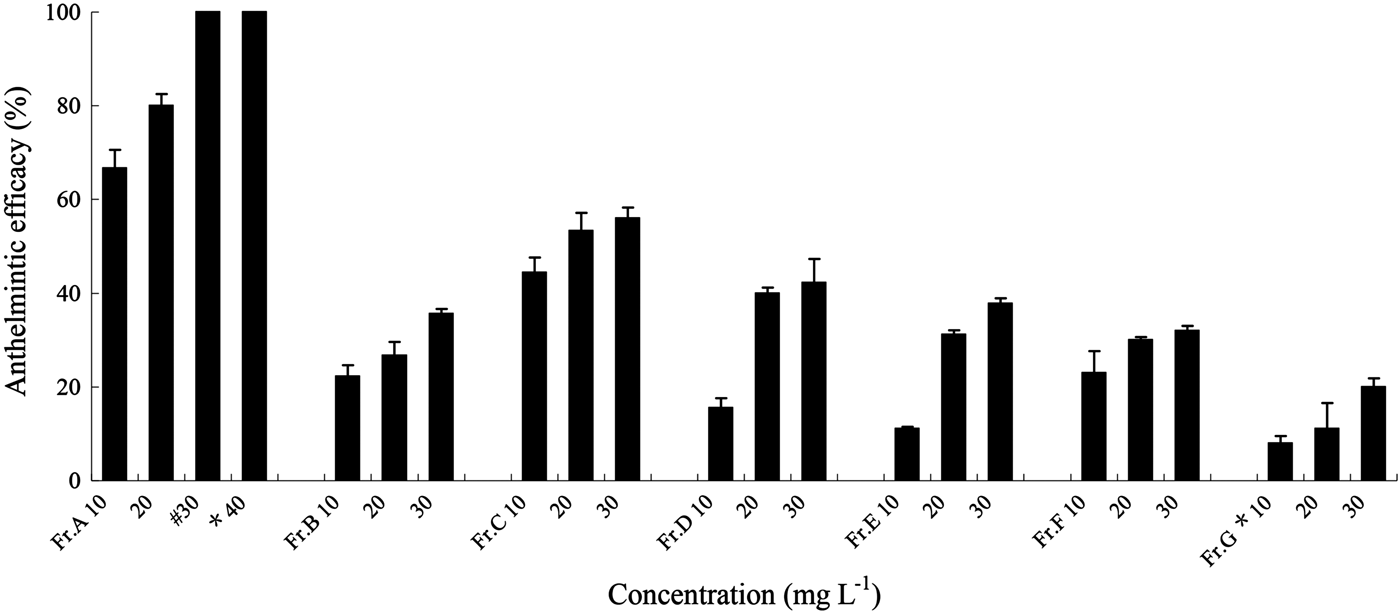
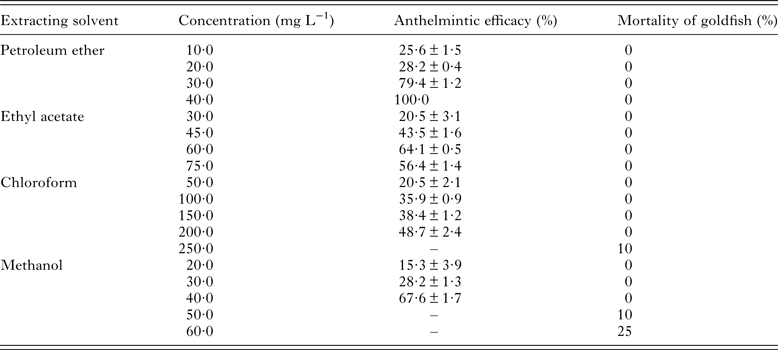
Powders of dried stem bark of C. cassia (2147·0 g) were extracted with methanol in 65 °C water bath for 3 times (2 h per time). The ratio of solvent to sample was 10:1 (V/M). The crude methanol extract was evaporated to obtain 436·7 g of solid extract, and then sequentially extracted by petroleum ether, ethyl acetate, chloroform and methanol yielding 105·4, 73, 56·1 and 190·4 g of extracts, respectively. The petroleum ether extract was used for further isolation because the extract exhibited the highest anthelmintic activity (Table 1). Part of petroleum ether extract (100·4 g) was dissolved into methanol, and separated by steam distillation yielding 10·11 g of essential oil. The oil (8·9 g) was put through a silica gel column (40 × 3 cm2, 150 g, silica gel: 200–300 mesh). The silica gel column was eluted with n-hexane : ethyl acetate (v/v = 50:1, 20:1, 10:1, 5:1, 2:1, 1:1, 1:2, 1:5, 1:10), ethyl acetate : methanol (v/v = 10:1, 10:2, 10:3, 10:4, 10:5, 10:6, 10:7, 10:8, 10:9, 1:1, 1:2, 1:5, 1:10, 0:1) to provide 483 fractions. Finally, based on Thin Layer Chromatograph (TLC) analysis, 7 main fractions were combined as follows: fraction A (Fr. A) (1–25), Fr. B (26–75), Fr. C (76–124), Fr. D (125–166), Fr. E (167–248), Fr. F (249–299), Fr. G (300–483). The result of the anthelmintic efficacy of the 7 fractions showed that Fr. A (2·53 g) exhibited the highest anthelmintic activity (Fig. 1), and was selected for further fractionation.
Anthelmintic efficiency of 7 fractions (Fr. A–Fr. G) from petroleum ether extract against Dactylogyrus intermedius after 48 h. # indicates this concentration caused 100% anthelmintic efficiency; *indicates more than this concentration caused fish death.

Anthelmintic efficiency of four extracts from Cinnamomum cassia against Dactylogyrus intermedius after 48 h exposure

Fr. A was placed on a silica gel column (30 × 2 cm2, 20 g silica gel, 200–300 mesh) and eluted with solvents (petroleum ether : ethyl acetate (v/v) = 50:1; 40:1; 30:1; 20:1; 10:1; 9:1; 8:2; 7:3; 6:4; 5:5; 4:6; 3:7; 2:8; 1:9 and 0:1; acetic ether : methanol (v/v) = 10:1; 10:2; 10:3; 10:4; 10:5; 10:6; 10:7; 10:8; 10:9; 1:1 and 0:1), yielding 260 sub-fractions (Sfr.). These sub-fractions were combined into four major fractions based on TLC analysis: Sfr. A1(1–42), Sfr. A2(42–99), Sfr. A3(100–175), Sfr. A4(176–260). The solvent of Sfr.A2 was volatilized at room temperature to give compound 1. Sfr.A4 was purified by recrystallization in chloroform: methanol to give compound 2. Chemical structures of the active compounds were identified by electron ionization mass spectrometry, nuclear magnetic resonance hydrogen spectrum (1H-NMR) and NMR carbon spectrum (13C-NMR).
In vivo anthelmintic bioassays
The anthelmintic assays were conducted according to the method of Wang et al. (Reference Wang, Zhou, Cheng, Yao and Yang2008). The test container was a 5 L plastic basin containing 3 L of groundwater with continuous aeration and 10 infected goldfish. The extracts, fractions and compounds were, respectively, dissolved into 0·02% dimethyl sulphoxide (DMSO) to obtain 0·1 g mL−1 stock solutions. After acclimatization in plastic basins for 48 h, the fish were exposed to a series of concentrations of the extracts (10–250 mg L−1), fractions (10–30 mg L−1) and compounds (0–16 mg L−1), respectively. The control groups with 0·02% DMSO but no fractions and compounds were set up under the same experimental conditions. After 48 h, the fish mortality in the treatment and control groups was recorded, and the mean number of parasites in the surviving goldfish was determined. The anthelmintic efficacy was represented as a percentage according to the following formula (Wang et al. Reference Wang, Zhou, Cheng, Yao and Yang2008):
 $${\rm AE} = \left( {B - T} \right)/B \times 100\% $$
where AE is antiparasitic efficacy; B is the mean number of living D. intermedius in the control groups; T is the mean number of living D. intermedius in the treatment groups.
Acute toxicity test
Acute toxicities of compounds 1 and 2 were performed as described in our previous work (Wang et al. Reference Wang, Zhou, Cheng, Yao and Yang2008). The fish were exposed to compound 1 at concentrations of 8, 10·4, 13·5, 17·6, 22·8 and 29·7 mg L−1 and compound 2 at concentrations of 20, 26, 33·8, 43·9, 57·1, 74·3, 96·5 and 125·5 mg L−1 for 48 h, respectively. The control groups containing 0·02% DMSO were set under the same conditions. All treatments were in triplicate at 24 ± 1 °C with dissolved oxygen of 5–6·5 mg L−1 and pH of 7–7·5. The dead fish was removed in time in order to avoid deterioration of the water quality.
Electron microscopic observation
Dactylogyrus intermedius with motility were collected from the gills of goldfish exposed to compound 1 at the median effective concentration (EC50) for 24 h. The parasites were fixed for 12 h in glutaraldehyde 2·5% buffered (pH 7·2) at 4 °C and post-fixed in 2% OsO4 for 2 h. The fixed samples were dehydrated in graded alcohol, and then dried at critical point after they were transferred to liquid CO2. The dried samples were mounted on metal stubs and sputtered with gold in an scanning electron microscope (SEM) coating unit prior to examination with an S-3400N SEM (Hitach S-3400N, Japan) operating at a voltage of 5 or 15 kV.
Data analysis
The homogeneity of the replicates of the samples was checked by the Mann–Whitney U test. Probit analysis was used for calculating the median lethal concentration (LC50) and EC50 with the 95% confidence interval (Finney, Reference Finney1971). The therapeutic index (TI) was calculated by comparing LC50 vs EC50.
RESULTS
In vivo anthelmintic bioassays
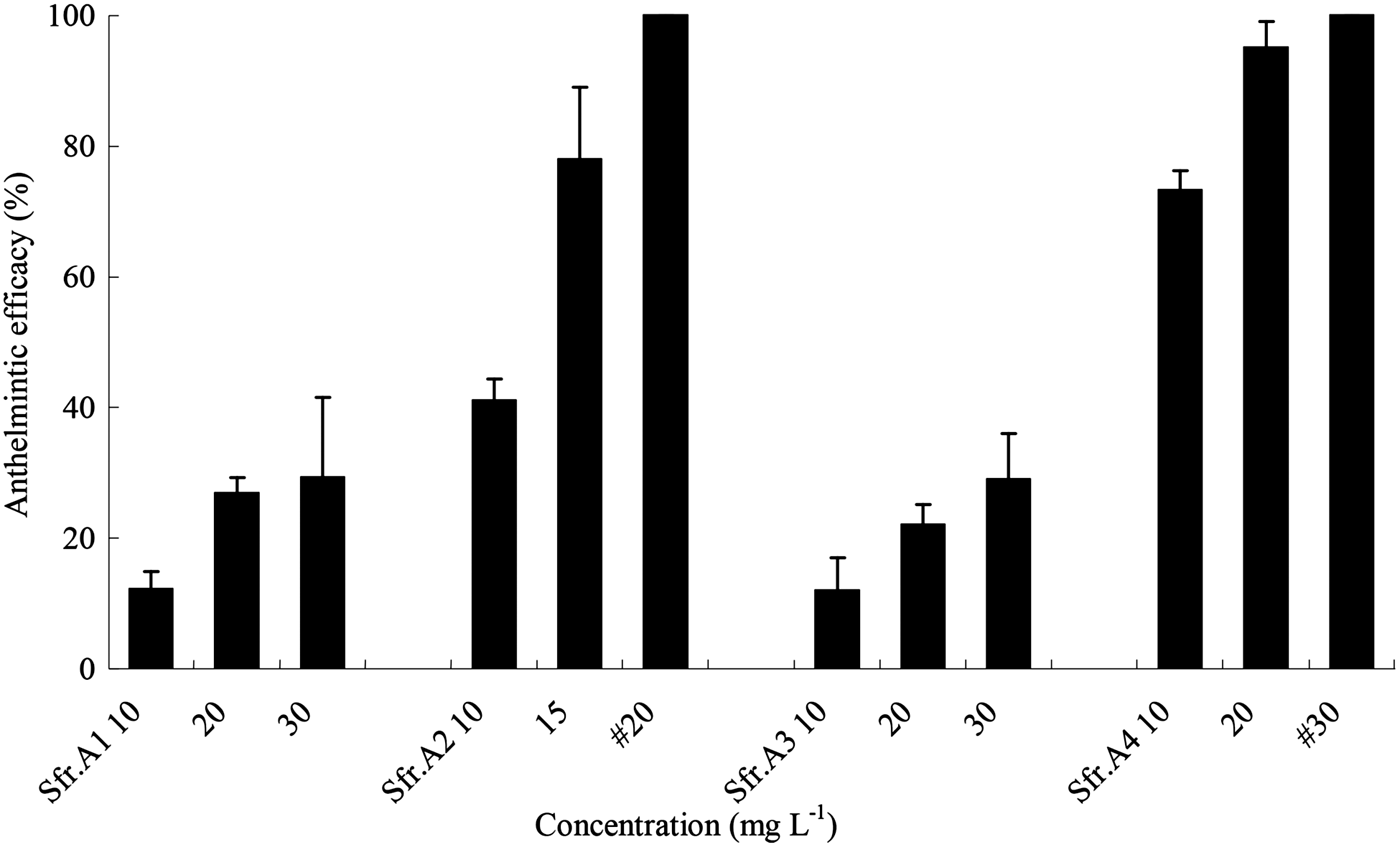
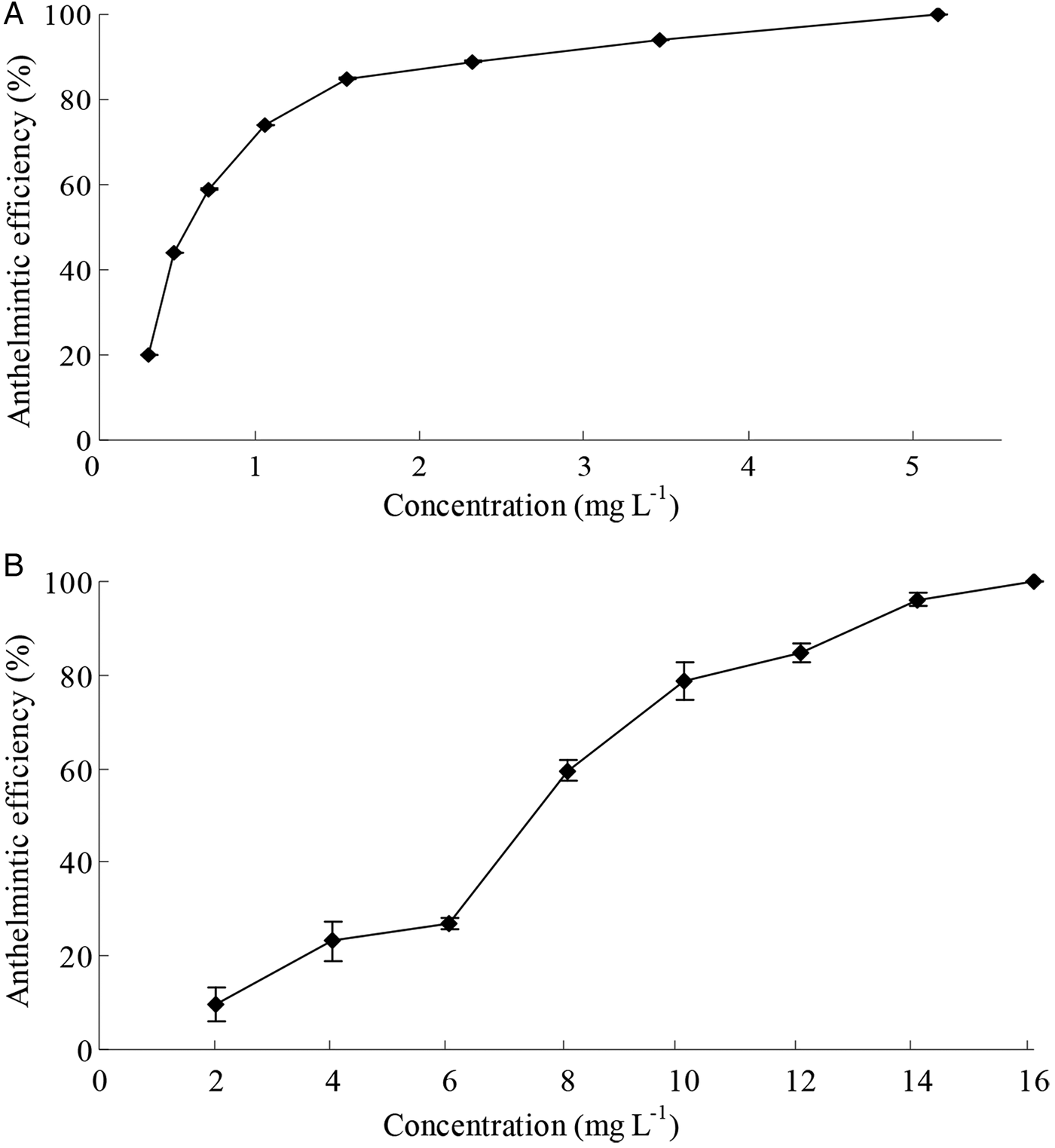
The anthelmintic efficacies of the crude extracts were listed in Table 1. Petroleum ether extracts at 40 mg L−1 had 100% efficacy after 48 h exposure, which was better than the other extracts. In addition, no fish were dead during 48 h exposure to the highest concentration of petroleum ether extracts. Due to noticeable anthelmintic activity and lower toxicity to fish, petroleum ether extracts were used for further fractionation. A total of 7 major fractions (Fr. A–Fr. G) was obtained, and Fr. A demonstrated 100% anthelmintic efficiency at 30 mg L−1 (Fig. 1). Next, Fr. A was further isolated, and Sfr. A2 at 20 mg L−1 and Sfr. A4 at 30 mg L−1 showed 100% anthelmintic efficiency (Fig. 2). Based on these results, Sfr. A2 and Sfr. A4 were selected for further purification, and then yielded a slightly sticky yellow volatile oil (compound 1) and a needle crystal (compound 2), respectively. The EC50 of compounds 1 and 2 were 0·57 and 6·32 mg L−1 (Fig. 3), respectively.
Anthelmintic efficiency of four sub-fractions (Sfr.A1– Sfr.A4) from Fr. A against Dactylogyrus intermedius after 48 h. # indicates that this concentration caused 100% anthelmintic efficiency.

Anthelmintic efficiency of active compound 1 (cinnamaldehyde, A) and compound 2 (cinnamic acid, B) against Dactylogyrus intermedius after 48 h.

Identification of active compounds
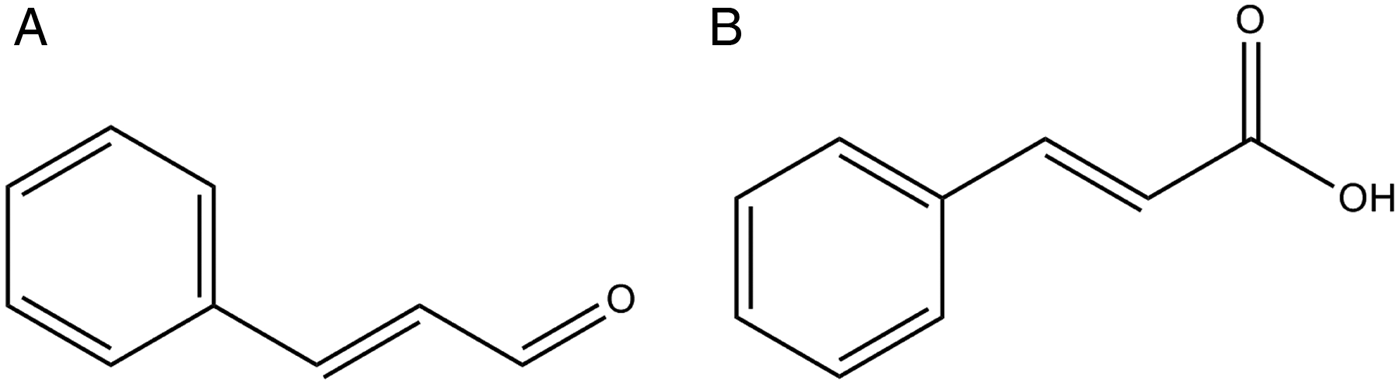
Compound 1 was light yellow oil. Electrospray ionization mass spectrometry (ESI-MS): m/z 203 [M + Na] + , 181 [M + H]+; 1H-NMR (CDCl3, 500 MHz) δ ppm: 6·35(2-H), 7·43(3′-H), 7·71(4′-H), 7·72(6′-H), 8·01(3-H); 13C-NMR (CDCl3, 125 MHz) δ ppm: 120·37 (4′-C), 121·46 (2′-C), 127·94 (4′-C), 128·01 (6′-C), 138·72 (2-C), 138·93 (1′-C), 181·5 (1-C). The compound 1 was identified as cinnamaldehyde. The molecular formula is C9H8O and its structure is shown in Fig. 4a.
Chemical structures of cinnamaldehyde (a) and cinnamic acid (b).

Compound 2 was a colourless acicular crystal. ESI-MS: m/z 219 [M+Na]+, 197 [M+H]+; 1H-NMR (CDCl3, 500 MHz) δ ppm: 6·47 (2-H), 7·22 (4′-H), 7·41 (5′-H), 7·85 (6′-H), 7·80 (2′-H); 13C-NMR (CDCl3, 125 MHz) δ ppm: 117·37 (2-C), 128·40 (2′-C), 128·99 (6′-C), 130·77 (3′-C), 134·08 (1′-C), 147·09 (3-C), 172·7 (1-C). The compound 2 was identified as cinnamic acid. Its molecular formula is C9H8O2 and its structure is shown in Fig. 4b.
Acute toxicity test
The LC50 values of goldfish for 48 h exposure to the active cinnamaldehyde and cinnamic acid were presented in Table 2. The LC50 values of cinnamaldehyde and cinnamic acid were 13·3 and 59·7 mg L−1, which were 23·4 and 9·44 times higher than the EC50 values (Table 2), respectively. The TI values of cinnamaldehyde and cinnamic acid were 23·4 and 9·44, respectively (Table 2).
The anthelmintic efficacy, acute toxicity and therapeutic index (TI) of active compounds after 48 h

EC50, 50% of effect concentration; LC50, 50% of lethal concentration; CI, confidence interval.
Morphological features under SEM
Dactylogyrus intermedius without exposure to cinnamaldehyde showed a sleek body contour and shallow wrinkles on the surface (Fig. 5a, b). By contrast, the helminths treated with cinnamaldehyde were covered with deep wrinkles (Fig. 5c), and the tegument was extensively damaged due to perforation caused by the chemical exposure (Fig. 5d).
Scanning electron micrographs of Dactylogyrus intermedius. (a) and (b) Untreated D. intermedius, (c) and (d) D. intermedius treated with cinnamaldehyde at 0·57 mg L−1 for 24 h.

DISCUSSION
Application of botanical pesticides is considered as an important alternative strategy for control of fish parasites. Until now, many anthelmintic compounds have been isolated from medicinal plants, and some showed high activities against monogenean parasites, for example, trillin and gracillin from Dioscorea zingiberensis (Wang et al. Reference Wang, Jiang, Li, Han, Liu and Liu2010), sutchuenoside A and kaempferitrin from Dryopteris crassirhizoma (Jiang et al. Reference Jiang, Chi, Fu, Zhang and Wang2013), saikosaponin a from radix bupleuri (Zhu et al. Reference Zhu, Ling, Zhang, Liu, Tu, Jiang and Wang2014) and so on. However, these compounds have limited potential to be used commercially because of their lower TI values. Therefore, the search for natural anthelmintic compounds with commercial potential becomes increasingly urgent. Our previous study showed that the crude extract of cinnamon exhibited the highest efficacy against D. intermedius among 42 medicinal plant extracts (Ji et al. Reference Ji, Lu, Kang, Wang and Chen2012). In this study, two anthelmintic compounds were isolated from cinnamon essential oil by bioactivity-guided fractionation and identified as cinnamaldehyde and cinnamic acid using NMR and ESI-MS. Furthermore, the acute test demonstrated that the two active compounds were safe to goldfish because their LC50 values were 23·4 and 9·44 times higher than the EC50 values, respectively. To the best of our knowledge, it seems to be the first report showing in vitro anthelmintic efficacy of compounds isolated from plant essential oil against monogenean parasites of fish and highlighting a new mean to discover novel anthelmintic compounds from plant essential oil for control of fish parasite infections.
Cinnamaldehyde and cinnamic acid are the most characteristic secondary metabolites in cinnamic acid pathway (Hoskins, Reference Hoskins1984). Both of them play important roles as intermediates in biosynthesis of coumarin and lignin in plants. Cinnamaldehyde, with an unsaturated bond and an aldehyde group, has powerful inoxidizability (Lin et al. Reference Lin, Wu, Chang and Ng2003) and can be used to protect against feed rancidity (Tomaino et al. Reference Tomaino, Cimino, Zimbalatti, Venuti, Sulfaro, De Pasquale and Saija2005). In this study, anthelimintic bioassays showed that cinnamaldehyde was effective against D. intermedius, with EC50 of 0·57 mg L−1 which is lower than EC50 of the other reported compounds. As far as is known, there is no information on antiparasitic activity of cinnamaldehyde against monogenean parasites of fish, and our results also may extend its general knowledge and scope of application.
Some studies showed that cinnamaldehyde induces apoptosis by mitochondrial permeability transition (Ka et al. Reference Ka, Park, Jung, Choi, Cho, Ha and Lee2003; Huang et al. Reference Huang, Fu, Ho, Tan, Huang and Pan2007). Accordingly, the anthelmintic mechanism of cinnamaldehyde may be related to interference with the energetic processes and induction of apoptosis in parasites. Cinnamaldehyde can be oxidized to cinnamic acid when exposed to air (Bal et al. Reference Bal, Childers and Pinnick1981; Mallat et al. Reference Mallat, Bodnar, Hug and Baiker1995). It can also be irreversibly oxidized to cinnamic acid by either aldehyde dehydrogenase or by alcohol dehydrogenase (Smith et al. Reference Smith, Cheung, Elahi and Hotchkiss2001). Therefore, the effective dose of cinnamaldehyde may be dependent upon the initial dose and the degree of oxidation.
Through the morphological comparison between the cinnamaldehyde-treated and control D. intermedius under SEM, cinnamaldehyde can induce significant tegumental damage, disruption and the pathological effects include intensive wrinkles, holes along with nodular structures. Similar observations were noted by some researchers who suggested that the tegument surface was a vital target organ for natural anthelmintic products (Martin et al. Reference Martin, Robertson and Bjorn1997; Kundu et al. Reference Kundu, Roy and Lyndem2012). Thus, it becomes apparent that cinnamaldehyde indeed exhibited high anthelmintic activity based on morphological assessment. Besides, we observed that the number of parasites removed from fish after 24 h exposure was greater than before 24 h exposure (unpublished data). According to our observation, it is supposed that the structural damage to the tegument forced the parasites to leave from the gills of fish; however, it is uncertain if the damage induced the death of the parasites and need to be further studied.
In summary, the anthelmintic activity and result of acute toxicity test indicate that cinnamaldehyde have the potential to be developed as a new drug for treatment against D. intermedius. However, further study is required for field evaluation, and exact mechanism of the antiparasitic activity need to be studied.
FINANCIAL SUPPORT
Financial support for this study was provided by the National Natural Science Foundation of China (NSFC) under Grant 31372559 (GW).
AUTHOR CONTRIBUTIONS
F Ling and C Jiang contributed equally to this work.