


In 1499 the French King Louis XII prepared to assert his claim to the Duchy of Milan by force of arms. When he asked Gian Giacomo Trivulzio, the Italian exile he had appointed to command his army, what was needed to ensure the success of the coming campaign, the condottiero and future Marshall of France famously replied that “three things are necessary: money, more money, and still more money.”Footnote 1
Wars are generally funded by a combination of taxes and loans. Always unpopular with the citizens, often irregular in their collection, and inconveniently seasonal until modern times, taxes have traditionally fallen far short of supplying the revenue necessary to meet the extraordinary demands of war in a timely manner. Although sometimes able to let their armies subsist on plunder of occupied lands and occasionally lucky enough to attract a foreign subsidy, belligerents have had to rely increasingly on borrowed money for their war efforts. But if money is the sinews of military power, then credit is its tendon of Achilles, because its availability and cost are tied not just to the institutions of the political economy of the state, but also to the fickle fortunes of war. Conversely, the ability of rulers to finance their militaries by borrowing impinges crucially on how they fight their wars, and on what terms they choose to terminate them.
This much is clear even from casual reading of history, and yet our theories of war are oddly divorced from financial considerations. The most widespread explanations of war assume either that the distribution of power—the very thing that is affected by finance—is fixed for the duration of the interaction or that its dynamics is not subject to control by the actors. Even recent theories that do allow actors to alter the distribution of power do not, as a rule, consider how their efforts are funded. We certainly have not studied what has become the most prevalent form of war finance: debt. In this article, then, I ask the following: If actors can borrow from third parties to augment their military capabilities, how does this affect their bargaining strategies? Specifically, can they use these funds to change the distribution of power and coerce opponents into more concessions? If so, is it possible that they incur so much debt that no peaceful settlement exists that can satisfy both actors given their financial commitments? In other words, can debt finance be a contributing cause of war and a factor that prevents war termination?Footnote 2
Beyond answering these substantive questions, I address what seems to me an important theoretical shortcoming of the prevailing rationalist approach to explaining war between two unitary actors. This approach focuses on reasons actors might be unable to agree on a distribution of the disputed benefit when war is costlier than peace. Regardless of whether the breakdown occurs because of private information or commitment problems, actors fight even though there are deals that both prefer to war. We have learned a lot from this approach but it does leave us with some questions. For instance, how can we account for cases in which both actors prefer to fight? When the bargaining range is not empty, we can only explain wars of regret: When war begins, at least one of the actors would prefer to make concessions that the opponent would accept in lieu of fighting but for some reason cannot do so. This is especially troubling for a behavioral framework that explicitly relies on choice.
The most straightforward way to explain wars of choice is by examining conditions that wipe out the bargaining range, leaving war as the only optimal way out for both players. I am offering one such possibility in this article. As usual, I assume that any peace deal implicitly accounts for what the actors expect to secure by fighting. The distribution of power is determined endogenously by the actors given the resources they have and their mobilization effectiveness. By itself, endogenizing the distribution of power is not sufficient to close to bargaining range, because it maintains the fundamental assumption that war is costlier than peace. I break this assumption by allowing a player to augment his mobilization capacity through borrowing and by supposing that he can repudiate the debt if he loses the war should one break out. These two features of the model ensure that peace is no longer costless and that under certain conditions it might be less efficient than war.
The key to the result is that the possibility of debt repudiation in defeat makes expected debt service less onerous in war than in peace. This increases the terms one could secure by fighting, and so drives up the minimal terms one would demand in peace. At the same time, the higher cost of expected debt service in peace drives up these terms further. Loosely speaking, the burden of debt weighs more heavily on peace, and under some conditions actors might find themselves borrowing so much that neither would want peace on the terms the other demanded: The necessity of repaying the debt in peace leads to excessive demands, and causes bargaining breakdown. Despite some commonalities with existing theories, the fundamental cause of war in the war finance model is different. Instead of seeking reasons for bargaining failure despite the existence of mutually acceptable peace deals, it focuses on factors that might ensure that such deals are altogether impossible.
Although I couch the discussion in terms of crisis bargaining, it should be clear that this model can be applied to intrawar bargaining as well. In fact, it is probably better to think of debt finance as an intrawar problem that affects whether fighting continues. For the war to end, actors must find mutually acceptable peace terms. If they finance their war effort by borrowing, the logic applies when actors become so heavily indebted that it is impossible to obtain peace terms that would enable them to repay their loans. The substantive implication is that if the losing side can mobilize additional resources in an ongoing war by borrowing, war termination becomes very unlikely even though the country might appear to be close to defeat.
DEBT AND WAR FINANCE
Of the many means by which a government can fund its military expenses, taxes and debt are by far the most common. Of these two, borrowing tends to be more attractive because taxation brings a whole series of political and military problems with it. The reliability of taxation depends on the assent of those being taxed. When it comes to elites, this might necessitate acceding to power-sharing demands, and when it comes to the peasantry or the urban population, this might mean devoting substantial forces to enforcement. Attempts to increase taxation during war can be especially dangerous because they might provoke resistance that, given the army's engagement at the front, could boil over into open rebellion. The state also needs a reliable and relatively efficient system of collection, which usually means a developed administrative apparatus and a reasonably noncorrupt bureaucracy, all very rare until modern times. The difficulty in securing consent for new taxes, the unpredictability and variance of yields, the need to enforce collection, and sometimes the sheer inability to do so effectively, meant that rulers had to look for a way to smooth consumption of mobilizable resources, with debt providing an important funding source, provided they could meet the terms of lenders. Many countries, major and minor powers alike, have financed a great many of their wars by borrowing.Footnote 3
There are three important features specific to debt finance: (i) it is mostly voluntaristic—the ruler must persuade lenders to fund the military expenses (resort to forced loans, although not rare, is not very common, either); (ii) it is risky for the lenders—although sovereign rulers generally try to repay their debts, they might be unable to do so, forcing lenders to absorb losses through either restructuring, debt repudiation, or inflation; and (iii) its risks vary with the fortunes of war—defeat, with its attendant losses of income to payments of indemnities or tax bases from occupied or ceded territories, makes it far more likely that the sovereign borrower will not be able to meet his obligations.
Governments do not default on their debts willy-nilly because their reputation as reliable borrowers can be very valuable (Tomz Reference Tomz2007). The usual pattern is one of genuine attempts to honor their obligations, and then as little repudiation as possible when they are faced with dire financial exigencies, of which defeat in war could be catastrophic. Sometimes even the governments themselves make no secret that their ability to repay might depend on winning the war, because the undefeated opponent is unlikely to make the concessions that would be necessary to meet the debt obligations. For example, during the First World War, the German annual war-related government expenditure averaged 24.4 billion marks between 1914 and 1918. The bulk of the average annual deficit of 25.9 billion marks was funded by debt.Footnote 4 The staggering amounts the government was committing to repaying after the war naturally increased the demands Germany expected to impose on its defeated opponents. The German Financial Secretary Helfferich used the model of the Franco-Prussian War to plan for a “massive indemnity [that] would be the panacea to Germany's war debt,” an idea to which his successor returned to as late as 1917 (Gross Reference Gross2009, 246–47). Any such scheme was obviously predicated on victory, and as the prospects receded, so did the ability of the government to raise more money. Even patriotic exhortations in the press subtly linked repayment to victory, or as one newspaper put it, the government promised that “the Reich will honor its obligations, that it will promptly pay any interest coming when it is victorious in the war.”Footnote 5
Lenders are, of course, quite aware of the risks that defeat exposes their investments to, and this is reflected in their willingness to subscribe to loans offered by the threatened government. Debt repudiation is especially common when defeat results in a change of regime or removes a territory from the control of the polity. For example, when the Bolsheviks came to power in Russia and withdrew from the First World War, they repudiated all debts, of the predecessor Empire, internal and external, to the tune of £3.4 billion (Moore and Kaluzny Reference Moore and Kaluzny2005). Even in Britain and the United States, the commitment was not absolute because debt repayment could be conditional on regime survival. The repudiation of all Confederate debt is enshrined in the Fourteenth Amendment of the American Constitution. The rates for bonds issued by the Bank of England dropped precipitously as advances by the armies of Louis XIV in support of the Pretender James III increased the likelihood of his victory and thereby the risk of repudiation, which “appeared likely in light of the fact that much of the national debt had accumulated since the Revolution, and had primarily been used to prevent a Stuart restoration and to fight France” (Wells and Wills Reference Wells and Wills2000, 428).
Given these features specific to debt as a source of war finance, the natural question to ask is whether they affect how wars are fought and terminated. To study this, I offer a model that builds on the existing bargaining models of war and extends them in the simplest possible way consistent with the three features of debt finance.Footnote 6 When deciding how much of their resources to mobilize for coercion and, potentially, war, actors can borrow money to expand their capabilities. The probability of default is higher in defeat than in victory or peace. Initially I consider interest-free loans, but in an extension I study what happens when players have to attract lenders by offering interest rates that take into account the risk of default.
THE MODEL
Two players, who can be either at peace or fighting already, must divide a benefit of size 1, and each controls mobilizable resources yi > 0.Footnote 7 The game has three stages: borrowing, mobilizing, and bargaining. In the borrowing stage, the two players simultaneously decide how much, if any, debt to incur by choosing di ≥ 0. After these observable choices, the players simultaneously decide how many forces to mobilize: mi ≥ 0. The marginal cost of mobilization is θi > 0, and players can only mobilize up to their resource constraints: θimi ≤ yi+di. The forces become immediately available and determine the distribution of power, summarized by the probability with which a player would prevail should war occur: pi=mi/(m 1+m 2) if m 1+m 2 > 0 and pi=1/2 otherwise. After their mobilizations, players bargain over the division of the benefit. Each is committed to repaying the debt if the interaction ends peacefully or if he is victorious in war, but repudiates the debt if defeated. The payoffs are as follows. If players agree to distribute the benefit (x, 1−x), with x∈[0, 1] being player 1’s share, then player 1’s payoff is x−d 1 and player 2’s payoff is 1−x−d 2. If they fail to reach an agreement, war occurs. War is a winner-take-all costly lottery: It destroys a fraction of resources such that only π<1 goes to the victor. The expected war payoff for player i is Wi(d 1, d 2)=pi(π−di).
I am interested in conditions sufficient for peace to be impossible regardless of how players negotiate. To this end, I leave the bargaining protocol unspecified and instead assume that if there existed settlements that neither player would fight to overturn, then players would use the Nash bargaining solution to reach an agreement. In any equilibrium, player 1 would not fight to overturn any deal that gave him  $x\ge W_1(d_1,d_2)+d_1\equiv \underline{x}$. Analogously, player 2 would not fight to overturn any deal that gives her opponent
 $x\le 1-W_2(d_1,d_2)-d_2\equiv \overline{x}$. The bargaining range is the set of deals that satisfy both players:
 $\underline{x},\overline{x}$. Mutually acceptable peaceful bargains would exist only when player 2’s maximum concession was large enough to satisfy player 1’s minimum demand:
 $\overline{x}\ge \underline{x}$. In this case, each player obtains the equivalent to his war payoff plus half of the remaining surplus. The peaceful distribution, then, is
 $x^* = \underline{x}+\left(\overline{x}-\underline{x}\right)/2$, and the peace payoffs are P 1(d 1, d 2)=x*−d 1 for player 1, and P 2(d 1, d 2)=1−x*−d 2 for player 2. Unlike the standard model, which assumes that peace can be had at no cost to the players, this is not the case here: P 1(d 1, d 2)+P 2(d 1, d 2)=1−(d 1+d 2)<1 for any positive debt by either player.Footnote 8
HOW DEBT FINANCE PRECLUDES PEACE
At the most fundamental level, we would like to know whether war can occur in equilibrium in this model. Can the mere fact that military mobilization is financed by borrowing make peace less likely? To answer this question, we need to specify the conditions under which players would not be able to find a mutually acceptable bargain to negotiate peacefully.
The War Condition
Since the existence of the bargaining range is necessary for peace, its nonexistence is a sufficient condition for war. The bargaining range does not exist when the minimal demand that would induce one of the players to avoid fighting exceeds the maximal concession the other is willing to make without a fight:  $\overline{x}<\underline{x}$. Suppressing the function parameters for clarity, this can be written as follows:
 \begin{equation}
p_2d_1+p_1d_2>1-\pi .
\end{equation}
Since the peace deal for a player comprises his expected payoff from war plus enough to repay his debt plus half of the surplus from having avoided war, peace deals are always better than war when they are available. When the bargaining range exists, no player will ever fight, so its nonexistence is a necessary condition for war. In other words, condition (W) is both necessary and sufficient for the interaction to end in violence.
In the traditional puzzle of war as a bargaining failure, war is always less efficient than peace. Indeed, it is precisely this assumption, usually represented by a costless peace, that creates the puzzle in the first place (Fearon Reference Fearon1995). Borrowing does not somehow make war itself more attractive: In fact, it is even costlier than in the traditional model, because of the debt burden for the victor. It does, however, make war more attractive relative to peace, because whereas with war a player must repay the debt only when victorious, with peace he must surely do so. Not only is peace costly, but also the funds to cover the player's debt can only come from concessions by the opponent. No opponent would concede more than what she expects from war. But since the cost of her debt is lower in war, her minimal demands are greater, so concessions become smaller. When the debt burden is heavy enough, concessions disappear altogether and only incompatible demands remain, ensuring the failure of peace.
It is important to realize that it is not merely the costliness of peace that causes war in this model, but also the fact that the expected debt burden would be lighter if war were to occur. (As we shall see, this is so even when players must pay an additional risk premium to attract lenders. Once debt is incurred, the interest terms are fixed, but the player who is still to decide on war can take advantage of the different expected costs of service.) Without such a difference in the expected costs of debt, peace would always prevail. To see this, observe that if players were committed to repaying the debt regardless of the outcome, then it would be a type of sunk cost. The war payoffs would be Wi=piπ−di, the smallest deal that player 1 would accept would be  $\underline{x}=p_1\pi$, and the maximum concession player 2 would make would be
 $\overline{x}=1-p_2\pi$. But since
 $\overline{x}-\underline{x}=1-(p_1+p_2)\pi =1-\pi >0$, the bargaining range would exist and (W) would not be satisfied. Players could still incur positive debt because an improvement in the balance of power would bring more concessions from the opponent. Although this would make peace costly, it would not provoke war.
This differentiates war finance from another mechanism of war under complete information: the costs of keeping the peace. In that explanation, players have to forego some consumption in order to maintain a force sufficient to deter the opponent from attacking. War can occur when the burden of defense is heavier than the costs of a war that might eliminate one of the players and allow the opponent to enjoy the full consumption of his resources in the future.Footnote 9 In this world, however, if players could agree to disarm, then there would be nothing to prevent them from doing so: they would allocate all their resources to “butter,” there would be no opportunity cost of foregone consumption, and hence there would be no incentive to renege by arming and attacking to eliminate the opponent. Moreover, the shadow of the future, which is crucial for the dynamic story because it gives players the reason to risk war now in order to benefit from eliminating the opponent in the long run, plays no role in the war finance model at all.
As condition (W) shows, what matters for the breakdown of peace under war finance are the debt amounts the players borrow, di, and the distribution of power that results from their mobilization decisions, pi. All of these variables are endogenous, and so to answer our original question, we need to know whether making these choices optimally (in equilibrium) would result in a situation such that (W) is satisfied, and war is inevitable. Most of the technical analysis is unfortunately not very illuminating in itself, and is thus relegated to Appendix B. Here, I will focus on the intuition behind the result.
The Zones of War and Peace
To see when players would borrow and arm in a way that makes war inevitable in equilibrium, it is useful to specify the set of debt levels, (d 1, d 2), that satisfy (W) provided the distribution of power, pi, results from the optimal arming decisions of the players. It turns out that for any given debt they have incurred, players always mobilize everything they have regardless of the outcome this would induce. To see why this is so, note that for any debt incurred, the game after the military allocations can end in only one of two ways: war and peace with a negotiated settlement. This means that the military allocations must maximize one of these payoffs while accounting for the possibility that doing so might change the outcome.
Since no player would ever borrow more than the amount of the postwar benefit, di∈[0, π) (Lemma B.1), the peace and war payoffs for each player are strictly increasing in the probability that he prevails in war. This means that players would arm to maximize that probability, even if doing so would cause war (Lemma B.2). The logic behind this is as follows: If the outcome is going to be peaceful, then each player is better off increasing his minimal demand regardless of what the other player chooses to do. Since the peace payoff comprises the player's minimal demand (the expected payoff of war) plus half of the surplus, doing so guarantees that player a higher payoff. However, since increasing the minimal demand also shrinks the bargaining range, it might be that at some allocation that range would disappear and any further mobilization would cause (W) to be satisfied, changing the outcome to war. To see that a player would increase his mobilization anyway, note that at the point where the bargaining range disappears, each player is precisely indifferent between his peace and war payoffs (there is no surplus from peace), and this is the highest payoff the player can have in peace. However, since the war payoff is strictly increasing in his arming, mobilizing more resources would make the player better off with war than peace. Thus, in any pure-strategy subgame-perfect equilibrium (SPE, or simply “equilibrium”), players mobilize all of their resources regardless of the amounts borrowed:  $\overline{m}_i=(y_i+d_i)/\theta _i$. We can therefore restrict attention to such subgames. Since (W) cannot be satisfied when each player borrows less than the costs of war, di ≤ 1−π, and we know that no player would borrow more than the surviving benefit, π, it follows that war can never occur if its costs exceed the surviving benefit. From now on, therefore, I assume that the costs of war are not that high: 1−π<π.
The fact that players mobilize everything considerably simplifies the analysis because it “eliminates” the arming choices and makes the equilibrium distribution of power a direct function of the debt choices. With players mobilizing everything, the equilibrium distribution of power is
 \begin{equation}
p_i^{\rm e}= \frac{y_i+d_i}{y_i+d_i+\vartheta _i(y_{-i}+d_{-i})},
\end{equation}
The most player can borrow for any given amount of debt by his opponent and still maintain peace is the amount that satisfies p e2d 1+p e1d 2=1−π, because any further increases in the level of debt would induce war.Footnote 10 The solutions to this equation define the zone boundary, Bi(d −i), which bisects the plane of debt levels into a zone of peace and a zone of war, as shown in Figure 1.Footnote 11 At the boundary itself, players have incurred debt at the precise levels that make them indifferent between fighting and settling peacefully. If players borrow so that (d 1, d 2) is above and to the right of the boundary, that level of borrowing lies in the zone of war, which means that the game cannot end in peace. Conversely, any borrowing that lies below and to the left of the boundary ensures that players will negotiate a peaceful outcome.
The Zones of War and Peace (π=0.75, y 1=0.5, y 2=0.35)

Figure 1 shows these zones for two scenarios. In each, war destroys 25% of the benefit, and player 1 has a slight resource advantage over his opponent. In one case, he is half as efficient as she (ϑ1=2.0, indicated by the solid curve), and in the other he is twice as efficient (ϑ1=0.5, indicated by the dashed curve). This figure illustrates why war cannot occur if its costs exceed the surviving benefit: If each player debt does not exceed the costs of war, di ≤ 1−π, the resulting allocation is always in the zone of peace, and since players never borrow more than the surviving benefit, di<π, it follows that if this benefit is smaller than the costs, π<1−π, any equilibrium allocation must lie in the zone of peace.
Conversely, if each player's debt exceeds the costs of war, di > 1−π, then the resulting allocation must lie in the zone of war. The only cases in which locating the debt in a given zone is affected by relative efficiency are those in which only one of the players borrows more than the costs of war. Figure 1 also illustrates how the zones change with the relative efficiency of the players in those situations: in the northwest (NW) sector where only player 2 has incurred excessive debt, d 2 > 1−π>d 1, and in the southeast (SE) sector where only player 1 has done so, d 1 > 1−π>d 2. To see what happens when player 1 becomes more efficient relative to player 2, compare the zones defined by the solid boundary to those defined by the dashed boundary. Increasing the efficiency of the player with the smaller debt expands the zone of war (NW sector), whereas increasing the efficiency of the player with the larger debt contracts that zone (SE sector). The intuition is as follows. As player 1 becomes more efficient, his probability of winning at any debt allocation must increase, so p e1 goes up (and p e2 goes down). Paradoxically, this reduces player 1’s “benefit” from war, p e2d 1, because he now expects to have to repay the debt with a higher probability. For the analogous reason, this increases his opponent's “benefit” from war, p e1d 2, because she expects to repudiate her debt with a higher probability. In other words, increasing player 1’s relative efficiency always dampens his incentive for war but exacerbates player 2’s. Which effect dominates the interaction depends on who holds the excessive debt. When it is player 2 (NW sector), the large increase in her incentive for war overwhelms player 1’s modest disincentive, which enlarges the zone of war. Conversely, when it is player 1 (SE sector), the large decrease in his incentive to fight overwhelms the modest increase in player 2’s incentive, which enlarges the zone of peace.
Now that we have established that equilibrium debt levels are partitioned into one of two zones, we need to know when optimal debt choices end up in the zone of war.
When Is Debt Not Sustainable in Peace?
Since the game can only end in one of two ways, in any equilibrium each player's debt must maximize his payoff given what the other player is choosing and what the outcome of the game is going to be. Moreover, since the outcome these debts will induce is certain in any pure-strategy equilibrium, it follows that each player's best response to any particular debt of his opponent depends on the location of the zone boundary. It cannot be the case that a player borrows optimally for peace when the equilibrium debt levels lie in the zone of war. Conversely, it cannot be the case that a player borrows optimally for war when the equilibrium debt levels lie in the zone of peace. In other words, the optimal borrowing choices must be consistent with the outcome they induce.
If the interaction is going to end in war, player i’s optimal war debt, d wi(d −i), must maximize his expected war payoff, W*i(d −i)≡Wi(d wi(d −i), d −i). Conversely, if the interaction is going to end in peace, player i’s optimal peace debt, d pi(d −i), must maximize his peace payoff, P*i(d −i)≡Pi(d pi(d −i), d −i). Lemma B.4 shows that for any given debt of the opponent, player i’s optimal debts of war and peace are unique, and establishes the properties of these functions. In equilibrium, the optimal debts must be mutual best responses, which means that they must solve one of the corresponding systems of equations,
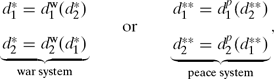 \begin{equation}
{\underbrace{\begin{array}{rcl}
d_1^*&=&d_1^{\rm w}(d_2^*)\\[10pt]
d_2^*&=&d_2^{\rm w}(d_1^*)
\end{array}}_{\text{war system}}} \qquad \text{or}\qquad {\underbrace{\begin{array}{rcl}
d_1^{**}&=&d_1^{p}(d_2^{**})\\[10pt]
d_2^{**}&=&d_2^{p}(d_1^{**})
\end{array}}_{\text{peace system}}},
\end{equation}
Lemma 1.The solution to the war system, (d*1, d*2), can be supported in SPE if, and only if, (i) it is in the zone of war, and (ii) no player can profit by reducing his debt and inducing peace. If (dpi(d*−i), d*−i) is also in the zone of war, then no such profitable deviation exists. The solution to the peace system, (d**1, d**2), can be supported in SPE if, and only if, (i) it is in the zone of peace, and (ii) no player can profit by increasing his debt and provoking war. If (dwi(d**−i), d**−i) is also in the zone of peace, then no such profitable deviation exists.
To see what these conditions mean, consider a possible SPE in which war occurs. Since players expect war to occur at the debt levels they have chosen, it must be the case that each player borrows optimally for war given that the other one is doing so (i.e., these debts must solve the war system). If this were not the case, then at least one player could improve his payoff by choosing the optimal war borrowing and starting war. This pair of debts must lie in the zone of war because if they do not, then condition (W) will be violated, which means that players will actually be better off negotiating a peaceful outcome, which they will do. But if this is so, then they cannot expect war to occur at these debt levels, which violates the supposition of equilibrium, since in any equilibrium, expectations about the outcome must be consistent with the strategies. For these debts to occur in equilibrium, it is further necessary that no player can do better with any other borrowing. The fact that these debts are the solution to the war system ensures that there is no profitable deviation that also causes the game to end in war. The only possibility, then, is a deviation that causes the game to end in peace. Given that the debt levels are in the zone of war, any higher borrowing would still lie in that zone, and thus would not alter the outcome. Thus, the only potentially profitable deviation is for a player to reduce his debt sufficiently to shift the allocation into the zone of peace. This is what the second condition ensures cannot happen. More specifically, if it is the case that a player's deviation to his optimal peace borrowing fails to shift the debts into the zone of peace, then no deviation that does so can be profitable. Roughly speaking, this follows from the fact that when the optimal peace deviation is in the zone of war (and so the outcome would still be war), the best attainable peace deviation is to the allocation at the zone boundary. However, since by definition this makes the player indifferent between peace and war, the fact that the optimal war allocation is strictly higher implies that the player is better off fighting. Thus, there can be no profitable peace-inducing deviation after all.
The enumerated necessary and sufficient conditions for equilibrium can easily be checked. Figure 2 exhibits a configuration of parameters for which war occurs in the unique equilibrium. In this case, war destroys 1/8 of the benefit, players have the same small initial amount of resources, but player 1 is twice as efficient as his opponent at mobilizing. The solid curve indicates the zone boundary, and the two sets of curves whose intersections are shown are the optimal debt of the players as functions of their opponent's debt. For instance, the curve with short dashes, dw 2(d 1), represents player 2’s optimal borrowing as a function of player 1’s debt when the interaction is expected to end in war. Analogously, the curve with long dashes, dw 1(d 2), is player 1’s optimal borrowing as a function of player 2’s debt in the same situation. Their intersection, (d*1, d*2), is the solution to the war system, and indicates the war borrowing levels that are mutually optimal. These levels lie in the zone of war, and so the first condition from Lemma 1 for them to be the equilibrium debt is satisfied. Moreover, should either player unilaterally reduce his borrowing to the optimal peace debt, the resulting allocation, (dpi(d*−i), d*−i), would still lie in the zone of war, and so would not induce peace. By Lemma 1, this is sufficient to ensure that no profitable peace-inducing deviation exists for either player, and so the second condition of the lemma is satisfied. In other words, (d*1, d*2) is an equilibrium in which war occurs. To see that this equilibrium is unique, simply note that the intersection of the optimal borrowing for peace, (d**1, d**2), lies in the zone of war. This violates the first condition of Lemma 1, and so this allocation cannot occur in equilibrium. Thus, the solution to the war system is the unique equilibrium: Players optimally borrow at levels that cannot be sustained in peace. It remains to be seen if we can establish general conditions under which the game has a unique SPE, and this equilibrium involves war.
Optimal Borrowing and Equilibrium (π=0.875, y 1=y 2=0.08, ϑ1=0.5)

The Unique Equilibrium
To establish the existence of a unique pure-strategy SPE, I will focus on conditions under which at least one of the players does not incur any debt. There are several reasons for doing so. First, Lemma 1 is then relatively straightforward to apply, which makes the analysis more transparent. Second, even though these conditions are not necessary for the existence of a unique SPE, as Figure 2 clearly demonstrates, they are sufficient to guarantee uniqueness. Third, it turns out that these conditions are easily satisfied, and that for many parameter configurations at least one player will, in fact, abstain from borrowing. The fourth reason is technical. When these conditions are not satisfied, the discontinuities in the best responses mean that a pure-strategy equilibrium is not guaranteed to exist. However, when it does exist (as in Figure 2), the equilibrium behaves analogously to the case I analyze now, so there seems to be little gain from tracing the contour set for its existence.
If one of the players does not borrow anything at the solution to the war system, then he would not borrow anything at the solution of the peace system either (Lemma B.5). Since his best response is the same regardless of the outcome, it follows that the equilibrium must be unique and that the equilibrium outcome turns entirely on what the other player does. If she borrows at an unsustainable level, then the unique equilibrium will end in war. The following lemma, which is formally stated in Lemma B.6, shows when an arbitrary player would incur no debt at the solution to the war system.
Lemma 2.Player i will optimally choose not to borrow for war, d*i=0, either when his resources exceed the postwar benefit ( yi ≥ π), or when they do not but he is efficient at converting them to military capabilities relative to his opponent (ϑiis not too large). When a player does not borrow for war, he also does not borrow for peace.
I shall call player i rich if, and only if, yi ≥ π; otherwise I shall call him poor. The intuition behind Lemma 2 is that when a player is rich, he can mobilize significant military capabilities and thus has no incentive to incur the additional costs of debt in order to expand his already large resource base. Even if his opponent were to borrow, the fact that she is going to limit the amount to no more than the postwar benefit (Lemma B.1) means that he does not have to offset this by borrowing himself. When a player is poor, on the other hand, his incentive to borrow depends on the balance between the expected costs of debt and the contribution this debt will make to enhancing his military capabilities. If the player is efficient relative to his opponent, then he can get a decent “bang for the buck” even out of his somewhat meager resources. The fact that his opponent is relatively inefficient means that she would have to borrow large amounts for small gains, which weakens her incentive to do so, and implies that the player would not have to borrow to offset this. The upshot is that a poor player who is efficient enough relative to his opponent would not have to incur any debt when he expected war. Since the optimal peace debt can never be larger than the optimal war debt (Lemma B.5), it follows that a player who borrows nothing for war must also borrow nothing for peace.
Consider now a situation in which both players are rich. By Lemma 2, each player optimally incurs no debt for either peace or war. Thus, (0, 0) must be the equilibrium pair of debt levels. Since condition (W) fails when no debt is incurred, it follows that this pair lies in the zone of peace. This satisfies the first condition of Lemma 1 for a peaceful SPE. Since deviating to the optimal war debt trivially preserves the debt levels in the zone of peace, the second condition of Lemma 1 for a peaceful SPE is satisfied. The equilibrium is unique because it is the only possible peaceful SPE, and we just saw that the solution to the war system cannot be supported in equilibrium. The following proposition summarizes this result.
Proposition 1.If both players are rich, then the game has a unique SPE. In it, neither player borrows anything, and the interaction ends in peace.
Consider now a situation in which only one of the players, say player 1, is rich. By Lemma 2, he does not borrow, either for war or peace. However, since his opponent is poor, she will borrow dw 2(0) if the game is to end in war, and dp 2(0) if it is to end in peace. If she is efficient enough relative to player 1, then her debt will also be zero, in which case the unique SPE will be peaceful by the logic outlined earlier. If, however, she is not that efficient, then she will end up with positive debt, and the amount she borrows will determine the outcome of the game. As we will see in the next section, when she is neither very efficient nor too inefficient, she will choose to incur a debt that cannot be sustained in peace. In other words, the unique SPE will involve war. The following proposition (whose proof is in Appendix B) establishes the result formally.
Proposition 2.If only player i is rich, then the game has a unique SPE. In it, player i borrows nothing, and his opponent borrows either dw −i(0), in which case the interaction ends in war, or dp −i(0), in which case the interaction ends in peace.
These two propositions exhaust the possibilities in which the wealth of at least one of the players is sufficient to induce him not to borrow. The remaining situation is that both players are poor, and so the choice to incur no debt turns entirely on their relative efficiency. As it turns out, if players are not collectively poor—that is, if y 1+y 2 ≥ π—then one of them is going to be efficient enough relative to the other to induce that player not to borrow even if the opponent borrows optimally. The following result, formally stated in Proposition B.1, establishes the unique solution for this case.
Proposition 3.If both players are poor but one of them is efficient enough relative to the other, then the game has a unique SPE. In it, the more efficient player i borrows nothing, and his opponent borrows either dw −i(0), in which case the interaction ends in war, or dp −i(0), in which case the interaction ends in peace. If the players are not collectively poor, then at least one of them must be efficient enough relative to the other to borrow nothing.
When players are collectively poor but neither is efficient enough relative to the opponent to induce him to maintain zero indebtedness, both must incur positive debt at the solution to the war system. Although Lemma 1 applies here just as well, and a unique SPE can exist, as shown in Figure 2, there might be parameter configurations for which there is no pure-strategy equilibrium. However, whenever it does exist, the equilibrium behaves analogously to the cases analyzed so far.Footnote 12
War and the Inability to Repay in Peace
As the propositions make clear, not every level of indebtedness makes peace impossible. Are there conditions that induce a player to borrow so much that the debt allocation must end up in the zone of war? As the costs of war become negligible (π→1), the right-hand side of (W) goes to zero, and so the sufficient condition for war will be satisfied if at least one of the players borrows a strictly positive amount. It turns out that if a player is at a large enough resource disadvantage, then he will do so.
Proposition 4.War is inevitable if the costs of war are sufficiently low and the prewar distribution of resources is sufficiently unfavorable for one of the players.
I have thus established the main result of this article: The mere fact that players are able to finance their military preparations by borrowing can change the bargaining dynamic. Under some conditions, this can cause the breakdown of bargaining even under complete information. War in the war finance model is caused by the differential expected costs of debt in peace and war, and thus the method of finance must be seen as a factor contributing to the failure of crisis or interwar negotiations to avoid fighting.
The clearest empirical implication of this theory is that if one chooses to fund military mobilization by borrowing, peace may become harder to obtain (or preserve) because its terms will have to provide for repayment of that debt, and the opponent may be unwilling to concede as much. Since most “real-world” cases tend to be quite complex—in addition to the factors identified here, there are often other political and economic considerations involved with the decision on how to fund military preparations and fighting—I provide two examples from an institutionally simple setting where the financial aspect emerges most clearly and where the simplifying assumptions of the model are not too distorting.
Consider cases in which borrowing takes the form of arrears for the soldiers. That is, the ruler promises to pay the soldiers at some point in the future in return for their service today. One can think of feudal levies that extend beyond the time or place customarily prescribed and thus have to be maintained voluntarily at the expense of the magnates or the soldiers themselves until payment from the ruler is received. One could also think of mercenary companies in aggregate-contract armies whose captains have to assume the fiscal burden of keeping them functional until paid. One could also think of state-commission armies with little or no conscription, where prompt payment is essential for maintaining battleworthiness.Footnote 13 This type of debt maps readily to the simple model because rulers have very strong incentives not to renege on payments (since doing so would seriously jeopardize their security), because repudiation of the obligation is very likely in defeat (often the defeated soldiers are too busy scattering to safety to collect their due or too dead to demand repayment), and because the terms of peace agreements would often explicitly have to provide the funds for prompt retirement of this debt. It also helps control for the political and fiscal institutions that would affect the price and availability of debt when it comes to other categories of lenders.Footnote 14
Going back to the involvement of France with the Duchy of Milan, the following incident reveals the financial problem at the tactical level. The best units of the French army defending Milan were Swiss mercenaries, and in April 1522 they were disgruntled because they had not been paid. They had effectively advanced their services, but the debt was not honored during the lull in fighting, nor were they to expect to fight and potentially “pay themselves” with loot. The French commander Odet de Foix had thus borrowed and had to find the means to pay. Since no concessions were forthcoming from the Imperials and the Swiss were threatening to walk away unless paid, he authorized the infamous attack on Bicocca on the 27th. The disastrous outcome is well known: The Spaniards defeated the French forces, and the surviving Swiss mercenaries dispersed to their cantons without compensation.Footnote 15
This sort of thing can also happen at the strategic level. Consider the position of the Swedes during the final phase of the Thirty Years War. Despite initially relying on its own conscripts, the Swedish Crown quickly found itself paying for the soldiers under its command in Germany (Asch Reference Asch1997, 164–65). Like other cash-strapped belligerents, Sweden borrowed from these soldiers by withholding their pay. As Wilson (Reference Wilson2009, 400) puts it, “Accumulating pay arrears became a major feature of the war and would partly dictate its course in the 1640s. Governments could hope to write off some of the money if men died on campaign, but the balance owed to the others exceeded any realistic hope of settlement. It became impossible to demobilize armies, because regiments refused to disband until they were paid.” This debt was a serious cause of concern for the Swedes and was a major factor in their negotiating position at the Osnabrück conference. Their demand that the settlement provide sufficient funds to retire this debt and the refusal of the Germans to make that concession prolonged the war. That the Germans did have the means to pay had they wished to is without doubt, since the loot from Bregenz and Prague alone that the Swedes took while the negotiations dragged on was estimated at 11 million talers, and the compensation that both sides finally agreed to in the peace treaty was only 5 million.Footnote 16 Thus, the method of war finance prolonged the war until the worsening fortunes of the Habsburgs finally prompted the Imperial Estates to agree to fund the debt Sweden had assumed from its soldiers.
THE ROLE OF MOBILIZATION EFFICIENCY
The sufficient conditions for war to occur in the unique equilibrium in Proposition 4 are independent of the relative efficiency of mobilization of the two players. If we are to consider less extreme situations, however, this parameter begins to play a crucial role.
Mobilization efficiency—the ability to convert a unit of resources into military capability—is not discussed very much in our theories of war, but appears to be quite important both empirically and in the war finance model. The marginal cost of mobilizing a unit of resources, θi, can represent a great many aspects of that process: (i) technological efficiency—how much and of what quality military equipment can be produced from some fixed amount of raw materials, (ii) transportation and distribution infrastructure—how much it costs to assemble, equip, and move troops to jump-off positions, (iii) regime and cause legitimacy—how many recruits would volunteer, how much it would cost to hire soldiers, how many feudal retainers would show up, and what their state of readiness would be, (iv) bureaucratic competence and agency slippage—how effectively orders are carried out and how much embezzlement and resource dissipation occurs down the chain of command, or (v) the source of ordinary revenue—how much additional resistance would be provoked by levying extra taxes for military purposes, and so on. Each of these factors affects the size of mobilized forces a government would have at its disposal for any given state of its finances, and through them, the probability of war.
Proposition 5.Assume that the sufficient conditions for war in Proposition 4 are not satisfied. War cannot occur if one of the players is either very efficient or very inefficient relative to his opponent at mobilizing his resources. If war occurs, it does so only when both players are moderately efficient.
Why do both high efficiency and low efficiency promote peace? Consider a situation, such as Figure 3, in which a rich player 2 faces a poor player 1. Here, the war destroys 15% of the benefit, player 2’s efficiency is fixed at θ2=1, and the initial resource asymmetry is quite severe: Player 2 is 18 times richer than her opponent. With such a resource advantage, this player will not incur any debt in equilibrium, and so we can simply focus on player 1 and ask how his borrowing changes as his relative mobilization efficiency goes from extremely high to half that of player 2. The curve with short dashes indicates dp 1(0), his optimal debt if the interaction is to end in peace, and the curve with long dashes indicates dw 1(0), his optimal debt if the interaction is to end in war. The solid curve marks which of these debts he will incur in the unique equilibrium for any value of his relative mobilization efficiency.
Efficiency and War, π=0.85, y 1=0.05, y 2=0.90, and θ2=1

When player 1 is very efficient at converting resources into military capabilities (ϑ1<0.53), the equilibrium distribution of power, pe 1, significantly favors him even though he is so resource-constrained. Moreover, borrowing even small amounts results in large improvements in his military position. Player 1 thus enjoys a double advantage because player 2 is quite willing to concede the additional amount that player 1 would need to repay his debt: the extra concession is small, and her war payoff not that great to begin with. Player 1 borrows and coerces player 2 into concessions short of war.
When player 1 is relatively inefficient at converting his resources into military capabilities (ϑ1 > 1.76), he suffers the reverse double whammy: The distribution of power he can achieve for any resource level is quite unfavorable (which means that his opponent's minimal terms are very demanding), and even marginal improvements can only be financed by borrowing very large amounts (which she would not concede). Player 1’s choice boils down to war, which at this level of indebtedness yields a small expected payoff despite the high probability of repudiation, or peace in which he cannot expect player 2 to concede anything extra that he could use to repay any positive debt. This makes borrowing unattractive, and player 1 simply agrees to the terms he can obtain under the existing distribution of resources.
When neither player is too efficient, ϑ1∈(0.53, 1.76), the peace-inducing incentives fail to restrain player 1. On one hand, his moderate efficiency means that he must borrow to improve the distribution of power (which, given player 2’s resource advantage, would otherwise favor her), and that he must borrow non-negligible amounts for the effect to have any bite at all. Borrowing so much means that player 2 must concede ever larger shares if the interaction is to end without fighting. Unfortunately, because of her resource advantage, the corresponding shift of the distribution of power in favor of player 1 is too small to induce her to such extraordinary concessions. The bargaining range vanishes and the interaction ends in war.
This analysis has another interesting substantive implication: A poor but relatively efficient player with access to debt can coerce a very powerful opponent into additional concessions. In the preceding example, the fact that the efficient player 1 chooses to incur positive debt while remaining at peace implies that his payoff from doing so is strictly higher than the payoff he would obtain if he were to borrow nothing and still remain at peace. Since debt is a cost, it must be that the additional concessions he is able to wrest from player 2 more than offset that cost and make borrowing worthwhile. Thus, even resource-starved players can coerce rich opponents by borrowing, provided they are efficient enough in turning these funds into military capabilities, and so their debt burden does not become excessive.
THE PROBLEM OF COMMITMENT
The most widespread explanation of war under complete information is that large, rapid power shifts create a dynamic commitment problem because the rising actor cannot credibly promise to provide enough benefits in the future to deter the declining actor from fighting today (Powell Reference Powell2006). One can think of at least two related problems of commitment in the war finance model as well. First, players cannot credibly promise to restrain their mobilizations to something below the maxima. Second, players cannot precommit to avoid incurring any debt.
Let us begin with the possibility that a player with a significant resource advantage voluntarily commits not to use it all. Since this would reduce the opponent's need to borrow, it might move the debt allocation into the zone of peace. Consider a situation, such as the one in Figure 3, in which player 2 incurs zero debt. The question then is whether her ability to commit not to utilize her superior existing resources can alter the outcome of the interaction. For some parameters, both players would benefit if player 2 were to limit her mobilization, because doing so would enable player 1 to reduce his debt to manageable proportions, and they could negotiate a peaceful outcome. The problem is that player 2 cannot credibly commit to doing so. If player 1 does reduce his borrowing, his total military capability is going to be smaller. This increases the marginal benefit of mobilizing additional resources for player 2 and enables her to achieve a much more favorable distribution of power for any mobilized resource. She is strictly better off breaking her promise and mobilizing everything, even if doing so would cause war. (This follows immediately from Lemma B.2: Once players borrow, it is always better to mobilize everything they have.) Thus, any promise player 2 makes to restrain herself is not credible, and players end up in an equilibrium in which both are worse off.
This is not to say that player 2 can generally benefit from such a commitment. There are situations in which the best peace payoff that player 2 can obtain when player 1 incurs positive debt is strictly smaller than her equilibrium war payoff. In this case, limiting her mobilization could still avoid war but it would certainly not be in her interest to do. In contrast to the situation we examined previously, this is not an instance in which she would have liked to be able to commit credibly to limiting her forces. This commitment problem cannot be the whole story.
The second possibility is that players commit to forego borrowing altogether. If they can do so, then d 1=d 2=0, so (W) is never satisfied, and war never occurs under complete information. Player 2 would dearly love to dwell in this world. Since she is rich and borrows nothing anyway, she has to meet some of the costs when her opponent resorts to debt finance: either because she must make a larger concession in peace or because she suffers the consequences of war. For any positive debt that player 1 incurs, player 2 would be strictly better off if players could commit not to borrow. Unfortunately, this is not the case for player 1, who is always better off when he can rectify some of the power imbalance by borrowing. The possibility of avoiding war is undermined by the fact that debt finance is actually useful to the borrower.
We now arrive at what seems to me a rather fundamental limitation of the traditional model of war as a result of bargaining breakdown: its assumption that war is the costliest dispute-resolution mechanism because of its destructiveness and unpredictability. With this assumption in place, the bargaining range can never be empty (Powell Reference Powell2006, 179–80). This creates a puzzle: Why would players opt to use such an inefficient mechanism rather than any of the others? Among the most prominent explanations is that informational asymmetries might cause players to fail to locate these mutually acceptable deals whose existence (and in some cases, precise specification) is common knowledge (Fearon Reference Fearon1995). The war finance mechanism differs in that it explains war by the nonexistence of mutually acceptable deals, not the players’ inability to locate them. The traditional approach explains war as a failure to agree on a mutually acceptable peaceful settlement from a nonempty bargaining range whose existence is common knowledge. The war finance approach explains war as a consequence of actions that eliminate the bargaining range so that there are no mutually acceptable peace settlements. Footnote 17, Footnote 18
DEBT SERVICING
The model analyzed so far assumes that loans are interest-free. Although the simplicity exposes very clearly the fundamental workings of the war-causing logic, one might be concerned about two issues with this particular simplification. First, if players were to pay interest, debt service would become more costly. This has two contradictory effects: On one hand, it must expand the zone of war because the difference between expected service in war and peace would increase, but on the other hand, it must reduce the incentive to borrow, which always enhances the prospects for peace. Second, the terms players have to offer in order to attract loans must be consistent with the expectations of the lenders, and compensate them for risks they are going to assume under these expectations. This means that when lenders expect the interaction to end in peace, the risk premium they demand is much lower than the one they demand when they expect the interaction to end in a war that might cause them to lose their investment altogether. Since players will have to offer higher interest rates when they expect to fight, the difference in expected cost of debt service between war and peace must decrease, which should make war less likely to occur. The main question then becomes: If we were to allow for endogenous risk premia, would war still occur in an equilibrium of the war finance model? The main task of this section is to show that indeed it will, even though the range of parameters for which it does is narrower.
Let r ≥ 0 be an alternative risk-free return on the amounts lent. If the lenders are atomistic, market-clearing implies that the value of expected debt servicing must equal the value of the alternative risk-free investment. Since players are committed to repaying the debt if war does not occur, there is no added risk to lending them money when the interaction is expected to end peacefully. On the other hand, if the interaction is expected to end in war, lenders face the risk of potential default on the debt if the debtor is defeated. Thus, the debt-servicing schedules for peace and war are
 \begin{eqnarray}
D_i^{\rm p}(d_i) = (1+r)d_i\qquad \text{and}\qquad D_i^{\rm w}(d_i) = \frac{(1+r)d_i}{p_i(d_i,d_{-i})}. \nonumber\\
\end{eqnarray}
The game is the same as before except that now player i must repay the debt di according to the equilibrium constraint in (DS). It is important to realize that in any equilibrium, both players must be committed to either the war debt-servicing schedule (if the outcome is war) or the peace debt-servicing schedule (if the outcome is peace). That is, it cannot be the case that the expectations embodied in the debt-servicing schedule fail to match the equilibrium outcome. Moreover, it cannot be the case that one player pays according to his war debt-servicing schedule while the other pays according to her peace debt-servicing schedule. If this were so, then either the lenders would be lending suboptimally (because they failed to demand the risk premium associated with war) or the actor would be borrowing suboptimally (because he paid such a premium even though there was no chance of war).
The existence of different debt-service schedules for war and peace does not impinge on equilibrium analysis when it comes to deviations from a strategy profile. Suppose (d*i, d*−i) is an equilibrium allocation in which war occurs, and so each player is committed to his war debt-servicing schedule. If some player, say player i, deviates to di<d*i, he must still pay according to the war debt-servicing schedule even if the resulting allocation, (di, d*−i), is in the zone of peace, and so the deviation will actually induce peace. This is so because at the borrowing stage the terms offered are consistent with the equilibrium expectations, not the deviation. Hence, player i will be committed to Dwi(di) because his deviation is from an equilibrium where everyone expects war to occur. Conversely, if his deviation is from an equilibrium where everyone expects peace to prevail, then he will be committed to the peace schedule, Dpi(di), even if the resulting deviation causes war.
With these observations in mind, the analysis can proceed very much along the lines of the basic model. Because that schedule is set at the time players decide on war and peace, it follows that in any equilibrium in which war occurs, it must be that no player prefers to accept a peace deal given that he has borrowed on terms for war. This yields the analogue to (W) under the war debt-servicing schedule (dependence of pi on debt suppressed):
 \begin{equation}
p_2D_1^{w}(d_1)+p_1D_2^{w}(d_2)>1-\pi . %\eqno{{\hbox{W$_{\text{ds}}$}}}
\end{equation}
 $_{\text{ds}}$). Since the converse is not true (any debt that was in the zone of peace despite the interest would also be in the interest-free zone of peace), it follows that borrowing with interest can make previously peaceful debt unsustainable.
In any equilibrium in which peace prevails, it must be that no player prefers to start a war even though he has borrowed on (the more attractive) terms for peace. This yields the converse of (W) under the peace debt-servicing schedule:
 \begin{equation}
p_2D_1^{p}(d_1)+p_1D_2^{p}(d_2)\le 1-\pi . %\eqno{{\hbox{P$_{\text{ds}}$}}}
\end{equation}
The existence of two different boundaries complicates the analysis because we must consider each allocation as a separate candidate for an equilibrium with war and an equilibrium with peace. Since Dwi(d −i)>Dpi(d −i), it follows that if (P $_{\text{ds}}$) fails at an allocation (d 1, d 2), then (W
 $_{\text{ds}}$) must obtain, and conversely, if (W
 $_{\text{ds}}$) fails for some allocation, then (P
 $_{\text{ds}}$) must be satisfied. In other words, Bp −i(di)>Bw −i(di), so the debt space is partitioned into three zones: (i) a zone of inevitable peace comprising allocations outside either zone of war, (ii) a zone of conditional peace comprising allocations in the zone of war under the war debt-servicing schedule but in the zone of peace under the peace debt-servicing schedule, and (iii) a zone of inevitable war comprising allocations in both zones of war. Any debt allocation in the first and third zones is uniquely associated with an outcome of the interaction regardless of the schedule to which players have committed, which implies that the war debt-servicing schedule cannot be sustained in equilibrium for any allocation in the zone of inevitable peace, and that the peace debt-servicing schedule cannot be sustained in equilibrium for any allocation in the zone of inevitable war. In the intermediate zone, however, a debt allocation would result in war if players were committed to the war schedules but peace if they were committed to the peace schedules. Thus, in addition to the debt burden itself being problematic for peace, the terms under which debt is assumed can also be a factor contributing to the outcome of the interaction.
As in the original analysis, the total debt payments players expect to make cannot exceed the size of the postwar benefit—Dpi(di) ≤ Dwi(di)∈[0, π) in any equilibrium (Lemma B.7)—and players mobilize at the maxima permitted by their available resources (Lemma B.8). Players have unique optimal war debt allocations (Lemma B.10), which implies that any pure-strategy SPE with war must occur at a solution of the analogue to the war system. At this point, I could repeat the analysis along the lines of the original model and attempt to characterize the contours of parameter sets that support one equilibrium outcome or another. For instance, it is clear that an analogue to Lemma 1 would obtain: A pair of debts can be supported in SPE with war if, and only if, it solves the war system (so both players are maximizing their war payoffs), it is not in the zone of inevitable peace (so their expectations of war are consistent with the outcome that would obtain under their strategies), and no player with positive war debt can benefit by reducing his borrowing and changing the outcome to peace (so players will, in fact, be willing to stick with their strategies). Moreover, it is possible to derive conditions analogous to those in Lemma 2 that would induce at least one of the players to borrow nothing when he expected war. As in the interest-free case, one condition that guarantees doing so is that he is sufficiently rich under the risk-free rate of return: 4(1+r)yi ≥ π (Lemma B.10).
The analysis so far suggests that there is little to be gained from explicit characterization beyond what the basic model delivers. The one potentially crucial issue, however, is whether the higher costs of borrowing with interest are going to eliminate the possibility of war altogether: Perhaps players will no longer find it optimal to borrow at levels that wipe out the bargaining range? I now show that this is not the case by deriving sufficient conditions for the unique SPE to involve war despite the high costs of borrowing.
Proposition 6.If player −i is rich under the risk-free rate of return, his opponent i is poor but moderately efficient, and the costs of war are sufficiently low, then the game has a unique SPE. In it, player i borrows dwi(0) > 0, his opponent incurs no debt, and the interaction ends in war.
Thus, even though debt finance is made quite a bit more costly by the risk premium that players must pay when they borrow to fight, it can still be an attractive course of action for players who otherwise would be disadvantaged by the existing distribution of power. When the stakes are high enough, they might resort to borrowing in order to enhance their military capabilities even though doing so would plunge them into war.
CONCLUSION
This article develops a theory of how financing military capability by borrowing can affect the terms of peace and the ability to terminate a war. If the risk of repudiating the debt is higher in defeat than in either peace or victory, then the expected debt burden is lighter in war than in peace. This provides actors with incentives to borrow in order to coerce their opponents into larger concessions. Sometimes, the magnitude of these debts becomes unsustainable in the sense that the opponent is unwilling to concede the amounts the actors need to repay such debts. When this happens, there exists no settlement that both actors prefer to war, and fighting is unavoidable. The specifics of the funding mechanism thus directly affect the probability of war. When funded by debt, wars can break out when they otherwise would not, last longer, and become harder to settle.
This war-causing mechanism builds upon the bargaining model of war but differs in one key respect: Instead of explaining why actors are unable to locate a mutually preferable war-avoiding deal, it explains war as a consequence of deliberate actions that ensure that no such deal exists. These actions are taken under complete information and in the absence of power shifts that can create commitment problems. Wars, when they occur, are not fought with regret about foregone opportunities of peace, but with the grim assurance that peace is impossible given how much debt actors have incurred in their attempts to finance their military capabilities. The fundamental difference between the traditional rationalist model of war and the present debt-finance model is that whereas peace can be had for free in the former, it is costly in the latter because of the need to repay the debt. With debt finance, war is no longer necessarily inefficient ex post relative to peace. Under some conditions, it might even be more efficient, which makes it the optimal course of action for both actors, and therefore rationalizes their choice of war. It is not, however, merely the costliness of peace that wipes out the bargaining range, but the fact that the different risks of repudiation make expected debt service less onerous in war. In this, the debt-finance model differs from other “costly-peace” explanations of war, in which the long-term burden of deterrence may make settling of scores more attractive.
I conclude by noting an important omission in the model that should be addressed in the next step in the development of a theory of war finance. The present model does not consider the source of funds—whether the rulers borrow domestically, in which case it might matter whether they do by selling bonds to the masses or making promises to small and politically influential elites, or whether they borrow internationally. One imagines that the risks of repudiation might be very different when a ruler must consider alienating a key constituency than when he must deal with distant foreign bankers. On the other hand, since providing loans affects both the terms of peace and the ability to wage war, it can be considered a type of foreign intervention when this is done by external actors. This introduces considerations beyond the bilateral balance of power, and can create the basis for proxy wars.
Finally, although the model does consider endogenous pricing of debt, it only does so with respect to the risks of defeat. The model is agnostic about institutional features that can affect the ruler's ability to commit to honoring a debt. In particular, it does not consider the possibility of repaying the lenders over a longer term with income derived from taxation. With taxes falling unevenly and across a wide segment of the population and interest income concentrated on the few wealthy enough to make the loans, such policies can have serious distributional consequences. Because of this, they are likely to be mediated by the economic and political institutions of the state. With further analysis, this approach can provide an institutional explanation for why some states have been more belligerent over longer periods of time and over greater distances than others.
APPENDIX A: WARS OF CHOICE VERSUS WARS OF REGRET
One natural concern about the explanation of war in this article is that the inefficiencies introduced by borrowing should give players strong collective incentives to avoid them. We have seen already that they do not have individual incentives to do so because borrowing is beneficial to the weaker player. However, since borrowing is detrimental to his opponent, she has incentives to agree to some transfer that would obviate the need to borrow in the first place. Thus, we can treat the model as a continuation game and ask whether players would prefer to settle before they entered the borrowing and arming phases. In other words, we can ask Fearon's (Reference Fearon1995) question at the stage prior to these decisions. If the mechanism is to explain anything, it must be the case that players somehow “activate” it by forsaking a peaceful solution and entering the continuation game where debt, and possibly fighting, can occur.
I now show that it is quite possible for players to activate the mechanism despite its inefficiencies. One possible reason is the familiar problem of incomplete information, this time arising from a player's mobilization efficiency. As discussed earlier, there are numerous factors that determine how good players are at converting resources into military capabilities. Many of them would not be known to the opponents, and some of them might often not be known to the players themselves. For instance, even the most powerful lord might be unaware just how many of his loyal vassals would bother to fulfill their obligations and answer a feudal levy or how much it would cost to make them stay beyond the stipulated time limit. Even the best-informed government might be unsure just how patriotic its citizens would be and how much it would cost to induce them to volunteer or prevent them from deserting if they were conscripted. Even the most efficient bureaucracy might be quite opaque and unable to audit captains who embezzle resources by enlisting phantom soldiers or simply skimping on the pay of real soldiers. It might be difficult for any ruler to obtain reliable information about his or her own mobilization efficiency, which must make it even harder for an opponent to do so. Thus, uncertainty about mobilization efficiency seems a natural, although hitherto neglected, candidate for players to have informational asymmetries about.
As we know from Proposition 5, war can occur only when players are moderately efficient. Fix player 2’s commonly known efficiency and let player 1 be one of two types, moderately efficient, θs1, and quite inefficient, θw1 > θs1. Suppose now that θs1 is such that the continuation game with complete information would end with positive debt and war, whereas θw1 is such that the game would end with zero debt and peace. For instance, using the numerical example from the section on mobilization efficiency, we could take θs1=1.2 and θw1=2.5. If players have complete information from the outset, they will coordinate on a mutually acceptable deal that will avoid war. This is easy to see if player 1’s type is θw1, because in this case nobody would borrow anything. Because there is no reason for either player to concede anything more than he would have to in the continuation game, Uw 1=P*1(0) and Uw 2=P*2(0), where we note that without debt the continuation game is itself efficient: Uw 1+Uw 2=1.
If player 1’s type is θs1, then entering the continuation game results in fighting with payoffs Us 1=W*1(0) for player 1 and Us 2=W*2(dw 1(0)) for player 2. Any deal x such that x ≥ Us 1 and 1−x ≥ Us 2 would be mutually acceptable to the players and induce them to avoid the continuation game with war altogether. Such a deal exists because war is inefficient but without borrowing peace is efficient: Us 1+Us 2<1. Thus, players can avoid fighting in this case as well. Note that since any player's expected payoff decreases in the player's own inefficiency, it follows that Us 1 > Uw 1.
Suppose now that player 1 knows his type but player 2 believes that his type is θw1 with probability q∈(0, 1) and θs1 with probability 1−q. Player 2’s expected continuation payoff given these beliefs is qUw 2+(1−q)Us 2. She cannot be induced to avoid the continuation game (and the risk war) if player 1’s concession is such that 1−x<qUw 2+(1−q)Us 2. Since player 1 would never concede more than he expects in the continuation game himself, the maximum that type θs1 would offer is 1−x=1−Us 1. Thus, he would not be able to induce player 2 to avoid the risk of war if
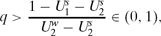 \[
q>\frac{1-U_1^{{s}}-U_2^{{s}}}{U_2^{w}-U_2^{{s}}}\in (0,1),
\]
On the surface, it appears as if the “cause” of war here is asymmetric information. However, the underlying mechanism is very different. In this setting, as in the traditional account, the rejection of the initial offer reveals that the player is strong, and so in both cases actors have full information after that action (in the two-type case). The difference is in what happens after that action but before war begins. In the traditional setting, the revelation of information leads to a precise determination of the bargaining range, and so players know not only that mutually acceptable peace deals exist, but also what they are. If they could renegotiate at this point, they would, because both would be better off if they avoided war. The problem is that they cannot, for if they could avoid war in equilibrium, then the decision to fight would not be risky and would not reveal the information necessary to revise optimistic beliefs (Slantchev and Tarar Reference Slantchev and Tarar2011). Even though uncertainties over common parameters, such as the probability of victory, are harder to resolve than those over private parameters, such as the costs of fighting (Fey and Ramsay Reference Fey and Ramsay2011), it might be possible to overcome even these problems with costly signaling that does not necessarily risk war (Slantchev Reference Slantchev2011). But in the traditional mechanism they cannot, and so they end up in a war of regret, which has the rather unfortunate flavor of a mistake.
Contrast this with the outbreak of war in the war finance model where fighting occurs if, and only if, the bargaining range does not exist. After the rejection of the initial offer reveals all the information, players begin the financing game, but as we know, in this game war occurs despite players knowing everything. The problem is not one of locating a mutually acceptable deal (the problem of asymmetric information) but the absence of any such deals (the problem of war finance). As we have seen, uncertainty may cause players to engage in behavior such that they would still prefer to fight even after all information was revealed. Unlike the traditional explanation where the revelation of information would invariably lead to peace if players were given the opportunity to negotiate, there is no such luck here. Instead, player 1 ends up in debt so deep that the bargaining range gets wiped out. There is no regret when fighting breaks out, in the sense that there is no alternative that players can agree to even now that the uncertainty has been resolved. When war occurs, it is a war of choice.
APPENDIX B: PROOFS
Lemma B.1.In any SPE, di∈[0, π). □
Proof. It is clear that no player would borrow di ≥ π if war is expected: Wi(di, d −i) ≤ 0<Wi(0, d −i) for any di ≥ π. That is, any player is better off not borrowing at all for war than borrowing more than the benefit he expects to win. I now show that the same holds when players expect the crisis to end in peace. WLOG, consider player 1, whose peace payoff comes from a deal x=(W 1+d 1+1−W 2−d 2)/2, so it is
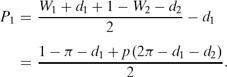 \begin{eqnarray*}
P_1&=&\frac{W_1+d_1+1-W_2-d_2}{2}-d_1\\
&=&\frac{1-\pi -d_1+p(2\pi -d_1-d_2)}{2}.
\end{eqnarray*}
 $\underline{P}_1=(1-\pi )/2$. Therefore, in any SPE his payoff must be at least as good.
Now fix d 2 ≥ 0 and suppose in a peaceful SPE player 1 borrows d 1 ≥ π. Consider player 1’s payoff in this SPE. Suppose first that 2π−d 1−d 2 > 0, so P 1 is strictly increasing in p. Then the best peaceful SPE payoff he can get would occur at p=1, so  $\overline{P}_1=(1+\pi -d_2-2d_1)/2$. But note now that
 $d_1\ge \pi \quad \Rightarrow \quad \overline{P}_1-\underline{P}_1 = \pi -d_1-d_2/2\le 0$, with the inequality being strict if either d 2 > 0 or d 1 > π (that is, only if d 2=0 and d 1=π will
 $\overline{P}_1=\underline{P}_1$). In all these cases player 1 would do strictly better by borrowing nothing and disarming, contradicting the supposition that he borrows d 1 ≥ π in equilibrium.Footnote 20 Suppose now that 2π−d 1−d 2<0, in which case P 1 is strictly decreasing in p. Since player 1 can always disarm regardless of what he has borrowed, in equilibrium he would choose p=0, and his payoff would be
 $(1-\pi -d_1)/2<\underline{P}_1$ for any d 1 > 0, another contradiction. Finally, suppose 2π−d 1−d 2=0, so his payoff is independent of p. But then
 $P_1=(1-\pi -d_1)/2<\underline{P}_1$ for any d 1 > 0, contradicting the equilibrium supposition. Therefore, it cannot be the case that in peaceful SPE player 1 borrows d 1 ≥ π. The same logic applies to player 2. ▪
Lemma B.2.In any SPE,  $m_i^*=\overline{m}_i$.
Proof. We shall use the necessary and sufficient condition for war from (W). Observe first that if d 1 > 1−π and d 2 > 1−π, then the condition is satisfied regardless of p, and war must be inevitable. Therefore, the game ends in war whenever min {d 1, d 2}>1−π. Conversely, if d 1 ≤ 1−π and d 2 ≤ 1−π, then (W) cannot be satisfied regardless of p, and peace must be inevitable. Therefore, the game ends in peace whenever max {d 1, d 2} ≤ 1−π. In all of these situations, the outcome is independent of the probability of winning, and since Pi and Wi both increase in i’s probability of victory, each player must maximize that probability in equilibrium, which implies that each player will mobilize at the resource constraint.
We now have two other cases to consider. In these, the outcome can depend on the probability of victory. Let us begin with 0 ≤ d 1 ≤ 1−π<d 2. Rewriting (W) tells us that in this case war will occur if, and only if,
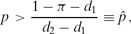 \begin{equation}
p>\frac{1-\pi -d_1}{d_2-d_1}\equiv \hat{p},
\end{equation}
 \begin{equation}
P_1-W_1 = \frac{1-\pi -\left[(1-p)d_1+pd_2\right]}{2},
\end{equation}
 $\hat{p}\in (0,1)$. Fix some m 2 > 0 and consider player 1’s best response. Let
 $\hat{m}_1$ be such that
 $p(\hat{m}_1,m_2)=\hat{p}$. We know that such an allocation exists and is unique because p is strictly increasing in m 1 and p(0, m 2)=0 and
 $\lim _{m_1\rightarrow \infty }p(m_1,m_2)=1$ but
 $\hat{p}\in (0,1)$. Observe, in particular, that
where we note that P 1−W 1 ≥ 0 whenever (W) is not satisfied with strict inequality (that is, peace is always strictly better than war whenever peace is strictly feasible). Moreover, since
 $m_1=\hat{m}_1\Rightarrow p=\hat{p}\Rightarrow P_1=W_1$, player 1 is indifferent between (feasible) peace and war whenever his allocation is
 $\hat{m}_1$. The game will thus end in peace if
 $m_1\le \hat{m}_1$ and in war otherwise. Suppose now that
 $\hat{m}_1\ge \overline{m}_1$. In this case peace will be the outcome for any feasible m 1, and so player 1 will simply maximize P 1, which we know is strictly increasing in p, and so
 $m_1^*=\overline{m}_1$ regardless of player 2’s choice. Suppose now that
 $\hat{m}_1<\overline{m}_1$, so player 1’s payoff is P 1 if
 $m_1\le \hat{m}_1$ and W 1 if
 $m>\hat{m}_1$. Since d 1<π in any SPE, both payoffs are strictly increasing in p. Thus, the best attainable peace payoff,
 $\overline{P}_1$, is at
 $m_1=\hat{m}_1$, whereas the best war payoff,
 $\overline{W}_1$, is at
 $m_1=\overline{m}_1$. But since
 $\overline{P}_1=W_1<\overline{W}_1$, it follows that player 1’s best response must be to choose the maximum allocation,
 $m_1^*=\overline{m}_1$, even though doing so ensures that the game will end in war. This establishes the claim for this configuration of debt levels.
Consider now the case where 0 ≤ d 2<1−π<d 1. Condition (W) tells us that in this case war would occur if, and only if,  $p<\hat{p}$. Fix some m 2 > 0 and consider player 1’s best response. As before,
 $\hat{m}_1$ is such that
 $p(\hat{m}_1,m_2)=\hat{p}$. The game will thus end in war if
 $m_1<\hat{m}_1$ and in peace otherwise. Suppose now that
 $\hat{m}_1<\overline{m}_1$. In this case, war will be the outcome for any feasible allocation, so player 1 would simply maximize W 1, which is strictly increasing in p, and thus he would pick
 $m_1^*=\overline{m}_1$. Suppose now that
 $\hat{m}_1\ge \overline{m}_1$, in which case player 1’s payoff is W 1 if
 $m_1<\hat{m}_1$ and P 1 if
 $m_1\ge \hat{m}_1$. But as we have seen in (4), peace is always strictly better than war whenever it is possible (and the difference is strictly increasing in p for this configuration of parameters), which means that player 1 would simply maximize P 1 by choosing
 $m_1^*=\overline{m}_1$ and ensuring the peaceful outcome. This establishes the claim for this configuration of debt levels.
The proof for player 2 is analogous. ▪
Lemma B.3.The zone boundary, Bi , is continuous, strictly decreasing, and convex.
Proof. The zone boundary is defined as the set of solutions to pe 2d 1+pe 1d 2=1−π, and can be described by the function
 \begin{equation}
B_i(d_{-i})=\frac{(1-\pi )\vartheta _i(y_{-i}+d_{-i})+(1-\pi -d_{-i})y_i}{\vartheta _i(y_{-i}+d_{-i})-(1-\pi -d_{-i})},
\end{equation}
Lemma B.4.Player i's optimal war debt, dwi(d −i), is unique, and is strictly increasing and concave whenever positive. Player i ’s optimal peace debt, dpi(d −i), is unique, and is strictly concave whenever positive. The optimal payoffs, W*i(d −i)≡Wi(dwi(d −i), d −i) and P*i(d −i)≡Pi(dpi(d −i), d −i), are strictly decreasing and convex.
Proof of Lemma B.4. Player i’s optimal war debt can be obtained by maximizing his war payoff assuming that the resulting distribution of power would be pe, and it is
 \begin{eqnarray*}
d_i^{w}(d_{-i}) &=& \max \Big (0, \sqrt{\vartheta _i(y_{-i}+d_{-i})(\pi +y_i+\vartheta _i(y_{-i}+d_{-i}))}\\
&&-\,y_i-\vartheta _i(y_{-i}+d_{-i})\Big ),
\end{eqnarray*}
 \[
\frac{\mathrm{d}\,d_i^{w}}{\mathrm{d}\,d_{-i}} = \frac{\vartheta _i\left[y_i+\pi +2\theta (y_{-i}+d_{-i})\right]}{2\sqrt{\vartheta _i(y_{-i}+d_{-i})(y_i+\pi +\vartheta _i(y_{-i}+d_{-i}))}} - \vartheta _i>0,
\]
 \[
\frac{\mathrm{d}^2\,d_i^{w}}{\mathrm{d}\,d_{-i}^2} = - \frac{\vartheta _i^2(\pi +y_i)^2}{4\left[\vartheta _i(y_{-i}+d_{-i})(\pi +y_i+\vartheta _i(y_{-i}+d_{-i}))\right]^{\frac{3}{2}}}<0.
\]
 \[
\frac{\mathrm{d}\,W_i^*}{\mathrm{d}\,d_{-i}} = -2\cdot \frac{\mathrm{d}\,d_i^{w}}{\mathrm{d}\,d_{-i}}<0 \quad \text{and}\quad \frac{\mathrm{d}^2\,W_i^*}{\mathrm{d}\,d_{-i}^2} = -2\cdot \frac{\mathrm{d}^2\,d_i^{w}}{\mathrm{d}\,d_{-i}^2}>0.
\]
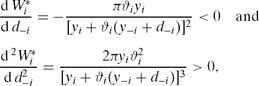 \begin{eqnarray*}
&&\frac{\mathrm{d}\,W_i^*}{\mathrm{d}\,d_{-i}} = -\frac{\pi \vartheta _i y_i}{[y_i+\vartheta _i(y_{-i}+d_{-i})]^2}<0 \quad \text{and}\\
&& \frac{\mathrm{d}\,^2 W_i^*}{\mathrm{d}\,d_{-i}^2} = \frac{2\pi y_i\vartheta _i^2}{[y_i+\vartheta _i(y_{-i}+d_{-i})]^3}>0,
\end{eqnarray*}
 $\zeta =2\sqrt{\vartheta _i(y_{-i}+d_{-i})(y_i+\pi +\vartheta _i(y_{-i}+d_{-i}))}>0$, the expression can be rewritten as [yi+π+2ϑi(y −i+d −i)−ζ]ϑi/ζ, and so its sign depends on the bracketed term, which is positive: yi+π+2ϑi(y −i+d −i)>ζ⇔(yi+π)2 > 0. The function is strictly concave:
Turning now to the value function, if dwi(d −i)>0, then the optimal payoff is W*i(d −i)=π−yi−2dwi(d −i), and so
If, on the other hand, dwi(d −i)=0, then W*i(d −i)=πyi/(yi+ϑi(y −i+d −i)), and so
so the optimal payoff function is strictly decreasing and convex.
Player i’s optimal peace debt can be obtained by maximizing the peace payoff under the assumption that pe obtains, and it is
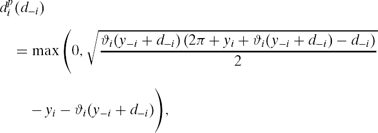 \begin{eqnarray*}
&&d_i^{p}(d_{-i})\\
&&= \max \left (0,\sqrt{\frac{\vartheta _i(y_{-i}+d_{-i})\left(2\pi +y_i+\vartheta _i(y_{-i}+d_{-i})-d_{-i}\right)}{2}}\right .\\
&& \quad -\, y_i-\vartheta _i(y_{-i}+d_{-i})\Bigg ),
\end{eqnarray*}
 \[
\hat{\vartheta }_i = \frac{\sqrt{2\left[(2\pi +y_i)^2+y_{-i}^2\right]}-(2\pi +y_i+y_{-i})}{2y_{-i}}>0,
\]
 \[
\hat{d}_{-i}=\frac{2\pi +y_i-(1-2\vartheta _i)y_{-i}-(2\pi +y_i+y_{-i})\sqrt{\frac{2\vartheta _i}{1+\vartheta _i}}}{2(1-\vartheta _i)}.
\]
 \[
P_i^*(d_{-i}) = \frac{1+\pi -\vartheta _i y_{-i}-(1+\vartheta _i)d_{-i}}{2} - y_i - 2d_i^{p}(d_{-i}).
\]
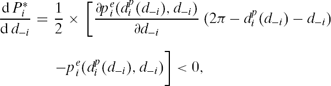 \begin{eqnarray*}
\frac{\mathrm{d}\,P_i^*}{\mathrm{d}\,d_{-i}} &=&\frac{1}{2} \times\, \left[\frac{\partial p_i^e(d_i^{p}(d_{-i}),d_{-i})}{\partial d_{-i}} \ (2\pi -d_i^{p}(d_{-i})-d_{-i})\right.\\
&& \left.-p_i^e(d_i^{p}(d_{-i}),d_{-i})(d_{-i}),d_{-i})}{\partial d_{-i}}}\right]<0,
\end{eqnarray*}
 \begin{eqnarray*}
\frac{\mathrm{d}\,P_i^*}{\mathrm{d}\,d_{-i}} &=& -\frac{1+\vartheta _i}{2}-2\cdot \frac{\mathrm{d}\,d_i^{p}}{\mathrm{d}\,d_{-i}}<0 \quad \text{and}\\
\frac{\mathrm{d}^2\,P_i^*}{\mathrm{d}\,d_{-i}^2} &=& -2\cdot \frac{\mathrm{d}^2\,d_i^{p}}{\mathrm{d}\,d_{-i}^2}>0.
\end{eqnarray*}
 \[
P_i^*(d_{-i}) = \frac{1}{2}\cdot \left[1-\pi +\frac{y_i(2\pi -d_{-i})}{y_i+\vartheta _i(y_{-i}+d_{-i})}\right],
\]
 \begin{eqnarray*}
\frac{\mathrm{d}\,P_i^*}{\mathrm{d}\,d_{-i}} &=& -\frac{y_i\left(y_i+\vartheta _i(2\pi +y_{-i})\right)}{2\left(y_i+\vartheta _i(y_{-i}+d_{-i})\right)^2}<0 \text{ and } \\
\frac{\mathrm{d}^2\,P_i^*}{\mathrm{d}\,d_{-i}^2} &=& \frac{\vartheta _i y_i\left(y_i+\vartheta _i(2\pi +y_{-i})\right)}{(y_i+\vartheta _i(y_{-i}+d_{-i}))^3}>0.
\end{eqnarray*}
 $\vartheta _i>\hat{\vartheta }_i$, where
and has a maximum at
 $\hat{d}_{-i}$ otherwise, with
Turning now to the value function, if dpi(d −i)>0, then we get
The envelope theorem tells us that
where the inequality follows from
 $\frac{\partial p_i^e}{\partial d_{-i}}<0$. Thus, we obtain
If, on the other hand, dpi(d −i)=0, then we get
and so
Thus, the function is strictly decreasing and convex, as claimed. ▪
Lemma B.5.The optimal war debt exceeds the optimal peace debt, dwi(d −i)>dpi(d −i), whenever they are not both zero.
Proof. Consider the definitions of dwi(·) and dpi(·) from Lemma B.4. Ignore the constraint that they must be non-negative and compare them without it. It is easy to see that dwi(d −i)>dpi(d −i)⇔yi+ϑi(y −i+d −i)+d −i > 0, and so the unconstrained optimal war debt always exceeds the unconstrained peace debt. This implies that dpi(d −i)>0⇒dwi(d −i)>0, and so the claim must hold when the debt levels are constrained to be non-negative as well. ▪
Proof of Lemma 1. Consider the claim about the war system. The first requirement is obvious: If (d*1, d*2) lies in the zone of peace, then war will not, in fact, occur at these allocations. Either player can switch to dpi(d*−i)<d*i, where the inequality follows from Lemma B.5. The deviation is profitable because the resulting allocation (dpi(d*−i), d*i) is also in the zone of peace, and i’s debt maximizes his payoff in this case, contradicting the equilibrium supposition. The second requirement follows from the definition of equilibrium and the fact that the only potentially profitable deviation must result in peace because players are already at their optima for war. Since increasing the debt produces yet another allocation in the zone of war, no such deviation can be profitable. The only possibility is that reduction of some player's debt induces peace. A necessary (but not sufficient) condition for such a deviation to be profitable is that (dpi(d*−i), d*−i) lies in the zone of peace. To see this, suppose that (dpi(d*−i), d*−i) is in the zone of war as well. Player i can still induce peace by choosing di ≤ Bi(d*−i). Since dpi(·) is strictly concave by Lemma B.4, it must be increasing for di<dpi(d*−i), and so the best deviation that induces peace must be at di=Bi(d*−i), which cannot be profitable because by definition that level makes player i indifferent between peace and war, and so Pi(Bi(d*−i), d*−i)=Wi(Bi(d*−i), d*−i)<W*i(d*−i). The proof for the peace system is analogous. ▪
Lemma B.6.Player i incurs zero debt at the solution to the war system, d*i=0, if, and only if, either (i) π ≤ yi , or (ii) yi<π and
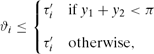 \begin{equation}
\vartheta _i\le \left\lbrace \begin{array}{@{}l@{\quad }l@{}}\tau _i^\prime &\text{if } y_1+y_2<\pi \\[10pt]
\tau _i^\prime &\text{otherwise}, \end{array}\right.
\end{equation}
 \[
\tau _i^\prime = \frac{y_i^2(2\pi -y_i)}{(\pi +y_{-i})(\pi -y_i)^2} \qquad \text{and}\quad \tau _i^\prime = \frac{y_i^2}{y_{-i}(\pi -y_i)},
\]
Proof. Solving dwi(d −i)>0 reduces to ϑi(π−yi)(y −i+d −i)>y 2i. Clearly, π−yi ≤ 0 is sufficient to ensure that this inequality cannot be satisfied. Thus, if π ≤ yi, then player i incurs zero war debt regardless of his opponent's allocation, and so he must do so at the solution to the war system in particular. This yields the first condition in the lemma. If yi<π, then dwi(d −i)>0 if, and only if,  $d_{-i}>y_i^2/[\vartheta _i(\pi -y_i)]-y_{-i}\equiv \overline{d}_{-i}$. Thus, d*i=0, which we can rewrite as dwi(dw −i(0))=0, can hold if, and only if,
 $d_{-i}^{w}(0)\le \overline{d}_{-i}$. We can reduce this inequality to ϑi ≤ τ′i, which itself can be satisfied only if ϑi ≤ τ′i. Since τ′i<τ′i⇔y 1+y 2<π, we obtain the second condition stated in the lemma. By Lemma B.5, dw −i(0) ≥ dp −i(0), and since dwi(·) is strictly increasing by Lemma B.4, we obtain 0=d*i=dwi(dw −i(0)) ≥ dwi(dp −i(0)) ≥ dpi(dp −i(0))=d**i, where the second inequality follows from another application of Lemma B.5. In other words, d**i=0, as claimed. ▪
Proof of Proposition 2. Assume, WLOG, that only player 2 is rich: y 1<π ≤ y 2. By Lemma B.6, d*2=d**2=0, and because y 1+y 2 ≥ π, condition (Z) is satisfied for player 1 if, and only if, ϑ1 ≤ τ′1. In that case, d*1=d**1=0, and so the unique SPE is at (0, 0), and it is peaceful. Suppose now that ϑ1 > τ′1, which means that d*1 > d**1 ≥ 0. Since player 2 chooses zero debt unconditionally, player 1 will choose between dw 1(0) and dp 1(0). If (dp 1(0), 0) is in the zone of war, which is the case when dp 1(0)>B 1(0), then Lemma B.5 implies that (dw 1(0), 0) is also in the zone of war, and by Lemma 1, the unique SPE is (dw 1(0), 0), and in it war occurs. If, on the other hand, (dp 1(0), 0) is in the zone of peace, there are two possibilities. If (dw 1(0), 0) is also in the zone of peace, which is the case when dw 1(0) ≤ B 1(0), then by Lemma 1, the unique SPE is (dp 1(0), 0), and in it peace prevails. If, however, (dw 1(0), 0) is in the zone of war, then player 1 will choose dp 1(0) if, and only if, P*1(0) ≥ W*1(0); otherwise he will choose dw 1(0). But if this is the necessary and sufficient condition for him to choose the appropriate optimal debt, Lemma 1 implies that the resulting allocation is the unique SPE, in which war occurs whenever player 1 chooses dw 1(0). This exhausts all the possibilities and completes the proof. ▪
Proposition B.2.If both players are poor but condition ( Z) is satisfied for some player i , then the game has a unique SPE. In it, player i borrows nothing, and his opponent borrows either dw −i(0), in which case the interaction ends in war, or dp −i(0), in which case the interaction ends in peace. If players are not collectively poor, then ( Z) must be satisfied for at least one of them.
Proof. I first establish that (Z) must be satisfied for at least one of the players if players are not collectively poor. Assume that y 1+y 2 ≥ π and suppose that (Z) is not satisfied for either player, and so ϑi > τ′i for all i. Since ϑi > τ′i⇔ϑ−i<1/τ′i, we obtain
 \[
\frac{y_2^2}{y_1(\pi -y_2)}<\vartheta _2<\frac{y_2(\pi -y_1)}{y_1^2},
\]
 \[
\frac{y_2^2}{y_1(\pi -y_2)}<\frac{y_2(\pi -y_1)}{y_1^2} \Leftrightarrow y_1+y_2<\pi ,
\]
Assume now that yi<π for each player i and suppose, WLOG, that (Z) is satisfied for player 2. There are two cases to consider. First, suppose (Z) is also satisfied for player 1. By Lemma B.6, d*1=d**1=d*2=d**2=0, and so the unique solution to both the war and the peace systems is (0, 0). Because (W) fails at this allocation, it must lie in the zone of peace, and by Lemma 1 this is the unique SPE, which is peaceful. Second, suppose (Z) is not satisfied for player 1, so the solution to the war system is (dw 1(0), 0), and the solution to the peace system is (dp 1(0), 0). Since player 2 chooses zero debt unconditionally, player 1 will choose between dw 1(0) and dp 1(0), and the proof reduces to the one used for Proposition 2. ▪
Proof of Proposition 4. Assume that players are not collectively poor when the costs of war are negligible: y 1+y 2 ≥ 1. We know that at least one of them must incur no debt in equilibrium. WLOG, suppose this is player 2, and so we can reduce  $\lim _{\pi \rightarrow 1}d_1^{w}(0)=\sqrt{\vartheta _1y_2(1+y_1+\vartheta _1y_2)}-y_1-\vartheta _1y_2>0$ to the two conditions, y 1<1, and ϑ1 > y 21/[y 2(1−y 1)], which, of course, is the converse of condition (Z). Observe now that as y 1→0 (so the first inequality is satisfied), the fact that y 2 ≥ 1 implies that the second inequality is satisfied as well. Thus, if y 1 is sufficiently smaller than y 2—that is, if the existing distribution of resources is sufficiently unfavorable for player 1—both inequalities will be satisfied, and by Lemma B.6, dw 1(0)>0, which means that the solution to the war system is in the zone of war. Any deviation by player 2 ends in the zone of war as well, so it cannot be profitable. The same holds for any deviation by player 1 that ends in that zone. The only potentially profitable deviation is for player 1 to reduce his debt and induce peace. Because the zone of war covers any positive allocation, the sole such possibility is to d 1=0. But now we obtain
 $\lim _{\pi \rightarrow 1,y\rightarrow 0}P_1(0,0)=\lim _{y_1\rightarrow 0}p^e(0,0)=0<\lim _{\pi \rightarrow 1,y\rightarrow 0}W_1^*(0)=\lim _{y\rightarrow 0}p^e(d_1^{w}(0),0)(1-d_1^{w}(0))$, where the inequality follows from the fact that limy→0dw 1(0)∈(0, 1) implies that
 $\lim _{y_1\rightarrow 0}p^e(d_1^{w}(0),0)>0$. Thus, the solution to the war system is an equilibrium, and it involves war. But because the equilibrium is unique when players are not collectively poor, this establishes the result. ▪
Proof of Proposition 5. Observe that for θi small enough, condition (Z) will be satisfied for player i no matter what the other parameters are. Lemma B.6 then tells us that d*i=d**i=0, so I only need to show that his opponent must pick dp −i(0) in the unique SPE. If π ≤ y −i, then Lemma B.6 implies that d*−i=d**−i=0, and so (0, 0) is the unique SPE, which we know is peaceful. If, on the other hand, y −i<π, then there are two possibilities. If player −i is also efficient enough for condition (Z) to be satisfied, Lemma B.6 again yields (0, 0) as the unique SPE. If she is not and condition (Z) is violated, then d*−i > d**−i ≥ 0. As θi becomes very small, ϑ−i becomes arbitrarily large:  $\lim _{\theta _i\rightarrow 0}\vartheta _{-i}=\infty$, and so condition (Z) must fail for player −i, as supposed. But since
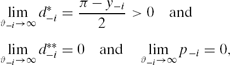 \begin{eqnarray*}
&&\lim _{\vartheta _{-i}\rightarrow \infty }d_{-i}^* = \frac{\pi -y_{-i}}{2}>0 \quad \text{and}\\
&& \lim _{\vartheta _{-i}\rightarrow \infty }d_{-i}^{**} = 0 \quad \text{and}\quad \lim _{\vartheta _{-i}\rightarrow \infty }p_{-i} = 0,
\end{eqnarray*}
Consider now θi becoming very large. If π ≤ yi, Lemma B.6 tells us that d*i=d**i=0, and because  $\lim _{\theta _i\rightarrow \infty }\vartheta _{-i}=0$, it follows that condition (Z) will be satisfied for player −i regardless of the other parameters. But then Lemma B.6 tells us that d*−i=d**−i=0, and (0, 0) must be the unique SPE, and it is peaceful. If, on the other hand, yi<π, then condition (Z) must fail for θi sufficiently large, and so d*i > d**i ≥ 0. Since in that case the condition is satisfied for player −i, it follows that d*−i=d**−i=0. But because
 $\lim _{\vartheta _i\rightarrow \infty }p_i=0$, it follows that as θi→∞, W*i(0)=−d*i<0<(1−π)/2=P*i(0), and so player i must be choosing dpi(0) in the unique SPE. Thus, if player i is sufficiently inefficient, peace must be the outcome as well.
Clearly, if one player is relatively very efficient, the other must be relatively very inefficient. Therefore, war can occur only if both players are moderately efficient relative to each other. ▪
Lemma B.7.In any SPE, Dpi(di)∈[0, π) and Dwi(di)∈[0, π).
Proof. In any pure-strategy SPE in which a player borrows at the war debt-servicing schedule, war must occur. Suppose Dwi(di) ≥ π. But then his payoff is Wi(di, d −i)=pi(di, d −i)(π−Dwi(di)) ≤ 0<Wi(0, d −i)=pi(0, d −i)π, where the inequality follows from pi(0, d −i)>0, which can be had for any yi > 0. Thus, he is better off borrowing nothing, contradicting the equilibrium supposition. Analogously, in any pure-strategy SPE in which he is committed to the peace debt-servicing schedule, peace must be the outcome. Player i can always borrow nothing and disarm, so that Dpi(0)=pi=0, in which case (P $_{\text{ds}}$) would reduce to 0 ≤ 1−π, and so peace would prevail at that allocation. This means that player i can always guarantee himself the payoff from this outcome, which would be
 $\underline{P}_i=(1-\pi )/2$, and so he must be getting at least that much in any SPE. Assume now that Dpi(di) ≥ π. Suppose first that 2π−Dpi(di)−Dp −i(d −i)>0, and so for any pi<1, player's i payoff is
 \[
P_i<\frac{1+\pi -2D_i^{p}(d_i)-D_{-i}^{p}(d_{-i})}{2}\le \frac{1-\pi -D_{-i}^{p}(d_{-i})}{2} \le \underline{P}_i,
\]
 $P_i=(1-\pi -D_i^{p}(d_i))/2<\underline{P}_i$, a contradiction. Finally suppose that 2π−Dpi(di)−Dp −i(d −i)=0, in which case
 $P_i=(1-\pi -D_i^{p}(d_i))/2<\underline{P}_i$, another contradiction. Therefore, Dpi(di)<π must obtain in any equilibrium. ▪
Lemma B.8.In any SPE of the game with interest,  $m_i^*=\overline{m}_i$.
Proof. Fix (di, d −i) and let p*i denote the (equilibrium) probability of victory for player i that lenders anticipate at the borrowing stage. It is important to realize that at the arming stage the debt-servicing schedule is set and players are free to choose any level of mobilization. However, in equilibrium, the resulting distribution of power must be such that pi=p*i. I now show that player i always maximizes his probability of winning for any fixed expectation by the lenders, which in turn implies that the only expectation lenders can have in equilibrium is that he does so. Consider, then, the arming stage. Since at this point player i can only affect the probability of winning, it follows that whenever he is committed to the war-servicing schedule Dwi(di)=(1+r)di/p*i, we obtain
 \[
\frac{\mathrm{d}\,W_i}{\mathrm{d}\,p_i}=\pi -\frac{(1+r)d_i}{p_i^*}>0
\]
 \begin{equation}
p_i\left(\frac{d_{-i}}{1-p_i^*}-\frac{d_i}{p_i^*}\right)>\frac{1-\pi }{1+r}-\frac{d_i}{p_i^*}.
\end{equation}
 $\overline{p}_i$ denote the distribution of power given player −i’s strategy when player i mobilizes fully with
 $\overline{m}_i=(y_i+d_i)/\vartheta _i$. Rewriting (W
 $_{\text{ds}}$), which must be satisfied whenever players commit to war debt-servicing schedules in equilibrium, for a fixed war debt-servicing schedule results in
If di/p*i > (1−π)/(1+r) and d −i/(1−p*i)>(1−π)/(1+r), then this condition is satisfied regardless of pi, and so the outcome will be war, as required, at
 $\overline{p}_i$ as well. Since player i’s war payoff is strictly increasing in his probability of winning, he chooses
 $\overline{m}_i$, as claimed. If, on the other hand, di/p*i ≤ (1−π)/(1+r) and d −i/(1−p*i) ≤ (1−π)(1+r), then (6) cannot be satisfied for any pi, and so peace would be the outcome regardless of what player i chose. But this cannot occur in equilibrium in which players have committed to war debt-servicing schedules, because the outcome is inconsistent with the expectations. I now have two possibilities to consider. I begin with 0 ≤ di/p*i ≤ (1−π)/(1+r)<d −i/(1+p*i), in which case (6) can only be satisfied if pi is sufficiently high (the term in parentheses and the right-hand side are both positive). If
 $\overline{p}_i$ satisfies this, then player i mobilizes everything, as claimed. Suppose, however, that (6) is violated at
 $\overline{p}_i$: That is, even at the maximum mobilization by player i, peace must prevail. This leads to a contradiction with the equilibrium requirement that lenders anticipate the outcome of the interaction, because for any other mobilization
 $m_i<\overline{m}_i$ that player i might use, (6) would still fail, and the outcome would be peace. But this implies that players and lenders commit to war debt-servicing schedules when they expect the interaction to end in peace, a contradiction with the equilibrium requirement that their strategies be optimal. Suppose now that 0 ≤ d −i/(1−p*i) ≤ (1−π)/(1+r)<di/p*i, and so both sides of (6) are negative. This now means that the inequality would be satisfied only if pi was small enough. If
 $\overline{p}_i$ is sufficiently small, then player i would choose
 $\overline{m}_i$ as claimed in order to maximize his war payoff. If, however,
 $\overline{p}_i$ is not small enough, mobilizing all his resources would actually induce peace. Since this outcome is inconsistent with the commitment to war debt-servicing schedules, it follows that player i must be mobilizing
 $m_i<\overline{m}_i$ such that the outcome is war because (6) is satisfied at the resulting distribution of power. I now show that this leads to a contradiction, because the best such war payoff is worse than deviating to the maximum allocation and inducing peace, a contradiction with the equilibrium requirement of no profitable deviations. Let
 $\hat{p}_<\overline{p}_i$ denote the maximum distribution of power where (6) is violated (i.e., where it holds with equality). Observe, in particular, that this implies that at
 $\hat{p}_i$ players would redistribute to maintain peace and since there is no surplus, each player would obtain the equivalent of his war payoff. Thus,
 $\hat{P}_i=\hat{W}_i=\hat{p}_i(\pi -(1+r)d_i/p_i^*)$. Since the war payoff is strictly increasing in his mobilization, player i’s equilibrium war payoff is worse than what he can obtain at
 $\hat{p}_i$, where peace must prevail, so
 $W_i<\hat{W}_i=\hat{P}_i$, which yields the contradiction because it shows that player i could improve his payoff by deviating to a larger allocation that induces peace, and so would not fight as supposed by the equilibrium. Thus, in any equilibrium in which war occurs, player i always mobilizes everything, as claimed.
Consider now that players are committed to the peace debt-servicing schedules, and so the interaction must end peacefully in equilibrium. Since Dpi(di)=(1+r)di, we obtain
 \[
\frac{\mathrm{d}\,P_i}{\mathrm{d}\,p_i}= \pi -\frac{(1+r)(d_i+d_{-i})}{2}>0,
\]
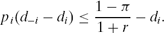 \begin{equation}
p_i(d_{-i}-d_i)\le \frac{1-\pi }{1+r}-d_i.
\end{equation}
 $_{\text{ds}}$), which must obtain in equilibrium for the fixed peace debt-servicing schedule, results in
If di > (1−π)/(1+r) and d −i > (1−π)/(1+r), then this condition cannot be satisfied regardless of πi, and so the outcome will be war no matter what player i does. This, however, contradicts the equilibrium requirement that players can only get the peace debt-servicing schedule when the outcome is expected to be peace. If, on the other hand, di ≤ (1−π)/(1+r) and d −i ≤ (1−π)/(1+r), then this condition is satisfied regardless of pi, which means that player i’s mobilization cannot affect the outcome. Since his peace payoff is strictly increasing, he mobilizes everything, as claimed. We now have two possibilities to consider. Suppose first that 0 ≤ di ≤ (1−π)/(1+r)<d −i, in which case (7) can only be satisfied if pi is sufficiently low (since both sides are positive). If
 $\overline{p}_i$ is low enough, then peace will prevail at all mobilizations that player i can utilize, and since his peace payoff is strictly increasing in pi, he mobilizes
 $\overline{m}_i$, as claimed. If, however,
 $\overline{p}_i$ is not small enough, then mobilizing everything will actually induce war. Let
 $\hat{p}_i<\overline{p}_i$ be the maximum distribution of power consistent with peace (i.e., (7) holds there with equality). Since players are indifferent between the peace and war payoffs at the boundary, it follows that
 $\hat{P}_i=\hat{W}_i=\hat{p}_i(\pi -(1+r)d_i)$, and this is the best peace payoff that player i can obtain. If war is to occur when players are committed to their peace debt-servicing schedules, player i’s payoff will be Wi=pi(π−(1+r)di), which is strictly increasing in pi as well. But now the fact that
 $\hat{p}_i<\overline{p}_i$ means that he has a profitable deviation because
 $\overline{p}_i(\pi -(1+r)d_i)>\hat{p}_i(\pi +(1+r)d_i)=\hat{P}_i$. This contradicts the equilibrium supposition because it means that player i can profitably deviate to war from an equilibrium in which the outcome is supposed to be peace. Suppose now that 0 ≤ d −i ≤ (1−π)/(1+r)<di, in which case (7) can only be satisfied if pi is sufficiently high (since both sides are negative). If
 $\overline{p}_i$ is high enough, then player i mobilizes everything, as claimed. Suppose, however, that
 $\overline{p}_i$ is not sufficiently high, and so (7) fails even when player i mobilizes everything. Since this implies that the condition would fail when he mobilized any
 $m_i<\overline{m}_i$ as well, it follows that for any such mobilization war would still occur. But this then means that such a mobilization cannot be a part of equilibrium in which players expect peace, a contradiction. Thus, in any equilibrium in which peace obtains, player i always mobilizes everything, as claimed.
This exhausts all the possibilities, and completes the proof. ▪
Lemma B.9.The boundaries of the zone of war under the war debt-servicing schedule, Bwi(d −i), and under the peace debt-servicing schedule, Bpi(d −i), are functions and Bpi(d −i)>Bwi(d −i).
Proof. Consider the war boundary under the war debt-servicing schedule defined in the text. Since players mobilize all of their resources,
 \[
\frac{p_1}{p_2}=\frac{p^e}{1-p^e}=\frac{\theta _2(y_1+d_1)}{\theta _1(y_2+d_2)},
\]
 \begin{equation}
\frac{\vartheta _1(y_2+d_2)}{y_1+d_1}\,d_1+ \frac{y_1+d_1}{\vartheta _1(y_2+d_2)}\,d_2=\frac{1-\pi }{1+r}.
\end{equation}
 \[
B_1^{w}(0) = \frac{(1-\pi )y_1}{(1+r)\vartheta _1y_2-(1-\pi )}.
\]
 \begin{eqnarray*}
a_2 &=&\frac{\vartheta _i^2d_i}{y_i+d_i}\ge 0\\
a_1 &=& y_i+d_i+\frac{2\vartheta _i^2y_{-i}d_i}{y_i+d_i}-\frac{\vartheta _i(1-\pi )}{1+r}\\
a_0 &=&\vartheta _iy_{-i}\left(\frac{\vartheta _iy_{-i}d_i}{y_i+d_i}-\frac{1-\pi }{1+r}\right),
\end{eqnarray*}
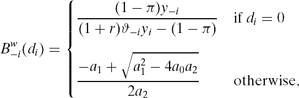 \[
B_{-i}^{w}(d_i)=\left\lbrace \begin{array}{@{}l@{\quad }l@{}}\displaystyle\frac{(1-\pi )y_{-i}}{(1+r)\vartheta _{-i}y_i-(1-\pi )}&\text{if }d_i=0\\[15pt]
\displaystyle\frac{-a_1+\sqrt{a_1^2-4a_0a_2}}{2a_2}&\text{otherwise}, \end{array}\right.
\]
 $_{\text{ds}}$) for any given di are values of d −i up to the smaller root or larger than the larger root, it follows that the larger root defines the boundary of this war zone. Thus,
and for a given di, all allocations (di, d −i) with d −i > Bw −i(di) are in this zone of war, and therefore peace cannot obtain if players have borrowed on terms that expect fighting.
Turning now to the war zone boundary under the peace debt schedules, we use p 1=pe and p 2=1−pe. Letting 1−Π≡(1−π)/(1+r), we obtain the familiar specification
 \[
B_{-i}^{p}(d_{i})=\frac{(1-\Pi )\vartheta _{-i}(y_i+d_i)+\left(1-\Pi -d_i\right)y_{-i}}{\vartheta _{-i}(y_i+d_i)-(1-\Pi -d_i)},
\]
Lemma B.10.The optimal war debt under the war debt-servicing schedule for player i, dwi(d −i), is unique, smaller than the optimal war debt without interest, and strictly concave in the opponent's debt whenever positive. Player i incurs strictly positive debt, dwi(d −i)>0, if, and only if, (i) 4(1+r)yi<π, (ii) ϑi<τi, and (iii)  $d_{-i}\in (\underline{d}_{-i},\overline{d}_{-i})$, where the latter interval is defined by
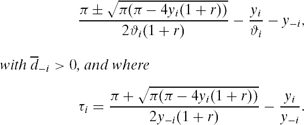 \[
\frac{\pi \pm \sqrt{\pi (\pi -4y_i(1+r))}}{2\vartheta _i(1+r)}-\frac{y_i}{\vartheta _i}-y_{-i},
\]
 \[
\tau _i=\frac{\pi +\sqrt{\pi (\pi -4y_i(1+r))}}{2y_{-i}(1+r)}-\frac{y_i}{y_{-i}}.
\]
 \begin{eqnarray*}
&&d_i^{w}(d_{-i})\\
&&\quad = \max \left(0,\sqrt{\vartheta _i(y_{-i}+d_{-i})\,\frac{\pi }{1+r}}-y_i-\vartheta _i(y_{-i}+d_{-i})\right),
\end{eqnarray*}
 \begin{eqnarray*}
&&\frac{\mathrm{d}\,d_i^{w}}{\mathrm{d}\,d_{-i}} = \sqrt{\frac{\pi \vartheta _i}{4(1+r)(y_{-i}+d_{-i})}}-\vartheta _i \gtreqless 0 \\
&&\quad \Leftrightarrow \quad d_{-i}\lesseqgtr \frac{\pi }{4(1+r)\vartheta _i}-y_{-i}.
\end{eqnarray*}
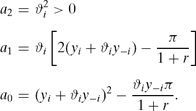 \begin{eqnarray*}
a_2&=&\vartheta _i^2>0\\
a_1&=&\vartheta _i\left[2(y_i+\vartheta _iy_{-i})-\frac{\pi }{1+r}\right]\\
a_0&=&(y_i+\vartheta _iy_{-i})^2-\frac{\vartheta _iy_{-i}\pi }{1+r}.
\end{eqnarray*}
 \[
\frac{\pi \pm \sqrt{\pi (\pi -4y_i(1+r))}}{2\vartheta _i(1+r)}-\frac{y_i}{\vartheta _i}-y_{-i},
\]
 \[
\vartheta _i<\frac{\pi +\sqrt{\pi (\pi -4y_i(1+r))}}{2y_{-i}(1+r)}-\frac{y_i}{y_{-i}}\equiv \tau _i>0,
\]
 \begin{equation}
\vartheta _i<\frac{\pi -\sqrt{\pi (\pi -4y_i(1+r))}}{2y_{-i}(1+r)}-\frac{y_i}{y_{-i}},
\end{equation}
 $\overline{d}_{-i}>0$, and where Proof. Maximizing the war payoff Wi(di, d −i) under the assumptions that (DS) holds and players mobilize everything they have yields the optimal war debt for player i,
which is clearly unique. It is easy to see by inspecting the two definitions that the optimal war debt with interest is strictly smaller than the optimal war debt without. It is also strictly concave:
To determine when a player would use strictly positive war debt, we start by rewriting dwi(d −i)>0 as a quadratic, which yields a 2d 2−i+a 1d −i+a 0<0, where
Since a 2 > 0, the solutions to quadratic inequality lie between its two roots. Therefore, any solution requires that the discriminant, π(π−4(1+r)yi)ϑ2i/(1+r)2, be positive, which is the case if, and only if, 4(1+r)yi<π, yielding the first (necessary) condition. When this condition is satisfied, there are two roots,
where we note that 4(1+r)yi<π implies that
 $\pi >\sqrt{\pi (\pi -4y_i(1+r))}$, and so the first term is always positive. If the larger root is negative, then the square inequality cannot be satisfied for any positive d −i, and so a necessary condition for dwi(d −i)>0 is that this root is strictly positive, or that
where the last inequality follows from 4(1+r)yi<π. However, if ϑi is too small, the smaller root becomes binding too because it is positive when
where we note that this bound is also strictly positive. ▪
Proof of Proposition 6. Assume that player i is poor, 4(1+r)yi<π, but his opponent is sufficiently rich, 1 ≤ 4(1+r)y −i. By Lemma B.10, dw −i(di)=0 for any di ≥ 0, and the solution to the war system is (dwi(0), 0). There are several requirements for this solution to be supportable in SPE: (i) it cannot be in the zone of sustainable peace, (ii) no player can profit by deviating and still fighting, and (iii) no player can profit by deviating and inducing peace. I start with the first requirement: (dwi(0), 0) is not in the zone of sustainable peace if, and only if, (W $_{\text{ds}}$) holds when one of the players incurs zero debt. Using (8), I write this as
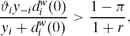 \begin{equation}
\frac{\vartheta _iy_{-i}d_i^{w}(0)}{y_i+d_i^{w}(0)}>\frac{1-\pi }{1+r},
\end{equation}
 \begin{eqnarray*}
&&\vartheta _iy_{-i}\\
&&\quad\in \left(\frac{1-\sqrt{1-4y_i(1+r)}}{2(1+r)}-y_i, \frac{1+\sqrt{1-4y_i(1+r)}}{2(1+r)}-y_i\right){\!},
\end{eqnarray*}
 $d_{-i}=0<\overline{d}_{-i}$, which I know from the proof of (B.10) to be satisfied whenever ϑi<τi. I now must make sure that the allocation is in the zone of war under the war debt-service schedules: (10) must be satisfied as well. I now show that it is satisfied when the costs of war are low: π→1. Since the assumed wealth conditions for the players are satisfied at the limit, I just need to show that dwi(0) > 0 there as well, because then (10) must be satisfied, as the left-hand side is positive and the right-hand side is zero. But since player i is poor, we only need to ensure that ϑi<τi in the limit and that
 $\underline{d}_{-i}<0$. Since (9) tells when
 $\underline{d}_{-i}>0$, taking its converse ensures that the requirement is met. Thus, if player i is moderately efficient, so that
then both conditions are satisfied in the limit, ensuring that dwi(0) > 0 there. Thus, if player i is poor and moderately efficient, his opponent rich, and the costs of war sufficiently low, then the solution to the war system, (dwi(0), 0), is in the zone of war.
Turning now to the possible deviations, observe first that no deviation that ends in war can be profitable for either player. Since the deviating player incurs the war debt schedule, fighting at any debt allocation that is not optimal cannot be improving, by definition. The only potentially profitable deviation is one that causes the interaction to end in peace. Since deviations still incur the war debt schedules, any d −i > 0 keeps the allocation in the zone of war, which implies that there is no deviation by player −i that can induce peace, and so there exist no profitable deviations for this player. The only possibility, then, is for player i to reduce his debt and induce peace. But since as π→1 any positive debt must be in the zone of war, the only possibility for this is that he incurs no debt either. In this case, his payoff is just
 \[
\lim _{\pi \rightarrow 1} P_i(0)=\frac{1}{2}\cdot \left[1-\pi +2\pi p_i^e(0,0)\right]=p_i^e(0,0) =\frac{y_i}{y_i+\vartheta _i y_{-i}}.
\]
 \[
\lim _{\pi \rightarrow 1}W_i^*(0) = \left(1-\sqrt{(1+r)\vartheta _iy_{-i}}\right)^2+(1+r)y_i >\lim _{\pi \rightarrow 1}P_i(0),
\]
 $_{\text{ds}}$) also fails for any positive debt by any player, and so the (inevitable) war zone includes all allocations except (0, 0). The only possible equilibrium with peace debt-service schedules must occur at that allocation, but since players do not borrow, their peace payoffs are the same regardless of the debt-service schedule. As just seen, however, player i strictly prefers to fight when his opponent has not incurred any debt. ▪



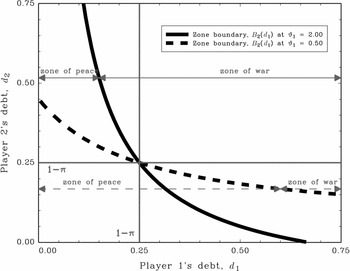
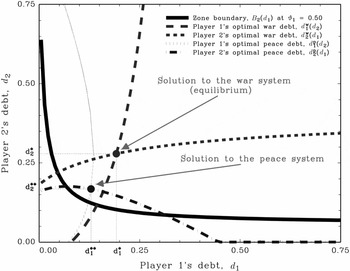
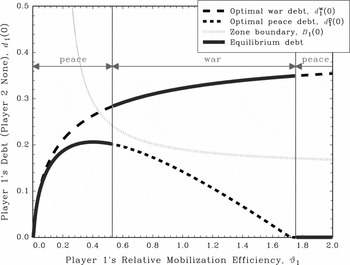



Comments
No Comments have been published for this article.