Since the formulation of the critical period hypothesis by Lenneberg (Reference Lenneberg1967), there have been various takes on the hypothesis, including on the second language (L2) acquisition of phonology. These range from multiple critical periods (Seliger, Reference Seliger and Ritchie1978), a fuzzy-edged sensitive rather than critical period (Flege, Reference Flege1987), to disputes about age of critical period termination. In phonology, studies have long suggested that L2 learners with early versus late exposure are two distinct populations in that younger starters are invariably superior to older starters (e.g., Ioup, Reference Ioup, Hansen Edwards and Zampini2008). We therefore expect learners’ interlanguage phonologies to differ fundamentally as a function of their age of initial exposure to the L2. Yet studies dating back to the early 1980s have indicated that younger and older learners’ interlanguage phonologies do not differ qualitatively; regardless of age of initial exposure, learners seem to make use of much the same linguistic mechanisms (see, e.g., Eckman, Reference Eckman1981; Wode, Reference Wode, Piske and Young-Scholten2009; and chapters in Ioup & Weinberger, Reference Ioup and Weinberger1987; Piske & Young-Scholten, Reference Piske and Young-Scholten2009).Footnote 1
How can we explain the well-attested ultimate failure of older starters despite observed lack of qualitative differences that would point to younger and older starters as two distinct populations? The influence of age of initial exposure and the influence of the learner's native language on their L2 have long been considered inevitable. That an older starter will retain a foreign accent in his/her L2 has the status of fact. However, when factors that might mitigate the effects of age and first language (L1) influence are upon occasion considered, we realize that we know too little about some factors to accept foreign accent as fact. One of these factors is input. Input can be considered from a developmental perspective through use of longitudinal data where “claims about learning . . . can be most meaningfully interpreted” to allow the possibility of identifying cause and effect (Ortega & Iberri-Shea, Reference Ortega and Iberri-Shea2005, p. 26; on such data in L2 phonology, see Hancin-Bhatt, 2008; Van Dijk, Verspoor, & Lowie, 2011). The present paper draws on longitudinal L2 phonology data.
MAPPING THE FIELD
Longitudinal studies are of value in their ability to identify qualitative differences; this is of particular value in addressing whether younger and older L2 learners constitute distinct populations. It was longitudinal data from L1 children and L2 adults that led Clahsen and Muysken (Reference Clahsen and Muysken1986, Reference Clahsen and Muysken1989) to conclude that fundamental differences exist between child and adult learners of German in the acquisition of syntax (see Note 1). As noted in Young-Scholten (Reference Young-Scholten, Dziubalska-Kołaczyk, Wrembel and Kul2011), there has been little relevant longitudinal work to pursue this issue in L2 phonology. Gut's (Reference Gut2009) survey of 39 years of research identified only 17 longitudinal studies. Among these are Abrahamsson (Reference Abrahamsson2003), Akita (Reference Akita1998), Carlisle (Reference Carlisle1998), Derwing, Munro, and Thomson (Reference Derwing, Munro and Thomson2008), Edwards (Reference Edwards2006), and Winitz, Gillespie, and Starcev (Reference Winitz, Gillespie and Starcev1995). Perhaps the best known is Snow and Hoefnagel-Höhle's (Reference Snow, Hoefnagel-Höhle, Krashen, Long and Scarcella1982) yearlong study of 33 English-speaking children, adolescents, and adults learning Dutch in The Netherlands. The study examined morphology, vocabulary, syntax, auditory discrimination, and pronunciation. The data showed a steady progression, with the older starters initially faster in morphology and phonology. Differences in phonology leveled out by the end of the year, and for a subset of learners tracked for an additional 6 months, the younger ones had overtaken the adolescents and adults in their acquisition of phonology, thus corroborating results from other studies that younger is ultimately better.
Interaction with native speakers plays a role in ultimate attainment in phonology for L2 learners of all ages; this is both assumed and has been empirically investigated (see, e.g., Moyer, 2009). Input factors less often considered include exposure to nonnative-accented input in the classroom (Winitz et al., Reference Winitz, Gillespie and Starcev1995; Young-Scholten, Reference Young-Scholten, Eubank, Selinker and Smith1995) and exposure to written text (Bassetti, Reference Bassetti, Piske and Young-Scholten2009). The study of L2 German phonology on which the present paper reports controlled for native speaker interaction and nonnative speaker classroom input by selecting three learners who from the start of their acquisition lived with host families and attended local secondary schools in Germany. Moreover, at their schools there were few nonnative speakers and no special language classes for them.
The study considers the effect of written exposure on the L2 acquisition of German by three American adolescents who spent a year as exchange students living with middle-class families in standard variety-speaking areas of Germany. They were acquiring German without instruction (i.e., naturalistically). In the following, we first elaborate on ideas on the influence of written text in the L2 acquisition of phonology. We then provide a brief review of the literature on longitudinal studies of naturalistic adult learners. Next, we turn to the study, and after discussing the research methodology, we present the results from our examination of realization of final voiceless stops and word-initial /z/. The results indicate the effect of written text on all three learners’ L2 phonology. We also consider whether influences other than orthographic input (OI) could have contributed to learners’ realization of <s> as /s/, and to do so we turn to oral data from native German speakers of the variety to which the learners were exposed. A Praat-based analysis of these data suggests that the input the learners received may have varied more than we assume. That is, word-initial /z/ is not always realized unequivocally as voiced [z] but depends on phonological context. Although these native German speakers were not those from whom the learners received their input, and the data collected from them involved a much smaller set of lexical items collected under conditions different from those for the learners, this nonetheless points to the need to include the phonetic details of input learners might have received in an analysis of their phonological development.
EXPOSURE TO WRITTEN TEXT AS A VARIABLE IN L2 PHONOLOGY
Few L2 phonology studies control for or isolate exposure to written text as a variable. Yet written text exposure is clearly one of the major differences between L1 and L2 acquisition. This is particularly the case when the L2 populations typically studied are classroom learners. L1 children acquire phonology before learning to read, but both younger and older L2 learners whose acquisition occurs in the classroom acquire their L2 phonology during exposure to written L2 text. While many children and adults acquire their L2s naturalistically, most research is conducted on learners in school (younger immigrants), in foreign language classes (both younger and older learners), or on older immigrant learners/students exposed to their L2 in instructional settings prior to moving to the target language country.
Let us consider how exposure to written text might function as a variable in the acquisition of a second phonology. Languages written using the Roman alphabet visually represent phonemes, albeit sometimes only loosely in opaque orthographies such as English. We assume (see, e.g., Bassetti, Reference Bassetti, Piske and Young-Scholten2009; Young-Scholten, Reference Young-Scholten, Burmeister, Piske and Rohde2002) that written text functions as an additional source of input in L2 phonology, and henceforth refer to learners’ exposure to written text as OI. In the classroom, when learners who can already read in their L1 encounter written text in the L2 while their L2 phonologies are developing, they may interpret the graphemes in the L2 using their L1 grapheme–phoneme correspondences.Footnote 2
We expect learners to benefit from OI when a phonemic contrast that does not exist in their L1 must be acquired in the L2. On how this might occur, see, for example, Esudero, Hayes-Harb, and Mitterer (Reference Escudero, Hayes-Harb and Mitterer2008), Escudero and Wanroiij (Reference Escudero and Wanrooij2010), and Hayes-Harb, Nicol, and Baker (Reference Hayes-Harb, Nicol and Barker2010). Whether OI has the power to offer additional support for learners in their acquisition of new phonemic distinctions remains an open question (see, e.g., Ota, Hartsuiker, & Haywood, Reference Ota, Hartsuiker and Haywood2008). The small but growing body of work examining negative effects of OI during actual L2 acquisition (vs. in experimental settings) shows that OI seems to filter aural input (Bassetti, Reference Bassetti, Piske and Young-Scholten2009; Rafat, Reference Rafat2011; Zampini, Reference Zampini, Hannahs and Young-Scholten1997). For example, OI may lead to learners’ overly strict adherence to L2 grapheme–phoneme correspondence rules (e.g., pronunciation of the [l] in <salmon> in English; see Bassetti & Atkinson, Reference Bassetti and Atkinson2015 [this issue]). OI also leads to patterns of development traceable to learners’ application of their L1 grapheme–phoneme correspondence rules, which often strengthens L1 phonology influence.Footnote 3 If we find these patterns differ from those for L2 learners exposed to little or no OI (younger, nonclassroom learners), we may uncover a new explanation for age differences.
LONGITUDINAL STUDIES OF NATURALISTIC LEARNERS OF GERMAN
The effect of OI can be expected to vary given that individuals vary in their access to the written representations of what they hear. For younger, less literate L2 learners, the amount of OI will be less than for older, more literate L2 learners. For older, uninstructed, naturalistic L2 learners, the amount of OI may be much reduced. Earlier studies of postpuberty naturalistic learners aimed to reduce if not eliminate the effect of explicit teaching on acquisition of aspects of the L2 such as inflectional morphology. Longitudinal studies of naturalistic adult learners document acquisition in a way that can enable identification of cause and effect, as noted above. Data therefore provide a more valid comparison with data from L1 children. The best known such studies are the 1970s–1980s 2-year longitudinal ZISA (Zweitspracherwerb italienischer-, portuguesischer- und spanischer Arbeiter) study of 12 Italian, Portuguese, and Spanish migrant workers in Germany (Clahsen, Meisel, & Pienemann, Reference Clahsen, Meisel and Pienemann1983) and the 2.5-year European Science Foundation study of 40 migrant adults from six different L1 backgrounds learning Dutch, English, French, German, or Swedish (Klein & Perdue, Reference Klein and Perdue1997). For naturalistic adult L2 learners, OI is reduced, compared with instructed learners because, unlike in the L2 classroom, phonological acquisition that occurs naturalistically does not revolve around learning to pronounce written text. However, in such studies, the learners were often socially and economically excluded and typically received insufficient L2 exposure to observe development beyond early stages (Vainikka & Young-Scholten, Reference Vainikka and Young-Scholten2011). Moreover, acquisition of morphosyntax rather than phonology was the focus of these studies. The study the present paper discusses sought to address the problem of insufficient L2 exposure by locating naturalistic postpuberty learners who could be expected to receive ample input, namely, secondary school exchange students. Their exchange program required no prior L2 exposure/knowledge, thus presenting the researcher with the opportunity to study older naturalistic learners from the earliest stages of acquisition in an environment where both quantity and quality of aural input were expected to be comparable to what younger L2 learners receive in similar situations. We might expect that in such an input-rich environment, the older learners under investigation would demonstrate considerable progress toward near-native German phonology. However, we will also take into account that this rich aural input was accompanied by written input.
THE STUDY: NATURALISTIC YEAR ABROAD LEARNERS OF L2 GERMAN
The learners
The learners were three young Americans, Joan, Paul, and George (pseudonyms), aged 15, 16, and 17 at the start of the study, who spent a year living with host families and attending the local secondary schools in North Rhine Westphalia, Schleswig-Holstein, and urban Lower Saxony, respectively. They had no prior exposure to German and little experience with foreign language learning (Joan, 1 month of Spanish; Paul, 1 semester of French; George, 1 year of French). Eleven half-day data collection sessions were conducted by the first author individually with each learner over 12 months. These sessions began 3 weeks after their arrival in August of that year and continued until shortly before their return to the United States the following July. The sessions involved informal conversation and broad and narrow elicitation tasks, including grammaticality judgment and comprehension tasks. Sessions were recorded with a Sony WM-D6C and ECM MS-907 microphone in various settings: a university office, the host family's home, and upon occasion in an uncrowded restaurant or café. Although the latter are not ideal environments for recording speech, interaction with the researcher in such environments was more likely to elicit the desired unmonitored spontaneous oral production data. These recordings were subsequently digitized as WAV files.
Joan, Paul, and George were in the best possible position to acquire German. The vast majority of their input was from native speakers of German, with no intrusion from English from now ubiquitous social media.Footnote 4 Apart from a 4-week induction course their first month in Germany (July–August), with morning sessions devoted to explicit instruction on German grammar, they received no German classes in which they were taught German with the support of written text. The induction course involved no assessment of their proficiency, and hence Joan, Paul, and George absorbed minimal content. The following sections reveal how, despite being naturalistic learners, these three learners processed the aural German input through the filter of the grapheme–phoneme correspondences of their native English. Their education and literacy may have made this unavoidable (Note 3).
The effect of OI on final devoicing
Young-Scholten (Reference Young-Scholten2004) examined Joan’s, Paul’s, and George's acquisition of a non-English German phoneme, a velar fricative, and its allophonic variant, a palatal fricative, written as <ch>. She also examined the neutralisation of a voicing contrast for the obstruents /b, d, g/ and /p, t, k/ in final position. For the latter, these are phonemes common to German and English. Here two hypotheses are relevant. First, Flege's (1995) speech learning model (SLM) predicts new L2 phonemes/phones to be easy to acquire and predicts those phonemes/phones that are similar in the L1 and L2 to be difficult to acquire due to equivalence classification. The SLM predicts that the new velar fricative phoneme will be easy and that neutralization of voicing will be difficult. Second, Eckman's (Reference Eckman1977) markedness differential hypothesis (MDH) predicts acquisition will be successful when an obstruent voicing contrast is absent in the word-final marked position. Unlike the SLM, the MDH predicts that final devoicing in German will be easy to acquire by English speakers because the neutralization of the final contrast is less marked than in English where b/d/g remain voiced in final position. To test these hypotheses, one of the narrow elicitation tasks the three learners took every month required them to orally translate 14 adjectives and 10 nouns in English into German and then repeat them with a suffix. All 24 words, which learners knew after several data collection sessions, ended in the target obstruents. For /b, d, g/ each learner's first production created a context for final devoicing and their second production removed that context, because the targets were no longer word-final. The suffixes learners added were the comparative <er> for adjectives and plural suffixes for nouns. The latter varied, due to the number of plural forms in German, but it was expected that these would be vowel-initial suffixes, and all were. This task revealed whether learners had acquired final devoicing and whether they had acquired targetlike underlying representations for these adjectives and nouns. These tokens were transcribed using the International Phonetic Alphabet (IPA) by the first author and checked by a second (native-speaking) transcriber, resulting in over 90% agreement.
Results supported Flege's SLM in showing a higher rate of target-likeness for the velar and palatal fricatives than for neutralization of the voiced stops in final position. The MDH-based prediction that learners would find final devoicing easy was not supported. There was variation in both learners’ application of final devoicing and in their underlying representations. Up to the end of their year in Germany, they failed to produce systematic targetlike alternation for pairs such as <Kind> “child” and <Kinder> “children.” Either word-final /d/ was realized as *[d] or the target /d/ was produced as [t], both word-medially and finally, indicating they had established the wrong underlying representation for <Kind> with /t/ rather than /d/. Young-Scholten argues that the learner's task of trying to figure out words’ underlying representations from the aural input is complicated by OI. For Joan and Paul, this additional source of input strengthened their initial L1-based assumption that the phonemes /b, d, g/ are phonetically realized as [b, d, g] in German in final position, just as they are in English, because they are spelled the same in German and English. Evidence in the aural input that voiced phonemes are devoiced seems to have been ignored. George did not ignore this input; final voiced stops in German were more often voiceless for him. However, this is at the expense of incorrect underlying representations. For example, he produced the word-medial <d> in <Kinder> “children” as [t]. This suggests that he adopted a new grapheme–phoneme correspondence rule whereby <d> in medial and final position is pronounced as [t]. OI seems to have less of an effect on the three learners’ acquisition of a new L2 phoneme, the velar fricative, and its allophone, the palatal fricative. This is unexpected given the fact that the digraph <ch> represents both these fricatives and several phonemes in American English, none of which is a velar or palatal fricative. However, it may be precisely because the German phoneme is new that OI has a weaker influence.
OI influence on route of development for word-initial /z/ <s>
We now turn to another set of graphemes, namely, <s> and <z>, both of which exist in English and German but which correspond to different phonemes in the two languages. Our three learners of German are faced with the task of remapping the grapheme <s> from /s/ in English to /z/ in German word-initially, and the grapheme <z> in English from /z/ to a new phoneme, /ts/, in German.Footnote 5 We focus here on the three learners’ word-initial production of /z/ for several reasons. First, unlike /ts/, the /z/ is not a new phoneme for English speakers. Second, the distribution of /z/ differs from its distribution in English where final devoicing means the German /z/ surfaces as [s], and word-medially surfaces as [z]. Third, [s]–[z] alternations exist in English in final position (plural/third-person singular/possessive allomorphs) and in word-medial position where /s/ surfaces as [z] as in <sound> versus <resound> and <sign> versus <design> (Venezky, Reference Venezky1970).
This is not a question of similarity; German and English /z/ are not just similar but identical. Flege's SLM is not relevant. Markedness and developmental considerations should predict few problems for learners’ production of a voiced obstruent rather than voiceless obstruent in word-initial position; it is the least marked position for a voicing contrast (Eckman, Reference Eckman1977), and young children often produce initially voiced obstruents that are not voiced in the input (Ingram, Reference Ingram1989). Given where they were located during their year in Germany (see above), the three learners were not exposed to those southern German varieties in which /z/ is voiceless word-initially. We instead predict orthographic influence because <s> in word-initial position is /z/ in German, realized as [z], while the grapheme is /s/ in English and realized as [s] in word-initial position.
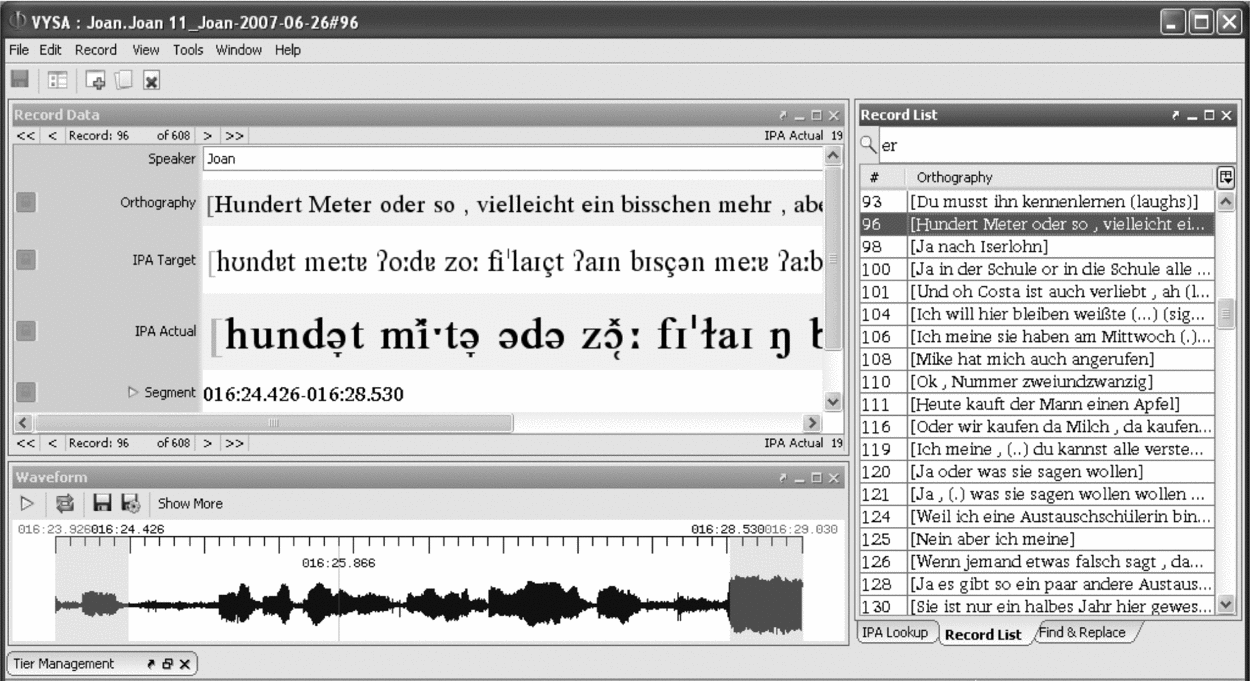
To examine the realization of the phonemes /z/ and /ts/, four data collection sessions from the three learners’ year in Germany were selected: Sessions 1, 2, 6, and 11 (first and second month of stay in Germany, midway, and final month in Germany). Two successive sessions were included due to the paucity of data at the beginning of learners’ acquisition. From each session, up to 30 min of spontaneous conversation with the interviewer and four oral elicitation tasks were phonetically transcribed. These tasks involved a picture card activity and a picture story activity to prompt production of short sentences, a spot-the-difference task to elicit negated utterances and an oral online translation of sentences with various syntactic constructions. The second author, a native speaker of standard German, took the digitized data from the spontaneous conversation and tasks and transcribed them in the IPA, using Phon (Rose & MacWhinney, Reference Rose, MacWhinney, Durand, Gut and Kristoffersen2014) as shown in Figure 1. Transcriptions were checked by the first author, a proficient nonnative speaker of German. For the current paper, all contexts for word-initial /z/ and /ts/ initial were extracted from the data.
Screen shot of Phon data for Joan Session 11.

Transcription conventions
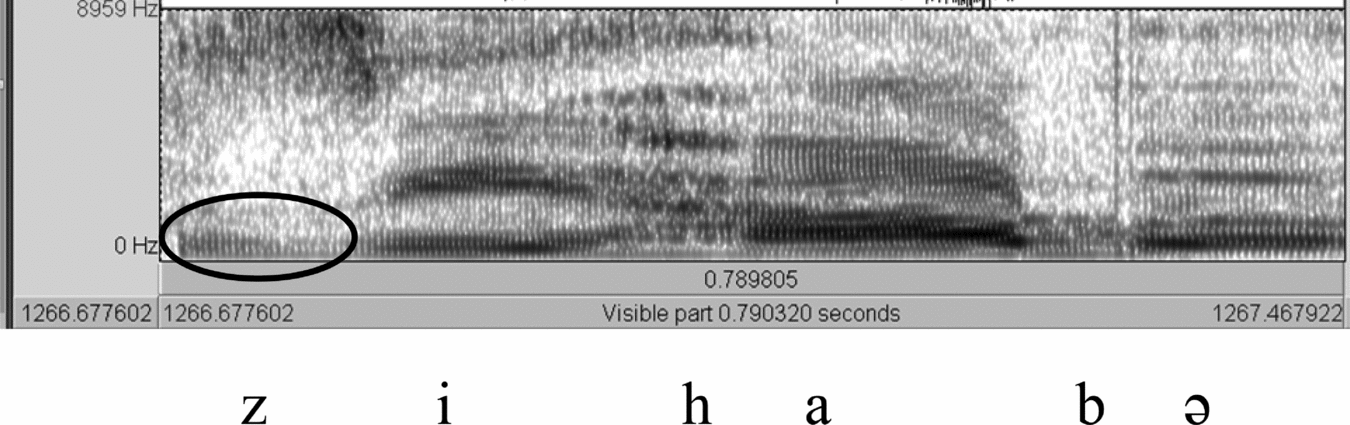
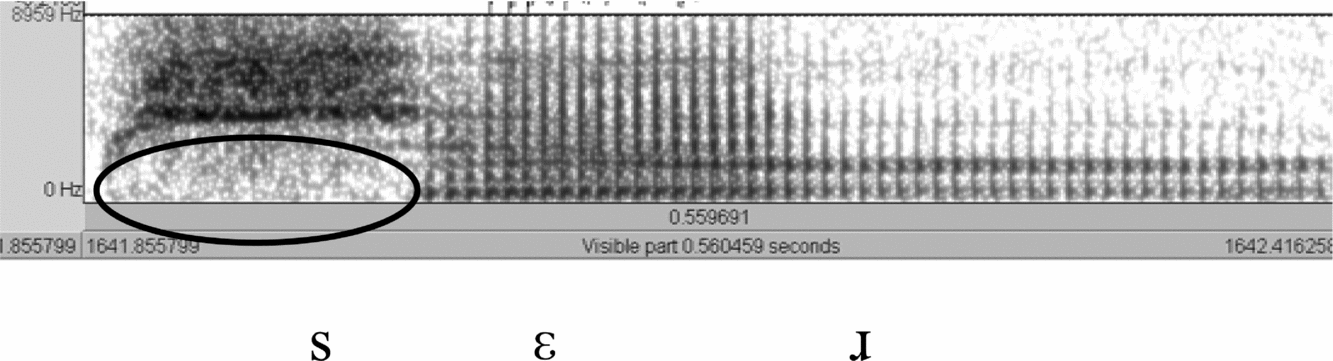
There was 90% agreement for the IPA transcriptions; however, the second author undertook an additional check using Praat, a program for spectrographic analysis (Boersma & Weenink, Reference Boersma and Weenink2013).Footnote 6 This led to some adjustments of the IPA transcriptions, with which both authors agreed. This step underscores the usefulness of Praat in allowing one to triangulate analysis of raw data. For example, during transcription exclusively using Phon (IPA), both authors transcribed learners’ production of initial /z/ as the target language [z]. Praat analysis, however, revealed that production of initial /z/ by all three learners was often voiceless [s]. The difference can be seen in Figures 2 and 3, where the voice bar allows us to differentiate [z] from [s].
Joan says <sie habe> “she has.” The circle shows voice bar.
George's production of <sehr> “very.” The circle shows lack of voicing; the line above is friction.
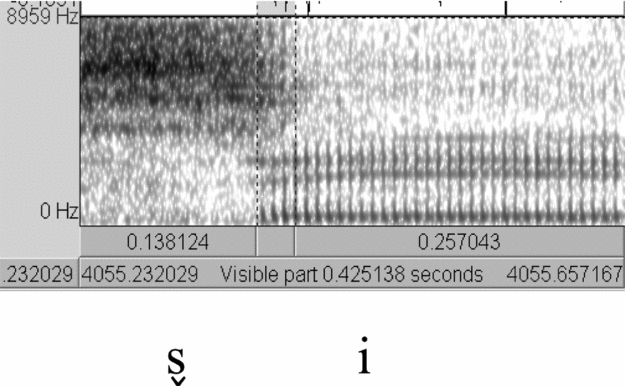
Although this voiced–voiceless distinction may seem straightforward when made visible, it is not entirely so. Several situations arose when a Praat analysis could not resolve the problem of the voiceless fricative [s] sounding like the voiced [z]. One such instance is shown in Figure 4.
George's production of <sie> “she.” The lines enclose the area of simultaneous friction and voicing.
It is obvious that the fricative is voiceless at the beginning of the word. We see that the onset of voicing occurs when friction is still present, resulting in the auditory impression of a voiced fricative. Here a diacritic was added, as in [ ], to represent this phenomenon. When instead a [z] was detected, with a tendency for voicelessness toward the end of its realization, this is represented as [
 ].
RESULTS
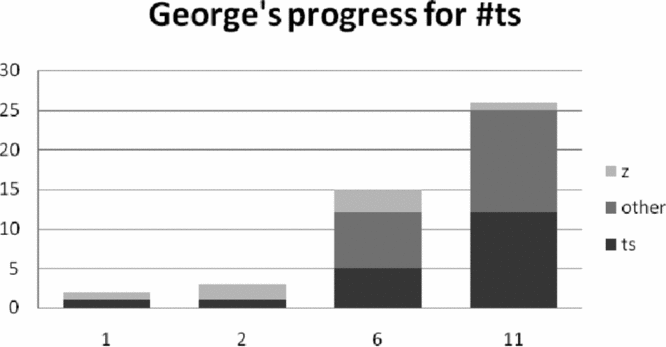
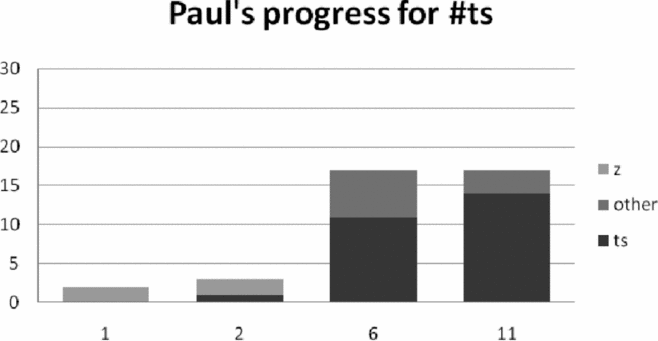
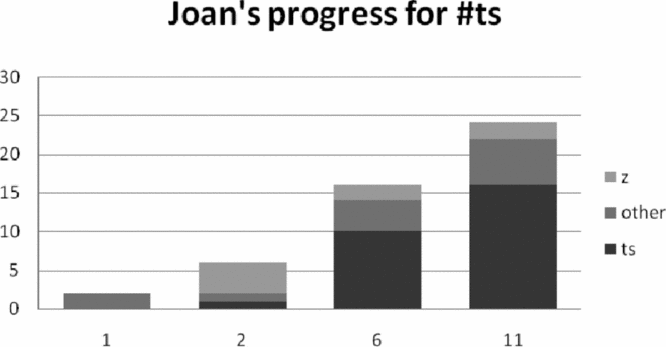
The figures from each learner's four data collection sessions show the following. The figures here and further below show raw numbers for contexts for initial /ts/ and /z/. The new German phoneme /ts/, which is orthographically represented by <z>, demonstrates development over time (Figures 5–7). George uses the target form in a third of the cases in Session 6, and in 46% of the cases in Session 11; for Joan, the percentages are 62% and 66%, respectively, with Paul showing the best progress, using the target form in 65% of the cases after 6 months, and in 82% of the cases at the end of his stay.
George's production of word-initial /ts/ by session.
Paul's production of word-initial /ts/ by session.
Joan's production of word-initial /ts/ by session.
Progress with /ts/ occurs for the learners despite initial transfer of /z/ (and /s/). Where orthography strengthens L1 phonological influence, this is eventually overcome, and learners’ grapheme–phoneme correspondence of <z> with /z/ in English shifts to /ts/ for German. We see a similar pattern with fricatives in German, where a digraph common in English and German, namely, <ch>, comes to represent the new phoneme (and allophone), the velar and palatal fricatives discussed earlier.
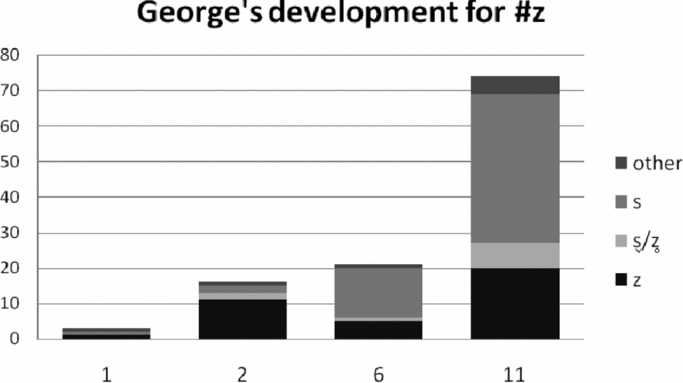
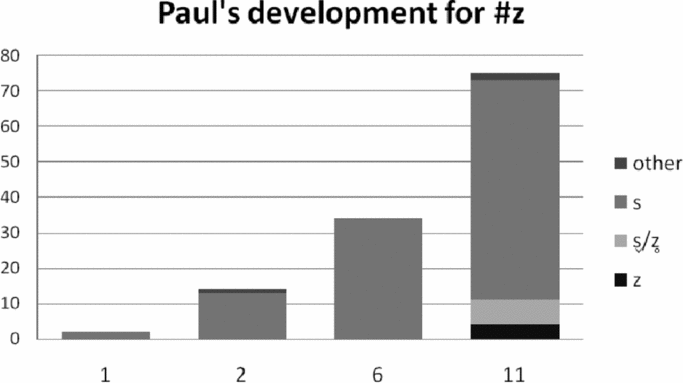
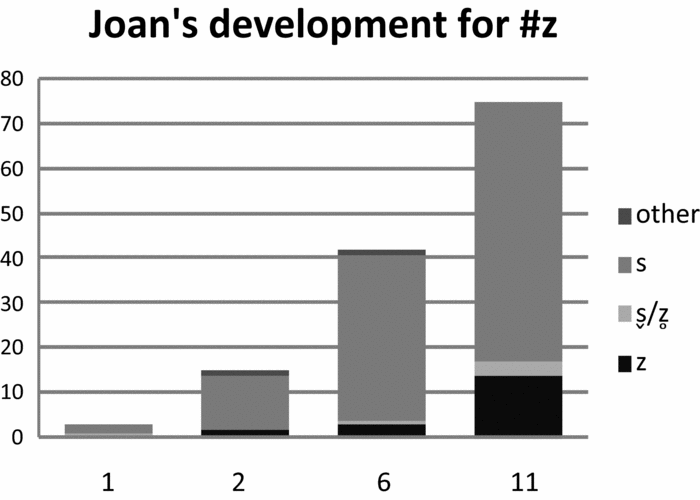
For word-initial /z/, orthographically represented as <s> in German, we see that it is initially equated to [s]. Unlike for /ts/, learners’ tendency to produce <s> as [s] rather than the target German [z] hardly decreases over time, as can be seen in Figures 8–10. One should be cautious with percentages for the first 2 months due to the small number of word-initial /z/ contexts. The data are clearer after half a year of exposure to German when the three learners were sufficiently talkative to produce a large number of words with initial /z/ in the target language. Looking at George's development (Figure 8), one can see that he produces a high percentage of [z] in Session 2 (11/17; 64%). Four months later, during Session 6, this percentage has dropped to 19% (5/26), and it rises slightly to 25% (20/80) at the end of his stay. George's use of [s] remains unchanged at about half the tokens. Paul only starts using [z] word-initially at the very end of the year, but he does so only four times, making up just 5% of the tokens. Joan's results are slightly worse than George’s. During Session 6, she uses [s] instead of [z] word-initially in 79% of the cases (37/47), and in Session 11, in 67% (58/86) of the cases. Her use of [z] during Session 6 is only 6% (3/47), and it is 16% (14/86) in Session 11.
George's production of word-initial <z> by session.
Paul's production of word-initial <z> by session.
Joan's production of word-initial <z> by session.
These results indicate that despite the existence of the same phoneme /z/ in English and German, which surfaces as the same phone [z] in initial position, along with considerable evidence in the aural input that /z/ only occurs as [z] word-initially, learners have great difficulty avoiding producing [s]. As in other such studies (e.g., Bassetti, Reference Bassetti, Piske and Young-Scholten2009; Young-Scholten, Reference Young-Scholten2004, discussed above), the culprit seems to be learners’ continued application of L1-based grapheme–phoneme rules. That is, they are equating word-initial <s> to their English [s] rather than the German [z].
A brief look at how the effect of OI is strengthened
An additional aspect of learners’ L2 acquisition offers an additional perspective on the context in which OI occurs. As noted above, these three learners received mostly native-accented German input from the start of their exposure, and the quantity of exposure, because they were attending normal secondary school classes, was at least 30 hr per week. These learners did not receive instruction in German as an L2, apart from the induction course at the very beginning of their stay in Germany. However, their daily attendance at school meant that they had a good amount of exposure to written German text.
With respect to acquisition of morphosyntax (reported on in Vainikka & Young-Scholten, Reference Vainikka and Young-Scholten2011), Joan was the most successful learner of the three. She was the most social and interacted with her native German peers more frequently than did George and Paul. Yet Joan was less successful than George and Paul in her acquisition of German phonology. She failed to restrict final position to voiceless stops, and she more often produced [s] rather than [z] for <s> than did George and Paul. To address this issue, information about the learners’ exposure to German can be considered (see Young-Scholten, Reference Young-Scholten, Burmeister, Piske and Rohde2002); we admit it is a challenge to accurately determine the details of the input learners receive (see Flege, Reference Flege, Piske and Young-Scholten2009).
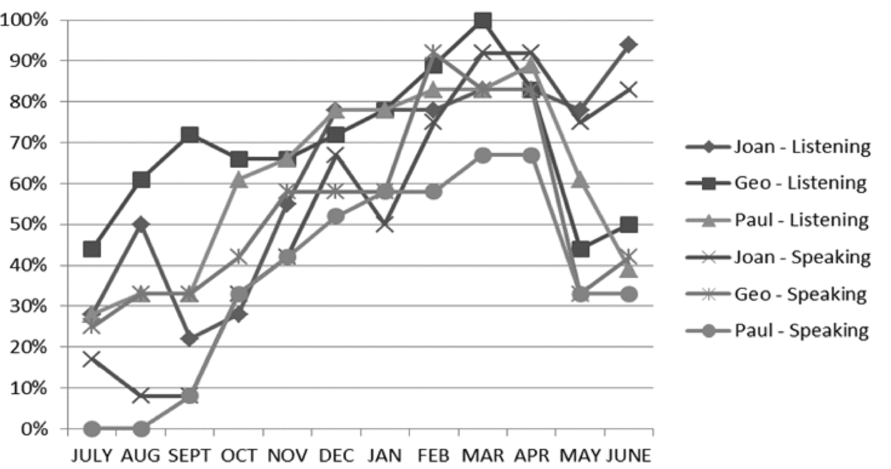
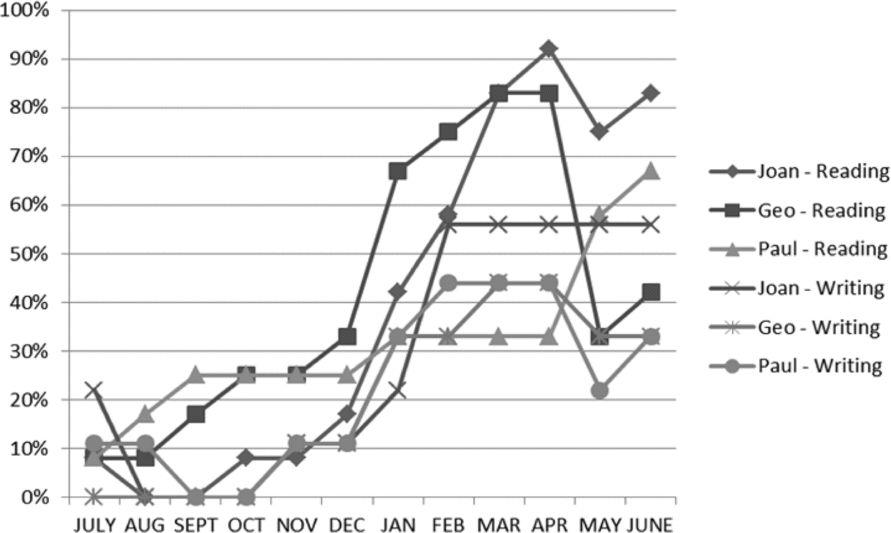
The data in Figures 11 and 12 come from questionnaires about learners’ amount of input/interaction from various sources and in various activities. These questionnaires were administered during monthly data collection sessions. Learners rated their participation in various activities on a 4-point scale. Reading included German newspapers, magazines, books, and school texts; writing included letters and school assignments in German (recall that the study was conducted before widespread Internet availability and mobile phone use). The ratings were converted into the percentages shown in the figures, with 100% indicating native-speaker-like (adolescent) behavior and 0% no involvement in any such activities. The three learners’ scores fall into the patterns we would expect if contact with written German contributes to the variability in their acquisition of final devoicing and of word-initial /z/. Joan's amount of OI is the highest, in that she reported spending more time over the year reading and writing (combined 35%) than did George (31%) or Paul (25%). This is most dramatically illustrated in the final month, when Joan's reported activities are 83% for reading and 56% for writing, while George's scores are 42% and 33%, and Paul's are 67% and 33%. Joan's combined mean score for oral/aural activities (59%) is higher than reading/writing, but it is closer to her reading/writing score than are George's (60%) or Paul's (50%).
Learners’ listening and speaking.

Learners’ written text exposure and interaction.
Use of such self-reporting to gauge learners’ level of aural and written German input/interaction might be questioned. Nonetheless, the three learners were similarly engaged in reading and writing from the start of their exposure, and we would expect an increase in written text engagement alongside improvement in their overall proficiency. Variation in level of engagement can be seen as due to their motivation to use German for a range of activities. Unlike the naturalistic learners in previous longitudinal studies of adult L2 German (e.g., the ZISA and European Science Foundation studies), these three learners were likely to be aware of the orthography of the words in their L2 lexicons.
REALIZATION OF INITIAL /z/ BY NATIVE SPEAKERS
A final consideration is the nature of the aural input learners received. Recall that transcription employing only Phon/IPA led to instances of word-initial <s> being transcribed as an acceptable [z]; learners sounded nativelike to both authors. Instances of disagreement between IPA transcription and acoustic analysis and instances of learners partially voiced and devoiced /z/ led the second author to locate a group of 10 native speakers of Standard German in their 20s.Footnote 7
These speakers each read out three sentences containing word-initial /z/ in several contexts: at the beginning of a sentence, and following words and syllables ending either in voiced or voiceless segments.Footnote 8 The sentences were Ich bin in X aufgewachsen und ich sage jetzt einen Satz, der mich an den warmen Sommer erinnert. Sina setzt ihre Brille ab, um im sauberen Wasser des Sees zu schwimmen, solange die Sonne noch scheint. Sie freut sich, nach dem vielen Lernen nicht sitzen zu müssen. (“I grew up in (place name) and I now read a sentence that reminds me of the warm summer. Sina takes her glasses off to go swimming in the clear lake water while the sun is still shining. She is happy after so much revising not to be sitting.”) These sentences provided contexts for 12 instances of initial <s> [z], 2 of which were sentence initial, and 1 of which was clause initial. Three other instances of <ss> and <s> were of [s].
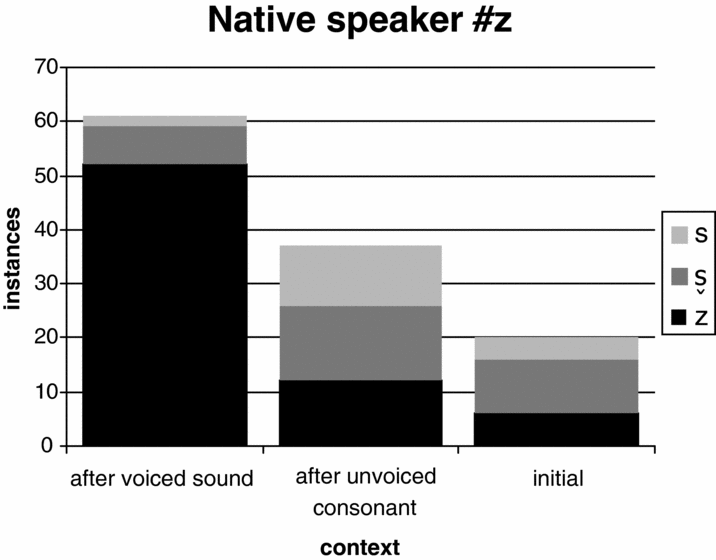
Data from 10 speakers’ production of 12 /z/ targets were analyzed only in Praat and are shown in Figure 13. We see that native speakers’ voiced production of word-initial /z/ is more context dependent than our above analysis assumes. After voiced segments, word-initial /z/ is realized as fully voiced 85% of the time (52/61 instances) and partially voiced 11% of the time (7/61 instances). After voiceless consonants, /z/ is fully voiced only 32% of the time, partially voiced 38% of the time, and voiceless 30% of the time. Sentence-initially and after long pauses, /z/ was voiced 30% of the time, partially voiced half the time, and voiceless 20% of the time.
Native speaker's use of word-initial /z/ according to context.
These data suggest that the conclusion that these three learners fail to respond to the aural input may be too strong. A voiceless fricative in initial position, provided it does not display exaggerated friction, does not necessarily represent a dialectal or nonnative speakers’ realization or a foreign accent. The late onset of voicing shown in the Praat analyses of the learner data can be seen as a possible way of approaching the target form, possibly influenced by the assimilation learners hear in the input. For example, in many instances during George's 11th session, voiceless sounds were transcribed as voiced, but Praat analysis suggested they were not. When transcribing Paul's 2nd session, almost half the voiceless instances were thought to be partially voiced; and in his 6th session, almost a third of his instances were voiced. It would be interesting to collect data on how other native speakers perceive the productions of the three learners, including ratings of how nativelike their productions sound.
Given different methods used to collect data from the learner group and the control group, we can only speculate about the role of variability in native speakers’ production. Determining whether L2 learners’ realizations of initial /z/ follow the patterns of variation found in the control group is certainly worth further study.
DISCUSSION AND CONCLUSION
We see a continued tendency by learners to fail to apply final devoicing to underlying voiced stops and to use [s] rather than [z] for <s> throughout their stay in Germany. This can be seen as partly in response to OI, whereby learners’ production can be accounted for by orthographic representations that they have carried over from their English (e.g., [siː] for <sie> “she” [ziː]). George's strategy of reconfiguring the grapheme–phoneme correspondence in German to <d> = /t/ is an exception. Phonemes that were new rather than identical in these English-speaking learners’ L2 German were more easily mastered despite an English grapheme <z> and digraph <ch> representing L1 phonemes that learners initially transferred. Lack of progress over the 12 months of their stay in Germany toward native German final devoicing and [z] in initial position is similar to what Rafat (Reference Rafat2011) found in her cross-sectional study of English-speaking learners of Spanish and their production of Spanish allophones that were plentiful in the input.
Learners’ production of partially voiced versions of /z/ prompted recruitment of 10 native speakers to determine whether our assumptions about the invariable realization of /z/ as [z] were correct. We found variability, and this suggests that our L2 learners’ variability is partly in response to the aural input, not solely due to OI. Their production of [z] as partially voiced fricatives points to this. These figures for the learners’ production do not compare to those for native speakers (11%–50%), but this may be a matter of longer exposure, where perception of the subtle differences involved is difficult in comparison to perception of the more salient affricate and more successfully acquired /ts/. A 1-year longitudinal study may be too short to capture the entirety of phonological development in an L2.
In closing, we emphasize that adult ab initio naturalistic learners who receive plentiful input from native speakers are an understudied population. Existing studies on naturalistic learners’ L2 phonology (e.g., Tropf, Reference Tropf, Leather and James1987) are usually of immigrants whose exposure to the target language is limited by their social exclusion. However, socially excluded learners could provide insights on the extent of orthographic influence during actual L2 acquisition, in addition to findings from word-learning studies by Escudero et al. (Reference Escudero, Hayes-Harb and Mitterer2008) and Hayes-Harb et al. (Reference Hayes-Harb, Nicol and Barker2010). Within this group are adults without native language literacy and emerging L2 literacy. Investigation of such learners promises to shed new light on the role of OI and of literacy in general on the acquisition of L2 phonology. Tarone, Bigelow, and Hansen (Reference Tarone, Bigelow and Hansen2009) consider literacy as a variable in the L2 acquisition of morphosyntax, but no studies to date have considered literacy as a variable in the L2 acquisition of phonology (see Young-Scholten, Reference Young-Scholten2013). That this line of investigation is worth pursuing is suggested by van de Craats (personal communication) who has informally observed during her decades of work with nonliterate, naturalistic immigrant adults that their L2 Dutch phonology is superior to that of their literate, educated counterparts. We encourage other researchers to undertake a study in which younger and older literate and nonliterate L2 learners receive the same quantity and quality of aural input to determine whether van de Craats is right.