Introduction
Pearl millet Pennisetum glaucum subsp. monodii (Maire) Brunken is an important crop widely cultivated in different regions, primarily in Asia and Africa, as a multipurpose cereal (ICRISAT, 1996; Havilah, Reference Havilah and Fuquay2017). In Saudi Arabia, pearl millet is grown in the western and southwestern regions during different seasons with various temperatures and different water needs. In the western region of Saudi Arabia, the local cultivars tolerate extreme heat where the day temperature ranges from 33 to 46°C in the summer season. In the southwestern region, where the temperature is more moderate (22–32°C), other pearl millet cultivars are grown under rainfed or limited irrigation. In these diverse environments, there are several local cultivars of pearl millet, but the number of cultivars remains undetermined (Bidinger and Hash, Reference Bidinger, Hash, Nguyen and Blum2003). To date, limited efforts have been made to evaluate genetic diversity within local Saudi pearl millet cultivars. In one instance, 12 cultivars of pearl millet were collected from the Jazan region in southwestern Saudi Arabia and registered in the gene bank of the King Abdulaziz City for Science and Technology (Al-Turki et al., Reference Al-Turki, Al-Namazi and Masrahi2019).
Previous studies have investigated the genetic diversity of millet cultivars from African and Asian countries using restriction fragment length polymorphism markers (Bhattacharjee et al., Reference Bhattacharjee, Bramel, Hash, Kolesnikova-Allen and Khairwal2002) and simple sequence repeat markers (McBenedict et al., Reference McBenedict, Chimwamurombe, Kwembeya and Maggs-Kölling2016). The efficiency of molecular markers in the classification of organisms has been reported in many studies (Kress et al., Reference Kress, Wurdack, Zimmer, Weigt and Janzen2005). The internal-transcribed spacer (ITS) regions of the nuclear ribosomal DNA (nrDNA) are useful markers to explore the evolutionary relationships among plants (Venkateswarlu and Nazar, Reference Venkateswarlu and Nazar1991; Hemleben, Reference Hemleben1993; Baldwin et al., Reference Baldwin, Sanderson, Porter, Wojciechowski, Campbell and Donoghue1995). The ITS1 and ITS2 sequences are non-functional parts of the nrDNA located within the 18S, 5.8S and 26S rRNA genes; they are transcribed as a single-transcription unit pre-rRNA molecule and then removed and degraded during rRNA processing. The sequence and structural elements of ITSs are critical to produce mature rRNAs (Veldman et al., Reference Veldman, Klootwijk, van Heerikhuizen and Planta1981; Van Nues et al., Reference Van Nues, Rientjes, Van Der Sande, Zerp, Sluiter, Venema, Planta and Raué1994). Moreover, the secondary structures of ITSs are more conserved than their nucleotide sequences, which makes them a useful tool to elucidate the evolutionary relationships among organisms (Coleman et al., Reference Coleman, Preparata, Mehrotra and Mai1998; Schultz et al., Reference Schultz, Maisel, Gerlach, Müller and Wolf2005).
The nrDNA of higher plants is organized in blocks in one or more chromosomal regions in the genome (Buckler et al., Reference Buckler, Ippolito and Holtsford1997). Within the family Poaceae, ITS sequences have been used to investigate the genetic relationships among 10 monocot species (Hsiao et al., Reference Hsiao, Chatterton, Asay and Jensen1994). Moreover, phylogenetic relationships within the genus Pennisetum have been assessed using ITSs (Martel et al., Reference Martel, Poncet, Lamy, Siljak-Yakovlev, Lejeune and Sarr2004).
Molecular characterization of local millets can help in the identification and conservation of local cultivars that have adapted to extreme environments. In the current study, we evaluated the genetic diversity among six local cultivars of the pearl millet (P. glaucum subsp. monodii) that are cultivated in different locations in Saudi Arabia based on ITS1 and ITS2 sequences of nrDNA. These cultivars are able to grow in various environments, from moderate temperature to extreme heat and from limited irrigation to rainfed conditions. Local cultivars constitute essential resources of genes for crop improvement programmes, and the evaluation of genetic diversity is important for their conservation.
Methods
Plant material, DNA extraction and primer design
Six local pearl millet cultivars grown in the southwestern and western regions of Saudi Arabia were collected from local farmers and named according to their origins (Table 1). Four cultivars were native pearl millets, and two were originally from Yemen and India. The collected seeds of the six cultivars were transferred to the Center of Genetic Resource in the Ministry of Environment, Water, and Agriculture in Saudi Arabia and given the registration numbers shown in Table 1. The seeds of the investigated cultivars are available for researchers, farmers and breeders under International Treaty on Plant Genetic Resources for Food and Agriculture. The rights of the farmers of the collected seeds are also guaranteed by this treaty. To isolate the nrDNA, genomic DNA was extracted from 5-day-old pearl millet seedlings leaves using Plant DNAzol reagent (Life Technologies). The isolated DNA samples were quantified by using a Qubit fluorometer and diluted to 100 ng/μl. The ITS-specific primers were designed based on the genomic region that includes the nrDNA. The P. glaucum subsp. monodii nrDNA sequences were retrieved from the NCBI GenBank. The P. glaucum ITS sequence (NCBI accession no. FJ766182.1) was used as the query sequence against pearl millet chromosome sequences to find similar genomic regions. Paralogous nrDNA sequences were found on chromosomes 3, 4 and 5; the highest similarity (90%) was observed in nrDNA on chromosome 5 (accession no. CM007986.2). Primer pairs were designed based on the genomic sequence from nucleotide 72922500 to 72924000 on chromosome 5, which spans from 18S to 26S rDNA.
Name, collection location and registration numbers of the six pearl millet cultivars

Yemeni and Indian cultivars were originally from Yemen and India, respectively, and currently cultivated by local farmers in Saudi Arabia. The other four cultivars are natives. The registration no. indicates the numbers of investigated cultivars in the Centre of Genetic Resource in the Ministry of Environment, Water and Agriculture in Saudi Arabia. The seeds of the investigated cultivars are available for researchers, farmers and breeders under International Treaty on Plant Genetic Resources for Food and Agriculture.
DNA amplification, sequencing and sequence analysis
The ITS sequences were amplified using five pairs of primers to identify the most suitable primer pair to produce a single-polymerase chain reaction (PCR) product for all cultivars. Of all tested primers, the primer pair: forward: 5′-CCTGCCCTTTGTACACACCG-3′, reverse: 5′-ACGCCTCTCCAGACTAC-3′ successfully amplified the entire ITS region. PCR was performed using 2× Phusion Master Mix with a high-fidelity buffer (Thermo Fisher Scientific), 0.4 μM of each primer and 25 ng of DNA template in a total volume of PCR reaction of 50 μl. The Taq polymerase in 1× Phusion Master Mix is 1 unit in the total volume of the reaction. PCR conditions were as follows: a pre-denaturing step of 5 min at 95°C; 30 cycles of 1 min at 95°C, 30 s at 56°C and 1.5 min at 72°C; and a final extension for 7 min at 72°C. The PCR products obtained were sequenced by Sanger's method (Sanger et al., Reference Sanger, Nicklen and Coulson1977) in both directions, with a dye terminator DNA sequencing kit (Applied Biosystems) on an ABI genetic analyzer 3730xi (Applied Biosystems). Sequencing was conducted in the Central Laboratory for Science and Medical Studies at King Saud University. The sequence of the first amplicon was subjected to a BLAST search in NCBI to confirm that the amplified region included the whole ITS region. Consensus sequences were obtained from at least three replicates of each cultivar. Sequencing results were aligned and assembled by UniGene software (Sayers et al., Reference Sayers, Agarwala, Bolton, Brister, Canese, Clark, Connor, Fiorini, Funk, Hefferon, Holmes, Kim, Kimchi, Kitts, Lathrop, Lu, Madden, Marchler-Bauer, Phan, Schneider, Schoch, Pruitt and Ostell2019), and the consensus sequences were subjected to further analysis.
Sequence variability and secondary structure analysis of ITSs
Sequence variability and GC content of the ITSs were analysed for the obtained nrDNA consensus sequences, including the ITS1–5.8S–ITS2 sequences and partial sequences of 18S and 26S rDNA, across the six cultivars. Sequence variation was investigated using DANSP (Rozas et al., Reference Rozas, Ferrer-Mata, Sanchez-DelBarrio, Guirao-Rico, Librado, Ramos-Onsins and Sanchez-Gracia2017), and the Oligo Calculator (http://biotools.nubic.northwestern.edu/OligoCalc.html) was used to calculate GC content (Kibbe, Reference Kibbe2007). The secondary structures of the ITS1, 5.8S rRNA and ITS2 sequences of the six pearl millets were determined separately using the mfold webserver (http://mfold.rna.albany.edu/; Zuker, Reference Zuker2003). RNA motifs were predicted using the MEME webserver (http://meme-suite.org/tools/meme; Bailey and Elkan, Reference Bailey and Elkan1994). The ITS1, 5.8S rRNA and ITS2 sequences of the six cultivars were imported to the MEME webserver to identify five motifs with a length of 8 bp in each alignment set of the ITS1, 5.8S rRNA and ITS2 sequences. Column alignment profile plots for ITS2 consensus secondary structures were generated using LocaRNA-P (http://rna.informatik.uni-freiburg.de/LocARNA/; Will et al., Reference Will, Joshi, Hofacker, Stadler and Backofen2012).
Phylogenetic and polymorphism analyses
The consensus nrDNA sequences for the six pearl millet cultivars were aligned using MEGA X (Kumar et al., Reference Kumar, Stecher, Li, Knyaz and Tamura2018) and subjected to a BLAST search to retrieve the complete sequences of ITS, including the ITS1, 5.8S rRNA and ITS2 regions, of other millet cultivars in the NCBI database. In total, 31 ITS accessions from different P. glaucum subsp. monodii cultivars were selected for the phylogenetic and nucleotide polymorphism analyses. These accessions included ITS sequences of Cenchrus americanus, Petalophyllum americanum and the hybrid between C. americanus and P. purpureum, as C. americanus and P. americanum are synonyms of P. glaucum (Veldkamp, Reference Veldkamp2014). P. purpureum is the tetraploid relative of pearl millet (2n = 4x = 28; Jauhar and Hanna, Reference Jauhar, Hanna and Sparks1998). The selected accessions of pearl millet cultivars and hybrids were grouped according to their countries of origin (China, India, Korea and France). The six ITS sequences obtained in this study were grouped together in a distinct group named ‘local accessions’. Three ITS sequences from three Panicum species were used as an outgroup in the phylogenetic and polymorphism analyses. The accession numbers and origins of accessions imported from NCBI are listed in online Supplementary Table S1. The sequences of ITS1, 5.8S and ITS2 were determined by alignment with selected ITS sequences retrieved from NCBI. Then, the sequences of 18S and 26S rDNA from all accessions were removed from the phylogenetic analysis. Phylogenetic trees were constructed using two methods, maximum likelihood (ML; Felsenstein and Churchill, Reference Felsenstein and Churchill1996) and maximum parsimony (MP; Felsenstein, Reference Felsenstein1985), with interior branch tests of 1000 replicates using the alignment of the complete sequences of ITS1, 5.8S and ITS2 on MEGA X software (Kumar et al., Reference Kumar, Stecher, Li, Knyaz and Tamura2018). DNASP version 6.12 (Rozas et al., Reference Rozas, Ferrer-Mata, Sanchez-DelBarrio, Guirao-Rico, Librado, Ramos-Onsins and Sanchez-Gracia2017) was used to determine the nucleotide diversity and the polymorphic and singleton sites in separate sequences of ITS1 and ITS2 among the 37 accessions.
Results
ITS sequence variability
The complete sequences of the ITS1–5.8S–ITS2 regions with partial sequences of 18S and 26S rRNA of six pearl millet cultivars were sequenced and submitted to NCBI (available under accession numbers from MN781142 to MN781147; Table 2). The obtained ITS sequences ranged from 772 to 774 bp in length. GC content was approximately 57% in all cultivars. The length of the ITS2 sequence was 219 bp in all six cultivars, whereas the length of ITS1 was 207 bp in all cultivars except the cultivar Sayah (208 bp). The partial sequence of 18S rRNA and complete sequence of 5.8S rRNA did not show any variation, with 100% similarity among all cultivars. However, the ITSs and the partial sequence of 26S rRNA showed nucleotide variation, and the ITS2 sequence showed the highest variation among the six pearl millet cultivars (Table 2). A single variable nucleotide site was observed in the 26S sequence (A725→G substitution in Tihamah and deletion in Jazan cultivar), whereas ITS2 was contained of four variable nucleotide sites owing to base substitution (G→A, T→C and C→G) in the Sayah and Jazan cultivars. Additionally, thymine base insertion at nucleotide 217 was observed in the ITS1 sequence of Sayah cultivar. The cultivar Sayah exhibited the highest number of variable nucleotide sites (three sites), followed by Jazan and Tihamah, and the Baydhan, Yemeni and Indian cultivars showed 100% identity in the entire obtained sequences that included the ITS1–5.8S–ITS2 regions and partial sequences of 18S and 26S rRNAs.
Accession numbers, GC content and variable nucleotide positions in the alignment of the obtained ITS sequences of the six P. glaucum subsp. Monodii cultivars

Secondary structures of ITS1, 5.8S rRNA and ITS2
The secondary structure of the ITS1 sequence of the six cultivars was generated at minimum free energy (MFE) = 86.40 kcal/mol. As shown in Fig. 1a, the secondary structure contained an open external loop at 5' and 3' ends and two central multi-branched loops. The mismatch pair types A–G, A–A, G–A, C–A and U–U were found in the stem helix and helices II and III. In the ITS1 sequences, the motifs were predicted at E-value < 4.7 × 10−72 (online Supplementary Fig. S2A).
Secondary structures of ITS1 and 5.8S sequences from local pearl millet cultivars predicted by the program mfold. Positions within the structures are numbered every 20 nucleotides. Helices are numbered I–V. The bonds between complementary AU pairs in the RNA helices are shown by blue lines, those between GC are shown by red lines and the stable pairs of GU are shown by green lines. (a) The secondary structure of ITS1 predicted at MFE value of 86.4 kcal/mol of all cultivars. (b) The secondary structure of the 5.8S sequence of all cultivars predicted at MFE value of 53.5 kcal/mol.

The secondary structure of the 5.8S sequence of the six cultivars was generated at MFE = 53.50 kcal/mol. The consensus secondary structure contained two central multi-branched loops, from which three helices emerged and two interior loops. The base mismatch type U–C was found in helix I, and the A–G and G–A mismatch pairs were found in helix IV (Fig. 1b). In the 5.8S sequences, the motifs were predicted at E-value < 1.7 × 10−77 (online Supplementary Fig. S2B).
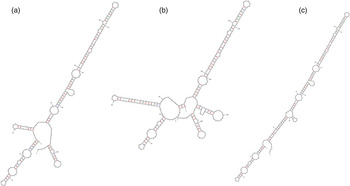
The secondary structure of the ITS2 sequence of the Baydhan, Indian, Tihamah and Yemeni cultivars was generated at MFE = 105 kcal/mol (Fig. 2a). It contained four helices, of which helix III was the longest, with mismatch pair type U–G in helix II and types U–U and A–C in helix III. The secondary structure of the ITS2 sequence of the Jazan cultivar was generated at MFE = 102.6 kcal/mol. It contained five helices, of which helix III was the longest, one multi-branched loop and two interior loops (Fig. 2b). The mismatch pairs were U–G and U–C in helix II and U–U and A–C in helix III. The secondary structure of the ITS2 sequence of the Sayah cultivar was highly distinct from that of the other cultivars (Fig. 2c). It was generated at MFE = 101 kcal/mol and contained a central multi-branched loop from which three helices emerged and five interior loops. Helix II was the longest with mismatch pair types U–U and A–C. Additionally, U–U and C–C mismatch pairs were located in the stem helix. In ITS2 sequences, the motifs were predicted at E-value < 3.3 × 10−73 (online Supplementary Fig. S2C). The predicted motifs were distributed in the multi-branched loops or helices. The consensus secondary structure for the ITS2 of the six cultivars was predicted by LocARNA-P and compared with the structures predicted by mfold. As expected, the consensus secondary structure was identical to the secondary structure of the ITS2 of the Baydhan, Indian, Tihamah and Yemeni cultivars and different from that of Jazan and Sayah (online Supplementary Fig. S1).
Secondary structures of ITS2 sequences from local pearl millet cultivars predicted by the program mfold. Positions within the structures are numbered every 20 nucleotides. Helices are numbered IV. The bonds between complementary AU pairs in the RNA helices are shown by blue lines, those between GC are shown by red lines and the stable pairs of GU are shown by green lines. (a) The secondary structure of ITS2 sequence of all cultivars except for Sayah and Jazan predicted at 105 kcal/mol. (b) The secondary structure of ITS2 sequence of Jazan cultivar predicted at 102.6 kcal/mol. (c). The secondary structure of ITS2 sequence of the Sayah cultivar predicted at 101 kcal/mol.

The mfold secondary structures of the ITS2 sequences obtained in the current study were compared with the ITS2 secondary structure templates in the ITS2 database (http://its2.bioapps.biozentrum.uni-wuerzburg.de/; Ankenbrand et al., Reference Ankenbrand, Keller, Wolf, Schultz and Förster2015). The secondary structure of the ITS2 sequence of the Baydhan, Indian, Tihamah and Yemeni cultivars was predicted directly through the ITS2 database, and it was identical to the consensus ITS2 secondary structure predicted by mfold and LocARNA-P. However, the secondary structures of ITS2 sequences of Jazan and Sayah could not be directly predicted by the ITS2 database, but they could be modelled by homology with high-quality models from the ITS2 database. Five high-quality templates of the ITS2 secondary structure from P. glaucum subsp. monodii were found. The template number 49066367 was the best model with 78.3% similarity with the ITS2 of Jazan, and 77.4% similarity with Sayah, and 100% of helix transfers for helices I, III and IV, and 85.7% for helix II.
Phylogenetic trees and polymorphism of cultivars
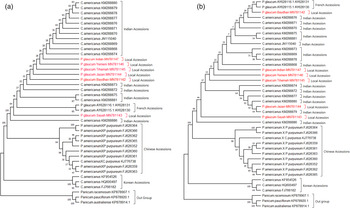
The constructed ML and MP trees showed similar clustering of the six sequences obtained in this study, which also showed close relationships with Indian and French accessions with certain differences in the positions in the Jazan and Baydhan cultivars (Fig. 3). The Korean accessions formed a separate cluster from all accessions with 100% bootstrap support in both ML and MP phylogenetic trees. The Chinese, Indian, French and the local cultivars clustered together in a large cluster in both trees. However, the Chinese accessions separated from other accessions in a separate subcluster with 100% bootstrap support in both trees. The second subcluster included the accession from the Indian, French and the local cultivars. In the ML tree (Fig. 3a), five local cultivars (Indian, Yemeni, Tihamah, Jazan and Baydhan) were separated as individual branches from the Indian accessions within the second subcluster with bootstrap values of 27–28%. In the MP tree (Fig. 3b), three cultivars (Indian, Yemeni and Tihamah) were separated as individual branches from the Indian and French accessions with a bootstrap value of 23% within the second subcluster. The local cultivars Jazan and Baydhan showed a different position in the MP tree from the ML tree. Jazan was clustered with the other group of Indian accession with 54% bootstrap support, and Baydhan was clustered with French accessions as an internal branch with a bootstrap value of 85%. The local cultivar Sayah formed a separate external branch from the second subcluster that included the six investigated cultivars with French and Indian accessions in both trees with bootstrap values of 44 and 98% in the ML and MP trees, respectively.
Phylogenetic trees of pearl millet cultivars based on ITS1, 5.8S and ITS2 sequences. The local pearl millet accessions obtained in this study are shown in red. The other 31 millet accessions adopted from NCBI GenBank are grown in four different countries – China, India, Korea and France. The origins of the NCBI accessions are shown to the right of the clusters. Outgroup accessions included Panicum species. Species names appear as in the NCBI database (C. americanus is the synonym of P. glaucum, and P. purpureum is the tetraploid relative of pearl millet). The respective NCBI accession numbers are provided after each species name. Support for each node was evaluated using 1000 bootstrap resampling. Phylogenetic trees were constructed using (a) the ML method and (b) the MP method using MEGA X software.

Nucleotide polymorphisms of ITS1 and ITS2 sequences were investigated using two multiple sequence alignment sets. The first alignment set included the six local cultivars. The second alignment set included 37 pearl millet cultivars, of which six accessions were the local cultivars and 31 accessions were imported from NBCI. ITS2 exhibited higher nucleotide polymorphism than ITS1 in both alignment sets. However, the degree of polymorphism among the six local cultivars was lower than that among the 37 accessions. As shown in Table 3, the number of variable sites and parsimony-informative sites and the nucleotide diversity value were all zero for the ITS1 sequences of the local cultivars due to the strict sequence conservation. However, the number of variable sites in the ITS2 sequences of local cultivars was four, and the nucleotide diversity value was 0.006.
Nucleotide polymorphisms of ITS1 and ITS2 sequences within the six local cultivars and within the 37 pearl millet cultivars including the local cultivars

Discussion
In the current study, we used molecular characterization of ITS regions to identify local pearl millet cultivars and to evaluate the polymorphism among these cultivars. Evaluation of genetic diversity among millet cultivars can help in the identification and conservation of these genetic resources. The obtained ITS1–5.8S–ITS2 sequences revealed that the local cultivar Sayah exhibited the highest number of variable nucleotide sites, followed by Jazan and Tihamah. These nucleotide variations between ITS sequences were due chiefly to point mutations and rarely to nucleotide insertions or deletions (Baldwin et al., Reference Baldwin, Sanderson, Porter, Wojciechowski, Campbell and Donoghue1995).
The predicted motifs in ITS1–5.8S–ITS2 sequences in Saudi millet cultivars appeared to be conserved in plants. The motifs GAAGGCGU and AAGGAACA were previously identified as conserved motifs in ITS1 in flowering plants (Liu and Schardl, Reference Liu and Schardl1994). The secondary structure of ITS1 is a helpful tool in the classification of green algae at the species level (Coleman et al., Reference Coleman, Preparata, Mehrotra and Mai1998). The conserved motifs within ITS1 may have a key role in the processing of rRNA genes (Liu and Schardl, Reference Liu and Schardl1994). The motifs AUGAAGAA and UUUUUGAA have been previously identified as conserved in 5.8S sequences among angiosperms (Liu and Schardl, Reference Liu and Schardl1994; Harpke and Peterson, Reference Harpke and Peterson2008). The motifs AGAAUCCC and UGUGAAUU in the 5.8S sequence of local cultivars are well known to be conserved in flowering plants (Jobes and Thien, Reference Jobes and Thien1997). The 5.8S secondary structure for pearl millets and the motifs identified in the current study are conserved among different plants and fungi (Freire et al., Reference Freire, Silva, Zhang, Almeida, Stacey and Oliveira2012; Hodač et al., Reference Hodač, Scheben, Hojsgaard, Paun and Hörand2014; Rampersad, Reference Rampersad2014). The predicted motif ACGUGGUG included the UGGU motif, which was previously identified in eukaryotes near the 5′ end of helix III of ITS2 (Schultz et al., Reference Schultz, Maisel, Gerlach, Müller and Wolf2005; Wolf et al., Reference Wolf, Schultz, Dandekar and Achtziger2005). This motif was located near the endonuclease cleaves site C2, where the initial step of the degradation process of ITS2 occurs (Geerlings et al., Reference Geerlings, Vos and Raue2000). The CCA single strand at 3'-end in ITS2 secondary structures appeared to be conserved in all angiosperms (Hershkovitz and Zimmer, Reference Hershkovitz and Zimmer1996). In eukaryotes, the common ITS2 secondary structure is clover leaf-like with four helices, and it contains conserved motifs, such as the U/C–U mismatch in helix II, that are important for excision of the ITSs from pre-rRNA to obtain mature rRNAs (Mai and Coleman, Reference Mai and Coleman1997; Schultz et al., Reference Schultz, Maisel, Gerlach, Müller and Wolf2005). The secondary structures of the ITS2 sequence of the Baydhan, Indian, Tihamah and Yemeni cultivars were constant with the clover leaf-like structure of eukaryotes. However, the Jazan genotype had an additional helix in the ITS2 structure, while the number of helices in the ITS2 sequences of Sayah cultivar was different from that in the commonly reported structure of eukaryotic ITS2. Additionally, the conserved U/C–U mismatch in helix II was only shown in Jazan cultivars. The variability in the ITS2 secondary structure among the different cultivars indicated the applicability of the ITS2 sequence in distinguishing between cultivars of the same species (Coleman, Reference Coleman2000, Reference Coleman2009).
The phylogenetic relationships within the species of P. glaucum subsp. monodii, based on ITS sequences, revealed close relationships between Indian and French pearl millet and all local cultivars, with the exception of the Sayah cultivar, which appeared to have distinct accession in the phylogenetic trees. This finding indicated that ITSs appeared to be sufficiently variable to facilitate differentiation between closely related organisms (Álvarez and Wendel, Reference Álvarez and Wendel2003). Nucleotide polymorphism analysis showed that the nucleotide diversity value and variable sites for the ITS2 sequences were higher than those in ITS1 sequences among the local cultivars due to the strict sequence conservation for ITS1 compared with ITS2. Previous studies have also reported consistent findings of the applicability of ITS2 sequences than ITS1 for differentiating between close cultivars (Gao et al., Reference Gao, Yao, Song, Liu, Zhu, Ma, Panga, Xu and Chen2010; Han et al., Reference Han, Zhu, Chen, Liao, Yao, Song, Chen and Meng2013).
Our results showed that the native cultivar Baydhan appeared to share similar ITS sequences with Yemeni and Indian cultivars. However, high polymorphism in the ITS2 sequence was observed in the other three native cultivars. The Sayah cultivar was distinct from the other local cultivars as it showed an especially high-nucleotide polymorphism and a different secondary structure for ITS2. The uniqueness of the native cultivar, Sayah, emphasizes the importance of conservation of genetic diversity of the native cultivars. The findings of this study provide insights into the degree of variation among local cultivars and contribute to the conservation of native pearl millets. Furthermore, ITS2 sequencing is a valuable tool to further identify and evaluate the genetic diversity within close cultivars.
Supplementary material
The supplementary material for this article can be found at https://doi.org/10.1017/S1479262121000393.
Acknowledgements
We are greatly indebted to the Central Laboratory for Science and Medical Studies at King Saud University for providing sequencing services. We also thank Maha Alrwais for her excellent technical assistance during RNA extraction. This study was financially supported under Project No. 2019/01/9512 from the Deanship of Scientific Research at Prince Sattam bin Abdulaziz University.