INTRODUCTION
Payments for ecosystem services (PES) are a relatively new economic policy instrument, which aim to translate the often non-market value of environmental goods and services into financial incentives to preserve the ecosystems that provide these services (Salzman Reference Salzman2005; Wunscher et al. Reference Wunscher, Engel and Wunder2008). The basic principle behind PES is that resource owners and communities who are in a position to provide ecosystem services should be compensated for the cost of their provision, and that those who benefit from these services should pay for them, thereby internalizing the benefits (Mayrand & Paquin Reference Mayrand and Paquin2004). Wunder (Reference Wunder2005) outlined five criteria to describe PES: a voluntary transaction, where well-defined ecosystem services (ES) are bought by a ES user from a ES provider under the agreed ES quantity and quality conditions in the transaction (conditionality requirement). In practice, PES is used as a more generic term for a variety of arrangements where local communities, farmers and other water and land managers are paid for conservation activities that deliver ES, of which biodiversity and landscape preservation, carbon sequestration and water protection are most common (Duncan Reference Duncan2006). PES has many attractive characteristics relative to other conservation approaches. However, ascertaining their advantages requires measuring the additional effects of actual programmes in the field, also referred to as the additionality requirement (Daniels et al. Reference Daniels, Bagstad, Esposito, Moulaert and Rodriguez2010). Such impact evaluation can also help in identifying opportunities for further improvements in efficiency of these programmes (Kerr & Jindal Reference Kerr and Jindal2007).
Existing reviews of PES schemes and assessments of success and fail factors are mainly qualitative in nature. This includes, among others, special issues in the journals Ecological Economics (Engel et al. Reference Engel, Pagiola and Wunder2008; Farley & Costanza Reference Farley and Costanza2010), Environment and Development Economics (Bulte et al. Reference Bulte, Lipper, Stringer and Zilberman2008), and the Journal of Sustainable Forestry (Rebelo Reference Rebelo2009). Bulte et al. (Reference Bulte, Lipper, Stringer and Zilberman2008) focused on PES both as a mechanism for environmental protection and poverty reduction, and showed that tying PES and poverty reduction may result in lower efficiency in meeting either objective, thus it may be better to focus programmes that concentrate on one or the other objective separately. Wunder et al. (Reference Wunder, Engel and Pagiola2008) conducted a comparative analysis of PES in developed and developing countries between user financed and government financed schemes using different criteria, including design, costs, environmental effectiveness and livelihood outcomes. The user-financed programmes were found to be better targeted, more closely adapted to local conditions and needs, with better monitoring and a greater willingness to enforce conditionality, and fewer confounding side objectives than government financed programmes. The large and increasing literature on economic valuation of ES and payments for ES has become difficult to interpret and there is a need for research synthesis techniques, in particular statistical meta-analysis, to aggregate information and insights. Meta-analysis is an important extension of and supplement to qualitative analysis (van den Bergh et al. Reference Van den Bergh, Button, Nijkamp and Pepping1997). In addition to identifying consensus in results across studies, meta-analysis is also of interest as a means of transferring results from existing studies to new ones (Stanley Reference Stanley2001).
The effectiveness of PES schemes may depend on several factors (Farley & Costanza Reference Farley and Costanza2010). Some of these factors relate to the clarity of the definition of the ES and a careful assessment of ES demand and supply, namely who are the beneficiaries who are willing to pay for the ES provision (Mayrand & Paquin Reference Mayrand and Paquin2004). This may be different from the question who finances the PES scheme. Here, options include donations and grants from national and international organizations, government payments and subsidies, payments from beneficiaries and market development for related goods and services at the national and international level (Mayrand & Paquin Reference Mayrand and Paquin2004). PES schemes also need clear and enforceable rules and transaction mechanisms. Rules specify the rights and obligations of parties and the responsibilities and powers of institutions. Key legal issues in PES rule-making in this context are clarification of rights and tenure (Greiber Reference Greiber2009), and establishing effective compliance and enforcement mechanisms (Smith et al. Reference Smith, Groot, Perrot-Maîte and Bergkamp2006).
PES efficiency is not only determined by the extent to which incremental ES are provided (Bruijnzeel Reference Bruijnzeel2006; Le Tellier et al. Reference Le Tellier, Carrasco and Asquith2009; Daniels et al. Reference Daniels, Bagstad, Esposito, Moulaert and Rodriguez2010), but also by the cost at which this is achieved. These costs include the opportunity cost of alternative land use activities, the implementation and maintenance costs of land use changes and the transaction costs of programme management and monitoring (Wunder et al. Reference Wunder, Engel and Pagiola2008). It is easier to convince beneficiaries to participate in a PES scheme when the costs and benefits of ES provision are visible and quantifiable (Rojahn & Engel Reference Rojahn and Engel2005). Generally speaking, beneficiaries will be more inclined to pay for specific services as opposed to general conservation services. In identifying beneficiaries, it is also important to identify potential free riders that could benefit from the provision of services without contributing in the PES system. This too may affect contributors’ support for the PES scheme or lead to their withdrawal from the scheme (Mayrand & Paquin Reference Mayrand and Paquin2004).
PES schemes must furthermore generate a sufficient and sustainable flow of revenues to land users to make sure that they implement and maintain land use changes that will generate the required ES (Pfaff et al. Reference Pfaff, Robalino and Sanchez-Azofeifa2008). Payments under PES schemes must therefore be ongoing as opposed to one-time payments and be open-ended to allow them to last over time (Pagiola & Platais Reference Pagiola and Platais2002). Payment methods also matter for PES efficiency. An ES buyer may be indifferent about the mode of payment as long as the provider signs the contract. But the contract's sustainability may eventually depend on the unforeseen development effect of payments on household incomes, changes in consumption, and demand for land and labour. These changes may have side-effects on conservation beyond what is stipulated in the contract. Wunder (Reference Wunder2005) therefore argued to carefully think about or experiment with different payment modes, including cash versus non-cash and the periodicity of payment.
Porras et al. (Reference Porras, Grieg-Gran and Neves2008) reviewed the status of some 50 payments for watershed services (PWS) schemes in developing countries and found that land security played an important role in their successful implementation. There are currently over 50–100 operational schemes worldwide. Most of them are listed on the International Institute for Environment and Development (IIED) watershed markets website (www.watershedmarkets.org). Due to the absence of reliable longer-term scientific data and adequate cross-evaluation of the additional effects of PWS on watershed service provision, there is limited evidence of the impacts of these schemes on sustainable levels of land-water management (Porras et al. Reference Porras, Grieg-Gran and Neves2008; Tognetti et al. Reference Tognetti, Aylward, Bruinzeel, Bruijnzeel, Scatena and Hamilton2010). Moreover, the factors that contribute to the functioning of the schemes are not well understood.
This paper aims to address this knowledge gap through an assessment of the institutional-economic factors that drive and explain the environmental performance of existing PWS schemes for which we were able to find sufficient information. Available secondary data and information about existing PWS schemes were collected from the watershed markets website, published and unpublished reports and articles, supplemented by a mail survey, and evaluated in a meta-analysis.
METHODS
Meta-analysis is the statistical evaluation of the findings of empirical studies, helping to extract information from often large sets of data in order to quantify a more comprehensive assessment (Glass et al. Reference Glass, McGaw and Smith1981). It is a method of synthesizing the results of multiple studies that examine the same phenomenon through the identification of a common effect, which is then explained using regression techniques in a meta-regression model (Nelson & Kennedy Reference Nelson and Kennedy2009). It enables researchers to explain differences in outcomes found in single studies on the basis of differences in underlying assumptions, standards of design and measurement (Wolf Reference Wolf1986).
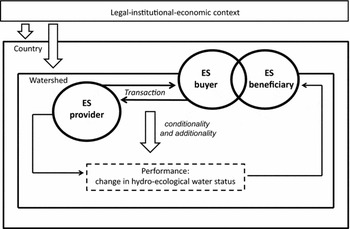
The conceptual framework of our meta-analysis (Fig. 1) is based on available information provided in Porras et al. (Reference Porras, Grieg-Gran and Neves2008) and on the IIED watershed markets website (www.watershedmarkets.org). We also consulted other secondary information sources, such as more extensive reports and publications on the specific PWS schemes listed on the watersheds markets website. Most of these schemes were also included in previously published overviews (see Muñoz-Piña et al. Reference Muñoz-Piña, Guevara, Torres and Braña2008; Huang et al. Reference Huang, Upadhyaya, Jindal and Kerr2009; Southgate & Wunder Reference Southgate and Wunder2009; Daniels et al. Reference Daniels, Bagstad, Esposito, Moulaert and Rodriguez2010). PWS schemes were selected based on the list of schemes presented on the IIED watershed markets website. These schemes all aimed at watershed protection. Watershed protection refers to a set of land uses that preserve the integrity of a watershed to yield water that is relatively free of pollutants, low in sediment and buffers against floods. A broader definition of PES is used than the one provided by Wunder (Reference Wunder2005), moving away from a pure Coasean market-based approach (Muradian et al. Reference Muradian, Corbera, Pascual, Kosoy and May2010), namely institutional arrangements where local communities, farmers and other water and land managers are paid for watershed conservation activities that deliver services such as drinking and irrigation water. Following Vatn (Reference Vatn2010), our selection was not limited to voluntary transactions only and also included schemes where participation is mandatory. We controlled for this difference in our analysis. Moreover, not all payment schemes aiming to improve watershed protection appeared to have clearly defined environmental objectives and associated ES quantity and quality conditions in the transaction. We also accounted for this in our analysis.
Conceptual framework.

Another important selection criterion for a PWS scheme to be included was the availability of sufficient information to be able to conduct a meaningful analysis. Together with the available information from secondary sources, we e-mailed a short questionnaire to 52 PWS scheme managers in Asia, Africa, Central and South America in March 2010, aimed at filling gaps or confirming facts. The questionnaire included 15 mainly open-ended questions about the type of environmental goods and services provided, the buyers and sellers involved, the environmental objectives of the PWS scheme, the mode of participation, selection criteria for service providers, payment mechanisms and the scale of operation.
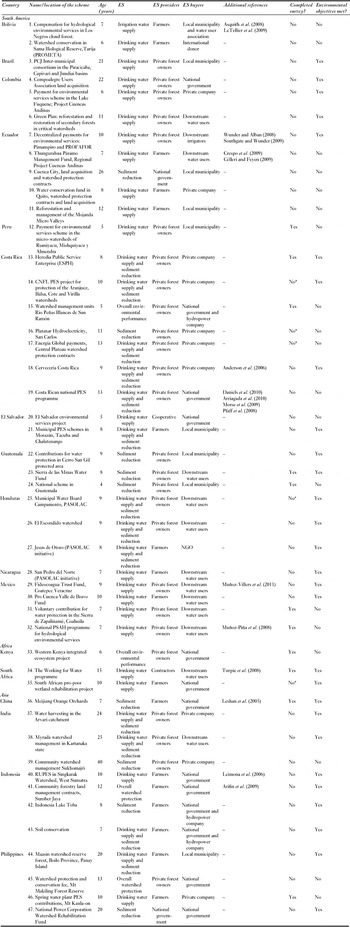
Twelve questionnaires were completed and returned after two reminders (giving an overall response rate of 23%), representing 16 different PES schemes. Four PWS managers did not complete the questionnaire, but sent additional documentation describing their schemes thus enabling us to complete the questionnaire on their behalf. Thus, we obtained additional information for 20 PES schemes directly from the PWS scheme managers. This information was cross-checked against the available secondary information. Based on these different sources of information, we managed to obtain observations for 47 different PWS schemes in total, including the additional information sources that were used to complete the database (Table 1).
Overview of the general characteristics of the payments for watershed services (PWS) schemes included in the meta-analysis. ES = ecosystem services. *Scheme manager sent documentation about the PES scheme. PROMETA = Protection del Medio Ambiente Tarija, PCJ = Piracicaba, Capivari and Jundiaí basins, PROFAFOR = Programa Face de Forestación, CNFL = Compañía Nacional de Fuerzay Luz, PASOLAC = Programme for Sustainable Agriculture in Hillsides of Central America, PSAH = Pago por Servicios Ambientales Hidrológico, RUPES = Rewarding Upland Poor for Ecosystem Services.

The dependent variable in the meta-analysis was the environmental performance of the PWS scheme. Environmental performance was modelled as a function of institutional-economic PWS characteristics. Quantitative scientific evidence of the extent to which the PWS schemes met the environmental objectives involved was not available for all case studies. In a few cases, quantitative information about the environmental objectives was actually reported, but only 47% of the schemes monitored their quantified objectives. As a result, we could only construct a binary variable reflecting whether the environmental objectives of the PWS schemes were met (or not), based on a combination of information provided in Porras et al. (Reference Porras, Grieg-Gran and Neves2008), on the watershed markets website, in available scientific publications about the PWS schemes and retrieved from the survey.
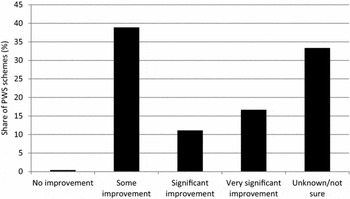
PWS managers who participated in the survey were asked, among other items, to rate the scheme's contribution to the improvement of environmental quality in the watershed as objectively as possible on an ordinal five-point measurement scale, ranging from ‘the environment showed no improvement’ to ‘the environment showed a very significant improvement’ as a direct result of the PWS scheme (Fig. 2). None of the PWS managers said that the environment showed no improvement, 39% said that the environment showed some improvement and 33% were not sure. Twenty-eight per cent of the managers said that the environment showed a significant or very significant improvement.
Self-reported contribution of the PWS scheme to environmental quality improvement.

We cross-checked these responses where we could with the available scientific literature. In the three cases where we had information both from the scientific literature and the PWS managers (schemes 32, 34 and 36 in Table 1), the self-reported environmental achievements corresponded with the findings in the published literature. Turpie et al. (Reference Turpie, Marais and Blignaut2008) and Leshan et al. (Reference Leshan, Xiaoyun, Zuoting, Bangyou and Haiyin2005) found evidence for the positive environmental performance of the Working for Water Programme in South Africa and the Orange Orchards project in the Meijiang watershed in China, respectively. The PWS managers answered in both cases that the environmental status of the watershed had shown some improvement. In the case of Mexico's national payments for hydrological services programme (Pago por Servicios Ambientales Hidrológicos or PSAH) for the provision of hydrological services, Muñoz-Piña et al. (Reference Muñoz-Piña, Guevara, Torres and Braña2008) and the work by Bruijnzeel et al. (Reference Bruijnzeel, Mulligan and Scatena2011) on cloud forests showed that the additionality of the schemes is context specific and surrounded by a lot of uncertainty. The scheme manager equally stated in the survey that the environmental effects were uncertain and we consequently coded the binary response variable as zero (namely ineffective in achieving the environmental objectives of the PWS scheme, while the binary variable takes the value 1 if the PWS scheme was effective in achieving the environmental objectives). Based on the available information from different sources (Porras et al. Reference Porras, Grieg-Gran and Neves2008, the watersheds market website, additional scientific literature and our survey), 58% of the PWS schemes were classified as effective in reaching their environmental objectives, while 42% were not.
The number of observations for the self-reported environmental achievements of existing PWS schemes on the five-point measurement scale (n = 18) was too small to conduct a meaningful statistical analysis. Moreover, the self-reported performance could only be cross-checked with available scientific literature in three cases. The available information from Porras et al. (Reference Porras, Grieg-Gran and Neves2008) and the watersheds market website was cross-checked with additional published scientific literature in 11 cases, with additional documentation sent by the PWS scheme managers in five cases and with the survey results in another 12 cases (see Table 1). In cases where we could not cross-check the limited available information from Porras et al. (Reference Porras, Grieg-Gran and Neves2008) and the website in any way, we consulted the IIED watershed market experts Ina Porras and Maryanne Grieg Gran, and relied upon our own assessment and interpretation of the information on the environmental performance of the schemes involved.
For the independent variables, we collected information about the type of ES, the ES providers, the ES beneficiaries, the characteristics (terms and conditions) of the transaction related to the PWS (such as whether there existed a contractual basis, with whom the contract was concluded, the mode of payment or the frequency of payments) and characteristics of the PWS scheme (such as year when the scheme started, how the scheme was financed, what were the conditions for participation and whether compliance and results were monitored).
RESULTS
General PWS scheme characteristics
Most PWS schemes were situated in Central America (n = 20), with equal numbers in South America and Asia (n = 12 in both cases) (Table 1). Most PWS schemes were in Costa Rica (n = 7), followed by Ecuador (n = 5), Mexico (n = 4), Indonesia (n = 4) and the Philippines (n = 4). The average age of the schemes was 11 years. The oldest schemes were in India. Drinking water supply (quantity and quality) was the most common ES provided in the schemes (n = 20), followed by sedimentation reduction (n = 10). Thirteen schemes (28%) had a double objective of providing drinking water and reducing sedimentation. Irrigation supply was the main objective in one of the PWS schemes in Bolivia. Four schemes in Costa Rica, Kenya, Indonesia and the Philippines aimed at improving environmental watershed protection in general. The service providers operated on a voluntary basis in 79% of the cases and were almost always private forest owners (53%) and farmers (34%), sometimes operating as a community. In three-quarters of the cases service providers owned the land. The national government was the ES provider in two schemes, in Ecuador and the Philippines. Although farmers can also be forest owners and vice versa, a distinction was made between these two mutually exclusive categories in the analysis to represent service providers who were paid for preserving existing forest on their land and service providers who were paid for reforesting their land.
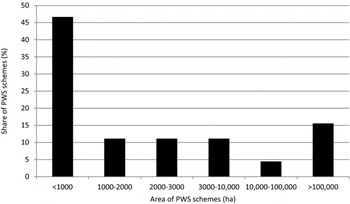
The number of service providers in the analysed schemes varied substantially. The Compoalegre Users Association in Colombia, for example, had only one private land owner selling the services, whereas the Working for Water project in South Africa had about 24 000 sellers of environmental services. The enrolled PWS schemes analysed in this study covered an area of almost 22 million ha of land (Fig. 3), but the land area varied between PWS schemes. Most schemes operated on less than 1000 ha. The Working for Water project in South Africa was the largest and covered 5–10 million ha.
Scale of operation of the different PWS schemes in hectares.

In 28% of the cases, the buyers of the ES were downstream water users, including irrigators. The national government buys the services in 25% and the local municipality in 19% of the cases. Thirty per cent of the schemes were implemented at national scale, the rest at local or regional (watershed) level. A private company was identified in 10 of the 47 schemes. Only in the PWS scheme in Bolivia was there an international donor who was paying for the services. In one scheme in Costa Rica and two in Indonesia, hydropower dams were paying farmers for their services (sustainable soil management) to reduce sediment flows in the river.
In almost 70% of the schemes, an important indicator of environmental performance was the amount of land covered with forests. However, quantified measurements of environmental performance were largely lacking, despite the fact that two-thirds of the schemes had quantitative objectives. Monitoring of the environmental performance was limited to 27 of the 47 PWS schemes (57%). For the statistical meta-analysis, these two variables were combined into an interaction term, representing schemes where quantitative monitoring of quantified environmental performance took place. As mentioned, only 47% of the schemes monitored their quantified objectives.
Institutional-economic factors explaining PWS environmental performance
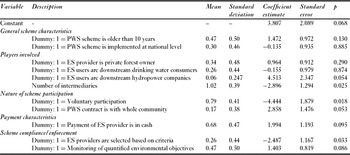
The binary logistic regression (Table 2) is significant at the 5% level (χ2 = 20.279, 11 degrees of freedom) and can explain 47% of the variation (R2) and correctly predict the environmental performance response variable in 77% of the cases. The factors that were theoretically expected to influence the environmental performance were categorized in five groups: (1) general scheme characteristics that were expected to have an impact on the schemes’ environmental performance such as the scheme's age and implementation scale, (2) the players involved such as the ES providers, ES users and number of intermediaries between the two, (3) the nature of scheme participation (voluntary or mandatory), (4) the payments involved and (5) possible compliance and enforcement issues. Different variables were tested within each group for their significance. Significant variables could not be found for every group (Table 2). Examples of non-significant factors include the location of the scheme (country), the type of ES (drinking water supply, sediment reduction or combination of the two), the way environmental performance was measured (based on biophysical results, namely effects, or degree of participation and implementation, namely effort) and the availability of penalties or sanctions for non-compliance. In other cases, there was overlap between explanatory variables causing multi-collinearity. For example, if the scale of implementation was national, this was heavily correlated with the national government as the ES provider. A strong correlation also existed between land tenure (public or private land) and ES providers (such as government, farmers and private forest owners).
Meta regression model results explaining the environmental performance of payment for watershed services (PWS) schemes (n = 47) as the response variable. ES = ecosystem services.

Correlation between the explanatory variables was tested explicitly, but could not completely be avoided due to the binary nature of most explanatory variables. Only two pairs of variables appeared to be significantly correlated (> 0.3). The highest correlation was for scheme participation and cash payment (r = 0.53), followed by selection criteria for ES providers and hydropower producers as the ES users (r = 0.44).
No significant effect at the 10% level could be detected for the age of the scheme (included either as a continuous or dummy variable) or the implementation scale of the schemes. If the PWS scheme was implemented at national instead of local or regional level, this had no effect on the scheme's environmental performance.
Whether ES providers were private forest owners conserving existing (patches of) forest on their land (instead of the baseline category consisting of farmers receiving payments for the reforestation of their land) had no significant positive effect on the probability that the PWS scheme achieved its environmental objectives either. If contracts were concluded with downstream hydropower companies to specifically reduce sediment loads in the water course in the watershed, this had a significant positive effect on the environmental performance at the 5% level. However, no effect could be detected if the main group of downstream payees were individual households who paid a surcharge over and above their drinking water bill. In both cases the baseline category consisted of the other ES buyers and financers (Table 1), including local municipalities, private companies, non-governmental organizations (NGOs) and national governments.
The number of intermediaries had a significant negative effect on the likelihood that the PWS scheme meets its environmental objectives: the more intermediaries were involved (varying between 0 and 2), the less effective the schemes tended to become. Intermediaries refer to third parties that bring ES providers and users together or facilitate a financial transaction between the two. This includes regulatory authorities responsible for or co-funding the implementation of PWS schemes. Most intermediaries in the schemes were national government (41%) or local NGOs (33%). Other intermediaries included local municipalities (11%) and international donors (6%). Multiple intermediaries usually involved national government working together with local NGOs and user groups. Examples were mostly found in PWS schemes in Costa Rica and Colombia (Table 2).
Mode of participation in the PWS schemes was also important. Voluntary instead of mandatory participation had a significant negative effect on the environmental performance, whereas contracts concluded with a community instead of single ES providers appeared to be significantly more effective.
Sixty-eight per cent of the schemes used cash as their main mode of payment (Table 2). If not in cash, service providers were paid in kind, for instance through the provision of environmental education and training (in 10% of the cases), investments in livelihood and infrastructure development projects (10%), provision of technical assistance (6%) or distribution of tree seedlings (6%). In one case in Honduras, the service providers received supermarket coupons. Paying in cash instead of in-kind had a significant positive effect on environmental performance at the 10% level.
The average payment for the provision of ES depended on the type and extent of the service provided. For example, the Costa Rica Institute of Electricity (ICE) scheme awarded the service provider US$ 1.30 per tree if a farmer planted 350–5000 trees. This could rise to US$ 65 ha−1 yr−1 on a maximum of 300 ha. Around 22% of the ES providers disclosed that the average yearly payment they received for service provision varied between US$ 4–36 ha−1. Although substantial differences were found between schemes, with schemes in Indonesia and the Heredia Public Service Enterprise in Costa Rica paying most for ES delivery (US$ 150–160 ha−1 yr−1), no significant effect of price variation was found in the meta-regression model.
No significant impact on environmental performance was found for payment frequency (for example annual instead of monthly) or the vehicle through which ES buyers pay, such as water fees, government taxation or donor funds. Water fees are also partly picked up by the downstream drinking water consumers who pay this fee, but this variable did not have a significant impact either (Table 2).
Contracts between service providers and buyers were concluded in 75% of the cases, in some cases through intermediaries. The duration of the contract had no significant effect on environmental performance; most contracts were for a period of one or two years, in some cases because the scheme was still in an initial experimental phase. The contract in the Meijiang Orange Orchard in China was an exception. This contract was signed for 30–70 years. The contract might also specify the quality of the services expected from the service providers, but this was not always the case. Sanctions could be imposed on those who did not comply with the terms and conditions of the contract, for example by cancelling business permits and payments or overall exclusion from the compensation scheme.
If scheme participants were chosen based on available selection criteria, this had a significant negative effect on environmental performance. Most criteria referred to the location (upstream of the watershed) and accessibility of land. Land tenure security was another frequently used criterion, where land holders were required to have clear legal rights to manage their land. In some cases, state ownership was the preferred status of land tenure. Land size also played a role in some schemes: the land had to be big enough (> 6 ha) to provide the ES. Other criteria referred to poverty reduction, where marginalized poor farmers were given priority.
Monitoring progress towards reaching quantified environmental objectives had, as expected, a significant positive effect on the likelihood of reaching the environmental objectives. No significant effect could be detected for the type of performance indicators that were monitored.
DISCUSSION
Despite the increasing popularity of PWS schemes worldwide, their effectiveness in ES provision remains underinvestigated. The growing body of literature on PWS allowed us to synthesize existing empirical results from developing countries in a more quantitative preliminary meta-analysis than existing qualitative reviews. The robustness of the meta-analysis depends crucially on the reliability of the input variables, in this case the measurement of the environmental performance response variable and the explanatory variables related to the characteristics of the PWS schemes. Given the simple and imprecise measurement of the binary response variable used in this study, the results presented here have to be interpreted with care.
Our findings confirm the need for establishing quantifiable environmental watershed objectives and monitoring progress towards reaching these objectives. Less than half of the schemes used quantifiable indicators and monitored the impact of the schemes on environmental performance. In a majority of these cases, the indicators furthermore referred to the efforts put into scheme implementation (such as area with forest cover) instead of the actual impacts and outcomes of the scheme. Direct payments by downstream hydropower companies to upstream land owners for reduced sediment loads are identified as a successful PWS example, confirming findings in the literature about the important role of user financed schemes. The significance of the role of user and government financed schemes more generally (Wunder et al. Reference Wunder, Engel and Pagiola2008) and of national and sub-national schemes (Daniels et al. Reference Daniels, Bagstad, Esposito, Moulaert and Rodriguez2010) could not be replicated in our meta-analysis.
Our results show a negative effect on environmental performance if a scheme is voluntary. Although voluntary agreements have been propagated in the PES literature (Wunder Reference Wunder2005), 20% of the schemes in the analysis are mandatory in practice. An example is the Sloping Land Conservation Programme in China, where households in certain parts of the country did not have full autonomy in participation (Bennett Reference Bennett2008). This might result in a lack of commitment from ES providers, but our results show that mandatory participation is, all things being equal, significantly more likely to be successful in reaching the environmental objectives involved than voluntary participation. Community commitment and participation had a positive effect on environmental outcome, in other words if the contract was concluded with the entire community instead of individual service providers. A possible explanation for this may be that the community plays an important role in compliance and enforcement.
Selection of ES providers also played a significant role. Careful selection of ES providers was expected to enhance environmental outcomes. However, a wide variety of selection criteria was applied in the PWS schemes. Only one scheme used ES provision effectiveness (best service for a fair price) as a prime selection criterion. Bulte et al. (Reference Bulte, Lipper, Stringer and Zilberman2008) showed that having different objectives lowered environmental performance of PES schemes, which is expected to also explain the negative sign in the meta-regression model. Kemkes et al. (Reference Kemkes, Farley and Koliba2010) emphasized the importance of carefully selecting existing intermediaries, but not the number of intermediaries. Having more intermediaries had a negative impact on the environmental performance of PWS schemes in our study. Multiple intermediaries are expected to increase transaction costs and delay decision-making, and hence increase inefficiency.
CONCLUSIONS
Key findings in our study with practical implications for PWS scheme design include the impacts of scheme participation conditions and the number of intermediaries between ES providers, users and payees on the likelihood of reaching the environmental objectives involved. Proper monitoring of the additional effects of PWS schemes on the relevant watershed services, such as water supply and sediment reduction compared to a clearly defined baseline serving as a control for the PWS schemes, should receive highest priority. International monitoring guidelines are needed to facilitate comparisons between different scheme designs. Only in this way will relevant causal relationships between institutional design and environmental performance be understood and hence those design factors driving the success or failure of PWS schemes in achieving environmental objectives. Understanding these relationships is paramount to the future design of cost-effective PWS schemes.
ACKNOWLEDGEMENTS
We are grateful to Maryanne Grieg-Gran and Ina Porras from the International Institute for Environment and Development for their permission and support to use their list of watershed market schemes as a starting point for our analysis. We also want to thank the PWS scheme managers who participated in our survey and provided us additional data and information, and the three anonymous reviewers for their valuable comments and suggestions. This research was conducted as part of the Netherlands Organization for Scientific Research NWO-WOTRO Science for Global Development funded project Blue Nile Hydrosolidarity and the EU FP7-funded project POLICYMIX (grant agreement number 244065). The authors are solely responsible for the content of the paper.