
Introduction
Charcoal fragments are ubiquitous at many archaeological sites. They most often correspond to firewood used by humans for domestic and other specific combustion activities, or to timber in the case of burnt houses. Anatomical criteria allow the identification of the taxa from which the archaeological charcoal originates using a reflected-light microscope, an identification atlas and reference collections of modern charcoal. In archaeobotanical research, the main goals of archaeological charcoal analysis, or anthracology, is to understand forest history and its exploitation, as well as the use of wood by past societies (Chabal Reference Chabal1992, Reference Chabal1997; Asouti & Austin Reference Asouti and Austin2005; Marguerie & Hunot Reference Marguerie and Hunot2007; Salavert & Dufraisse Reference Salavert and Dufraisse2014).
Since the mid 1960s, a branch of archaeology has developed in the USA that focuses on the study of the material remains of military camps of the American Civil War (Smith Reference Smith, Geier and Winter1994). Similarly, in Europe, although traditionally considered more the domain of historians, the period from the eighteenth century onwards has become the subject of archaeological research in France (Buchli & Lucas Reference Buchli, Lucas, Buchli and Lucas2001). The archaeology of recent historical conflicts is now in full development, as shown by the fieldwork carried out on the battlefield of Waterloo (Scott & McFeaters Reference Scott and McFeaters2011; Bosquet et al. Reference Bosquet, Ternaux and Fossion2014; Waterloo Uncovered 2015). Rescue excavations in northern France have unearthed numerous remains from armed conflicts, such as those of the Great War (1914–1918). Archaeological analyses have not only affirmed historical sources but have also, on occasion, contradicted them (Desfossés et al. Reference Desfossés, Jacques and Prilaux2009; Bellan & Journot Reference Bellan and Journot2011). Nevertheless, archaeobotany, and anthracology in particular, is still rarely applied to recent historical periods.
Yet issues concerning firewood acquisition and the economic value of wood resources during archaeologically recent periods are just as relevant as they are for earlier periods. Indeed, until very recently, wood was the main resource used by humans to produce fire for heating, lighting and cooking in Western Europe. Moreover, at the beginning of the nineteenth century, forests played a major role in military strategy by providing building material for ships, weapons, barracks and other facilities for the army (Brosse 2000). In order to manage the land better and prevent deforestation, a law was passed in 1803, proposed by Napoléon, that established strict controls over forest clearance by civilians; it laid the foundation for future forest legislation later in nineteenth-century France (Reitel Reference Reitel1994). Charcoal fragments from archaeological contexts are able, therefore, to provide the most direct evidence of firewood used by soldiers of the period. Anthracology is well placed to provide these reliable data, which can add to the information provided in nineteenth-century historical sources, especially with regard to past woodland composition and forest management practices.
This paper focuses on the firewood remains from a Napoleonic camp located at Étaples in the north of France. As far as we are aware, this is the first attempt to apply anthracology to an archaeological site attributed to the eighteenth century in Europe (Hello Reference Hello2013). The work is part of a wider archaeological project led by the French National Institute of Preventive Archaeological Research (INRAP) that aims to understand the everyday living conditions of the soldiers, including those of the Grande Armée in the early nineteenth century (Lemaire Reference Lemaire2010, Reference Lemaire2013, Reference Lemaire2015). By comparing the archaeological charcoal to evidence provided from historical sources, this paper aims to examine the global potential of anthracology for enhancing the current knowledge of historical forest exploitation. Specifically, it aims to understand firewood management by Napoleonic troops in greater detail through charcoal analysis. Did the supply of firewood, as evidenced through the archaeological charcoal, accurately reflect that which was noted in the official military records? Were there any differences in firewood use according to hierarchical rank within the army?
The Napoleonic camps: historical background and archaeological context
Historical background
In 1803, the army known as the Côtes de l'Océan, formed by Napoléon, was intending to invade England, following the breaking of the peace treaty signed the previous year. He gathered together a large army and stationed it in the Boulogne camps located on the French and Belgian coasts of the English Channel, as well as on the Dutch coast of the North Sea (Dumas Reference Dumas1822a & Reference Dumasb; Battesti Reference Battesti2003a & Reference Battestib; Bonaparte & Navarro Reference Bonaparte and Navarro2004). Between 1803 and 1805, around 175 000 soldiers were routinely gathered and trained for the planned invasion of England. In late August 1805, the army left the camps for Germany. In October of that year, the French fleet, commanded by Admiral Villeneuve, was totally destroyed at Trafalgar, marking the end of the Napoleonic invasion project. In 1810, the Boulogne camps were finally abandoned (Masson Reference Masson1995).
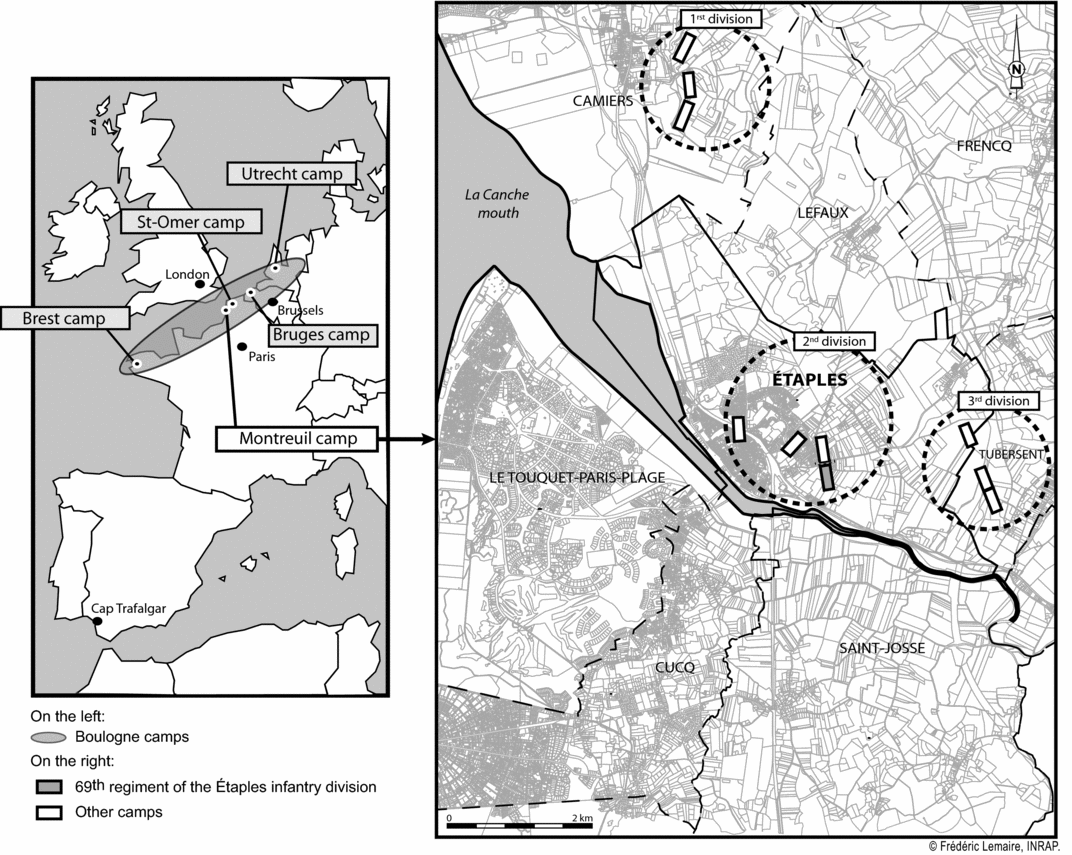
The ‘Boulogne camps’ is a general term used to qualify the camps collectively at sites such as Saint-Omer, Bruges and Montreuil, located on the English Channel coast and the North Sea (Figure 1). These camps benefited from their close vicinity to port facilities, as well as having access to the wood resources of the Boulonnais forests. The camps of Montreuil were settled in the mouth of the Canche River in a landscape composed of dunes and marshes (Figure 1). They comprised three infantry divisions: Camiers, Tubersent and Étaples. The latter, occupied from October 1803 to August 1805, was stationed by more than 6000 soldiers distributed across four regiments. According to various historical sources, three of the four regiments benefited from approximately 139ha of available land around the camp, including 25ha of land damaged by previous military installations in the Canche delta (Lemaire Reference Lemaire2015).
Location of some of the Boulogne camps (left), the location of the three infantry camps of Montreuil and the 69th Regiment of Étaples (right), based on old maps, testimonies and archive documents.

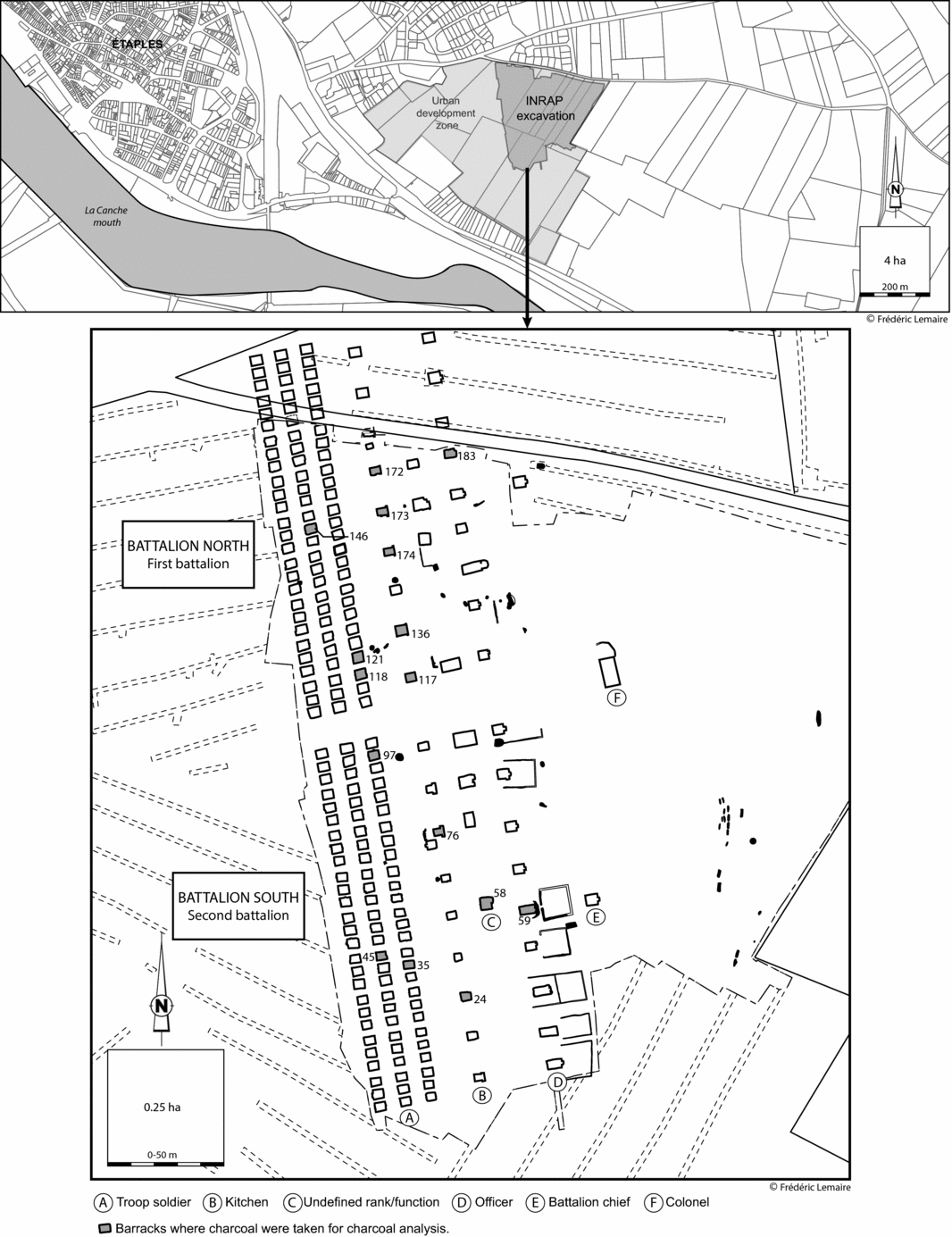
The camps were composed of multiple lines of barracks, organised according to battle order on the battlefield (Figure 2). The living conditions in the camp were unhealthy and marked by overcrowding, especially in winter. Barracks consisted of half-buried shelters, built with daub and covered with a straw roof set down on two earthen embankments. In these barracks, which were usually much smaller than 20m2, 12–16 men were sheltered (Hiriart Reference Hiriart1804; Roguet Reference Roguet1864; Montesquiou-Fezensac Reference Montesquiou-Fezensac1870).
Location of the INRAP rescue excavation and plan of the 69th Regiment camp at Étaples, showing barracks where samples were taken for charcoal analysis.

Archaeological context
The camp of the 69th Regiment of the Étaples infantry division was discovered thanks to a rescue excavation overseen by INRAP in 2010, prior to the construction of an urban development zone at Étaples. The camp, covering 5ha, was almost entirely excavated during a period of six months (Figure 2).
A total of 191 barracks were discovered (Lemaire Reference Lemaire2009, Reference Lemaire2010), the majority of which were in a remarkable state of preservation. One hundred and eighty-two of them were excavated. The 69th Regiment, under the direction of a chief, consisted of two battalions (north and south) with several rows of barracks corresponding to six military ranks (Figure 2). For each battalion, directed by a colonel, the troops’ barracks, spreading over three lines, were the most numerous. The battalion itself was composed of nine companies; each company being comprised of nine troop barracks and a kitchen, under the direction of three officers who were accommodated separately, behind the kitchen. The barracks of the fifth line were intended, in theory, to house surgeons and general staff, but their function seems more complex and probably also had a collective recreational use: mess room, dance floor, fencing room and the like.
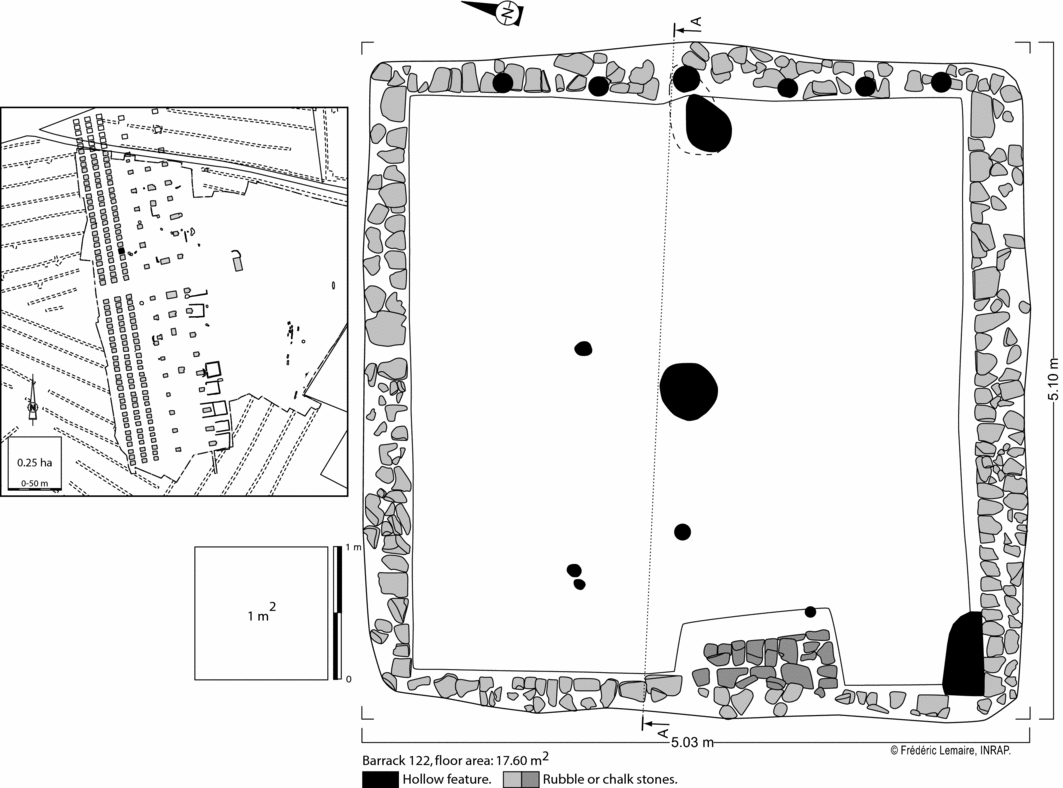
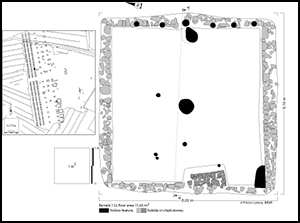
The camp of the 69th Regiment therefore appears to have been built according to the ministerial directions and military regulations that standardised barrack size and camp layout (Narbonne-Lara Reference Narbonne-Lara1792; Bardin Reference Bardin1813). The archaeological excavation did, however, highlight some diversity in the building techniques used and in the internal organisation within the barracks (Figure 3). A small proportion of the buildings comprised rubble and chalk-stone building materials, and contained features corresponding to postholes that had once supported a roof made of vegetal matter (Figure 3). The officers’ barracks were all equipped with a fireplace, whereas the soldiers’ barracks did not, generally, have any means of heating. The kitchen dimensions were different in size to other buildings in the barracks, and that may indicate more specific uses: sometimes smaller, they contained one or several large masonry chimneys per building.
Plan of one of the troop barracks from the north battalion. Floor area: 17.6m2.

Around 6000 archaeological artefacts were discovered, including uniform buttons, gun parts, coins, razors, lice combs, couture scissors, pipes made of burnt clay, crockery, metal nails, furniture parts and so on. These diverse objects all relate to different aspects of daily camp life, and mainly originated from the troops’ barracks.
Charcoal analysis
Material and method
Analysis focused on charcoal-rich sediments from the stratigraphic layers in which human activity occurred: the barrack floors and chimney fireplaces of 16 entirely excavated buildings (Figure 2). The presence of charcoal on the floors of the troops’ barracks suggests that at least some of the soldiers made use of small domestic fireplaces. The sampling contexts may correspond to their final firings for heating and cooking at the end of the camp occupation, between 1803 and 1805. During the excavation, 100 soil samples comprising approximately 1300L of sediment were sieved in water through 2mm and 0.5mm mesh sieves. From these, a total of 23 samples were deemed viable for further analysis on the basis of the number of charcoals present.
The well-preserved archaeological charcoals were observed with a reflected-light microscope using both dark-field and bright-field illuminations (magnification ×50 to ×1000). Taxonomic identification was performed using an identification atlas (Schweingruber Reference Schweingruber1990) and the reference collection of modern charcoals. Normally, wood anatomy only allows identification to genus level. A minimum of 50 fragments were identified in each archaeological sample, and for each new taxon determined, an additional 50 fragments were again identified. For temperate Europe, this was sufficient to predict the “optimal sample size to select and study” so as to have the most complete overview of species diversity exploited for firewood in the past (Chabal Reference Chabal1994, Reference Chabal1997: 33; Salavert et al. Reference Salavert, Bosquet and Damblon2014).
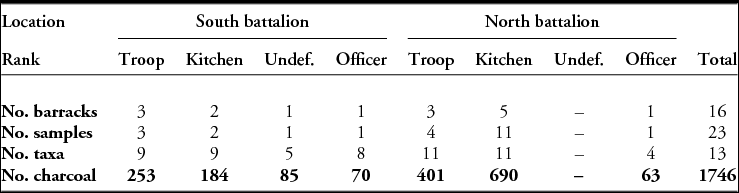
The dataset presented variations in the number of barracks, samples and charcoal fragments identified by rank (kitchen, troop, undefined rank, officer) and battalion (north, south). These variations have to be taken into account in order to ascertain whether the wood supply varied according to location and rank. For example, the most substantial charcoal assemblages come from the kitchens (seven barracks) and troop accommodations (six barracks). Only one barrack of the fifth line, attributed to an undefined rank, and two officers’ barracks were investigated (Figure 2; Table 1). There are two principal reasons to explain these quantitative differences. Firstly, troop barracks are the most numerous within a battalion. Thus, there was an increased chance that they would deliver more ash-rich deposits favourable to anthracological analysis than others. Secondly, the kitchens, as the largest firewood consumers, were expected to provide the most extensive archaeological evidence of combustion activities. The four hierarchical ranks were only fully observable in the south battalion, and, therefore, the results obtained from the undefined line had no corresponding counterpart in the north battalion. Also, the sum of the barracks and charcoal fragments studied for undefined staff and officer lines was much lower than those of the troops and kitchens. Using such a small corpus of samples could, potentially, affect the number of taxa identified and lead to over-representation of some types. No samples were taken from the colonel's barracks because of its poor preservation, nor from the two barracks of the battalion chiefs, which were destroyed by the construction of facilities during the Second World War.
Comparison of the number of barracks, samples, taxa and charcoal fragments studied depending on rank and location.

Results
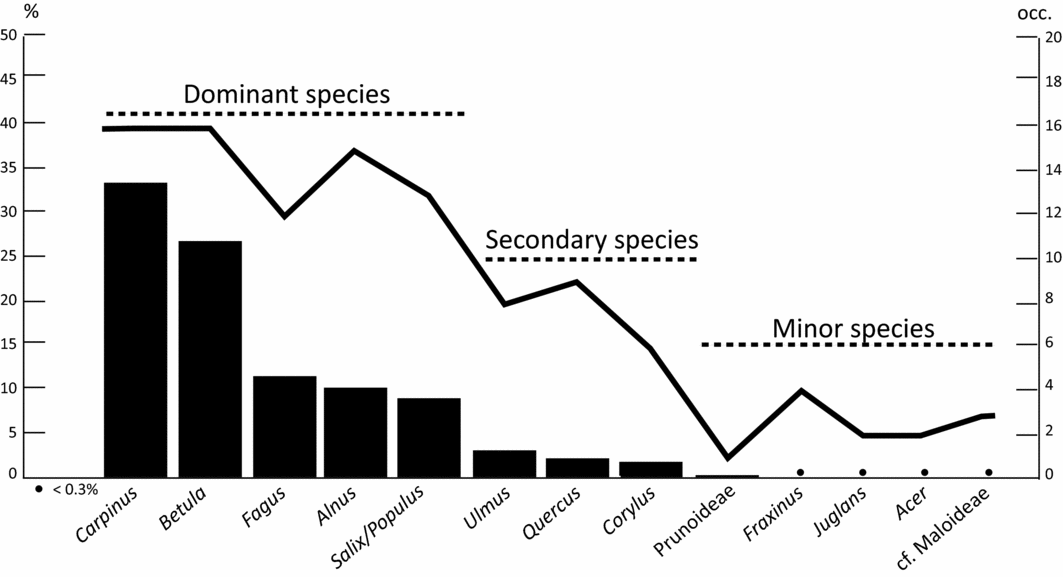
A total of 1746 charcoal fragments and 13 species were identified at Étaples (see Table S1 in online supplementary material). The species were ordered according to their relative proportions calculated on the total number of fragments identified on the site, as well as the number of barracks in which each taxon was identified (i.e. occurrence) (Figure 4). Overall occurrence is important for confirming the hierarchy of species, and for counterbalancing percentages that could be over- or under-estimated due to the number of charcoals identified within the sample, or to taphonomical processes.
Proportion (%) of wood species identified from the charcoal assemblage of the 69th Regiment of Étaples, and the number of barracks where each taxon was identified (occ.).

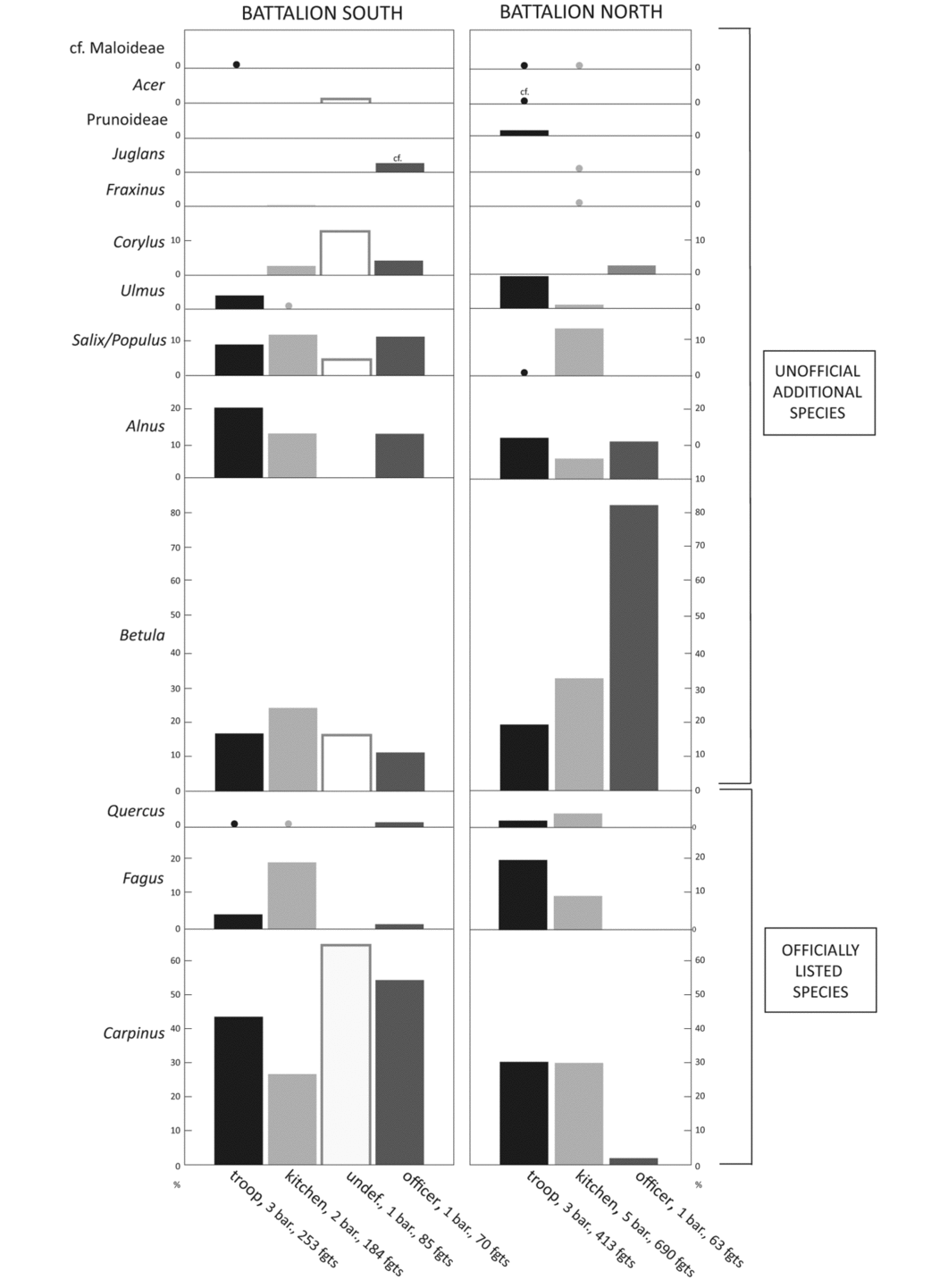
From the charcoal assemblage, five species, accounting for more than 90 per cent of the identified fragments dominated: Carpinus, Betula, Fagus, Alnus and Salix/Populus. These species were identified in at least 12 of the 16 barracks studied. Secondary species were Ulmus, Quercus and Corylus, which represented between 3 and 2 per cent of the charcoal assemblage, and were identified in more than a quarter of the structures. Minor species included: Prunoideae (sub-family of Rosaceae including the Prunus genus), Fraxinus, cf. Maloideae (sub-family of Rosaceae including the Malus, Sorbus and Pyrus genera), Juglans and Acer. The five dominant species were similarly represented in both battalions (Figure 5): Carpinus, Betula, Fagus, Alnus and Salix/Populus. The importance of Betula may, however, have been overestimated in the north battalion due to the small number of fragments studied in the officers barrack. Among the other species, Prunoideae was not identified in the north, although this absence is regarded as irrelevant, as the taxon only formed part of the minor species. The list of species was, therefore, consistent according to grade and location. The study of the spatial distribution of charcoal assemblages did not indicate a differential wood supply by rank (kitchen, troop, undefined rank, officer) or battalion (north, south) (Figure 5).
Charcoal assemblages according to their location and hierarchical rank: ‘bar.’ refers to the number of barracks studied, and ‘fgts.’ refers to the number of charcoal fragments identified.

Discussion
Contribution of historical records
The data gathered from anthracological analysis of firewood supply in the Napoleonic camp at Étaples may be integrated with information given by primary historical sources, such as soldiers’ letters, military orders and previous historical publications for a better-informed interpretation (see Table S2). Specific aspects concerning the use of wood resources and their economic value for the camps are predominantly known through letters or reports from the military to the General Staff (Hello Reference Hello2013). Among them, weekly reports documented the supply of food, fodder, weapons and firewood to the camps. During this period, the wood resources provided for soldiers were controlled by the official supplier to the army who acquired 200ha of forest around the Boulogne camps to provide wood for heating and lighting services. According to the agenda of the Bruges camp, written by Général Mathieu Dumas, the official wood species stockpiled by the Napoleonic army consisted of Carpinus, Fagus and Quercus. In addition to firewood, peat, coal and candle oil were also supplied to the soldiers (Chochois & Poultier Reference Chochois and Poultier2004).
As the historical sources indicated the supply of only three species to the Boulogne camps, we expected to identify the equivalent from the archaeological charcoal. In contrast, the number of species identified within the charcoal assemblage comprised 13 different species. The three species noted as being supplied officially (Carpinus, Fagus and Quercus) amounted to less than half (47 per cent) of the fragments identified. Carpinus and Fagus were dominant in this charcoal assemblage (confirming their use as firewood); despite its identification in more than half of the barracks, the percentage of Quercus was surprisingly low (2 per cent). The low percentage of Quercus may be due to the composition of forests officially exploited by the army wood supplier, or from the last firewood stocks allotted to the camps.
As can clearly be seen, there is a major discrepancy between the archaeological and historical sources with the identification of at least 10 unofficial species, including Betula, Alnus and Salix/Populus, which are not recorded in any official documents and yet are dominant among the charcoal assemblage (Figure 5). The results can be explained in one of two ways: either the official supply comprised more than three species, or the supply of firewood was not entirely managed by the official supplier to the Boulogne camps.
Additional historical records regarding wood resource management highlight problems with the supply of firewood to the Boulogne camps. For example, in a letter of 1804, Colonel Demarçay announced an interruption of firewood distribution for eight days at the camp of St-Omer. Another letter, from the Inspecteur aux Revues to Général Andréossy, and dated from the same year, raised concerns over soldiers using wood intended for the construction of the barracks for heating instead. It therefore appears that the soldiers from the Boulogne camps suffered greatly from regular firewood shortages. The archaeological evidence from Étaples may, therefore, allude to firewood gathered from the vicinity of the camp. This hypothesis is supported in letters from Général Dutaillis, written in 1805, which reported significant damage to woodland adjacent to the Montreuil camps.
Interpretation of archaeological charcoal assemblages
In anthracology, it is generally assumed that the greater the range of species represented in a sample, the more complete the image of exploited woodland will be (Chabal Reference Chabal1994, Reference Chabal1997). At Étaples, up to 13 species were identified, of which 10 taxa did not come from the army's official stock. This number of taxa is consistent with the taxonomic diversity obtained on pre- and protohistorical sites from the north of France and Belgium (Pernaud Reference Pernaud1997; Salavert et al. Reference Salavert, Bosquet and Damblon2014). At Étaples, the majority of the archaeological samples may simply represent wood resources available from around the site, rather than a determined selection based on particular species. Thus, even if the charcoal assemblage does not provide an exhaustive list of all the available species exploited for firewood, it does at least give those used most commonly by the soldiers.
The additional taxa from the charcoal assemblage may correspond to different vegetation communities. Often, within the same genus, the ecological requirements, such as water and light needs, vary depending on the species. That level of identification is, however, rarely achieved in anthracology. For example, Salix caprae can be found growing on the edge of forests and across open woodlands, whereas Salix fragilis is associated only with damp conditions such as riverbanks (Rameau et al. Reference Rameau, Mansion and Dume1989). This can lead to sharply differing interpretations of the forest composition when analysing archaeological charcoal. In order to gain a reliable overview of the forest composition and the taxa exploited for firewood during this period, both the groups of, and typical plant characteristics for, the wood species identified in the archaeological charcoal assemblages must be taken into account.
The three officially sanctioned species delivered to the camps of Boulogne probably came from mature oak-hornbeam (Carpinion betuli) or beech (Fagus sylvatica) forests located in the Boulonnais region, and managed by a supplier for the Napoleonic army. Betula, Alnus and Salix/Populus, three of the dominant additional species, and Fraxinus and Ulmus, minor and secondary species, respectively, are prominent in damp or waterlogged soils, such as riparian or swamp forests (Rameau et al. Reference Rameau, Mansion and Dume1989) similar to those surrounding the site. The possibility that some of the additional dominant species, together with secondary or minor taxa such as Corylus, Acer, cf. Maloideae and Prunoideae, could have also come from the forest edges or degraded forests inland cannot be excluded. Episodes of war were often destructive to forested areas (Amat Reference Amat1987; Dubois Reference Dubois, Amat and Corvol-Dessert1994; Reitel Reference Reitel1994; Puyo Reference Puyo2004); during the twentieth century, and possibly even earlier, disturbed soils favoured the growth of local hygrophilous vegetation to the detriment of oak-hornbeam forests in the north of France (Dubois Reference Dubois, Amat and Corvol-Dessert1994), which might explain the presence of the additional taxa at Étaples. Unfortunately, palynology, which could indicate the local and regional vegetation around Étaples, is of relatively little help to support the discussion of the charcoal data. Indeed, there are very few palynological studies of the Boulonnais recording and discussing levels throughout the nineteenth century. In the few existing studies, the absence of radiocarbon dating for the upper levels of palynological diagrams prevents the precise timing of forest dynamics (Munaut & Gilot Reference Munaut and Gilot1976; D'Hauwe Reference D'Hauwe1979).
Juglans was a minor species and probably not part of the local vegetation from around the camp. Indeed, this taxon is extremely sensitive to spring frosts, which would most certainly have occurred in the north of France at that time (Musset Reference Musset1962; Rameau et al. Reference Rameau, Mansion and Dume1989). The high economic value of Juglans suggests that its original use was not for heating or cooking, but rather for a secondary use as furniture or even rifle parts (Guinier Reference Guinier1953). The identification of Juglans in only two barracks (one kitchen and one officers barrack) indicates that this practice remains limited in the camp, and these fragments probably came from weapon parts that were beyond salvageable repair.
The archaeological evidence and historical records indicate that the wood resources used for lighting, heating and cooking by the soldiers of the 69th Regiment may have had two points of origin: the army supplier, who provided the three officially listed species, and the local vicinity, from which the 10 unofficial additional species were gathered (Figure 5). As with charcoal assemblages from older archaeological sites, this wood, collected in an opportunistic manner by the soldiers, contributes to our understanding of local forest composition, probably in the Canche delta. Furthermore, the application of anthracology at Étaples highlights the importance of regular wood shortages in Napoleonic camps at the beginning of the nineteenth century. These shortages, combined with arduous living conditions, meant that by the end of the camp's occupation, soldiers were forced to collect firewood from the local vicinity for use by all ranks.
Conclusion
Anthracology, as a supplement to historical documents, has provided a substantial contribution to our understanding of firewood economy among Napoleonic camps, and especially to the everyday life of the Napoleonic soldier at the beginning of the nineteenth century. The additional taxa clearly correspond to wood resources collected in the vicinity of the site. These ‘unofficial’ wood collections offset the shortages recorded at the Boulogne camps due to potential transport problems or an overexploitation of the official forests themselves due to military needs, especially for shipbuilding (Boudriot Reference Boudriot1999). In France, the forest reached its lowest geographic area around either 1816 or 1830, and the Napoleonic Wars contributed significantly to this decrease (Bainville & Ladoy Reference Bainville and Ladoy1995; Dupouey et al. Reference Dupouey, Bachacou, Cosserat, Aberdam, Vallauri, Chappart and Corvisier de Villele2007). The application of dendrometric tools and methods to archaeological charcoals has developed considerably, and should also provide additional information on the structure of the residual woodlands exploited for firewood at the beginning of the eighteenth century. This first application of archaeological charcoal analysis to a Napoleonic military camp constitutes a good example of the potential for studying charcoal fragments from recent archaeological sites, and suggests how we may further our understanding of woodland history during historical conflicts.
Acknowledgements
Historical records were consulted in the archives of the Nord-Pas-de-Calais Region and the Service historique de la Défense at Vincennes, as well as specialised collections within the Fondation Napoléon and the Bibliothèque Nationale de France. We gratefully thank V. Matterne who assisted at the very outset of the study, and V. Malécot for his support during the redaction of the article.
Supplementary material
To view supplementary material for this article, please visit http://dx.doi.org/10.15184/aqy.2016.174