INTRODUCTION
Protected areas (PAs) have been implemented worldwide as the main policy instrument for conservation of ecosystems and their biodiversity (Leverington et al. Reference Leverington, Lemos Costa, Courrau, Pavese, Nolte, Marr, Coad, Burgess, Bomhard and Hockings2010). As the extension of lands under government-managed PAs continues to increase (UNEP-WCMC [United Nations Environment Programme-World Conservation Monitoring Centre] 2010), discussions about the relative merits of restrictive and participatory models of conservation persist.
Given that much of the world's biodiversity is found within areas inhabited by people who are highly dependent on natural resources for subsistence (Sunderlin et al. Reference Sunderlin, Angelsen, Belcher, Burgers, Nasi, Santoso and Wunder2005), the model of government-imposed PAs, in which most uses of nature are banned or restricted, has generated critical voices. Some refer to the detrimental impacts of strict conservation for local people (Hackel Reference Hackel1999; Ferraro Reference Ferraro2002; West et al. Reference West, Igoe and Brockington2006; Lele Reference Lele, Wilshusen, Brockington, Seidler and Bawa2010), referring to their exclusion from access to natural resources (Sunderlin et al. Reference Sunderlin, Angelsen, Belcher, Burgers, Nasi, Santoso and Wunder2005), their forced dislocation (Kalibo & Medley Reference Kalibo and Medley2007), and the criminalisation of local land-use practices (West et al. Reference West, Igoe and Brockington2006). Other critics draw attention to potentially detrimental impacts on conservation efforts, such as the increase in deforestation resulting from weak engagement of local people in the protection and sustainable use of biodiversity (Chowdhury Reference Chowdhury2006; Nagendra et al. Reference Nagendra, Pareeth and Ghate2006). Still others address social justice issues (Naughton-Treaves et al. Reference Naughton-Treves, Holland and Brandon2005) highlighting how government-imposed models fail to involve local people in planning the use of the very lands which they have traditionally inhabited (Campbell & Vainio-Matilla Reference Campbell and Vainio-Matilla2003; García-Frapolli et al. Reference García-Frapolli, Ramos-Fernández, Galicia and Serrano2009) or even to provide local people with basic information about changes in the legal status and management regulations of those lands (Rao et al. Reference Rao, Maikhuri and Saxena2003; Smardon & Faust Reference Smardon and Faust2006; Olomí-Solà et al. Reference Olomí-Solà, Zorondo-Rodríguez, Triguero-Mas, Jha and Reyes-García2012; Reyes-García et al. Reference Reyes-Garcia, Ruiz-Mallén, Porter-Bolland, Garcia-Frapolli, Ellis, Mendez, Pritchard and Sanchez-Gonzalez2013). Some authors have associated local people's limited knowledge about government-managed PAs with the failure to consult local residents about the process of establishing and managing these conservation initiatives (Fiallo & Jacobson Reference Fiallo and Jacobson1995; Olomí-Solà et al. Reference Olomí-Solà, Zorondo-Rodríguez, Triguero-Mas, Jha and Reyes-García2012).
International policies have increasingly required that the government-managed PAs implement participatory approaches with a view to both improving local livelihoods and enhancing conservation outcomes (Agrawal & Gibson Reference Agrawal and Gibson1999). Such participatory approaches implicitly treat communication and environmental education as essential instruments to raise local people's awareness and support of PA (Goldstein Reference Goldstein2003; Pujadas & Castillo Reference Pujadas and Castillo2007; Berkes Reference Berkes2010).
The importance of community-driven initiatives for conservation is also being increasingly documented (Porter-Bolland et al. Reference Porter-Bolland, Ellis, Guariguata, Ruiz-Mallén, Negrete-Yankelevich and Reyes-García2012) and recognized by international agreements (UN [United Nations] 1992). Moreover, the PA framework of the International Union for the Conservation of Nature (IUCN) and the programme of work on PAs of the Convention on Biological Diversity (CBD) include recognition of indigenous peoples’ and community conserved areas and territories (ICCAs) (Dudley Reference Dudley2008), defined as natural and/or modified ecosystems containing significant ecosystem functions and biodiversity and cultural values which are voluntarily conserved by indigenous or other local communities through their own customary laws (IUCN 2011). ICCAs are expected to provide economic incentives to local people while protecting biodiversity, as in community-based ecotourism projects. These projects are developed, often with the support of government subsidies and non-governmental organizations (NGOs), at major tourism destinations such as in the Yucatan Peninsula in south-eastern Mexico (Pi-Sunyer & Brooke Reference Pi-Sunyer, Brooke, King and McCarthy2005; CDI [Comisión Nacional para el Desarrollo de Pueblos Indígenas] 2013).
The Yucatan Peninsula contains the largest expanse of remaining mature seasonal tropical forests in Mexico, providing connections to other forested areas of Mesoamerica (Vester et al. Reference Vester, Lawrence, Eastman, Turner II, Calmé, Dickson, Pozo and Sangermano2007). In the context of the high conservation value of this region, there are 23 federally recognized PAs. Amongst these are biosphere reserves (BRs), which fall under the UNESCO Men and Biosphere Programme. By claiming to promote sustainable development activities (CONANP [Comision Nacional de Areas Naturales Protegidas] 2013) BRs, in principle, suggest a changed approach to nature conservation in Mexico: from an exclusionary to an inclusive perspective (Paz-Salinas Reference Paz-Salinas2005; Paré & Fuentes Reference Paré and Fuentes2007). Within their boundaries, research, monitoring, education and information exchange can be conducted, whereas hunting, firewood and non-timber forest product collection, logging and agricultural activities are not permitted (INE [Instituto Nacional de Ecologia] 2000, but see exceptions in CONANP 2007). Previous research has already documented that although BRs overlap or border on communal territories (Massieu & Chapela Reference Massieu, Chapela, Concheiro and López-Bárcenas2007), local participation in decision-making regarding their establishment and management is, in practice, negligible (García-Frapolli et al. Reference García-Frapolli, Ramos-Fernández, Galicia and Serrano2009). For instance, Sian Ka'an and Calakmul BRs were created in 1986 and 1989, respectively, both without prior consultation with local communities (Smardon & Faust Reference Smardon and Faust2006). Nonetheless, the 1993 Management Plan of Sian Ka'an set out to involve local stakeholders in the long term decision-making processes by improving training and environmental education and by engaging local stakeholders in conservation and sustainable development actions (INE 1993). Likewise, the 2000 Calakmul's Management Plan identified the need to increase local people's cognisance of conservation issues through training, environmental education and local participation in natural resource management, although it did not specify any actions to increase people's involvement in decision-making (INE 2000).
The increasing number of tourists visiting PAs in the Yucatan Peninsula has resulted in the Mexican authorities providing subsidies or credit to local communities to develop conservation initiatives based on community ventures (Bonilla-Moheno & García-Frapolli Reference Bonilla-Moheno and García-Frapolli2012). Nature-based tourism (Cornejo Reference Cornejo2004; Buitrago Tello et al. Reference Buitrago Tello, Marín Guardado and Fraga Berdugo2012) and charismatic fauna sightseeing (Galicia & Baldassarre Reference Galicia and Baldassarre1997; García-Frapolli et al. Reference García-Frapolli, Ayala-Orozco, Bonilla-Moheno, Espadas-Manrique, Ramos-Fernández, Silva Rivera, Vergara Tenorio and Rodríguez-Luna2012; Ziegler et al. Reference Ziegler, Dearden and Rollins2012) have emerged. These initiatives are confined to zones to facilitate management, which devote some areas entirely to conservation, scientific research and ecotourism, and others for extraction, sustainable exploitation of resources and adventure tourism (see Elizondo & López-Merlín Reference Elizondo and López-Merlín2009). This governance model assumes that these conservation areas are voluntarily created and managed by communities who stand, collectively, to obtain and share economic benefits from ecotourism. This does not accommodate the reality that communities are heterogeneous entities comprising multiple groups of actors who differ in interests and socioeconomic characteristics (Adhikari & Lovett Reference Adhikari and Lovett2006) and where internal social and cultural barriers operate to define different access to decision-making and power and may generate conflicts among community members. These characteristics shape the nature and extent of local involvement and empowerment of different groups in such initiatives, but may also weaken the achievement of conservation and development outcomes (Berkes Reference Berkes2007; Dressler et al. Reference Dressler, Buscher, Schoon, Brockington, Hayes, Kull, McCarthy and Shrestha2010; Peterson Reference Peterson2011). Our study acknowledges these internal differences.
We compare local people's level of cognisance and participation in government- and community-driven conservation initiatives. Specifically, we examine local perceptions of the communication processes taking place in management of PAs established as BRs or as ICCAs which have ecotourism projects. We then examine local people's cognisance of and participation in the decision-making and implementation of management activities in each type of conservation initiative. By cognisance we refer to awareness of the existence of the PA, its main traits, management rules and decision-making process. By participation we refer to local people's involvement in the PA decision-making and management actions. We distinguish between three types of participation, namely: participation by consultation when local members are asked by decision-makers about the design and implementation of management plans defined a priori; functional participation when local people are involved in predetermined management activities; and pro-active participation when locals have or exert a decision-making role over PAs management (Pretty Reference Pretty1995). Since ICCAs, at least in principle, allow for greater local involvement in decision-making and management than BRs, we expect to find higher levels of cognisance and participation amongst local residents when asking about ICCAs than when asking locals about the nearby BRs. In recognition of the socioeconomic factors which shape the access of groups to information on and participation in PAs (Agrawal Reference Agarwal2001; Heinen & Shrivastava Reference Heinen and Shrivastava2009; Olomí-Solà et al. Reference Olomí-Solà, Zorondo-Rodríguez, Triguero-Mas, Jha and Reyes-García2012), we also test the association between sociodemographic characteristics of local residents and their cognisance of and participation in the decision-making and management of BRs and ICCAs.
We use data from two indigenous communities that have established ICCAs to develop community-based ecotourism projects within their lands. One community is adjacent to the Sian Ka'an BR and the other is located within Calakmul BR, both in the Yucatan Peninsula. We aim to identify challenges and opportunities to enhance participatory and egalitarian management approaches in government- and community-driven PAs.
METHODS
Study site
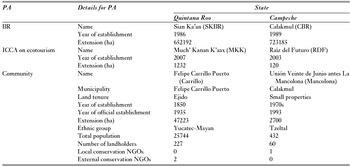
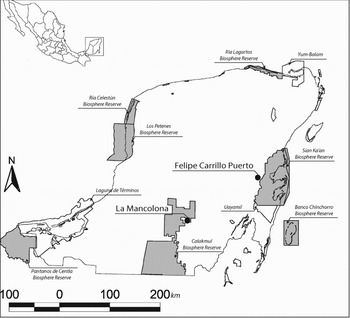
Sian Ka'an BR (SKBR; state of Quintana Roo) and Calakmul BR (CBR; state of Campeche) are surrounded by local communities with distinct cultural and organizational features, land tenure types and socioeconomic characteristics. Despite their differences, all these communities share a high dependency on forest resources for their livelihoods. We conducted research in two villages that have developed community-based ecotourism projects in their ICCAs: Felipe Carrillo Puerto (hereafter Carrillo) in SKBR and Union Veinte de Junio, antes La Mancolona (hereafter Mancolona) in CBR (Table 1; Fig. 1).
Protected areas and community characteristics. PA = protected area, BR = biosphere reserve, ICCA = indigenous and community conserved area, NGO = non-governmental organization.

Location of the communities where research was conducted and protected areas in Yucatan Peninsula.

The Yucatec-Mayan ejido of Carrillo lies 8 km from the SKBR and has approximately 8% of its territory within the limits of the BR. It surrounds the town of Felipe Carrillo Puerto, which is a rural-urban centre with a population of ≤25000, mainly working in the service sector. As an ejido, Carrillo has a common property system with defined tenure codes and political relations (Jones & Ward Reference Jones and Ward1998). The General Assembly is responsible for the management of resources within the ejido land. Its members include 227 ejidatarios, who hold exclusive land rights to communal land and are mostly men who work in forestry and agriculture.
Since the establishment of the SKBR in 1986, the NGO Amigos de Sian Ka'an has promoted local cognisance of the BR. In 2007, with assistance from another local NGO (U'yolche) and the Mexican government, the community created an ICCA called Much’ Kanan K'aax (MKK, Together we take care of the forest). It devoted an area of 1230 ha to maintain the forest and to monitor, reforest and train for the planned future implementation of a carbon sequestration programme. ICCA management bans the establishment of agricultural plots, although families with plots before the ICCA was created are permitted to continue working them. The community has also established an ecotourism project in this conservation area, which has yet to generate significant economic benefits.
Mancolona is a migrant community with 85% of its territory within the CBR. Its population of 432 Tzeltal-speaking people was expelled in the late 1970s by the Mexican government from their territories in Chiapas in order to make way for the creation of the Montes Azules BR. The community settled in southern Campeche, but was again forced to move in 1989 because the core zone of the newly created CBR was established precisely where the community village was located. Finally, in 1993, the community resettled in an area located within and around the buffer zone of the CBR. The Mexican government granted individual land titles to 60 household heads. Despite this, residents have retained the tradition of collective work and decisions are largely taken in assemblies. Their main productive activity is milpa agriculture, a form of swidden agriculture. They also keep bees, ranch cattle and grow chilli.
In 2003, members of the community, with the support of a regional grassroots organization (named CRIPX) and the British Embassy, created an ICCA called Raíz del Futuro (RDF, Roots of the Future). This adopted the same management restrictions as in the CBR. Funding was provided for an ecotourism initiative and construction of basic infrastructure, but this was soon abandoned because of internal conflicts and insufficient funds for maintenance. Nonetheless, the project was restarted with government funds by a group of community members with the support of CRIPX. This has recently created a conservation area of 120 ha. Although a trail, a camping area and several cabins were built, it does not yet generate funds.
Data collection
Data were collected by researchers who resided in the communities from January to October 2010, using semi-structured interviews and questionnaires with adults (≥18 years of age) in the ejido (hereafter ‘community’) of Carrillo and the community of Mancolona. We worked with translators fluent in Spanish and the corresponding indigenous languages (Yucatec-Mayan and Tzeltal).
We conducted a total of 13 semi-structured interviews: 10 with community members (eight from Carrillo and two from Mancolona) and three with BR and NGO representatives. These provided preliminary information about: PA history, local involvement in the PA and PA managers’ communication strategies with local people. During interviews, we used the term ‘protected area’ to inquire about BRs and the terms ‘ejidal reserve’ and ‘ecotourism area’ to ask about ICCAs in Carrillo and Mancolona. This is because prior informal conversations with local leaders revealed that respondents were most familiar with these terms.
We used interview data to design a questionnaire to assess local cognisance of the existence and management rules of BRs and ICCAs, and participation in the management of those initiatives. Specifically, for each of the two governance models (BRs and ICCAs), we asked each interviewee whether s/he knew of its existence, main traits (such as name and location) and management rules regarding hunting, gathering, logging, traditional agriculture, cattle ranching, tourism and research (1 = respondent knew about the area and its characteristics, 0 = otherwise). Then, for each initiative reportedly known by a person, we asked whether s/he had participated in decision-making during its creation, the design of its management plan, managing the area as decision-maker, and any other management activities (1 = respondent had been involved in any of these activities, 0 = otherwise). The questionnaire also contained questions to provide sociodemographic information on the interviewees.
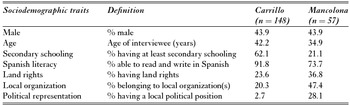
We applied questionnaires to 115 women and 90 men. In Mancolona, we sampled all households (n = 57) and, in Carrillo, we selected a stratified random sample of 150 households from a community census (75 households where one or more adults had land rights titles and 75 where adults did not have land rights). In both communities, a respondent was randomly selected from those adults present in the household at the moment of the interview. Since adults in two households in Carrillo refused to answer the survey, the total sample for the community was 148 households (Table 2).
Sociodemographic description of the sample.

Data analysis
Interviews were inductively analysed by using annotations and no predefined codes (Newing Reference Newing2011). Interviewees’ responses regarding PA history were organized into three categories: before, during, and after the creation of the PA. We used this information to understand the context of PA governance: who makes decisions and how are they taken. We coded responses regarding involvement in the creation and management of the PA across sociodemographic factors. To analyse perceptions of communication of information regarding PAs, we sorted information from semi-structured interviews into four categories: indirect communication, or information transmission through secondary sources; direct, one-way communication, or information transmission from knowledgeable informants to others; dialogue, or two-way information transmission; and training, or information transmission with the aim of improving technical knowledge and skills.
We used questionnaire data to generate individual scores of cognisance of and participation in management for each type of conservation initiative. To generate the cognisance score, we noted one point if the person had some knowledge of the PA main traits or its management rules and one more if s/he knew most or all requested information about the area. To assess the level of local participation, we generated the dummy variable participation (1 = respondent had participated in decision-making or management activities in the PA, 0 = otherwise). We then calculated the descriptive statistics of local people's cognisance and participation for each model of PA governance and excluded from the analysis people who were unaware of the existence of the PA because this condition precluded their potential participation. We used Fisher's exact test to compare cognisance scores of people who had some level of participation in the creation and management of the PA and people who had none. We used the same statistical tool to test whether groups of people with different sociodemographic characteristics differed in their level of cognisance of and participation in both BRs and ICCAs.
RESULTS
Transmission of information and cognisance of conservation initiatives
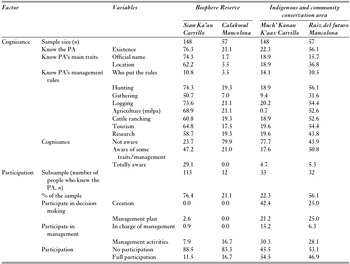
The communication adopted by SKBR decision-makers towards Carrillo inhabitants was one-way. Informants from Carrillo explained that people in charge of SKBR had conducted meetings at which community authorities and interested people had been told about developments regarding the BR, including about official reports and availability of government subsidies to conduct sustainable productive projects (ecotourism and agro-forestry) inside the SKBR. Informants also highlighted the role of the NGO Amigos de Sian Ka'an in providing information about SKBR and organizing the meetings. By contrast, indirect communication was prevalent in the information transmission from CBR decision-makers to Mancolona residents. These locals reported that not only was it just the local ecotourism group that had received information about CBR, but that it had not been transmitted by the official managers in charge of the CBR. Rather it had been informed through the NGOs and researchers working in the area who had trained a few community residents in ecotourism and agro-forestry. Seventy-four per cent of Carrillo respondents were able to provide the correct name of SKBR, whereas only 2% of those in Mancolona knew the official name of CBR. Interviewees from Carrillo were also more informed about the BR management rules than Mancolona interviewees. In general, those who knew about the existence of the BR were also aware of restrictions on hunting, logging, agriculture and cattle ranching. However, few informants (11%) knew who elaborated the SKBR management rules. Whereas 29% of interviewees in Carrillo demonstrated knowledge of the SKBR main traits, management rules and decision making process, none of the respondents in Mancolona had the same level of knowledge about CBR. In fact, of the Mancolona residents, only 21% knew some of the CBR traits and management rules, compared with 47% of the interviewees in Carrillo.
Regarding the ICCAs, interviews showed that in both communities the typical communication strategy of local managers was via dialogue with the other community members, although information was disseminated more widely in Mancolona than in Carrillo. In Carrillo, interviewees explained that ICCA issues were discussed in the General Assembly meetings, which few people attend (only ejidatarios). As an ejido member from Carrillo said: ‘Those people who are not ejidatarios do not attend (the General Assembly meetings) because they only can go to the meetings (but not vote)’, while the wife of an ICCA member in Carrillo stated: ‘The General Assembly only takes into account the decisions of the ejidatarios’.
In Mancolona, informants mentioned that the ecotourism group, which had received more information and training from CRIPX and researchers, had both invited local people to participate and shared information through local channels. An ICCA member said: ‘When the ecotourism programme came to us, we invited all the community in general but especially the landowners’, and the ICCA president said: ‘On many occasions I have talked about the conservation programme in the (community) assembly’.
Although few people in Carrillo (22%) were aware of the existence of the ICCA, most of those who were also knew about its main traits and management rules. Surprisingly, only 0.7% was aware that agriculture was not allowed in MKK. In Mancolona, 56% of people were aware of the existence of the ICCA, while only 5% demonstrated more complete knowledge. Of these, 16% knew its official name and 37% knew its location.
Local people's cognisance of the PA varied considerably depending on whether they were asked about the BR or the ICCA. Local cognisance also varied according to the community of residency (Table 3). The existence of a BR was better-known among interviewees from Carrillo (76%) than among informants from Mancolona (21%), but the latter were more aware of the existence of the ICCA (56%) than interviewees from Carrillo (22%).
Percentage of people who know and participate in management of the protected area (PA).

Access to decision-making and local participation
In both communities there were lower levels of local participation in decision-making and management for BRs than for ICCAs. Interviewees stressed that local people were not invited by official managers to take part in SKBR and CBR decision-making or management activities. In Carrillo, some perceived that participation in the SKBR was restricted, and an ICCA member disclosed: ‘I think that it [management at the SKBR] is intended so that we don't see what is going on inside’.
In Mancolona, although informants mentioned that the CBR supported the ICCA ecotourism project, none of our informants had taken part in decisions relating to the CBR and only two out of the 12 people who were aware of the BR had also participated in its management activities. In Carrillo, only 3% of respondents who knew about SKBR took part in decisions relating to its management plan, 8% were involved in management activities, and only 1% said they were in charge of some management activity (Table 3).
Local participation in Carrillo's ICCA was higher than in SKBR, but lower than in Mancolona's ICCA. During interviews in Carrillo, informants said that only by attending community meetings would residents be aware of ICCA issues, but recognized that participation of those who were not ejidatarios was limited because these meetings took up much of their time without providing them with the opportunity of any economic compensation. Specifically, one ICCA member stated: ‘People's lack of participation is not because they are not interested in those issues. For instance, all people participate in reforestation activities because they are paid. People live from day to day, so they go if they earn money. If it is not paid, they go one or two days but not more because they need to make money to live’.
In Mancolona, 42% of those people who knew about the ICCA were involved in decision-making regarding its creation and 21% participated in the design of its management plan. Fifteen per cent had been in charge of the ICCA management and 30% participated in management activities (Table 3).
Cognisance and participation across conservation initiatives
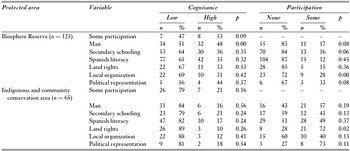
There was a positive association between participation in the decision-making or management activities in both SKBR and CBR and cognisance of the PAs traits and management rules (p < 0.1) (Table 4). Cognisance of and participation in BRs were greater among men than among women (p < 0.01). Participation in BRs was also greater among: people having secondary or higher levels of schooling (p < 0.1), members of local organizations (p < 0.01), and those having a local position (p < 0.1) than among people without those characteristics. The association between cognisance of the ICCAs and participation, although positive, was not significant (p = 0.16). Our proxies for local participation in ICCAs and people holding land rights were associated (p < 0.05).
Fisher's exact test of the association between cognisance of and participation in government- and community-driven conservation initiatives of those who know the existence of each type of Protected area and their sociodemographic characteristics (p is 1-side Fisher exact; for definition of variables see Tables 2 and 3).

DISCUSSION
Our hypothesis that local people's cognisance of and participation in ICCAs would be greater than cognisance of and participation in BRs was only confirmed in the case of Mancolona. Cognisance and participation in both BRs and ICCAs appeared to be related to certain sociodemographic characteristics of individuals. Men had greater cognisance of and participation in the BRs than women, whereas participation was also dependent on characteristics such as sex, education, membership to a local organization and holding a representative role in the community. By contrast, participation in ICCAs was specifically associated with the individual's land holding rights status.
Thus our first finding suggests that locals’ cognisance of and participation in PAs was more dependent on the individuals’ access to information than on the type of conservation initiative and its characteristics (such as location and size). Information on both types of PA had been disseminated, accessed and shared amongst the residents of respective communities in different ways. In the case of Mancolona (a relatively small community that is clearly defined in spatial and social terms) those people who led the ICCA (most of them members of the grassroots organization CRIPX) had organized open community meetings as a means to inform the whole community about the area, and as an invitation to participate. This would explain the high levels of knowledge about the conservation initiative and its management. In contrast, low levels of cognisance of the CBR, despite being one of the largest reserves in Mexico and besides Mancolona being within the buffer zone of the reserve, were most obviously a consequence of the lack of communication between the BR managers and Mancolona residents. However, given the traumatic history of forced relocation that has experienced this community, it is entirely plausible that individuals would opt to not demonstrate knowledge of the management of CBR since, in their experience, anything related to a BR had already caused them hardship. Furthermore, the exclusion of the Mancolona people in the initial establishment of the CBR may have deterred them from interest to participate in any of the subsequent PA management activities or even to oppose to the BR, as has been documented in conservation initiatives (Wilshusen Reference Wilshusen, Clark, Willard and Cromley2000).
In Carrillo, people were more aware of the BR than of the ICCA. Since the SKBR creation in 1986, the NGO Amigos de Sian Ka'an had disseminated information to the local populations about the BR. Thus the presence of such external organizations that support conservation initiatives through the transmission of information would seem to constitute another factor that increases local people's cognisance of PA management. It is also possible that local residents were less aware of the ICCA than of the SKBR management rules because only those few who were directly involved in ICCA management and decision-making had any knowledge of it. Decisions regarding communal areas were only made by those holding land rights or ejidatarios, who were mostly men. This means, as has been demonstrated elsewhere in Mexico (Haenn Reference Haenn2006), that an important part of the population seems to have been excluded from access to information and participation in management because of this concentration of power and knowledge amongst ejidatarios. In Carrillo, local elites control such community-based conservation initiatives, and this reflected similar experiences involving indigenous communities engaged in ecotourism in Kenya (Thompson & Homewood Reference Thompson and Homewood2002) and sustainable forest management in Nepal (Varughese & Ostrom Reference Varughese and Ostrom2001; Iversen et al. Reference Iversen, Chhetry, Francis, Gurung, Kafle, Pain and Seeley2006) and India (Macura et al. Reference Macura, Zorondo-Rodríguez, Grau-Satorras, Demps, Laval, Garcia and Reyes-García2011). It might not occur in Mancolona because within the community power was more decentralized or stronger systems of accountability existed. Thus, community characteristics (such as history, population and social organization) seem to define the extent to which local leaders retain or share the information that they have access to with the wider community.
In both types of PA governance, people with certain characteristics (namely men and land rights holders) seemed to be privileged in having access to information about PA management and able to be involved in it. In the case of the BRs, where cognisance of and participation in management appear to be related, men demonstrated the greatest levels of cognisance of and participation. We know from our ethnographic data that information about SKBR and CBR was transmitted in official meetings from conservation technicians to local leaders, who were literate men typically involved in other local organizations. Moreover, the presence of officials would likely inhibit the participation of women in the context of gender and education inequalities in rural Mexico, consistent with other rural areas across Latin America (Ferranti et al. Reference Ferranti, Perry, Ferreira and Walton2004). Similarly, the participation of women in ICCA decision-making was often limited by customary rules and land holding norms. Our findings suggest that those people holding land rights, who were typically men, were also those involved in ICCA management. Research in Nepal and India has shown that women there were typically excluded from community forestry institutions. Many of those who were invited to join were poorly informed or even unaware that they were included (Agarwal Reference Agarwal2001, Reference Agarwal2009a ), yet after their active involvement in decision-making groups, both forest protection and rule compliance, were demonstrated to improve (Agarwal Reference Agarwal2009b ). Thus, while ICCAs may formally create opportunities for local participation, the communities, through their requirement of membership, might fail to effectively involve local people in community-based initiatives thus excluding the most vulnerable or marginalised, such as women, who, given the opportunity, might contribute to improve ICCA management for conservation.
CONCLUSIONS
By identifying variations between local people's cognisance of and participation in PA management in both government-managed and community-driven conservation initiatives and the factors which affect these, this study provides insights as to how local participation and cognisance manifest in the context of the different types of PAs. Particularities of the history and social structure of the communities mean that appreciations of the governance type of conservation initiative cannot be mechanically predicted. Behaviour and cognisance are mediated also by a complex interplay of characteristics internal to the communities, relating to processes of power and communication, and to factors that are idiosyncratic to each. In view of this, it is simplistic to view community-based conservation areas, even those providing economic benefits to local people, as a panacea to facilitate wider involvement of community members in conservation. Similarly, communities should be understood as complex entities that consist of groups of individuals with different sociodemographic traits and interests that influence levels of knowledge and participation in PAs. Thus our findings contribute to the wave of more critical work on participation, which has become an international buzzword (Cornwall & Brock Reference Cornwall and Brock2005), emerging as a concept in which it is believed that different actors, including governments, development and conservation agencies, as well as community members, need to take part in order to achieve successful biodiversity conservation (Lele et al. Reference Lele, Wilshusen, Brockington, Seidler and Bawa2010; Schultz et al. Reference Schultz, Duit and Folke2011). As our research shows, existing local circumstances and social inequalities privilege some individuals above others and define the way that information is shared and cognisance is promoted. Further research on community-driven conservation areas in the region which assess both conservation outcomes and local engagement in decision-making processes could serve to improve our understanding of the effectiveness of such conservation strategies.
Direct communication and education actions focused on enhancing training and information-sharing about conservation-related issues could be directed at sectors that are typically excluded or marginalized, such as women and those with less formal education. BR managers must improve their communication plans to inform local people living in or around these PAs about their rights and duties towards biological conservation. This imperative is greater since local participation is identified as one of BR goals (Stoll-Kleemann et al. Reference Stoll-Kleemann, De la Vega-Leinert and Schultz2010) requiring the implementation of mechanisms that facilitate local involvement in the management and decision-making of these areas. The existence of inequalities within communities points to the need for this type of action even for the ICCA initiatives. ICCAs managers, as well as the NGOs which support them, must develop more effective participatory mechanisms for decision-making and communication strategies to improve both conservation and development outcomes of these community-driven initiatives.
ACKNOWLEDGEMENTS
We thank the communities of Mancolona and Carrillo for their hospitality and participation in our field work. Research was funded by grants from the Fondo de Cooperación Internacional en Ciencia y Tecnología UE-Mexico (FONCICYT 94395), from the Programa de Cooperación Inter-Universitaria e Investigación Científica, Ministerio de Asuntos Exteriores y Cooperación (A/023406/09 and A/030044/10), and Fundació Autònoma Solidària-UAB (XXVII and XXVIII).