Introduction
A botanical survey was conducted in the core zone of Dihang Dibang Biosphere Reserve of Arunachal Pradesh, India, during July and August 2010. Amongst the plants collected were many specimens of the genus Neottia Guett. (Orchidaceae). These were compared with the descriptions in the available literature (Hooker, Reference Hooker and Hooker1890; King & Pantling, Reference King and Pantling1898; Chen, Reference Chen1981; Chen & Luo, Reference Chen and Luo2002; Pearce & Cribb, Reference Pearce and Cribb2002; Chen et al., Reference Chen, Gale, Cribb, Wu, Raven and Hong2009) and with authentic herbarium material at CAL, ASSAM and ARUN [Herbarium of Botanical Survey of India, Arunachal Pradesh Regional Centre, Itanagar]. Two collections could not be matched with any known species of Neottia and are therefore described as new. The other collections of this genus have been identified as Neottia alternifolia (King & Pantl.) Szlach., N. acuminata Schltr. and N. divaricata (Panigrahi & P.Taylor) Szlach.
Species Descriptions
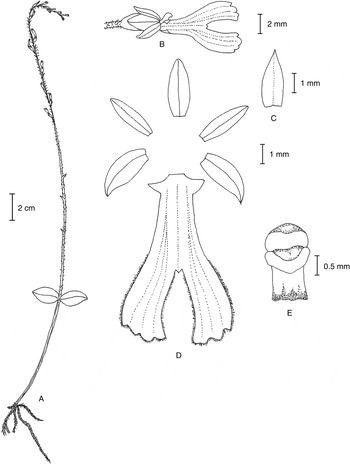
1. Neottia dihangensis M.Bhaumik, sp. nov.Fig. 1.
Fig. 1.Neottia dihangensis M.Bhaumik. A, habit; B, flower; C, floral bract; D, floral parts; E, column.

Species nova Neottia nanchuanicae (S.C.Chen) Szlach. affinis sed foliis sessilibus, minoribus (usque ad 2 cm longis), pedunculis longioribus (> 10 cm longis), inflorescentia multiflora (12–27 floris), epichili lobis non imbricatis, lobulis 3 rotundatis instructis differt. – Type: India, Arunachal Pradesh, Upper Siang District, Sitoma camp–Ruitala camp, 3600 m, 22 vii 2010, Bhaumik36874 (holo CAL; iso ARUN).

Terrestrial, autotrophic, 30–40 cm tall. Roots fascicled, hairy. Stem below the leaves terete to semi-terete, 8–13 cm tall, ridged, yellowish green; sheath solitary in lower part of the stem. Leaves 2, sessile, opposite, 7–9 cm above ground, below the middle of the plant; lamina broadly ovate, 1.8–2 × 1–1.3 cm, membranous, upper surface dark green, paler beneath, base rounded, apex acute, with 3 pairs of prominent primary veins and 2–4 pairs of faint secondary veins, margins undulate. Inflorescence a 12–27-flowered raceme; peduncle 13–19 cm tall, laxly glandular hairy; peduncular bracts 3–5, lanceolate, 2–4 × 0.5–1 mm, membranous, acuminate; rachis 8–12 cm long, densely glandular hairy. Floral bracts elliptic-lanceolate, 2.5–3.2 × 1–1.2 mm, acuminate, 1-veined, greenish. Flowers green, on terminal part of the inflorescence; sepals and petals strongly reflexed and therefore parallel to the ovary; pedicel 3–5 mm long, densely hairy; ovary oblong, 2–3 × 1.5–1.8 mm, greenish, angular, glabrous. Dorsal sepal broadly ovate-elliptic, c.3 × 1 mm, acute, lateral sepals obliquely ovate, c.3.2 × 1 mm, membranous, acuminate, 1-veined. Petals lanceolate, c.3 × 0.5 mm, acute, 1-veined, membranous. Lip subobovate, 8–9 × 3–6 mm, hypochile with two lateral triangular auricles c.1 mm long, mesochile gradually broadened below the deeply bilobed epichile; lobes parallel and not overlapping, oblong, c.3 × 1.5 mm, faintly 2–3-veined, margins papillose all around, terminating with three rounded lobules, a short median triangular tooth in the sinus. Column straight, perpendicular to the lip, stout, 1.5–1.8 mm long, without foot.
Distribution. India, Arunachal Pradesh. Known only from the type collection.
Habitat and ecology. Temperate semi-dense bamboo, Rhododendron and Abies forest floor near the forest edge. Flowering in July.
Conservation status. Least Concern (LC). The species grows in the primary forest of Dihang Dibang Biosphere Reserve far from any human habitation. There are no immediate threats to the survival of the species. However, only one patch of 6–10 individuals was seen during our exploration.
Etymology. The specific epithet is derived from its geographical origin, namely the Dihang Dibang Biosphere Reserve.
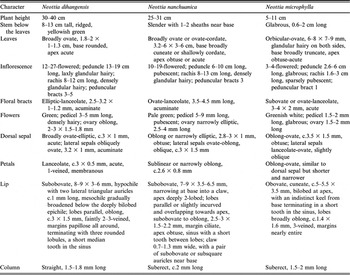
Note. This species is similar to Neottia nanchuanica (S.C.Chen) Szlach. and N. microphylla (S.C.Chen & Y.B.Luo) S.C.Chen, S.W.Gale & P.J.Cribb in the leaves below the middle of the plant, the floral bracts obovate, ovate-lanceolate to elliptic-lanceolate, the flowers green, pale green to greenish white, the lip subobovate to obovate, and the epichile with a short tooth in the sinus. Of these it is more similar to Neottia nanchuanica, but differs in the sessile and smaller leaves (up to 2 cm long), longer peduncles (more than 10 cm long), inflorescence 12–27-flowered, and epichile lobes not overlapping and terminating with three rounded lobules. It also shows some resemblance to Neottia wardii (Rolfe) Szlach. in the papillose-ciliate epichile margin but differs in its many-flowered raceme, the lip without lamellae and the epichile lobes terminating with rounded lobules. A comparison of the new species with Neottia nanchuanica and N. microphylla is given in Table 1.
A comparison of Neottia dihangensis with N. nanchuanica andN. microphylla

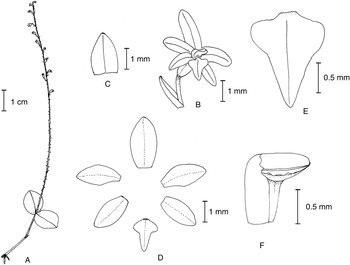
2. Neottia confusa M.Bhaumik, sp. nov.Fig. 2.
Fig. 2.Neottia confusa M.Bhaumik. A, habit; B, flower; C, floral bract; D, floral parts; E, lip; F, column.
Species nova Neottia tizanensi (Fukuy.) Szlach. similis sed caule ad medium usque foliato, labio, minore, triangulari, integro, 1.2–1.5 cm longo, breviter ungiculato, hypochilo lato et epichilo integro, ad apicem non incisurato nec emarginato differt. – Type: India, Arunachal Pradesh, Upper Siang District, Sitoma camp–Ruitala camp, 3200–3800 m, 22 vii 2010, Bhaumik36891 (holo CAL; iso ARUN).

Terrestrial, autotrophic, 12–15.5 cm tall. Stems below the leaves terete to semi-terete, ridged, 2–5.5 cm long; sheath solitary or sometimes absent. Leaves opposite, sessile, borne much below the middle, broadly ovate-orbicular to ovate-elliptic, 8–12 × 6–11 mm, rounded to subacute at apex, primary veins in five pairs. Inflorescence a raceme, 15–20-flowered; peduncle terete, glandular hairy, 0.5–2.2 cm long; peduncular bracts 2–3, sometimes absent, elliptic-ovate, c.2.2 × 0.9 mm, acuminate; rachis 3.5–5 cm long, densely glandular hairy. Floral bracts oblong-lanceolate, 1.5–2 × 0.6–1.2 mm, acute to acuminate, semi-membranous, greenish, 1-veined. Flowers greenish, 3–4 × c.2 mm; pedicel and ovary 2–3 mm long, glabrous. Dorsal sepal elliptic-oblong, 2–2.5 × 0.8–1.3 mm, rounded at apex, indistinctly 1-veined; lateral sepals 1.8–2 × 0.6–1 mm, elliptic-oblong, rounded to subacute. Petals obliquely elliptic-oblong, c.2.2 × 1 mm, rounded at apex, veins not distinct. Lip simple, triangular in outline, minutely clawed, 1.2–1.5 × c.1 mm, hypochile expanded on both sides forming pseudoauricles, mesochile gradually narrowed into a triangular epichile. Column stout, straight, 0.8–1 mm long, curved at apex, without foot.
Distribution. India, Arunachal Pradesh. Known only from the type collection.
Habitat and ecology. Growing on moss-covered moist forest floor in the temperate to subalpine zone. The forest is dominated by shrubby Rhododendron species and occasional Abies trees. About 10–15 individuals of the orchid species at three different places have been seen growing scattered along with Neottia acuminata Schltr., Juncus species and many other herbaceous elements. It flowers and fruits in July and August.
Conservation status. Least Concern (LC). Like Neottia dihangensis this species also grows in the primary forest of a conserved area, namely Dihang Dibang Biosphere Reserve, far from any human habitation. There are no immediate threats for the survival of the species.
Etymology. In the genus Neottia (including Listera R.Br.) the lips are usually bilobed or entire and apically emarginate and are often longer than the sepals and petals. Simple and comparatively short lips, as found in Neottia confusa, are rather atypical in the genus. Consequently, the specific epithet confusa is coined.
Notes. Neottia confusa has a simple and small lip with an undivided epichile and therefore resembles the two holomycotrophic species N. acuminata and N. taibaishanensis P.H.Yang & K.Y.Lang. However, its autotrophic habit with two distinct opposite leaves rather indicates a close affinity with Neottia taizanensis (Fukuy.) Szlach., N. biflora (Schltr.) Szlach. and N. morrisonicola (Hayata) Szlach. where the epichile is shallowly notched or emarginate. Its expanded hypochile base can be considered as a pair of auricles, and the entire epichile shows that the new species is distinct from the other species. It is most similar to Neottia taizanensis but differs in its leaves borne below the middle of the plant, and the lip smaller, triangular, entire, 1.2–1.5 cm long, minutely clawed, hypochile wide, epichile entire and neither notched nor emarginate at apex.
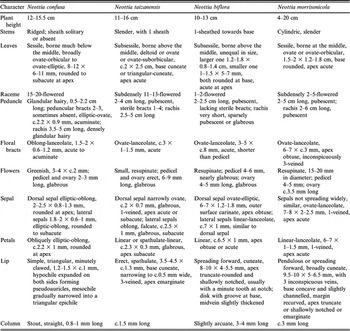
Listera R.Br. and Neottia Guett. have been treated as separate genera for the last two centuries mainly due to differences in their habit. In recent studies all Listera R.Br. species have been moved into Neottia Guett. (Szlachetko, Reference Szlachetko1995). Neottia confusa is somewhat intermediate between the genera Neottia Guett. and Listera R.Br. A comparison of Neottia confusa with N. taizanensis, N. biflora and N. morrisonicola is given in Table 2.
A comparison of Neottia confusa with N. taizanensis, N. biflora andN. morrisonicola

Acknowledgements
The author is grateful to Dr M. Sanjappa, former Director, and Dr P. Singh, Director, Botanical Survey of India, Kolkata, and to Dr A. A. Mao of the Botanical Survey of India, Itanagar, for providing the necessary facilities to conduct the work. The author is also grateful to Dr Kanchi Gandhi, Senior Nomenclatural Registrar, Harvard University Herbaria, for providing the Latin diagnoses and to the anonymous reviewers and the Editor for substantial improvement of the manuscript.