Susan L. Ferguson shows how Victorian novelists used the reported speech of their characters to create a “ficto-linguistics” wherein “the systems of language that appear in novels . . . indicate identifiable alternative patterns congruent to other aspects of the fictional world” (1). These novels present self-contained systems, she says, in which “speech relates in style as well as content to the speech of other characters, [and] all quoted language in a novel is contained within and potentially interacts with the language of the narrator” (1). Ferguson's interpretation of novelistic speech enables more convincing analyses of reported dialect speech than earlier efforts, which compared them directly to real-life dialects – a tendency that itself reflects the “grand narrative” of “authenticism” (Sanchez-Arce) – and which assumed that discrepancies and inconsistencies were stylistic weaknesses due, for instance, to over-sentimentality or “lowness” (Quirk 5), or to the writer being reluctant to depict virtuous characters as speaking non-standard English, regardless of the likelihood or possibility that characters from badly educated backgrounds would speak anything else.Footnote 1
As a novel that is fundamentally about social mobility, personal integrity, “identity formation” (Hakala 14), even identity as commodity (see Grass), the question of how characters are made to speak in Dickens's Great Expectations is both thematic and literary. This essay looks at the ficto-linguistics of the novel by first discussing Victorian attitudes towards non-standard dialects as authentic or inauthentic, and then investigating the speech of Joe Gargery, Abel Magwitch, Mr. Pumblechook and the protagonist / narrator Pip. The issue of narrative authenticity and, ultimately, of the authenticity of the implied author is raised in the conclusion.
Authenticity, Corruption, and Vulgarity
We have much anecdotal evidence about language and etiquette – from Victorian books, from letters, and also, of course, from fiction – that authenticity was in that period a very important concern underlying most evaluations of language use. As now, the adjective authentic carried three main meanings: authorized, true in substance, and genuine. The different meanings were not always separately identified; its meaning in Victorian grammar books was, simply, “true to one's roots” (Hakala 3), but it could also be used to mean a representation that was true to an authorizing model (OED). In literary scholarship this aspect of authenticity is closely linked to the question of how we approach and evaluate formal realism, and it is in this sense that Hakala uses the word when she says “questions of accuracy and authenticity have too long preoccupied literary criticism” (6). The study that I present here is not concerned with the accuracy of Dickens's transcriptions of local speech; it is, rather, concerned with Victorian attitudes towards and perceptions of speech styles, and how the novelist manipulates these attitudes in the creation of authentic or inauthentic characters.
Authenticity was part of a network of ideas related to truth, origins, stability, and hierarchy, and it could be associated with the moral qualities of truth and integrity. Sanchez-Arce's historical survey shows that in Dickens's time two dominant assumptions about authenticity were current: one was the idea that “the person who accepted his / her class situation ‘will be sincere and authentic, sincere because authentic’” (Lionel Trilling qtd. in Sanchez-ArceFootnote 2). The other was a radical shift away from relating authenticity to authority (where authentic means being true to accepted teaching) and towards the Romantic concept of authenticity as “staying true to our inner selves,” while “directly anticipat[ing] existentialist notions of ‘authenticity’ as self-fashioning” (Sanchez-Arce). Change or irregularity in speech and behavior was likely to be seen as a deviation from both types of authenticity and was therefore highly suspect. Mixtures of speech or behavioral styles were to be even more mistrusted, and the strongest of terms were reserved for criticizing mixtures of dialects or of other markers of social origin like clothing habits. The following list summarizes attitudes towards non-standard dialects as expressed in nineteenth-century commentaries and discussed at greater length by Mugglestone, Görlach, and Chapman:
• Authentic I: unchanged, unspoiled, and rural
• Authentic II: unmixed and socially appropriate to the speaker
• “Corrupt”: mixed regional dialects
• Demonstrating “vulgarisms”: genteelisms, non-standard and other low status elements in a matrix of standard higher-status speech.
Rural dialects from remote districts were seen as the purest and oldest forms of English, representing an “authentic” English unsullied by imports from other places, a historical and sometimes nationalistic turn (Chapman 41).Footnote 3 As such it would be untouched by developments in the modern world, a Romantic turn attractive to “the nostalgia for a vanished past which took many forms in the Victorian mind” (40; see also Hakala 228). Here authenticity is seen as adherence to origins and is approved because what is oldest was (somehow) considered to be truest, as if life itself were merely a sequence of performances imperfectly reflecting an original preordained reality. In this view, speakers are vehicles for transmitting (performing) the ancient language through the generations, and the less contact they have with new or different ways of speaking, the purer the language will remain (Görlach 29, 35).Footnote 4 Early and mid-century collectors of dialect usages were often specifically motivated by the desire to find older forms. There were fears that this older English could be lost: Görlach found evidence of “[g]rievous concerns about the imminent loss of dialects [that] began around 1870” (30), just nine years after the publication of Great Expectations. By 1923 Gepp was regretting the demise of “[t]he good old English speech, . . . the speech of ancient, unsophisticated England” (vii). Even transient visitors might spoil the authenticity of local dialects: he complained that “[r]ailways and main road traffic beyond a doubt have made deadly havoc of the vernacular” (v). In Great Expectations, apparently minor details like the early nineteenth-century setting, Joe's education being “like steam, yet in its infancy” (42; bk.1, ch. 7); his unnamed village lying off the beaten track, “the wooden finger on the post directing people to our village — a direction which they never accepted, for they never came there –” (15; bk. 1, ch. 3);Footnote 5 and Joe never having another home than the forgeFootnote 6 become important in establishing him as an example of this type of authenticity: that of the non-mobile, old, rural males sought by Victorian dialectologists towards the end of the century.
Adherence to one's place in the social hierarchy was also important in nineteenth-century judgements of speech styles; for the speaker of a non-standard dialect, “[t]o speak plainly and bluntly was a way of performing [Trilling’s] authenticity, a way of saying, ‘I’m not trying to be something I’m not’” (Hakala 15). The dialect of the environment to which one was deemed to belong, even if that dialect was neither ancient nor rural, was seen as the “natural” language of the speaker, and in this way dialect use could be associated with both nature and honesty, an association that D. H. Lawrence would make much of in the following era. Some Victorian writers used this attitude towards non-standard speech to emphasize the Romantic notion of “the basic honesty and goodness of the uneducated poor” (Chapman 55), but only as part of a larger repertoire of characterization tools. I found that Magwitch's utterances – the rough words of a rough character – become tinged with this sort of authenticity when his criminality is linked to his ignorance and poverty, during his later and longer conversations with Pip in London.
Consistency and / or being linguistically true to one's social origins or habitual social circles seem to be the keys to Victorian concepts of authentic speech. For grammarians and dialectologists of the time, any inconsistent speech style was seen as a fault, and two types were repeatedly singled out for condemnation. One was called “corrupt speech,” where the imagined purity of one dialect was seen to have been spoiled by intrusions from another dialect. For example, many commentators denounced the Cockney dialect because they saw it as a mixture of different dialects, and new varieties emerging in the expanding industrial cities like Liverpool were considered so corrupt by nature and origins that they were not even considered to be dialects at all. The corrupting influence of big cities could spread far. This comment on the Kentish dialect shows the strong terms in which such incursions were described:
The purity of the dialect diminishes in proportion to the proximity to London of the district in which it is spoken. It may be said that the dialectal sewage of the Metropolis finds its way down the river and is deposited on the southern bank of the Thames, as far as the limits of Gravesend-Reach, whence it seems to overflow and saturate the neighbouring district. (Parish and Shaw vii)
“Vulgarities” or “vulgarisms,” a different manifestation of inauthenticity, occurred where incongruent elements were found within speech that in other respects approximated the approved, standard speech of higher-status speakers. While the adjective vulgar often meant, simply, “of the people,” in certain contexts and especially when altered to the noun “vulgarism” it had a more restricted and derogatory application. Vulgarism is defined as “[a] vulgar phrase or expression; a colloquialism of a low or unrefined character,” and also “the quality or character of being vulgar; vulgarity” (OED, definitions 2a and 3a), the latter being illustrated with a 1749 statement that “Vulgarism in language is the distinguishing characteristic of bad company and a bad education.”
All non-standard, ungrammatical, uneducated, and low-status language forms could be called vulgar, but since such language was authentic usage for socially unpretentious dialect speakers, it could also be admired for its honesty, and thus “be simultaneously deemed ‘vulgar’ and ‘authentic’” (Hakala 3). This combination of words and attitude could still be found in the twentieth century. Chesterton went so far as to welcome Dickens's “return . . . to his vulgarity” in Our Mutual Friend, for “[i]t is the old democratic and even uneducated Dickens who is writing here. The very title is illiterate” (mutual is the vulgarism here, “our common friend” being the correct phrase) (207). Chesterton continues to display the class implications of this particular error or vulgarism, saying that “Dickens is the old self-made man; you may take him or leave him. He has its disadvantages and its merits. No university man would have written the title; no university man could have written the book” (209). Vulgar was nevertheless a pejorative term in all language handbooks, and by the late nineteenth century a more general shift to this pejorative meaning is clearly shown in Ruskin's expression of just this point: “Provincial dialect is not vulgar” (1888, qtd. in Görlach 40). Where a speaker had attained some degree of education, it was imagined that any non-standard usages represented a lack of attention to the learned proprieties of speech. In 1870 Henry Alford castigated those who dropped their h's as “lacking in self respect and energy because if [they] had these [they] would long ago have set to work and cured it” (qtd. in Görlach 58).Footnote 7 A vulgarism was singled out for comment not because it was non-standard but because it was embedded in more pretentious speech and uttered by those who should know better that. Vulgarisms showed up the inauthenticity of an incompletely learned prestige dialect; they were intrusions of non-standard (unauthorized) or low-status elements into the language of a speaker who was claiming a higher status through what he or she thought was a more educated speech style. Vulgarisms could come from non-standard grammar and pronunciation, malapropisms, use or misuse of a shibboleth word (a usage marked as characterizing a certain class), use of genteelisms (“the inappropriate use of words thought to be more refined than the proper plain expression”), “the use and abuse of French and Latinate words,” and the use of “slang and cant characteristic of informality, in-group use and expressiveness” (Görlach 39). The writer of the anonymous Vulgarities of Speech Corrected (henceforth VC), an 1829 handbook for “correcting” speech with “elegant expressions,”Footnote 8 repeatedly criticizes what he or she calls the “vulgarly-genteel” style and identifies different types of vulgarities as well as different types of vulgar speaker-styles, including pedantic vulgarities and slovenly vulgarities.
With vulgarisms, the inconsistency being criticized is based on status and class, not regional origins. Speakers guilty of the lapses listed above were judged as doing two despised things at the same time: on the one hand they were corrupting so-called correct speech with non-standard intrusions, and on the other they could be criticized for departing from their dialects of origin by trying to speak in the dialect of a different set of people – or “endeavouring to speak finer than your associates,” as VC puts it (9). Of course the real concern here was class mobility, and the real offence to some linguistic sticklers may have been not so much the speakers’ language itself as the underlying matter of speakers entering a class to which they did not belong by birth. This not so much because of trespassing over any caste boundariesFootnote 9 but rather because mobility made evident the instability of both the social and the linguistic meanings of that useful grammar-book construct the “best speakers.” That many people were changing their class positions was acknowledged and sometimes celebrated, but Victorian grammarians and writers of self-help manuals were working with prescriptive and inflexible models of language, even though they could not agree on all details of “correct,” “elegant,” or “best” language (VC allows itself to disagree with the popular Walker's Pronouncing Dictionary, see Enfield, and with Fielding's work on proverbs, for instance). Perhaps more importantly, they were able to sell their books only if the population were made to feel unsure about their social and educational attainments. The accepted assumption was that upward mobility involved adopting the habits of the higher class and hiding the habits of the lower, and both advice to and criticisms of social climbers prioritized language or placed it as equal in importance to physical appearance. Speech and clothing were seen as the two areas of behavior most likely to reveal class insecurity. For instance, “[a] servant who had dropped into a large fortune, asked his master how he was to pass muster in future as a gentleman. The answer was, ‘dress in black and hold your tongue’” (G. W. Moon, 1865, qtd. in Chapman 12). In Pip's first encounter with the upper middle class, Estella famously commented on his language and then his appearance: “he calls the knaves Jacks, this boy! . . . And what coarse hands he has, and what thick boots!” (55; bk. 1, ch. 8).Footnote 10 The class positions of both Joe and Magwitch are more frequently underscored by their speech and attire than by any other aspects of their behavior and appearance.
The middle and lower-middle classes were particularly likely to be conscious of their speech in terms of its social implications (its “social indexicality,” Hakala 16n) and thus, in some cases, to attempt “improvements.” The sociolinguistic explanation is that they comprise the social strata most likely regularly to encounter both higher- and lower-status speech and most frequently to witness class mobility. As a result, in the Victorian era as well as in the following century, “the craze for correctness was a predominantly a middle-class feature” (Gőrlach 38). Considering vulgarisms from a present-day sociolinguistic standpoint, it has been noted that even the most unpretentious of speakers from these classes were and are likely to have mixed standard and non-standard usages in their speech, since dialects are not matters of all or nothing but exhibit gradation. From infancy the child born in the middle classes, as Dickens himself was, would have heard middle-class speech, a speech pattern which contains more standardized elements than lower-class dialects would use, but also different, and perhaps more, non-standard elements than the higher class would. It seems to us now, therefore, inaccurate as well as unacceptably judgmental to consider all non-standard elements of middle-class speech as shameful vulgarisms. But that's just what the Victorians did, and it was a matter of the author's discretion as to whether he emphasized or ignored the mixed nature – that is, the vulgarity – of his middle-class characters’ speech. In Great Expectations Dickens creates a character (Wemmick) whose speech mostly avoids vulgarisms when he is in his workplace, but who uses many non-standard words and expressions when out of it. The careful distinction between his two lives, and its breakdown,Footnote 11 are important elements of his characterization that are expressed and supported in his distinctive speech styles. He is the only truly bi-dialectal character in the novel.
Although corruption and vulgarism, and the mixed language practices indicated by them, could overlap to a considerable degree, uses of the terms in nineteenth-century grammar books and pronunciation guides maintained a distinction between them: underpinning the term corrupt was a conception of regional dialects as separate, pure, and ancient modes of local expression, while below the term vulgarism lay the shifting grounds of class consciousness; a vulgarism always implied a class solecism. When Hakala talks about “education's ironing out or migration's potentially polluting effects” (6) on dialects, she (like many commentators of Dickens's time) brings the two together, for education might bring about vulgarisms (alongside standardization), while migration was perceived as a major source of corruption. Pip, the “poor dazed village lad” (117; bk. 1, ch.17) who migrated to London and was educated “to be a gentleman” (129; bk. 1, ch. 18) seems to have been destined to speak – for some years at least – both inauthentic styles of English in London, first developing a corrupt language, mixing his native Kentish dialect with London dialect, and then being able to produce an almost completely standardized speech, but with its incomplete acquisition being signaled by vulgarisms, since he would not have acquired a perfected standard and “elegant” spoken English overnight.
The Authentic Language of Joe and Magwitch
It ain't that I’m proud, but that I want to be right, as you shall never see me no more in these clothes. I’m wrong out of the forge, the kitchen, or off th’meshes. You won't find half so much fault in me if you think of me in my forge dress, with my hammer in my hand, or even my pipe . . . [if] you put your head in at the forge winder and see Joe the blacksmith there, at the old anvil, in the old burnt apron, sticking to the old work. (205; bk. 2, ch. 8)
I’ve no more notion where I was born, than you have – if so much. I first became aware of myself, down in Essex, a thieving turnips for my living. . . . I know’d my name to be Magwitch, chrisen’d Abel. How did I know it? Much as I know’d the birds’ names in the hedges to be chaffinch, sparrer, thrush. I might have thought it was all lies together, only as the birds’ names come out true, I supposed mine did. (317; bk. 3, ch. 3)
The speech of both Joe and Magwitch is mostly reported directly, more than is the case for other characters and to a degree that was not always usual in Dickens's practice.Footnote 12 Some few of Joe's utterances are entirely in the standard dialect, and some – even fewer – of Magwitch's are too; but most, and certainly the ones we remember, are very noticeably non-standard. As with all of Dickens's dialect speakers, we find that dialect is represented by a “simplified deviance” from the standard (Chapman 18). That is, the messy reality of real–life speech is left out,Footnote 13 but a fair number and variety of non-standard elements are put into the framework of understandable sentences.Footnote 14 There may also be throughout this and other novels many indications of socially marked usages that escape modern readers because the speech attitudes of the time have changed and left only a partial record behind them.Footnote 15 In Dickens's work the individual non-standard elements that are put in non-standard speakers’ mouths are not present on every possible occasion (for instance, Joe retains his h's more often than he drops them). Instead, they are scattered about with such frequency, and there are so many different types of them (non-standard pronunciation, grammar, lexis, morphology, and even prosody are indicated), that a strong overall impression of dialect speech is created.
Dickens uses the same technique in reporting for both Joe and Magwitch's speech; he frequently resorts to eye dialect (non-standard spellings which do not indicate any non-standard pronunciation)Footnote 16 and repeats a rich repertoire of non-standard usages to establish the social indexicality of the character. But he includes verbal tics (idiosyncratic repetitions) to create an individualized voice; for instance, Joe starts sentences with relative pronouns, Magwitch with “Look’ee here.” Dickens also shows the impact on speech of heightened emotion, with Joe repeating “I meantersay” and Magwitch swearing in such moments.
Dickens places a core of commonly found and recognizable non-standard usages into the speech of dialect speakers in the novel. For Joe and Magwitch these include features of the informal speech of speakers from all over the country or from most social and educational classes. Examples include the old weak forms “em” for them and “thankee” for thank you; the greeting “halloa” is used by all the main male characters in the novel.Footnote 17 Other forms shared by these two characters, forms that were as commonly found as they were labelled incorrect by grammarians, include “that” or “what” for who(m), double and even triple negatives like Joe's “don't never do it no more” (65; bk. 1, ch. 9) and Magwitch's “didn't you never think it might be me?” (31; bk. 1, ch. 5), the use of “flat” or uninflected adverbs Joe's “awful dull” in place of standard awfully, Magwitch's “I lived rough that you should live smooth” (291; bk. 2 ch. 20), and the use by both (and others) of “ain’t” for isn’t or haven’t.
There is, in addition, a degree of localization indicated by these two characters’ speech, most of their local dialect forms being ones which were shared by both districts. Dickens does not give them usages that are inappropriate to the South or East of England, the broad region with which they are associated. Even though we do not look to novels for philologically detailed transcriptions of all aspects of directly reported speech, the conventions of formal realism being developed (with Dickens as a major contributor to that development) demanded at least some degree of believable imitation. For Joe's speech this means the dialect of Kent in which he has lived since his earliest reported memories, but for Magwitch, who claims to have been a vagrant since infancy and to have no idea about where he comes from, there may be no clear dialectal origin. Readers familiar with local dialects would have found that Dickens's representation of Joe's dialect supports a Kentish origin, even though he uses relatively few of the specifically Kentish features noted in nineteenth-century descriptions of this dialect. Perhaps surprisingly, they may find that Magwitch's speech, in spite of his many years in prisons and on prison ships as well as in Australia, also conforms with the place of his earliest memory, Essex.Footnote 18 At the same time, these characters’ dialect forms overlap because Dickens was using a general South and South-East dialect as his model for both characters and, perhaps, also because he chose elements of Kent and Essex speech that were easily understood – precisely because they were shared in the wider region, the dialects themselves overlapping.
Some examples of the many localized dialect forms that are shared by Joe and Magwitch and also found in both Kent and Essex dialect glossaries of the time are: “pint” / “biling” for point / boiling, “fer” for for, the much derided substitution of w for v in words like “wittles” and “welwet,”Footnote 19 and the word “afeerd,” which was not only one of the first words in glossaries of Kent and Essex speech (see Clark, Gepp, Nall, and Parish and Shaw), but also a form spoken by people all over England and one of the most frequently used examples of non-standard speech in language guides (Hakala 3).Footnote 20 Less common is the extraordinarily accurate way in which Dickens notices these speakers’ non-standard forms of past tense verbs, like “see” for saw, “knowed” for knew, “done” for did and participles like “took” for taken and “giv’” for given.Footnote 21
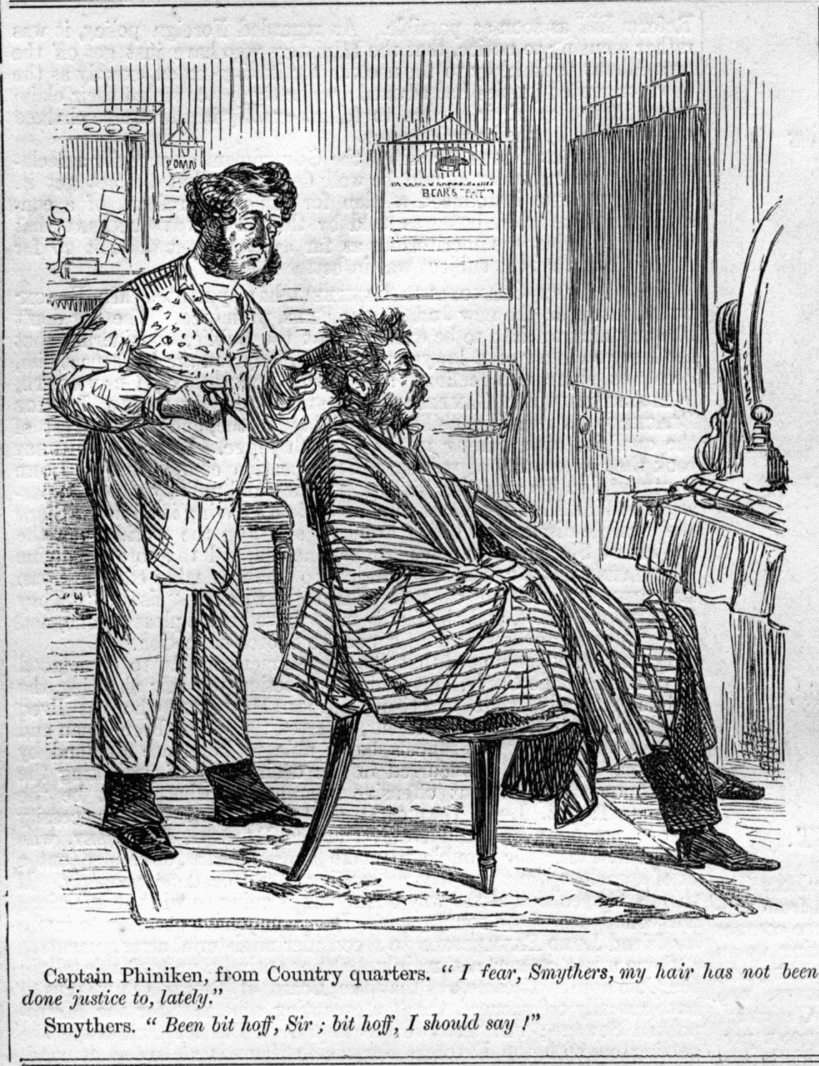
Far fewer are the forms that only Joe or only Magwitch use and that are also documented as characteristic of their local dialects. Like Pip, Joe says “meshes” for marshes,Footnote 22 and his “they [lies] didn't ought to come” (64; bk. 1, ch. 9; emphasis added) is close to the Kentish “hadn't ought” (Parish and Shaw). His use of “come”/ “put to it” (256/425; bks. 2/3, chs. 16/18) is also a recorded local version of standard come/put to do it (Parish and Shaw 176).Footnote 23 Very noticeable and easily recognized by all readers is the habit of dropping his hs: “The king upon his throne, with his crown upon his ed” (65; bk. 1, ch. 9), “Miss A or otherwise Havisham” (204; bk. 2, ch. 8). The reverse, hypercorrectly inserting an h at the start of words beginning with vowels, is seen as well: in the written word “HOUT” (90; bk. 1, ch. 13) and the spoken words “hup” (91; bk. 1, ch. 13) and “haim” (101; bk. 1, ch. 15), which referred to the most famous and commented-upon feature of non-standard pronunciation that was (and still is) found in most parts of the kingdom.Footnote 24 Magwitch's “taturs” for potatoes (317; bk. 3, ch. 3) and “alonger” for along of (319; bk. 3, ch. 3) also appear as local forms in Gepp's Contribution to an Essex Dialect Dictionary (7), and his frequently used “yourn” for yours appears in both Kent and Essex dialect dictionaries. By far the most interesting of his localized speech habits is the fact that he does not drop his hs. This is the clearest evidence we have from the novel that Dickens may have intended Joe and Magwitch to have locally separate and separable dialects, and (whether the distinction in this particular case was consciously informed or not) which must be seen as a tribute to his fine ear for local variations of pronunciation. For in spite of all the attention that was paid to this simple sound or, rather, to its absence in the dialects of most of England, h-dropping was not a feature of all dialects, and while Kentish speech dropped its hs, neighboring Essex speech did not.Footnote 25 (Figure 5)
Punch, or the London Charivari (July 9, 1895): 20. Nonstandard “bit hoff” for bitten off show two of the most commonly noticed features of nonstandard speech, an unconventional participle and the “hypercorrect” insertion of /h/ in the “wrong” place showing the speaker's awareness that he has a tendency to drop his “h”s.

We have seen that Dickens's representation of dialects through “simplified deviance” from the standard involved the selection of commonly found and easily recognizable forms from a broad region consonant with the geographical origins of his characters; the use of a very few forms are specific to the narrower locality of each speaker. This simplification involved ignoring many noticeable and well attested characteristics of local speech, like the Kentish “dat” and “dere” for that and there, and the Essex “sich” for such and “goo” for go.Footnote 26 In addition, both Kent and Essex speech were famous for pronouncing not just /v/ as /w/ but also the reverse, resulting in such forms as “ven” and “vat” for when and what. Although both Joe and Magwitch regularly and memorably use ws in place of vs, neither is shown to switch the sounds the other way round.Footnote 27
While some of their more extraordinary departures from the standard appear as pure comedy or fancy – Joe's “Architectooralooral” (203; bk. 2, ch. 8) and “unacceptabobble” (423; bk. 3, ch. 18), and Magwitch's “a molloncolly-mad sheep” (327; bk. 3, ch. 4)Footnote 28 – others might easily reflect genuine features of uneducated speech that were noticed and recorded in writings about local dialects. The amusing case of Joe reporting that his father died from “a purple leptic [apoplectic] fit” (43; bk. 1, ch. 7), for instance, rests upon documented speech habits:
Almost every East Kent man has one or two special words of his own, which he has himself invented, and these become very puzzling to those who do not know the secret of their origin; . . . Broad titus, for instance, would not easily be understood to mean bronchitis. (Parish and Shaw vi-vii)
These examples should be sufficient to show how Dickens presented both Joe and Magwitch as consistent speakers, with large amounts of directly reported speech convincingly (if somewhat generally) representing the dialects of Kent and Essex.
Additionally, Joe is presented as an authentic speaker of the first type, a man who has never lived away from his native, cut-off rural village,Footnote 29 and whose village, furthermore, belongs to that part of Kent considered the last bastion of “the true dialect of Kent” (Parish and Shaw vii). His habits as presented have never been substantially altered, polished, or varnished by education: he repeatedly insists that he is “most awful dull.”Footnote 30 In various and often subtle ways, he represents a nostalgic version of an old and pre-Industrial England. His iron-age occupation and great size provide him not only with almost mythic qualities, but also refer to a lost time in rural Kent, where cottage industry ironwork had previously been a mainstay but was now mostly gone, being superseded by work in paper manufacturing, shipbuilding, and the running of prisons.Footnote 31 The narrator refers to Joe, the forge, and Joe's speech in almost identical terms: “dear old Joe and the forge” (120; bk. 1, ch. 17), “[Joe’s] good honest face” (200; bk. 2, ch. 8), “the honest old forge” (248; bk. 2, ch. 15), “the dear old home voice” (423; bk. 3, ch. 18).
These associations combine with Joe's faithfulness in emotional attachments, his routines, and speech habits from which he does not deviate,Footnote 32 in short his marked reliableness, to create the reassuringly rock-like sense of an unchanging origin for Pip. To this origin the younger Pip will relate in conflicting and agonistic ways; from it, older Pip will have to separate himself if he is to develop (as an act of willed inauthenticity). He will have to accept it on his own terms if he is to mature fully, and he will only return to it as a visitor when he is able to pay his debts with money made abroad.Footnote 33 The narrator acknowledges this distinction between Joe's immutability and his own earlier need for change, saying “It was not because I was faithful, but because Joe was faithful, that I never ran away. . . . It was not because I had a strong sense of the virtue of industry, but because Joe had a strong sense of the virtue of industry, that I worked with tolerable zeal against the grain,” and contrasting the “amiable honest-hearted duty-doing man” that was Joe with the “restlessly aspiring discontented me” of his apprenticeship (98; bk. 1, ch. 14). Bearing in mind the importance to the narrator of Joe's solid unchanging-ness, we may look again at the repetition of the adjective “old” in the quotation given at the start of this section and in those of this paragraph, recognizing in it much more than just a modest (and typically Kentish) modifier.Footnote 34
Joe's many verbal repetitions and his own insistence upon repetition in his life (“On the Rampage, Pip and Off the Rampage, Pip – Such is life”; 105; bk. 1, ch. 15), imply stability of life and integrity of character; the emphasis on sameness that Joe himself makes (explicitly and implicitly) shows that it is just as important for him to feel rooted as it is for Pip to have him be rooted, and from this solid rootedness comes his overall authenticity. To the narrator he represents, unswervingly, the authentic dialect speaker and all that it stands for personally, nationalistically, and Romantically.
Magwitch's speech is, perhaps surprisingly, also consistent and true to his social and local origins. His speech characteristics conform to the dialect of Essex as described in nineteenth- and early twentieth-century records (see Halliwell). Like Joe, he does not mix his dialects, and he uses even fewer standard sentences than Joe, making him in this respect more of an authentic speaker than Joe. With a life of vagrancy behind him, one would not expect his speech to be taken as authentic in the first sense (ancient, rural, and unspoiled), rather his dialect could be seen as authentic in the personal sense of not pretending to be anything other than what he is. Whatever the case, we find that he is given his Essex characteristics as much as Joe has his Kentish markers, and he explicitly, and startlingly poetically, associates his knowledge of language with nature in the passage given at the start of this section. Further promoting the idea of Magwitch as a product of nature, he is frequently associated with the ground (one of his verbal characteristics from his London time is to call himself “low”) and even with the subterranean: readers first see him arising out of the marshes, or out of a tomb as Pip momentarily thinks, “soaked in water, and smothered in mud, and lamed by stones, and cut by flints, and stung by nettles, and torn by briars” (4; bk. 1, ch. 1); and when Pip first takes leave of him, he sees him among the nettles and brambles “as if he were eluding the hands of the dead people, stretching up cautiously out of their graves, to . . . pull him in” (6; bk. 1, ch. 1). Then he is seen fighting in a muddy ditch (33; bk. 1, ch. 5), later he remembers his origins as a varmint stealing turnips (316; bk. 3, ch. 3); this association of images extends even to his secret envoy, the returned convict carrying Joe's purloined file, who talks “principally about turnips” (70; bk. 1, ch. 10).Footnote 35 The association between food and the ground is delicately repeated in Magwitch's indelicate expression concerning his appetite: “I’m a heavy grubber. . . . If it had been in my constitution to be a lighter grubber, I might ha’ got into lighter trouble” (302–03; bk. 3, ch. 1). Conversely, we hear of him being pulled down under the Estuary waters, struggling under the surface and barely escaping with his life (406; bk. 3, ch. 15). Where Joe is rooted, Magwitch (we might say) is uprooted, but always on the verge of being sucked back down into the bowels of the earth; not surprisingly he says “I wish I was a frog. Or a eel!” (6; bk. 1, ch. 1).
Magwitch does not know where he comes from but his speech does. When we remember that his speech is being reported retrospectively by a mature Pip, we may say that Pip's giving an authentic dialect to this character is due either to an excellent memory for the long-dead criminal's Essex speech or to a desire to bestow authenticity on a man for whom he had developed a deep affection and whose daughter he loves. He may also be trying to pay his debts to the dead Magwitch, making up for his arrogant behavior to the returning Magwitch, by depicting the older man as an authentic character in terms of his reported behavior and speech. Narrating Pip works hard in the river and prison scenes to present to the readers a restituted Magwitch who is no longer either the terrible mud-spectre of the marshes, nor the grotesquely comic figure of his first days in London. He is never anything other than a rough convict whose crimes are so dreadful that he will not name them to Pip (302; bk. 3, ch. 1), but in the narrative he changes from a graveyard ghost of cannibalistic tendencies to a man whose approaching death brings to him a resignation so peaceful and patient as to be presented in dignified, almost sanctified, terms. Like Pip he remembers being a shivering scrap of a child out in the cold, unfairly punished, and misunderstood by adults; like Joe he is unable to fit convincingly into any costume other than his own workaday clothes, and he is similarly unable or unwilling to disguise his speech.
There are other similarities between Magwitch's speech and Joe's that remind us of the parallels created by the plot: both men in very different ways seeing themselves as surrogate fathers to Pip (Magwitch openly claims this relationship, while meek Joe never goes further than to assert that they are “ever the best of friends”), and both men supporting him financially; both men learn to read and write late in life, and, of course, they both love Pip. They are the only two characters that Pip has felt ashamed of, and he recognizes that he is more condescending to them than to any other character;Footnote 36 eventually he learns much from being ashamed of his attitudes and behavior towards them. In their speech they use parallel expressions: Joe calls Pip “dear chap”Footnote 37 (or “old chap”), and Magwitch, in the second half of the novel, calls him “dear boy”;Footnote 38 Joe's repeated assertion that he is “dreadful dull” has an echo in Magwitch's repeated apologies for “a being [sic] low.” As I have mentioned, many of their non-standard forms are shared. Finally, we can say that giving Magwitch an authentic dialect allows him to be remembered (by both the narrator and the readers) with a degree of the dignity invested by integrity and also presents him as a character type, the criminalized vagrant or varmint, that is by implication as much positioned in society, and as unchanging, as more fortunate figures like blacksmiths.Footnote 39 In fact it makes him the stylistic pair of Joe, for only these two characters in the novel speak so consistently and authentically in dialect, and at such length.
Magwitch and Pip could have been presented as speakers of mixed-dialects, since wherever people change their geographical, social, or educational situation, at least some of their language is likely to record that change. Within this novel's ficto-linguistics, however, Dickens chooses not to give Magwitch the corrupt or mixed-dialect speech that he could have done, using his language instead to associate him with Joe and to underscore his qualities of integrity and faithfulness that are necessary if the dedication of all his wealth to a child met many years before is going to make sense, and if Pip is to accept and love him as a father.Footnote 40 The best example of an inauthentic speaker that we have – best because both his character and the quantity of speech given to him provide us with sufficient evidence to be confident in our assessment – is Pumblechook.
Pumblechook's Vulgarisms
Mr. Pumblechook is a splendid example of a middle-class small-town merchant whose speech is presented as vulgar and ludicrous. The manuscript of the novel (referred to here as MS.) shows that the authorial changes and insertions made to his speech were frequently details that increased the vulgarity or pomposity of his speech style. His style of discourse exactly matches the 1826 description of the pedantic, awkward, and genteel vulgarian in VC. Its description of one class of speakers fits Pumblechook exactly:
Some persons are never at ease in society, except where they can take the lead, and assume the style of dictation. A man of this class, seeks . . . to impress others with a high opinion of his talents. . . .
He endeavours to engross all the conversation; he wishes not to hear remarks, but merely to be listened to and admired. If you oppose to him the slightest contradiction, he only speaks louder, and assumes a more decisive tone, and when no one replies he fancies everybody is convinced. (151)
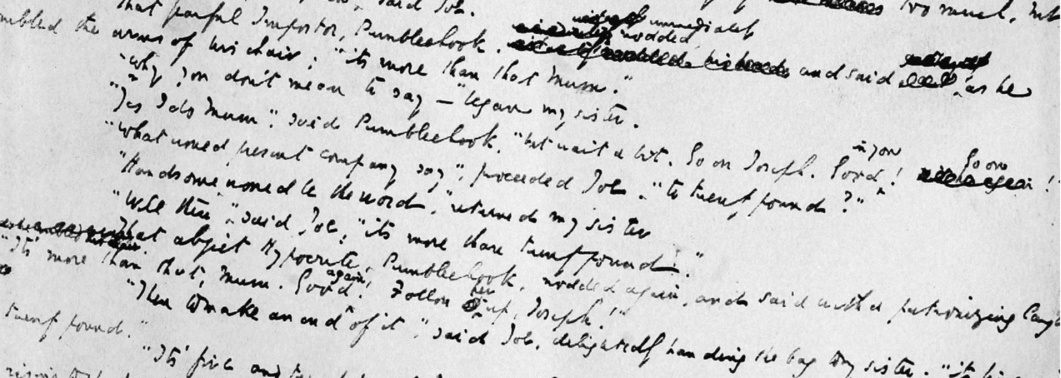
Pumblechook's pretensions are exposed in the content of his speech, which usually refers to money, food, or property (which VC calls “vulgar subjects of conversation,” 186ff.). He likes to dominate conversations in the ways described above, extending his sentences with repetitions and rhetorical questions, and is thus a very patronizing interlocutor. His self-elevation is reflected in his verbal habit of interrupting other people's speech with exclamations like “true again” and “you’ve hit it, sir!” (24; bk. 1, ch. 4), “good again” (28, 47, 94; bk. 1, chs. 5, 7, 13) (the “again” in the second of these instances being added above the line in the manuscript, MS. 60) (Figure 6), “Prettily pointed!” “Good indeed!” (47; bk. 1, ch. 7) (both added above some deleted words in the line, MS. 30), “follow her up” (47, 94; bk. 1, chs. 7, 13) (“her” inserted above the line, MS. 60),Footnote 41 and “Good in you!” (94; bk. 1, ch. 13) (“in you” added above the line, MS. 60). All are splendid examples of what VC describes as “the vulgarity of bye words” (16 et passim). His occasional slips into non-standard pronunciations and frequent grammatical solecisms, together with the use of (low status) shibboleth words, are sharp and sometimes comic reminders that he does not have the social power that his speeches claim for him, in spite of his proud ownership of a “shay-cart” (434; bk. 3, ch. 19). This last form is itself a shibboleth reflecting the speaker's lack of familiarity with French; it is catalogued as an “impropriety” in a pre-1852 tract:Footnote 42 “He keeps a chaise; pronounce it shaze, and not shay. It has a regular plural, chaises” (qtd. in Peabody 117).Footnote 43
Part of MS p 60 showing Dickens's insertions of the vulgarisms “in you,” and “again” (also an inappropriate/vulgar “her”) above the 4th and 9th lines from the bottom of the page.
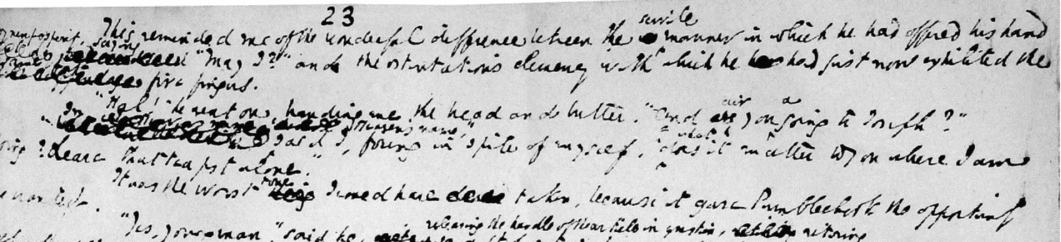
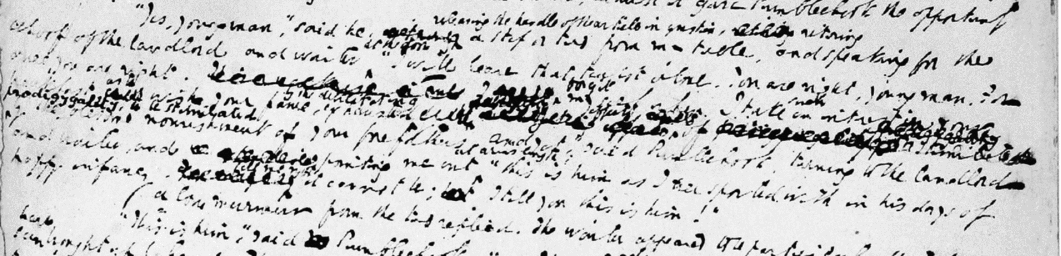
For Pumblechook's reported speech Dickens uses the rhetorical device of bomphiologia, the use of overly-inflated expressions for trivial or mean topics.Footnote 44 Within that, Dickens makes use of the same techniques and elements of non-standard speech that he gave to Joe and Magwitch, but there are fewer examples of these in total because so much less of his speech is reported. His speech nevertheless seems to be different from Joe's and Magwitch's because his pronunciation is, in the early volumes, rarely represented as non-standard and is everywhere in the novel mostly unremarkable, there being only seven types of phonetic vulgarisms in his speech, most of them instanced just a few times. Like Joe and Magwitch he demonstrates a local /ai/ or /ei/Footnote 45 pronunciation of words in <oi> – but just twice, in “biled” (26; bk. 1, ch. 4) and “pinted” (435; bk. 3, ch. 19). It is considered a grave fault, rather than dialectalism, in Peabody: “never say pi-son for poi-son” (136; bk. 1, ch. 19). Again like our two criminals he eliminates the glide sound before long /u/ in “gratitoode” and “ingratitoode” (435; bk. 3, ch. 19), a vulgarism commented on in most handbooks of the time (and earlier): called “an instance of the pedantic vulgar-genteel” by VC (12; also 102, 131, and 261) and a “vicious pronunciation” by Peabody (102). Loss of glide in the second syllable is also indicated in Pumblechook's “fortun” (141, 434; bks. 1, 3, ch. 19) and “picter” (140; bk. 1, ch. 19),Footnote 46 Peabody's tracts commenting about this pronunciation: “[d]o not pronounce creature creeter as is also often heard” (128).Footnote 47 Like Joe, Pumblechook occasionally says “air” for are (four times on 433–34 (bk. 3, ch. 19) (Figure 7), the first instance being altered in the manuscript from an original “are” (MS. 270); just once he is caught out dropping an h: “’olesome” (434; bk. 3, ch. 19). For farthings he uses an old form “fardens” (65; bk. 1, ch. 9) that had been noted as “vulgar” since the eighteenth century,Footnote 48 and he pronounces forget as “forgit” (434; bk. 3, ch. 19)Footnote 49 (an insertion above the line in MS. 270) (Figure 8) and unto as “untoe” (ibid.). Like all male speakers in this novel he can use the weak form “em” for them (151; bk. 2, ch. 1), but, like the dialect speakers, only he uses the contraction “d’ye” for do you (32; bk. 1, ch. 5), a form that is singled out for special opprobrium in VC and other handbooks (VC calls “d’ye” “very vulgar” (43), even while their writers admit that very many good speakers use contractions of this sort). Similarly, the spelling of “M’ria” for Maria (434; bk. 3, ch. 19) (Figure 9) may reflect no particularly vulgar pronunciation, or it may refer to the growing use of the “neutral” vowel sound /ə/ in unstressed syllables that is much disliked in nineteenth-century handbooks.Footnote 50 It is a measure of the relative scarcity of Pumblechook's pronunciation vulgarisms that they can be listed in a single paragraph; a full list of the types and tokens of low-prestige pronunciations indicated in Joe's and Magwitch's reported speech would require many pages.
Part of MS p 270 showing Dickens's insertions of “air” (in place of “are”) and “a” (to make “a going”) above the 4th line.
Part of MS p 270 showing “forgit” inserted above the 5th line, just after a heavily erased part; “prodigygality” inserted at the very start of line 7.
Part of MS p 270 showing “Georgianna M'ria” inserted over the long deletion.
The most regular grammatical solecism that Mr. Pumblechook falls into is the use of non-standard verbal forms and inflexions. Combining habits found in both Joe's and Magwitch's dialects, he demonstrates non-standard (local) past and preterite forms of strong verbs, replacing “see” for saw, “spoke” for spoken, and “took” for taken (62; bk. 1, ch. 9), “knowed” for knew (435; bk. 3, ch. 19) (called “incorrect and vulgar,” and among “ungrammatical vulgarities” in VC 35 and 203), and the “a-doing” and “a-going” participial forms,Footnote 51 which the manuscript shows to have been in one case an afterthought, the “a” having been added above the line (MS. 40: “what was she a doing of”). He exhibits the further “ungrammatical vulgarities” or “popular vulgarisms” (Görlach 78) of lack of concordFootnote 52 with “says you” three times (434–35; bk. 3, ch. 19), and “do” for does in the splendid vulgarism “you do not know it . . . but that man do” (ibid.), and many nonstandard pronominal usages, such as “them that.”
Pumblechook exhibits two very strange grammatical inversions with his question “What like is Miss Havisham?” (61; bk. 1, ch. 9) and his exhortation to Pip to “be forever grateful unto them which so did do” (that is, brought him up by hand) (88; bk. 1, ch. 12). These could be exaggerated cases of what Görlach calls a typically nineteenth-century attempt at “genteel syntax” (74). They are clearly examples of VC's “awkward vulgarities,” where “phraseology is particularly awkward, affected, and vulgar . . . [e. g.] ‘true it is’ instead of ‘it is true’” (49). Pumblechook's strange, twice uttered “founder of my fortun’s” may be another case – it certainly looks awkward enough.Footnote 53 The non-standard pronoun uses found in “them which so did do” (in place of “those who” or even “those that”) is a solecism that Pumblechook regularly commits and is another much-noted vulgarism in most handbooks of the time (VC discusses it on 210).
Vulgarisms also appear in Pumblechook's use of non-standard forms of common words, which contrast pointedly with his attempts at elevated rhetoric. He occasionally substitutes local and archaic forms for standard ones, like “ain’t” for isn’t (26, 46; bk. 1, chs. 4, 7),Footnote 54 a favorite bugbear of nineteenth-century handbooks of correct usage, perhaps (like other contractions) because it was recognized in the speech of the higher classes as well, and grammarians liked to warn their readers against bad usage that was commonly heard. The usages “afore” for in front of (139; bk. 1, ch. 19) and “howsever” for howsoever (62; bk. 1, ch. 9) are recognized as “pedantic vulgarities . . . words which have become obsolete, or nearly so” by VC (138). Pumblechook has one “flat” adverb, “he saw it plain” (435; bk. 3, ch. 19), another target for abuse and a diagnostic of the vulgar speaker as distinct from the genteel speaker, according to “A Word to the Wise” (qtd. in Peabody 85). Further, he uses the singular following expressions of quantity, for example, “five and twenty pound” (95; bk. 1, ch. 13), a usage singled out for criticism in “A Word to the Wise” (Peabody 124). These nonstandard usages are commonly found in authentic speakers’ dialects too, but the point here is that they are “uneducated” intrusions in a speech pattern that is elsewhere heavily marked as pretentious – as in his announcement that “This occasion shall not entirely pass without that affability [i. e., shaking hands] on your part” (142; bk. 1, ch.19), which is a fine example of the “vulgar-genteel” fault of “affectation” (VC 9).
Pumblechook's most noticeable vulgar intrusions include four out of the five sorts of lexical vulgarisms listed in Görlach (39):Footnote 55
• “garbled pronunciations and confusions of Latinate words” (called “pedantic, learned or affected vulgarities” in VC). Pumblechook provides one fine example of each of these, being “with respections to [this boy]” (88; bk. 1, ch. 12), and “prodigygality” (434; bk. 3, ch. 19) (Figure 8); Dickens inserted both of these utterances above their lines of writing in the manuscript (MS. 56, 270);
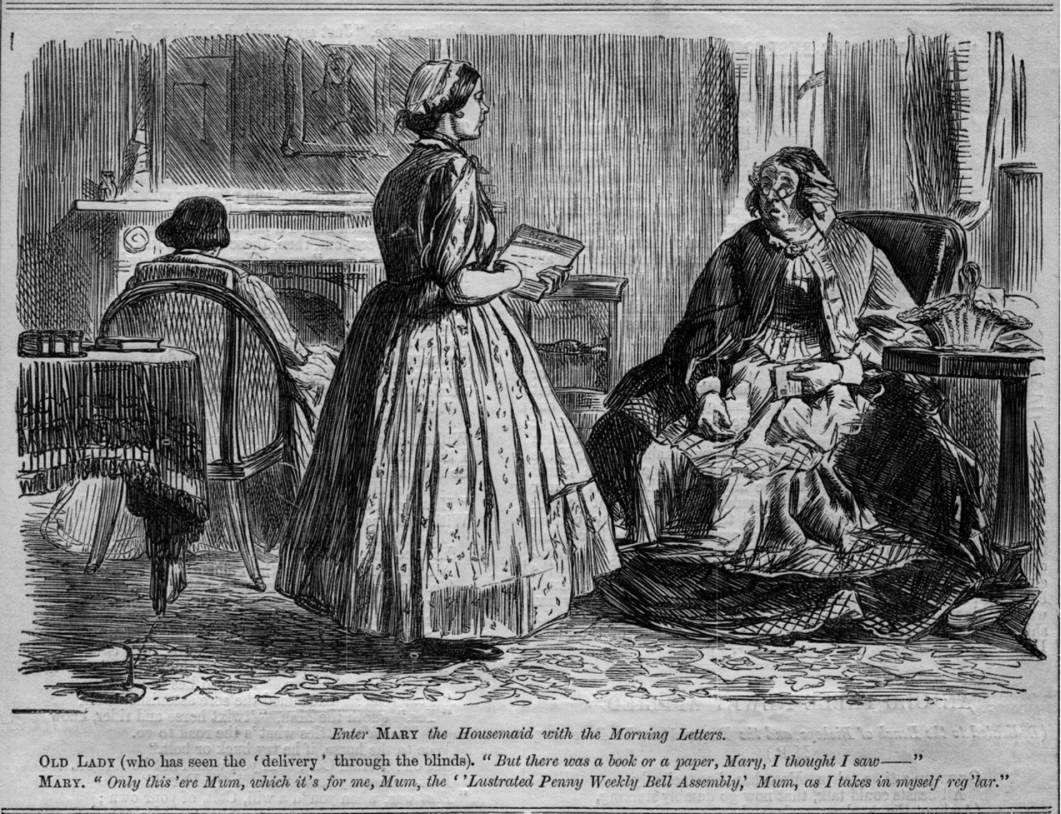
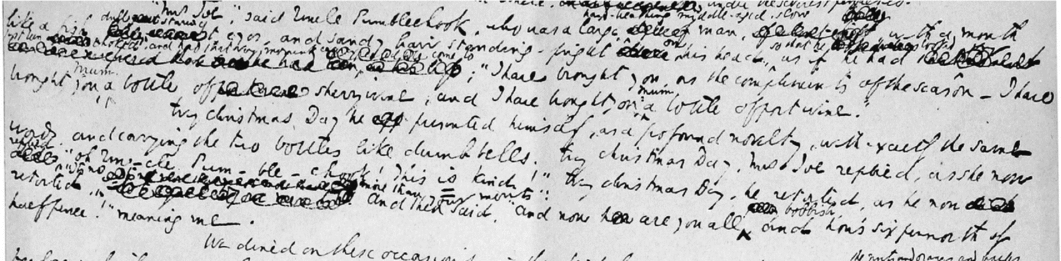
• “the lexical choice between synonyms misleadingly classified as ‘U’ and ‘non-U’.” For example referring to Mrs. Joe as “Mum” (no less than seventeen timesFootnote 56) and using “Sir” as an apostrophe in exclamations while Joe or Pip are incidentally present and thus apparently being addressed (24, 60, 140, 434; bks. 1, 1, 1, 3, chs. 4, 9, 19, 19) – these are inappropriate appellations for one who calls him “Uncle,” another to whom he usually refers, patronizingly, as “Joseph,” and a third previously addressed as “boy.” (The first two instances of “Mum” are inserted above the line in the manuscript (MS. 14) (Figure 10) and thereafter they are parts of the running (first version) text. On one occasion “Sir” has been added in the print version where it does not appear in the manuscript (GE 24, MS. 16; bk. 1, ch. 4)). “Mum” and “Sir” are appellations used by the shopkeepers, cabbies, porters, and household servants in Punch cartoons of the period, and never by the prestige classes (Figure 11). Pumblechook's habit of calling Pip “boy,” not in itself vulgar, nevertheless links him with the rough or insulting behavior of pre-transported MagwitchFootnote 57 and Estella, who also do so, and with shopkeepers like Mr. Trabb who have “boys” in their employ; in two instances of Pumblechook's reported speech it appears as an afterthought of Dickens’s, in insertions above the line on MS. 31 and 39 (GE 49 and 61; bk. 1, chs. 8, 9);
Figure 10.Punch, or the London Charivari (Nov. 23, 1861): 213. One of many nineteenth-century illustrations showing menials addressing higher class women as “mum.”
 Figure 11.
Part of MS p 14 showing Dickens's insertions of the vulgarisms “Mum” and “bobbish” above the 4th and 8th lines.
• “Genteelisms.” For example “you’ve hit it, Sir!” (to Joe) (24; bk. 1, ch. 4), “We’ll do our best endeavours” (27; bk. 1, ch. 4), “my little all” (139; bk. 1, ch. 19), and, possibly, “Sherry wine” (22; bk. 1, ch. 4);Footnote 58 and
• “slang and cant characteristic of informality, in-group use and expressiveness.” For example “Good in you!” (94; bk. 1, ch. 13), “bobbish” (22; bk. 1, ch. 4), “Sixpennorth of halfpence” (ibid.), “to put salt upon their tails. . . . A man needn't go far to find a subject if he's ready with his salt box” (24; bk. 1, ch. 4), “a squeaker” (25; bk. 1, ch. 4), “let's have a cut at this same pie” (27; bk. 1, ch. 5), and “thanks of fortune” (139; bk. 1, ch. 19), to put forward a few of many potential examples.Footnote 59 Among these the following were inserted above the original lines of writing in the manuscript: “bobbish” (14), “put salt on their [tails],” “if he's ready with his salt box” (both on 16), and “same” as in “let's have a cut at this same pie” (17).
Many more of his expressions would have been recognizable as genteelisms or similar markers of vulgarity in 1861, if the handbooks of correctness accurately reflect Dickens's audience's sensibilities. As they are no longer considered in that light, we cannot now easily identify all of the vulgarisms that would have so greatly entertained Victorian readers. The narrator's ridicule or his repetitions may signal an example, though, as in his comment on the currently unremarkable phrase “in the lap of luxury . . . as Pumblechook might have said” (GE 164, bk. 2, ch. 3),Footnote 60 which indicates that it was seen as ludicrous or perhaps vulgar by Dickens and his readers. Other phrases which seem simply odd to us now may also have been noticeable to the first readers; any strangeness in Pumblechook's speech may have been interpreted as part of his overriding pretentiousness and affectation. Such phrases might include addressing “Joseph and Wife” (95; bk. 1, ch. 13), and, later and more peculiarly, “Squires of the Boar” and “William which his father's name was Potkins” (435; bk. 3, ch. 19) (Figure 9).
Nineteenth-century handbooks of correct and incorrect usages are helpful in identifying attitudes to language that have since altered. As noted earlier, VC provides examples and descriptions of different types and tokens of vulgarism that are exceptionally close to the language that Dickens gives his vulgar characters. Many of the vulgarities in this handbook can be found in Pumblechook's speech and most elements, perhaps all elements, of Pumblechook's speech style can be found described in VC.
In addition to the “vulgar-genteel,” “affected speaking,” and “awkward vulgarity” that have been noted, we find in Pumblechook's speech “mercantile phrases [that] have become no less common than vulgar” (VC 143) like “the market price of the article” (25; bk. 1, ch. 4), “market” being inserted above the line in the manuscript (MS. 16). His “awkward” and self-important use of repetition (VC 54) may be seen in “I have brought you” . . . “have brought you, Mum, a bottle of sherry-wine – and I have brought you, Mum, a bottle of port wine” (22; bk. 1, ch. 4), his listing of the “goods” he has brought being as well mercantile in tone. He uses at least one expression castigated as “shopkeeper's slang” (82) in Hotten's 1860 Dictionary of Modern Slang, Cant, And, Vulgar Words: “she ain't in that line” (46; bk. 1, ch. 7; emphasis added).
There are also in his speech “vulgar topics of conversation,” both “trivial” and “disgusting” (VC 196): the whole of the conversation prefaced with “Look at Pork alone. There's a subject! If you want a subject, look at Pork!” (24; bk. 1, ch. 4). The “low” inclusion of “minute circumstances of no importance to the subject talked of” (VC 198) is exemplified by “I will tell you what to say to Joseph. Here is Squires of the Boar present, known and respected in this town, and here is William, which his father's name was Potkins if I do not deceive myself” (434; bk. 3, ch. 19). We find, too, the “continued repetition of meaningless questions” than which (says the author of VC) she or he “know[s] nothing more offensive” (50): “If you had been born such would you have been here now?” . . . “Would he have been doing that?” . . . “And what would have been your destination?” (25; bk. 1, ch. 4).
Pumblechook is supremely guilty of the “vulgarity of Egotism” (VC 187): “I am one of them that always go right through with what they’ve begun,” “I said I’d see to it,” and “that's my way” (all on p. 95; bk. 1, ch. 13); “as I said when my opinion was asked” (inserted above the line in the manuscript, MS. 60); and “to think that I should have been the humble instrument” (139; bk. 1, ch. 19). VC would call this latter example “false modesty.” Pumblechook also practices “the vulgarity of proverbs and proverbial expressions” (104), with utterances like “a pleasure's a pleasure, all the world over” (95; bk. 1, ch. 13) and the “put salt on their tail” expression, which comes from a proverbial way to catch animals (GE 461n). Further, his conversation is full of clichés like “compliments of the season,” “to tell you the truth” (22; bk. 1, ch. 4), “the humble instrument” and “my little all” (139; bk. 1, ch. 19), and phrases like “never mind me” (9; bk. 1, ch. 2), which, VC points out, always mean the opposite of what they say and are both hackneyed and egotistical. These examples come mostly from Pumblechook's earlier appearances in the novel, and they could be augmented with many more from the rest of his speech. Every sentence he speaks is vulgar through and through, in the terms of Victorian handbooks on correct speech.
As a final example we may consider this rich utterance in terms of VC's comments: “But do I . . . see afore me, him as I ever sported with in his times of happy infancy?” (139; bk. 1, ch. 19). First of all, it is one of Pumblechook's repeated and unnecessary questions; secondly, it is entirely egotistical; thirdly, it contains the “vulgar archaism” afore; fourthly, we find “as” in place of “that” or “who” (an “ungrammatical vulgarity”); fifthly, it has an awkward and affected word order (the vulgarities of pedantry and affectation); sixthly, it has the vulgar-genteel and hackneyed phrase “sported with” in place of “played with”; and in seventh place, most vulgar of all in the terms of VC, it is a lie (the ultimate in “Vulgarity of Content”). There are more and different examples of vulgarities in Pumblechook's speech to be found but the preceding examples and discussion should suffice to make the point that with this character Dickens created a speaker whose discourse provides a magnificent display of vulgarity in its many forms.
Both in behavior and in speech, then, Pumblechook proves to be an inauthentic character. The overall pretentious, over-inflated, and ludicrous effects of his vulgarisms are increased by association with the narrator's comments that seem to pick up on Pumblechook's way of speaking (and exaggerate it) when talking about him, as if by infection: his elbow and parlour are “Pumblechookian” (23, 106; bk. 1, chs. 4, 15) (a coinage too delightfully Dickensian to be ignored), his premises are “of a peppercorny and farinaceous character” (48; bk. 1, ch. 8), and he eats “in a gorging and gormandizing” fashion (50; bk. 1, ch. 8). Some shifts into the Pumblechookian register imply free indirect reporting of the man's words themselves: “Mr Pumblechook was in favour of a handsome premium for binding me apprentice to some genteel trade – say the corn and seed trade, for instance.” Others present a parodic irony: following Pip's own curt and colloquial advice “wait a bit,” we are told that “[t]he united vastness and distinctness of this view so struck him that he no longer asked if he might shake hands with me” (141; bk. 1, ch. 19); and Pip's early arrogance soon after learning of his great expectations leads the narration of his thoughts to take on Pumblechook's habit of commenting on other people's expressions with “Good” and “prettily pointed!”: “‘Well deserved, well deserved!’ [said Pumblechook.] This was coming to the point, and I thought it a sensible way of expressing himself” (139; bk. 1, ch. 19).
The contrast between the authentic speech of Joe and the inauthentic utterances of Pumblechook can be summed up in the differences between the ways they address Pip: differences between the former's affectionate and recurring “old chap” (later alternating with a respectful “Sir”) and the latter's change from the abrupt “Boy!” to an unctuously intimate “my dear friend” and “my young friend” and thence to the distancing “young man” of his last reported speech. Even more clearly, it can be seen in the stylistic difference between what in his Preface to Lyrical Ballads Wordsworth called “simple unelaborated expressions” and “social vanity” (245): Joe characteristically saying “What Larks!” (GE 423; bk. 3, ch. 18) and “Ever the best of Friends” (44; bk. 1, ch. 7, et passim), and Mr. Pumblechook lying in this pretentious description of Pip as “him as I ever I [sic] sported with in his times of happy infancy” (139, 434; bks. 1, 3, chs. 19, 19).
Pip: The Key to the Ficto-Linguistics of Great Expectations
As both narrator and protagonist, Pip's language attitudes are the key to the internal linguistic system of this novel. These attitudes necessarily affect the way that, as the older, narrating Pip, he reports the speech of his character. The ficto-linguistics of the novel displays Pip's language attitudes as much as it displays the language usages of reported speakers. That is, how Pip narrates speech tells us how Pip finally judged his characters, and this necessarily includes how he judged his own, younger self. The same could be said of the implied author, the “Dickens” behind Pip's narrative, who is judging the narrator himself through the language he gives to him, about which more will be said later.
Young Pip's dialect is reported as standard speech with only occasional and very rare dialectal words and sentences. I found only ten instances of non-standard forms in his speech;Footnote 61 his most dialectal spoken sentence is “You’ve been lying out in the meshes and they’re most dreadful aguish” (17; bk. 1, ch. 3). His precocious and unconvincingly standardized speech (albeit often reported indirectly in the first volume) has been criticized by commentators, much as was the speech of Oliver Twist (e. g., by Lewes in 1837; qtd. in Collins 68); more recent critics have noted that the strongest evidence we have of the way young Pip “really” spoke, or must have spoken, comes from his letter to Joe in volume one.Footnote 62
Most of the speech of very young Pip is indirectly reported and is therefore in the voice of the narrating Pip. Free indirect reporting of both speech and thought allows for all shades of compromise between the characters of the narrator and the narrated speaker. Even when Pip's speech is directly reported, the older, narrating Pip's voice creeps in – sometimes inappropriately, sometimes amusingly, and sometimes poignantly – presenting a degree of inauthenticity. When Pip admits to Joe that he had lied about the velvet coach and the veal cutlets and reveals that he has been made to feel his humble social position most cruelly, he tells Joe “I am ignorant and backward” and “I have learnt next to nothing, Joe. You think much of me. It's only that” (64; bk. 1, ch. 9). Here little Pip is made to speak in narrating Pip's standard English; furthermore, he is using the older Pip's viewpoint. However aware of his own educational shortcomings this child was, those same shortcomings would have rendered him unable to express himself in these words.Footnote 63
The incongruity between the child's perceptions and the often exaggeratedly learned sentences that are used to report them, resulting in a complicated pattern of sudden changes from simple to elaborated registers of language, is a characteristic feature of Dickens's style. Quirk, citing Orwell, praises Dickens for his sensitivity in having his first person narrators “compromis[e] in language . . . between the maturity at which they write and the immaturity of which they write” (26), noting separately that Dickens used free indirect speech to suggest (among other things) “the impact of one character upon another without either the clumsiness of explanation or the delay and cumbersome loss of continuity that would be entailed if this were done by making the second speak his reaction” (32). This is a concise description of how Dickens uses the reported speech (as well as the free indirect reported speech) of his narrator and characters in this novel and particularly of the relationship between the younger manifestations of Pip and his narrating self. In the indirect reporting of speech and thoughts a tinge of the indirectly reported voice and mindset is allowed to flavor the style of the reporting voice, and – less discussed but equally importantly – something of the reporting voice and mindset can be reciprocally attributed to the reported character. Thus younger Pip's perceptions often take on the maturity of the narrator's words and understanding, while the narrator's words express observations from or about his younger viewpoint. In Dickens's first-person narratives there is the further complication of readers’ familiarity with their author and their knowledge that it is Dickens, creator of other famous novels, who has given words to his narrators; if narrating Pip's discourse style leaks into little Pip's language, then isn't Dickens's discourse style also perceived to leak into that of his narrators? Similarities between the style and humor of invisible narrating Pip to that of other narrators, including Dickens's third-person narrators, encourages a close identification between the implied character of Pip the narrator and that of the biographical, real Charles Dickens at this textual level. Dickens himself was praised or criticized for the demotic, or vulgar, speech of his novels, not his characters or narrators.
The result of Pip's edited (mostly standardized) speech and these leakages between narrative levels in Great Expectations is that the speech of very young Pip, whose character is that of an authentic young village boy, is dishonestly narrated as mixing a few dialectalisms into a highly standardized language, making him an inauthentic speaker when compared, for instance, with Joe (and we may note here how well this narrator's dishonesty agrees with or is reflected onto little Pip's concerns about lying and his overriding sense of guilt). The London Pip, whose mismatched social ambitions and village childhood give him the ideal profile for a producer of vulgarisms, is, in contrast, misleadingly reported as speaking an unmixed, completely standard English, as will be discussed below. Another effect of the inappropriately sophisticated language used by the narrator to describe little Pip's life, this time a cumulative one, is that because very young Pip seems (largely by association with this indirectly reported speech) to have always been able to express himself in a standard language, his directly and indirectly reported speech of volumes two and three do not appear at odds with his earlier (under-reported) dialect.
On accepting the conditions for receiving his “expectations” that Jaggers puts forward to him in Joe's parlour, Pip is enjoined to get a new set of clothes before coming to London; but when he gets there he realizes that the very best efforts of Mr. Trabb are still inappropriate for a young gentleman in London. Among the tradesmen's cards that Jaggers has given Pip to guide him in his necessary purchases is one for a tailor. As part of his new education he has to learn other class attributes like how to eat, how to employ a servant, and even how to run into debt. We see his first clumsy gestures at table with Herbert gently guiding him, and the narrator tells us that he was soon dressing very finely, including a dressing gown with a flowered pattern that makes Joe's eyes go “round and round” during his first visit to Bernard's Inn (201; bk. 2, ch. 8). His awkwardness with an altogether unnecessary and overdressed servant (the Avenger) is described in comic terms, and his debts are elsewhere spread out on a table for the reader to survey. Pip is learning his social skills through trial and error. Not so for speech, however.
We are not told if, when, or how Pip learns to speak like a gentleman. Once Pip has arrived in London we hear no more non-standard utterances from him. This is a notable exception on two counts: first of all, as a narrator the older Pip (and Dickens too) glories in the idiosyncrasies of all his other characters’ speech habits, making a world densely populated by ficto-linguistic data (in other words, this is a very polyphonic and heteroglossic novel). Pip is the only main character not to have a highly distinctive voice; even the less prominent characters Herbert and Drummle have more individualized speech habits than him. Secondly, as previously indicated, we have plentiful evidence that the ways people spoke and dressed were the two most prominent, discussed, and noted markers of class position (Adams 57 and 60). Conduct books of the time were fierce in ruling that correct dress and speech were the most important of all attributes of manner for the aspiring lady or gentleman.
The intermediate and therefore mixed, corrupt, and possibly vulgar speech style that Pip would have used in his early London months or years while he was acquiring the standard speech is completely unreported. In his directly reported speech he is (as far as a present-day reader can ascertain) never shown to utter a vulgarity nor is his reported speech corrupt: no charge of inauthentic speaking can be brought against the London Pip, although the narrator (and possibly the implied author) might well be guilty of inauthentic reporting.Footnote 64 The only indication given that Pip is changing his accent comes from Trabb's boy, with his mocking parody of what seems to be a snobbish (or high-prestige) pronunciation of you: “Don't know yah!” (225; bk. 2, ch. 11). This happens a few months after Pip has been learning from Herbert and Mr. Pocket; Pip has already become conscious that Herbert “carrie[d] off his rather old clothes much better than he, Pip, carried off [his] new suit” (163; bk. 2, ch. 3). This observation should most likely be understood as extending to the two young men's modes of speech, too.
Never mentioning his efforts to change the way he spoke is sleight of hand by the narrating Pip who, in spite of a painful honesty about his lack of integrity towards old friends and about his raw arrogance in more prosperous days, does not wish to, or is unable to, remember himself exactly as he expressed himself to others. All his efforts to improve himself educationally, from early youth onwards, would have made him familiar with the standard written grammar and vocabulary, but until he went to London nothing he read could have aided him to acquire an easy familiarity with the speech patterns of the educated classes, and especially with the pronunciations that he rarely or never heard (what we know of Wopsle's speech does not lead to confidence that he was a good model, and only in Satis House would Pip have heard upper-class pronunciation). Neither could books, not even guides to correct speech, have informed him about the lack of prestige of all the many expressions and turns of phrase he came across every day. These were things he had to learn from the Pockets and his new circle of friends.
There is a direct connection to be found between the veiling of Pip's speech blunders in his early London period and Dickens's assertion about himself that, “even during his time working alongside common boys, ‘my conduct and manners were different enough from theirs to place a space between us. They, and the men, always spoke of me as “the young gentleman”’” (qtd. in Douglas-Fairhurst xii).Footnote 65 As Grass says, Dickens “never ceased to be the anxious and unhappy child: too aware of poverty, too fearful of his secret vulgarity” (9). His Pip, both as a growing child and as a mature narrator, would seem to be the same. Is this, then, the meaning of Pip's own speech style as a character, speech which is unconvincingly reported in much of the novel, with an individualized voice coming out only with those nine small exceptions from the earliest pages?Footnote 66 Might the incongruously learned language of passages narrating a village childhood, and the remarkably immediate removal of any nonstandard or local usages from his speech the moment he arrives in London, be fake, all part of the grown up, narrating Pip's continued desire to distance himself from any language with “low” or criminal connotations – just as he claims not to know the meaning of Orlick's phrase “I’ll be jiggered,” which he most likely did know?Footnote 67
Narrating Pip does not describe himself directly as he does the other characters. We build up a sense of his character through the ways in which he describes the characters and events in his story, and through his language. This is consistently a standard written dialect, modified for artistic purposes, or it is his literary English. Through his multi-vocal, many-layered virtuoso performance he shows his successful acquisition of the most demanding of styles attainable by the educated classes. It is possible, however, that Dickens has encoded within this narrator's work, indications that this is not exactly the high prestige discourse that a “true gentleman in manner” (166; bk. 2, ch. 3) would use, for the narrator is not an aristocratic gentleman, educated as such from the cradle; he received a late and restricted formal education (for his village school experience is described as negligible), supplemented it with a habit of daily reading, and became a businessman and, later, a writer.
Davies argues that “Great Expectations is a businessman's tale written in appropriate language” – and he points out that the language of business is not a gentleman's language (96–97); his discussion relies on a restricted definition of what was meant by “gentleman” at the time and in the novel, and on a lack of distinction being made between a narrator's written language and what might be his spoken performances. Davies's understanding that no “‘real’ gentleman because of birth” (96) would be concerned with the matters that interest small businessmen openly admits that it refers to only one definition of gentleman, the feudal or caste-based. This is a definition that would not be relevant to Victorian readers or writers of self-help language handbooks, who knew that education could make a working man into another sort of gentleman, as in the case of the famous scientist Faraday, for instance. Pip started off wanting to be, or to have, the attributes of the first sort (which is why Biddy advised him against it), and that is what Magwitch wanted for him, too: he was to be brought up as if his status was inherited, “as a gentleman – in a word, as a young fellow of great expectations,” as Jaggers says (125; bk. 1, ch. 18).Footnote 68 He was to be endowed with “the things which money can buy – education, accent, fine clothes – [which] are the attributes of a gentleman” and which are enough to give a man an “advantage over his fellow men” (Calder 27). He ends up as the second sort, however, as something in between Wemmick (who also migrated from a craftsman's background into office work) and Jaggers (who has the attributes of clothes, language, and education), who works for his living but whom the narrator refers to as a “gentleman” (sometimes as a “strange gentleman”) throughout the novel.
The quibble about gentlemanliness aside, Davies's observation that narrating Pip frequently resorts to terms related to the world of business and trade is thought-provoking, implying as it does that he is guilty of something as inauthentic as the mercantile vulgarisms of Pumblechook. On examination, however, the business-related terms like “I entertained this speculation” that Davies has drawn attention to and that are said to be frequent in the narrator's written discourse are found not to belong to the same category of stylistic intrusions as Pumblechook's bombast and blunders. They are easy to miss because they are not humorous and are perceptually overshadowed by the more grossly exaggerated examples of verbal play to be found in their vicinities. Most of the examples that Davies finds “commercially suggestive” were never restricted to the business world, according to the citations provided by the OED (“assign,” “secure,” “consideration,” “addition,” “to take note” (9)), nor are they so restricted now. Furthermore, none of these examples is used in a business sense in the novel, apart from one instance of addition meaning bill or “invoice” (225; bk. 2, ch. 11). Other expressions that are argued to refer to Pip's habituation to the business world, such as Miss Havisham's “referring back” to Estella's letters as if to business correspondence, are even harder to accept as linguistic identifications of a businessman's rhetoric. Interpretations can differ, however, and nineteenth-century readership may have found louder echoes of business language in this discourse than we do today. Nevertheless, in my opinion they are unlikely to have judged as vulgar the inclusion of these terms into the narrator's writing, because of these words’ general and non-business use elsewhere and because of important differences between the conventions of spoken and written language. Writing looks to quite other models from those applicable to conversation styles. Indeed, VC implies the necessary differentiation between the discourse types when it castigates speech guilty of sounding like or quoting from books or borrowing from professional jargon: “book speakers” model their pronunciation on spellings (13), affected pedants quote from books or the theatre (140, 142), and professional pedants use in their speech favorite expressions from their habitual work vocabulary (143). In the written medium, however, correct spellings are different from pronunciation, books and the theatre do have distinctive styles that are quotable, and for all texts writers use the vocabulary appropriate to their texts, which in the case of Narrating Pip is the elaborated and heteroglossic lexicon of realistic fiction.
We have seen that London Pip does not include any non-standard or vulgar elements in his speech. There remains the question of whether as a narrator he is guilty of vulgarity in his own (non-dialogue) written language, partially addressed in the preceding paragraph, especially perhaps in his frequently inflated language, and in his direct and indirect references to literature. These could be seen as the self-made man showing off his verbal skills and gentlemanly education. For the first of these, a contrast between the narrator's elevated rhetoric and the everyday things to which it is applied is notable from the earliest pages and has been commented on above. Such narrative voices are everywhere encountered in the novels of Dickens and are a characteristic feature of Dickens's fictions: a great ironic distance between subject matter and narrative style is one of the major sources of enjoyment in reading a Dickens novel. He is evidently conscious of the borderline between humor and pretentiousness, emphasizing the humor of pretentious written styles in his satire of small-town journalism (especially in the local newspaper report about the “young artificer in iron,” 211; bk. 2, ch. 9) while at the same time allowing his narrator to use it for comic effect. The humorously inflated narrative language of many passages in Great Expectations amuses the reader as it appears also to amuse the narrator, for it is a very self-conscious irony, even a self-parody or self-satire, where the older narrator is patronizingly and poignantly presenting his younger self's limited world view, in which he (young Pip) takes himself too seriously, using phrases like “[t]he felicitous idea occurred to me,” “[i]n pursuance of this luminous conception” (66; bk. 1, ch. 10). Even while they show off the narrator's hard-gained education and the distance he has travelled in terms of learning, such expressions cannot be intended as a reflection of the narrator's conversational habits, for no directly reported speech of educated Pip takes on this style or hints at it;Footnote 69 these expressions reflect a written humor only. Uttered in conversation and without being signalled as having a comic intent (expressed through intonation), they would be gross vulgarisms of a Pumblechookian kind. In the medium of writing, however, and especially in literary writing, stylistic play of this nature is not only tolerated but encouraged. I would argue, then, that the narrator's written bomphiologia was mostly presented and generally received as stylistic versatility and humor, not as inauthenticity or vulgarism.
Discourse mixing in the form of quotations and allusions to literary works is also found in the narration of Great Expectations. The narrator of this novel, whose first literary guide was the church reader and amateur actor, Mr. Wopsle (99; bk. 1, ch. 15), quite frequently quotes from or alludes to English literature, the Bible, the Book of Common Prayer, and several other well-known writings. According to the quotations and allusions identified in the notes of recent editions of this novel, Shakespeare is his primary resource, with fifteen direct references identified by present-day editors, counting as just one the long “Denmark” passage where Pip and Herbert see Mr. Wopsle acting in Hamlet. The Bible and Book of Common Prayer provide the next most numerous allusions (ten), and then there are references to figures from the ancient Greek and Roman myths and legends (in total, nine). On six occasions Pip the narrator alludes to the popular theater, a children's collection of tales, popular songs, and ballads. In addition, he makes direct and sometimes indirect allusions to a scattering of other well-known English literary works: Milton's Paradise Lost and Collins's Ode twice each, and once each to Thomas Browne, Byron, Grey's Elegy, “Monk” Lewis, Mary Shelley's Frankenstein, Tennyson, Thompson, Sheridan, and even to the newly published writer of fiction, George Eliot. There are individual references also to works by Darwin, Rousseau, and Townshend. This number of literary references does not seem excessive for a novel of over four hundred pages. Many of them are fairly subtle allusions, such as the similarity of the wording in a passage by Thomas Browne to narrating Pip's amusing reference to the death of Mr. Wopsle's great aunt (who “conquered a confirmed habit of living” [111; bk. 1, ch. 16])Footnote 70 and the parallel between the conclusion to Paradise Lost and the revised ending of this novel. Pip could have become familiar with the majority of these sources during his years of reading and studying at the forge. His studying and regular reading habits at and after Mr. Matthew Pocket's establishment have added only a minority of the literary and learned allusions in the narrative, because nowhere does narrating Pip quote from the “foreign” matter found among the hundreds of books in his bookshelves (292, 310; bks. 2, 3, chs. 20, 1). Most notably, there is no use of Latin or Greek, signs of the Victorian gentleman's education, anywhere in this narrative.
In conversation, frequent quotations comprise the vulgarity of pedants, according to VC, and Thomson and Grey are, readers are warned, without fail quoted by the pedant fond of “trite quotation” (VC 140–41). On the other hand, quotations can be “usefull [sic] as well as elegant, when judiciously selected and appropriately introduced” (141). Narrating Pip is not a vulgar pedant in these respects: he may be proud of his literary learning, but he does not quote from it in conversation, and he recalls being made particularly uncomfortable by the request to read to Magwitch in a “foreign language” (310; bk. 3, ch. 1). This dislike of showing off his reading even when he was at his most unbearably snobbish is consistent with the older narrator's restraint in the frequency and choice of his quotations: they are well spaced out and mostly from commonly read sources. In his quotations, narrating Pip is, like Charles Dickens his author, a writer who strives to speak to readers of most social classes. He never quotes in a foreign language, and, anyway, he quotes only from English sources or works translated into English. His classical references sit lightly in the text and are not abstruse. A reader who does not recognize a quotation or allusion in Great Expectations will not find that the meaning of any sentence or passage is rendered obscure; they are, indeed, elegantly presented, “judiciously selected and appropriately introduced.”
A first implication of the written style of narrating Pip is not so much authenticity as authority – by taking complete control of the language of so many different speakers and speech styles, narrating Pip shows that he has complete control over his own story and over all the other speakers in it. The man who can write an amusing phrase like “ophthalmic examination” as a humorous variant of “a poke in the eye” is far from both the child who speaks the local dialect and the slightly older “poor dazed village lad” (117; bk. 1, ch. 17) who uses local expressions like “keep company” (120; bk. 1, ch. 17) for courting, and “turning to at it” (114; bk. 1, ch. 17) for studying. Excessively wordy utterances like “Uncle Pumblechook's premises . . . were of a peppercorny and farinaceous character” (48; bk. 1, ch. 8) bring to the reader the entertainment of mimicry and parody, and it has been argued here that there is also a degree of self-parody in the narrator's enjoyment of such sentences. Pip the narrator's use of literary devices and rhetoric in his literary work is neither vulgar nor inauthentic.
Conclusion
The categorizing of Victorian attitudes to dialect through their concerns with authenticity revealed two main ways in which non-standard and dialect speech could be approved of, one relating to the authenticity of origins, the other relating to the authenticity of being true to one's self. These are seen to reflect major trends in developing conceptions of authenticity, an older one relating to authorization (harking back to a master narrative of some kind, e. g., ideals of divinely ordained social order or national purity), and a Rousseauian one evoking “a return to nature [that] could be found within everyone” (Sanchez-Arce). The nineteenth century and Dickens within it seem to have accepted both, and sometimes to have merged them, for instance in associating authenticity with uneducated, non-mobile, older, rural characters like Joe. The dialect usages of the four major characters investigated in this essay show Joe and Magwitch speaking in the consistent, non-standard, and unmixed dialects that could be correlated with, or could even signal, these authenticities: both authenticities being applicable to Joe's character, mostly Rousseauian authenticity being Magwitch’s. The emphasis that the narrator and Joe himself place upon Joe's overall authenticity cater to the narrator's and Joe's needs for an origin or authorizing basis for their own senses of identity. Pip is made to feel uncomfortable with that original identity, however, and his speech lacks authenticity as a result. His speech contrasts also with that of Magwitch, who never pretends to be other than he is. The significance to the narrator of Magwitch's authenticity is multiplex, with important functions of restituting a character about whom Pip changes his mind and emphasizing his role as an alternative surrogate father.
Breaches of each type of authenticity are strongly criticized in prescriptive language books and etiquette manuals, and these fall into, again, two categories of usage. In the nineteenth century mixed usage, that is local dialects incorporating elements from other regions (“corruptions”), was derided as divergence from their original, authorizing forms. Comments about language indicate an almost fatalistic sense that time and the progress of modern life would inevitably corrupt dialects in this way, a belief that was a major spur in the late nineteenth-century desire to gather data and fix dialectal usages in novels, glossaries, and dictionaries. Although many elements of the simplified dialects reported for Joe and Magwitch were identical, this overlapping is true to the reality of neighboring dialects and does not necessarily represent a corruption of either. With this understanding of the two main dialect speakers’ habits, none of the characters from Great Expectations can be said to show any marked mixing of regional dialects.
For vulgarisms, however, there is a wealth of data. These unwelcome infringements of both types of authenticity were considered by Victorians to be just as inevitable as corruptions in a world where social and educational change were everywhere evident. Whether allowing non-standard forms into a standardized speech pattern or inappropriately (or incorrectly) using high-status words which acted as shibboleths, vulgarisms signalled that one was not speaking in accordance with one's educational or social origins. The utterer of vulgarisms was thus authentic neither in the authorized sense (where standard English had become the authority), nor in the Rousseauian sense. Pumblechook commits almost every type of vulgarism and compounds these faults with an excessively pompous rhetoric that was outrageously inappropriate to the parochial and trivial audiences and topics of his discourses – perhaps at its most ludicrous in his formal apostrophizing of a cooked chicken (140; bk. 1, ch. 19). The inauthenticity of his speech is a part of the overall inauthenticity of his character, which is itself frequently emphasized by the narrator, who calls him a “fearful impostor,” an “abject hypocrite,” and “the basest of swindlers,” all on the same page (94; bk. 1, ch. 13), and supplements these with “ass” and “windy donkey” (88, 434; bks. 1, 3, chs. 12, 19), among other epithets. An examination of the manuscript shows some alterations to Pumblechook's speech that increase its vulgarity, and none that decrease it.
As both protagonist and narrator, Pip is placed at the center of the web of speakers in the novel. That he is sometimes shown to be a local dialect speaker and at others to be in complete control of a literary and standard English can be interpreted as a marker of inauthenticity. However, it is here suggested that this lack of authenticity belonged not to the character of the young child or even to a lapse in the writer's skills, but to the bad faith of the narrator. This narrator, the mature Pip who is never described but everywhere reveals his character, is so much in control of his own language that he can mimic the full range of speech styles of his characters and play along the borders of different dialects in free indirect reportage that merges standard and non-standard voices with the parallel merging of different viewpoints. He can parody standard narrating styles, with passages of his own bomphiologia as well as with passages enjoying other people's bombast. Under these typically Dickensian conditions of linguistic versatility and play, it is all the more surprising that his childhood dialect is not made more of, and the vulgarisms and corruptions that Pip would surely have used when learning how to be a gentleman are unreported. In this way Pip does not allow himself to be paired with other dialect or vulgar speakers,Footnote 71 and on the linguistic level we can say that narrating Pip has truly rejected his personal, social, and regional origins as (ancient) authorizing grand narratives, while at the same time appearing to subscribe to the modern authorizing discourse of standard literary English.
Here again we find a merging of the fictional narrator with the biographical author, who regularly diluted conventional, standard written English through indirect reporting, parody, and informal usages. Just as Pip stands accused of bad faith in his self reporting, so is Dickens taken to task for his lack of stylistic decorum by his contemporaries. One of these (perhaps unconsciously) shows an understanding of the complex merging of speech styles that is characteristic of free indirect reporting, and perhaps also of the merging of narrating and authorial personae, in accusing Dickens of “purposely [casting] his language into the mould of the vulgar characters he represents, and as it were, [fondling] their phrases, idioms, and ideas” (Cleghorn, qtd. in Collins 188).Footnote 72 The freedom with which he could mould his prose to his own purposes without kowtowing to the increasingly prescriptive sensitivities of his critics implies, however, that he rejected the Victorian standardizing authority, and like Pip he stood true only to his individual and self-created identity. In this respect both Pip and Dickens went far beyond the Victorian models of authenticity and prefigured the “self-fashioning” of existential protagonists (Sanchez-Arce).