Identifying the developmental pathways that lead to positive and negative adaptation outcomes is a central scientific goal of developmental psychopathology (e.g., Cicchetti & Sroufe, Reference Cicchetti and Sroufe2000; Masten, Burt, & Coatsworth, Reference Masten, Burt, Coatsworth, Cicchetti and Cohen2006). One approach to identifying developmental pathways involves modeling cascading effects, or the progressive associations among various domains of functioning (Masten et al., Reference Masten, Roisman, Long, Burt, Obradović and Riley2005; Rutter & Sroufe, Reference Rutter and Sroufe2000). In this framework, change in one area of functioning is viewed as leading to effects on other areas of adaptation in later developmental periods (Sameroff, Reference Sameroff2000). Research on cascade effects models has important theoretical and applied implications. Such research can examine developmental theory concerning how achievements and mental health problems in one developmental period contribute to future adaptation outcomes (Masten et al., Reference Masten, Burt, Coatsworth, Cicchetti and Cohen2006) and test causal theories about spreading effects and processes underlying these cascades in development (Obradović, Burt, & Masten, Reference Obradović, Burt and Masten2009). In addition, knowledge of cascading effects can be useful in the design of preventive interventions that can have significant individual and societal benefits (Masten, Reference Masten2009; Masten & Wright, Reference Masten, Wright, Reich, Zautra and Hall2009).
The present study examined cascade effects models to predict mental health problems and substance use in emerging adulthood using data from a randomized trial of a preventive intervention, the New Beginnings Program (NBP), which was designed to improve children's short-term and long-term adaptation outcomes. This study builds on our earlier work that showed that program-induced improvements in positive parenting affected mental health problems in late childhood/early adolescence, which in turn affected competencies and problem outcomes in adolescence (Bonds McClain et al., Reference Bonds McClain, Wolchik, Winslow, Tein, Sandler and Millsap2010). In the current study, we focused on adolescence and emerging adulthood. Specifically, we examined linkages between competencies, mental health problems, and substance use in adolescence, and mental health problems and substance use in emerging adulthood. Below, we briefly review the research on divorce as a risk factor and describe the findings from the efficacy trials of the NBP. We then discuss the research that provides support for the links in the proposed models and describe the results of the tests of the cascade effects models. We end by discussing the contributions of the current study and directions for future research.
Parental Divorce Confers Risk Across the Life Span
Although the rate of divorce in the United States has decreased gradually from the 1980s (National Center for Health Statistics, 2008) and most children do not manifest serious mental health or social adaptation problems after parental divorce (e.g., Amato, Reference Amato2001), parental divorce remains a significant public health concern. Currently 30%–50% of children in the United States are expected to experience parental divorce (National Center for Health Statistics, 2008). Compelling evidence demonstrates that this family transition confers risk for multiple problems in childhood and adolescence, including elevated levels of problematic substance use (Arkes, Reference Arkes2013; Brown & Rinelli, Reference Brown and Rinelli2010), cigarette smoking (Arkes, Reference Arkes2013; Brown & Rinelli, Reference Brown and Rinelli2010; Deleire & Kalil, Reference Deleire and Kalil2002), and mental health problems (Amato, Reference Amato2001; Amato & Keith, Reference Amato and Keith1991; Kim, Reference Kim2011); early onset of sexual activity (Aseltine, Doucet, & Schilling, Reference Aseltine, Doucet and Schilling2010; McLanahan, Reference McLanahan and Hetherington1999); poor academic performance (Frisco, Muller, & Frank, Reference Frisco, Muller and Frank2007); school dropout (Biblarz & Gottainer, Reference Biblarz and Gottainer2000; McLanahan, Reference McLanahan and Hetherington1999; Strohschein, Roos, & Brownell, Reference Strohschein, Roos and Brownell2009); and physical health problems (Langton & Berger, Reference Langton and Berger2011; Troxel & Matthews, Reference Troxel and Matthews2004; Yannakoulia et al., Reference Yannakoulia, Papanikolaou, Hatzopoulou, Efstathiou, Papoutsakis and Dedoussis2008).
For a sizable minority, the effects of parental divorce continue into adulthood, with some research showing that the difference in adaptation outcomes between those from two-parent and divorced homes increases from childhood to adulthood (Cherlin, Chase-Lansdale, & McRae, Reference Cherlin, Chase-Lansdale and McRae1998). Parental divorce has been related to increases in substance use, mental health problems, mental health service use, suicide attempts, and psychiatric hospitalization in adulthood (Alonzo, Thompson, Stohl, & Hasin, Reference Alonzo, Thompson, Stohl and Hasin2014; Cherlin et al., Reference Cherlin, Chase-Lansdale and McRae1998; Gilman, Kawachi, Fitzmaurice, & Buka, Reference Gilman, Kawachi, Fitzmaurice and Buka2003; Kessler, Davis, & Kendler, Reference Kessler, Davis and Kendler1997). Illustratively, in the National Comorbidity Study, Kessler et al. (Reference Kessler, Davis and Kendler1997) found that parental divorce was related to elevated rates of multiple addictive (odds ratio [OR] = 1.46–2.38) and mental (OR = 1.39–2.61) disorders, controlling for demographics. Parental divorce is also related to lower educational attainment (e.g., Amato & Cheadle, Reference Amato and Cheadle2005; Larson & Halfon, Reference Larson and Halfon2013; Sun & Li, Reference Sun and Li2008), lower job prestige and income (Larson & Halfon, Reference Larson and Halfon2013; Sun & Li, Reference Sun and Li2008), poorer marital quality (e.g., Amato, Reference Amato2000), higher rates of divorce (e.g., Amato & Sobolewski, Reference Amato and Sobolewski2001), worse health practices (Larson & Halfon, Reference Larson and Halfon2013), more health problems (Lacey, Kumari, & McMunn, Reference Lacey, Kumari and McMunn2013; Maier & Lachman, Reference Maier and Lachman2000), and increased mortality risk (Larson & Halfon, Reference Larson and Halfon2013; Martin, Friedman, Clark, & Tucker, Reference Martin, Friedman, Clark and Tucker2005). There is also evidence that the negative consequences of parental divorce extend beyond the effects on offspring whose parents divorced. Using data from a national, representative sample, Amato and Cheadle (Reference Amato and Cheadle2005) found that divorce in the first generation was related to the grandchildren's lower education, higher marital discord, and weaker ties with both parents.
The high prevalence of divorce and its broad, far-reaching effects mean that the impact of parental divorce on youth and adult problems is substantial. The population attributable risk fraction (PAF; the proportion of an outcome due to a risk factor or percentage of cases that could be prevented by removing the factor or its consequences; Schoenbach, Reference Schoenbach2000) provides compelling data on the magnitude of the public health burden of parental divorce. For example, PAFs for parental divorce are 23% for school dropout, 36% for clinical levels of mental health problems between ages 18 and 22, and 30% for teen pregnancy based on relative risk figures from a prospective study of a national probability sample, controlling for predivorce stressors, socioeconomic status, and child vocabulary (Furstenberg & Teitler, Reference Furstenberg and Teitler1994; Zill, Morrison, & Coiro, Reference Zill, Morrison and Coiro1993). Using odds ratio data comparing adults from divorced and two-parent families in Kessler et al.'s (Reference Kessler, Davis and Kendler1997) nationally representative survey, the PAF for drug dependence is 23%, controlling for demographics, prior disorders, and adversities (Wolchik et al., Reference Wolchik, Sandler, Tein, Mahrer, Millsap and Winslow2013).
Underlying Theory and Short-Term Effects of the NBP
The NBP is a theory-based preventive intervention designed to improve children's postdivorce adaptation. The underlying theoretical framework of the NBP combined elements of the risk and protective factor and person–environment transactional models. The risk and protective factor model posits that the likelihood of problematic outcomes is affected by exposure to risk factors and the availability of protective resources (Institute of Medicine, 1994). Transactional models posit that dynamic person–environment processes underlie development across time in which aspects of social environments affect the development of problems and competencies, which in turn influence social environments and the development of competencies and problems later in development (Cicchetti & Schneider-Rosen, Reference Cicchetti, Schneider-Rosen, Rutter, Izard and Read1986; Sameroff, Reference Sameroff1975).
The NBP targeted four risk and protective factors that have been associated with children's outcomes in correlational studies of children's postdivorce adjustment: parent–child relationship quality, effective discipline, contact with the nonresidential parent, and exposure to interparental conflict (for a discussion of empirical support for selecting these correlates, see Wolchik, Sandler, Weiss, & Winslow, Reference Wolchik, Sandler, Weiss, Winslow, Briesmeister and Schaefer2007; Wolchik et al., Reference Wolchik, West, Sandler, Tein, Coatsworth and Lengua2000). Two randomized trials have evaluated this parenting program (Wolchik et al., Reference Wolchik, West, Westover, Sandler, Martin and Lustig1993, 2000). The age range of the children in the first trial was 8 to 15 years, and the age range in the second trial was 9 to 12 years. A wait-list control condition was used in the first trial, and a literature control condition was used in the second trial. In addition to providing a replication of the first trial, the second trial tested the additive effects of a child component by comparing the parenting program alone to a dual-component program that included the parenting program and a child coping program. In both trials, the NBP significantly improved parenting and reduced children's mental health problems at posttest compared to the control condition. The parenting plus child coping condition did not produce additive effects on children's mental health outcomes at posttest or 6-month follow-up (Wolchik et al., Reference Wolchik, West, Sandler, Tein, Coatsworth and Lengua2000).
Long-Term Effects of the NBP
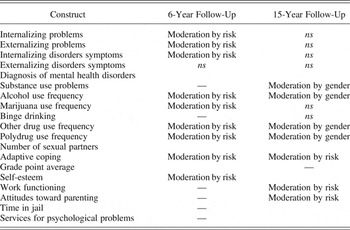
Given that the parenting plus child coping condition did not produce additive effects on children's mental health outcomes at posttest or 6-month, 6-year, or 15-year follow-up (Wolchik et al., Reference Wolchik, West, Sandler, Tein, Coatsworth and Lengua2000, Reference Wolchik, Sandler, Millsap, Plummer, Greene and Anderson2002, Reference Wolchik, Sandler, Tein, Mahrer, Millsap and Winslow2013), the two active conditions were combined and compared to the literature control condition to provide a more parsimonious perspective on the program effects at the follow-ups. As shown in Table 1, at the 6-year follow-up, program effects were found on a wide range of outcomes, including internalizing and externalizing problems, symptoms of internalizing disorder, diagnosis of mental disorder in the last year, alcohol use, marijuana use, other drug use, polydrug use, number of sexual partners, adaptive coping, grade point average, and self-esteem (Vélez, Wolchik, Tein, & Sandler, Reference Vélez, Wolchik, Tein and Sandler2011; Wolchik et al., Reference Wolchik, Sandler, Weiss, Winslow, Briesmeister and Schaefer2007). For several effects, the benefits were greater for those with higher risk at program entry.
Direct program effects on mental health problems, substance use, and competencies at 6- and 15-year follow-up

Note: The mother program and mother-plus-child program were combined and compared to the literature control condition. Diagnosis of mental disorder in the past year was assessed at the 6-year follow-up. Onset of internalizing disorder, externalizing disorder, and substance use disorder from adolescence to emerging adulthood was assessed at the 15-year follow-up. (—) The construct was not assessed.
Similar to the findings at the 6-year follow-up, the NBP led to improvements in multiple problem outcomes at the 15-year follow-up. Both males and females in the NBP had a significantly lower incidence of internalizing disorders from adolescence to emerging adulthood than those in the literature control condition (7.55% vs. 24.4%; OR = 0.26; Wolchik et al., Reference Wolchik, Sandler, Tein, Mahrer, Millsap and Winslow2013). For males, the NBP reduced the number of substance use disorders from adolescence to emerging adulthood. The NBP reduced polydrug use and other drug use in the past year, and substance use problems in the past 6 months for males. Although females in the NBP drank more alcohol in the past month than those in the control group, both groups reported low levels of drinking (i.e., three to five drinks in the past month). As shown in Table 1, emerging adults in the NBP reported fewer sexual partners, spent less time in jail, and used fewer services for psychological problems than those in the control group (Herman et al., Reference Herman, Mahrer, Wolchik, Porter, Jones and Sandler2015). The NBP led to increases in multiple competencies. Among those with higher risk at program entry, those in the NBP reported higher coping efficacy, self-esteem (Vélez, Wolchik, Kim, Tein, & Sandler, Reference Vélez, Wolchik, Kim, Tein and Sandler2014), and work functioning (Christopher, Wolchik, Tein, & Sandler, Reference Christopher, Wolchik, Tein and Sandler2015) and more positive attitudes toward parenting than their counterparts in the control condition (Mahrer, Winslow, Wolchik, Tein, & Sandler, Reference Mahrer, Winslow, Wolchik, Tein and Sandler2014).
Mediators of Short- and Long-Term Program Effects
Mediational analyses in the first trial indicated that improvement in mother–child relationship quality partially mediated improvements in children's mental health problems (Wolchik et al., Reference Wolchik, West, Westover, Sandler, Martin and Lustig1993). Mediational analyses in the second trial showed that the effects of the NBP on internalizing problems at posttest were accounted for by improvements in mother–child relationship quality; the effects on externalizing problems at posttest and 6-month follow-up were mediated by improvements in relationship quality and effective discipline (Tein, Sandler, MacKinnon, & Wolchik, Reference Tein, Sandler, MacKinnon and Wolchik2004).
Zhou, Sandler, Millsap, Wolchik, and Dawson-McClure (Reference Zhou, Sandler, Millsap, Wolchik and Dawson-McClure2008) found that program-induced improvements in effective discipline at posttest mediated the program effect on grade point average at the 6-year follow-up. In addition, program-induced improvement in mother–child relationship quality mediated the program effect on adolescents’ mental health problems for those with high baseline risk for maladjustment. Examining parental monitoring and substance use at the 6-year follow-up, Soper, Wolchik, Tein, and Sandler (Reference Soper, Wolchik, Tein and Sandler2010) found that parental monitoring mediated reductions in alcohol and marijuana use, polydrug use, and other drug use for those with high risk for maladjustment at program entry. In addition, program-induced increases in mother–child relationship quality at posttest led to increased coping efficacy and active coping in adolescence (Velez et al., Reference Vélez, Wolchik, Tein and Sandler2011).
Current Study
The current study extends our earlier research on the cascading effects of the NBP (Bonds McClain et al., Reference Bonds McClain, Wolchik, Winslow, Tein, Sandler and Millsap2010) from posttest to the 6-year follow-up. In that study, we found that the NBP led to an increase in positive parenting at posttest, which was related to a decrease in externalizing and internalizing problems at short-term follow-up. Fewer externalizing problems at short-term follow-up were related to reductions in substance use and symptoms of externalizing disorders and higher grades; fewer internalizing problems at short-term follow-up were related to increases in self-esteem and fewer symptoms of internalizing disorders in adolescence.
In the current study, we test cascade effects models of the links between mental health problems, substance use, and competencies in adolescence and mental health problems and substance use in emerging adulthood. Examining the cascades that may occur between these two periods of development in youth who have experienced parental divorce is important for several reasons. First, some problems associated with parental divorce involve the accomplishment of salient developmental tasks of both adolescence and emerging adulthood, such as education, work, romantic relationships, and friendships. Second, several of the mental disorders that are associated with parental divorce and have significant public health burden have a median age of onset (Burke, Burke, Regier, & Rae, Reference Burke, Burke, Regier and Rae1990) and/or increase or peak in prevalence during emerging adulthood (e.g., Kessler et al., Reference Kessler, McGonagle, Zhao, Nelson, Hughes and Eshleman1994; Regier & Kaelber, Reference Regier and Kaelber1995). Third, emerging adulthood involves multiple changes in social and contextual roles, and individuals make key choices in multiple life spheres during this period (e.g., Schulenberg, Sameroff, & Cicchetti, Reference Schulenberg, Sameroff and Cicchetti2004). Thus, the stakes for successful functioning in this stage are particularly high and significant difficulties may have even more serious and long-lasting consequences in this stage than in others (e.g., Newman et al., Reference Newman, Moffitt, Caspi, Magdol, Silva and Stanton1996). Fourth, examining the links between behavior problems and competencies in adolescence and mental health problems and substance use in emerging adulthood can further our theories about spreading effects across development, and identify the pathways through which the program affected outcomes across stages of development.
Empirical Support for Predicting Cascading Effects From Adolescence to Emerging Adulthood
There is strong support from nonexperimental longitudinal studies for continuity in mental health problems from adolescence to emerging adulthood and for cascading effects across domains of functioning across these periods of development. Illustratively, externalizing problems in adolescence predict externalizing problems in young adulthood (e.g., Achenbach, Howell, McConaughy, & Stanger, Reference Achenbach, Howell, McConaughy and Stanger1995; Brook, Whiteman, Finch, & Cohen, Reference Brook, Whiteman, Finch and Cohen1996; Fleming, Mason, Mazza, Abbott, & Catalano, Reference Fleming, Mason, Mazza, Abbott and Catalano2008; Masten et al., Reference Masten, Roisman, Long, Burt, Obradović and Riley2005). Adolescent conduct disorder and externalizing symptoms also predict internalizing disorders (Bardone, Moffitt, Caspi, & Dickson, Reference Bardone, Moffitt, Caspi and Dickson1996; Chassin, Pitts, DeLucia, & Todd, Reference Chassin, Pitts, DeLucia and Todd1999; Masten et al., Reference Masten, Roisman, Long, Burt, Obradović and Riley2005) and substance use (e.g., Chassin et al., Reference Chassin, Pitts, DeLucia and Todd1999) in young adulthood. Processes that may underlie these relations include cumulative continuity, in which individuals select environments that strengthen externalizing problems and interactional continuity, in which externalizing problems are sustained by the reciprocal responses they evoke in others (Caspi, Bem, & Elder, Reference Caspi, Bem and Elder1989). Adolescent externalizing problems may also lead to later problems by reducing environmental and interpersonal opportunities, increasing exposure to at-risk contexts (Bardone et al., Reference Bardone, Moffitt, Caspi and Dickson1996; Capaldi & Stoolmiller, Reference Capaldi and Stoolmiller1999), or leading to developmental “snares,” such as school dropout (Moffitt, Reference Moffitt1993). Longitudinal nonexperimental studies have shown continuity between internalizing problems in adolescence and young adulthood (e.g., Achenbach et al., Reference Achenbach, Howell, McConaughy and Stanger1995; Pine, Cohen, Gurley, Brook, & Ma, Reference Pine, Cohen, Gurley, Brook and Ma1998; Reinherz, Paradis, Giaconia, Stashwick, & Fitzmaurice, Reference Reinherz, Paradis, Giaconia, Stashwick and Fitzmaurice2003). Research has also shown significant relations between internalizing problems in adolescence and externalizing problems, mental disorder, and drug use (Bardone et al., Reference Bardone, Moffitt, Caspi and Dickson1996; Devine, Kempton, & Forehand, Reference Devine, Kempton and Forehand1994) in young adulthood. Plausible mechanisms include a negative cycle in which internalizing problems lead to an ongoing cycle of poor social relationships (Capaldi & Stoolmiller, Reference Capaldi and Stoolmiller1999) and increased vulnerability to later stressors (Reinherz, Giaconia, Hauf, Wasserman, & Silverman, Reference Reinherz, Giaconia, Hauf, Wasserman and Silverman1999). In addition, substance use might be motivated by the expectation that substance use will alleviate the distress associated with internalizing symptoms (Hussong, Jones, Stein, Baucom, & Boeding, Reference Hussong, Jones, Stein, Baucom and Boeding2011). Further, the deficits in interpersonal skills associated with internalizing problems can lead to association with marginalized peers who engage in deviant behaviors, which increases the risk for engaging in deviant activities, such as substance use and externalizing problems (Hussong et al., Reference Hussong, Jones, Stein, Baucom and Boeding2011).
For many youth, engaging in risky behaviors, such as alcohol use and drug use, represents a brief period of experimentation (e.g., Botvin, Baker, Dusenbury, Tortu, & Botvin, Reference Botvin, Baker, Dusenbury, Tortu and Botvin1990), with a “maturing out” occurring in young adulthood (e.g., Chen & Kandel, Reference Chen and Kandel1995). However, research consistently shows that substance use in adolescence predicts substance use in young adulthood (Brook et al., Reference Brook, Whiteman, Finch and Cohen1996; Chassin et al., Reference Chassin, Pitts, DeLucia and Todd1999; Chassin, Prost, & Pitts, Reference Chassin, Prost and Pitts2002; Guo, Collins, Hill, & Hawkins, Reference Guo, Collins, Hill and Hawkins2000; McCambridge, McAlaney, & Rowe, Reference McCambridge, McAlaney and Rowe2011). Although some studies have shown that adolescent drug use is related to depression, anxiety, and antisocial problems (Brook, Cohen, & Brook, Reference Brook, Cohen and Brook1998; Brook et al., Reference Brook, Whiteman, Finch and Cohen1996; Chassin et al., Reference Chassin, Pitts, DeLucia and Todd1999) in young adulthood, a large birth cohort study found nonsignificant relations between adolescent substance use and anxiety disorder and depression in young adulthood (e.g., Wells, Horwood, & Fergusson, Reference Wells, Horwood and Fergusson2004). Plausible mechanisms for the effects of adolescent substance use on young adult mental health problems include greater exposure to at-risk developmental contexts (Newcomb & Bentler, Reference Newcomb and Bentler1988; Tapert, Aarons, Sedlar, & Brown, Reference Tapert, Aarons, Sedlar and Brown2001), lack of development of adaptive coping strategies (Baumrind & Moselle, Reference Baumrind and Moselle1985), and negative effects of substance use on relationships (Baumrind & Moselle, Reference Baumrind and Moselle1985).
Three of the adolescent competencies that were impacted by the NBP have been found to predict functioning in young adulthood. Poor academic performance in adolescence is related to internalizing problems in young adulthood (Masten et al., Reference Masten, Roisman, Long, Burt, Obradović and Riley2005) and to involvement in antisocial criminal behavior (Petrocelli & Petrocelli, Reference Petrocelli and Petrocelli2005) in adulthood. These relations may be due to the influence of academic performance on opportunities for achievement and occupation choices (Kokko & Pulkkinen, Reference Kokko and Pulkkinen2000) or the effects of poor academic performance on self-perceptions that lead to increased mental health problems (Masten et al., Reference Masten, Roisman, Long, Burt, Obradović and Riley2005). Academic problems may also lead to involvement in deviant peer groups (e.g., Dishion & Patterson, Reference Dishion, Patterson, Cicchetti and Cohen2006; Dishion, Patterson, Stoolmiller, & Skinner, Reference Dishion, Patterson, Stoolmiller and Skinner1991) that promote externalizing problems across developmental stages.
Self-esteem in adolescence is related to depression (Hoffmann, Baldwin, & Cerbone, Reference Hoffmann, Baldwin and Cerbone2003; Pelkonen, Marttunen, & Aro, Reference Pelkonen, Marttunen and Aro2003) and psychological distress (Kaplan & Robbins, Reference Kaplan, Robbins, Mednick and Van Dusen1983) in young adulthood. High self-esteem may promote adaptive coping efforts and increase opportunities for mastery (Kliewer & Sandler, Reference Kliewer and Sandler1992), which could lead to lower internalizing problems. Research also shows that adaptive coping in adolescence is related to lower substance use in young adulthood (Hussong & Chassin, Reference Hussong and Chassin2004). This relation might be accounted for by the ability to reframe problems in a positive way or more effectively manage negative affect that could lead to substance use.
Contributions of the Current Study and Hypotheses
The 15-year follow-up of the NBP sample provides a rare opportunity to test the pathways by which program-induced improvements in adaptation in adolescence lead to improved functioning in emerging adulthood. In this study, we examined how domains of problem behaviors and competencies on which significant or marginal program effects (direct or indirect) occurred at the follow-up in adolescence relate to mental health problems and substance use in emerging adulthood. This study contributes to the literature on cascade effects models of developmental processes in four ways. First, it goes beyond testing passive longitudinal models by examining how program-induced changes in parenting and problem outcomes in late childhood/early adolescence and adolescence affect mental health problems and substance use in emerging adulthood. Second, the 15-year period in which assessments occurred spans three developmental periods (late childhood/early adolescence, adolescence, and emerging adulthood), a longer window of development than that examined in most other studies. Third, a broad range of domains of mental health, substance use, and competence outcomes in adolescence were tested for cascading effects on internalizing problems, externalizing problems, and substance use outcomes in emerging adulthood. Fourth, unlike most previous longitudinal studies that have examined functioning across adolescence and emerging adulthood, the current study controlled for the longitudinal stability of functioning in these domains and for the within time period covariance among functioning in these domains in adolescence.
Given previous research and theory, we expected that there would be continuity within domains of functioning, so that functioning in adolescence (e.g., decreased externalizing problems) would be related to functioning in the same domain in emerging adulthood (e.g., decreased externalizing problems). In addition, based on theory and our review of findings from nonexperimental longitudinal studies, we predicted cross-domain effects over time such that externalizing problems in adolescence would be related to internalizing problems and substance use problems in emerging adulthood, internalizing problems in adolescence would be related to externalizing problems and substance use in emerging adulthood, and substance use in adolescence would be related to internalizing problems and externalizing problems in emerging adulthood. We predicted that self-esteem and adaptive coping would be related to internalizing problems. We also expected that academic performance would predict internalizing problems and externalizing problems. Adaptive coping was expected to be related to substance use.
We also examined gender differences in the link between outcomes in adolescence and outcomes in emerging adulthood. Some researchers have suggested that substance use in adolescence may constitute higher risk for later problem drinking in males than in females because the transition to emerging adulthood for females may involve roles and life situations that place greater restraint on continuing heavy drinking than do the roles assumed by most males during this developmental transition. It is also possible that there is less stability in problematic substance use across gender because as adolescents, females may never have been as involved in problem drinking as their male counterparts (Donovan, Jessor, & Jessor, Reference Donovan, Jessor and Jessor1983). However, although some research has shown significant gender differences in the predictors of problem drinking, as well as internalizing problems and externalizing problems, from adolescence to young adulthood (e.g., Chassin et al., Reference Chassin, Prost and Pitts2002; Miettunen et al., Reference Miettunen, Murray, Jones, Mäki, Ebeling and Taanila2014; Pulkkinen & Pitkänen, Reference Pulkkinen and Pitkänen1994), there is significant inconsistency in the findings on such gender differences (e.g., Guo et al., Reference Guo, Collins, Hill and Hawkins2000; Nolen-Hoeksema, Reference Nolen-Hoeksema2004; Zimmermann et al., Reference Zimmermann, Wittchen, Höfler, Pfister, Kessler and Lieb2003). Thus, we did not make specific hypotheses about the tests of gender differences.
Method
Participants
The study included 240 adult offspring and their mothers who had participated in a randomized controlled trial of the NBP in late childhood or early adolescence. Potential participants for the trial were identified primarily through court records of divorce decrees in a large Southwestern metropolitan county (20% were recruited by media advertisements or word of mouth). Eligibility criteria were (a) divorced in past 2 years; (b) primary residential parent was female; (c) at least one 9- to 12-year-old child resided (at least 50%) with their mothersFootnote 1 ; (d) neither mother nor any child was in treatment for mental health problems; (e) mother had not remarried, did not plan to remarry during the program, and did not have a live-in boyfriend; (f) custody was expected to remain stable; (g) family resided within an hour drive of the program site; (h) mother and child could complete assessments in English; (i) child was not learning disabled or in special education; and (j) if diagnosed with attention-deficit disorder, the child was taking medication. In families with multiple children in the age range, one was randomly selected as the target child for the assessment of program effects to ensure independence of responses. Because of the preventive nature of the intervention and ethical concerns, families were excluded and referred for treatment if the child endorsed an item about suicidality or exhibited severe levels of depressive symptomatology or externalizing problems at pretest.
Families were randomly assigned to (a) a mother-only program (n = 81 families), (b) a mother plus child program (separate, concurrent groups for mothers and children, n = 83 families), or (c) a literature control condition (LC; n = 76 families). Given the lack of differences between the mother-only and mother plus child programs at posttest, 3- and 6-month follow-ups, and 6- and 15-year follow-ups, including tests of the positive parenting variable and the outcomes in childhood, adolescence, and emerging adulthood in this study, these conditions were combined and labeled as NBP. At pretest, the average age of the children was 10.4 years (SD = 1.1); 49% were girls. Mothers’ mean age was 37.3 years (SD = 4.8); 98% had at least a high school education. Mothers’ ethnicity was 88% non-Hispanic White, 8% Hispanic, 2% Black, 1% Asian or Pacific Islander, and 1% other. Parents had been separated and divorced an average of 2.2 years (SD =1.4) and 1.0 year (SD = 0.5), respectively.
Comparison of program accceptors and refusers (i.e., refused to participate in the evaluation of the program but completed the pretest, N = 59) showed that pretest child maladjustment and family income/needs ratio positively predicted enrollment (Winslow, Bonds, Wolchik, Sandler, & Braver, Reference Winslow, Bonds, Wolchik, Sandler and Braver2009). The three experimental conditions did not differ significantly on child mental health problems or demographic variables at pretest.
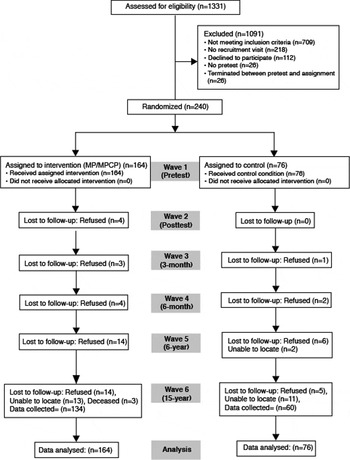
Figure 1 shows the screening and enrollment process. At the 6-year and 15-year follow-ups, the average age was 16.9 (SD = 1.1, range = 15.1–19.1) and 25.6 (SD = 1.2, range = 24–28). At both follow-ups, 50% of those interviewed were female. Ethnicity was 88.7% Non-Hispanic White, 6.7 % Hispanic, 2.1% African American, and 2.5% other. Educational attainment was less than high school, 2.6%; high school only, 19.6%; some college, 45.3%; college graduate, 29.4%; and postgraduate, 3.1%. Of the emerging adults, 51% were married or living as if married; their median income was in the $30,000 range (choices were $5,000 categories ranging from ≤$5,000 to ≥$200,000).
Participant flow.

Intervention conditions
The parent program consisted of 11 group sessions (1.75 hr) and 2 individual sessions. The program taught skills to improve mother–child relationship quality and effective discipline, decrease barriers to father–child contact, and reduce children's exposure to interparental conflict. Intervention methods, based on social learning and cognitive behavioral theories, were derived from prior intervention research on effective approaches to strengthening relationship quality (Guerney, Reference Guerney1978; Guerney, Coufal, & Vogelson, Reference Guerney, Coufal and Vogelsong1981), discipline (Patterson, Reference Patterson and Olson1976), and anger management (Novaco, Reference Novaco1975). Based on Marlatt and Gordon's (Reference Marlatt and Gordon1985) work, maintenance strategies, such as giving parents handouts on skills and leaders attributing change to maternal efforts, were included. The highly structured program used active learning methods, videotaped modeling, and role-plays. Homework assignments focused on practicing the program skills. There were 18 mother groups (9 in the mother-program condition and 9 in the dual-component condition).
In the mother plus child program, mothers participated in the mother program and children participated concurrently in an 11-session group program. The child program targeted active coping, avoidant coping, threat appraisals of divorce stressors, and mother–child relationship quality. The change strategies, based on social learning and social cognitive theory, were derived from intervention research (e.g., coping and appraisals: Pedro-Carroll & Cowen, Reference Pedro-Carroll and Cowen1985; relationship quality: Guerney et al., Reference Guerney, Coufal and Vogelsong1981). Didactic presentations, videotapes, leader modeling, role-plays, and games were used to teach the program skills. Homework involved practicing the program skills. There were 9 child groups with an average group size of 9 (range = 9–10). For more information about the programs, see Wolchik et al. (Reference Wolchik, West, Sandler, Tein, Coatsworth and Lengua2000, Reference Wolchik, Sandler, Weiss, Winslow, Briesmeister and Schaefer2007).
Each group was led by two master's-level clinicians (13 leaders for mother groups, 9 for child groups). The leaders used highly detailed manuals to deliver the sessions. Extensive training (30 hr before the program and 1.5 hr/week during delivery) and supervision (1.5 hr/week) were provided by doctoral-level clinicians. Before delivering each session, leaders were required to score 90% on a quiz about the session. Videotapes of sessions were rated by trained coders for completion of session activities. The mean degree of session completion was 2.86 (SD = 0.39) and 3.00 (SD = 0.02) for the mother and child sessions, respectively.
In the LC, mothers and children each received three books about children's divorce adjustment and a syllabus to guide their reading. Books were mailed at 1-month intervals. Mothers and children reported reading about half the books.
Procedure
Families were interviewed on six occasions: pretest at Time 1 (T1), posttest at Time 2 (T2), 3-month follow-up at Time 3 (T3), 6-month follow-up at Time 4 (T4), 6-year follow-up at Time 5 (T5), and 15-year follow-up at Time 6 (T6). Although the current study focuses on relations between outcomes at the 6-year and 15-year follow-ups, the cascade effects models use data from all waves.
Trained staff conducted separate home interviews with parents and youth. Confidentiality was explained, and parents and youth signed consent/assent forms. Families received $45 compensation at T1, T2, T3, and T4; parents and youth each received $100 compensation at T5. At T6, emerging adults received $225, and parents received $50. Participation rate at the family level was 100% at T2, 98% at T3 and T4, 91% at T5, and 90% at T6.
Measures in childhood
The measures are described in terms of the developmental period in which they were administered.
Demographics
At pretest, mothers completed items about their children's age, their own ethnicity and income, and other demographics.
Positive parenting
Positive parenting was a composite of mother and child reports of two parenting constructs: mother–child relationship quality and effective discipline.
Mother–child relationship quality
At T1 and T2, mothers and children completed shortened versions of the acceptance (10 items) and rejection subscales (10 items) of the Child Report of Parental Behavior Inventory (Schaefer, Reference Schaefer1965). The internal consistency reliability coefficients (Cronbach α) for the acceptance and rejection subscales were 0.86 and 0.81 for mother report at T1 and T2, respectively, and 0.84 and 0.89 for child report, respectively. Mothers and children also completed the open family communication subscale (10 items) of the Parent–Adolescent Communication Scale (Barnes & Olson, Reference Barnes, Olson, Olson, McCubbin, Barnes, Larsen, Muxen and Wilson1982). The αs were 0.71 and 0.75 for mothers at T1 and T2, and 0.85 and 0.87 for children at T1 and T2, respectively. Mothers also completed an abbreviated 7-item version of the Family Routines Inventory (Jensen, Boyce, & Hartnett, Reference Jensen, Boyce and Hartnett1983). The items were selected because they assessed dyadic interactions between the mother and child. The αs were 0.67 and 0.63 for mothers at T1 and T2, respectively. Mother and child reports were standardized and averaged to create a multimeasure, multireporter composite. The weighted αs (Lord & Novick, Reference Lord and Novick1968) across the variables were 0.88 and 0.90 at T1 and T2, respectively.
Effective discipline
Mothers and children completed the 8-item inconsistent discipline subscale of the Child Report of Parental Behavior Inventory (Schaefer, Reference Schaefer1965). The α values were 0.82 and 0.80 for mothers at T1 and T2, and 0.74 and 0.73 for children at T1 and T2, respectively. Mothers completed 14 items on appropriate/inappropriate discipline (T1 α = 0.70, T2 α = 0.71) and 11 items on the follow-through subscale (T1 α = 0.80, T2 α = 0.76) from the Oregon Discipline Scale (Oregon Social Learning Center, 1991). These four scales (i.e., mother report of inconsistent discipline, child report of inconsistent discipline, mother report of appropriate/inappropriate discipline, and mother report of follow-through) were standardized and averaged to create a composite. The weighted α values across the variables were 0.84 and 0.89 at T1 and T2, respectively.
Children's internalizing and externalizing problems
Mother report of mental health problems during the last month was assessed with the 31-item internalizing and 33-item externalizing subscales of the Child Behavior Checklist (Achenbach, Reference Achenbach1991a; Achenbach & Edelbrock, Reference Achenbach and Edelbrock1983). At T1 α = 0.89, at T3 α = 0.86, and at T4 α = 0.85 for internalizing problems and 0.88 at T1, 0.88 at T3, and 0.88 at T4 for externalizing problems. Adequate reliability and validity have been reported (Achenbach, Reference Achenbach1991b).
Child report of depression was measured using the 27-item Child Depression Inventory (CDI; Kovacs, Reference Kovacs1981). The CDI has been shown to have high internal consistency, test–retest reliability, and validity (Saylor, Finch, Spirito, & Bennett, Reference Saylor, Finch, Spirito and Bennett1984). In this study, αs were 0.84 at T1, 0.78 at T3, and 0.80 at T4. Youth report of anxiety was assessed using the 28-item Revised Children's Manifest Anxiety Scale (Reynolds & Richard, Reference Reynolds and Richard1978). Convergent and discriminant validity has been supported by high positive correlations with other trait measures of anxiety (Reynolds & Paget, Reference Reynolds and Paget1981). In this study, αs were 0.88 at T1, 0.91 at T3, and 0.91 at T4. A composite of reports on the CDI and Revised Children's Manifest Anxiety Scale was formed as the mean of the standardized scores to represent child report of internalizing problems. Children completed 27 items from the aggression and delinquency subscales of the Youth Self-Report (Achenbach, Reference Achenbach1991b; T1 α = 0.87, T3 α = 0.86, and T4, α = 0.88). Reliability and validity of these subscales has been demonstrated (Achenbach, Reference Achenbach1991b). The average correlation of mother and child report across assessments was .29 for internalizing problems and .28 for externalizing problems. Given the short period of time between T3 and T4 (3 months), we summed scores for externalizing problems/internalizing problems across T3 and T4 and then averaged them.
Measures in adolescence
Adolescent symptoms of externalizing and internalizing disorders
Symptoms of externalizing disorders and internalizing disorders over the past year were assessed using mother and adolescent versions of the computer-assisted Diagnostic Interview Schedule for Children (Shaffer, Fisher, Lucas, Dulcan, & Schwab-Stone, Reference Shaffer, Fisher, Lucas, Dulcan and Schwab-Stone2000). Total symptom scores were derived separately for internalizing disorders (i.e., agoraphobia, generalized anxiety disorder, obsessive–compulsive disorder, panic disorder, posttraumatic stress disorder, social phobia, specific phobia, eating disorders, and major depression) and externalizing disorders (i.e., conduct disorder, oppositional defiant disorder, and attention-deficit/hyperactivity disorder), according to symptoms endorsed by either the parent or adolescent. Compton and Cottler (Reference Compton, Cottler, Hersen and Segal2000) reported reliabilities of diagnoses ranging from κs = 0.33 to 0.86 (M = 0.58). The DIS has been validated against the WHO Schedules for Clinical Assessment in Neuropsychiatry (Wing et al., Reference Wing, Babor, Brugha, Burke, Cooper and Giel1990).
Adolescent substance use
Adolescents completed the Monitoring the Future Scale (Johnston, Bachman, & O'Malley, Reference Johnston, Bachman and O'Malley1993). The following scores were used: frequency of marijuana use and alcohol use in the past year (7-point scale, 1 = 0 occasions to 7 = 40 or more occasions). This scale has adequate validity (Johnston et al., Reference Johnston, Bachman and O'Malley1993).
Adolescent self-esteem
The six-item global self-worth subscale of Harter's (Reference Harter1985) Self-Perception Profile for Children was used to assess global self-esteem (α = 0.86 at T5; α = 0.71 at T1). Scores on this measure have been negatively related to youth reports of depressive symptoms and clinical depression (Renouf & Harter, Reference Renouf and Harter1990).
Adolescent academic performance
Archival data were collected for all participants, whether or not they were currently attending school. Questionnaires requesting the unweighted (based on 4.0 scale) cumulative grade point average (GPA) for high school were mailed to school principals, along with an Authorization to Release Information form. Cumulative high school GPA was used to measure academic performance.
Adolescent adaptive coping
Adolescent report of active coping efforts and coping efficacy were used to assess adaptive coping. The 24-item active coping dimension of the Children's Coping Strategies Checklist—Revised (Ayers, Sandler, West, & Roosa, Reference Ayers, Sandler, West and Roosa1996) reflects positive coping strategies that youth generally used when faced with a problem in the previous month, including behavioral actions to fix the problem and cognitive engagement strategies that reduce the threatening implications of the stressor. The 7-item coping efficacy scale (Sandler, Tein, Mehta, Wolchik, & Ayers, Reference Sandler, Tein, Mehta, Wolchik and Ayers2000) assessed satisfaction with handling problems in the past and anticipated effectiveness in handling future problems. Alphas for active coping and coping efficacy were 0.87 and 0.73, respectively, for T1, and 0.92 and 0.82 for T5. The two measures were standardized and averaged. The correlation between active coping and coping efficacy was 0.53 at T1 and 0.89 at T5.
Measures in emerging adulthood
Emerging adult internalizing problems and externalizing problems
The internalizing problems and externalizing problems subscales of the Adult Self-Report (Achenbach & Rescorla, Reference Achenbach and Rescorla2003) and Adult Behavior Checklist (Achenbach & Rescorla, Reference Achenbach and Rescorla2003) were used. These scales, which assess mental health problems in the past 6 months, have adequate reliability and validity (Achenbach & Rescorla, Reference Achenbach and Rescorla2003). Alphas for internalizing problems were 0.90 and 0.92 for emerging adult and mother reports, respectively. Alphas for externalizing problems were 0.84 and 0.92 for emerging adult and mother reports, respectively. The correlation of mother and emerging adult scores of internalizing problems was 0.46 and 0.27 for externalizing problems. Mother and emerging adult scores were standardized and then averaged.
Emerging adult substance use outcomes
At 15-year follow-up, the same items from the Monitoring the Future Scale (Johnston et al., Reference Johnston, Bachman and O'Malley1993) as were used to measure substance use at the 6-year follow-up were used to assess alcohol use and marijuana use in the past year. In addition, binge drinking was measured using an adaptation of an item from the Quantity and Frequency of Alcohol and Drugs Scale (Sher, Walitzer, Wood, & Brent, Reference Sher, Walitzer, Wood and Brent1991) that assessed the frequency of binge drinking in the past year (1= less than five times, 2 = more than 5 times but less than once a month, 3 = 1–3 times a month, 4 = 1–2 times a week, 5 = 3–5 times a week, and 6 = every day).
Baseline covariates and risk
Using the current sample, Dawson-McClure, Sandler, Wolchik, and Millsap (Reference Dawson-McClure, Sandler, Wolchik and Millsap2004) developed a risk measure for children from divorced families and demonstrated that the most consistent predictors of adaptation problems in the LC at the 6-year follow-up were children's externalizing problems and a composite of environmental stress (i.e., composite of negative events that occurred to the child, interparental conflict, maternal distress, reduced contact with father, and per capita income at pretest). Analyses have shown that program benefits at the 6-year follow-up were greater for those youth with higher baseline risk, defined as a composite of externalizing problems and the composite of environmental stress (Dawson-McClure et al., Reference Dawson-McClure, Sandler, Wolchik and Millsap2004; Wolchik et al., Reference Wolchik, Sandler, Weiss, Winslow, Briesmeister and Schaefer2007). Given that the effects of the NBP at the 6-year follow-up depended on level of risk at baseline, it is possible that risk could moderate the relations between outcomes in adolescence and those in emerging adulthood. We expanded the risk measure used by Dawson-McClure et al. (2004) to include baseline internalizing problems. Thus, a risk measure that included baseline measures of children's internalizing problems, children's externalizing problems, and environmental stress was used as a covariate for the posttest positive parenting variables as well as the outcomes in childhood, adolescence, and emerging adulthood and as a potential moderator of the program effects on these variables. For any of the postintervention (T2 to T6) measures, in addition to including the risk measure as a covariate, the baseline (T1) variable of the same measure or a similar measure, if existing, was included as a covariate (e.g., controlling for T1 self-esteem for T5 self-esteem; controlling for T1 academic competence for T5 GPA). T1 academic competence was assessed with mother and child report of the six-item subscale from the Coatsworth Competence Scale (Arizona State University Prevention Research Center, 2006). For mother report α = 0.91; for child report α = 0.78. Mother and child report of academic competence were correlated at 0.56 at T1.
Statistical analysis
Correlations and descriptive statistics of the study variables were conducted as preliminary analyses. Attrition analyses were conducted to compare the rates of attrition between the NBP and LC at 6- and 15-year follow-ups. For these follow-ups, we also compared those who participated with those who did not on the baseline demographic and study variables using χ2 tests (for categorical variables) or t test (for continuous variables). The interaction between attrition status and group membership on these variables was also evaluated, using two-way analyses of variance (for continuous variables) or logistic regression (for categorical variables).
Structural equation modeling with observed variables (i.e., path modeling) was used to test four cascade effects models. We hypothesized that intervention-induced improvement in parenting (posttest) would be related to reductions in internalizing problems and externalizing problems in late childhood/early adolescence (3- and 6-month follow-up), which would be related to reductions in substance use and internalizing symptoms and externalizing symptoms as well as increased competencies in adolescence (6-year follow-up). We hypothesized that the intervention effects on the outcomes in adolescence (6-year follow-up) would have cascading effects on the problem outcomes in emerging adulthood (15-year follow-up). That is, reductions in internalizing symptoms, externalizing symptoms, and substance use, and increased competencies in adolescence were predicted to be related to decreased internalizing problems, externalizing problems, and substance use in emerging adulthood. Note that including all of the outcomes in emerging adulthood in the same model would have resulted in a large number of the parameters to be estimated and issues of getting proper solutions (e.g., nonconvergent issues).
For the posttest positive parenting variable, the childhood and adolescent outcomes as well as the outcomes in emerging adulthood, we included paths from the program condition (to test direct intervention effects), the T1 measure of the same variable, if existing, and the risk measure, as well as the Intervention × Risk interaction (to examine possible moderated effects by baseline risk). For any interaction that was not significant or marginally significant, we deleted the interaction and reran the model. A previous study (Wolchik et al., Reference Wolchik, West, Sandler, Tein, Coatsworth and Lengua2000) showed that the program effect on positive parenting was stronger for families that had lower baseline positive parenting scores. Thus, we also examined whether baseline positive parenting moderated the program effect on posttest positive parenting. For significant moderation effects, we probed the direction of the moderation effects. Included in the model but not shown in the figures are the effects from the covariates and all of the correlations among the study variables measured at the same time point, including the outcome variables.
To test gender differences in the cascade effects paths, we examined which regression parameters were substantially different between gender groups. Because there were restricted sample sizes relative to the complicated cascade effects models, we employed a heuristic method to test only the parameters that appeared to be different between groups based on the following procedure. The cascade model was examined for males and females separately. Based on the results from the separate groups, two criteria were used to select regression parameters to test for differences: (a) when the regression coefficients were both significant and the signs were opposite for males (e.g., negative) and females (e.g., positive); or (b) when the regression coefficient was significantly different from zero for one group (e.g., males) but not for the other group (e.g., females), regardless of the signs. Then, the cascade model was conducted simultaneously including both groups (i.e., multigroup analysis), and the MODEL CONSTRAINT feature in Mplus was applied to examine the differences in these regression coefficients between males and females.
Mplus software (Version 7.12; Muthén & Muthén, Reference Muthén and Muthén1998–2014) was used for the analyses with continuous or binary outcome variables. Maximum likelihood estimations with robust standard errors were used. Full information maximum likelihood estimations were applied to handle missing data.
Results
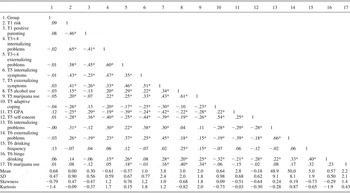
Table 2 shows the zero-order correlations and descriptive statistics of the study variables, excluding baseline covariates. Positive parenting, posttest internalizing problems, and externalizing problems in childhood had significant correlations with almost all of the outcomes in adolescence and emerging adulthood. The skewness and kurtosis of all of the study variables fell within the acceptable range (skewness cutoff ≤ 2 and kurtosis cutoff ≤ 7; West, Finch, & Curran, Reference West, Finch, Curran and Hoyle1995). Rates of attrition did not differ significantly across the NBP and LC at either the 6-year or the 15-year follow-up. No significant attrition or Group × Attrition interaction effects on demographic or baseline variables were found at the 6-year or 15-year follow-up except that at the 15-year follow-up, baseline internalizing problems and self-esteem were significant predictors of attrition. Emerging adults who participated in the 15-year follow-up had significantly more internalizing problems (–0.06 vs. –0.30, t = –2.05, p = .03) and lower self-esteem (20.45 vs. 21.53; t = 2.33, p = .03) at baseline than those who did not participate. The intraclass correlations of the variables among the mothers/children in the same intervention group were generally very low across all assessments (M = 0.02, SD = 0.02).
Correlations and descriptive statistics of study variables

*p < .05.
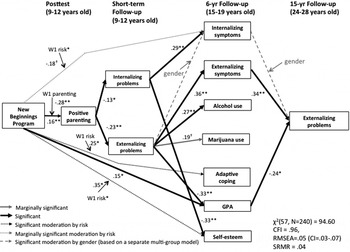
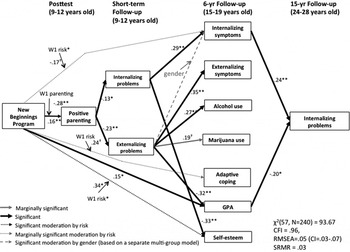
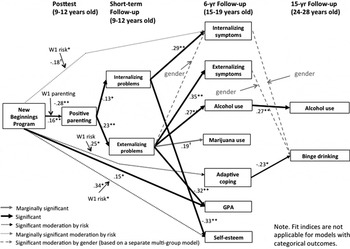
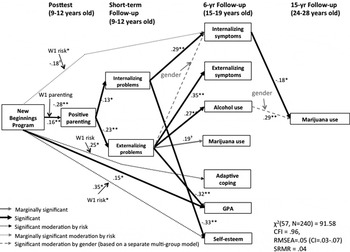
Figures 2–5 show the model fit indices and standardized regression coefficients of cascade models for internalizing problems, externalizing problems, alcohol use and binge drinking, and marijuana use at 15-year follow-up, respectively. In the figures, we only show the paths representing the cascading effects from adolescence to emerging adulthood that were significant.
Cascade effects model of mental health problems, substance use, and competencies in adolescence on externalizing problems in emerging adulthood.

Cascade effects model of mental health problems, substance use, and competencies in adolescence on internalizing problems in emerging adulthood.

Cascade effects model of mental health problems, substance use, and competencies in adolescence on alcohol use and binge drinking in emerging adulthood.

Cascade effects model of mental health problems, substance use, and competencies in adolescence on marijuana use in emerging adulthood.

These models had the same pathway structure from program condition to the 6-year follow-up outcomes. Although the results were consistent across the four models, the use of the maximum likelihood method produced slightly different parameter estimations. For illustration, we present the results using the model with externalizing symptoms at the 6-year follow-up as the outcome. We then describe the effects from the 6-year follow-up outcomes to the 15-year follow-up outcomes.
Cascade model from intervention to adolescent outcomes
The hypothesized cascade model for externalizing symptoms fit the data well. As shown in Figure 2, families in the NBP on average had significantly higher posttest scores on positive parenting than families in the LC. In addition, families that had lower baseline scores on parenting benefited more from the NBP. Positive parenting at posttest was associated with lower internalizing problems and externalizing problems at the short-term follow-ups in late childhood/early adolescence (T3 + T4). Childhood internalizing problems were significantly associated with higher internalizing symptoms and lower self-esteem in adolescence. Childhood externalizing problems were significantly or marginally associated with higher externalizing symptoms, greater alcohol and marijuana use, as well as lower scores in self-esteem in adolescence. After taking problem behaviors and academic competence in childhood into account, NBP had a direct effect on increasing adolescent academic performance. Baseline risk significantly or marginally moderated the program effects on internalizing symptoms, adaptive coping, and self-esteem in adolescence. Specifically, NBP was related to lower internalizing symptoms as well as higher adaptive coping and self-esteem for adolescents who had higher baseline risk. In addition, externalizing problems in childhood were positively related to internalizing symptoms in adolescence for males but not for females.
Cascade model from adolescent outcomes to emerging adulthood outcomes
The expected continuity within domain of behavior across developmental stage was found for three of the four outcomes that were assessed at both periods of development; externalizing symptoms, internalizing symptoms, and alcohol use in adolescence were related to externalizing problems, internalizing problems, and drinking frequency in emerging adulthood, respectively (see Figures 2, 3, and 4). Unexpectedly, internalizing symptoms in adolescence were significantly, negatively related to marijuana use (see Figure 5). Higher competence in adolescence was associated with reduced problem behaviors in emerging adulthood. Specifically, academic performance in adolescence was significantly related to lower internalizing problems and externalizing problems (see Figures 2 and 3). In addition, adaptive coping was significantly negatively related to binge drinking (see Figure 4).
Gender differences in cascade effects pathways from adolescence to emerging adulthood
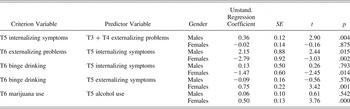
Table 3 summarizes the regression paths that were significantly different between males and females. For males, internalizing symptoms in adolescence were positively related to externalizing problems in emerging adulthood. However, for females, internalizing symptoms in adolescence were negatively related to externalizing problems in emerging adulthood. For females, internalizing symptoms in adolescence were also negatively related to binge drinking, but externalizing symptoms in adolescence were positively related to binge drinking. In addition, for females, alcohol use in adolescence was positively related to marijuana use in emerging adulthood.
Gender differences on regression coefficients

Discussion
Using a developmental cascade conceptual framework, the current study tested models that proposed linkages between mental health problems, substance use, and competencies in adolescence and mental health problems and substance use in emerging adulthood. These tests were housed within a larger cascade model that included a positive cascade effect of a parenting-focused preventive intervention on mental health problems in childhood, which led to lower levels of mental health problems and substance use and higher levels of competencies in adolescence.
The results provide support for the cascade model of development (Cicchetti & Sroufe, Reference Cicchetti and Sroufe2000) in which cascading effects occur from successes or difficulties in one domain of behavior to successes or difficulties in other domains of behavior later in development. Specifically, academic competence in adolescence had cascading effects on internalizing problems and externalizing problems in emerging adulthood. In addition, adaptive coping in adolescence showed significant, negative relations with binge drinking. It was unexpected that internalizing symptoms in adolescence were significantly negatively related to marijuana use in young adulthood. Some gender differences in the linkages between domains of problem behaviors in adolescence and outcomes in emerging adulthood occurred. Internalizing symptoms were significantly negatively related to externalizing problems and binge drinking for females but significantly positively related to externalizing problems for males. In addition, for females only, externalizing problems were significantly positively related to binge drinking, and frequency of alcohol use predicted frequency of marijuana use.
The expected continuity over time within domains of behavior occurred. For three of the four outcomes assessed in adolescence and emerging adulthood, significant relations occurred between these constructs in adolescence and emerging adulthood. For the two constructs that had been assessed in late childhood/early adolescence as well, internalizing problems and externalizing problems, continuity occurred across the three developmental periods.
It is important to note that the analyses explicitly included attention to the interplay between these domains of behavior by controlling for the longitudinal stability of these domains and for the within time period covariance among the domains in adolescence. By providing a test of the within- and cross-domain effects from adolescence to emerging adulthood that cannot be accounted for by shared variance between domains of functioning in adolescence, these models provided a conservative test of the predictive relations between functioning in adolescence and functioning in emerging adulthood.
Developmental cascades
Effects of mental health problems and substance use in adolescence on mental health problems and substance use in emerging adulthood. Consistent with previous findings (e.g., Achenbach et al., Reference Achenbach, Howell, McConaughy and Stanger1995; Brook et al., Reference Brook, Whiteman, Finch and Cohen1996; Burt, Obradović, Long, & Masten, Reference Burt, Obradović, Long and Masten2008; Fleming, Boyle, & Offord, Reference Fleming, Boyle and Offord1993; Masten et al., Reference Masten, Roisman, Long, Burt, Obradović and Riley2005), continuity occurred for externalizing problems and internalizing problems. The stability of these problems from late childhood/early adolescence to emerging adulthood indicates that the occurrence of these problems in late childhood/early adolescence should not be viewed as transient concerns. Children's externalizing problems, such as aggression and delinquency, are related to criminality and unemployment in adulthood (Loeber & Hay, Reference Loeber and Hay1997), which are estimated to cost the United States between $335 and $350 billion each year (Miller, Reference Miller, Biglan, Brennan, Foster and Holder2004). Internalizing problems, such as depression, cost the United States more than $83 billion annually in medical services, loss of lifetime earnings due to suicide, and lost workplace productivity (Greenberg et al., Reference Greenberg, Kessler, Birnbaum, Leong, Lowe and Berglund2003). In the context of the substantial public health burden of these problems, the current findings highlight the importance of providing preventive interventions designed to reduce externalizing problems and internalizing problems early in development. The current study shows that such interventions have the capacity to reduce problems that cascade to increase other problems and reduce competencies from childhood to adolescence to emerging adulthood.
Three aspects of drug use were assessed in emerging adulthood: frequency of binge drinking, alcohol use, and marijuana use. Similar to other findings (e.g., Brook et al., Reference Brook, Whiteman, Finch and Cohen1996; Chassin et al., Reference Chassin, Pitts, DeLucia and Todd1999, 2002; Guo et al., Reference Guo, Collins, Hill and Hawkins2000; McCambridge et al., Reference McCambridge, McAlaney and Rowe2011), continuity was observed between adolescence and emerging adulthood for frequency of alcohol use. Binge drinking was not assessed in adolescence, and thus its continuity across adolescence and emerging adulthood could not be examined.
Cross-domain relations between internalizing problems in adolescence and externalizing problems in emerging adulthood differed across gender, with a positive relation occurring for males and a negative relation occurring for females. It is possible that the social withdrawal that accompanies internalizing symptoms may protect female adolescents, but not male adolescents, from engaging in social relationships that promote externalizing problems in emerging adulthood. Externalizing problems in adolescence did not predict later internalizing problems in emerging adulthood for males or females. Previous research has found positive (e.g., Bardone et al., Reference Bardone, Moffitt, Caspi, Dickson, Stanton and Silva1998; Chassin et al., Reference Chassin, Pitts, DeLucia and Todd1999), negative relations (e.g., Burt et al., Reference Burt, Obradović, Long and Masten2008; Masten et al., Reference Masten, Roisman, Long, Burt, Obradović and Riley2005) and nonsignificant relations (e.g., Bonds McClain et al., Reference Bonds McClain, Wolchik, Winslow, Tein, Sandler and Millsap2010) between these two dimensions of mental health problems in adolescence and young adulthood. The discrepancies across studies are possibly due to differences in initial level of problems, sample characteristics such as at-risk status and gender, inclusion of other aspects of mental health problems and competencies in the model, and the interval between the assessments. Research is needed to identify the contexts that affect the direction of the relations between internalizing problems and externalizing problems across development.
Cross-domain effects were found for internalizing problems on substance use. However, in contrast to the findings of most other studies, higher internalizing problems were related to less marijuana use. It is important to note that negative relations have been found by a few researchers for internalizing problems and cannabis use earlier in development (Colder et al., Reference Colder, Scalco, Trucco, Read, Lengua and Wieczorek2013; Fleming et al., Reference Fleming, Mason, Mazza, Abbott and Catalano2008; Rogosch, Oshri, & Cicchetti, Reference Rogosch, Oshri and Cicchetti2010). It is possible that as Masten et al. (Reference Masten, Roisman, Long, Burt, Obradović and Riley2005) suggest, internalizing problems may reflect a personality trait, such as inhibition, which may reduce risk for frequent substance use. Alternatively, the social withdrawal that accompanies internalizing symptoms may protect late adolescents from engaging in social relationships that promote substance use in emerging adulthood (Colder et al., Reference Colder, Scalco, Trucco, Read, Lengua and Wieczorek2013).
Gender differences occurred for some predictors of substance use. For females, but not males, internalizing problems predicted less binge drinking, externalizing symptoms predicted more binge drinking, and alcohol use predicted more marijuana use. It may be that the social withdrawal that accompanies internalizing symptoms may protect female adolescents, but not male adolescents, from engaging in social relationships that promote binge drinking in emerging adulthood. Similarly, high externalizing symptoms and marijuana use in adolescence may be reflective of or lead to involvement in deviant peer groups that promotes binge drinking in emerging adulthood for females but not males. These gender differences were not predicted, and given the number of comparisons, it is possible that these effects could be due to chance. However, in the context of other research that has found gender differences in predictors of substance use in emerging adulthood (e.g., Chassin et al., Reference Chassin, Prost and Pitts2002; Miettunen et al., Reference Miettunen, Murray, Jones, Mäki, Ebeling and Taanila2014; Pullkkinen & Pitkanen, Reference Pulkkinen and Pitkänen1994), the current findings highlight the importance of identifying the conditions under which gender differences occur and the processes that account for them.
Effects of adolescent competencies on mental health problems and substance use in emerging adulthood
Academic performance, assessed by high school GPA, predicted both internalizing problems and externalizing problems in emerging adulthood. The finding for internalizing problems is similar to Masten et al.'s (2005) finding and is consistent with the theories of depression in which failures or difficulties in key developmental tasks in one period of development lead to susceptibility for failing to handle future challenges, which leads to increases in depression (Cicchetti & Schneider-Rosen, Reference Cicchetti, Schneider-Rosen, Rutter, Izard and Read1986). In the context of the larger model, the relation between academic performance and internalizing problems can be seen as consistent with the model of depression put forward by Patterson, DeBaryshe, and Ramsey (Reference Patterson, DeBaryshe and Ramsey1989) and Patterson, Reid, and Dishion (Reference Patterson, Reid and Dishion1992), in which deficiencies in parenting lead to problems in competencies, which then lead to depressive symptoms. The positive association between poor academic performance and externalizing problems echoes findings in earlier developmental periods (e.g., Patterson, Reference Patterson1986). This cross-domain effect may be due to the link between academic problems and involvement in deviant peer groups (e.g., Dishion & Patterson, Reference Dishion, Patterson, Cicchetti and Cohen2006; Dishion et al., Reference Dishion, Patterson, Stoolmiller and Skinner1991) that promote externalizing problems across developmental stages. The finding that academic success in adolescence predicts lower externalizing problems in emerging adulthood, even after controlling for level of externalizing problems in adolescence, highlights the importance of academic success in providing a positive bonding to prosocial institutions that counteracts the pull of involvement with deviant groups in adolescence (Hirschi, Reference Hirschi1969).
Support for a positive cross-domain effect of adaptive coping was also found. Adaptive coping was significantly negatively associated with binge drinking. These findings extend the very limited research on the relation between coping in adolescence and drinking in emerging adulthood, which has shown that planful coping in adolescence reduced risk for heavy alcohol use (Hussong & Chassin, Reference Hussong and Chassin2004). Plausible explanations for this association include adolescents with higher levels of adaptive coping experiencing less stress or managing negative affect more effectively than adolescents with lower levels of adaptive coping. The finding that academic competence and adaptive coping had positive effects on subsequent mental health problems and binge drinking underscores the value of including competencies in research and theoretical work on the development of psychopathology. These findings also reinforce the importance of developing interventions that not only reduce problem behaviors but also promote competencies.
Understanding the effects of positive parenting from childhood to emerging adulthood
The current study elucidated pathways through which the program-induced changes in positive parenting affected mental health problems and substance use in emerging adulthood. This study extended the previous study that showed that the NBP's effects on positive parenting in late childhood/early adolescence had cascade effects on mental health problems and competencies in adolescence (Bonds McClain et al., Reference Bonds McClain, Wolchik, Winslow, Tein, Sandler and Millsap2010) by demonstrating that both competencies and mental health problems in adolescence had cross-domain effects into the next developmental period of emerging adulthood. The finding that improvements in parenting have enduring effects on offspring outcomes is consistent with a large body of cross-sectional and longitudinal research that has identified positive parenting as a key resilience resource (e.g., Baumrind, Reference Baumrind1971; Masten, Reference Masten2001; Werner, Reference Werner, Goldstein and Brooks2013). The current findings add to a growing body of findings of experimental trials that have documented long-term effects of preventive parenting-focused programs on a broad range of adaptation outcomes as well as the results of mediational analyses that have demonstrated that program-induced improvements in parenting mediated program effects on long-term outcomes through multilinkage cascade effects (Sandler, Ingram, Wolchik, Tein, & Winslow, Reference Sandler, Ingram, Wolchik, Tein and Winslow2015).
Limitations
There are several limitations that need to be noted. Several of these are related to the characteristics of the sample. The sample consisted of families in a randomized trial of a preventive intervention for divorced families that included multiple eligibility criteria. In addition, the sample was almost exclusively middle class and non-Hispanic White, and the offspring were in late childhood or early adolescence when the study began. These aspects of the sample raise concerns about the generalizability of the findings. Further, the sample was relatively modest in size. In addition, those who participated in the 15-year follow-up assessment had significantly higher internalizing problems and lower self-esteem than those who did not participate. However, the analytical strategy that was used to deal with missing data likely diminished the effects of attrition (Graham, Reference Graham2009). Further, although the measures of mental health problems were based on reports of both offspring and their mothers, the measures of substance use and most of the measures of competencies were self-report.
Directions for future research
There are several areas that could advance our understanding of developmental cascade effects of positive parenting, competencies, mental health problems, and substance use in earlier stages of development and outcomes in emerging adulthood. First, given the restricted nature of the sample in terms of ethnicity, social class, and offspring age, replicating the findings with larger samples that are diverse in age, ethnicity, and socioeconomic background would be an important direction for future research. Second, additional attention to gender differences in predictors of substance use and mental health problems is needed to identify the conditions under which gender moderates the relations between competencies, mental health problems, and substance use in adolescence and substance use and mental health problems in the next stage of development. Third, it would also be important to test cascade effects models that examine how competencies, mental health problems, and substance use in adolescence affect competencies in emerging adulthood, such as success in the roles of romantic partner, parent, and worker. Fourth, given that parenting interventions are considered among the most effective approaches to prevention (O'Connell, Boat, & Warner, Reference O'Connell, Boat and Warner2009; Sandler, Schoenfelder, Wolchik, & MacKinnon, Reference Sandler, Schoenfelder, Wolchik and MacKinnon2011), future research should identify the processes underlying the cascade effects that are set in motion by programs that enhance parenting.