Introduction
Intergenerational relationships in contemporary European societies have been considerably influenced by recent demographic changes. Firstly, European populations are ageing as a consequence of increasing life expectancy and decreasing fertility rates (see e.g. Lutz, Sanderson and Scherbov Reference Lutz, Sanderson and Scherbov2008). The increasing proportion of older people puts more requirements on public systems of pensions and care services, as well as on family members, who provide help and care to ageing members of the family.
Secondly, most European countries face an increasing age at first birth. Due to postponement of childbearing, not only parents, but also grandparents are older than in the past. According to Leopold and Skopek (Reference Leopold and Skopek2015), increasing life expectancy and the postponement of grandmotherhood lead to the overlapping of grandparental and filial roles. Middle-aged adults are expected to support or care for their own ageing parents and parents-in-law and for their grandchildren. Moreover, people are forced to work longer since the retirement age has increased and they must balance their roles within the family with their activity in the labour market.
The current research on the middle-aged generation focuses primarily on a conflict between working and caring responsibilities for children and grandchildren, older parents or a disabled partner (see e.g. Bolin, Lindgren and Lundborg Reference Bolin, Lindgren and Lundborg2008; Crespo and Mira Reference Crespo and Mira2014; Ettner Reference Ettner1995; Gray Reference Gray2005; Hochman and Lewin-Epstein Reference Hochman and Lewin-Epstein2013; Leopold and Skopek Reference Leopold and Skopek2014; Wang and Marcotte Reference Wang and Marcotte2007). The conflict in multiple caring responsibilities has been addressed by research on the ‘sandwich generation’: mostly women who care for an older family member as well as for their own dependent children. A substantial number of middle-aged people provide support to their older parents in the form of time, e.g. according to Bonsang (Reference Bonsang2007), it is about 30 per cent of adult children in European countries. Previous research has shown that the proportion of people who care for both older parents and underage children is not very high, however, many middle-aged people experience co-residency with their adult children (Angelini, Laferrère and Pasini Reference Angelini, Laferrère and Pasini2011; Isengard and Szydlik Reference Isengard and Szydlik2012; Le Blanc and Wolff Reference Le Blanc and Wolff2006), support them (Grundy and Henretta Reference Grundy and Henretta2006) and those who have grandchildren are often involved in their care (Guzman Reference Guzman2004; Organisation for Economic Co-operation and Development 2012). For that reason, the concept of the sandwich generation might be used also for people who simultaneously care or support both their older parents and their adult children or young grandchildren. A four-generation approach is used here: grandparents (generation 1), parents (generation 2), children (generation 3) and grandchildren (generation 4). The perspective of the second generation of parents is used in the analysis. Parents are the central generation and they are the main providers of support.
Following Grundy and Henretta (Reference Grundy and Henretta2006), two competing hypotheses are tested in the present study. Firstly, it can be hypothesised that people experiencing the responsibilities of assisting their older parents are discouraged from caring for their grandchildren because they lack time, energy or other resources. There is, however, also an alternative hypothesis: due to the stronger emotional and solidarity bonds to other family members, those people who help their older parents are also more likely to take care of their grandchildren.
The following study investigates how the probability of looking after grandchildren is influenced by the provision of care to older parents by the same person. It analyses the panel data from the Survey of Health, Ageing and Retirement in Europe (SHARE) collected between 2004 and 2012 in 13 European countries and Israel. The macro-level analysis of countries in propensity and intensity of care for older parents and underage grandchildren is provided to show significant differences and clustering of European countries. In the second section, an individual-level multivariate analysis is conducted to test the influence of taking care of an older family member on the probability of looking after grandchildren on an occasional and regular basis.
Macro-level determinants of informal help and care
The frequency and intensity of grandparental child care vary considerably across European countries. Some authors indicate that grandparents in Scandinavian countries and the Netherlands show a higher propensity of care, but they are less likely to provide care on a regular basis (Fokkema, Ter Bekke and Dykstra Reference Fokkema, Ter Bekke and Dykstra2008; Hank and Buber Reference Hank and Buber2009; Ogg and Renaut Reference Ogg and Renaut2006). On the contrary, southern countries (Italy, Spain and Greece) show the lowest proportion of caring grandparents, but grandparents who provide some care tend to provide it regularly. This variation is partially caused by different family settings, for example, the co-residency of parents and adult children and grandchildren. Hank and Buber (Reference Hank and Buber2009) also point out the potential differences in perceiving the intensity of care about which grandparents report.
A similar pattern has been observed also in the case of adult children taking care of their older parents. Support to parents is provided in two forms: help and care (Brandt, Haberkern and Szydlik Reference Brandt, Haberkern and Szydlik2009; Igel et al. Reference Igel, Brandt, Haberkern and Szydlik2009). Help is characterised as less demanding and it is more prevalent in Northern European countries. On the contrary, care as a more demanding form of support is more common in Southern European countries. The divide between northern transfer regimes with a high proportion of people providing less-intense support and southern transfer regimes with a low proportion of people providing more-intense support has been suggested also by other authors (see e.g. Bonsang Reference Bonsang2007; Ogg and Renaut Reference Ogg and Renaut2006).
Classification of countries not belonging to the group of either southern or Scandinavian countries is less clear. Kraus et al. (Reference Kraus, Czypionka, Riedel, Mot and Willemé2011) build a typology of countries based on the organisation and generosity of their systems of formal care. Western countries such as France, Germany and Belgium belong to a cluster of mostly Nordic countries (Sweden, Denmark, the Netherlands) with the most generous and well-developed systems of care. Eastern countries generally share a low generosity in terms of financial support but they differ with regard to the level of development. The system is well-developed in Estonia, Slovakia, Bulgaria and the Czech Republic, while it shows a lower level of development in Poland, Hungary, Lithunia and Romania. According to Jappens and Van Bavel (Reference Jappens and Van Bavel2012), Eastern European countries usually show a high level of support exchange between parents and adult children.
The variation across countries is associated with cultural aspects. Fokkema, Ter Bekke and Dykstra (Reference Fokkema, Ter Bekke and Dykstra2008) found that people in Scandinavian countries demonstrate low responsibility towards their family members, while people in southern countries generally feel much more obligated to support their relatives. Besides culture, the welfare state regime seems to be a crucial factor for macro-level differences. Northern countries are characterised by strong welfare states that secure a substantial part of the caring responsibilities for dependent people. On the contrary, southern countries rely on families as key providers of help and care. According to Igel and Szydlik (Reference Igel and Szydlik2011), a strong welfare state motivates (‘crowd-in’) family members to help each other, but discourages them (‘crowd-out’) from providing demanding care on a regular basis. The crowding-in effect has been shown also by others (Brandt, Haberkern and Szydlik Reference Brandt, Haberkern and Szydlik2009; Künemund and Rein Reference Künemund and Rein1999; Motel-Klingebiel, Tesch-Römer and von Kondratowitz Reference Motel-Klingebiel, Tesch-Römer and von Kondratowitz2005). The main idea is that the existence of a strong welfare state does not lead to the weakening of family solidarity but it rather changes the structure and characteristics of interpersonal relationships within the family (Daatland and Lowenstein Reference Daatland and Lowenstein2005).
On the basis of the findings cited above, it can be hypothesised that the help and care of parents and the care of grandchildren are positively related on the macro-level. Countries with a high proportion of people who support their older parents have a high proportion of grandparents looking after grandchildren and vice versa. Before testing this hypothesis, the conclusion of findings on individual factors related to help and care is provided in the following section.
Individual determinants of informal help and care
Gender is one of the most distinct factors influencing the likelihood of grandparents' care. Women look after grandchildren considerably more often than men (Danielsbacka et al. Reference Danielsbacka, Tanskanen, Jokela and Rotkirch2011; Hank and Buber Reference Hank and Buber2009), but as mothers they are also more likely to be helped by their parents since maternal grandmothers invest the most, followed by maternal grandfathers, paternal grandmothers and paternal grandfathers (Coall, Hilbrand and Hertwig Reference Coall, Hilbrand and Hertwig2014; Euler and Weitzel Reference Euler and Weitzel1996; Laham, Gonsalkorale and von Hippel Reference Laham, Gonsalkorale and von Hippel2005). There is also clear evidence about the influence of geographical proximity and contact between parents and children (Baydar and Brooks-Gunn Reference Baydar and Brooks-Gunn1998; Guzman Reference Guzman2004; Hank Reference Hank2007; Hank and Buber Reference Hank and Buber2009; Vandell et al. Reference Vandell, McCartney, Owen, Booth and Clarke-Stewart2003).
Working grandparents are generally willing to care as frequently as non-working grandparents, but with less intensity (Attias-Donfut, Ogg and Wolff Reference Attias-Donfut, Ogg and Wolff2005; Gray Reference Gray2005; Hank and Buber Reference Hank and Buber2009). Lakomý and Kreidl (Reference Lakomý and Kreidl2015) suggest that some grandparents tend to reduce their employment in order to provide care for their grandchildren and grandparents tend to retire earlier (Hochman and Lewin-Epstein Reference Hochman and Lewin-Epstein2013; Van Bavel and De Winter Reference Van Bavel and De Winter2013). Besides the position in the labour market, there is also the effect of education: highly educated grandparents tend to care for their grandchildren more than grandparents with a lower education (Baydar and Brooks-Gunn Reference Baydar and Brooks-Gunn1998; Silverstein and Marenco Reference Silverstein and Marenco2001).
The likelihood of the grandparents' care is, however, not formed only by the structure of grandparents' characteristics and opportunities, but also by parents' characteristics. Grandparents tend to care more regularly if the mother is employed (Del Boca Reference Del Boca2002; Del Boca, Locatelli and Vuri Reference Del Boca, Locatelli and Vuri2005). Women who are helped by grandparents are more likely employed, they work more hours and also earn more (Brewster and Rindfuss Reference Brewster and Rindfuss2000; Del Boca Reference Del Boca2002; Gray Reference Gray2005; Hank and Kreyenfeld Reference Hank and Kreyenfeld2003; Vandell et al. Reference Vandell, McCartney, Owen, Booth and Clarke-Stewart2003).
Both grandparents' and grandchildren's age are important factors. Younger grandparents tend to look after their grandchildren more than older ones and younger grandchildren receive more care from their grandparents (Coall, Hilbrand and Hertwig Reference Coall, Hilbrand and Hertwig2014; Luo, Hughes and Waite Reference Luo, Hughes and Waite2012; Silverstein and Marenco Reference Silverstein and Marenco2001). Regardless of age, the health limitations of grandparents decrease the propensity of care (Hank and Buber Reference Hank and Buber2009). Some authors also suggest that older grandparents may be less involved in the care of their grandchildren because they must deal with not only their own health issues, but a number of them also care for their dependent older parents (Minkler and Fuller-Thomson Reference Minkler and Fuller-Thomson2000).
According to the studies on the intergenerational care of older people, a significant proportion of the European and the American population provides some kind of help to the older generation (Brandt, Haberkern and Szydlik Reference Brandt, Haberkern and Szydlik2009; Grundy and Henretta Reference Grundy and Henretta2006). Individual determinants of older parents' care-givers are considerably similar to determinants of grandchildren's care. As in the case of grandchildren's care, significantly more women than men provide some support to parents, assistance is provided by children living nearby, without health limitations, with a higher education and the propensity for giving help decreases with the increasing age of the care provider (Bonsang Reference Bonsang2007). Apart from the opportunities of children, the needs of older parents strongly influence the propensity for receiving some assistance (Silverstein, Gans and Yang Reference Silverstein, Gans and Yang2006). Children in family-oriented countries tend to be more responsive to the needs of their parents (Kalmijn and Saraceno Reference Kalmijn and Saraceno2008).
In sum, the characteristics of people who provide care or help are shared both by people looking after grandchildren and assisting their older parents. They are usually middle-aged, women, without health limitations, with a rather high education and living near their relatives. Furthermore, normative solidarity and responsibility towards family members influence the support provided to both older parents and grandchildren. Several studies have shown the effect of filial responsibility on the provision of support to parents (e.g. Bromley and Blieszner Reference Bromley and Blieszner1997; Silverstein, Gans and Yang Reference Silverstein, Gans and Yang2006). Others show the positive effect of perceived family obligations on grandparents' engagement in grandchildren's care (Coall, Hilbrand and Hertwig Reference Coall, Hilbrand and Hertwig2014). These findings indicate that in some cases, it might be the same person who simultaneously provides help or care to both grandchildren and older parents. The term ‘sandwich generation’ can be extended to describe this group of people who are in a similar position as parents raising underage children and assisting their older parents. The next section provides information about previous findings on the sandwich generation.
The sandwich generation in the four-generation approach
The sandwich generation is usually defined as a middle-aged generation (or ‘pivot generation’) of people who simultaneously care for their older parents or parents-in-law and dependent children (Tebes and Irish Reference Tebes and Irish2000). This generation is involved not only in roles related to family, but they are usually also at the peak of their careers and, for that reason, they must balance competing demands inside and outside the family (Riley and Bowen Reference Riley and Bowen2005).
Investigation of the sandwich generation requires a multigenerational approach to analyse how different family roles interact with each other. Some authors (Fingerman et al. Reference Fingerman, Pitzer, Chan, Birditt, Franks and Zarit2011; Grundy and Henretta Reference Grundy and Henretta2006) employ a three-generation approach: a generation of children, a middle-aged generation of parents and a generation of grandparents. However, the contemporary family is characterised as multigenerational (Bengtson Reference Bengtson2001) and it might be desirable to include even more generations into the investigation of related concepts. Due to increasing life expectancy and healthy life years, people can spend a significant part of their life with their grandchildren. The following analysis, therefore, considers four generations: children, parents, grandparents and their older parents.
According to the research using the three-generation approach, recent findings suggest that downward care prevails: parents tend to help their children more than their parents but in the case of parental disability they support the parents more (Fingerman et al. Reference Fingerman, Pitzer, Chan, Birditt, Franks and Zarit2011). This could indicate that support provided to dependent older parents represents a burden, which discourages people of the middle-aged generation from supporting their children.
It is, however, necessary to distinguish different levels of a support, e.g. more demanding care of strongly dependent older parents and less-demanding help such as assistance in the household (Brandt, Haberkern and Szydlik Reference Brandt, Haberkern and Szydlik2009), as well as various levels of frequency and intensity. Less-demanding support does not take much energy and time, and therefore does not necessarily constrain other activities and caring duties. In fact, there can even be a positive relationship because providing support can represent the expression of a general willingness to support other family members. On the other hand, the effect of highly intense and demanding care for the older can prevent grandparents from looking after their grandchildren, either due to a lack of energy or time. The literature shows extensive evidence on the negative effect of caring on the mental and physical health or general wellbeing of the care-giver (see e.g. Hiel et al. Reference Hiel, Beenackers, Renders, Robroek, Burdorf and Croezen2015; Marks, Lambert and Choi Reference Marks, Lambert and Choi2002; Pavalko and Woodbury Reference Pavalko and Woodbury2000).
The frequency and intensity of support can play an important role in the investigation of the conflict between caring roles. For that reason, the following analysis distinguishes regular and occasional help or care provided to grandchildren and parents.
Data and methods
The analysis is based on data from the SHARE. It collects information about people aged 50+, which is the age at which a substantial number of people already have adult children and they also have parents after or close to retirement age. So far, a module on intergenerational support has been included in all four regular waves (except for the retrospective survey SHARELIFE in 2008) in 2004–2012. The SHARE enables the use of panel data for respondents participating in at least two waves and its international approach gives access to comparative information. Data from 14 participating countries are available for analysis: Austria, Germany, Sweden, the Netherlands, Spain, Italy, France, Denmark, Greece, Switzerland, Belgium, Israel, the Czech Republic and Poland. Most of these countries participated in all four waves, with the exception of the Czech Republic and Poland (they joined SHARE in the second wave of the survey in 2006 and 2007) and Israel (joined SHARE in 2009–2010 for the data collection in the second wave).
As said above, the data were collected among people aged 50+. For that reason, the analysis takes the perspective of the second generation of parents but it will control also for characteristics of three other generations: generation of respondents' parents (generation 1), generation of respondents' children (generation 3) and generation of respondents' grandchildren (generation 4). Since the goal is to consider simultaneous care of both older parents and descendants, the sample will be limited to middle-aged people between 50 and 69 years. Furthermore, only those respondents who have at least one grandchild younger than 15 years and a living parent will be considered.
Dependent measures
Two dependent variables have been constructed. The first is a dummy indicator based on the question asking whether a respondent looked after grandchildren during the last 12 months. The second dependent variable differentiates between regular care (at least once a week) of grandchildren and occasional care (less than once a week). Two separate models with these dummy dependent variables have been constructed. The first model includes all respondents with at least one grandchild younger than 15 years and distinguishes between those who provided any care of grandchildren and those who did not. The second model covers only those respondents who provided any care and investigates the factors affecting the probability of regular care.
Independent measures
The main independent variable considers whether a respondent provided any assistance to one of his or her parents, step-parents or parents-in-law in the previous year.Footnote 1 Assistance is defined as one of the three kinds of help: personal care, practical household help and help with paperwork. Furthermore, respondents were asked how often they had been providing this help. The main independent variable was created on the basis of a question about the frequency of the provided help to parents: daily; about once a week; about once a month; less often; never.
The models, moreover, control for many factors that have been already identified as important determinants of help and care for parents by previous research. First, they control for characteristics of the main respondent (grandparent): gender; level of education (low, medium or high); labour market status (retired; employed or self-employed; unemployed; sick or disabled; home-maker); age (50–55; 56–60; 61–65; 66–70; 71–80); marital status (married; not married); and health status (excellent; very good; good; fair; poor). Secondly, they control for characteristics of children: education; geographical proximity (in the same household; in the same building; 1–25 kilometres (km); 26–100 km; more than 100 km); marital status (married; divorced, separated or widowed; never married); and employment status. Age of the youngest grandchild has also been considered. It is not possible to control for the age of the person (parents, step-parent or parent-in-law) who received help from the respondent since data do not allow unambiguous identification of those people who received help. However, main respondents are people aged 50–69 so their parents should be at least 65 or older.
Furthermore, the models control for the perception of responsibility towards family members. The indicator of family responsibility has been constructed on the following battery of questions on normative family obligations: ‘Parents’ duty is to do their best for their children even at the expense of their own wellbeing’; ‘Grandparents’ duty is to be there for grandchildren in cases of difficulty (such as the divorce of parents or illness)’; ‘Grandparents’ duty is to contribute towards the economic security of grandchildren and their families'; ‘Grandparents’ duty is to help grandchildren's parents in looking after young grandchildren’. Respondents were asked to what extent they agree with these statements: strongly agree; agree; neither agree not disagree; disagree; or strongly disagree. While the first item measures the parents' obligations, the others focus on the grandparents' role. For that reason, the first item has been dropped from the analysis and the other three items have been used for a construction of an index of family obligations as a mean of these questions. The Cronbach's alpha confirmed the reliability of the index since it is almost 0.9 for the aggregated data-set and it is between 0.79 and 0.95 in country data-sets.
The data have a multi-level structure. The primary respondents are people aged 50 and over who were asked about their children and they were interviewed in at least two years. The first level is, therefore, a panel data component created by two or more years. The second level of analysis consists of children clustered by the family on the third level. For that reason, the methods of multi-level data analysis were employed. Since the dependent variables are coded as binary indicators, the mixed-effects models for binary responses were used. The final data-set is quite large and three levels of analysis make it computationally demanding. Since the main focus of the analysis lies in the fixed-effects estimates, the Laplacian approximationFootnote 2 has been chosen for estimation of models to increase computational efficiency. Furthermore, data contain another level of analysis, which is the country. The number of countries is, however, too low (14 countries) for using the country indicator as another level of analysis and therefore dummy indicators for the country are used as control variables.Footnote 3
Macro-level analysis
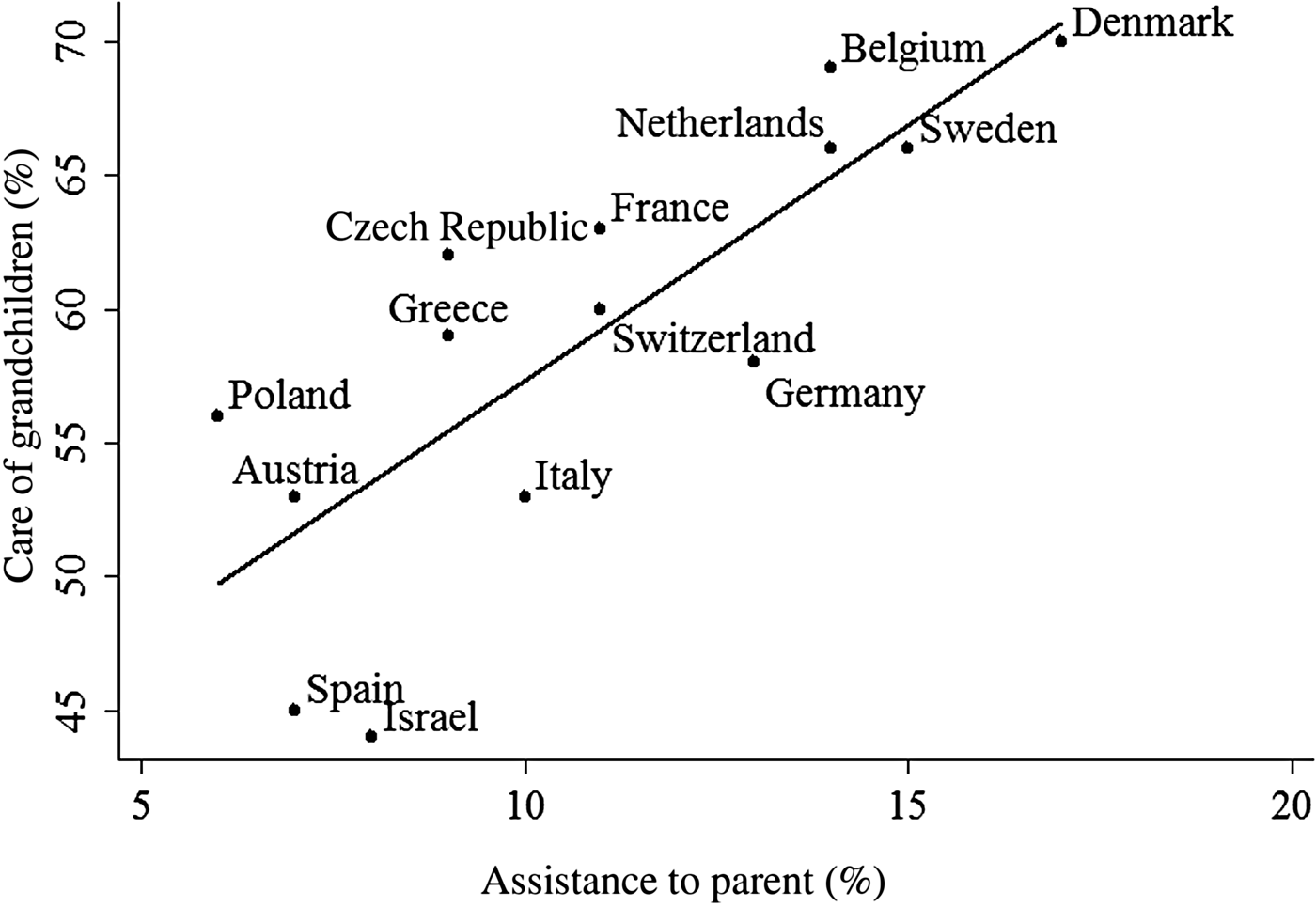
As mentioned above, previous research has suggested a general pattern of private caring regimes in different countries. As Figure 1Footnote 4 shows, a clear south–north gradient exists for the probability of looking after grandchildren and any kind of assistance to older parents by people aged 50+. Recent investigations are extended here by adding more countries from Eastern Europe. These countries (Poland and the Czech Republic) are similar to countries in Southern Europe with a rather low proportion of people providing care to their older parents and low engagement in grandchildren's care. The macro-level analysis does not suggest a conflict between caring roles because countries with a relatively high proportion of people helping their older parents show also a high proportion of people looking after their grandchildren regularly or occasionally.
Proportion of people who regularly or occasionally look after grandchildren and provide help to parents in European countries.

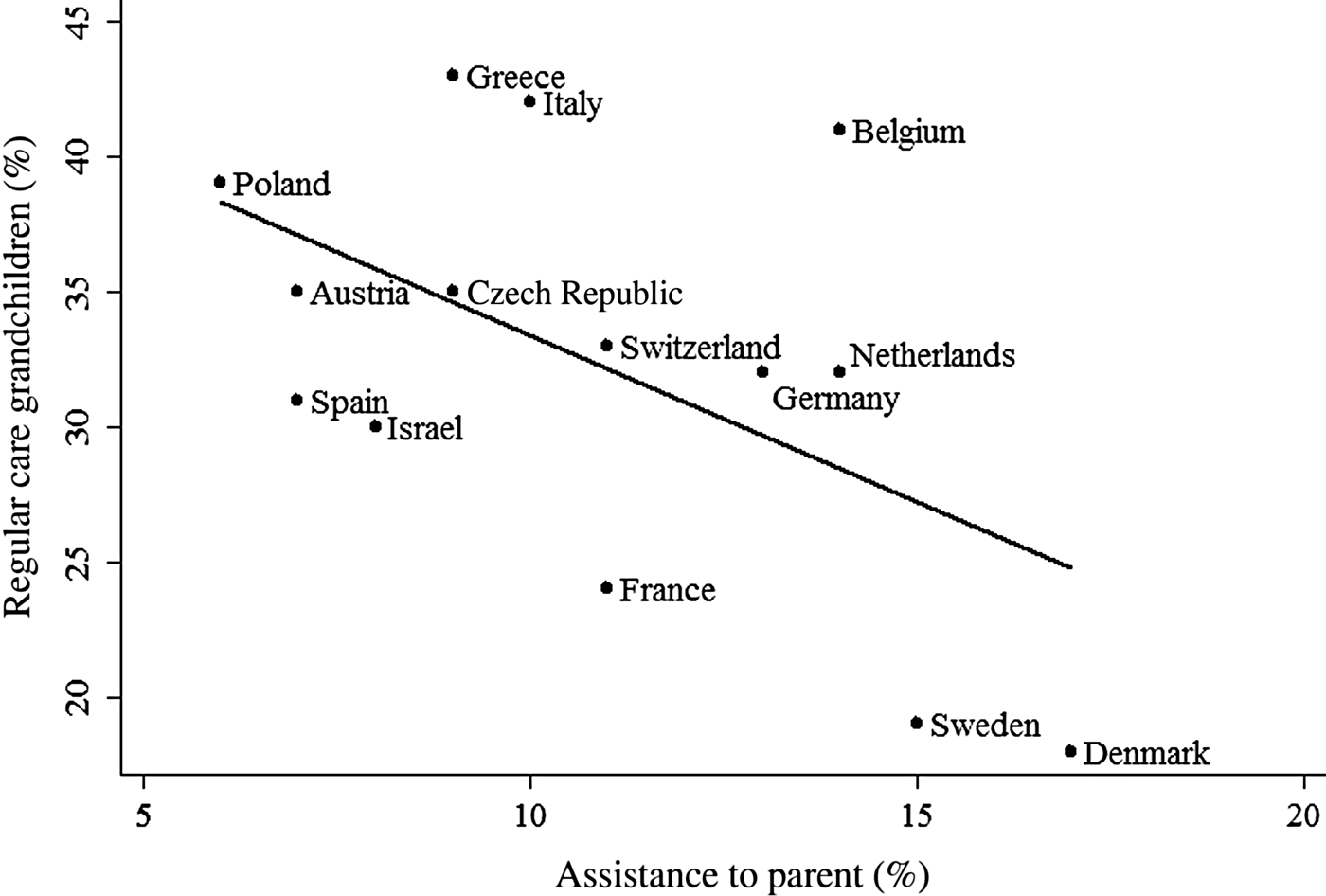
Figure 1, however, does not take into consideration the frequency of provided care. As has been shown, southern countries (and as expected, eastern countries) demonstrate a rather low proportion of people caring for their family members, but with a higher frequency and intensity than people from northern countries. Figure 2, therefore, displays an association between older regular care of grandchildren (daily or at least once a week) and any assistance to ageing parents. The association is opposite in this case. Southern and eastern countries show a higher proportion of regularly caring grandparents in comparison with northern countries. However, the negative association between regular care of grandchildren and assistance to older parents does not necessarily indicate the conflict between caring responsibilities but rather different arrangements of family services in European countries. Scandinavian countries ensure services and financial benefits for both child care and the care of older people; southern countries, on the contrary, keep most of the caring responsibilities within the family. A higher proportion of people who occasionally look after their grandchildren suggests that due to high accessibility of child-care services, people in Scandinavian countries do not care for grandchildren because it is necessary but because it brings them joy. Since their engagement in child care is rather sporadic, they can devote their time also to other members of the family.
Proportion of people who regularly look after grandchildren and provide support to parents in European countries.

To sum up, according to the macro-level part of the analysis, there are substantial differences across European countries in terms of caring responsibilities. While any care of grandchildren is positively associated with helping parents, regular care of grandchildren is correlated negatively on the country level. The next part of the analysis investigates whether this pattern exists also on the individual level after controlling for country effects.
Individual-level analysis
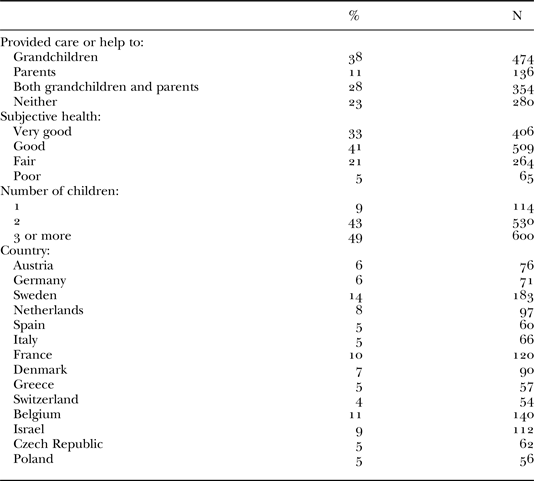
A total number of 1,244 respondents was selected for the second part of the analysis. The number is quite small since the sample is limited to respondents aged 50–69 and to those who have at least one grandchild aged 14 or younger and a living parent. Table 1 shows that most of the respondents provided care or help either to grandchildren or parents or both. Only 23 per cent of middle-aged people provided no assistance to parents or grandchildren. The largest share of respondents cared just for their grandchildren. However, also caring for both grandchildren and parents is quite common, since 28 per cent of respondents provided assistance to both groups.
Descriptive statistics: grandparents' care and help to older parents

Note: N = 1,244.
Source: Survey of Health, Ageing and Retirement in Europe, 2004–2012.
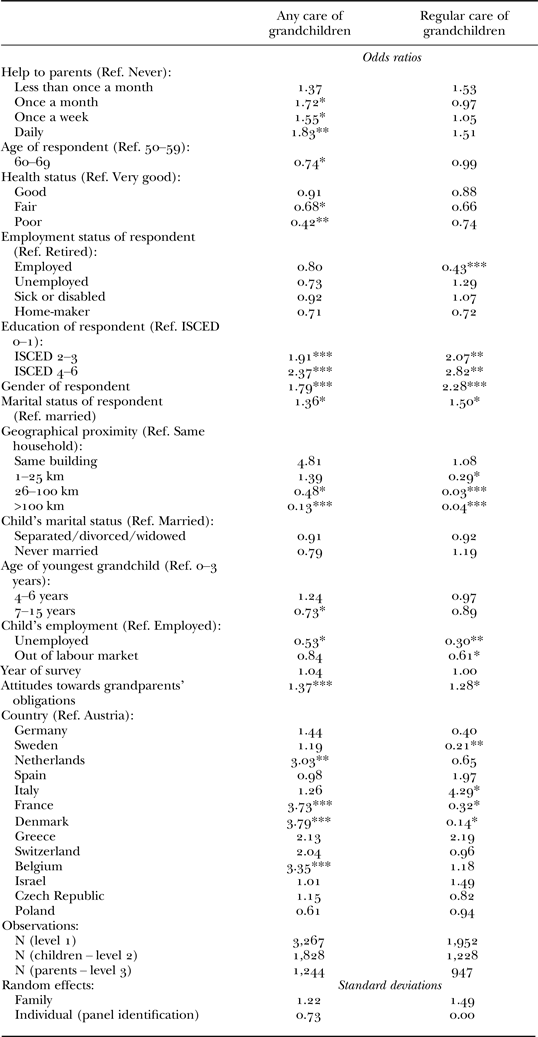
To investigate the relationship between the help provided to parents and the care provided to grandchildren on the individual level, two mixed-effects models for binary responses have been created (see Table 2). The final models show that the variation on the individual level cannot be explained only by differences across countries caused by different social policies. Models control for country fixed effects and there is still a rather strong connection between caring responsibilities of grandchildren and helping older parents.
Odds ratios of grandchildren’ care regardless of the frequency and regular care of grandchildren

Notes: Mixed-effects models for binary responses: odds ratios. Ref.: reference category. ISCED: International Standard Classification of Education. km: kilometres.
Source: Survey of Health, Ageing and Retirement in Europe, 2004–2012.
Significance levels: * 5 per cent, ** 1 per cent, *** 0.1 per cent.
The direction of the association is the same as for the macro-level analysis. People who provide help to their parents also tend to look after their grandchildren more than their counterparts without helping responsibilities. In addition, those who help regularly have the highest tendency to look after grandchildren. The dependency is still present after controlling for age and subjective health of respondents.
The second model which distinguishes between regular and occasional care is less clear. However, there is still some indication that those who provide help to their parents tend to care for their grandchildren more regularly than those who do not provide any help to their ageing parents. People who never provide any help to their parents are the least prone to look after their grandchildren. However, the sample size is quite small in this case (947 respondents) and the results do not reach statistical significance.
The main conclusion based on the two presented models is that the assistance provided to one family member generally does not decrease the probability of help to other family members. Furthermore, the individual random effects show a very low variability over time (approaching zero), indicating a strong stability of the caring tendencies.
Other factors affecting the probability of looking after grandchildren are similar for both models and are in accordance with previous findings. The likelihood of providing care of grandchildren is negatively associated with age (both grandparents' and grandchildren's), poor health, lower education, and being employed or unemployed (however, it is significant only for regular care of grandchildren and being employed).Footnote 5 Furthermore, the employment status of children also has a significant effect. Children who are employed receive help from their parents more often than children currently unemployed or out of the labour market. The child's marital status does not affect significantly the probability of grandparents' involvement in the grandchildren's care. Furthermore, the effect of geographical proximity is remarkable. The probability that grandparents look after grandchildren is higher if grandparents share the same building with their children than if they share the same household. However, respondents were asked if they had looked after grandchildren without the presence of parents. Grandparents sharing the same household with their children and grandchildren probably spend a significant amount of time with their grandchildren, but usually the parents are also present. Furthermore, those people who share the same household with their grandchildren might not report the time spent with their grandchildren. In some countries, the co-residency of parents and adult children is widely acceptable and common (Albertini and Kohli Reference Albertini and Kohli2013; Albertini, Kohli and Vogel Reference Albertini, Kohli and Vogel2007). People in multigenerational households can feel that they do not look after their grandchildren but simply spend time with them.
One of the important factors is the indicator of normative attitudes towards grandparents' obligations. Respondents who tend to agree that grandparents are obligated to support their grandchildren tend to look after them considerably more often than grandparents who do not think that it is the grandparents' obligation. This effect is not surprising; however, the normative attitudes obviously do not explain the association between help provided to parents and care provided to grandchildren. The explanation might be therefore related to other factors such as emotional bonds between family members or to the saturation of respondent's social needs rather than normative obligations.
The country effects show persisting significant differences across countries, even after controlling for many individual factors. The Netherlands, France, Denmark and Belgium show the highest tendency to any care of grandchildren, but lower relative tendencies towards regular care. On the contrary, Italy and Greece have the highest probability of being involved in the regular care of grandchildren.
Discussion
The present analysis follows the findings from research on intergenerational relationships that suggests there are increasing demands on the pivot generation. A substantial number of middle-aged people provide help to either their adult children or older parents or both. Providing instrumental help is related to different structures of needs and resources. Unlike the resources of emotional closeness, individual resources of time and energy are limited (Grundy and Henretta Reference Grundy and Henretta2006). The resources can be therefore exhausted by supporting some family member, while other family members are deprived of help. On the other hand, people who tend to support their relatives may share some characteristics that influence the support of both grandparents and grandchildren.
To investigate these two competing hypotheses, the association between looking after grandchildren and providing help to ageing parents has been examined. It is shown here that the positive association between caring responsibilities exists on the country level. The effect is opposite if the regular care of grandchildren is considered. People in northern countries care for their grandchildren rather sporadically but a higher number of them devote their time to older parents. Scandinavian countries are known for their high availability and accessibility of both child care and care services for older people. The state, however, obviously does not crowd out the family but it rather contributes to the voluntary and pleasurable character of family relationships.
Individual results indicate that the hypothesis of family solidarity is closer to reality. The care of grandchildren by people aged 50 or more with at least one grandchild younger than 15 years is much more frequent for people who also provide some help to their parents. Furthermore, there is an indication that the positive effect of providing assistance to older parents exists even when regular care has been considered. People who help their parents tend to look after their grandchildren more regularly than those who do not help. This association is not caused by the most relevant factors such as health status, employment status or age of respondents because the positive relationship between two analysed caring responsibilities is still clearly present after controlling for these confounding variables. Furthermore, controlling for attitudes towards grandparents' obligations does not eliminate the association between help provided to parents and care of grandchildren. Thus, it is suggested that the tendency to care is not strictly a matter of solidarity or at least not the normative one.
The results indicate that instead of a competition between different responsibilities, there can be some general tendency to care, which is based on factors not considered in this analysis, such as emotional closeness between family members and the saturation of respondent's social needs. The caring responsibilities can be therefore perceived from a cumulative perspective. Responsibilities of a specific group of people do not compete but accumulate and further investigation is necessary to analyse potential risks of excessive burden related to multiple caring responsibilities.
Future research should focus on several questions. First, what is this general tendency to care and how is it related to other individual characteristics? The present analysis does not control for a full range of respondents' attitudes towards family norms and values that are likely linked to their behaviour and relationships with relatives. Second, how do multiple caring responsibilities interact with other demands outside the family and do they have any consequences for the providers of care? Providing help to other people likely limits other activities of care-givers. Do people who simultaneously support more family members restrict their working activity? Does extensive helping of relatives influence the care-givers' health? Thirdly, available data do not allow a detailed investigation of the different intensities of care and help since SHARE researched the type of help provided only in the first two waves. However, the more demanding regular personal care of a dependent parent can have a negative effect on the likelihood of looking after grandchildren. Future research should consider these distinctions. Finally, only a limited examination of country differences has been provided in this paper. It is not clear how different welfare regimes and normative structures interact with multiple caring responsibilities across European countries. Including more countries in the analysis and employing a multi-level approach could explain country-level differences in a more detailed manner.
Acknowledgements
This paper uses data from SHARE Waves 1, 2, 3 (SHARELIFE), 4 and 5 (doi:10.6103/SHARE.w1.260, doi:10.6103/SHARE.w2.260, doi:10.6103/SHARE.w3.100, doi:10.6103/SHARE.w4.111, doi:10.6103/SHARE.w5.100), see Börsch-Supan et al. (Reference Börsch-Supan, Brandt, Hunkler, Kneip, Korbmacher, Malter, Schaan, Stuck and Zuber2013) for methodological details. The SHARE data collection has been primarily funded by the European Commission through the 5th Framework Programme (QLK6-CT-2001-00360), 6th Framework Programme (SHARE-I3: RII-CT-2006-062193, COMPARE: CIT5-CT-2005-028857, SHARELIFE: CIT4-CT-2006-028812) and 7th Framework Programme (SHARE-PREP: N°211909, SHARE-LEAP: N°227822, SHARE M4: N°261982). This research was supported by the Czech Science Foundation (Grant Number 14-36154G: Dynamics of Change in Czech Society). The funder played no role in the design, execution, analysis and interpretation of data, or writing of the study. Additional funding from the German Ministry of Education and Research, the US National Institute on Aging (U01_AG09740-13S2, P01_AG005842, P01_AG08291, P30_AG12815, R21_AG025169, Y1-AG-4553-01, IAG_BSR06-11, OGHA_04-064) and from various national funding sources is gratefully acknowledged (see www.share-project.org).