I. INTRODUCTION
Most material failures occur on the surface such as fatigue crack, wear, and corrosion. Accordingly, the surface properties are closely related to the overall behavior of the material. In recent years, many efforts have been focused on improving surface properties by conferring work hardening to the surface region of the material to generate a nanocrystalline surface layer. Most commonly used methods include surface nanocrystallization and hardening, Reference Dai, Villegas, Stone and Shaw1 equal channel angular pressing, Reference Murashkin, Sabirov, Kazykhanov, Bobruk, Dubravina and Valiev2 ultrasonic shot peening, Reference Yin, Hu, Hua, Wang, Suslov and Han3 and surface mechanical attrition treatment (SMAT), Reference Lu and Lu4 and so on. The obtained nanocrystalline surface layer with gradient hardness and compressive stresses enhances the materials' resistance to fatigue, wear, and corrosion. Reference Ya, Xing, Dai, Lu and Lu5–Reference Guan, Tang, Chu and Jiang7 Additionally, the nanocrystallization often gives rise to many unique and attractive mechanical and chemical properties in the material due to the resulted small grain size (<100 nm) and high volume fraction of grain boundaries. Reference Hamal and Klabunde8,Reference Tao, Wang, Tong, Sui, Lu and Lu9
45 steel has long been widely used for its moderate strength and good ductility. Reference Han, Gao, Zhang, Du and Liu10 However, the poor behavior in corrosion resistance becomes one of the negative effect for its application, as well as other metallic materials. Reference Oguzie, Li and Wang11 In most cases, the failures of materials are sensitive to the surface microstructure and the properties of material surface. Therefore, the question how to improve the corrosion resistance of materials via surface modification has attracted considerable scientific interest. Surface nanocrystallization is a popular means to enhance the corrosion resistance of metallic materials. For instance, Laleh et al. Reference Laleh and Kargar12 applied SMAT on AZ91D to achieve surface nanocrystallization and thus higher surface hardness and better anticorrosion properties. E. E. Oguzie et al. Reference Oguzie, Wang, Li and Wang13 applied magnetron sputtering to the surface of low carbon steel and reported that the corrosion rate of the nanocrystalline surface in aerated 0.5 M H2SO4 aqueous solution was lower than that of the bulk steel. S. Jelliti et al. Reference Jelliti, Richard, Retraint, Roland, Chemkhi and Demangel14 drew the conclusion that there were beneficial impacts of SMAT on corrosion behavior of Ti–6Al–4V alloy. Yang et al. Reference Yang, Cui, Lee, Zhang, Yin, Xia and Yang15 enhanced the corrosion resistance of magnesium alloy by means of plasma surface modification in chloride containing environments.
Recently, electropulsing-ultrasonic surface treatment (EUST) is reported to be a novel and highly efficient method to improve the plasticity and modify the microstructures of metallic materials. Reference Yanbin, Guoyi, Chanhung, Yaohua, Lei, Shaonan and Zhuohui16–Reference Lu, Zhang and Qin19 Previous researches on the effect of EUST in titanium alloys have demonstrated that electropulse addition is highly effective to increase the surface microhardness and enhance the corrosion resistance. Reference Kuang, Li, Ye, Tang, Liu, Wang and Tang20–Reference Ye, Kuang, Li and Tang22 Compared with traditional nanocrystallization processings, EUST is more efficient in microstructure evolution, the improvement of surface microhardness, the elimination of surface roughness, and the improvement of other properties of material surface. Reference Maawad, Brokmeier, Wagner, Sano and Genzel23–Reference Ye, Wang, Tse, Tang and Song26
In the present study, this technology combines high-frequency ultrasonic surface treatment (UST) and high-energy electropulsing processing to improve the properties of material surface in a short time. However, EUST, as an innovational and promising processing method of metallic materials, has not raised enough attention in microstructure evolution or the generation of continuous gradient microhardness layer in a single procedure and low temperature. Additionally, corrosion resistance is so significant in the application of metallic materials, which is also rarely reported for steel application in EUST process. Thus, microstructure evolution, gradient microhardness layer generation and anticorrosion performance of 45 steel processed under EUST were investigated in our work.
II. MATERIALS AND METHODS
A. Materials
The as-received 45 steel rods were processed by cold-rolled treatment prior to being cut into pole-shaped specimens with a dimension of Ф15 mm × 200 mm. The chemical composition of 45 steel is presented in Table I.
Chemical component of the as-received 45 steel rods.

B. Processing treatment and characterization
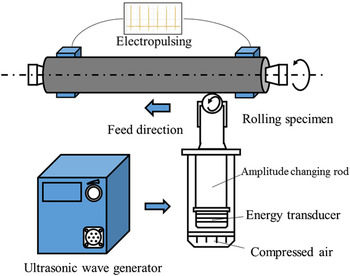
The UST and EUST experiments of 45 steel were carried out on the CJK0632 lathe. The schematic view of the experimental platform is shown in Fig. 1. In the processing, 45 steel specimen was held on the lathe by the chuck and the tailstock. The rotation speed of specimen was 18.84 m/min by calculation. The sample surface was treated by the working head with an ultrasonic vibration with a frequency of 30 kHz. The feed rate of working head was 0.1 mm/r and the force applied was 800 N. The ultrasonic vibration amplitude was 20 μm. For UST, the specimen was only subjected to ultrasonic vibration. For EUST, the high-energy electropulsing current and the ultrasonic vibration were applied simultaneously. The high-energy electropulsing current (500 Hz in frequency and 60 μs in pulse width) flowed through the sample via the electric brush. The maximum current density was calculated to be 7.61 A/mm2.
Schematic view of EUST set-up.

To investigate the influence of UST on microstructure evolution, microhardness evolution, anticorrosion performance and other properties of the sample surface with or without high-energy electropulsing current, we changed two key parameters, i.e., current density and treating times of UST, while kept the other parameters unchanged. The specimen without UST was the blank group in the experiments. Three-dimensional surface morphology was observed using HiROX KH-7700 three-dimensional Digital Microscope (Hirox China Co. Ltd., Shanghai, China). The microhardness of the specimen on cross-sections and the surface roughness was measured, respectively, by the Vickers indenter with a 0.987 N loading force and a Surtronic 25 Taylor Hobson roughness-meter (Taylor Hobson Ltd., Leicester, United Kingdom) with a measuring range of 4.0 mm the microstructure was analyzed using Hitachi S-4800 field emission scanning electron microscope (FESEM; Hitachi Limited, Tokyo, Japan). X-ray diffraction (XRD) phase identification was performed on Rigaku D/MAX-2500 diffractometer using Cu Kα radiation (Rigaku Corporation, Tokyo, Japan).
For the evaluation of the electrochemical corrosion behavior, sample electrodes were prepared by cold-resin mounting and the electrolyte solution was 3.5 wt% NaCl aqueous solution. Only 1 cm2 area of the sample electrode was exposed to the electrolyte solution. For all the tests, the open-circuit potential (OCP) was measured with a steady value through 2.5 h. The measuring system is a three-electrode system. Pt metallic slice was used as an auxiliary electrode and saturated calomel electrode (SCE) as a reference electrode. Potentiodynamic polarization measurements were carried out at a scan rate of 1 mV/s, in the potential range from −250 mV (SCE) in the cathodic direction to +1500 mV (SCE) in the anodic direction from OCP. During the corrosion process, the sample electrodes surface can be considered as a simple resistor (solution resistance) in series with a parallel combination of a resistor (polarization resistance) and capacitor (double layer capacitance). Reference Balusamy, Kumar and Sankara Narayanan27 Therefore, it is important to properly choose the scan rate for polarization study, otherwise it would incorrectly reflect the corrosion process. The scan rate should be set at a slow level to make sure the capacitors remain fully charged, so that the current/voltage relationship reflects only the interfacial corrosion process at every step of the polarization scan. Otherwise, it would reflect not only the corrosion process but also the charging of the surface capacitance. In such conditions, the measured current would be much greater than the current actually generated by the corrosion reactions. Reference Kumar and Sankara Narayanan28 In the electrochemical impedance spectroscopy (EIS) tests, the frequency of the alternating current started from 10 kHz and ended with 0.01 Hz, and the alternating current amplitude was 10 mV. All tests were conducted at room temperature.
III. RESULTS AND DISCUSSION
A. EUST-induced microstructure evolution
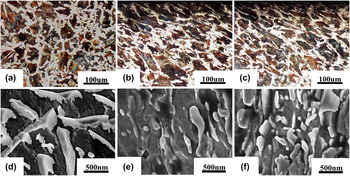
During EUST, impingement of the working head on the rotating 45 steel specimen greatly changed the microstructure of surface layer. The cross section microstructure evolution of the samples are shown in Fig. 2. We can see the classical microstructure of hypoeutectoid steel from Figs. 2(a) and 2(d), including white ferrite networks and gray pearlite lamellas in the surface layer of the original sample. When treated by UST, the surface microstructure deforms considerably [Fig. 2(b)]. The pearlite lamellas are partly destroyed into grains with nanoscale, as shown in Fig. 2(e). As for EUST, the electropulse enhances the influenced layer depth and the pearlite breaks into grains with a smaller size, as shown in Figs. 2(c) and 2(f). In the EUST process, the electropulse can help improve the migration of sub-boundaries, form new grains and boundaries, and accelerate the refinement of grains, Reference Ye, Liu, Ye, Wang, Tang and Song21 which accounts for the deeper impact layer and the smaller grain size.
Optical images of the top surface cross section for (a) untreated sample, (b) sample treated by UST for 5 times, and (c) sample treated by EUST for 5 times; scanning electron microscope (SEM) (10 kV) images of the top surface layer for (d) untreated sample, (e) sample treated by UST for 5 times, and (f) sample treated by EUST for 5 times.

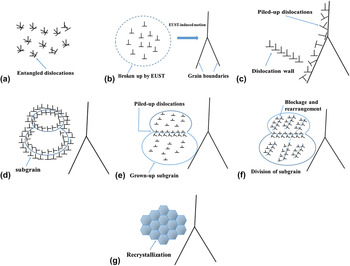
Figure 3 shows the concluded schematic view of EUST-induced microstructure evolution and surface nanocrystallization mechanism referring to dislocation behavior in the recovery and recrystallization process. Reference Ye, Li, Song and Tang29 After cold deformation, there are large amounts of entangled dislocations in 45 steel, as shown in Fig. 3(a). When treated by EUST, the tangled dislocations are rapidly broken up and arrange orderly [Fig. 3(b)]. Then EUST electron wind force pushes the dislocations toward grain boundaries forming dislocation wall, as shown in Fig. 3(c). Electropulsing thermal effect accelerates the nucleation of subgrains with a thick dislocation wall near the grain boundaries [Fig. 3(d)]. As subgrains grow, the thickness of the subgrain boundary reduces, and then sub-division of the subgrains occurs [Figs. 3(e) and 3(f)]. Figure 3(g) shows the formation of newly recrystallized grain microstructure under EUST process. In the nanocrystallization process, the high-energy electropulse can produce a large flux of vacancies, accelerate the atoms diffusion, and reduce the dislocation activation energy, so as to reduce the dislocation pinning and promote the movement of dislocations, Reference Zhou, Zhang, Wang, He and Guo30 which is helpful to expanding the ultrasonic impacted zone and accelerating the EUST-induced surface nanocrystallization process.
Schematic view of EUST-induced nanocrystallization mechanism referring to dislocation behavior in the recovery and recrystallization process: (a) entangled dislocations in the untreated state, (b) dislocations broken up by EUST and migration toward grain boundaries, (c) piled-up dislocations and formation of dislocation wall, (d) nucleus of subgrains with thick boundary, (e) grown-up subgrains and piled-up dislocations, (f) division of subgrains, and (g) newly formed recrystallized grains.

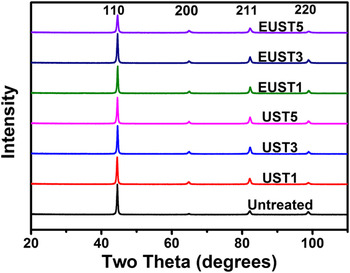
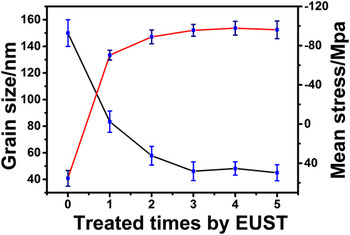
The XRD patterns of untreated and treated (UST and EUST for 1, 3 and 5 times) samples are shown in Fig. 4. We can see a reduction in intensity and a broadening of the peaks pertaining to Fe (110) planes for the treated samples, which could be due to the increase of defect density and nanosized grains induced during the treatment process. Figure 5 shows the average grain size and the residual stress measured as functions of treatment times of EUST. We measured the average grain size according to the Scherrer formula. When treated for one time by UST, the average grain size is 83.4 nm, and five times 48.2 nm, while the value of the EUST counterpart is 64.6 and 45.0 nm. We can see that, by the process of UST and EUST, nanosized grains can be obtained, and the grain size decreases with the increase of treatment times from 1 to 5. What's more, the EUST brings a faster transition trend and the grains are smaller than that of UST, which is correlated with the surface nanocrystallization by the coupling effect of electropulse and ultrasonic impact. Tensile stress was eliminated during the process of EUST, and compressive stress was induced concomitantly. Compressive stress tended to be stable swiftly as treated by EUST for one time, increasing slightly in the subsequent cycles.
XRD patterns of the surface of samples untreated and treated by UST and EUST for various times.

Change in average grain size and the mean residual stress of 45 steel treated by EUST for various times.

B. EUST-induced mechanical characteristics
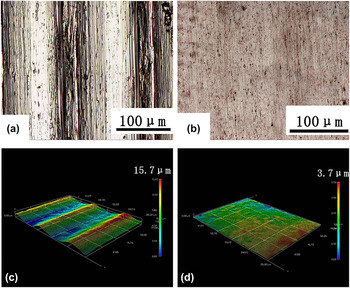
The process of EUST greatly improves the surface properties of 45 steel. We can see the rough scratches after turning in Fig. 6(a) and it's waved surface in Fig. 6(c). By contrast, the surface of sample treated by EUST looks smoother, as shown in Figs. 6(b) and 6(d). The surface roughness is found to be a function of the treatment times of EUST, which is presented in Table II. The surface roughness of the specimens decreases with the increase of times subjected to EUST, as well as UST. EUST decreases the surface roughness in a more effective way and keeps it at a more stable level due to the assistance of electropulse, which can promote the deformation of grains (explained in Fig. 3) to remove the folded zone on the surface and then improve the whole processability. Reference Ye, Yang, Song and Tang31
The surface morphology of 45 steel specimens obtained by 3D digital microscope (a) optical surface image after turning, (c) three-dimension surface morphology image after turning, (b) optical surface image treated by EUST, and (d) three-dimension surface morphology image treated by EUST.

The surface roughness (R a/μm) of 45 steel specimens treated by the UST and EUST.

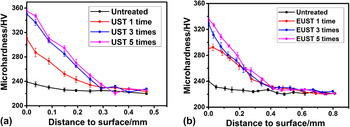
The Vickers hardness of the sample surface is shown in Fig. 7, which is a function of the distance from the surface. The impact depth of the surface strengthened layer can also be determined through the continuous gradient microhardness. As shown in Fig. 7(a), the surface microhardness shows an obvious improvement as treated by UST. Treated for one time, the microhardness of the surface is about 310 HV, exhibiting an improvement of 40% compared to the sample as-received whose hardness is about 220 HV. As the treated times increases, the surface microhardness also increases till the fifth treated time, after which the microhardness comes to a stable level of 350 HV, 60% higher than the original one.
The microhardness of the cross-section as the function of the distance to the surface of 45 steel samples treated by (a) UST and (b) EUST for various treating times.

As for the EUST-treated sample, the surface microhardness increases more mildly compared to the UST counterpart treated for the same number of cycles. When treated by EUST for one time, the microhardness increased by 32%–290 HV, while it is 310 HV treated for one time by UST. The similar situation occurs as the treated cycle increases. This could be attributed to the plasticity change induced by the electropulsing processing, which mildly inhibits the increase of microhardness. Reference Wang, Huo, Li and Fan32 What's more, the EUST-affected zone is about 400 μm in depth, 40% deeper than that of UST specimens. This should be explained by the effect of electropulsing current on the grain refinement, dislocation annihilation, and microcrack healing. Reference Zhou, Zhang, Wang, He and Guo30
C. EUST-induced corrosion behavior
1. Open-circuit potential measurements
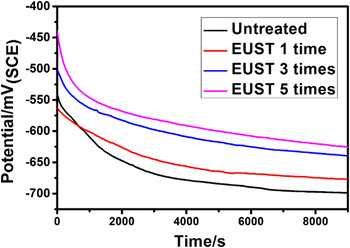
The variation of the open-circuit potential (E ocp) with time of samples treated by EUST for 1, 3, and 5 times in 3.5 wt% NaCl aqueous solution are shown in Fig. 8. We can observe an initial decrease in E ocp for all systems, after which E ocp comes to a steady value gradually. The plots show that surface nanocrystallization shifts the E ocp of 45 steel sample in the positive direction with the increase of the EUST times, implying that the surface becomes more stable after the treatment of EUST.
Open-circuit potential–time curves of 45 steel untreated and treated by EUST for various times in 3.5 wt% NaCl aqueous solution.

2. Potentiodynamic polarization measurements
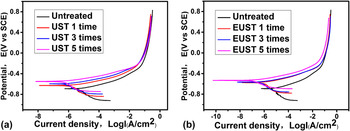
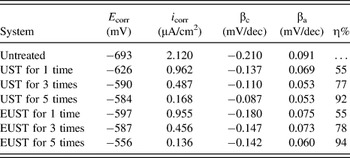
Typical cathodic and anodic polarization curves of untreated and treated (UST and EUST) samples in 3.5 wt% NaCl aqueous solution are illustrated in Fig. 9, and the corresponding electrochemical parameters including corrosion potential (E corr), corrosion current density (i corr), tafel coefficient of cathodic (βc), and anodic (βa) polarization curves for each sample are given in Table III. All samples exhibit the trend of transition to passivation at a potential about −0.20 V versus SCE. It suggests that similar corrosion mechanism is expected to occur for all samples, due to the similar polarization curve each we get. Surface nanocrystallization has an active influence on the polarization behavior of 45 steel in electrolyte solution, decreasing the current density and shifting the corrosion potential slightly in the positive direction. Nanocrystalline surface layer inhibited the anodic metal dissolution reaction on account of the decrease of microcorrosion area exposed to the electrolyte solution and the change of stress state in the surface layer during the process of both UST and EUST. Inhibition efficiency was calculated from the polarization data as follows Reference Ouici, Benali, Harek, Larabi, Hammouti and Guendouzi33,Reference Bılgıç and Çalıskan34 :
 $$\eta = {{{i_{{\rm{corr}}}} - i_{{\rm{corr}}}^\prime } \over {{i_{{\rm{corr}}}}}} \times 100\% \quad ,$$
where i
corr and
 $i_{{\rm{corr}}}^\prime$
are the corrosion current density of 45 steel samples untreated and treated by UST/EUST, respectively. Treated for one time by UST, E
corr was −626 mV (SCE), with a shift in the positive direction when compared to the untreated sample whose E
corr was −693 mV (SCE). The i
corr was 0.962 μA/cm2, 55% decreasing versus the untreated sample (2.120 μA/cm2). As the treated times increase, E
corr shifted in the positive direction slightly and i
corr got smaller and came to 0.168 μA/cm2 when treated for 5 times, with a decrease by 92%. We can see the similar behavior for the EUST samples. This is indicative of a lower corrosion susceptibility of the nanocrystalline surface.
Potentiodynamic polarization curves of 45 steel untreated and treated by (a) UST and (b) EUST for various times in 3.5 wt% NaCl aqueous solution.

Polarization data for UST and EUST in 3.5 wt% NaCl aqueous solution.

The corrosion behavior of sample surface can be explained in terms of the surface roughness, passive film formation, extent of grain refinement, stress state, and defect density changed during the process of nanocrystallization. Surface roughness has a tight relationship with the surface corrosion behavior. Reference Arslan, Totik, Demirci and Alsaran35 A smoother surface can generally offer the surface a better corrosion resistance. S. Yin et al. Reference Yin, Li and Bouchard36 have reported that a smoother surface would decrease the metastable pits on AISI 1045 steel. As shown in Fig. 6 and Table I, UST/EUST can make the sample surface smoother in a large degree, which would lead to an increase in electron work function and a decrease in microcorrosion area, and then decrease the corrosion rate. The formation of a passive film for each sample can be revealed from polarization curves as shown in Fig. 9. The passive film on the surface of all treated sample is easier to form and more stable compared to the sample as-received. The formation of passive film in the present study could be attributed to surface nanocrystallization, because XRD patterns (Fig. 4) of all treated samples did not reveal the formation of any oxides, which were reported to have the possibility to improve the passivity. Reference Balusamy, Kumar and Sankara Narayanan27
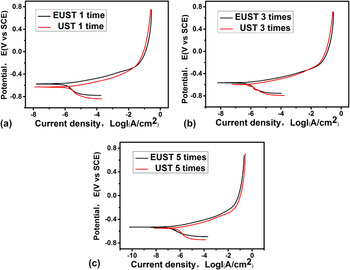
Grain refinement also has a significant influence on the corrosion resistance. In the nanocrystallization process, the impact of the working head has caused a reduction in grain size for all treated sample as we can see from Figs. 2 and 5. It has been reported that grain refinement could increase the corrosion rate of stainless steel, Reference Hassani, Raeissi, Azzi, Li, Golozar and Szpunar37 AZ31 magnesium alloy Reference Srinivasan, Zettler, Blawert and Dietzel38 and many other materials by forming several microelectrochemical corrosion cells. However, in the present study, UST/EUST has offered each treated sample an extremely smooth surface whose roughness was lower than 0.33 μm (R a), which actually led a great decrease rather than an increase in the number of active sites working as microelectrochemical corrosion cells in the electrolyte solution. What's more, the process of UST/EUST eliminated almost all the microcracks generated during the previous machining process, that also accounted for the decrease of corrosion rate. Therefore, the corrosion behavior of nanocrystalline surface cannot be analyzed only in terms of grain size or any certain single factor, but other factors such as residual stress, defect density, and surface free energy should also be considered. Potentiodynamic polarization curves of specimens treated by UST and EUST for one time, three times, and five times are shown in Fig. 10. When treated by EUST, the nanocrystalline surface performs better on corrosion resistance with a lower i corr and a higher E corr than the sample treated by UST for the same treatment time. In the EUST process, the high-energy electropulse has the function of tempering that can release most interior residual stress, which results in less surface free energy. Therefore, sample treated by EUST performs better on corrosion resistance.
Potentiodynamic polarization curves of 45 steel treated by UST and EUST for the same treated times: (a) one time, (b) three times, and (c) five times.

3. Impedance measurements
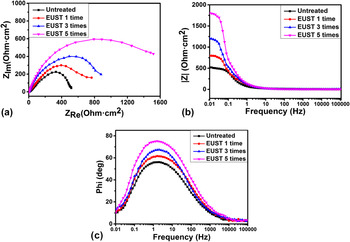
The Nyquist, Bode impedance, and Bode phase angle plots of samples untreated and treated by EUST for one, three, and five times are respectively shown in Figs. 11(a)–11(c). The Nyquist plots of all samples are quite similar and characterized by a single semicircle, indicating identical corrosion characteristics and the involvement of single time constant. It is obvious that EUST resulted in an increase in the diameter of the semicircle [Fig. 11(a)], in the impedance of the interface [Fig. 11(b)], and in the maximum phase angle [Fig. 11(c)]. This suggests that samples treated by EUST possess better corrosion resistance in 3.5 wt% NaCl aqueous solution. In the Nyquist plots, the expansion of the capacitance semicircle suggests a uniformity of the capacitance due to homogeneities associated with the electrode surface. The diameter of the semicircle increases as the treated times increase, meaning an improvement in the corrosion resistance. We can observe in the Bode plots only one maximum phase angle, about 56°, 61°, 67°, 75° at about 2 Hz, respectively, for samples untreated and treated by EUST for one, three, and five times. The higher phase angle extracted for the EUST film is indicative of an homogeneous surface compared to the untreated one, Reference Oguzie, Li and Wang11 as illustrated by surface morphology images in Fig. 6.
Electrochemical impedance plots of 45 steel untreated and treated by EUST for various times in 3.5 wt% NaCl aqueous solution: (a) Nyquist, (b) Bode impedance, and (c) Bode phase angle plots.

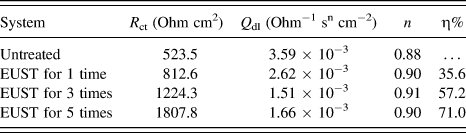
We analyze the impedance spectroscopy for the Nyquist plots by fitting to an equivalent electrical circuit model, as shown in Fig. 12. In this model, R s, R ct, and CPE represent solution resistance, charge transfer resistance, and constant phase element, respectively. The validity of this model is confirmed based on the nonlinear least square fitting of the experimental data with a little error (<4%). The values of the EIS parameters derived from the Nyquist plots using the equivalent electrical circuit model are compiled in Table IV. The terms Q dl and n represent the magnitude and exponent of CPE of the double layer capacitance, respectively. The impedance of CPE is described by the expression Reference LÓpez, Simison and de Sànchez39 :
 $${Z_{{\rm{CPE}}}} = {Q^{ - 1}}{\left( {j\omega } \right)^{ - n}}\quad ,$$
where j is an imaginary number and ω is the angular frequency in rad s−1. CPE is introduced as a capacitor to compensate for the deviations from ideal dielectric behavior associated with the nonhomogeneity of electrode surface. We can see from Table IV that, R ct of samples treated by EUST improves in a large degree as the treated times increase. When treated for five times, R ct improves by 71%, indicating higher corrosion resistance compared to the untreated one. The inverse case occurs for Q of the CPE, whose decrease normally results from the increase in the double layer thickness. Reference Lebrini, Bentiss, Vezin and Lagrenée40 As for the values of n, the slight increase indicates a smoother surface of the samples treated by EUST. The corrosion behavior of untreated and treated samples analyzed by open-circuit potential, potentiodynamic polarization, and EIS support with each other.
Nonlinear least square fitting for the Nyquist plots of 45 steel in 3.5 wt% NaCl aqueous solution: (a) untreated, (b) treated by EUST for one time, (c) treated by EUST for three times, and (d) treated by EUST for five times.

Electrochemical impedance parameters for UST and EUST in 3.5 wt% NaCl aqueous solution.

IV. CONCLUSIONS
In the present study, the coupling technology of high-energy electropulsing treatment and high-frequency UST was introduced into the nanocrystallization process of 45 steel, which fabricated a nanocrystalline layer on the material surface region. Structural analysis revealed that, EUST brought in a smoother (R a < 0.33 μm) and harder (>320 HV) surface layer, with a mean grain size of about 50 nm and compressive stress at about −95 MPa when treated for more than one time. As for the effect of high-energy electropulse, EUST was proved to be a highly efficient technique to accelerate microstructure evolution in the surface nanocrystallization process of metallic materials.
As for the synergistic effect of high-energy electropulse and ultrasonic impact, EUST decreased the surface roughness, the number of microelectrochemical corrosion cells and the surface free energy of 45 steel specimen, which led to a better performance in corrosion resistance. Open-circuit potential, polarization, and EIS studies indicated that the nanocrystalline surface and bulk steel have identical corrosion mechanisms in 3.5 wt% NaCl aqueous solution, with distinct transition to passivation within the potential range investigated. The results of polarization measurements revealed that the nanocrystalline microstructure inhibited the corrosion of 45 steel in the electrolyte solution, decreasing the current density by 55% from 2.120 to 0.962 µA/cm2 and shifting the corrosion potential to positive direction. EIS studies showed that the nanocrystalline layer decreased the kinetics of the anodic reaction and increased charge transfer resistance (R ct) by 36% from 523.5 to 812.6 Ohm cm2, which account for the corrosion resistance enhancement.
ACKNOWLEDGMENTS
This project is supported by Science and Technology Research Funding Project of Guangdong Province (Grant no. 2014B090901029) and Research & Development Funding Project of Shenzhen (Grant no. JCYJ20140417115840280 and CXZZ20140702113545562).