R1. Introduction
We were pleased to receive comments on a wide range of aspects of our proposed model. Some commentaries provided supportive evidence from areas we had not touched upon in our review (e.g., development of body representation, Christie & Slaughter), others had important comments on the nature of the proposed dissociations between functional and neural entities and possible interactions between them (e.g., Brozzoli, Farnè, & Rossetti [Brozzoli et al.]; Drewing & Schneider; Holmes & Spence), and some found fault with general idea of separate processing pathways for action and perception in the somatosensory system (e.g., Graf; Marin & Lagarde; Travieso, Aivar, & Gomilla [Travieso et al.]). Finally, several comments were related to detailed aspects of the model, which we had not filled in sufficiently (de Vignemont; Hughes; Klatzky & Lederman; Tessari & Borghi; Vallar). As a first response, we feel encouraged by the overall positive reactions to our ambition to summarize the existing literature into a comprehensive and testable model of somatosensory processing. We hope that it will serve as a platform for generating new research, and the comments we have received suggest that we have already succeeded to some degree.
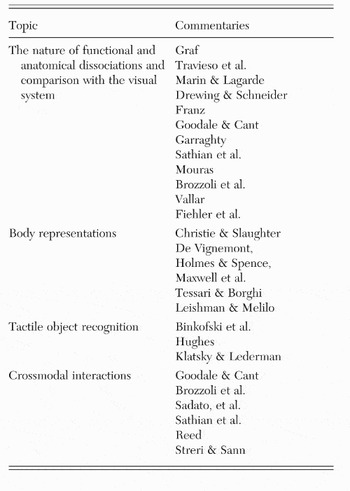
We have organized our detailed response in separate sections, each dealing with commentaries on specific parts of our target article. The following aspects are discussed: (1) the nature of the anatomical and functional dissociations and comparison with the visual system; (2) body representations; (3) haptic object recognition; and (4) crossmodal interactions (see Table R1).
An overview of the commentaries for each section of this response

R2. The nature of functional and anatomical dissociations and comparison with the visual system
One of the starting points of our review was the analogy with the visual system in which two separate processing streams have been identified by Milner and Goodale (Reference Milner and Goodale1995) for visuomotor control and object recognition. Several commentators question the strict distinction between processing for perception and action for the somatosensory, as well as for the visual system (Graf; Marin & Lagarde; Travieso et al.). All three commentaries cite evidence in favour of close interactions between perception-related and action-related processes, but from different angles. With respect to the commentaries of Marin & Lagarde and Travieso et al., part of the differences in opinion seems to be related to differences in definition of what perception constitutes. Both commentaries implicitly seem to equal perception to “processing of sensory signals.” In contrast, within the context of the perception-action dichotomy, we use the term perception in a more strict sense. Here, “perception” is conceptualized as a goal for processing, in this case, recognition and conscious experience. This may cause confusion as visual sensory processes, such colour or texture extraction, are in this view not perception. These are the primitives that may be used to achieve perception.
Another confusion concerns the erroneous interpretation of our model that there is a strict division between the two pathways from different types of peripheral sensory input up to high-level processes (i.e., conscious perception or action). For instance, Travieso et al. suggest that proprioceptive input aids object recognition, and, on the other hand, cutaneous input is involved in motor control, which would contradict our model. However, we entirely agree with this idea and have never meant to suggest that tactile input is solely related to object recognition and proprioception to action. In section 2 of the target article, we state the following:
Indeed, certain types of input may be more important for certain tasks, with proprioceptive input contributing more to action-related processes, and the skin receptors providing more information for perceptual purposes. However, this mapping of different somatosensory submodalities to output is by no means absolute. (sect. 2, para. 4)
As we suggested before, it is not the input characteristics rather than the purpose of sensory processing that determines the processing routes. Therefore, several examples provided by Marin & Lagarde and Travieso et al. do not, in our opinion, contradict our model (e.g., haptic involvement in object recognition [mentioned earlier here]; cutaneous involvement in motor control; phase synchronization).
A central issue is raised by Graf, who questions the validity of this distinction in vision. He suggests that – as we proposed for the somatosensory modality – that there are substantial interactions between the two visual pathways, as well. He discusses three lines of evidence, which are mainly concerned with the idea that the ventral object recognition stream uses visuospatial information and invokes parietal activation. First, perception and action operate conjunctively when eye movements actively explore a visual scene. Second, regions within the parietal cortex are recruited in certain recognition tasks, such as misoriented or distorted images of objects. Finally, Graf argues that the processing principles in the “what” and the “how” streams might be more comparable than Milner and Goodale have put forward. These comments are important as they concern our conceptualisation of two separate processing steams. Drewing & Schneider express similar concerns. They suggest that we have put forward a convincing case for a functional dissociation between “how” and “what” streams but have failed to disentangle the functional description from structure. They point to the act of manipulating external objects as the most poignant example of a situation that requires heavy interactions between structural areas. We are grateful to Graf and to Drewing & Schneider for raising this issue in such an eloquent manner as this provides us with an opportunity to clarify our position on this matter (which has been commented on by others, too, e.g., Brozzoli et al.; Franz; Goodale & Cant).
We envisage a cumulative approach in which it is useful to delineate the major processing steams first. The work of Milner and Goodale was exemplary here as they proposed one of the first models of vision that focussed on the objective, to which end information was being processed – that is, vision for action versus vision for recognition. The distinction between these pathways was further corroborated by the finding of parallel processing. Neuropsychological double dissociations (Milner & Goodale Reference Milner and Goodale1995), differential activations in imaging studies (Culham et al. Reference Culham, Danckert, DeSouza, Gati, Menon and Goodale2003; James et al. Reference James, Culham, Humphrey, Milner and Goodale2003) and distinct differences in behavioural tasks (Pelisson et al. Reference Pelisson, Prablanc, Goodale and Jeannerod1986) have all supported the idea that one stream can function independently of the other. However, these observations do not preclude the possibility of cross-talk between the processing streams. It was always likely that this was the case in vision, given the anatomical connections between the ventral route and the dorsal route, and it is logically necessary in somatosensory processing. Milner and Goodale (Reference Milner and Goodale1995) already stated that the two streams are not “hermetically sealed” (see also Goodale & Cant). In sum, we agree with Graf that there is evidence for cross-talk in the visual system, but in our view this strengthens the idea of separate pathways. This probably applies to vision, audition, and somatosensory processing. In order to prevent circularity of arguments and to allow the model to be falsifiable, clear, a priori descriptions are required of the type of tasks in which interactions between the pathways occur, and the putative neural mechanisms. These descriptions should allow testable hypotheses to be developed.
The suggestion by Drewing & Schneider that it is “attention” that forms the “glue” between the two systems is interesting and requires further study. It appears to us, however, that a substantial amount of processing that depends on both pathways does not require conscious attention. The issue of attention is also discussed by Franz. She suggests that it is the allocation of attention that determines which pathway is engaged. Again, we have no problem with this suggestion, although we would like to see a more tangible definition of attention and especially of the concept of allocation. There is a risk here of reverting back to the idea of a homunculus in charge of an army of talents. Franz's suggestion that attention might to some extent “define the functions of different systems … attention itself might be a guiding principle” (para. 6) is beyond the scope of our model. Our proposal is less ambitious and merely tries to define the function of somatosensory subcomponents in terms of goal-specific processing.
Another issue that is brought up in several commentaries concerns the nature of the processing characteristics within the two visual streams. In particular, it has been suggested that other distinctions or dichotomies (than perceptual and action) may be more appropriate to describe the ventral and dorsal stream functions (Brozzoli et al.). As previously described by Milner and Goodale (Reference Milner and Goodale1995), and summarized in our target article, a distinction based on what the sensory input is used for, does have consequences for the processing characteristics in each stream. That is, accurate performance of a goal-directed grasping movement may require different visual parameters than, for example, successful recognition of an object. As a consequence, the characteristics of visual processing in the dorsal stream (real-time egocentric) differ in a number of aspects from ventral stream processing (viewpoint-independent and storage over a longer period). Milner and Goodale further suggest, as we mentioned, that ventral stream processing may be required for several aspects of visuomotor action, for example, when a delay is introduced between the stimulus display and the motor action (see also Goodale et al. Reference Goodale, Jakobson and Keillor1994; Milner et al. Reference Milner, Dijkerman, McIntosh, Rossetti and Pisella2003). This is also true during the visual control of grip force (as Goodale & Cant describe in their commentary) or, indeed, when the motor response depends on an allocentric spatial representation. The recent observation of a dissociation between ego and allocentric task performance of patient D.F. (Schenk Reference Schenk2006), therefore, does not seem inconsistent with the original proposal put forward by Milner and Goodale and indeed has been reported previously (Carey et al. Reference Carey, Dijkerman, Murphy, Goodale and Milner2006; Dijkerman et al. Reference Dijkerman, Milner and Carey1998; Murphy et al. Reference Murphy, Carey and Goodale1998). We suggest that action-related processing and perception-related processing in the somatosensory system differ with respect to a number of characteristics. For example, several authors have suggested that the somatosensory characteristics contributing to different body representations differ, with the action-related body schema representation being mainly fed by bottom-up signals from the entire body and being less enduring than the perceptual body image that can also be prone to local inconsistencies (Tsakiris et al. Reference Tsakiris, Prabhu and Haggard2006) (see also section R3 on “Body representations”).
Brozzoli et al. wondered whether action is less susceptible to somatosensory illusions. There now is evidence from at least four different somatosensory illusions that suggest task-dependent differences of these illusions. The effects of a haptic size contrast illusion on grasping and perceptual size matching responses were described by Westwood and Goodale (Reference Westwood and Goodale2003). Differential effects of the vibrotactile illusion have been reported by Marcel (Reference Marcel, Roessler and Eilan2003) and Kammers et al. (Reference Kammers, van der Ham and Dijkerman2006), and the rubber-hand illusion is discussed in section R3. In addition, we have recently obtained opposite patterns for size matching and grasping responses involving Weber's illusion (Anema et al., submitted b). We are therefore confident that differential effects of somatosensory illusions on perception-related and action-related responses do exist, although we do not claim that motor responses are always more veridical. Whether they are also present for the after-effect described by Brozzoli et al. remains to be tested.
The discussion by Garraghty regarding the physiological data on somatosensory processing across species is crucial. The suggestion that cats and primates may have a different architecture is important to the degree that we should not over-generalise data from other species (see also Sathian, Lacey, Gibson, & Stilla [Sathian et al.]). More important are the suggestions concerning the role of the different modality-specific processing areas. Garraghty and others will have noticed that we have omitted the use of the term primary somatosensory area (SI) in our target article, because we were aware of the ongoing debate about the specific role of these primary somatosensory areas. More research is needed to define the precise distribution of labour here. Furthermore, Sathian et al. comment on differences in cortical areas involved in processing of different somatosensory submodalities, with the anterior parietal cortex (APC) being associated with kinaesthesis and tactile input and the parietal opercular-insula region being involved in thermo-nociceptive processing. We are, of course, aware of input from touch thermal and pain receptors to the insula, bypassing the APC (Craig Reference Craig2002; Olausson et al. Reference Olausson, Lamarre, Backlund, Morin, Wallin, Starck, Ekholm, Strigo, Worsley, Vallbo and Bushnell2002). Indeed, the work of Craig described in our article has been particularly relevant, and this input may be especially important for the affective aspects of body representations as mentioned in section 3.2. The data presented by Mouras in his commentary are also consistent with the idea of involvement of the posterior insula in sensory processing for affective body representations. However, the context in which he defines goal-directed behaviour is somewhat different from ours.
The neural basis of somatosensory processes is also discussed by Vallar. His insightful commentary provides several important additions and specifications to our proposed model. He is correct when he observes that we have not always been very specific about laterality differences regarding somatosensory processing. His suggestion that higher spatial representations related to the right hemisphere not only play a role in tactile object recognition and higher-order perceptual body representations, but also in the more basic ability to detect somatosensory stimuli, is convincing. Indeed, in addition to temporary improvement of tactile detection after left caloric stimulation, we have also observed a long-term improvement in tactile pressure sensitivity and proprioceptive finger-position sense after adaptation to rightward-displacing prisms in a patient with a right hemisphere lesion (Dijkerman et al. Reference Dijkerman, Webeling, Ter Wal, Groet and Van Zandvoort2004). A second suggestion made by Vallar concerns the role of the premotor cortex. Our model has mainly been concerned with posterior cortical areas, but we agree that the premotor cortex is also important for bodily awareness and ownership. Evidence for this comes from patient studies (e.g., see Arzy et al. Reference Arzy, Overney, Landis and Blanke2006a) and functional imaging studies using the rubber-hand illusion (Ehrsson et al. Reference Ehrsson, Spence and Passingham2004; Reference Ehrsson, Holmes and Passingham2005a).
A further comment regarding the neural basis of somatosensory processes was made by Fiehler, Engel, & Rösler (Fiehler et al.). The neural areas involved in memory for haptically explored objects (secondary somatosensory cortex [SII], insula, and posterior parietal cortex [PPC]) and haptically encoded spatial positions (SII and PPC) are similar to the areas we proposed to be involved in haptic object recognition and spatiotemporal integration. The idea of storage of somatosensory representations for actions is in our opinion more controversial. Fiehler et al. cite evidence from a hand-movement recognition task, showing activation of APC, SII, and PPC. Although not described in detail, the hand-movement sequences made in this task were probably not goal directed and may involve different somatosensory processes, compared with goal-directed grasping movements (this distinction is similar to that made between optic ataxia and apraxia in the visual modality). Again, the maintenance of hand-movement sequences which increase in length may require greater temporal-spatial integration, resulting in activation of the PPC. In contrast, the numbsense patient studied by Rossetti et al. (Reference Rossetti, Rode, Boisson, de Gelder, De Haan and Heywood2001) reverted to chance-level performance when reaching movements were made after a delay of only a few seconds. This finding suggests little, if any, memory capacity when somatosensory target input is processed for guidance of a goal-directed action.
R3. Body representations
The commentaries raised several important points regarding the functional characteristics of different body representations. Interesting supportive evidence for different body representations for perceptual and action-related responses comes from developmental studies. Christie & Slaughter suggest different developmental trajectories for sensorimotor representations (present before birth) and recognition of one's own body (present at 5 months of age). This is followed by manual exploration of objects at about 6 months of age, while higher-level visuospatial and higher-level body representations appear even later. These findings are consistent with the idea of multiple body representations, although they by no means rule out a certain interdependence between the development of the different representations.
The commentaries by Holmes & Spence and by Maxwell, Masters, & van der Kamp (Maxwell et al.) both relate to possible interactions between action-related and perception-related representations. Holmes & Spence describe the effect of the rubber-hand illusion on different measures of limb displacement. They suggest that the visual capture effect and the feeling of ownership result in a larger displacement as compared to proprioceptive drift (as measured by pointing movements). This is consistent with a differential effect of the illusion on action-related responses as compared to perceived position and body ownership. Recent work from our lab also confirms that the rubber-hand illusion has a stronger effect on perceived position of the hand as compared to motor localisation responses (Kammers et al., submitted). Holmes & Spence, however, argue that a link is required between the body image and the body schema representations, as the illusion is significantly stronger when the rubber hand is placed in an anatomically compatible position. This suggests that input from a postural schema is used during the rubber-hand illusion. In our view, this finding is also compatible with the idea that structural knowledge about the body is important for inducing the arm displacement in the rubber-hand illusion. Structural knowledge about the body would be related more to perceptual body representations as compared with sensorimotor representations (see also, Buxbaum & Coslett Reference Buxbaum and Coslett2001; Schwoebel & Coslett Reference Schwoebel and Coslett2005). Note that this does not mean that we consider the body image and body schema as entirely separate representations without any scope for one to influence the other. There are probably many instances in which perceptual representations influence sensorimotor representations (see sect. R2). Here of course the danger of a non-falsifiable model resurfaces, and one of the current challenges is to define the specific conditions and circumstances in which such interactions occur.
Maxwell et al. suggest that the body image may not always be unconscious. They describe several instances in which performers are aware of how their body moves during their actions, and they describe how this usually has a detrimental effect on the performance of the movements. Although it feels intuitively plausible to consider that the input one is aware of is the same that is used to guide one's actions, this may not necessarily be the case. Studies with somatosensory illusions, such as the vibrotactile illusion (Marcel Reference Marcel, Roessler and Eilan2003; Kammers et al. Reference Kammers, van der Ham and Dijkerman2006), but also the rubber-hand illusion (as discussed earlier), suggest that the position of where one consciously perceives one's arm to be is not necessarily the position one's motor system “considers” the arm to be at. Rather, the effects described by Maxwell et al. suggest that the perceptual body image may be able to influence the motor system, but is less proficient in doing so.
Holmes & Spence's comments regarding the effect of a postural schema on the rubber-hand illusion also relate to the precise definition of the different body representations. Uniformity in definitions unfortunately is rather lacking, as de Vignemont and Christie & Slaughter point out. We have tried to be clear in our definition by linking it to some of the most well-known descriptions of body image and body schema made by Paillard (Reference Paillard, Gantchev, Mori and Massion1999) and Gallagher (Reference Gallagher2005). But a detailed description is wanting. De Vignemont and Christie & Slaughter are, therefore, right to suggest that further specification and more precise definitions are an important next step. De Vignemont provides some useful suggestions about which criteria to use and which pitfalls to avoid, and she also suggests that a distinction between action-oriented and recognition-oriented body representations may not be such a clear criterion as we assume.
Of course, these are very broad categories which can easily be further subdivided, and we agree that this may be necessary. Nevertheless, we suggest that a basic organisation principle of sensory systems, including the somatosensory system, is that processing depends on task requirements; and considering that these are different for action-related and perception-related responses, we assume different processing characteristics. Indeed, body representations may be dynamic in nature, in that they draw upon different input sources (visual, proprioceptive, tactile, semantic, and structural knowledge) to different extents, depending on task requirements. The basic difference between body representations may be their access to certain input sources. For example, the action-related body representations may not be influenced by semantic and other cognitive knowledge about the body, whereas the body image is. Tessari & Borghi also comment on the definitions of different body representations and suggest we did not relate the body image to semantics in our model. Indeed, we have not been very explicit, in either the target article text or in its Figure 1, about the link between body image and semantics, although we do mention this in the text. As described earlier in this response, we do consider this link to be important and a characteristic that distinguishes body image from body schema. Other aspects that are mentioned by Tessari & Borghi and by Brozzoli et al. are the dynamic nature of the body schema (in that it can be modified during tool use) and perspective taking. We agree that the dynamic nature of the body schema is an important characteristic and one that may be less applicable to the body image (Gallagher Reference Gallagher2005).
Regarding perspective taking, this has been an issue mainly with respect to visual representations of body parts. As somatosensory input is inherently egocentric, this topic has received considerably less attention (but see Newell et al. [Reference Newell, Ernst, Tjan and Bülthoff2001] for the role of perspective taking for haptic object recognition). Nevertheless, it would be of interest to assess whether haptic input can lead to representations from a third person's perspective, and we are currently planning such experiments. With respect to imitation, an accurate representation of one's own body no doubt plays an important role as suggested by Tessari & Borghi; however, this is not only fed by somatosensory input, but also by visual input. Indeed, the studies mentioned by Tessari & Borghi – Buxbaum et al. (Reference Buxbaum, Giovanetti and Libon2000), Chaminade et al. (Reference Chaminade, Meltzoff and Decety2005), Goldenberg (Reference Goldenberg1996) – mainly deal with visual imitation and do not specifically assess the role of somatosensory input pertaining to the body. We would hypothesize that if the somatosensory body schema, as defined in our target article, is impaired, this may affect visual imitation. However, to our knowledge this has so far not been tested.
One interesting aspect touched upon by Leishman & Meillo is the difference between global and local processing. They suggest that, for visual input, global processing is generally related to dorsal stream processing, whereas local processing is related to the ventral stream. A similar suggestion has been put forward with respect to body representations. Gallagher (Reference Gallagher2005) suggested that the body schema functions in a holistic and more integrated way, in contrast to the body image, which may involve partial or local representations of the body (and therefore also be more susceptible to inconsistencies such as those evoked by the rubber-hand and vibrotactile illusions). We, therefore, view this as another example of similarities in functional organisational principles between different modalities.
R4. Haptic object recognition
Across the commentaries, comments regarding the tactile object recognition emphasize the interaction between somatosensory processing for perception and for action (Binkofski, Reetz, & Blangero [Binkofski et al.]; Graf; Marin & Lagarde; Reed; Travieso et al.). As several commentaries deal with visual, as well somatosensory, processing, they are discussed in different sections. Binkofski et al. focus their commentary on the role of area intraparietal sulcus (AIP) in object recognition. They suggest that this area appears to be involved in haptic object recognition, as well as exploratory finger movements. They proposed that AIP may be a crucial interface between perceptual and action-related processes. This is entirely consistent with our ideas and indeed has been mentioned in section 3.1 of the target article.
Klatzky & Lederman suggest that haptic rather than tactile object recognition is a more accurate description, because recognition of objects does not only involve tactile but also proprioceptive input. This is, of course, correct, and we do agree that haptic may be a more accurate description. However, especially in the neuropsychological and functional imaging literature, the term tactile object recognition is commonly used, which is why we adopted it. More importantly, Klatzky & Lederman further specified different stages during object recognition, based on their model (Lederman & Klatzky Reference Lederman and Klatzky1990). We agree that haptic object recognition does not necessarily always involve extensive exploratory finger movements and that Stage 1 (grasping, and where appropriate, lifting) may be sufficient. Again, considering the wide scope of the target article, we were unable to discuss different strategies to achieve object recognition in detail, and we are grateful to these authors for stressing this point in their commentary. Klatzky & Lederman's proposal of variations in the involvement of the APC-PPC and APC-SII-insula routes, depending on the extent and purpose of exploration, is interesting and warrants further investigation. We would like to add that different components of the APC-PPC route may be involved in the movements made during Stage 1 (grasping and lifting) and Stage 2 (extensive exploration). For example, neurons in area 5 in monkeys have been related to grasping (Stage 1) (Debowy et al. Reference Debowy, Ghosh, Ro and Gardner2001; Gardner et al. Reference Gardner, Ro, Debowy and Ghosh1999; Ro et al. Reference Ro, Debowy, Ghosh and Gardner2000), whereas AIP is involved in exploratory finger movements, as mentioned by Binkofski et al., and in grasping (Culham et al. Reference Culham, Danckert, DeSouza, Gati, Menon and Goodale2003). Whether right hemisphere dominance for haptic object recognition may also be particularly related to Stage 2, or is involved in other aspects of somatosensory processing as suggested by Vallar, remains to be tested.
Klatzky & Lederman and Hughes further mention the difference between distal and proximal levels. The main point raised by Hughes relates to the mechanism that produces a transition of proximal stimulation of the skin to an object representation through distal attribution. He describes the example from Gibson (Reference Gibson1962) which illustrates how, when holding a pencil, contact with five-finger pads can result in the percept of one object. Hughes wonders how the question of distal attribution can be answered by the data used for developing our model. We have glossed over this important issue, and we are grateful to Hughes for raising it. Although the mechanisms through which distal attribution is achieved are far from clear, we hypothesize that the APC-SII-insula route would be particularly important. This would involve a combination of increasingly complex feature processing within this route, crossmodal interactions, and top-down influences from higher-order perceptual and semantic systems situated within the infero-temporal cortex. Interestingly, the examples provided by Gibson (Reference Gibson1962) and Benedetti (Reference Benedetti1985; Reference Benedetti1986) suggest that the spatial configuration of the hand influences perceptual processing of external stimuli. Recent experiments on finger agnosia in a patient with Gerstmann's syndrome also support this point. This patient was impaired when asked to state verbally, or point to a line drawing of a hand, which finger had been touched (Anema et al. Reference Anema, Kessels and Dijkerman2006). Nevertheless, she performed normally when asked to point directly to the touched location, suggesting a perceptual “finger image” impairment with intact “finger schema” (cf. Paillard Reference Paillard, Gantchev, Mori and Massion1999). She additionally showed an impairment in perceptual integration of tactile stimuli in external space across fingers, suggesting that internal perceptual body representations can influence perception of external tactile stimuli (Anema et al., submitted a) This suggests that representations of the body influence representations of external stimuli, similar to interactions between perceptual and sensorimotor processes. An important challenge for future research is to establish when and how these interactions occur.
R5. Crossmodal interactions
There is now abundant evidence for a close collaboration between the sensory modalities. This means that any model concerned with sensory processing should take these interactions into account. In our target article, we have addressed a number of issues in this realm, but we have not covered all possible crossmodal phenomena. One such omission is commented on by Goodale & Cant, who remind us that calculating the grip force and load force during reaching movements requires adequate knowledge about the material properties. More importantly, they emphasize the close collaboration that is required between the visual and somatosensory systems for the act of manipulating external objects. Vision guides us towards objects, whereas somatosensory feedback informs us in detail about the weight and size. This information is used to fine-tune the forces applied to the object. Functional imaging studies have discerned dedicated areas within the ventral system that encode objects' surface characteristics, such as texture, that help to define the material properties. We completely agree with the suggestion that this information, in addition to stored knowledge about objects, is used in modulating reaching movements. In fact, it is reminiscent of our proposals regarding the interactions between the two somatosensory streams. Streri & Sann's commentary concerning the developmental trajectories of visuo-tactile interactions also supports the idea of a separate crossmodal system for sensory processing for perception and action because the influence of vision differs. In addition, a further distinction can be made between macro- and micro-geometric properties with respect to perceptual crossmodal interaction. Perhaps this may also be the case when contrasting the development of the relation between grip force and size and texture cues in the action system.
Brozzoli et al. also point to recent data that question a strict division between the two pathways in vision. By implication, it is suggested that such a division cannot be absolute in somatosensory processing either. Again, we want to stress that we feel that the interactions between the different pathways that we identified are a central feature of the model, and, second, that the model is postulated in order to refine the descriptions of these interactions. In addition, Brozzoli et al. point to an important aspect of visual-tactile interaction, which is, that perceived (visually or somatosensory) variations of limb positions in peri-personal space modulate localisation performance in the other modality. We agree that the model should incorporate a multisensory peri-personal space representation to deal with these findings.
The interaction between the visual modality and the somatosensory modality for object recognition in peri-personal space is critically reviewed by Reed, who argues that close scrutiny of the intermodal connections suggests that the visual “what” system connects to the somatosensory “where” system, and vice versa. Although the evidence presented is in our view preliminary, we concur that this is an interesting idea that deserves further exploration, and we agree that this kind of detailed filling in of the model is required.
In their commentary, Sathian et al. point to the complex structure of the somatosensory cortex, and, in general terms, we agree with their observation that important details are missing in the model we have proposed. It was intended to be, as they phrase it, a working hypothesis. In addition, they point to the observation that particular cerebral cortical regions are activated in functional imaging studies in a “task-specific, modality-independent” manner, suggesting that crossmodal processing is a general rule in perception (Sathian Reference Sathian2005). Regions known to be specialized for processing particular aspects of vision are often also recruited during performance of corresponding tactile tasks. In our review, we focussed on the question of whether there is specificity in the crossmodal interactions with somatosensory processing. More specifically, do processes in other modalities influence somatosensory processing for action differently, compared with perceptual recognition? The additional data reported by Sathian et al. suggesting that regions that are specialized for processing particular aspects of vision may also be recruited during performance of corresponding tactile tasks, do not contradict our proposal.
Sadato, Nakashita, & Saito (Sadato et al.) provide further evidence from functional imaging for specificity in visual-tactile interactions. Their studies suggest that the PPC is involved in the comparison of shapes presented in the two modalities. Perhaps more relevant, their data support our notion that the lateral occipital complex is important for object recognition whether the object is presented visually or through touch. Interestingly, their results suggest substantial plasticity in crossmodal effects in the lateral occipital complex, as subjects with a large amount of visual and tactile experience with the objects showed significantly more activation.
R6. Epilogue
The target article on somatosensory processing was intended to bring together different strands of research in order to postulate a model that would enable the formulation of testable hypotheses. We feel that we have touched upon an emerging area within the cognitive neurosciences. This exercise was instructive for more than one reason: Among others, it showed us that there is so much work going on in different scientific realms that do not communicate on a regular basis. There is already gratification in the idea that we might have promoted further interdisciplinary discourse.
The replies have been very instructive and have brought a number of central issues to the fore. First, the perception-action dichotomy, whether in vision, audition, or haptics, appears to be – at the same time – both a viable organisational principle of the functional neuroarchitecture and a simplification that impedes a true understanding of the brain. It depends who you talk to. We are convinced that the idea of the purpose of processing as an important guiding principle when describing the organisational structure of cortical somatosensory processing (which has led to the formulation of the perception-action dichotomy) remains valid. Second, despite the similarities between modalities, somatosensory processing has unique properties. The intricate relationship between perception and action, as exemplified by the exploratory movements of the fingers and the hand during tactile recognition, is, perhaps more than in any other sensory systems, a defining feature of haptic processing. Third, the monomodular exploration of individual sensory systems is a methodological shortcut, but we are acutely aware that these systems are intertwined. For a more complete understanding, future research will need to expand in order to incorporate these crossmodal interactions. Fourth, the commentaries have raised several important points regarding the functional characteristics of different body representations. In this context, we sense a great allegiance to the late Jacques Paillard, who first suggested many of the ideas we incorporated in our model. His distinction between body schema and body image remains a guiding principle. But of course more work is needed.
The exploration of the processes and brain structures involved in somatosensory processing is now gaining momentum, but it will require more and more multidisciplinary investigation. Only from this synergy will evolve a better understanding, or, as Seneca would have put it: “One hand washes the other.”