Introduction
Most recent research on teacher identity in the TESOL field has focused on how non-native English-speaking teachers (non-NESTs) view and position themselves vis-à-vis native English-speaking teachers (NESTs), and which factors influence their construction of their professional identities. However, the perceived native speaker/non-native speaker (NS–NNS) dichotomy greatly oversimplifies a complicated phenomenon by representing it as solely linguistic and disregarding sociocultural and political issues. Beyond the question of nativeness versus non-nativeness, race, ethnicity, nationality, and cultural identity have played key roles in how teachers position themselves within English language teaching (ELT). These other factors may be critical in how others judge the capability of a teacher of English and authenticity of his/her English.
Over the past two decades the issue of race has emerged noticeably in the TESOL field, but has received little research attention. The association of racism with overt forms of bigotry rather than structural or institutional inequalities may tend to prevent open dialogue (Kubota & Lin, Reference Kubota and Lin2006). In addition, White dominance in TESOL tends to be taken for granted because English, Whiteness, and power are inseparably intertwined (Pennycook, Reference Pennycook2001) in the perceptions of EFL learners around the world. They are likely to doubt the legitimacy of English teachers of color, and particularly Black teachers of English (BTEs). As Grant and Lee (Reference Grant, Lee, Kubota and Lin2009) observed, ‘[a]mong the non-White groups, Blacks are most often the target of negative attention and derogatory comments’ (p. 56).
A preference for White speakers of English is also related to native-speakerism, a belief that, as Holliday (Reference Holliday2006) stated, ‘native-speaker teachers represent a ‘Western culture’ from which spring the ideals both of the English language and of English language teaching methodology’ (p. 385). Here the term ‘Western culture’ refers specifically to American or British cultures, which have commonly been represented as the target cultures in ELT (Bonilla–Silva, Reference Bonilla–Silva2000). Learners of English therefore may easily associate American or British cultures with Whiteness, which is the dominant racial identity in both countries (Yook & Lindemann, Reference Yook and Lindemann2013). Accordingly, they tend to consider White teachers as ideally qualified to teach the target culture and doubt the expertise of teachers of color.
This belief in the greater expertise of White English teachers and the greater authenticity of their language (Ruecker & Ives, Reference Ruecker and Ives2015) has also been found in Korean ELT. BTEs face discrimination at the earliest stages of screening in the ELT recruitment process. Korean recruiters can easily identify an applicant's race from the photo required on a job application. Kim (Reference Kim2017) reports that BTE applicants are usually rejected without a job interview because initial judgments are based on appearance rather than actual qualifications. Given the prevalence of this bias in Korean ELT, the question arises as to the experiences of BTEs who do secure positions as English teachers in Korea. This study investigates the teaching experiences of BTEs in Korea and how these experiences affect their construction of their teacher identities.
Methodology
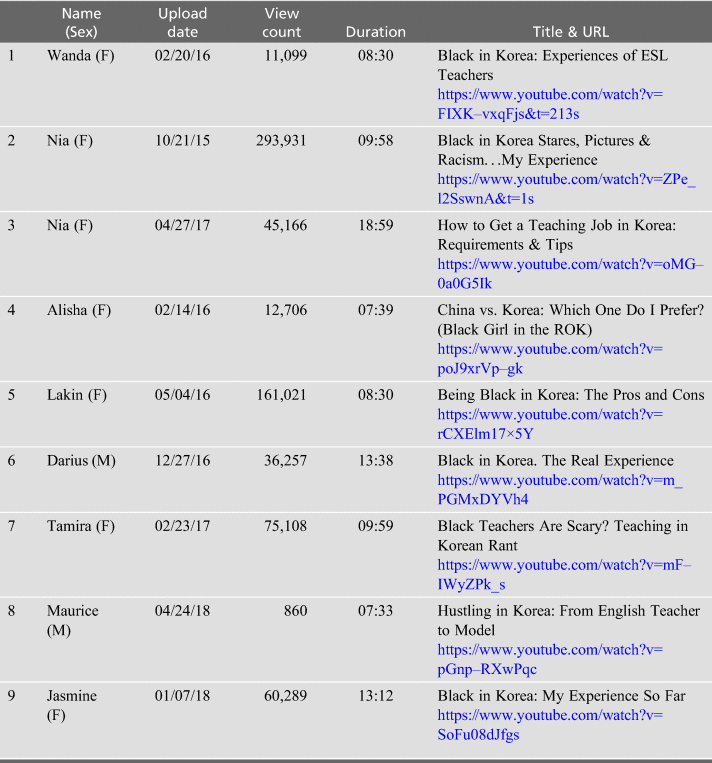
The data for this study are autobiographical narratives posted on YouTube by BTEs who were teaching or had taught in Korea. Since its launch in 2005, YouTube has become one of the largest and most popular sources of user-generated content among various social media platforms. The sharing of narratives on social media such as YouTube allows individuals to participate collectively in the construction of a communal phenomenon (Georgakopoulou, Reference Georgakopoulou2007) and, through their interactions with others, to co-construct their social identities within this collective. To investigate the experiences of BTEs in Korea, therefore, we searched YouTube's database using the key phrase, ‘Black English teachers in Korea.’ Among these videos, we selected nine, from eight participants, according to the following criteria: recent posting (between 2015 and 2018), relevance to the research focus, length of the video (more than five minutes), and view count (more than 10,000 views except for one, which was included to reduce the gender imbalance). Table 1 provides detailed information for each video clip. To protect confidentiality, all names are pseudonyms. All the selected BTE narrators, six females and two males, were from the United States. At the time of data collection, Nia, Alisha, and Lakin had left Korea when their contracts ended, and Darius and Jasmine were still teaching in Korea. The whereabouts of Wanda, Tamira, and Maurice were unknown.
Detailed information of the YouTube video clips

Data analysis was conducted through the following four stages. In the initial stage, we read transcripts several times with no underlines, highlights, or margin notes. We just tried to get familiar with the data and further to understand the participants’ experiences as BTEs. In the second stage, we wrote our impressions on the BTEs’ professional identity in the margin with a word or phrase. These first impression phrases were subsequently reduced to approximately thirty codes. In the third stage, we concentrated on discovering emerging themes or patterns from the thirty codes. We first categorized the codes into major themes individually, and then compared each other's. Discrepancies between us were remedied through debates to reach a consensus. We finally identified three themes, namely the processes that the BTEs’ went through in Korean ELT. In the final stage, we reread transcripts. We then chose best excerpts for each theme and edited them if necessary.
Findings
The BTEs in this study went through three stages of racially infused professional identity development, either positively or negatively, through negotiation and compromise. The themes from the data analysis presented below illustrate their changing trajectories as BTEs in Korean ELT.
I don't feel like I'm beautiful in Korea
The BTEs described their application experiences negatively, reporting that Korean ELT has a discriminatory hiring process. They were often turned down by recruiters because they were not the right fit for Korean ELT, which the narrators interpreted as a thinly veiled reference to their race and the Korean recruiters’ presumed preference for White teachers of English. Alisha, who had worked in both Shanghai and Seoul, compared her experience during job interviews in China and Korea as follows:
I think it's easier to get a job in China as a Black person than it is to get a job in Korea as a Black person … I went on so many job interviews. It was crazy … In Korea, I had a harder time. My skin color seemed to be a bigger issue.
Nia, another participant, worried that her ‘darker skin’ would affect getting a job. Although she seemed to be perfectly prepared for the job application, she was aware that her race could prevent her from getting hired:
I remember going through that process. I remember out the day like I need to make sure that my application is flawless, my resume is flawless, and my introduction video is flawless. I went in as strong as I could to ensure that I made sure that I can get a job career, because I already knew that there were many things that were against me … I didn't really kind of fit the [recruiters] were looking for. You know, my darker skin. I mean people may say, ‘Oh, that doesn't affect you,’ but it does.
All BTEs thought that Koreans had deeply rooted preferences for White English teachers. For example, Wanda was self-conscious about her race, which she felt was negatively judged in Korea: ‘I don't want to say the word ugly, but I don't feel like I'm beautiful in Korea because they really value light skin.’ They also reported that there were certain unspoken standards unrelated to actual teaching credentials and language skills, such as race (White) and accent (American), in the hiring of NESTs for Korean ELT.
The BTEs talked about their experiences being black in Korean ELT. For example, Jasmine related an unforgettable experience when she had just started teaching:
When I was just sitting at my desk in my school, one of my students came in. He was a third grader. He grabbed my arm, and I just gave it to him. He began rubbing, as if he was trying to see if the color on my skin came off and he was comparing my colors of my hands and arms.
Jasmine was disconcerted by the student's behavior, which she thought would not happen in America. She attributed the student's action not only to rudeness but also to what she perceived as Koreans’ general race insensitivity because of the country's homogeneity:
When I first came, some of my students had no filters. ‘Why are you black? Why are your lips brown? They're not pink like mine.’ They're very intrigued and they're not afraid to ask, ‘But why are you this way?’ … because Korea is so homogeneous, so they don't see other ethnicities and cultures.
Jasmine also shared her friend's unpleasant experience with students:
One unfortunate story that I've heard about being Black in Korea … It's terrible. My friend thought her students gave her a cute nickname, geomdung-i [literally meaning black, but normally used as a pejorative term], which is the Korean equivalent of the n-word. When the teachers heard it, they laughed at the kids … So, she thought it was like a cute nickname until one of our Korean friends said, ‘Wait! Your students call you what … ? That's not good, that's like the Western n-word.’ All this time, no teacher told them not to do it.
What seemed most disturbing to the narrator was that the Korean teachers regarded the students’ misconduct as acceptable behavior, suggesting the pervasiveness of prejudice against blacks even in Korean schools.
We get used to being Black
The BTEs reported that they had become numb to disrespect and discrimination while teaching in Korean ELT. The following narrative describes Tamira's experience with a racial epithet and how she dealt with it as well as the issue of her race every day as an English teacher in Korea:
In my school, my kids had nicknamed me, ‘Obama teacher.’ They called me Obama teacher every time I walked up and down the hall. ‘Obama teacher! Obama teacher!’ Actually, I got over Obama teacher … You get caught up in every small – even, like, micro-aggression. If you get caught up in every little thing that happens to you, you're going to be miserable. You're going to find yourself very bitter.
Although her students’ constant references to her race at first made her uncomfortable, Tamira decided to turn away from it, realizing that attending to it would make her professional life unbearable. Instead she labeled the behavior ‘micro-aggression’ and put it into the background, where she could more easily ignore it.
Darius on the other hand revealed that the struggles and challenges that he experienced in Korea were minor compared to his experiences in the United States, where he believed that African Americans were subject to much more explicit discrimination than in Korea:
Honestly, I'm not going to get shot here for the color of my skin. I'm not going to get the crap beat out of me by police. A huge number of things could happen to me in America. I was racially profiled when I went home. I hadn't been home for two days, and I was walking home from the bank and got stopped by the police. I match a description [of someone they were looking for]. [In Korea] I could be walking [any time without being bothered]. In my small city, around 1 or 2 a.m., I was coming back from the bar. And there's a lady walking toward me and she didn't run across the street and hold her bag; she just walked toward me. The first time that happened to me, and I was witnessing this, I had culture shock. She didn't walk across the street. Didn't she think I was going to kill her? Oh, my god! This is how normal people act. Being a person of color, in Korea, to me, it's better than being a person of color in America.
Having felt more threatened in America, where Black males are routinely profiled and regarded with fear by Whites, made Darius's negative experiences as a BTE tolerable. In contrast with the negative image of Black males that had become entrenched in White America, in Korea he experienced what it felt like to be treated as just another person on the street.
Despite such instances of feeling ‘normal,’ the BTEs were aware of the preference for White NESTs, not just in Korea, but throughout the world. Darius said:
[In] many countries, White is right. That sounds very weird to say, but many countries want Whites. That's why many job postings want [someone] with White skin, blond hair, and blue eyes. You can be discriminated [against] for the color [of] your skin.
His comments reveal that an explicit favoritism towards Whites is a global phenomenon, and BTEs may have no choice but to accept it. Another reason for their tolerance is that they often believe Koreans’ racial insensitivity is not intentional in the same way it can be in other settings, as reflected in Jasmine's remarks:
Most of the time, people really don't mean to be racist. It's just a bit of insensitivity and slight ignorance, for example, the n-word. You hear the n-word numerous times in songs and you hear the Koreans in the club saying the n-word. They don't know what that means. You can't be mad at them. I'm guaranteeing they don't know what they're saying … I guess this country hasn't really been negative [to Blacks].
We are Black educators
Despite Jasmine's generous interpretation of Koreans’ use of language that would be inflammatory in the US, the BTEs reported that they were struggling with stereotypical images of Blacks. Darius claimed that one of the questions they heard most from Korean students was, ‘Do you have a gun?’:
I've had people say, ‘How many guns do you have?’ ‘You're Black, don't you have guns? All Black guys have guns because in the movies….’ I just look at them and say, ‘No, I don't have a gun. Why?’
The above excerpt highlights the power of the mass media to reinforce stereotypes, especially in settings in which there are no other experiences with a target group to counter sensational images marketed by media. Jasmine observed:
I think movies [in which Blacks are typecast as criminals] really help [shape] the way Korean people perceive Black people in general. Until [those] movies came out, they really didn't know how to see us. They see us twerking in music videos, robbing a bank, going to jail, or shooting somebody like [in a] gang. Koreans can only see us from what they see on TV. So, in essence, you can't really blame them.
Wanda said that distorted images of Blacks are even presented in textbooks:
We have a curriculum we follow. One of the units is [about] poor people and helping them. There's a picture of it that looks like Africa, and they had stuff on their heads as if they carry food. Now my students associate poor people totally with Africans.
After the class completed the unit, her students held the belief that because Africa is very poor, so are all Blacks. Nia made a similar comment concerning misperceptions she encountered that all Blacks are from Africa. She inferred that Koreans did not separate ethnicity from nationality because they perceive their own country as a racially and culturally homogeneous one:
I see many people get really offended when people ask where they're from or ask if they're from Africa. I think it's because Africa has this negative connotation. And, in general, people think all Black people come from Africa. Africa's poor, and so are all Blacks. Koreans have to understand the concepts of nationality and ethnicity are different. Contrary to our perception of nationality and ethnicity in countries like America, in Korea, if you look a certain way, you are considered Korean; that is your ethnicity as well as nationality.
Here Nia suggests that by associating African Americans with Africa, which is often depicted as poor, Koreans may think that Blacks cannot be from America. In the comment below, Maurice, counters this perception by declaring that he is not African, but a Black person with American citizenship:
I grew up well in a good environment. The place where I grew up is a rich place to live. If I'm called African, we know that's not true because we're not from Africa. My race is African, but I'm American. I have three degrees. A bachelor's, an associate, and a certificate … Before I came to Korea, I used to be a scientist … I wanted a change in life, so I came to Korea. And now I'm here doing this.
In this statement, Maurice is not only emphasizing his nationality over his ethnicity but asserting his middle-class status as an educated person from an affluent neighborhood, thus implying that he is well qualified as a teacher.
Not thwarted by the misconceptions and insensitivities they encountered, these BTEs reported trying to change their students’ views because, as Wanda said, their job is to change those perceptions and create different narratives. For example, Darius explained to Korean students why the n-word is not acceptable:
They don't understand its taboo nature. They don't know you can get stomped out for that. You've got to explain that to them. They go, ‘Oh, okay.’ I understand they're ignorant because they don't know. It's because they just don't know the connotations of [that particular word].
Lakin described her mission as a BTE as opening students’ minds to diversity:
You have the potential to really positively impact the way that they [Korean students] view Black Americans or the way that they view Black people in general. You can educate them. You can give them the lens through which they will look at all people. You have the power to shape their ideas, their thoughts, and their perceptions of all those people.
Lakin's narrative showed that she and her colleagues should not limit their role to teaching English but extend it to that of a facilitator who helps students change their perceptions and adopt new ways of seeing people. Toward this end, Lakin decided to openly discuss her Blackness with her students:
[I got] crazy questions about my hair. They assume that my hair is straight [but] Black [like theirs], so if it's curly that means I permed it. So, I wore my hair down … Two weeks ago, I made a public service announcement: ‘This is my original hair. I get to stay original.’ And then they understand, like, ‘Whoa, you're different, you're not like me, we're not the same, not in a bad way.’
According to Lakin, her decision to discuss Blackness was very successful in helping here students understand Black people much better.
Discussion and Conclusion
This study provides insight into the lived experiences of BTEs in Korean ELT. The teachers’ comments showed how they faced racial prejudices and were discriminated against, beginning with the initial stage of employment screening and continuing throughout their employment to the end of their teaching stints in Korea. They were surprised at the prevalence of racial prejudices in Korea, but became used to it, acknowledging that preference for White skin is not only a Korean, but a global phenomenon. While they were obliged to struggle with stereotypical images of Black people in general, they believed that as BTEs they had the power to change students' perceptions of Blacks by openly discussing physical and cultural differences and opening students’ eyes to tolerance and appreciation of diversity.
These BTEs’ narratives revealed that they experienced racism and discrimination throughout their employment in Korean ELT, and, accordingly, they reported difficulty in positioning themselves as teachers. They perceived that Koreans’ concepts of native speakers of English do not include non-White people, no matter how effective they may be as teachers, so BTEs have been regarded at best as underqualified teachers. This finding is in line with previous studies (e.g., Mahboob & Golden, Reference Mahboob and Golden2013; Rivers & Ross, Reference Rivers and Ross2013). Kohli (Reference Kohli2009) states that BTEs’ accents and teaching skills are often double-checked and consistently questioned, Kubota and Lin (Reference Kubota, Lin, Kubota and Lin2009) assert that because Whites are frequently regarded as native speakers and non-Whites as non-native speakers, White teachers of English are evaluated as the most qualified. Jenks (Reference Jenks2017) points out that even when non-Whites are considered native speakers, correct, authentic English is usually associated with Whiteness, a phenomenon referred to as ‘white normativity’ in the ELT profession (p. 86). Kubota (Reference Kubota2016) similarly argues that White privileging in ELT results in discrimination against non-White NESTs.
The BTEs assumed that a major reason for racism in Korea is the country's long history of ethnic homogeneity, which Koreans are taught to value and take pride in (Choe, Reference Choe2009; Kim, Reference Kim1997; Shin, Reference Shin2006). The Korean government has used this homogeneity as a political ideology and a strategy to promote national unity (Park, Reference Park2009; Seth, Reference Seth2011), which may take the form of intolerance toward others (Dhawan, Reference Dhawan2016). Not only people of visibly different races, such as Blacks, but also people from neighboring countries such as China and Japan may suffer discrimination in Korea; only Whites experience far fewer racist attitudes and negative behaviors than other races, perhaps because, as Jenks (Reference Jenks2017) argues, in Korea, White people are often seen as superior to people of other races
The BTEs’ narratives suggest that, having experienced both domestic racism during their lifetimes and institutional racism from the prevalent ideology in ELT (Kubota, Reference Kubota2016), they had become accustomed to ignoring ordinary, micro-level, and unintentionally discriminatory events (Sue et al., Reference Sue, Capodilupo, Torino, Bucceri, Holder, Nadal and Esquilin2007), such as those experienced from Koreans every day, inside and outside schools. Supposedly, as shown in Darius’ narratives, they considered Korean racism less virulent than the much more endemic racism they had experienced in America. Because the BTEs believed that Koreans’ discriminatory behaviors were due to lack of exposure to different races and of recognizing racial prejudices, they tried to change Korean students’ perceptions of race. While their self-concept as Blacks in this environment made them feel marked as disadvantaged minorities, their self-concept as teachers encouraged them to build relationships with students and guide the students in the right direction. Their sense of responsibility as educators combined with their heightened sense of identity as Blacks, as presented in Darius’ and Lakin's narratives, led them to try to educate their students to open their minds.
The BTEs also wanted to be viewed as African Americans rather than Africans, suggesting that nationality was a more essential part of their identities than racial heritage. They were uncomfortable with Koreans’ broad generalizations about Black people as a whole and proud to be Americans, perhaps to establish that their educational and socioeconomic status was higher than that of most Africans. Apart from this motivation, they sought to change Korean students’ oversimplification of Blacks and, further, to give their students a sharper lens through which they could look at all people.
The findings also suggest an urgent need for multicultural education to be integrated into Korean ELT. The BTEs’ experiences with discrimination may reflect this lack of multicultural education. Jenks (Reference Jenks2017) observes that native Koreans have long been satisfied with the notion of ‘one people, one nation,’ and they themselves would never experience ethnic/racial discrimination as long as they lived as Koreans in Korea. In this situation, Korean students would have few opportunities to develop their multicultural awareness inside or outside of school. Recently, however, Korea has been becoming a more multicultural society at a very rapid rate due to an increase of migrant workers, international marriages, and foreign students (Lee, Reference Lee2018). In response to these changes, Korean ELT should incorporate multicultural education into the curriculum from the earliest stages in order to provide a solid foundation for its success and sustainability (Karuppiah & Berthelsen, Reference Karuppiah and Berthelsen2011). As shown in this analysis, BTEs can make an important contribution to changing both students’ and teachers’ views of diversity and their own position as global as well as Korean citizens.
Acknowledgement
This work was supported by Hankuk University of Foreign Studies Research Fund.
 HOHSUNG CHOE is Professor and Chair of the School of English for Interpretation and Translation at Hankuk University of Foreign Studies (HUFS), South Korea. He teaches various courses in foreign/second language education from undergraduate to the doctoral level. He holds a BA in English Education and an MA in English Linguistics from HUFS. He received both an MS and a PhD in Language Education from Indiana University. His research interests include language teacher/learner identity, multilingualism and multiculturalism, world Englishes, and narrative inquiry. Email: choe@hufs.ac.kr
 YOUNGJOO SEO (corresponding author) is a Lecturer in the School of English for Interpretation and Translation at Hankuk University of Foreign Studies (HUFS), South Korea. She completed doctoral coursework at HUFS and obtained her PhD in Language Education from Indiana University. She gained an MA in English Education from Kyungpook National University, South Korea. Her research areas include teacher education, language teacher and learner identity, family language policy, language ideologies, and critical pedagogy. Email: yjseo0922@gmail.com