1. INTRODUCTION
Over the past fifteen years scholars have paid increasing attention to the causes, costs, and consequences of the U.S. government's reliance on private actors and market mechanisms to channel social benefits to its citizens.Footnote 1 Whether through tax deductions, government-regulated employer-provided benefits, social programs delegated to private providers, tort law, or credit programs, the public–private welfare state (the term I use to encompass this broad set of indirect arrangements) has been argued to possess a distinctive character from the traditional welfare state institutions that rely on more direct tax-and-transfer channels. In contrast to its more visible counterpart, the public–private welfare state's indirect channels are thought to submerge the role of the government from public view, making the distribution of public–private benefits appear to citizens as the product of impersonal market forces rather than political ones, while at the same time activating the interests of the third-party providers it brings on board. It is argued that this encourages a distinctive type of policy feedback from citizens and organized groups.
I argue in this article that rather than submerging the role of the government from citizens and removing these issues from the policy agenda, public–private policies have at times generated conflicts over the state's obligation to ensure citizens' access to privately provided social benefits, as well as over its authority over the private providers it brings in as partners. These conflicts are shaped in part by a feature of the public–private welfare state itself: that the market-friendly mechanisms that governments use to sidestep more direct and visible channels of distribution must still be defined and defended by the state. At times this has provided openings for citizen advocacy groups to challenge the terms of access and distributional effects of public–private policies, arguing that their constituents have been systematically denied fair access to the public–private welfare state's benefits. This article, then, highlights an overlooked feature of the public–private welfare state: the political salience surrounding issues of inclusion and exclusion.
I demonstrate this salience by examining responses of black civil rights advocates and veterans advocates to their constituents' inability to access government mortgage insurance and guarantees through the Federal Housing Administration (FHA) and Veterans Administration (VA) in the early years of each program. FHA loan insurance and VA loan guarantees both aimed to enable widespread homeownership by lowering the upfront costs (through low down payment requirements) and monthly payments (by lengthening the number of years borrowers had to repay their loans) for middle-class Americans. They sought to accomplish this not through direct government lending, but rather through encouraging private lenders to offer these new features in their loan contracts in exchange for insurance against losses. Such a program design could have obscured the hand of the government in promoting homeownership, and it may have for the millions of citizens who ultimately benefited from the programs. (In fact, this was pointed to as a virtue of the FHA's design while it was first being debated.Footnote 2 ) However, as the cases also show, not only was the government's role in expanding access to homeownership clearly visible to the advocacy groups whose constituents were unable to fully access those benefits, it also provided an opening for groups to contest what they saw as inadequate or inequitable terms of access.
This article makes three contributions to the study of the public–private welfare state. First, it elaborates on a policy area that has received little attention in the literature despite being identified by several scholars as a component of the public–private welfare state: government mortgage programs, including loan insurance and guarantees.Footnote 3 Second, it contributes to debates on policy feedback by elaborating on an overlooked source of feedback: rather than looking towards the beneficiaries of public–private policies as potential drivers of stability or expansion, it points to the role of advocacy groups whose constituents have found their access to the public–private welfare compromised for various reasons.Footnote 4 More broadly, the findings contribute to political scientists' understanding of American state-building, illustrating how citizens advocacy groups have continually fought from the bottom up to redefine the boundary between public and private, and to redefine the authority and capacity of the state to govern private activities.Footnote 5
2. PROVIDERS AND CITIZENS IN THE PUBLIC–PRIVATE WELFARE STATE
In his 1959 essay, Richard Titmuss advised scholars to look beyond taxes and transfers towards the less visible ways that governments promote social welfare aims, including through fiscal and occupational channels.Footnote 6 Following Titmuss is a range of work describing the complex set of indirect mechanisms governments use to direct economic and social outcomes. Many of these studies emphasize the obscurity of the government's role in shaping economic or social outcomes, employing such terms as “submerged,” “hidden,” “delegated,” or “out of sight,” or drawing vivid comparisons to Rube Goldberg contraptions to describe the use of indirect policy channels to direct social and economic outcomes. Recent studies have suggested that these less visible public–private policies produce types of policy feedback that are different from the more visible tax-and-transfer style programs, often noted for their ability to generate entrenched constituencies who mobilize for a policy's continuation and expansion. Two patterns have stood out in particular.
First, public–private policies tend to generate few if any feedback effects from their targeted citizen beneficiaries. In contrast to direct welfare state programs, even the most far-reaching public–private policies have not generated equivalents to the AARP for Social Security, failing, for example, to mobilize homeowners benefiting from the home mortgage interest deduction into a cohesive bloc.Footnote 7 In other cases, such as Morgan and Campbell found in their study of delegation in the Medicare Modernization Act of 2003, public–private policies may demobilize public opinion and reduce public demand for a government option.Footnote 8 These findings about feedback effects are perhaps less surprising when considered alongside the finding that at the individual level many citizens fail to link public–private policies to the government. As Suzanne Mettler finds, this extends even to citizens who use these programs.Footnote 9 For example, federal student loans are often perceived—even by the students who receive them—as a private program, despite “the fact that such loans would not be available without government—which took the initiative to encourage lending, provided generous subsidies to lenders, and bore the risk of defaults.”Footnote 10 Mettler sums this up as the “quintessential experience of the submerged state: it benefitted them [citizens], providing opportunities and relieving financial burdens, without them even knowing it.”Footnote 11
The second pattern that stands out is who it does mobilize and entrench. In many instances public–private policies were opposed by businesses at the outset. Yet once in place, the ambivalence of third-party providers has often given way to support for maintaining and even expanding the public–private welfare state. For example, the banking industry opposed changes to the student lending program proposed by the Higher Education Act of 1965, preferring the earlier system of direct government loans to the proposed bank-based lending system, only to come to the new system's defense in later decades.Footnote 12 And while the home mortgage interest deduction failed to generate an interest group representing the homeowners who benefited from the policy, it did help to mobilize a coalition of interest groups representing real estate agents, homebuilders, and others within the housing industry.Footnote 13 Government mortgage programs have faced a similar dynamic, with many within the lending industry concerned from the beginning about the wisdom of a government-backed, 30-year, low-down-payment mortgage, and later coming to support the idea once it turned out to be successful. Beyond home mortgage interest and student loans, the public–private welfare state has mobilized a variety of third-party providers, including insurers, colleges and universities, hospitals, lenders, and nonprofit organizations.
An immediate implication of the public–private welfare state is that the indirect channels of provision render the role of the state less visible and traceable to government than in more direct (i.e., traditional) welfare state programs.Footnote 14 In this sense, the public–private welfare state is thought to depoliticize the distribution of its benefits to citizens, transforming social policy issues into issues that are resolved mainly through market mechanisms of prices, preferences, and profits.
3. CITIZENS ADVOCACY GROUPS AND ACCESS TO THE PUBLIC–PRIVATE WELFARE STATE
In short, the literature examining the feedback effects of public–private policies predicts that most of the time business and other third-party providers will dominate discussions of policy stasis and change, with citizens unknowingly on the sidelines. Yet so far this analysis has typically been applied to those who already receive benefits from the public–private welfare state, contrasting their lack of engagement with the heightened attention that the public–private welfare state generates among third-party providers. I argue that groups whose access to public–private programs is constrained may recognize the source of their constraint as being government-generated, and they may mobilize to challenge this by pressing for more generous terms of access and fairer and more inclusive terms, as well as by pressuring the government to use its authority to change the practices of private providers.
To understand why, consider the mechanisms that allow public–private policies to function without being visible and traceable to many citizens who use them. Public–private benefits are often channeled to individuals through businesses or employers, who have in turn been incentivized by the state to provide social benefits.Footnote 15 This often places the government in the position of having to define and defend market boundaries, or criteria to determine who will and will not be eligible for access to public–private benefits, and on what grounds those determinations will be made. These boundaries include formal laws stipulating who the providers will be, eligibility criteria for beneficiaries, the nature of the activities or goods that will be supported, and so on. Formal boundaries are not the only ones shaping access to the public–private welfare state. Access is also bounded by competition, preferences, and tastes. Some people may simply be priced out of certain public–private programs as the prices of goods rise past their willingness (or ability) to pay or inability to qualify in some other way. Others may be excluded by discrimination from providers based on personal tastes, perceived group characteristics, or perceived effects on other customers or employees.Footnote 16 In short, not everyone will be able to access the public–private welfare state, for a variety of reasons.
This is important because the state's role in setting and backing boundaries to access can politicize (for some groups) the inequalities of access that ensue, even as it obscures the role of the government to citizens who already use and enjoy the benefits of the public–private welfare state. Furthermore, the specific boundaries to access shaped by the state may provide both a focal point and an angle of attack for those wishing to contest the legitimacy of those distributional outcomes. In these ways, public–private policies can draw advocacy groups, third-party providers, and government actors into conflicts over their terms of access.
Citizens advocacy groups—in particular, those whose constituents have had difficulty accessing public–private benefits—have been crucial drivers of this conflict over the terms of access in three ways. First, they have worked to aggregate individual grievances into broader collective problems. Second, they have traced these problems not to impersonal market mechanisms, but to government policies as well as to the state's implicit endorsement of private practices. Finally, they have pushed for the reform of policies and practices to ensure more inclusive or fairer terms. They have used the structure of the public–private welfare state as an opening to contest distributional consequences, calling on the state not only to change its own policies but also to use its authority to change private practices, including by threatening the removal of regulatory benefits from providers.Footnote 17
This suggests the need for reappraising earlier characterizations of the public–private welfare state as invisible to citizens, propelled by providers, and politically preempted. Instead, it suggests that groups with grievances not only may recognize the public–private welfare state's indirect (and characterized as invisible) mechanisms, but may also challenge the government's use of indirect mechanisms to channel public–private benefits to some citizens while denying access to others.Footnote 18 As the following sections show, these expectations hold across two cases where constituents' inability to use public–private homeownership programs was generated by very different forces. In the first case, African American civil rights advocates and allies detected and contested features of the FHA that systematically discriminated against blacks, monitoring the activities of the FHA as well as private providers over decades. In contrast to blacks, whose race effectively barred them from access, World War II veterans were a relatively privileged class, explicitly targeted as beneficiaries of the Servicemen's Readjustment Act of 1944 (GI Bill). However, the housing market conditions of those first few years and inadequacies of the legislation itself rendered the loan provisions unusable by many veterans. Pressured by the American Legion and other veterans organizations, Congress and the VA responded to grievances concerning inequalities of access by revising the original terms of the GI Bill as well as by introducing new programs and initiatives to bring private providers in line. Before discussing the cases in further detail, the next section describes the public–private welfare state in housing and several of its boundaries to access.
4. HOMEOWNERSHIP AND THE PUBLIC–PRIVATE WELFARE STATE
Since the 1930s, the U.S. government has encouraged housing provision, both rental and owner-occupied, through indirect policy tools. On the homeownership side, government-developed incentives have included insuring or guaranteeing private loans through the FHA and VA, setting and subsidizing interest rates, creating and supporting a secondary mortgage market (through, for example, the Federal National Mortgage Association [Fannie Mae]), subsidizing private developers to construct rental housing for target groups, and by using tax incentives in various ways that have promoted home ownership.Footnote 19 Although the nature of the federal government's involvement in promoting homeownership has shifted markedly in recent decades, over the time period under study, the FHA and VA composed a large share of U.S. mortgage market activity and dominated the market for newly constructed housing, as Figure 1 shows.
FHA-Insured and VA-Guaranteed Loans as a Percent of Total Lending on New Residential Construction.

Created in 1934, the FHA has been an important public–private tool to encourage homeownership, lauded by elected officials, bureaucrats, and industry for its ability to provide widespread social benefits in a market-friendly manner.Footnote 20 Through the FHA, the U.S. government would promote homeownership indirectly, by insuring loans originated by private lenders. To qualify, the lenders would have to accept certain restrictions on the value of the house, meet minimum requirements on building standards and appraisals, and offer long-term (20 years, to start), fixed-rate, self-amortizing mortgages, with much lower down payment requirements than were traditionally expected. As experts of this era have noted, the results were revolutionary. Previously, households wishing to buy houses with private loans faced high down-payment requirements (often with loans capped at 50–60 percent of the value of the property) with repayment periods of three to fifteen years.Footnote 21 By relaxing down payment requirements, extending repayment terms, and underwriting the risks to private lenders, the FHA programs helped to usher in an unprecedented expansion of homeownership in the United States and fundamentally altered the shape of the mortgage market along with it.Footnote 22
Yet the exercise of expanding access to mortgage credit to millions of Americans would require the government to draw lines around who—both from the borrower side and the lender side—would be included and excluded from the program. The creators of the 1934 legislation recognized this task on a superficial level, discussing during hearings the need for the government to set some limits to the program to help draw a line between safe and insurable risks and unsafe ones, in the form of down payment requirements and maximum insurable loan values.Footnote 23 The final legislation stipulated that borrowers must present at least a 20 percent down payment and limited FHA-insurable housing values to a maximum of $16,000 (this was reduced to $6,000 in 1938). By 1938, the criteria effectively barred the wealthiest (who would purchase more expensive houses) and the poorest (who could not amass a down payment) from access to FHA-insured mortgages, but still covered, in one estimation, about 85 percent of owner-occupied housing houses, given house prices at the time.Footnote 24
That number concealed more profound ways that state actors promoted and constrained access to homeownership. After the legislation passed, actually administering the new program would require criteria for evaluating the riskiness of potential borrowers, as well as the likelihood that the house would maintain its value in case the borrower defaulted. The FHA issued additional guidelines to meet these challenges. To help lenders determine the creditworthiness of borrowers, the FHA circulated a “Standardized Factual Data Report” in its early years of administration. The report asked lenders, among other things, to consider the applicant's age, racial descent, reputation for honesty, and domestic satisfaction (“Does his wife lend encouragement to him?”), among other questions about business dealings, current and future income, religion, and sex of the borrower.Footnote 25 Properties themselves, as well as their neighborhoods, would be subject to the judgment of the FHA's Underwriting Manual, which today is well known for legitimating, as Louis Hyman summarizes, the “casual racism, antiurbanism, and pro-development assumptions of the bureaucrats” who helped write the Manual.Footnote 26
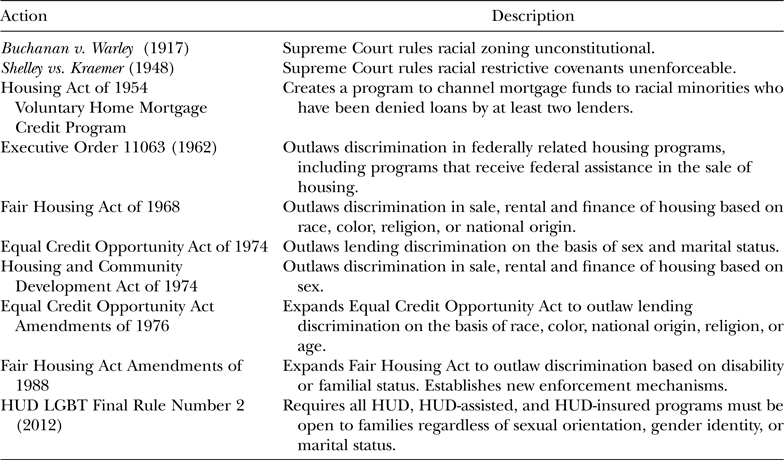
There is ample evidence that the FHA's architects viewed themselves as the upholders of market principles, incorporating into their formal guidelines what the industry and private organizations (for example, the Better Homes movement) had determined as the criteria for determining sound lending.Footnote 27 What the FHA ultimately did, however, was codify its designers' vision and preexisting biases about what constituted the idealized house, neighborhood, and borrower. While opening up homeownership to millions, the FHA effectively closed it off to others: people not having the right type of job or employment history; not living in the right area; or not the right sex, age, race, or religion were assumed out of full participation by virtue of the criteria used by its administrators. A number of these earlier constraints have since been addressed through legislative and administrative reforms and court decisions, even if they still persist to a lesser degree in private practices. Table 1 in the Appendix lists, for example, a selection of policies and decisions aimed at various forms of discrimination in the government-backed housing market, though other policy changes—for example, opening up FHA insurance to urban areas previously denied insurance and rural areas that lacked physical proximity to lending institutions—also opened up access to government-backed mortgage credit.
While those benefiting from the new opportunities opened up by the FHA market may have been oblivious to the government's hand in the housing market, the FHA's style of administration—that it put the imprimatur of the federal government on these practices—also made it vulnerable to the claims of groups who had been denied access.
5. CONTESTING THE FHA'S COLOR LINE
There was little initial indication that the FHA would be racially exclusive.Footnote 28 The hearings for its enacting legislation contained no explicit discussion of race as a possible ground for inclusion or exclusion, though the legislation was designed and supported by private real estate interests that had a pervasive history of discriminating against blacks. And when the National Housing Act was signed into law in 1934, the Chicago Defender published a note praising the “opportunity afforded by the Federal Housing Administration” and encouraging interested members to apply for FHA-backed loans. The article reassured its readers that “it is believed that there will be no discrimination in local communities, and if such should be found to be the case you are advised to take up the matter with the officials at Washington through the congressman in your district.”Footnote 29 If anything, African American groups may have pinned on the federal government their hopes of protection from a long history of discrimination from private lenders and real estate agents.Footnote 30
Soon after the FHA's inception it became clear that any hopes African Americans had for a more equitable housing market through government involvement had been misplaced. Across the country, prospective black homeowners, developers, lenders, and contractors contacted local and national NAACP branches, complaining of difficulties in accessing FHA-insured loans.Footnote 31 Studies conducted during the 1940s and 1950s confirmed that African Americans faced limited housing prospects compared with whites. In 1945, the American Council on Race Relations identified the “arbitrary limitation of land area available for occupancy by Negros” as one of the chief problems affecting the poor housing conditions of African Americans.Footnote 32 A report by the American Friends Service Committee found that between 1935 and 1950 only 1 percent of new private housing was open to black occupancy. Over the same period, moreover, only 2 percent of FHA loans went to nonwhites, even as the FHA backed nearly two-thirds of all newly purchased houses.Footnote 33 While both blacks and whites saw increased homeownership rates, there remained a persistent gap between black and white rates, with white homeownership rates reaching 64 percent in 1950 versus 36 percent for blacks (Figure 2). The gap between black and white homeownership rates grew from 23 to 28 percent between 1920 and 1960.
Homeownership Rates by Race of Household Head, 1900–1990.

Much contemporary scholarship places the blame for the gap at the feet of government housing policies, which in their implementation expanded the housing opportunities available to whites while closing off the same opportunities to blacks.Footnote 34 Yet in the moment the racial housing gap could have been linked to persistent differences in income or credit risk between African Americans and whites, or to private sector discrimination squarely outside of the reach of the federal government—after all, private housing providers had discriminated for decades against blacks.Footnote 35 Even employees of the government housing agencies did not view themselves as creating the conditions that denied African Americans homeownership opportunities; instead, they saw themselves as upholding market principles. Individuals dealing with the system, moreover, did not have to come to view their individual difficulty in getting access as a systematic process of government-sponsored discrimination, as others have pointed out.Footnote 36
Advocacy groups, including the NAACP, the National Urban League, the American Council on Race Relations, and the National Committee Against Discrimination in Housing; allies like the American Friends Service Committee; and a handful of black newspapers, including most prominently the Chicago Defender, all worked to challenge the FHA's tendency to submerge its role in black housing exclusion from public view. Along with others, these actors detected and aggregated individual exclusion from the FHA into broader patterns, traced it back to the government as well as to the private sector, and then contested the role of the government and private lenders in promoting such exclusion.
The public–private nature of the government's housing programs provided an opening for civil rights groups to contest the legal basis of black housing exclusion.Footnote 37 What market providers and bureaucrats argued was a matter of private market preferences and tastes, civil rights leaders, prospective homeowners, and businesses came to argue was the product of government-sponsored discrimination.
Redlining, Restrictive Covenants, and the FHA Underwriting Manual
Examples of activism around the exclusionary aspects of FHA administration date almost to the agency's founding. As early as 1936, advocates questioned whether the FHA was engaging in restrictive practices. Two years later, in 1938, the Jamaica Long Island NAACP branch filed complaints with the White House and FHA, ultimately procuring a copy of the FHA's Underwriting Manual from a local FHA field office.Footnote 38 The text of the Manual confirmed the branch's suspicion that the FHA had been encouraging its appraisers to use race-based criteria in making lending decisions, by prohibiting loan insurance in neighborhoods that failed to protect against the encroachment of “inharmonious racial groups.”Footnote 39 After learning of the language in the Manual, the NAACP's special counsel, Thurgood Marshall, then saw visual confirmation in the form of color-coded FHA maps used to determine which neighborhoods would not qualify for loans.
In response, the NAACP wrote to the FHA, protesting the agency's promotion of “Jim Crow” housing policy, and charging, moreover, that the FHA had accomplished this segregation with the financial backing of U.S. taxpayers. The letter called on the FHA to repeal the offending sections of the Underwriting Manual, complaining that “Colored people have been branded as slum-dwellers without ambition to live in good houses and yet when they seek better housing, they are told by the government that they must remain within certain areas.”Footnote 40 The efforts of the NAACP had forced an official for the local Long Island branch of the FHA branch to backtrack on its earlier position and admit that it had in fact drawn boundaries restricting the eligibility of African Americans.Footnote 41
Unfortunately for civil rights advocates, the success in getting the FHA to admit bias was only local. Moreover, admitting the policy was by no means tantamount to changing it, in statute or in practice. In response to the NAACP's letter and call for the retraction of the offending sections of the Underwriting Manual the FHA held firmly to its position that it was not promoting racially restrictive practices, arguing that the NAACP's charges of discrimination were baseless.Footnote 42 “No possible interpretation of those paragraphs could lead to the conclusion … that the FHA discriminates against negroes or fosters their segregation,” wrote one FHA official in a letter to his superior, though the letter did suggest further investigation as a way to quell the NAACP's concerns.Footnote 43
Over the next five years the NAACP continued to see numerous indications that the FHA was continuing to discriminate against blacks in its administrative practices, contrary to its earlier statements to the NAACP. Dissatisfied with the FHA's handling of the complaints they had voiced since 1939, the NAACP appealed to President Roosevelt in 1944.Footnote 44 Writing to Roosevelt, NAACP Secretary Walter White complained of the FHA's refusal to “administer the powerful implement in their hands in such manner as to help relieve these fundamental needs [of blacks]. The necessary relief is administrative and operational but will require positive direction from you as the Chief Executive.”Footnote 45 Continuing, White provided a list of complaints pertaining to the FHA's discriminatory operations and promotion of segregation. White stressed that the FHA's practices made it impossible for an otherwise “potentially effective agency” to meet the housing needs of black citizens.Footnote 46 In making its case, the NAACP letter also quoted the FHA Underwriting Manual to argue once again that the FHA was not “using the funds and power of all the citizenry on the side of sound housing and social policies.”Footnote 47
The complaint was forwarded to the FHA, which responded with a memo outlining its record in promoting mixed-race housing, suggesting that any racial inequalities that arose did so not due to the “discriminatory operations in the administration of the National Housing Act,” but rather were shaped by “market conditions and market attitudes rather than racial considerations.”Footnote 48 Since the problem was due to the “reticence of private capital to enter this field,” the FHA suggested to the NAACP that it could play an important role in “encouraging the cooperation of Negro financial institutions” to secure a greater amount of housing for African Americans.Footnote 49
The FHA also reasoned that the NAACP's arguments, and the precedent that the group had cited as supporting its argument, if anything, actually justified the FHA's position in upholding racially restrictive private practices: “it is difficult to see how it [the FHA] could fail to recognize the validity of such restriction and the right of private individuals to place them upon the property,” it wrote in a memo to the association.Footnote 50 The FHA argued that the agency's public obligation was to ensure the soundness of the loans it backed. Thus, if racial “infiltration will be unacceptable to the local real estate market and desirability of properties will be reduced in the market's mind, then this administration has no alternative but to so recognize the conditions in its valuation of specific properties within that sphere of influence.”Footnote 51 As a public–private institution, the FHA argued its main obligation to the government and citizens as accurately reporting market conditions: “contrary to allegations made [by the NAACP] the underwriting operation does not encourage or discourage segregation of races but records conditions as the market reflects them.”Footnote 52
This clash over the nature of the market and FHA's responsibility was also present in the campaign that civil rights groups waged after the Supreme Court's Shelley vs. Kraemer decision in May 1948 declared racial restrictive covenants unenforceable. Despite the ruling, the NAACP continued to hear complaints from its members that private real estate agents, lenders, and sellers were continuing to honor racial covenants.Footnote 53 In Salinas, California, for example, at least fifteen real estate agents were implicated in a gentlemen's agreement to uphold existing covenants. NAACP branches also collected evidence from local chapters documenting further collusion between banks and realtors to uphold implicit covenants in Atlanta; Dearborn; Detroit; St. Louis; Washington, DC; and Chicago.Footnote 54 In a Levittown development in Long Island, developers flagrantly violated the Court's ruling, continuing to require would-be residents to sign a restrictive covenant, again drawing Marshall's attention, who followed up with a letter of complaint to the FHA on behalf of the NAACP.Footnote 55
The NAACP did not have to invoke the FHA in its complaint. After all, the issue that the Supreme Court had ruled on was the legal enforceability of the contract between buyer and seller; the FHA was not a direct party to this transaction. Moreover, the FHA had arguably accomplished (as it did argue) all that was required of it by removing the explicit racial references from its Underwriting Manual after earlier pressure. Yet the NAACP had been monitoring the FHA's implementation and learned that many within the FHA had retained “a policy of refusing to approve a loan to any subdivision or project … if its occupants are to be of more than one race” despite the fact that explicit racial language had been washed from the Manual.Footnote 56
Marshall reasoned that the Shelley ruling about the judicial enforcement of restrictive covenants applied to “all governmental action in support of racial restrictive covenants.” In Marshall's definition, this extended to projects backed by the FHA.Footnote 57 For Marshall and the others who challenged the FHA's association with racial covenants, the federal government did not even need to pass legislation to change the FHA's practices, as the Supreme Court had already made the “determination that government power may not be exercised to aid private persons in accomplishing racial discrimination in housing.”Footnote 58 The FHA was unconvinced. Countering Marshall, the agency maintained that in the absence of statutory authority, there was no basis on which it could deny private individuals the right to dispose of their property however they saw fit.
The discussion in Shelley's aftermath revealed the persistent gulf in thinking between the FHA, on the one side, and the antidiscrimination allies, on the other, on the nature and responsibility of the public–private housing agency. The FHA continued to argue that its primary responsibility as a government agency was to accurately reflect market conditions. To the extent that the agency was willing to encourage black homeownership, its willingness only went so far as to suggest to business leaders that they consider the “great opportunities” available to them by breaking into the minority housing market and to encourage local FHA field office directors to “use all available facilities at hand to stimulate the interest of builders and lenders in the planning and production of housing for sale and rent to minority groups,” as the FHA commissioner explained to his field staff in 1948.Footnote 59
The Urban League and Market Providers
Civil rights advocates found limited successes in these strategies for attacking the public–private basis of black housing exclusion. By the mid-1950s there were a few indications that the federal government's relationship to the public–private program was shifting in the direction—though certainly not magnitude—of what civil rights activists had pressed for. As of February 1950, the FHA was no longer supposed to insure properties containing racial restrictive covenants. Over the previous three years the FHA had also removed explicit racial criteria from its Underwriting Manual.Footnote 60 Government housing officials had also begun to show a willingness to serve in a coordinating capacity for the minority housing advocates, reaching out to business associations involved in the housing market that were initially cold to the civil rights groups.Footnote 61
One sign of change could be seen in the collaboration that was beginning to occur between civil rights groups and business associations to build relationships with the National Association of Home Builders, the Mortgage Bankers Association of America (MBAA), and (with little success) the National Association of Real Estate Boards. This collaboration represented a deliberate strategy by the National Urban League's Housing Committee, formed in 1952, to address the FHA's claim about the market basis of their members' exclusion.Footnote 62 This included challenging the industry's earlier arguments that the gap in white and black homeownership was due to economic differences between the groups, and not a lack of market opportunities for blacks.
For instance, through the Urban League's efforts, the MBAA's Board of Governors eventually established a Committee on Financing for Racial Minorities in February 1954 “to study and review the obstacles in this area and to take constructive steps to overcome them,” also inviting the Urban League to take part in a session of its annual meeting.Footnote 63 Through the committee, the MBAA conducted an eighteen-month study of minority mortgage issues, reporting in October 1955 that it was “plain that the lending industry cannot be said to be in the [African American] market on a wholehearted basis,” and suggesting that minority mortgage lending was possibly “the largest undeveloped opportunity for the expansion of mortgage activity.”Footnote 64 Moreover, the report noted that between the rising incomes, an increasing nonwhite population, and a persistent gap in homeownership between whites and blacks, expanding into the minority housing market posed “a prospect for additional business and additional service to the community that mortgage men cannot ignore.”Footnote 65
The Urban League similarly reached out to the National Association of Home Builders to convince it to establish a Minority Housing Committee. By 1954 the Minority Housing Committee had collaborated with the FHA, the Housing and Home Finance Agency, and the Urban League in order to develop a plan for increasing minority housing. In a report of the committee's findings, it called on the individual members of the National Association of Home Builders “do everything possible to induce private lending institutions to provide the necessary funds with which to do this job,”Footnote 66 and also resolved to contact representatives from insurance companies, savings banks, and other investors to help increase the availability of financing for minorities.
The Voluntary Home Mortgage Credit Program (VHMCP), created by the Housing Act of 1954, was another sign of progress. Targeted towards racial minorities and residents of remote rural areas, the VHMCP established a procedure whereby a prospective borrower could apply directly to the program for a loan after two unsuccessful attempts at securing a private loan. Though it fell far short of a decisive government repudiation of segregated housing, it went after another problem that civil rights advocates had identified and that private industry was warmer to: the limited access to finance for African Americans.
Within the subtext of the VHMCP was also a warning to businesses against shirking their responsibilities in the public–private housing market—a far cry from the FHA's early position. In a speech to a banking association, Housing and Home Finance Agency administrator Albert Cole pointed out that the program was ultimately a response to business calls for entering a market that the federal government otherwise would have to corner.Footnote 67 In a reversal from the FHA's earlier refusal to claim any obligation towards getting the private sector to serve minorities' housing needs, Cole reminded banks of their
social, ethical, and, yes, a political, responsibility to consider and serve the requirements of minorities. This is just as much your responsibility as it is mine, and as it is that of the President of the United States…. If private enterprise will not provide for them, then the Government proposes to assist him to get the home financing he needs on terms equal to those afforded othersFootnote 68
Cole also noted that his position as Housing and Home Finance Agency administrator conferred on him “a good deal of authority that I haven't used. I haven't used it because I want private industry to do the job. I have leaned over backward, gentlemen, to see that private enterprise has—that you have—the opportunity.”Footnote 69 Nor was Cole shy about explaining precisely how he intended to use his authority to further this goal should the private sector fail to meet its obligation, continuing on in his speech to explain that he had up until this point resisted using the authority vested in him by Fannie Mae. Rather than using Fannie Mae to increase minority housing opportunities, Cole argued that he was “giving private enterprise, through the VHMCP, the opportunity to show what it can do—what it will do for these families. But I cannot wait indefinitely.”Footnote 70
The VHMCP was significant in that it was the first time a public law expressly attempted to address with racial exclusion in housing. Previously, the federal government dealt with racial exclusion in housing either through the Supreme Court, agency-level directives, or ad hoc advisory committees, when not engaging in inaction or deflection. The VHMCP, on the other hand, recognized expressly that minorities had difficulties accessing credit and devised a procedure to help ease those problems. By April 1955, more than 1,700 lending institutions had offered their cooperation with the program.Footnote 71 Within four years, the program had insured 40,000 loans.
But despite the novel approach to the problem of black housing, the VHMCP was a failure in the broader scheme. As the 1959 Commission on Civil Rights Report revealed, only 8,000 of the program's loans went to African Americans in metropolitan areas.Footnote 72 Reflecting Cole's interest in increasing minority housing options without requiring desegregation, the program did nothing to deal with the underlying problems, chief among them the restricted housing supply for blacks. It might have even exacerbated those problems by allowing speculators to profit off the artificially low housing supply.Footnote 73 For all of Cole's warnings, the fact that the program “relied totally on the good faith of private lenders to make available additional mortgage funding” precluded it from addressing the fundamental problems of black housing exclusion.Footnote 74 By the time of his departure from the Housing and Home Finance Agency in 1959, Cole had failed to make good on his promise to use Fannie Mae as a more muscular form of federal intervention.
The Limits of Contestation
The activities throughout this period show that civil rights groups detected broad patterns of exclusion of their constituents, linked it to government policies and activities, and mobilized to change the boundaries to full participation. Civil rights advocates including the NAACP and National Urban League (not to mention the contributions of the National Committee Against Discrimination in Housing and other allied groups) made several political gains over these decades, including convincing the FHA to remove language permitting restrictive covenants and racial redlining, pressuring the government to step up the enforcement of anti-redlining court decisions, and publicizing private infringements in order to generate investigations by the Justice Department and other federal agencies. After 1954 the VHMCP offered an opportunity for the FHA, private builders, and lenders finally to cooperate in the minority housing field. While the program fell short of the decisive antisegregation stand that would be needed in order to vastly improve African Americans' housing options, it reflected at least a recognition that the concerns of blacks in the housing market were tied to government policy and state authority.
The failure of advocates to transform government housing institutions in a manner that would bring a more genuine equality of opportunity to blacks should not diminish the fact that the efforts made by civil rights advocates are at odds with the logic of the public–private welfare state, which often posits third-party providers as the main actors within these policy areas, and citizens as generally unaware of the role of the government in shaping seemingly market-based outcomes. The activities of the 1930s through 1950s should also be viewed as a precursor to the more visible initiatives in the decades that followed. Like the efforts described here, the Fair Housing Act (1968), the Home Mortgage Disclosure Act (1975), the Community Reinvestment Act (1977), and related reforms to open access to mortgage insurance in urban areas (which disproportionately affected blacks by this point) used a strategy that linked exclusion to both government policies and practices and also argued that the government, as a promoter of private sector benefits, had both the authority to intervene to ensure equal access to the public–private welfare state and an obligation to do so.
6. VETERANS AND THE GI BILL
In many regards, veterans' housing may seem an inappropriate case to compare to African Americans' struggle for housing equality. African Americans, after all, faced incessant racial discrimination not limited to housing, but rather, as scholars such as Desmond King, Robert Lieberman, and Rogers Smith have argued, inscribed in American political and social institutions.Footnote 75 Veterans as a class were explicitly targeted to receive benefits under the GI Bill, so when the program initially did not function as intended, the basis of veterans' grievances was fundamentally different.Footnote 76 The contrast between these two cases is instructive in demonstrating the capacity of public–private welfare state institutions to generate attention and responses from those unable to gain access, regardless of the nature of the constraints on access, and the capacity of advocacy groups to help transform the public–private welfare state.
Central to veterans' grievances were the shortcomings of the early GI Bill, which became almost useless when the bill's provisions came up against a severe housing shortage. In response to complaints from its members across the country and in consultation with housing industry leaders and the VA, the American Legion identified the specific boundaries that were preventing veterans from making full use of the programs, linking veterans' inability to secure loans to government policies (and not simply veterans' personal circumstances or impersonal market forces such as housing prices), and helped to rewrite key provisions within the GI Bill. Beyond changing the law, the American Legion also identified problems in the application of laws and regulations, and at times it called for using the structure of the public–private welfare state itself as a way to discipline private providers. Through these actions, the American Legion and its allies helped to transform the GI Bill away from its earlier purpose as a reconversion measure (with housing included almost as an afterthought) into a long-range housing program in which government policy and authority were—for a time—central to encouraging private homeownership for veterans.
The GI Bill
Title III of the Servicemen's Readjustment Act of 1944 (GI Bill) offered honorably discharged veterans loan guarantees backed by the VA of up to 50 percent of the loan value, capped at $2,000. An additional provision in the bill allowed veterans to combine their VA guarantee with an FHA-insured loan (provided that they could qualify for both), in essence allowing some veterans to purchase a home with no down payment.Footnote 77 Loan terms were set at twenty years, and veterans would have two years from the date of their separation from the military or five from the official end of the war in which to apply for the guarantee. Like the FHA, the guarantee was to cover loans secured through private lenders, and until 1950 the VA engaged in no direct lending.Footnote 78
As a component of a sweeping veterans bill containing unemployment and training provisions for newly returned veterans, the reasons for including loan provisions in the omnibus legislation were twofold.Footnote 79 First, it was believed that those who had fought in the war had lost valuable time to accumulate a down payment and would need extra help accessing credit (for businesses and farms, as well as homes). To the extent that lenders may have considered veterans poor risks because they had spent less time building a credit history or accumulating savings, the guarantee was intended to compensate—“to make him [the soldier] a good banking risk,” as one congressman later noted, and as members of the banking industry also recognized.Footnote 80 A second aim of the loan provisions was to help redirect the large amount of capital that had accumulated over the war “into normal peacetime activities,” which was also supposed to help avert a postwar recession.Footnote 81 Few anticipated that it would be used in high numbers. In hearings, the VA's General Hines estimated the potential take-up in the hundreds of thousands. He was not alone in arguing that veterans would likely be more interested in getting an education and finding a job before settling down to buy a house, even if the majority would eventually want to become homeowners.Footnote 82
Given these expectations, few may have been surprised by the low rates of take-up during the program's first year. As of April 1945 the VA had issued only 2,400 guarantees (out of 1.7 million discharged veterans).Footnote 83 Of the 1,029 applications to insure veterans' houses through the FHA over the same period, the agency had approved only 29, with 400 still undecided on and the remaining rejected.Footnote 84 By the end of 1945, the VA would guarantee 43,000 home loans for veterans, a dramatic increase from the first few months, but a sliver in comparison to the 2.4 million World War II veterans who would make use of the home loan provisions by 1952.Footnote 85 These low numbers belied the extent of veterans' demand for the loans. Both the American Legion and the Veterans of Foreign Wars reported that the bulk of the GI Bill complaints they had received from veterans were in relation to the Title III loan provisions.Footnote 86 Lenders and others in the housing industry echoed these concerns, reporting to the VA, veterans groups, and even the president about the difficulties that they had extending credit under the GI Bill and the frustration of veterans attempting to use the provisions. The VA also reported that the loan provisions were the subject of most of the complaints.Footnote 87 A branch office in New York City reported receiving daily complaints from veterans unable to find housing with the loans.Footnote 88
The Postwar Housing Shortage
Title III's shortcomings were tied to the developing housing shortage, which became more acute as the nation's housing stock—deteriorated from years of neglect and shortages of materials during the Great Depression and World War II—was unable to keep pace with housing demand as veterans began returning home.Footnote 89 Beyond the sheer lack of houses was the related problem of a lack of affordable housing. During the war house prices had already increased by 50 percent in many areas of the country. In the lower-cost end of the market (around $4,500), which was the price range that most veterans would need to be able to afford, increases of 100 percent were common in markets across the country.Footnote 90 With the nation's housing stock unable to reabsorb the returning GIs and their families, approximately 1.2 million families (including nonveterans) took to doubling up in houses and apartments. Smaller numbers took to more extreme measures, such as camping out and living in Quonset huts, former army barracks, attics, chicken coops, and boxcars.Footnote 91 In one case publicized in Newsweek in 1945, a high school principal and his wife were discovered as having taken up residence in the school, after students noticed the smell of breakfast meat wafting out of the home economics classroom one morning.Footnote 92
The housing shortage might very well have privileged veterans, advantaged by VA guarantees as well as by the option to combine VA and FHA backing, but this was not the case in the first year of the program's operation. Instead, the first year revealed the bill's inadequate terms of access.
Finding the GI Bill's Boundaries
The housing shortage rapidly displaced unemployment as the nation's greatest postwar challenge—a challenge that would need to be addressed for both civilians and veterans. A sign of the severity of the crisis for the nation as a whole (and not confined to veterans), an estimated twenty-two governmental agencies and seventy-five business organizations had conducted or were in the process of conducting studies into various aspects of the housing market by early 1945, with calls from business leaders for coordination of these studies.Footnote 93 Yet despite housing's new status as a national problem and priority, veterans organizations (most prominently the American Legion) took to solving the veterans housing problem in particular. The American Legion led the charge in pushing for legislative and administrative reforms to the GI Bill's loan programs. In response to the hundreds of complaints the Legion had received in the bill's first few months of operation, it launched a survey of housing problems among its local units and convened a conference held over two days in May 1945 to discuss the results with members of the financial, insurance, and real estate industries, as well as the federal government, holding another conference with real estate interests in September to discuss the proposed legislative reforms.Footnote 94
The Legion's reforms took aim at a handful of problems within the current legislation, its administration, and the context that it was operating within that had contributed to preventing veterans from using the program to its fullest. One problem involved the red tape surrounding eligibility certification. Though in principle open to all honorably discharged veterans, in practice the application was a cumbersome process that took on average twenty-eight days (a problem in a market where housing turned around in about eleven days), with some cases taking eight to twelve weeks.Footnote 95 A New York Times article published in April 1945 noted that in a tight housing market many sellers were unwilling to wait weeks for a veteran to provide such documentation when there existed a line of people already qualified to buy a house in such a price range as was eligible for the guarantee.Footnote 96
A second problem lay in the legislation's stipulation that house prices fall within a “reasonable normal value” as determined by a VA-appointed appraiser, a standard later described by an American Legion committee as “so unrealistic that it was virtually impossible to complete a loan under the guarantee.”Footnote 97 The reasonable normal value provision was intended to protect veterans, whom many worried would be vulnerable to abuse by lenders and real estate agents. Some of the provision's supporters had also hoped that it would help to bring house prices closer to prewar levels and to counter inflationary trends. But in the short term the provision posed a boundary to veterans' ability to access VA guarantees. As the Legion's legislative director John Thomas Taylor wrote in the American Legion Magazine in August 1945, the provision “has operated to bar many veterans from the purchase of homes, farms or businesses. I have a case on my desk in which a veteran wanted to buy a home for $6,800. The appraiser set its ‘reasonable normal value’ at $6,500—and the Veterans Administration refused to guarantee the loan.”Footnote 98 Even more challenging was that nobody could quite agree on what “reasonable normal value” actually meant. Did it mean that prices should return to prewar levels? Or should they simply need to level off? And how was the reasonable normal value to be calculated?Footnote 99 Taylor worried that reasonable normal value was “an intangible factor, and no two appraisers will agree on it precisely for any property.”Footnote 100
A third problem limiting veterans' ability to use the program was found in the interaction of the tight housing market with the bill's statutory limits—the limits on the value and percentage of the loan guarantee, the twenty-year repayment period, and the two-year application period.Footnote 101 With a $2,000 ceiling and 50 percent limit on guarantees in an unusually expensive housing market, veterans hoping to find a house priced around $4,000 were left with few options. Even the promise of zero down payments was illusory. As the Wall Street Journal observed, this advantage was “nearly nullified by the fact that monthly payments on principal must be steeper if the ex-soldier is to amortize his loan in the maximum period of 20 years allowed by the G.I. bill,” rendering the mortgages unaffordable to many and more expensive than renting.Footnote 102
Having summarized the problems of the bill that had been collected throughout the country from veterans, members of the real estate and lending industries, and the VA, the Legion brought a list of procedural changes to General Hines of the VA, proposing that the VA streamline the certification process by eliminating the eligibility certificate and examining a veteran's eligibility at the same time as they processed the loan application, publishing a list of appraisers preauthorized by the VA for lenders to choose from when a veteran applied for a loan, shorten the appraisal form, give field office managers more discretion in making decisions, and improve outreach, instruction, and education to “all qualified lenders in urban and rural communities.”Footnote 103
Beyond reforming VA procedures, the Legion also developed a list of proposed amendments to the GI Bill, which it brought to Congress, including extending the time veterans had to apply for a GI Bill loan, speeding up and streamlining the eligibility determination procedure for veterans, redefining “reasonable normal value” to either “reasonable value,” “normal value,” or “value,” either allowing banks to use their own appraisers or creating a list of approved appraisers to make available for lending agencies, improving educational outreach to qualified lenders, simplifying the required paperwork, and expanding the scope of banking institutions with the authority to lend under the GI Bill.Footnote 104
Renegotiating the Terms of Access
By the end of 1945, Congress had adopted most of the Legion's proposed reforms, increasing the loan terms from twenty to twenty-five years, allowing the veteran a full decade to use the program, doubling the loan guarantee to $4,000, and, perhaps most controversially, replacing “reasonable normal value” with “reasonable value.”Footnote 105 Writing on the program's tenth anniversary, a VA report noted that “in many respects, the loan guaranty program started practically afresh on March 1, 1946, the date on which the regulations promulgated under the amended law became effective by publication in the Federal Register.”Footnote 106
The Legion continued to monitor the adoption of the laws and the housing problems, forming a National Committee on Veterans' Housing in 1946 to study local housing problems and make additional policy recommendations.Footnote 107 As several predicted, liberalizing the appraisal criteria and terms of access to the loans allowed appraisers to run roughshod over the program, inflating house values in ways described by the Committee on Veterans' Housing report as “inequitable and unfair to the veteran… . There is a great opportunity to victimize the veteran and defeat the aid to him under the GI loan.”Footnote 108 In its report the Legion recommended additional revisions to the VA's loan policies, including additional changes to its appraisal system. The VA had been working to respond to calls to rein in appraisers, initially by removing uncooperative appraisers from its list of approved affiliated appraisers, in New York blacklisting thirty of its 339 affiliated appraisers. When this tactic failed, the VA responded by ultimately changing the appraisal system altogether, shifting it towards an FHA-style appraisal system.Footnote 109
Over the next few years, veterans secured additional policy gains that helped to expand and preserve their access to the government-backed private housing market. The Veterans' Emergency Housing Act of 1946 required builders to give veterans first preference in the purchase of newly constructed homes, both rental and owned, and created new FHA provisions targeted directly at veterans. In addition to gradually relaxing VA lending standards, Truman increased the power of the Office of the Housing Expediter to steer postwar housing production to keep construction costs in line with veterans' ability to pay.Footnote 110 As Miles Colean, one of the architects of the legislation that created the FHA, recounted, the act effectively created “a controlled realty market, in so far as additions to the supply were concerned” for the primary benefit of veterans.Footnote 111
Reforms to the VA program for World War II veterans continued over the next few years, with the opening of VA-backed loans to Fannie Mae's secondary mortgage market in 1948.Footnote 112 Beyond liberalizing loan terms, the Housing Act of 1950 addressed a separate shortcoming of the VA program that had long been discussed, that of a lack of access to loans in rural areas that typically went underserved by private lending institutions, by offering a direct loan program for remote rural areas.Footnote 113
The improvement of the program's terms of access could be seen in its expanding use and popularity. The VA saw a nearly tenfold increase in loans guaranteed from 1945 to 1946 (412,000 loans), rising to 542,000 in 1947.Footnote 114 By 1949, 7 percent of World War II veterans had used the VA's home loan program.Footnote 115 At its peak in 1955, the VA issued 650,000 guarantees. In total, the VA would guarantee the home mortgages of 2.4 million World War II veterans.
The GI Bill's Shifting Purpose
The outcome of the Legion's and others' advocacy efforts was a fundamental shift in the way the state would provide for veterans in the housing market. Recall that the bill initially was conceived as a short-term readjustment measure. Its relatively limited timeframe had helped to ensure that it would not function as a long-range program, as did the fact that its provisions were aimed at making up for lost time more than giving veterans a leg up over civilians. By liberalizing the terms of the guarantees, by shifting the veterans' timeframe to use the guarantee, by creating new programs like the direct loan program to target underserved areas, and by calling on the VA to help keep providers in line, the purpose of the GI Bill was fundamentally altered into “a long-range housing program for veterans.”Footnote 116 A write-up by the Legion's legislative committee noted proudly that the “financial benefits of the loan guaranty program under this act will continue to provide cheaper financing for 14,000,000 veterans of World War II for a generation after many other benefits have ceased.… [I]t will continue as a credit to The American Legion for a long time to come.”Footnote 117
7. DISCUSSION AND CONCLUSION
It should surprise few social scientists that citizens with grievances about access to government social programs would mobilize politically to see their concerns addressed. Yet mobilization presupposes citizens' recognition that those boundaries to access are generated and/or backed by the government and susceptible to change through politics and the policymaking process. In studies of the public–private welfare state, scholars have emphasized citizens' inability to recognize the government's role in shaping distributional outcomes and pointed to their political demobilization as a result.
Theoretically, homeownership programs would seem to offer a “typical” or “representative” case of these presumed dynamics.Footnote 118 In this policy domain, scholars have suggested that citizens typically assume that the “mighty hand of the government” has had little to do with helping middle-class citizens become homeowners.Footnote 119 Yet in the cases described here, citizens advocacy groups refused to accept the argument that it was the invisible hand of the market alone that constrained their constituents' access to homeownership. Instead, they came to view their constituents as being denied access to government programs from which they should have benefited. Yet this was a multistep process. Advocacy groups aggregated their constituents' individual complaints into broader patterns, linked those patterns to government policy (both explicit and implicit), and mobilized across multiple venues to convince government actors to overturn previous policies and practices that had hindered their members' ability to access mortgages backed by the government. They also interacted with third-party providers directly, at times coordinating with or challenging them in order to help their members gain access to loans. Gradually, they helped to redefine the government's role in the public–private system it created and oversaw. American political development scholarship has long been concerned with identifying what drives shifts in state capacity and governing authority over time. The cases here suggest that citizens advocacy groups have been crucial mediating factors helping to drive these shifts—even in areas often considered submerged from public view.
More research is needed to flesh out the precise role of advocacy groups in expanding the state's role in this policy domain as well as others. As these cases have illustrated, contesting the boundaries of access does not guarantee policy change, either in formal laws, administrative rules, or outcomes on the ground. Although most policy change is “overdetermined,” future research could examine which factors have more or less regularly contributed to success or failure. For instance, further consideration should be given to the ability of the group to generate public support and sympathy, the organizational strength and capacity of the movements challenging the government and private providers, the nature of the public–private program itself under attack, and the nature of the advocacy groups' and movements' relationships to those parts of the bureaucracy they seek to change.
The comparative-historical approach taken here could also be extended to see whether similar dynamics characterize the distributional politics for different groups navigating this same policy area (for example, women and low-income households facing different barriers to accessing homeownership), as well as across other policy areas where the government delegates provision of benefits to third-party providers (for example, the development of federally subsidized student loans or the market for private regulatory enforcement). The comparisons could also extend even further, to examinations of whether citizens groups have played similar roles in expanding the boundaries to access in more direct welfare state programs, such as comparing federal mortgage insurance to direct government lending, or employer-sponsored pensions to Social Security.
A final area for further inquiry pertains to the implications over time of the developments uncovered here. As groups become incorporated into the various programs of the public–private welfare state, their members may forget that they are beneficiaries of government social policies. Lacking recognition that they (or their forbearers) have benefited from government policies in securing benefits that seem to have come from the market, insiders may be less willing to join coalitions or provide other types of support for outsiders' calls for inclusion. Moreover, the additional expense of including the last, most marginalized, groups—typically society's poorest—in a particular policy may place additional political obstacles in the way of further expansion that alter the dynamics described here.Footnote 120 In other words, there may well be a natural limit to the growth of the public–private welfare state.
In sum, by emphasizing the hidden and submerged nature of the public–private welfare state, scholars have tended to overlook the political conflicts that public–private policies can generate among providers, outsiders, and state actors over the terms of access. How those conflicts unfold is an important piece of the story of the development of the public–private welfare state, the governing capacity of the state, and the process by which its role becomes submerged from public view. It is also a reminder to scholars that policies that are invisible to many may still “make politics” for those citizens less able to access them.
Appendix
Select Public Laws, Executive Orders and Supreme Court Rulings Relating to Discrimination in Housing.