A Post-Mortem on “Will the Republicans Retake the House in 2010?”
A bare-bones, “economic performance” model of the number of seats won by the president's party in U.S. House of Representatives elections, estimated over the 1914–2008 period, yielded a point forecast of 227 seats for the Democrats, a net loss of 30 seats relative to what the party held at the start of the 111th Congress (if estimated with midterm elections only; 27 seats, if estimated with all elections). However, there was a great deal of uncertainty around that number, to the degree that there was “one chance in three or four that the Democrats [would] lose at least 40 seats,” enough to deprive them of a majority (Cuzán Reference Cuzán2010a). Moreover, “the historical distribution of incumbent midterm losses” since 1914 suggested “that the odds of such an outcome occurring [were] around two in five,” so that “although the model forecasts lean against it, a change in party control cannot be dismissed tout court” (Cuzán Reference Cuzán2010a, 640–41).
In the event, the lower probability outcome came to pass—and then some. Democrats lost more than twice the point forecast—as of this writing, about 63 seats, or 25% of their caucus. This is the largest numerical loss of any party since 1938 and the largest percentage loss since 1922, years when the incumbent party's membership going into the election (Democrat and Republican, respectively) exceeded 300. So although “historic” is a much overused adjective, it is not hyperbolic to attach the term to the blow that the Democrats were dealt this past November.
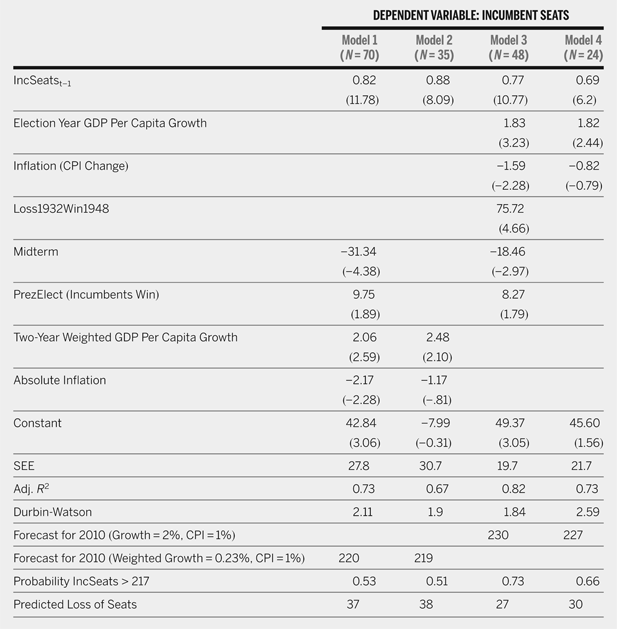
That the forecast fell so wide of the mark may indicate that the model suffers from flawed measurements or omitted variables. Addressing the former issue first, table 1 displays two pairs of model estimates. The second pair includes Models 3 and 4, copied from the original forecast (Cuzán Reference Cuzán2010a). As well as being estimated over a longer period, Models 1 and 2 measure economic performance differently: instead of using election-year real growth in per capita gross domestic product, I employ a weighted average of the same variable over the first two years of the administration, with the first year's rate weighted by one-third and the second year's rate by two-thirds; as well, inflation is measured in absolute rather than nominal terms. The members of this pair of models yield point forecasts that are around 10 seats lower than the forecasts of the original model specification, leaving the Democrats teetering on the edge of losing majority control. It is clear that how one measures economic performance can make a difference.
Estimating the Number of House Seats Won by the President's Party: Different Time Periods and Economic Measures

In addition to measurement issues, the original model may omit variables that either exert their own independent influence on the vote or else operate through public perceptions of economic conditions, making the situation appear worse than it actually is. It is possible that the Democrats, having misread their victory in 2008 as a mandate to “transform America,” as then-candidate Obama said on the eve of his election, rushed to place on the agenda and then stage votes on a series of bills extending the reach of government into a number of areas, an approach that turned out to be less popular than expected.Footnote 1 Similarly, the Republican Party's assumption of a unanimous or near-unanimous posture of opposition, a stand that earned them the sobriquet “the party of no,” may have stimulated as much as reflected a popular backlash against the expanding scope of the federal government.Footnote 2 These ideas need to be systematically tested.
In sum, the initial point forecast made with a simple “economic performance” model of congressional elections, even as it was hedged with a caveat that there was “a nontrivial chance that 40 or more [Democrats] will be defeated in November” (Cuzán Reference Cuzán2010a, 641), fell far short of the actual outcome, badly underestimating the beating that the party was administered on Election Day. Experimenting with different economic measures and lengthening the period over which the model is estimated, as I have done here, can yield better results. But because the model includes many more elections and eschews direct measures of voter sentiment, such a simple construction is likely to incur larger errors than models that are driven by polls. One way around that problem would be to borrow a page from business practitioners and adjust the statistical model forecast with the use of extra-model information.Footnote 3 For example, after the APSA conference at which the original forecast was presented, I re-estimated two pairs of variations of the model using elections held since 1870. One pair was estimated over all elections, the other was estimated over midterm elections only, and one member of each pair was estimated with several outliers omitted. The models yielded a point forecast ranging between 31 and 36 seats. The mean absolute error for one-step-ahead forecasts for 10 previous elections (excluding the 1998 and 2002 outliers) was 6% of the total number of seats forecast (not of the likely loss). Noting extra-model information that suggested that any error was likely to be one of overshooting rather than undershooting the total number of seats that the incumbents would win, I subtracted the average error from the total yielded by the model and produced a likely loss of between 43 and 48 seats (Cuzán Reference Cuzán2010b). This forecast still fell short of the actual outcome, but it was well within the range of those generated with poll-driven models.
In conclusion, the “economic performance” model of congressional elections that I used to forecast this year's outcome may be improved with better measures of economic performance and, hopefully, additional variables that capture aspects of the system that are now omitted. Along with the revised specification, for forecasting purposes the statistical model may need to be supplemented with an application of the judgment method, in which the forecast is adjusted in light of extra-model information as circumstances dictate.