Implications
Faba bean (FB) can be widely used in poultry nutrition, and it can be included in diets for young turkeys at up to 30%, which may have important implications for the poultry industry. Faba bean-based diets improve bird welfare because they reduce excreta moisture content and alleviate the symptoms of footpad dermatitis (FPD). This applies to both white-flower and coloured-flower FB varieties, and diets should be supplemented with exogenous enzymes to improve feed conversion.
Introduction
Previous experiments demonstrated that high tannin content is a factor limiting the use of FB in broiler chicken diets (Helsper et al., Reference Helsper, van Loon, Kwakkel, van Norel and van der Poel1996). The results of a more recent study revealed that chickens can tolerate diets containing 15% to 20% of seeds of conventional FB varieties (Nalle et al., Reference Nalle, Ravindran and Ravindran2010), and that diets containing up to 30% of low-tannin FB have no adverse effect on the growth performance of chickens, as compared with the control soya bean meal (SBM)-based diet (Usayran et al., Reference Usayran, Shaar, Barbour, Yau, Maalouf and Farran2014).
Another factor responsible for the limited suitability of FB in intensive poultry feeding is the presence of low-digestible carbohydrates, including cellulose, non-starch polysaccharides (NSP) and galactooligosaccharides, which could reduce nutrient digestibility and dietary energy utilisation (Longstaff and McNab, Reference Longstaff and McNab1991). According to estimates, apparent metabolisable energy of SBM is approximately 28% less for poultry when compared with swine (National Research Council (NRC), 1994), mostly due to lower utilisation of low-digestible oligosaccharides and polysaccharides in the gastrointestinal tract (GIT) of poultry (Nalle et al., Reference Nalle, Ravindran and Ravindran2010).
The addition of exogenous enzymes to diets, as demonstrated by experiments on chickens (Hughes et al., Reference Hughes, Gross and Hargreave2004; Abdulla et al., Reference Abdulla, Rose, Mackenzie, Mirza and Pirgozliev2016), has been considered as a way to increase energy utilisation. However, there is no information on the effect of NSP-degrading enzymes on the development and function of GIT in turkeys fed diets containing FB. The efficacy of next-generation carbohydrases that contain enzymes specifically developed to target various NSP components of feed ingredients applied in typical soya bean-cereal diets has not been analysed in turkeys fed FB-based diets (Meng et al., Reference Meng, Slominski, Nyachoti, Campbell and Guenter2005).
In view of the above, the objective of this experiment was to evaluate the physiological response of the upper and lower GIT segments of young turkeys (up to 8 weeks of age) to a diet containing 30% of FB and to dietary supplementation with a blend of NSP-degrading enzymes.
Material and methods
Birds and housing
A total of 896 1-day-old Hybrid Converter male turkey poults obtained from a commercial hatchery were placed in pens on litter (wood shavings) and were randomly allocated to four dietary treatments, with seven replicate pens (10 m2 each) per treatment and 32 birds/pen. The temperature and lighting programmes were consistent with the recommendations of Hybrid Turkeys (2014b). The protocol for this study was approved by the Local Ethics Committee, and the animals were cared for under guidelines comparable with those laid down by EU Directive 2010/63/EU.
Experimental design and diets
A completely randomized 2×2 factorial design with SBM or FB as the main high-protein component of diets, with and without the addition of NSP-degrading enzymes, was used to evaluate the GIT response and growth performance parameters of young turkeys (1 to 56 days of age). Coloured-flower FB var. Bobas was obtained from the Plant Breeding Station in Strzelce (Poland). Both SBM- and FB-based diets were divided into two batches, one of which was supplemented with the multi-carbohydrase commercial product (Canadian Bio-Systems Inc., Calgary, AB, Canada) containing wheat flour as a carrier. The enzymatic preparation was added at the expense of wheat, and it supplied 1100 U of pectinase, 1700 U of cellulase, 1200 U of xylanase, 360 U of glucanase, 240 U of mannanase, 30 U of galactanase, 1500 U of amylase and 120 U of protease perkg of the diet.
During each of two feeding phases (weeks 1 to 4 and 5 to 8), birds were ad libitum fed isoenergetic diets containing 28.0% and 25.5% of CP, respectively, as per nutrient requirements of turkeys (Hybrid Turkeys, 2014b). A control wheat-SBM-based diet and a diet containing 30% of raw FB seeds as a substitute for SBM, wheat and other ingredients were formulated at each feeding stage. Complete diets were pelleted at 65°C using the pelletizer machine (Jesma Company, Sprout Matador, Denmark). Starter diets were offered as crumbles whereas grower diets (days 29 to 56) were prepared as 3 mm pellets.
Sample collection
Body weight and BW gain (BWG) were recorded and calculated on a pen basis. Daily feed intake (DFI) per bird was calculated on a pen total feed consumption and days in the period. Feed conversion ratio (FCR; kg of feed/kg of BWG) for the experimental period was calculated on a pen basis based on BWG and feed consumption. Mortality rates, including their causes, were recorded daily, and the weights of dead birds were used to adjust average BWG, DFI and FCR.
After 6 weeks of feeding, 14 birds with similar BW (2.65±0.15 kg) were selected from each treatment (seven replicates, two birds per replicate) and transferred to battery cages for balance trials. The diets were administered ad libitum and turkeys had free access to water. After a 3-day preliminary period, an excreta collection period was continued for 4 days. Excreta were collected three times daily from all turkeys in seven cages per treatment. Each replicate consisted of excreta collected per cage during 4 days, which were weighed, pooled within cages, and stored at −20°C. Freeze-dried excreta were ground to pass through a 0.5 mm sieve (Retsch-Grindomix, Type GM200; Retsch GmbH, Haan, Germany) and stored in airtight polyethylene containers at −20°C for subsequent analyses.
On the last day of the experiment, cardboard trays were placed on litter in each pen, and five samples of fresh excreta were collected per replicate. The samples were pooled and used to determine excreta dry matter (DM) content as a criterion for evaluating the effect of diet and enzyme supplementation on excreta moisture. In addition to BW determination, FPD scores were evaluated for all birds according to the method described by Krautwald-Junghanns et al. (Reference Krautwald-Junghanns, Ellerich, Mitterer-Istyagin, Ludewig, Fehlhaber, Schuster, Berk, Petermann and Bartels2011), on a five-point scale (0 to 4 points) where 0 – the skin of the footpad feels soft to the touch and no swelling or necrosis is evident and 4 – more than half of the footpad is covered by necrotic cells.
At 56 day of age, seven turkeys per treatment were selected (one bird representing average BW±15%/pen) and sacrificed by cervical dislocation, and segments of the digestive tract (small intestine and caeca) including the contents were carefully collected and weighed. As soon as possible after euthanasia (~20 min), the pH of the ileal and caecal digesta was measured (mean of three readings) directly in the intestinal segment using a microelectrode and a pH/ION meter (model 301; Hanna Instruments, Vila do Conde, Portugal). Fresh samples of ileal (middle one-third section of the ileum) and caecal contents were used for immediate analysis (ileal viscosity, ileal and caecal DM, caecal ammonia). The remaining portion of the ileal and caecal digesta, including 0.2 g for the determination of ileal and caecal short-chain fatty acid (SCFA) concentrations, was transferred to test tubes and stored at −70°C until needed.
Chemical analyses
Samples of FB, SBM, feed and excreta were analysed in duplicate for DM, CP, fat and fibre fractions (NDF and ADF) using Association of Official Analytical Chemists (AOAC) methods (Association of Official Analytical Chemists, 2005). The content and composition of NSP and raffinose family oligosaccharides (RFOs) (raffinose and stachyose) were determined as described by Slominski et al. (Reference Slominski, Guenter and Campbell1993). Starch was analysed using the Megazyme Total Starch Kit (Megazyme International Ireland Ltd, Co. Wicklow, Ireland) according to AOAC procedure 996.11. Condensed tannins were analysed using acidified vanillin reagent (Broadhurst and Jones, Reference Broadhurst and Jones1978), and the results were expressed as mg catechin equivalents (CE/g). The ileal and caecal DM content was determined at 103°C. Pooled samples of ileal digesta were vortexed and centrifuged at 7211×g for 10 min. The supernatant fraction (0.5 ml) was placed in the Brookfield LVDV-II+ cone-plate rotational viscometer (CP40; Brookfield Engineering Laboratories, Stoughton, MA, USA), and apparent viscosity was measured at 39°C and shear rate of 60 s−1. Ammonia was extracted from fresh caecal digesta, trapped in a solution of boric acid in Conway dishes and determined by direct titration with sulphuric acid. The concentrations of SCFAs in samples were analysed in a gas chromatograph (GC-2010; Shimadzu, Kyoto, Japan) equipped with a capillary column (SGE BP21, 30 m×0.53 mm; SGE Europe Ltd., Milton Keynes, UK).
Statistical analysis
For performance parameters, excreta DM content and FPD scores and the nutrient digestibility of diets, a single pen or cage (n=7) was considered as a replicate experimental unit in the statistical analysis. For the analysis of intestinal parameters and SCFA concentrations, individual birds (n=7) were considered as experimental units. The model assumptions of normality and homogeneity of variance were examined by the Shapiro–Wilk and Levene tests, respectively. The experiment had a completely randomized 2×2 factorial design, and two-way ANOVA was performed to assess the effects of diets (C and FB) with and without enzyme supplementation, and their interactions. When a significant interaction effect was noted (F test), treatment means were separated using the post hoc Newman–Keuls test. All calculations were performed using the GLM procedures of the STATISTICA software system ver. 10.0 (StatSoft Inc., 2011). Data variability was expressed as mean values with a pooled standard error of the mean, and P<0.05 was considered statistically significant.
Results
Chemical composition of feedstuffs and experimental diets
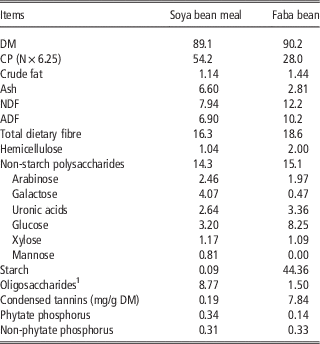
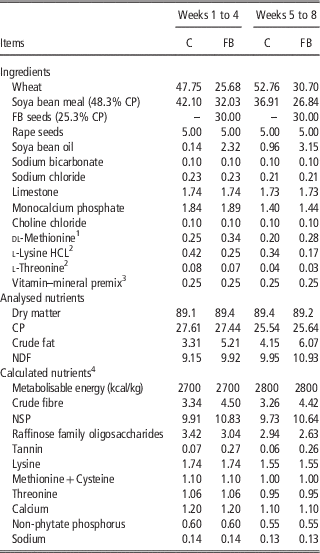
In comparison with SBM, FB seeds had almost twofold lower CP content and substantially higher starch content (Table 1). As regards fibre fractions, greater differences between SBM and FB were noted in NDF and ADF content, and smaller differences were observed in total dietary fibre and NSP content. The predominant NSPs were galactose and glucose in SBM, and glucose and uronic acids in FB. Oligosaccharide concentrations were over fivefold higher in SMB, whereas the content of condensed tannins was over 40fold lower than in FB seeds. The content of non-phytate phosphorus was similar in both feed components, whereas the content of phytate phosphorus was higher in SBM. In comparison with SBM-based, FB diets contained less RFOs and more NSP and almost 4 times more condensed tannins (Table 2).
Chemical composition of soya bean meal and faba bean seeds (% dry matter (DM) unless stated otherwise)

1 Including raffinose and stachyose.
Composition and calculated analysis of experimental diets (%, as-fed basis unless indicated otherwise) containing faba bean (FB) seeds fed to turkeys from 1 to 8 weeks of age

1 990 g methionine/kg, MetAMINO®; Evonik Degussa GmbH, Essen, Germany.
2 780 g/kg lysine and 985 g/kg threonine; Ajinomoto Eurolysine S.A.S, Amiens, France.
3 Provided the following per kilogram of feed (feeding period: weeks 0 to 4 and 5 to 8, respectively): retinol 3.78 and 3.38 mg, cholecalciferol 0.12 and 0.10 mg, α-tocopheryl acetate 100 and 90 mg, vitamin K3 5.8 and 5.6 mg, thiamine 5.4 and 4.7 mg, riboflavin 8.4 and 7.5 mg, pyridoxine 6.4 and 5.6 mg, cobalamin 0.032 and 0.028 mg, biotin 0.32 and 0.28 mg, pantothenic acid 28 and 24 mg, nicotinic acid 84 and 75 mg, folic acid 3.2 and 2.8 mg, Fe 64 and 60 mg, Mn 120 and 112 mg, Zn 103 and 88 mg, Cu 23 and 19 mg, I 3.2 and 2.8 mg, Se 0.30 and 0.28 mg, choline chloride 400 and 376 mg, respectively.
4 DM, CP, fat and NDF were determined analytically, and the content of the remaining nutrients was calculated based on the analysed chemical composition of soya bean meal and FB seeds and according to the Polish Feedstuff Analysis Tables (Smulikowska and Rutkowski, Reference Smulikowska and Rutkowski2005).
Physicochemical properties of ileal and caecal digesta
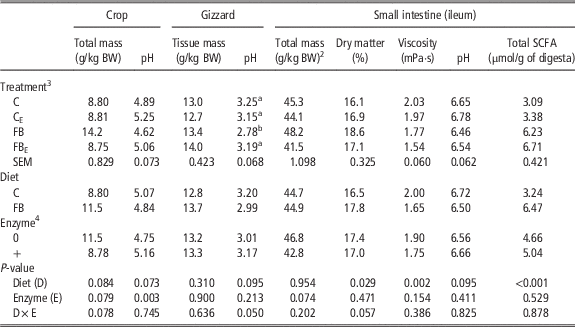
Faba bean seeds, used as a partial substitute for SBM, did not lower the pH of digesta in the upper GIT (P>0.05), but increased the DM content (P=0.029) and decreased the viscosity of small intestinal digesta (P=0.002) (Table 3). In comparison with diets without multi-carbohydrase supplementation, enzyme-supplemented diets increased the pH of crop digesta (P=0.003), whereas the differences in digesta pH in the remaining GIT segments were not statistically significant (P>0.05). In all experimental groups, total SCFA concentrations in the small intestinal digesta were very low (<7 µmol/g), but increased from 3.24 to 6.47 µmol/g (P<0.001) when turkeys were fed FB-based diets. The multi-carbohydrase preparation had no effect (P>0.05) on the concentrations of fatty acids in the small intestinal digesta.
Parameters of the upper gastrointestinal tract function of turkeys at 8 weeks of ageFootnote 1

SCFA=short-chain fatty acids; FB=faba bean; NSP=non-starch polysaccharides.
a,bValues within a column with different superscripts differ significantly at P<0.05.
1 Data are the means of seven birds per treatment group.
2 Tissue with digesta.
3 Diets C and FB contained 0% and 30% of FB without NSP-degrading enzymes; diets CE and FBE contained 0% and 30% of FB with NSP-degrading enzymes.
4 NSP-degrading enzymes.
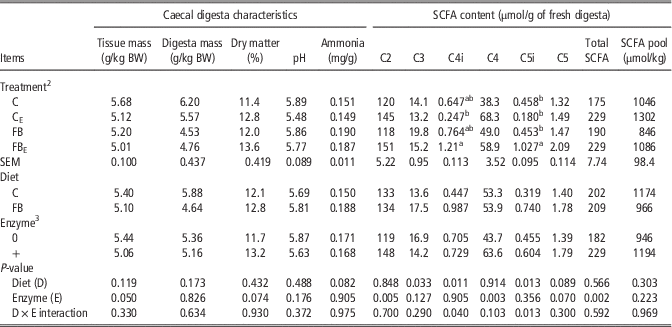
Faba bean-based diets had no influence on caecal digesta mass or DM content and pH of caecal digesta, but tended to increase (P=0.082) the concentrations of ammonia in caecal digesta (Table 4). Enzyme supplementation decreased caecal tissue mass (P=0.050) and tended to increase the DM content of caecal digesta (P=0.074). Both experimental factors (FB inclusion and enzyme supplementation) affected the levels of selected fatty acids in the caecal digesta of turkeys. In comparison with the control group, FB seeds increased the concentrations of propionate (P=0.033), iso-butyrate (P=0.011) and iso-valerate (P=0.013) in the caecal digesta. Faba bean seeds had no influence on the content of acetic acid (quantitatively most important) or the concentrations and total pool of SCFAs in the caecal digesta (P>0.05). In comparison with diets without enzyme supplementation, the multi-carbohydrase preparation increased the concentrations of acetate (P=0.005), butyrate (P=0.003) and total SCFAs (P=0.002), but the increase in the total SCFA pool in the caecal digesta was below the significance level (P>0.05).
Physicochemical properties of caecal digesta in turkeys at 8 weeks of ageFootnote 1

SCFA=short-chain fatty acids, C2=acetic, C3=propionic, C4i=iso-butyric, C4=butyric, C5i=iso-valeric, C5=valeric; FB=faba bean; NSP=non-starch polysaccharides.
a,bValues within a column with different superscripts differ significantly at P<0.05.
1 Data are the means of seven birds per treatment group.
2 Diets C and FB contained 0% and 30% of FB without NSP-degrading enzymes; diets CE and FBE contained 0% and 30% of FB with NSP-degrading enzymes.
3 NSP-degrading enzymes.
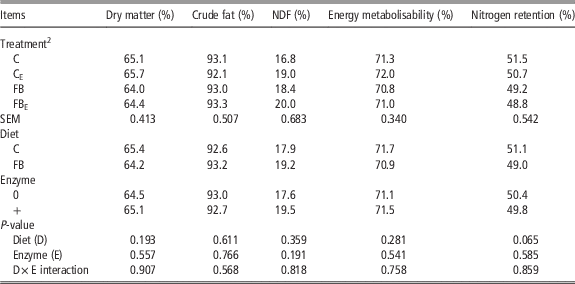
In comparison with the control group, FB seeds decreased nitrogen retention at a level close to statistical significance (P=0.065), but enzyme supplementation had no effect (P>0.05) on nutrient digestibility in turkey diets (Table 5).
Coefficients of total tract apparent digestibility of nutrients in 7-week-old turkeys fed control diets and diets containing faba bean (FB) seeds with or without enzyme supplementationFootnote 1

NSP=non-starch polysaccharides.
1 Data are the means of seven replicates with two birds each.
2 Diets C and FB contained 0% and 30% of FB seeds without NSP-degrading enzyme; diets CE and FBE contained 0% and 30% of FB seeds with NSP-degrading enzyme.
Growth performance of turkeys
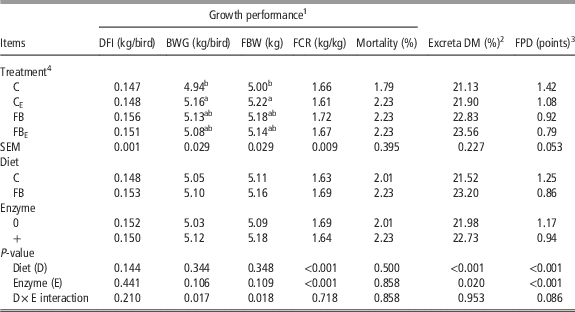
In comparison with SBM, FB contained in turkey diets resulted in similar DFI and BWG, but higher FCR (P<0.001) (Table 6). A significant diet×enzyme interaction indicates that NSP-degrading enzymes significantly improved the BWG and final BW of group C turkeys, but they did not affect the above parameters in turkeys fed FB-based diets. Non-starch polysaccharide-degrading enzymes had no influence on DFI, but significantly improved FCR (P<0.001).
Growth performance parameters, excreta moisture content and footpad dermatitis (FPD) incidence in turkeys at 1 to 8 weeks of age

DFI=daily feed intake; BWG=BW gain; FBW=final BW; FCR=feed conversion ratio; DM, dry matter; NSP=non-starch polysaccharides.
a,bValues within a column with different superscripts differ significantly at P<0.05.
1 Data for DFI, BWG, FBW and FCR are the means of seven replicates per treatment group.
2 Data are the means of seven replicates with five samples each.
3 Data are the means of seven replicates with approximately thirty birds each.
4 Diets C and FB contained 0% and 30% of FB without NSP-degrading enzymes; diets CE and FBE contained 0% and 30% of FB with NSP-degrading enzymes.
Survival and welfare of turkeys
Both the inclusion of FB in the basal diet and enzyme supplementation decreased excreta moisture content and reduced the incidence and severity of FPD at the end of the experiment (Table 6). The DM content of excreta in 8-week-old turkeys fed FB-based diets was significantly higher than in control birds (23.2% v. 21.5%, P<0.001). Enzyme supplementation significantly increased excreta DM content (P<0.020). Both experimental factors (FB inclusion and enzyme supplementation) reduced the severity of FPD in turkeys (P<0.001 in both cases). During experimental 56-day feeding, the mortality rates of turkeys were negligible (1.8% to 2.2%) and unrelated to the dietary treatments (P>0.05).
Discussion
The effect of dietary faba bean
The concentrations of CP, fibre fractions and starch in the seeds of the coloured-flower FB variety Bobas, used in our experiment, were generally similar to those reported for other varieties grown in other soil and climatic conditions. The condensed tannin content of FB seeds (7.84 mg/g DM) was consistent with the classification of FB varieties grown in Poland, according to which Bobas is a high-tannin variety (Księżak and Bojarszczuk, Reference Księżak and Bojarszczuk2014).
Due to lower CP content, the replacement of SBM with FB results in a 50% or higher increase in the total content of high-protein components in chicken diets (Nalle et al., Reference Nalle, Ravindran and Ravindran2010). In our experiment, the inclusion of 30% of FB in turkey diets decreased SBM content by ~10% and wheat content by ~20%. Faba bean-based diets contained more NSPs and less RFOs, and almost four times more condensed tannins than SBM-based diets. However, it had no effect (P>0.05) on the morphological parameters of GIT development, measured as the weights of tissue and digesta in selected GIT segments, including the gizzard. A different trend was observed in chickens where a diet containing 20% of FB increased gizzard size (Nalle et al., Reference Nalle, Ravindran and Ravindran2010).
In the present experiment, the average value of digesta viscosity was low (<2 mPa·s) in all dietary treatments. This should be treated as a physiologically normal state of the gut in turkeys, at which the anti-nutritional effect is not observed (Jankowski et al., Reference Jankowski, Zduńczyk, Mikulski, Przybylska-Gornowicz, Sosnowska and Juśkiewicz2013). In our study, FB decreased the viscosity of small intestinal digesta, most probably due to lower concentrations of RFOs and a lower proportion of cereal polysaccharides in the total NSP pool. It is also known that wheat is a feed component with a high share of arabinoxylans in the total NSP pool (Smeets et al., Reference Smeets, Nuyen, Van Campenhout and Niewold2014).
The content and composition of dietary fibre (Choct et al., Reference Choct, Dersjant-Li, McLeish and Peisker2010) and the polyphenol content of diets (Surai, Reference Surai2014) play an important role in GIT function in poultry. An increased dietary fibre content of diets is expected to enhance the intensity of fermentation processes in the caeca, whereas increased polyphenol concentrations may exert the opposite effect (Zduńczyk et al., Reference Zduńczyk, Jankowski, Kaczmarek and Juśkiewicz2015). The results of previous experiments on chickens suggest that increased concentrations of dietary polyphenols reduce the enzymatic activity of gut microbiota (Longstaff and McNab, Reference Longstaff and McNab1991), which was not observed in our experiment.
In our study, SCFA concentrations in the small intestine contents of FB groups were higher but in the caecal digesta were similar in turkeys fed FB-based and control diets. This indicates that the inclusion of FB in turkey diets increased the amounts of readily fermentable components in the small intestine, but it did not increase the amount of substrate that is fermented in the caeca. It has been demonstrated that the major part of starch in FB seeds is amylase-resistant in vitro (Hejdysz et al., Reference Hejdysz, Kaczmarek and Rutkowski2016). As the large surface of granular starches facilitates bacterial adhesion (Crittenden et al., Reference Crittenden, Laitila, Forssell, Mȁttȍ, Saarela, Mattila-Sandholm and Myllȁrinen2001), amylase-resistant starch can be fermented more rapidly than oligosaccharides and polysaccharides. Amylase-resistant starch could increase the amount of substrate in the caeca, whereas the amount of arabinoxylans from wheat was reduced in FB-based diets.
Douglas et al. (Reference Douglas, Sullivan, Gonzalez and Beck1993) demonstrated that a diet with high tannin content (0.49% to 1.96%) decreased BWG in turkeys to 8 weeks of age. In a more recent experiment (Usayran et al., Reference Usayran, Shaar, Barbour, Yau, Maalouf and Farran2014), a diet with 30% of tannin-free FB did not compromise the growth performance of broiler chickens. This is an important consideration because due to the presence of tannins, the inclusion levels of FB in broiler starter and finisher diets were maintained at 15% to 20% (Nalle et al., Reference Nalle, Ravindran and Ravindran2010).
The growth performance parameters determined in our study indicate that turkeys at 1 to 8 weeks of age can tolerate tannins supplied by diets containing up to 30% of seeds of a coloured-flower FB variety. Diets with a high content of raw FB (containing 0.26% of tannin) were found to produce BWG similar to those observed in turkeys fed reference wheat-SBM-based diets. As a result, the final BW of turkeys were high in both groups C and FB (5.11 to 5.16 kg), exceeding by 5% to 6% the values recommended by Hybrid Turkeys (2014a). In our experiment, the dietary inclusion of FB led to higher FCR values. Similarly, Helsper et al. (Reference Helsper, van Loon, Kwakkel, van Norel and van der Poel1996) reported that broiler chickens fed diets with tannin-containing FB seeds were characterised by higher feed intake and higher FCR than birds receiving diets with corresponding inclusion levels of tannin-free FB.
A decrease in excreta moisture content, observed in turkeys fed FB-based diets, could result from lower RFO concentrations in FB seeds and lower arabinoxylan levels in diets containing FB, which also had lower wheat content. According to Bedford (Reference Bedford1995), RFOs contribute to the hydroscopic properties of excreta leading to increased litter moisture, and wet litter has been reported as a risk factor for the development of FPD in poultry (Mayne et al., Reference Mayne, Else and Hocking2007). In our study, a decrease in the moisture content of ileal digesta and excreta was accompanied by lower incidence and severity of FPD in turkeys fed FB-based diets, as compared with turkeys fed SBM-based diets. The reduced incidence of FPD can also be attributed to the lower potassium (K) content of diets containing FB. As SBM is relatively high in K (1.98%), compared with FB seeds (1.20%; NRC, 1994), reducing the share of SBM in the diet could lead to lower dietary concentrations of K. High dietary concentrations of K contribute to increased water intake, thus increasing litter moisture content (Eichner et al., Reference Eichner, Vieira, Torres, Coneglian, Freitas and Oyarzabal2007). Therefore, lower concentrations of RFOs and K in FB-based diets (due to lower SMB content) could exert positively synergistic effects on FPD incidence.
The relatively small differences in GIT function parameters and satisfactory growth performance and welfare of young turkeys, noted in our study, indicate that the differences in the NSP composition and tannin content of control and FB-based diets were insufficient to disturb gut homoeostasis. The tannin content of FB seeds was reduced from 15.7 to 35.4 g/kg (Makkar et al., Reference Makkar, Becker, Abel and Pawelzik1997) to 2.1 to 7.4 g/kg in the seeds of coloured-flower FB varieties (Jezierny et al., Reference Jezierny, Mosenthin and Bauer2010). A considerable decrease in tannin concentrations was also noted in the seeds of coloured-flower FB varieties grown in Poland, including var. Bobas used in the present experiment (Księżak and Bojarszczuk, Reference Księżak and Bojarszczuk2014).
The effect of multi-carbohydrase
To our knowledge, a comparison of the physiological responses of turkeys fed SBM- and FB-based diets formulated with and without enzymes has not been reported in the literature. In a recent study of broiler chickens fed diets containing 30% of FB, the addition of exogenous tannase, pectinase and phytase decreased gizzard weight (Abdulla et al., Reference Abdulla, Rose, Mackenzie, Mirza and Pirgozliev2016). In the present experiment performed on turkeys, such a physiological effect was not observed when the diets were supplemented with a blend of NSP-degrading enzymes. The morphological parameters of GIT development, including gizzard relative weight, were not affected by enzyme inclusion in SBM- and FB-based diets.
According to Silva and Smithard (Reference Silva and Smithard2002), depolymerisation of NSPs increases carbohydrate digestibility and decreases the rate of carbohydrate fermentation by intestinal microflora in the crop, duodenum and ileum. In our experiment, enzyme supplementation did not decrease SCFA concentrations in the small intestinal digesta of turkeys. The multi-carbohydrase preparation significantly increased SCFA concentrations in the caecal contents. This may indicate that the blend of NSP-degrading enzymes increased the amount of substrate in the caeca of turkeys. It is known that NSPs degraded by enzymes in the small intestine to low molecular weight polysaccharides and possibly oligosaccharides would be more readily fermented to SCFAs in the caeca than their intact form. No such effect was observed when broiler diets were supplemented with xylanase alone (Józefiak et al., Reference Józefiak, Rutkowski, Jensen and Engberg2007) or xylanase and glucanase (Rebole et al., Reference Rebole, Ortiz, Rodriguez, Alzueta, Trevino and Velasco2010).
In the present experiment, the total SCFA pool did not increase significantly in the caecal digesta, but a desirable increase in the proportion of butyrate in total SCFAs was noted. Butyrate present in the intestines plays an important role in both immune and digestive functions, including the control of pathogen colonisation of the small intestine, improved structure of intestinal villi and growth performance of broiler chickens (Onrust et al., Reference Onrust, Ducatelle, Van Driessche, De Maesschalck, Vermeulen, Haesebrouck, Eeckhaut and Van Immerseel2015).
In our study, the addition of multi-carbohydrase to the control (wheat-SBM) diet improved the BWG of turkeys, but such an effect was not observed when turkeys were fed FB-based diets. This suggests that high molecular weight polysaccharides, including arabinans, arabinogalactans and pectic polysaccharides present in the NSP fraction of FB, are more hardly fermentable in the large intestine than the NSP fraction of SBM. This, in turn, could contribute to less complete nutrient utilisation. On the other hand, the present data suggest that the composition of FB-based turkey diets could be optimised by supplementation with exogenous enzymes. This was confirmed by improved feed efficiency in turkeys fed FB-based diets supplemented with multi-carbohydrase, which was comparable with that noted in birds fed SBM-based diets without enzyme supplementation. Thus, the addition of NSP-degrading enzymes to both SBM- and FB-based diets improves NSP degradation, as documented by earlier studies (Meng et al. Reference Meng, Slominski, Nyachoti, Campbell and Guenter2005). The mode of action of NSP-degrading enzymes, based on elimination of the physical barrier of endosperm cell walls and nutrient encapsulation, can provide an explanation as to why the enzymes applied in the current study improved FCR in birds. Previous studies investigating the use of carbohydrases in poultry nutrition revealed a 9% to 20% increase in the metabolisable energy content of FB seeds in chickens (Hughes et al., Reference Hughes, Gross and Hargreave2004). An improvement in FCR was also reported by Abdulla et al. (Reference Abdulla, Rose, Mackenzie, Mirza and Pirgozliev2016) in an experiment where starter broiler diets containing 30% of FB were supplemented with exogenous tannase, pectinase and phytase. Other authors (Mayne et al., Reference Mayne, Else and Hocking2007) demonstrated that wet litter was a risk factor for the development of FPD in poultry. In our study, the dietary multi-carbohydrase preparation decreased excreta moisture content by 16% to 23%, thus reducing the severity of FPD symptoms. Although enzyme supplementation had no effect on the mortality rates of turkeys, it improved their welfare.
In conclusion, the inclusion of 30% of raw FB in the diets of young turkeys (to 8 weeks of age) had no adverse effects on the analysed parameters of GIT development and function, as compared with SMB-based diets. Dietary inclusion of FB increased FCR, but also decreased excreta moisture content and the severity of FPD symptoms. A dietary blend of carbohydrases had no influence on most parameters of GIT function, but it improved feed efficiency in turkeys fed SBM-based diets, and reduced excreta moisture content and FPD incidence in all dietary treatments.
Acknowledgements
This study was supported by the Polish Ministry of Agriculture and Rural Development under the ‘Improvement of Native Plant Protein Feeds, Their Production, Trade Turnover and Utilisation in Animal Feed Mixtures’ programme.