Introduction
‘Sugar is unique’. This statement introduces the only publication devoted to the world sugar economy in the inter-war period.Footnote 1 In it, Bill Albert and Adrian Graves argue that the uniqueness of sugar was evident in two ways. First, sugar was the single most valuable bulk commodity traded internationally, until it had to yield that title to oil.Footnote 2 As a commodity and as an industry, sugar played an integral part in globalisation. In his seminal study, Sweetness and Power, Sydney Mintz showed the importance of the global sugar trade for national mass consumption. Sugar played a critical role in shaping nutrition and globalisation.Footnote 3 For that reason, second, sugar has remained important in the global political landscape. In response to the global interconnectedness of sugar, sugar protectionism became a central tool in foreign trade policy.Footnote 4 In particular the European states implemented what is known to political economists as the beggar-thy-neighbour strategy. The internal problems of an industry that was unable to compete nationally and internationally due to more efficient sugar production elsewhere were externalised through tariff protection. The European system of agricultural protection was characterised by a set of ‘diabolical technicalities’ in the global agricultural sector. In addition to tariffs, import quotas were imposed as a ‘second line of defence’.Footnote 5 The European sugar industry claimed that by these measures, European sugar would become ‘naturally competitive’ on the world market.Footnote 6
As this article will demonstrate, sugar was equally ‘unique’ amidst the agricultural internationalism of the first half of the twentieth century. Sugar was pivotal in economic internationalism before the First World War. The Brussels Sugar Agreement of 1902 was signed only by European states. Its rationale was to limit national export subsidies and import duties on the European continent.Footnote 7 The international body that was founded for this purpose, the International Sugar Council, was empowered to intervene in national tariff policy and thus in the sphere of national sovereignty. In 1950, when Robert Schuman proposed his path-breaking plan for a higher European authority and so introduced the concept of supranationality into the domain of international co-operation, the Brussels Sugar Agreement was seen as a historic antecedent.Footnote 8
Moreover, after 1902 sugar internationalism was conceptually identified as a free trade policy. This essential ‘mechanic of internationalism’, which survived the First World War, became crucial to economic internationalism in the inter-war period.Footnote 9 The League of Nations was the central body entrusted with the promotion of this free trade heritage. Nor was its Economic Committee the only authority to follow the free trade track. The League's two World Economic Conferences, in Geneva (1927) and London (1933), prominently focused on international efforts to combat protectionism.Footnote 10
The League's efforts to free the world market from exaggerated protectionism and hence reduce sugar protectionism were a complete failure. This article is predicated on the conceptual antagonism between agricultural nationalism, in the form of national protectionism, and agricultural internationalism, in the form of international free trade policy. Taking a transnational perspective on international sugar policy during a global sugar crisis, it brings together apparently contradictory currents of nationalism and internationalism in processes of negotiation and co-operation, and aims to show how the notion of agricultural internationalism changed profoundly during the Great Depression.
In the case of sugar, the opposition of protectionism and free trade is best symbolised by the raw materials involved, sugar beet and sugar cane, or in geographical terms by ‘Europe’ and the Dutch colony of Java. The article uses the two dichotomies to tackle three main questions addressed in this special issue. First, it looks at the emergence and activities of transnational networks in international sugar politics. The first transnational organisation in this field was the International Commission of European Sugar Beet Growers (Commission Internationale des Betteraviers Européens, CIBE). Founded in 1927, this organisation (which still exists) is unknown to historiography, as until now its archives have remained untouched.Footnote 11 The second transnational body was the International Sugar Council (ISC), which was founded in 1931 on the basis of a transnational agreement among the world's major sugar exporting industries, the Chadbourne Agreement. By looking at these networks, the article traces a new understanding of agricultural internationalism and hints at what recent historiography has called ‘Europeanisation’.Footnote 12
Second, the article seeks to contribute to a more detailed understanding of Java's loss of export markets in the inter-war period. Sugar is the single most ‘colonial’ commodity, as it is the product most closely associated with the history of colonialism.Footnote 13 The standard explanation for colonial distress during the Great Depression has been the general decline of world market prices. Recently, Roger Knight has argued that Java was crowded out of its key markets in Asia due to ‘exogenous colonialism’. By this he means that metropolitan demand and preferential treatment, combined with the introduction of protectionism in Java's colonial export markets, caused an increase in domestic sugar production and a falling demand for Javanese cane sugar. This article argues that transnational agreements played a major role in Java's economic distress; it therefore challenges conventional views of transnational co-operation as a consistently progressive force.
Third, the article aims to contribute to a transnational perspective on the League of Nations and its sugar policy. By tracing the activities of the CIBE and the ISC in Geneva, it attempts to traverse the boundaries between official and unofficial action, between transnational concepts and intergovernmental policy.Footnote 14
Java in the inter-war world sugar market
Sugar cane and sugar beet, the raw materials for the production of sugar, have always been in competition from both the processing and the geographical point of view.Footnote 15 The differences in the biology of the two plants and the climatic conditions they require are directly relevant to productivity per hectare in different areas. One of the most productive sugar areas in the first half of the twentieth century was Java. The reason for its relatively high productivity, even compared to other sugar cane areas, is to be sought in the colony's plantation policy. The area used for the cultivation of sugar cane in Java was restricted. Otherwise, the production of other foodstuffs would have suffered. Therefore sugar refineries could increase production only by obtaining a higher yield per hectare. For that reason, the Dutch-owned sugar industry in Java had invested in agricultural research. One of the most famous research institutes was the Proefstation Oost Java. In 1928, it released on to the commercial market what is called the ‘POJ 2878 sugar cane variety’, which soon accounted for 90 per cent of Java's sugar plantations. The yield of this prolific variety was up to 12 per cent higher; it had a high sugar content and was highly disease resistant.Footnote 16 POJ 2878 became the global synonym for sugar productivity. In Europe, this cane variety came to symbolise the threat of a sugar cane invasion of Europe, although only 12 per cent of Java's sugar ever entered the European market.Footnote 17 Similarly Cuba, Java's foremost competitor on the free world market, feared the high productivity of Indonesian sugar cane. Additionally, Javan sugar had the lowest production costs in the world, at only 10 English pounds per ton, whereas Cuban producers had to reckon on 11,5 and European producers on 16 English pounds per ton.Footnote 18
Java's colonial sugar producers ranked second in the world in terms of quantity exported. Only Cuba produced and exported more sugar. Since the early twentieth century, the Caribbean island had had semi-colonial ties with the United States of America. Cuba enjoyed a preferential tariff treatment, which granted her a 20 per cent tariff reduction on sugar imports, and North American banks had invested in the Cuban sugar industry. By the mid-1920s, 70 per cent of Cuban sugar mill capacity was owned by North American banks. One of the most prominent Americans involved with Cuban sugar was the New York lawyer Thomas L. Chadbourne, representative of North American interests in Cuba and himself a heavy investor in the Cuban sugar industry.Footnote 19
As illustrated by the example of Cuban sugar, colonial production of raw materials was usually earmarked for the metropolitan consumer. The colonial sugar industry in Java did not relate to such metropolitan demand. Since Java was part of the Dutch East Indies, Javanese sugar production had developed from the late 1870s to the early 1930s outside the endogenous colonial context of ‘home’ markets, imperial connections and metropolitan financial and ownership ties. Java had to find markets for its foremost export commodity outside the small European metropole; in the 1920s it exported mainly to the Indian subcontinent, China, and Japan. Thus Java's sugar industry had a globally unique ‘outsider’ status and was exposed to all the vicissitudes and volatility of the international sugar trade. At a time when the notional ‘world market’ for sugar was diminishing, Java's sugar industry depended on a free global sugar market.Footnote 20
Around the turn of the century Java was exporting mainly to the United States, where sugar imports from Cuba had dropped due to revolution on the island and the subsequent Spanish-American war of 1898. Java lost this market completely a decade later, however, when the Platt Amendment of 1901 granted Cuba the status of preferred sugar exporter to the United States. The First World War brought another surge in Javanese sugar exports west of Suez: the war destroyed the equilibrium of cane and beet on the global sugar market by bringing European sugar beet production to a standstill. Accordingly, cane-sugar production was raised to meet world demand. Cuba in particular expanded its production capacity, but Java's sugar industry also benefited as the island increased its sugar exports to Europe until they absorbed one third of the total output.Footnote 21
By the mid-1920s European sugar production had returned to pre-war levels. Recovery was particularly strong in Germany, Czechoslovakia and Poland, where the sugar industry was well protected by high tariff walls and import quotas. While agricultural protectionism in European states took different forms and was of varying intensity, a constant factor was government intervention. Contemporaries identified agricultural protectionism as a European zeitgeist, a response to the global agricultural crisis.Footnote 22 Europe's sugar protectionism following the First World War forced Javanese cane sugar off the European market. Unable to rely on sufficient sugar demand in the Netherlands, Java concentrated its exports on Asian markets. Eighty-two per cent of Javanese sugar went to British India, China and Japan.Footnote 23 The expansion of European beet-sugar production, together with the high level of cane-sugar production in Cuba and Java, caused a severe global crisis of overproduction and a steep fall in world market prices. Java faced a heavy drop in production due to the Great Depression. Javanese output peaked in 1930 at about three million tons. Five years later, only thirty of 180 refineries were still in operation and produced only half a million tons. Javanese sugar exports to British India amounted to 1,101,238 tons in 1928, which shrank to a meagre 42,952 tons in 1936.Footnote 24
The standard explanation for the colonial economic crisis relates it to the global fall in commodity prices during the Great Depression. Contemporary studies suggested that ‘the colonies are the victims of the international economic distress’.Footnote 25 Recently, Roger Knight has revealed another aspect. Java's exodus from sugar in the 1930s was not due solely to the general effect of the Great Depression on the commodity market. Owing to the absence of a ‘home’ market and the consequent dependence on sugar demand in Asia, Java fell victim to growing protectionism and Empire preference in the Indian subcontinent, Japan and China, over which it had practically no influence and no control. In particular, the loss of its position in the ‘Japanese sugar empire’ cut Java off from its key Asian markets, exposing the island to the vicissitudes of ‘exogenous colonialism’.Footnote 26
The transnational perspective on the global sugar market in the inter-war period suggests another reason for the decline in Javanese sugar production, in addition to the economic and politico-economic aspects of the Great Depression and exogenous colonialism. That reason is Europe.
Europe imagined, Europe constructed. The European sugar cane invasion and the International Commission of European Sugar Beet Growers
Java's loss of its Asian key markets did not occur overnight. In anticipation, from the mid-1920s onward, Java tried to argue its way into the highly protected European continent as a new export market in order to maintain its level of sugar exports. Its main justification was the Brussels Sugar Agreement of 1902. In opposition to this free trade discourse reinforced by the general policy in Geneva, the European sugar beet growers organised themselves into the CIBE:
Farmers of old Europe, cast off the lethargy which is such a deadly threat to your most vital interests. Forget your national jealousies, collaborate in an intense working relationship, save your threatened existence; you are a majority, you are a force, but you lack a precise programme and a strong organisation – create both . . . Footnote 27
Founded in 1927 – the year of the League's venture into international co-operation in the economic sector – the CIBE became the central body through which European sugar beet growers organised and articulated their common interests. The first meeting of the CIBE in May 1927 was attended by members of national sugar interest organisations from Austria, Belgium, Czechoslovakia, Denmark, France, Germany, Hungary, Italy, the Netherlands, Poland and Switzerland.Footnote 28 As the years went by, the core membership of the CIBE emerged as Czechoslovakia, France, Germany, Italy and Poland, although the Europe the organisation claimed to represent was much larger.Footnote 29 The CIBE created both an imagined and a constructed Europe on the basis of ‘a unity of views and a unity of action’.Footnote 30 It founded its imagined community on a common discourse.Footnote 31 In the first place, the CIBE defined itself through its interest in beta vulgaris, a ‘European plant par excellence’, and its economic implications.Footnote 32 This is especially obvious in the founding resolution of the CIBE, written by the well-known leader of the French Parti Agraire et Paysan Français, Gabriel Fleurant Agricola:
Sugar beet in Europe, which competes with tropical cane sugar, is an absolute necessity, not only for the agricultural economy – especially that of European countries – but also because sugar beet is directly beneficial to agricultural production. There is no substitute for the sugar beet, and indeed the European economy also benefits indirectly from it, since it contributes to solving major economic and social problems.Footnote 33
Second, sugar beet symbolised European society. Because sugar beet was a key crop for European farmers, to defend it was to defend the European social order.Footnote 34 The idea that the whole community of Europe was linked to European sugar beet is best understood by looking at the CIBE Congress held in February 1932 in Heidelberg, at which the CIBE approved the final version of its articles of association. At a dinner in the Hotel Ritter, CIBE president Aimé Monmirel, who was also president of the French Sugar Producers Association (Confédération Générale des Planteurs de Betteraves, CGB), put the new organisation in the context of a specific view of European history. CIBE members, he said, had walked many paths in Europe before finding ‘our community of thought and action’. Now, at long last, the organisation had finalised its articles of association in Heidelberg, one of the cradles of European civilisation. Not far away, researchers had found Homo heidelbergensis, the ancestor of the ‘white race’. With this palaeo-anthropological allusion, Monmirel put the CIBE at the culmination of the history of his imagined Europe.Footnote 35 ‘A few kilometres away from the Rhine, the great river that must henceforth serve as a strong link between the nations of western Europe, our economic civilisation is about to create an organisation which is just one of the most recent proofs of its existence’.Footnote 36
The central pillar of common interest was opposition to international free trade policy. National tariffs in Europe were considered indispensable in order to combat energetic competition from cane sugar.Footnote 37 Acting in conjunction, European systems of protectionism would ‘never allow the European export market to be flooded with cane sugar’.Footnote 38 The common tariff position proved to be both a unifying and a dividing force. In this context, it is interesting to note that the Netherlands were pointedly excluded from the CIBE in the 1920s and 1930s, only to join again after the Second World War. The Dutch members had argued in favour of the Brussels Sugar Agreement of 1902. Stanislav Humnicki, Honorary President of the CIBE, suspected that the Dutch delegation was trying to promote Java's interests within the organisation.Footnote 39
The imagined ‘Europe’ of the sugar beet growers had a practical implication over and above demands for protectionism. Out of this imagined community emerged a Europe constructed on the basis of a politico-economic plan for an intra-European preferential tariff and a European export community. This economic Euro-nationalism expressed itself in the slogan ‘Europe for the Europeans!’ which can be interpreted as a first call for European regulation of the sugar sector.Footnote 40 The CIBE stated that there was a shortfall of 1.5 million tons on the European market. It aimed to cover 50 per cent of that shortfall by European sugar through a special European preferential agreement.Footnote 41
This intra-European preferential sugar tariff had to fit in with the politics of the global market. It would not be economically viable unless the problem of global overproduction could be solved. This involved an international approach that was fundamentally different from the League of Nations’ policy of tariff truce and reduction of protectionism. Therefore, second, the CIBE's economic programme followed the path of international commodity agreements (ICAs).
ICAs can be seen as a revolution in economic internationalism. Their main objective was to construct an organised world market by forging international agreements for export quotas and so influencing national production. The famous League of Nations economist Gottfried Haberler defined this kind of international production cartel as ‘uniting the producers, in a given branch of industry, of as many countries as possible into an organization in order to exercise a single planned control over production and price and possibly to divide markets between the different producing countries’.Footnote 42 The major goal of ICAs was to reduce the global output of the products concerned in order to sustain the world market price. Likewise, the CIBE's stated aim was ‘to participate in the organisation of sugar distribution on the world sugar market . . . for by so doing European agriculture will be saved . . . through international economic co-operation to the benefit of each individual country’.Footnote 43
ICAs had important national implications. As they were de facto cartels, they were perfectly in line with European sugar protectionism, since they did not affect national tariff positions. On the contrary, because they divided the market, ICAs ‘tended to stabilise rather than to modify the tariff position’.Footnote 44 One could argue that the European sugar beet growers were playing a two-level game. On the national level, they continued to press for national protectionism and tried to influence their respective governments to veto any free trade convention negotiated in Geneva. On the international level, they advocated a sort of agricultural internationalism, which fitted with European protectionism and, at the same time, might bring about global equilibrium between sugar supply and demand.Footnote 45 Consequently, the CIBE's agricultural internationalism substituted Adam Smith's invisible hand by a visible hand of international quantitative market intervention with genuine European implications. The CIBE called this approach to international co-operation ‘Live and let live’.Footnote 46 If the slogan had any collaborative implications, they leaned much more towards competition than co-operation.
The CIBE established Europe as a political argument on the international level: an imagined community with practical political implications. This Europeanisation of the international sugar question became a central pillar of national sugar policies in Europe. The process of Europeanisation went so far that formerly national and even nationalistic interest groups started lobbying their governments to intervene in the League of Nations – not in favour of their respective national agriculture but in favour of European agriculture.Footnote 47
Negotiating a prototype for world market intervention. The Chadbourne Agreement of March 1931
The economic programme of the CIBE, and the conceptual economic antithesis between Europe and Java, also applied to another part of the sugar sector: the sugar refining industry. Sugar beet growers and the sugar industry were not part of the same economic sector. In a colonial context, growers were the colonised while the industry was dominated by the colonisers. For instance, the Cuban colonos had contracts with a Cuban refining industry that was primarily American-owned. During the Great Depression, their respective interests diverged significantly when the colonos fought for higher production in order to maintain their living standards in times of falling prices, while the industry tried to limit Cuban sugar output.Footnote 48 The same divide existed in Europe, although the two interests did not differ in times of crisis. European sugar growers and sugar refiners both fought for ICAs on the global sugar market. Although European sugar refiners were not organised in a corporation comparable to the CIBE, they maintained close professional contacts with each other.Footnote 49
In 1927, the founding year of the CIBE, the first attempts were made to get the world's most important sugar exporters together in order to negotiate a limitation of sugar exports. Surprisingly, Cuba made the first step. The reason why the Cuban officials did not argue for global free trade was the preferential sugar tariff treatment they received from the United States of America. Had Cuba claimed free access to the American market, it would immediately have provoked opposition from the American sugar producers, who might then have fought against the preferential system.Footnote 50 Furthermore, it would have provoked competition from Java on the American market. Cuba invited the major European exporting sugar industries of Belgium, Czechoslovakia, Germany, Hungary, Poland and Yugoslavia to negotiate for a global export organisation in order to sustain world market prices. Europe agreed to co-operate. In addition to the general European interest in ICA internationalism, the main problem for the European sugar exporting industry was the export process itself, which generated heavy losses in view of the low world market price.Footnote 51
Cuba and Europe accounted for only 30 per cent of world sugar production and could not alone influence the world market price through export limitation. Hence Java had to join. Throughout the transnational negotiations, Java was unwilling to limit its sugar exports on to the world market.Footnote 52 Every Cuban effort to win over Java's sugar cartel in Amsterdam, the Vereenigde Javasuikerproduzenten (VJSP), ended in failure.Footnote 53 The VJSP's reluctance was rooted in its profound belief in Java's superior expertise and unbeatable price efficiency based on cost leadership and POJ 2878. Additionally, in view of the sharp competition from Cuba, Java deemed it a better strategy to embark on a gruelling price war and take advantage of the Cuban trade crisis, rather than trying to improve the situation on the world market. The aim was to ‘kill off Cuba as a commercial rival’.Footnote 54 Therefore Java's representatives advocated global sugar internationalism in accordance with the Brussels Sugar Agreement of 1902.Footnote 55
Nonetheless Cuba and Europe forced Java into an ICA. In the summer of 1930, Cuba flooded the remaining world sugar market.Footnote 56 The world market price fell far below two cents per English pound. Even the highly competitive sugar industry in Java could not make a profit at this low price level. Java also feared that a further sharp fall in prices would cause permanent damage to its export markets in Asia by provoking an endogenous protectionist reaction among major importers such as British India, where competing domestic producers were calling for help. Indeed, there is evidence that an endogenous sugar tariff was applied systematically in India. The Indian Tariff Board adopted a policy of matching its proposed tariffs to the current price of sugar. Furthermore, Cuban and even European sugar was finding its way on to oriental and Asian markets. As a result, the VJSP was forced to participate in an international solution pursued by Cuba and Europe. Following the sugar industry negotiations, the CIBE proclaimed with satisfaction that Java had finally understood that it was preferable to produce 60 per cent with a guaranteed profit rather than 100 per cent with a loss.Footnote 57
On 9 May 1931 the Chadbourne Agreement was signed by delegates from Cuba and Java and representatives of the sugar industries of Belgium, Czechoslovakia, Germany, Hungary, Poland and Yugoslavia.Footnote 58 Named after the New York lawyer Thomas L. Chadbourne, who represented American investment in the Cuban sugar industry, the convention's main purpose was to bring the world sugar market into equilibrium. It was the first international commodity agreement in the global agricultural sector: global sugar surplus was to be taken off the market, thereby eliminating its price-depressing effects. The surplus stocks were to be released gradually over a five year period. At the same time, exports would be restricted in order to raise the world market price, or at least prevent it from falling. Hence, the key provision of the agreement established export quotas and stipulated that unsold stocks were to be set aside pending an orderly release.
The Chadbourne Agreement laid down the five central mechanisms that would be used to attain this goal. First, the contracting parties agreed on export quotas.Footnote 59 Although restrictions on production were not part of the agreement, the fixed quotas, in combination with the segregation of stocks, implied that production would indeed be reduced. Second, all parties agreed to withdraw a certain quantity of stocks from the market. Those stocks were to be released in equal portions over the next four years. Third, the transnational ‘gentlemen's agreement’ was translated into the national law of every country concerned. Independent firms in each country were given incentives to defect. In Germany, for instance, the mechanism for implementing the Chadbourne parameters was imposed through national law, even though Fritz Harney, the director of the German sugar industry, had signed the transnational agreement.Footnote 60 Fourth, the ISC, which was to act as both governing body and clearing house, was set up. The remit of the ISC was to collect data, administer procedures, monitor compliance, and act as arbitrator in disputes between members. Furthermore, each signatory had the exclusive right to its own domestic market. Finally, the parties agreed a common pricing policy.Footnote 61
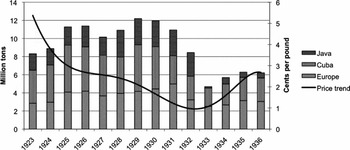
In the eyes of contemporaries, the Chadbourne Agreement was unprecedented. For the first time, a quantitative agreement among producers was being influenced by a new zeitgeist.Footnote 62 Frank Trentmann has described it as an ‘experiment in transnational governance’ that led to significant changes in forms of intergovernmental discussions.Footnote 63 If we consider only the Chadbourne countries, the transnational agreement can be described as a rousing success. According to League of Nations statistics, the decrease in worldwide production from the 1930–1931 output of 5.2 million tons was due to cutbacks by these countries. Although they supplied only about 50 per cent of total world raw sugar exports, they did not anticipate much competition from non-signatories in their customary market because the global cost leaders, Cuba and Java, were members, and other producers previously exporting to protected markets would not be competitive in the lower-priced free market. Contrary to expectations, however, importing countries either intensified or introduced protectionist measures in order to create a domestic sugar industry. The cost of so doing depended on the difference between free-market prices and domestic production costs. For each importing country, the Chadbourne Agreement might be expected to raise the free-market price and so lower the costs of protectionism. Since this was true for all importing countries, their production actually increased dramatically in these years, making it impossible for the Chadbourne Agreement to achieve its goal of significantly raising world market price levels.Footnote 64
Raw sugar production in the Chadbourne countries and world market price (New York, cost & freight)
Statistisches Jahrbuch für das Deutsche Reich (Berlin: Statistisches Reichsamt), 1929, 31*; 1933, 37*; 1938, 96 *; author's calculations.

Insofar as the existence of the Chadbourne Agreement encouraged protectionism, it actually worked against the best interests of its members, particularly those of Java – which had been forced into becoming a member in the first place. Hence, Roger Knight's theory of exogenous colonialism has to be put in the context of the Chadbourne Agreement, in that it encouraged protectionism and deprived Java of its key sugar export markets. The figures are sufficient testimony to the crowding out of Java and the direct impact of this for the Dutch colony. Java had anticipated export growth in India, Japan and China, where it had transport-cost advantages; yet in 1931 those markets were respectively at 60, 48 and 77 per cent of their 1929 levels, and showed every sign of declining further. Javanese production dropped dramatically in response to the collapse of demand. In 1934 Java produced 645,000 tons and in 1935 513,500 tons, compared to 2,900,000 tons in 1929.Footnote 65
In view of these figures, and bearing in mind that Cuba could partly rely on preferential treatment by America and that European sugar industries were well protected behind their tariff walls (further fortified by the Chadbourne Agreement), it is clear that Java was the big loser. Even European officials argued that Java would make sacrifices because of the Chadbourne Agreement, of which the European sugar industries, protected by high tariff walls, were bound to take advantage in the long run.Footnote 66 The VJSP had been forced to acknowledge that transnational co-operation and international competition were two sides of the same coin.
Javanese frustration with the agreement that had been forced upon them, and still more its obvious failure and the fact that the cost to Java was highest of all, caused the Indonesian producers to call for an end to this new form of internationalism. But times had changed, free trade was considered uncivilised, and market organisation now seemed to be synonymous with modernity:
There is a feeling among about 25 per cent of the Javanese producers that the only solution of the problem is a fight to a finish, with the survival of the fittest. This is the law of the jungle, and while it may have accomplished something in years that are gone, it is an absolutely suicidal policy for everybody concerned under modern conditions.Footnote 67
Once again, Cuba threatened to dump sugar on the world market and even managed to force Java into further export restrictions.Footnote 68
From laissez-faire to intervention. The metamorphosis of the League's sugar policy in the Great Depression
The transnational activities of the CIBE and the project of international sugar market intervention pursued by the Chadbourne countries were paralleled within the League of Nations, thereby influencing economic thinking in Geneva. The League of Nations’ economic policy followed a dogmatic free-trade path, taking Adam Smith's laissez-faire as a blueprint for intergovernmental negotiations on economic policy. This policy was articulated at a number of conferences, such as the World Economic Conference of 1927, several conferences in 1928 and 1929, and the London Monetary and Economic Conference of 1933.Footnote 69 The conceptual antagonism between international free trade and national protectionism, between ‘world free trade’ and national ‘vital interests’, is best understood by looking at the first two verses of the ‘Hymn of the World Economic Conference’ of 1927. Although the actual function of that hymn is not given in the sources, its satirical duct perfectly reflects the core conflicts in international economic policy in the inter-war period:
In line with its general free trade policy, the Economic Committee observed that ‘there is probably no product in connection with which the free play of economic forces is so much interfered with by Government action as sugar’.Footnote 71 Intergovernmentalism and transnationalism stood for different approaches to economic internationalism. Private international co-operation promoted international market intervention at a time when League of Nations internationalism was all in favour of non-intervention and freedom of trade.
The ever-growing crisis on the international sugar market forced the Economic Committee of the League of Nations to take an intergovernmental approach to the problem.Footnote 72 In 1927, concurrently with the commencement of negotiations on the sugar industry and with the founding of the CIBE, the Cuban delegates had proposed sugar as a subject for discussion and study during the World Economic Conference of the League of Nations.Footnote 73 The Council of the League of Nations referred the question to the Economic Committee for investigation and report. Faced with the multitude of technical details in a heterogeneous global sugar market, divided into various beet-sugar and cane-sugar producing areas as well as into growers and refiners, with the consequent plethora of differing interests, the Economic Committee decided to bring in ‘experts’ to deal with the global sugar question.
In contrast to the apolitical knowledge-based networks favoured by most international organisations, the Economic Committee set up two consultation rounds addressed to interest-based networks: representatives of the sugar industry and representatives of the European beet growers met in Geneva in 1929.Footnote 74 The reason for the Economic Committee's preference for interest-based networks is to be sought in its determination that the League ‘must be completely impartial both in its policy and in its procedure; it must take into consideration the interests of all the countries and all the categories of persons interested in the problem’.Footnote 75
In the first round, from 4 to 6 April 1929, sugar industry experts sat together in Geneva. This meeting was a trial run for the later Chadbourne round, not only because the same arguments were exchanged but mainly because the same people were involved. By inviting the sugar industry to send its ‘experts’, the League of Nations had constituted itself as a platform for transnational negotiations. Owing to the League's ‘moral prestige’ in economic internationalism – as it was called in transnational agricultural circles – transnational negotiations could claim international legitimacy by linking themselves to the ‘spirit of Geneva’.Footnote 76
At the sugar industry meeting, two different approaches to sugar internationalism met in Geneva for the first time. The Dutch sugar scientist Hendrik Coenraad Prinsen Geerligs, who spoke for the interests of the sugar industry in Java and was the only sugar industry representative to uphold the free trade discourse usually to be heard in the Economic Committee, faced up to a protectionist European sugar front. Its mastermind was the German Erich Rabbethge.Footnote 77 He stressed that tariffs were vital for Europe's sugar industry and for European agriculture in general. Any international co-operation that put the European tariff system into question would be decisively rejected by Europe. Rabbethge's statement was backed by action – a new German import tax on sugar. During the international negotiations in Geneva, the German sugar industry had fought for a higher tariff which would make the domestic price independent of the world market price.Footnote 78
The meeting ended without agreement. However, the negotiations did produce one important outcome which was certainly not expected by the Economic Committee. Free trade Java was depicted as the only obstacle to an international agreement, while the representatives of Germany, Czechoslovakia, Poland, Hungary, Belgium and Cuba formed a ‘task force’ to fight for agricultural internationalism.Footnote 79 Suddenly, and under the League's own auspices, the League's free trade policy had become the main obstacle to internationalism in Geneva. With obvious dislike of this outcome, the Economic Committee's representative, Ernst Trendelenburg, hastened to point out that the ‘League is an association of States and the only measures it can take are governmental measures’.Footnote 80
It is possible that Trendelenburg's distaste for agricultural transnationalism and its political interventionist implications turned into open despair during the ‘consultation of experts on beet production’ on 13 and 14 May 1929. One reason why the League felt bound to call this meeting was an act of active lobbying by the CIBE, which had sent a telegram to the Consultative Economic Committee demanding that it should consider sugar beet production as an integral part of European agriculture and hence provide with it an international platform in Geneva.Footnote 81
Historians have generally portrayed the League of Nations as a Eurocentric international organisation, in view of its personnel and its leading member states.Footnote 82 The consultation of experts on beet production was exclusively European: representatives from Belgium, Czechoslovakia, Denmark, England, France, Germany, Hungary, Italy, the Netherlands, Poland, Rumania and Serbia ‘examined [the sugar question] in Europe . . . solely from the point of view of agricultural and not of industrial interests’, because sugar beet had played a significant role in the European crop rotation and hence in ‘the development, or else the decline, of agriculture, the welfare of peoples or a rise in the cost of living’.Footnote 83 But the League's own staff also contributed to the Europeanisation of the discussion. Drawing on his experience of the sugar industry meeting in April, Ernst Trendelenburg tried to encourage the sugar beet fraternity to ‘take a step forward and . . . forget your own standpoint and give us your opinion on the aspects of the international situation from an international point of view’.Footnote 84 But in view of the composition of the meeting, this international point of view would inevitably turn into a European point of view.
Thus Hungary's representative, Servan, constructed a European space within the global sugar crisis. The situation was identical in all European countries and therefore ‘the sugar question [was] . . . an economic problem of quite exceptional importance in Europe’. Within this European space, the discourse of the consultation round of experts on European beet production was mainly shaped by the CIBE. Its president Aimé Monmirel, its Czechoslovakian vice-president Vladislav Brdlik, and its Polish vice-president Stanislav Humnicki – all of them leading figures in their respective national sugar organisations – were major contributors to the discussion.
Brdlik saw the problem in terms of a struggle between European sugar beet and sugar cane. The fight of the sugar beet was a fight against the tropical sun. ‘It is a struggle for the maintenance of a higher social culture and a higher civilisation in Europe, a struggle in which our production is handicapped by higher taxation and higher social costs. Safeguarding beet production means safeguarding the employment prospects of many millions of workers in Europe’. Humnicki demonised imported cane sugar as ‘synonymous with dire living in Europe and . . . a serious danger to the prosperity of the entire European population’.Footnote 85
The sugar beet experts agreed that the reason for the crisis was ‘not increased production of beet sugar, which has just attained its pre-war level . . . but increased production in cane-sugar countries’. Therefore, declared Monmirel, a European sugar tariff was ‘a necessity for the vast majority of European countries’, and this was non-negotiable. Internationalism, in the sense of the Brussels Sugar Agreement of 1902, would mean the ‘ruin of European beet cultivation’. The ‘key to the solution was in Java. All the other exporters were agreed upon making an effort to fix rationing and if Java would show a little goodwill the crisis might be solved’.Footnote 86
The Economic Committee concluded from the two expert meetings that it was not the right institution to deal with the question and that it did not want to take any responsibility or any initiative in the international sugar crisis. One reason for the League's institutional passivity was the memory of the failed free trade conferences in 1928 and 1929. ‘Unless there is some reasonable chance of a common formula being found, a general conference might very well be a failure, and we have already had too many League conferences during the last year which were more or less concealed failures’.Footnote 87 Accordingly, the Committee's official statement had a rather general and cautious ring:
The difficulties with which the industry is at present beset are such as can, to a large extent, either remedy themselves or be remedied by those responsible for the conduct of business.
1. We do not consider, therefore, that we are called upon to express any view concerning the relative merits of the various proposals for purely private action which have been put forward.Footnote 88
This official statement, from July 1929, is the very first evidence of the disintegration of the League's free trade doctrine. In fact, the Committee's conclusion is contradictory. On the one hand, the expression ‘remedy themselves’ suggests a free trade approach whereby the Economic Committee hoped to solve the crisis by leaving it to the operation of market forces. But to say in the same sentence that the crisis could also be ‘remedied by those responsible for the conduct of business’ – i.e. by the sugar industry – meant a clear break with the liberalism of laissez-faire and could only encourage the creation of an international sugar industry cartel, as stipulated in the later Chadbourne Agreement.Footnote 89
The League's last big battle against global protectionism was fought at the London Monetary and Economic Conference in 1933. Again, the intergovernmental gathering failed to establish an international consensus on the reduction of protectionism.Footnote 90 But London was also a place for sugar transnationalism. Already on 19 January 1933, the ISC had asked the economic subcommittee of the expert commission preparing for the conference to include the international sugar question on the agenda. As a second step, the ISC had tabled a proposal for a rigid international system of co-ordination by experts based on a much wider membership than that of the Chadbourne Agreement, in view of the fact that the Chadbourne Agreement had not worked out as its members had intended.Footnote 91
The ISC proposal was debated by Economic Sub-Commission II (Co-ordination of Production and Marketing) on 27 June 1933. A Sugar Sub-Commission was set up to discuss global sugar planning. It is interesting to note that the commission did not discuss free trade in sugar – only market intervention. It was generally acknowledged that a certain global equilibrium had been attained ‘mainly owing to the action taken, and the sacrifices borne, by the signatories to the International Sugar Agreement of 9th May, 1931 (the Chadbourne Agreement)’. This equilibrium was being endangered by a ‘free rider problem’: states that were not signatories to the Chadbourne Agreement were raising their sugar production whereas the Chadbourne countries were trying to cut back. There seemed to be only one option: the basis of any new international sugar agreement would have to be wider, and the agreement would have to be intergovernmental, rather than transnational, so that national industries could be forced to comply.Footnote 92
Based on this diagnosis, on 30 June 1933 the Sugar Sub-Commission instructed the ISC to start negotiations with the representatives of all states participating in the conference in order to assess the possibility of an intergovernmental sugar convention along the lines of the Chadbourne Agreement.Footnote 93 This is astonishing on two grounds. First, the mechanics of the Chadbourne Agreement were incorporated into a conference agenda that had the obvious purpose of re-establishing freedom of trade. The sub-commission was faced with a policy recommendation which was in stark contrast to the conference's liberal aims. Second, the responsibility for intergovernmental negotiations was being put in the hands of a transnational body. The ISC had become an international player acting far beyond its original remit in terms of both its membership base and its practical activity, which was confined to monitoring compliance with the Chadbourne Agreement.Footnote 94 Only one delegation, from Ireland, objected to this procedure of ‘placing negotiations with governments in the hands of an unofficial organisation which had no connection with the League of Nations or the Conference and which was a purely commercial body representing only sugar producing interests’.Footnote 95
The fact that the ISC was responsible for international negotiations clearly implied that free trade was no longer on the agenda. Internally, the ISC's secretary, Margaret Shufeldt, baldly informed Pietro Stoppani, head of the economic relations section of the League of Nations, that the ISC could deal only with the question of market organisation: ‘In view of the position of some of the European beet-sugar countries party to our Agreement, the Council – as such – cannot of course take up the tariff aspect of the question’.Footnote 96
Two weeks later, the ISC presented the results of its talks with over forty governmental representatives.Footnote 97 Based on these results, the Sugar Sub-Commission advised Economic Sub-Commission II to initiate a broad intergovernmental sugar agreement on export and production. This recommendation was accepted unchanged and the plenum of the conference, in its last session on 27 July 1933, approved all reports submitted to it. By so doing, the conference approved without question all the resolutions taken by Economic Sub-Commission II.Footnote 98 From then onward, the bureau of the London Monetary and Economic Conference, in co-operation with the ISC, was responsible for organising an intergovernmental sugar conference wedded to international market intervention. This task eventually led to the international sugar agreement of 1937, which divided up the world sugar market and imposed export and production quotas based on national protectionism, largely as conceived in Europe.Footnote 99
Conclusions: Java and ‘Europe’ in an organised world sugar market
Transnational networks were the main forces behind sugar internationalism during the inter-war period. Their activities had a significant impact on the relationship between nationalism and internationalism. Against the established antithesis between protectionist nationalism and free trade internationalism, these networks managed to establish international market intervention as a synthesis of nationalism and internationalism. From this perspective, transnationalism is to be seen as an attempt to use international co-operation to sustain national boundaries, insofar as transnational networks did not aim at international reglobalisation in the liberal sense.Footnote 100
One major actor – and one that played a two-level game, of both transnational co-operation and nationalism – was the CIBE By imagining and constructing a ‘sugar Europe’, the CIBE contributed to the Europeanisation of the international sugar crisis. It claimed that European sugar beet was essential to European society and the European economy. The political implication was that there must be a European preferential tariff system for sugar; but it had to fit with a globally organised sugar market, and that could not be achieved by lobbying only at national level. At the same time, European sugar protectionism was not to be reduced. This process of Europeanisation in the inter-war period is important for understanding developments after the Second World War, when the CIBE contributed to the integration of the European sugar market in the context of the European Common Agricultural Policy from 1968 onwards. With understandable pride, but a degree of exaggeration, the ex-president of the CIBE, Henry Cayre, stated in 1982 that the CIBE was at the roots of the common agricultural policy and that the common sugar market was the offspring of the CIBE.Footnote 101
The Chadbourne Agreement provided an important testing ground for European market planning. Like the Brussels Sugar Convention of 1902, the Chadbourne Agreement had a supranational aspect. In contrast to the 1902 convention, however, this aspect was not written into the international contract and it did not involve intervention in national tariff policy. By fixing export quotas, the Chadbourne Agreement indirectly influenced levels of national production – and this was the keystone of European sugar market organisation.
The CIBE did not only demand and support global market intervention using the mechanism of the ICA. It also promoted the application of the Chadbourne Agreement on the European level, because the agreement was seen as essential in order to keep sugar beet growing in European fields.Footnote 102 By making use of the ICA mechanism, the Chadbourne Agreement introduced a new tool for agricultural internationalism: instead of challenging national protectionism on the international stage, global market intervention was to be used as an organising principle which would replace the free play of supply and demand. Accordingly, due to the relative success of this kind of internationalism, which was not nationally vetoed by agricultural interest groups, the Chadbourne Agreement became the prototype for market intervention in other sectors.Footnote 103
The success of this interventionist internationalism was one of the main reasons for the demise of the sugar industry in Java. Throughout the transnational sugar negotiations, the representatives of Java had been the only promoters of global free trade. Even the intergovernmental sugar agreement of 1937 was signed by Java with a heavy heart.Footnote 104 Thus, Java's disappearance from the world market in the 1930s was not due simply to the sharply falling world market price and the peculiar conditions of exogenous colonialism. It has been argued that Java missed an opportunity to industrialise, mainly because the one essential stimulus to industrial growth, sugar cane processing, was insufficiently organised and the trade regime was too open.Footnote 105 This openness became the nemesis of Java's sugar industry when it had to face the practical consequences of the exogenous transnationalism created by the Chadbourne Agreement.
The League of Nations also had to face up to this exogenous transnationalism. The transnational networks of both the CIBE and the ISC were actively involved in the League's sugar policy. Hence the League of Nations should not be considered as a mere puppet amidst the interplay of international relations among the nation states. Contrary to the usual interpretation, according to which the League's esprit de corps gained it a de facto autonomy, the League's independence from nation states was really due to transnational hijacking.Footnote 106
The League's preferred free trade track was abandoned in two stages. First, the meeting of experts in 1929 under the auspices of the Economic Committee established the idea of international market intervention. Second, the activity of the ISC in the context of the London Monetary and Economic Conference in 1933 launched a new type of intergovernmentality which was the antithesis of the free trade course originally pursued in London. This leads to a paradoxical finding: the roots of the failure of the League's international free trade policy do not lie mainly in economic nationalism, but rather in true internationalism.