Introduction
Psychotic symptoms in older adults may be more common than was previously thought (Wynn Owen and Castle, Reference Wynn Owen and Castle1999; Kohler et al., Reference Kohler, van Os, de Graaf, Vollebergh, Verhey and Krabbendam2007; Reeves and Brister, Reference Reeves and Brister2008). Nevertheless, knowledge is still sparse and controversial regarding the cognitive profile and the evolution/prognosis of late-onset psychotic symptoms (LOPS) and late-onset schizophrenia (LOS) which generally refers to the apparition of psychotic symptoms after the age of 40 years old or more (Reeves and Brister, Reference Reeves and Brister2008).
Attempts to identify and characterize the patterns of cognitive impairment associated with later onset psychotic disorders began in 1953 with the work of Hopkins and Roth. Studies were then conducted without a clear consensus regarding the inclusion criteria and the age cut-off (onset after 40, 45, 50 or 60 years old) to make the proper diagnosis. These attempts to characterize the cognitive profile and the evolution/prognosis of LOPS/LOS also suffered from several methodological limitations such as small sample size, absence of control groups involving age and education-matched healthy individuals or patients from different clinical groups (e.g. late-onset depression, elderly patients with schizophrenia), brief cognitive evaluation not sensitive to early stages of dementia, and utilization of research designs not allowing inferences regarding the evolution of the syndrome.
Regarding the cognitive profile, the literature commonly reports impairments of attention, memory and executive functions while verbal knowledge is usually spared in schizophrenia (Saykin et al., Reference Saykin, Gur, Mozley, Resnick, Kester and Stafiniak1991; Gold et al., Reference Gold, Randolph, Carpenter, Goldberg and Weinberger1992; Heinrichs and Zarkanis, Reference Heinrichs and Zarkanis1998). More specifically, an association between an earlier age at onset and more severe cognitive deficits has been reported by some authors (Paulsen et al., Reference Paulsen1995; Hoff et al., Reference Hoff1996; Jeste et al., Reference Jeste1998; Tuulio-Henriksson et al., Reference Tuulio-Henriksson, Partonen, Suvisaari, Haukka and Lönqvist2004). This is also the case with the meta-analysis of Rajji et al. (Reference Rajji, Ismail and Mulsant2009), in which individuals with youth-onset had severe cognitive deficits whereas those with LOPS (age at onset >40 years old) had some relatively preserved cognitive functions. This review reported minimal deficits on the Arithmetic, Digit Symbol Coding, and Vocabulary subtests of the Wechsler Adult Intelligence Scale, as well as on verbal memory, but more severe impairment on tasks evaluating attention, verbal fluency, global cognition and visuospatial construction in LOPS. The authors concluded that the number of studies comparing the neuropsychological profile of individuals presenting with LOPS with those with first-episode schizophrenia or youth-onset schizophrenia was very small. Only nine publications on this topic were considered by the meta-analysis over the past 20 years, thus making difficult the identification of differential cognitive profiles between the LOS/LOPS and early-onset schizophrenia (EOS) groups.
Regarding the evolution and prognosis of LOS/LOPS, data are again controversial. Some authors hypothesize that LOS/LOPS might be a prodromal or an early stage of dementia. Other authors do not believe that there is sufficient data to support the neurodegenerative hypothesis regarding LOS/LOPS. According to the review of Lagodka and Robert (Reference Lagodka and Robert2009), the findings of clinical, anatomopathological and cerebral imaging studies suggest altogether that LOS, as a prodromal phase of Alzheimer's disease (AD), is very unlikely. This conclusion is in agreement with Reeves and Brister's review article (2008), which reported that cognitive deficits are non-progressive in most LOS patients. The International Late-Onset Schizophrenia Group (Howard et al., Reference Howard, Rabins, Seeman and Jeste2000) also concluded, after a literature review and discussions among experts, that LOS and very late-onset schizophrenia like psychosis (VLOSLP) were associated with a cognitive impairment pattern quantitatively and qualitatively distinct from that seen in dementia patients. This group also mentioned that there was no pathophysiological evidence that a progressive dementia disorder was associated with late-life-onset schizophrenia.
On the other hand, some studies with various research designs reported data in favor of a neurodegenerative etiology in LOPS, particularly when considering very-late onset psychosis (onset >60 years old) and a longer disease duration (Reeves and Brister, Reference Reeves and Brister2008; Lagodka and Robert, Reference Lagodka and Robert2009). Korner and colleagues (Reference Korner, Lopez, Lauritzen, Andersen and Kessing2008; Reference Korner, Lopez, Lauritzen, Andersen and Kessing2009a; Reference Korner, Lopez, Lauritzen, Andersen and Kessing2009b) recently showed an increased risk of later developing dementia in patients with a large spectrum of late-onset first psychosis compared to the general population and patients with osteoarthritis using a series of nationwide register-based studies. The prospective longitudinal study of Brodaty and colleagues (Reference Brodaty, Sachdev, Koschera, Monk and Cullen2003) showed that 47.4% of the patients with LOS (onset >50 years old) became demented within five years following baseline, and thus concluded that LOS could be a prodromal stage of AD. Regarding clinicopathological findings, Casanova and colleagues (Reference Casanova, Stevens, Brown, Royston and Bruton2002) showed that elderly women with schizophrenia more often displayed neuropathological changes indicative of possible Alzheimer's disease (Braak stages III and IV), especially if the onset of psychotic symptoms was after 40 years old. Finally, the literature on Mild Cognitive Impairment (MCI) provides interesting evidence in favor of a possible neurodegenerative etiopathogeny in LOPS. Lopez, Becker and Sweet (Reference Lopez, Becker and Sweet2005) examined the prevalence of psychiatric symptoms in 228 MCI and 427 probable AD entering to an Alzheimer's Disease Research Center (ADRC) cohort and suggested that later development of psychosis without previous history of psychiatric illness should be considered as potential supportive symptoms for the diagnosis of dementia in MCI. In any case, these data support the conclusions of a review of the literature (Kerssens et al., Reference Kerssens, Pijnenburg, Schouws, Eikelenboom and van Tilburg2006) stating that the extent to which neurodegenerative factors play a role in late manifestation of psychotic symptoms is still unknown. Thus, while some authors suggest that cognitive impairment observed in LOS is stable rather than progressive, other authors argue that a neurodegenerative and/or vascular underlying process should be postulated in these patients.
Given that available data on cognition and prognosis of LOS/LOPS are still sparse and controversial, the objectives of this study were to characterize and compare the cognitive profile and natural evolution of patients presenting with LOPS (onset ≥50 years old) to those of elderly patients with life-long/early-onset schizophrenia (EOS: onset <40 years old) using a historical cohort study design and an exhaustive neuropsychological battery that has good sensitivity to early stages of dementia. Because of the exploratory character of the study, no specific hypothesis was formulated a priori regarding the differential cognitive profile of the LOPS and EOS groups. However, it was hypothesized that patients with LOPS would develop more cognitive decline and dementia over time than patients with EOS.
Methods
Design and setting
This was a multicenter, longitudinal historical cohort study with a cross-sectional controlled component. Patients were recruited in psychiatry and geriatric psychiatry units of five hospital centers in the province of Quebec (Canada).
Participants
Patients presenting with late-onset psychotic symptoms (LOPS) were compared to patients who had received a diagnosis of schizophrenia before the age of 40 (EOS). More specifically, LOPS patients had to meet the following criteria: (1) first psychotic symptoms at or after 50 years old; (2) diagnostic criteria for schizophrenia, schizophreniform disorder, delusional disorder, non-specific psychotic disorder or paraphrenia by a qualified psychiatrist/geriatric psychiatrist using the DSM criteria in use at the time; (3) no diagnosis of dementia at the onset of psychotic symptoms; (4) psychotic symptoms not explained by another psychiatric and/or neurological, and/or systemic disorder; and (5) consent to participate by the patient and the legal substitute (when applicable). The 50-year old cut-off was chosen to optimize the recruitment strategy and because prior preliminary data (see Girard and Simard, Reference Girard and Simard2008) showed no clear difference regarding the initial symptoms of LOS/LOPS and very-late-onset schizophrenia-like psychosis (VLOSLP). The EOS patients had to meet the following inclusion criteria: (1) patients aged 50 years old or older; (2) diagnosis of schizophrenia before the age of 40, made by a qualified psychiatrist using the DSM criteria in use at the time; (3) psychotic symptoms not explained by another psychiatric and/or neurological and/or systemic disorder; and (4) consent to participate by the patient and the legal substitute (when applicable). Furthermore, two control groups, each including 11 healthy elderly participants, were formed by selecting subjects from the database of a normative study conducted at the Laboratory of Geriatric Neuropsychology (School of Psychology; Laval University, Quebec, Canada). A statistical adjustment for age and education was made when appropriate.
Ethical considerations
This research was approved by the Ethical Research Committee of the five hospitals involved in this study. Written informed consent was obtained from every patient and/or legal substitute (when applicable) by a research assistant not involved in the evaluation part of the study. Patients had to consent to the following conditions: (1) participate in the evaluations of the study (mandatory); (2) allow the co-principal investigator (co-PI) of the study (CG) to review the medical file (optional) or, if not, agree to answer a sociodemographic and medical questionnaire (mandatory); (3) allow the co-PI to contact a family member or a friend (optional); (4) have a summary of his/her results put in his/her personal medical file (optional). All data were coded and registered anonymously in the database.
Material
Sociodemographics and medical data were collected using a standard questionnaire including questions on physical status, medical and family antecedents, medications and past investigations. This information was corroborated using the patient medical charts (when authorized). Current and past psychological state and symptoms (e.g. presence/absence of anxiety/depressive symptoms or disorders) were assessed using specific questions (e.g. Have you lost interest in things you used to appreciate? Do you feel tense or wound up?). Current and past psychotic symptoms were assessed using a semi-structured interview elaborated from the Scale for the Assessment of Positive Symptoms (SAPS; Andreasen, Reference Andreasen1984) and the Scale for the Assessment of Negative Symptoms (SANS; Andreasen, Reference Andreasen1983). The results of these assessments are the object of another article in preparation. A neuropsychological battery including the following measures was administered to each patient by a graduate student (CG) under the supervision of a board-certified neuropsychologist (MS):
• Tests of general cognition: Dementia Rating Scale-2 (Mattis, Reference Mattis2001); MMSE/3MS (Folstein et al., Reference Folstein, Folstein and McHugh1975; Teng and Chui, Reference Teng and Chui1987).
• Tests of short term/working memory: Digit Span (WAIS-III; Wechsler, Reference Wechsler1997).
• Tests of verbal episodic memory: California Verbal Learning Test-II (CVLT-II; Delis et al., Reference Delis, Kramer, Kaplan and Ober2000).
• Tests of language: Phonologic and Semantic Verbal Fluency Tasks (Canadian Study of Health and Aging Working Group, 1994)
• Tests of visuospatial/construction praxis: Clock Drawing Test (Rouleau et al., Reference Rouleau, Salmon, Butters, Kennedy and McGuire1992)
• Tests of attention/executive functions: Stroop Interference Color Test (D-KEFS; Delis et al., Reference Delis, Kaplan and Kramer2001); Trail Making Test (D-KEFS; Delis et al., Reference Delis, Kaplan and Kramer2001).
Z-scores were calculated for each score of the neuropsychological battery, according to the norms of the test manuals. All these tests were previously reported to have good sensitivity to detect early dementia (Shay et al., Reference Shay1991; Rouleau et al., Reference Rouleau, Salmon, Butters, Kennedy and McGuire1992; Bondi et al., Reference Bondi1994; Masur et al., Reference Masur, Sliwinski, Lipton and Blau1994; Cahn et al., Reference Cahn1995; Tierney et al., Reference Tierney, Szalai, Snow and Fisher1996).
Procedure
In the first phase of the study, physicians specialized in geriatric psychiatry (five geriatric psychiatrists, one geriatrician and one family physician working in geriatric psychiatry) were informed of the inclusion criteria of LOPS and EOS patients. They had to explain the study briefly to eligible patients. When patients demonstrated interest in participating in the study, their names and phone numbers were transmitted to a research assistant who explained the study in detail and collected their written consent. Each patient was then evaluated by the co-PI (CG), using the semi-structured interview elaborated from the SAPS and the SANS and the neuropsychological material described above. Two kinds of neuropsychological assessment were used to establish the differential cognitive profile of the LOPS and EOS patients: normative scores and comparisons between patients and controls on the raw scores. The utilization of the normative scores was necessary to compare the LOPS and EOS patients because these two groups were not matched according to age and education. The comparison of the patients’ raw scores with those of control groups was meant to improve the validity of the study.
In a second phase of the study, all the current and past information available on each patient, i.e. sociodemographics, medical, neuroimaging, psychiatric data, standardized scores of current and past cognitive evaluations, was made anonymous, and then transmitted to the diagnosis teams (n = 14). Each team included a neuropsychologist and a physician. The clinicians in each team were blind to the diagnosis (LOPS or EOS) at onset of the psychotic symptoms. They were also blind to the diagnosis made by the other member of the consensus team; thus they had to establish independently if a diagnosis of dementia or prodromal stage of dementia should be added using the diagnostic criteria for dementia with Lewy bodies (McKeith et al., Reference McKeith2005), frontotemporal lobar degeneration (Neary et al., Reference Neary1998), primary progressive aphasia (Mesulam and Weintraub, Reference Mesulam and Weintraub1992), vascular dementia (Román et al., Reference Román1993), subcortical ischemic dementia (Chui et al., Reference Chui, Victoroff, Margolin, Jaqust, Shankle and Katzman1992), Alzheimer's disease (McKhann et al., Reference McKhann, Drachman, Folstein, Katzman, Price and Stadlan1984), mild cognitive impairment (MCI; Petersen, Reference Petersen2004), cognitive impairment no dementia (CIND; Canadian Study of Health and Aging Working Group, 1994; Graham et al., Reference Graham1997) and vascular cognitive impairment (VCI; Erkinjuntti and Gauthier, Reference Erkinjuntti and Gauthier2009).
Statistical analyses
Descriptive statistics (ratios, means and standard deviations) and univariate analyses (independent t-tests) were performed to compare the sociodemographics, medical status and neuropsychological profile of the patients presenting with LOPS and EOS. The percentage of maximum dosage of first and second generation antipsychotics administered to the patients was calculated using the maximum recommended dose for each antipsychotic medication contained in the Canadian Compendium of Pharmaceuticals and Specialities published each year (Canadian Pharmacists Association, 2010). This method is reported to avoid the ambiguity associated with the chlorpromazine equivalent dosage method (Hung, Reference Hung2007). This information can be considered an indirect indicator of the disease severity. Fisher's exact test and χ2 tests were conducted to compare qualitative data (e.g. gender, presence/absence of a disease, etc.). Independent t-tests were used to compare quantitative information (e.g. age, years of education, test scores, etc.). A covariance analysis (ANCOVA) with “age” and “education” as covariates and comparing the cognitive profile of LOPS patients with that of their controls was also performed. Analyses were performed using SPSS for Windows version 17. A more restrictive but constant α was determined (p ≤ 0.01) because the study had an exploratory character and involved multiple comparisons (Cohen, Reference Cohen1992). Results were thus considered significant at p ≤ 0.01.
Results
Of the 60 patients (LOPS: n = 33; EOS: n = 27) referred for recruitment between May 2005 and August 2008, 19 refused to participate, five were considered ineligible following a more detailed investigation (cerebral tumor (n = 1); bipolar disorder (n = 1); psychopathic personality with sexual disturbances (n = 1); impossibility to determine the moment of first symptoms (n = 1); end-stage illness (n = 1)) and two were unreachable. Finally, one patient withdrew his consent and another was unable to complete the neuropsychological evaluation, resulting in a final sample of 15 patients with LOPS and 17 with EOS.
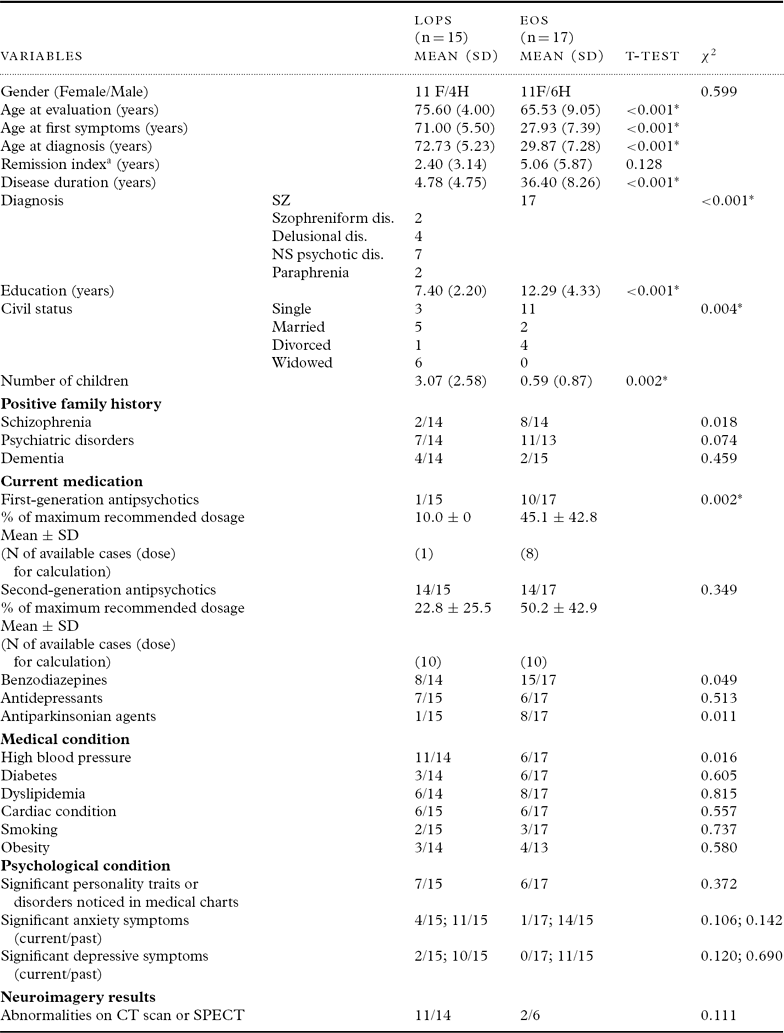
Table 1 presents the sociodemographic and medical data of the two groups. LOPS patients tended to have been living significantly more often with a spouse (married and widowed) than the EOS patients, and they had significantly more children than the EOS patients. Other significant differences (age at first symptoms and at diagnosis, disease duration, type of diagnosis) were consequent to the selection criteria. A matching procedure for age and education was not possible, resulting in significant differences between LOPS and EOS, with LOPS patients being significantly older and having less education than EOS patients. Both groups were principally composed of women. There was no between-group difference regarding the remission rates, conceptualized as the number of years between the time of evaluation and the last psychotic episode.
Sociodemographics and medical data of LOPS and EOS

aNumber of years between last episode and evaluation.
LOPS = late-onset psychotic symptoms; EOS = early-onset schizophrenia; SZ = schizophrenia; Szophreniform dis. = schizophreniform disorder; Delusional dis. = delusional disorder; NS psychotic dis. = non-specific psychotic disorder; CT = computed tomography; SPECT = single photon emission computed tomography; SD = standard deviation.
Regarding medical data, the results showed that the EOS group received significantly more first generation antipsychotics than LOPS even if second generation antipsychotics were the principal medications in both groups. The doses of antipsychotics were higher in the EOS than in the LOPS group. Considering family history, a trend towards significance was observed in favor of a more common family history of schizophrenia in the EOS group whereas family antecedents of other dementia/psychiatric disorders were comparable between the two groups. No difference was obtained regarding the general medical condition and the presence/absence of the vascular risk factors listed in Table 1 between the two patient groups. Nevertheless, most (n = 11) of the LOPS patients for whom neuroimaging results were available (n = 15; CT-scan: n = 14; SPECT: n = 1) presented cerebral abnormalities: subcortical leucoencephalopathy (5 cases); mild-to-moderate cortical atrophy (4 cases) and subcortical atrophy (2 cases); ischemic lacunar infarcts in lenticular nuclei and/or internal capsule (4 cases); white matter infarcts in bilateral frontal cortex and pons (1 case), and moderate hypoperfusion in left frontal with mild hypoperfusion of right inferior occipital cortex (1 case). Only six EOS patients had available neuroimaging results: four had normal CT scans while one patient presented evidence of parietal stroke with leucoencephaloapthy and one had cortical and subcortical atrophy. All the LOPS patients (n = 15) had been administered at least a Mini-Mental State Examination (MMSE) and/or Modified Mini-Mental State (3MS) examination in the past whereas 5/17 EOS had been administered at least a MMSE and/or 3MS before the current study. Current and past psychological status was comparable in the two groups with only a few patients currently endorsing symptoms of depression and/or anxiety whereas a majority of patients had suffered from significant anxious and depressive symptoms in the past.
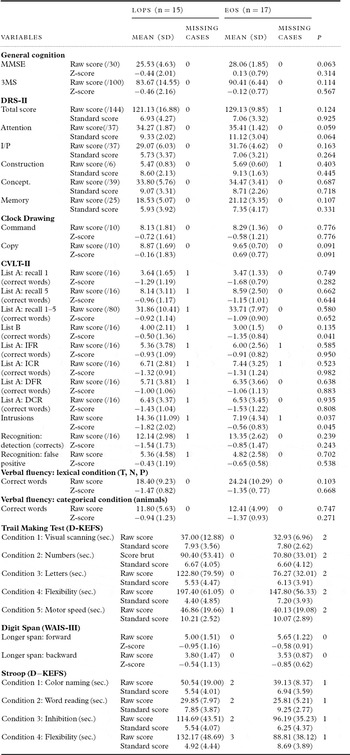
Table 2 illustrates the cognitive profile (raw and normative scores) of the two clinical groups. The mean standardized scores presented here were calculated using the norms of the test manuals. A standardized score inferior or equal to 1.5 standard deviations under the mean (Z ≤ −1.5) was considered in the deficit range. No significant difference was observed between the two groups of patients on any of the variables when considering mean standardized scores. Nevertheless, trends toward significant differences (p<0.05) were observed on the flexibility condition of the Stroop (standardized execution time score: LOPS <EOS: p = 0.024) and on the following scores of the verbal memory task (CVLT-II): number of words recalled on list B (standardized score: LOPS > EOS: p = 0.041) and number of intrusions (standardized score: LOPS <EOS: p = 0.045).
Cognitive Performances of LOPS and EOS

MMSE = Mini = Mental State Examination; CVLT−II = California Verbal Learning Test, 2nd edition; Concept. = conceptualization; DRS-II = Dementia Rating Scale, 2nd edition; EOS = early-onset schizophrenia; I/P = Initiation/Perserveration; IFR = immediate free recall; ICR = immediate cued recall; DFR = delayed free recall; DCR = delayed cued recall; LOPS = late-onset psychotic symptoms; sec. = seconds; SD = standard deviation.
Qualitatively, a visual inspection of the mean standardized scores on the various cognitive variables suggested different patterns of alterations in the two groups of patients. Deficit mean standardized scores (Z-score ≤ −1.5) were noted in LOPS patients on the total intrusions and recognition scores of the CVLT-II and regarding execution time of the flexibility conditions of the TMT and the Stroop (conditions 4). EOS patients had deficits (Z-score ≤ −1.5) on the number of words recalled at the first trial of learning and on the delayed cued recall of the CVLT-II.
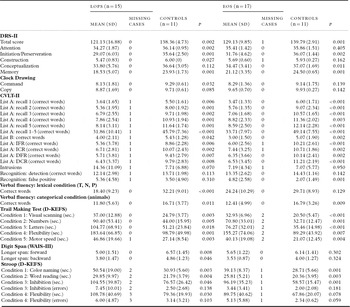
The mean raw scores of the cognitive performances of each clinical group were also compared to those of two control groups (Table 3). Controls were matched according to age, gender, level of education and mother tongue with the EOS patients. The EOS patients registered worse performances than the controls on the Total score and on two of the five subtests of the DRS-II (Initiation/Perserveration, Memory); on the categorical fluency task; on execution time of every condition of the TMT; on execution time of the simple (Color naming and Word reading) and Inhibition conditions of the Stroop, as well as on the following variables of the CVLT-II: number of words recalled on trials 1–5, on list B, on immediate and delayed recall (free and cued) with a higher number of false positives in the delayed recognition task. The control group of the LOPS were significantly younger and more educated than the patients. No difference remained significant between these two groups after statistical adjustment for age and education (covariance analysis).
Raw scores of LOPS, EOS and controls

CVLT-II = California Verbal Learning Test, 2nd edition; DRS-II = Dementia Rating Scale, 2nd edition; EOS = early-onset schizophrenia; IFR = immediate free recall; ICR = immediate cued recall; DFR = delayed free recall; DCR = delayed cued recall; LOPS = late-onset psychotic symptoms; sec. = seconds; SD = standard deviation.
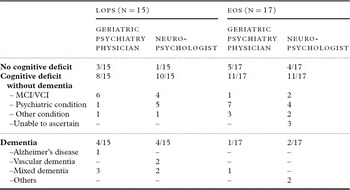
Table 4 presents the results of the consensual diagnostic procedure. In the LOPS group, a consensual diagnosis of dementia was made for three patients (20% of the LOPS) compared to one EOS patient (5.9% of the EOS). However, the majority of the patients in the LOPS (from 53.3% to 66.7% depending on the expert opinion), and EOS (64.7%) groups were considered to present with significant cognitive deficits but no dementia.
Consensual diagnosis procedure: results

MCI = mild cognitive impairment; VCI = vascular cognitive impairment.
More specifically, the diagnoses of the geriatric psychiatry physicians revealed that MCI and VCI were the most frequent consensus diagnoses in the LOPS group (n = 6/15; 40.0%) while cognitive deficits in the EOS group were judged to be most commonly associated with a psychiatric condition (n = 7/17; 41.2%). The diagnoses of the neuropsychologists revealed that 4/15 (26.7%) LOPS cases were classified as MCI/VCI and 5/15 (33.3%) of LOPS were judged to present a cognitive deficit consecutive to a psychiatric condition. Only 2/17 (11.7%) EOS met the criteria of MCI/VCI per the neuropsychologists.
In summary, a detailed inspection of the data concerning the three LOPS patients who received a consensus diagnosis of dementia showed that these patients were women, with a mean age of 78.7 years who lived in the community and who had all developed their first psychotic symptoms after the age of 60 years (mean age at first symptoms = 69.7 years). One of these three LOPS cases had presented with psychotic symptoms for more than five years. A positive family history of dementia was observed in two LOPS cases with dementia while a positive family history of schizophrenia was “suspected” in one case. The neuroimaging examinations registered subcortical lacunar lesions, white matter hyperintensities, leucoencephalopathy, cortical and subcortical atrophy in the three LOPS patients with dementia. Only one case presented multiple vascular risk factors and a poor medical condition. Regarding the psychiatric status at the moment of the neuropsychological evaluation, all three cases had active delusions and significant negative symptoms (affective poverty, alogia, apathy and anhedonia). Regarding the neuropsychological profile, the observation of the standardized scores suggested impairments on tests of working and episodic memory, as well as on tests of attention and executive functions. Considering the previous cognitive data available, two patients presented a significant deterioration on the MMSE (10 points over two years and 5 points over a year's evolution) while the other patient showed a stable but impaired performance (MMSE: 17/30 and 18/30).
The unique EOS patient who received a consensual diagnosis of dementia was a woman aged 81 years, living in a religious community who presented multiple confounding medical conditions and sensory limitations, important vascular risk factors and cerebral frailty confirmed by a CT scan administered five years ago. Regarding her psychiatric status, current positive symptoms (delusions, behavioral disturbances and formal thought disorder) and negative symptoms (affective poverty, alogia, anhedonia) were registered. The neuropsychological evaluation was only partially completed due to physical/sensory limitations.
Discussion
This longitudinal cohort study with a cross-sectional controlled component aimed to characterize and compare the cognitive profile and natural evolution of LOPS and EOS patients aged ≥50 years old.
Cognitive profile of LOPS and EOS
Different results were obtained depending on the analyses made, i.e. using the normative scores or the raw score comparisons of patients versus controls. The results of the variance analysis using normative scores (per the manuals of tests) suggested no difference between LOPS and EOS cognitive performances. This finding could first be interpreted as similar cognitive functioning in the two clinical groups, as some authors have previously suggested (Heaton et al., Reference Heaton1994; Jeste et al., Reference Jeste1995; Sachdev et al., Reference Sachdev, Brodaty, Rose and Cathcart1999; Howard et al., Reference Howard, Rabins, Seeman and Jeste2000; Huang and Zhang, Reference Huang and Zhang2009). However, a visual inspection of the results suggests otherwise. This approach is well suited in the present situation since the lack of statistical power due to small sample size possibly led to an underestimation of significant results. For instance, a difference of almost two standard scores on the Dementia Rating Scale (DRS-II) subscales of Attention, Initiation/Perserveration and Memory domains (LOPS<EOS) is clinically relevant and significant. The visual inspection of results also suggests more executive deficits in LOPS because intrusions were more common in LOPS than in EOS on the CVLT-II (mean Z scores = −1.82 vs −0.56 for LOPS and EOS, respectively), and also because the flexibility conditions of the TMT and of the Stroop were more altered in LOPS than in EOS (standard scores of 4.40 vs 7.20 on the TMT and of 4.92 vs 8.69 on the Stroop for the LOPS and EOS, respectively).
The cross-sectional comparisons of LOPS and EOS performances with their respective control groups also underlined differences in the cognitive profile of LOPS and EOS. While LOPS had comparable performances to those of controls after statistical adjustment, EOS presented cognitive deficits involving memory (encoding processes) and executive functions. Although the quality of normative data could be questioned, the small sample size (n = 11/control group and n = 15/LOPS and n = 17/EOS) inducing a lack of statistical power, needs to be considered to explain the result discrepancies between standardized and raw scores. The possibility that mean raw scores and standardized mean scores masked extreme cases and intra-group heterogeneity should also be considered as a possible explanation for the discrepancies.
From a clinical point of view, cognitive deficits seem to be part of both groups as 80%–93.3% of the LOPS compared to 70.6%–76.5% of the EOS were judged to have cognitive deficits with or without dementia depending on expert opinion. Three principal reasons may possibly explain why the consensual diagnostic procedure suggested cognitive deficits in the majority of the LOPS, contrary to the results of the comparisons between patients and controls. First, regarding the current cognitive functioning of patients, the consensual experts only had access to current individual normative scores instead of LOPS and EOS versus controls raw scores. The second possible explanation for the discrepancy between the results of the consensual procedure and those of the patient-control comparison procedure lies in the longitudinal versus cross-sectional aspects of these two procedures. The physicians and neuropsychologists of the consensual teams had access to some data related to the past cognitive and clinical functioning of the LOPS and EOS patients. For instance, all 15 LOPS patients had at least one previous MMSE score (mean score = 26.87; range 18–30) that could allow comparisons and provide some longitudinal information. Finally, the members of the consensual team also had access to some cerebral neuroimaging results for 14/15 LOPS (compared to 6/17 EOS) that showed cerebral abnormalities in 11 LOPS (73.3%). These abnormalities were generally of vascular and neurodegenerative nature and constituted a major risk factor for cognitive alteration.
The present findings contrast significantly with the results of the recent meta-analysis by Rajji and colleagues (Reference Rajji, Ismail and Mulsant2009) including individuals with youth-onset (onset <19 years old; 23 publications), late-onset (onset >40 years old; 9 publications) and adult first-episode (78 publications) schizophrenia. This meta-analysis reported that late-onset schizophrenia patients presented with minimal deficits on arithmetic, digit symbol coding, verbal memory and vocabulary, but severe impairments on scores of tasks evaluating attention, fluency, global cognition, IQ and visuospatial abilities. Furthermore, the impairment in learning ability (recall progression) observed in the LOS patients of Zakzanis and colleagues (Reference Zakzanis, Andrikopoulos, Young, Campbell and Sethian2003) cannot be confirmed on the basis of the present results. The current results are also partly inconsistent (depending on the data considered: normative scores vs patient/control comparisons) with the hypotheses of the Consortium on Late-Onset Schizophrenia (Howard et al., Reference Howard, Rabins, Seeman and Jeste2000), which mention that LOS and VLOSLP patients should perform significantly worse than controls on measures of executive functions, learning, motor skills and verbal ability. The type of results (standardized results using normative data vs patient/control raw score comparisons) may possibly explain the inconsistencies between the literature findings and the present results and limit conclusions. Several methodological differences also need to be considered as potential explanation of discrepancies. First, the present study had inclusion criteria allowing some heterogeneity regarding the diagnosis of late-onset psychotic symptoms (see Methods section). Secondly, the 50-year-old age cut-off chosen to include the LOPS was more restrictive than that reported in some previous studies (40, 45 years old). Thirdly, the present study had a design (historical cohort and cross-sectional controlled comparisons) that contrasted with the cross-sectional design of most prior research. Finally, the higher number and different types of cognitive tests used in the present study to evaluate patients may also possibly explain the discrepancies.
On the other hand, the memory and executive deficits observed in the EOS patients when considering patients vs controls comparisons were consistent with the literature reporting deficits in learning, abstraction and cognitive flexibility in older patients with EOS when compared to healthy elderly adults (Reeves and Brister, Reference Reeves and Brister2008). Sachdev and colleagues (Reference Sachdev, Brodaty, Rose and Cathcart1999) also reported that EOS (n = 30) performed more poorly than controls (n = 34) on neuropsychological tests assessing speed of information processing, memory and frontal executive functions. Moreover, it is possible that cognitive impairments were present in the EOS but not in the LOPS when compared to controls matched for age, gender, education and language and this may be associated with an earlier age at onset and more severe cognitive deficits as postulated by many authors (Paulsen et al., Reference Paulsen1995; Hoff et al., Reference Hoff1996; Jeste et al., Reference Jeste1998; Tuulio-Henriksson et al., Reference Tuulio-Henriksson, Partonen, Suvisaari, Haukka and Lönqvist2004). In any case, the possibility that the more extensive use of typical neuroleptics in EOS had contributed to the cognitive deficit profile cannot be ruled out. Indeed, many controversies remain regarding the impact of antipsychotics on cognition in schizophrenic patients (Mishara and Goldberg, Reference Mishara and Goldberg2004; Stip, Reference Stip2006).
Evolution/prognosis of LOPS
Regarding the evolution of the patients’ symptoms, it has been hypothesized that patients with LOPS would develop more cognitive decline and dementia over time than patients with EOS. In fact, 20% of LOPS patients (3/15 cases) versus 5.9% of EOS patients (1/17 cases) met the diagnostic criteria for dementia by expert consensus. The prevalence of dementia in the Canadian community population of the same age group (75–79 years) is estimated to be 2.5% (Nabalamba and Patten, Reference Nabalamba and Patten2010). Therefore, taken together, these data suggest a higher prevalence of dementia in LOPS than in EOS. However, these differences between LOPS and EOS and controls, and between LOPS and controls, must be interpreted with caution given the small sample size.
MCI and VCI are two conditions conceptualized as potential prodromal stages of dementia (Bowler and Hachinski, Reference Bowler and Hachinski2003; Petersen, Reference Petersen2004). The fact that the LOPS patients receive a diagnosis of MCI or VCI by physicians (40%) and neuropsychologists (26.7%) more often than EOS patients (5.8%–11.8%) suggests a greater vulnerability to neurodegeneration. This has been noticed previously by other authors. Rabins and Lavrisha (Reference Rabins and Lavrisha2003) reported a higher incidence of dementia (50%) at 10-year follow-up in patients presenting with late-onset schizophrenia (LOS: n = 28: onset >44 years old) and late-life major depression (n = 48). Korner and colleagues (Reference Korner, Lopez, Lauritzen, Andersen and Kessing2008; Reference Korner, Lopez, Lauritzen, Andersen and Kessing2009a; Reference Korner, Lopez, Lauritzen, Andersen and Kessing2009b) also found an increased risk of dementia in different late-onset psychotic disorders within 6 months following the index diagnosis. Brodaty and colleagues (Reference Brodaty, Sachdev, Koschera, Monk and Cullen2003) suggested that late-onset schizophrenia (onset >50 years) should be considered as a prodromal phase of Alzheimer's dementia because 47.4% of the LOS reassessed at 5-year follow-up developed dementia. These findings also suggest that a longer observation period than that of the present study could have revealed other cases of dementia in the LOPS. Finally, age and educational differences between the two groups may possibly account for the greater number of patients with dementia or MCI / VCI in the LOPS compared to the EOS group.
An alternative hypothesis was proposed to account for late-onset expression of psychotic symptoms. Two reviews of LOS/LOPS patients concluded that structural brain abnormalities of a vascular nature could contribute to the development of LOS/LOPS (Howard, Reference Howard2001; Lagodka and Robert, Reference Lagodka and Robert2009). The vascular contribution to the development of LOPS is compatible with the present results and especially with the neuroimaging data of all three LOPS patients with dementia who presented with subcortical vascular lesions. Vascular and mixed dementia were the most frequent consensus diagnoses in the LOPS group (see Table 4).
Interestingly, the review by Lagodka and Robert (Reference Lagodka and Robert2009) found no study that compared LOS/LOPS and dementia with Lewy bodies (DLB). These authors suggested that LOPS should be investigated as a possible prodromal stage of DLB in future studies. In accordance with this suggestion, Korner and colleagues (2009) hypothesized that a significant number of their patients with late-onset psychosis, and diagnosed with unspecified dementia, could actually be suffering from DLB. This hypothesis is interesting given that two LOPS patients in the present study were diagnosed with mixed dementia, and one of them was also suspected of having DLB by the neuropsychologist on the consensus team.
Evolution/prognosis of EOS
Regarding the prognosis of EOS, only one case (5.8%) was considered to meet the diagnostic criteria for dementia, although the majority of these patients were diagnosed with some cognitive impairment. This prevalence is slightly superior to that observed in the same age group of the general Canadian population (approximately 3.3% among 80–84 years old; Nabalamba and Patten, Reference Nabalamba and Patten2010) but must be interpreted with caution because it is based on only one observation. Unlike the other patients of the EOS group, the patient who received a consensual diagnosis of dementia presented several comorbid medical conditions that were likely risk factors for dementia (e.g. Parkinson disease; past history of stroke; multiple vascular risk factors). Furthermore, only one or two cases (depending on the expert opinion) of EOS patients with cognitive deficit were considered to be compatible with MCI/ VCI.
A stable or a favorable cognitive outcome in EOS has been suggested by many authors. Reeves and Brister (Reference Reeves and Brister2008) reported a non-progressive course in most of the EOS patients. More specifically, Heaton and colleagues (Reference Heaton, Gladsjo, Palmer, Kuck, Marcotte and Jeste2001) conceded that when cognitive/functional deterioration occurs, it is usually shortly after the disease onset and it is often limited to the first five to ten years of the disease, followed by stability or even improvement of the symptoms with aging. From a clinical point of view, the present EOS patients were clearly in clinical remission because only a few mild symptoms were endorsed by a minority of patients.
The prevalence of AD in elderly patients with chronic schizophrenia is reported to range from 2.4% to 9% (see Bozikas et al., Reference Bozikas, Kovari, Bouras and Karavatos2002) which is not significantly superior to the prevalence of dementia in the Canadian community population (10.7%; Nabalamba and Patten, Reference Nabalamba and Patten2010). Cognitive deterioration was difficult to establish because previous neuropsychological data were often lacking in the chronic EOS (prior MMSE available for only 5/17 EOS). Nevertheless, the cognitive profile characterized by impairments in memory and executive functions has already been largely described in EOS by several authors (for a review, see Simard and Grandmaison, Reference Simard and Grandmaison2006).
Limitations
This study provides useful information regarding the clinical status, cognitive profile and natural evolution of the LOPS and EOS. However, some limitations should be mentioned.
Despite a multicenter recruitment strategy, this three-year study managed to recruit only a small sample which affected statistical power. The historical cohort study design did not permit clear and rigorous inferences to be made as would have been possible in a prospective longitudinal study regarding the etiology of the diagnoses. However, given that a previous study by our team demonstrated that the prevalence of LOPS and VLOPS in a psychiatric inpatient population of Quebec City was low (respectively 1.3% and 0.7%), the present design was the most appropriate in terms of feasibility and retention of patients. LOPS patients are generally hard to recruit (almost 30% of the referred patients refused to participate in the current study), and are thus more susceptible to attrition in a longitudinal study design. Consequently, the representativeness of the current sample may have been affected, i.e. patients who agreed to participate were probably less severely ill in terms of psychiatric and cognitive symptoms than those who refused to participate.
In addition, no control or standardization was possible concerning the time between the initial diagnosis of late-onset psychiatric disorders and the clinical and neuropsychological evaluations of the present study. This is an important limitation because several authors suggest that neurodegenerative processes could exert their influence with longer disease duration (5–10 years) (Brodaty et al., Reference Brodaty, Sachdev, Koschera, Monk and Cullen2003; Reeves and Brister Reference Reeves and Brister2008; Lagodka and Robert Reference Lagodka and Robert2009). The standard deviation of the mean delays between LOPS and neuropsychological evaluation was rather large (mean = 4.78 ± 4.75 years); therefore it is possible that some new LOPS were included in patients who could have gone on to develop dementia much later in the course of the disease.
Regarding the consensual diagnosis procedure, an important limitation concerned the absence of inter-observer agreement. Each chart was sent to only one neuropsychologist and only one physician in order to facilitate the procedure. To date, no in-vivo biological marker exists to diagnose LOPS/LOS, and the differential diagnosis of LOPS/LOS and dementia relies heavily on clinical criteria. The criteria for LOS/LOPS are not clearly established by the literature, and thus are largely dependent on the expertise of the examiners (Zazkanis et al., Reference Zakzanis, Andrikopoulos, Young, Campbell and Sethian2003), which was ensured in the present study by the recruitment of experienced board-certified neuropsychologists and physicians specialized in geriatric psychiatry.
From a theoretical point of view, it cannot be excluded that the dementia process and/or cognitive decline was the cause of the psychosis onset. This hypothesis was proposed by Korner and colleagues (Reference Korner, Lopez, Lauritzen, Andersen and Kessing2008; Reference Korner, Lopez, Lauritzen, Andersen and Kessing2009a; Reference Korner, Lopez, Lauritzen, Andersen and Kessing2009b) who suggested that their patients were suffering from some prior cognitive dysfunction that was unrecognized or masked by the psychotic symptoms. This possibility remains relevant for the explanation of our data since the main inclusion criteria (presence of late-onset psychotic disorder without dementia at the time of diagnosis) was totally dependent on the opinion of the psychiatrist who often made the initial diagnosis without exhaustive neuropsychological data.
Finally, the possibility that the diagnosis of dementia was overestimated cannot be totally ruled out. However, the high consistency between the diagnoses of physicians and neuropsychologists regarding the presence/absence of dementia weakens this hypothesis. On the contrary, the possibility that dementia was under diagnosed is a more likely possibility, given that a conservative approach was adopted in the absence of prior exhaustive neuropsychological and/or daily functioning assessment, which was common.
In the future, investigators should initiate multicenter prospective longitudinal studies involving larger samples. In addition, these samples should be compared with other clinical groups such as patients with late-onset depression, with mild dementia (e.g. dementia with Lewy bodies and multi-ischemic subcortical dementia). Different age cut-offs (> 40, 50, 60 years) for late-onset psychosis should also be tested.
Conflict of interest
None.
Description of authors' roles
Caroline Girard was co-principal investigator and was responsible for the elaboration and realization of the study (evaluation of the patients, review of medical files, data coding, statistical analyses, editing of the paper). Martine Simard was the principal investigator and was responsible for conceptualization, elaboration and supervision of the study, and editing and revision of the paper. R. Noiseux, L. Laplante, M. Dugas, F. Rousseau, N. Gagnon, F. Primeau, E. Keller and P. J. Bernier assisted with recruitment of patients, and acted as consensual diagnosis experts and reviewers of the paper.
Acknowledgments
This work was supported by doctoral grants awarded to Dr. Caroline Girard by the Reseau Québécois de Recherche sur le Vieillissement (RQRV), the Fonds de Recherche en Santé du Québec (FRSQ), the Canadian Institutes of Health Research (CIHR), the Fondation de l'Université Laval (Bourse Hydro Québec), and by a 2005 NARSAD Young Investigator Award granted to Dr. Martine Simard.