Introduction
The cooccurrence of features of depression and mania has long been recognized,Reference Kraepelin 1 and in the modern DSM era this cooccurrence has been designated as “mixed episodes.” During the past 20 years, the clinical significance of the coexistence of manic/hypomanic symptoms during an episode of major depression has been the subject of increased research. In patients with bipolar depression, cooccurring manic symptoms have been associated with greater suicidality,Reference Bauer, Wisniewski and Marangell 2 – Reference Swann, Moeller, Steinberg, Schneider, Barratt and Dougherty 5 poorer longitudinal course,Reference Judd, Schettler and Akiskal 4 , Reference Dodd, Kulkarni and Berk 6 an increased risk of manic symptoms in patients prescribed antidepressants,Reference Goldberg, Perlis and Ghaemi 7 a greater number of depressive episodes,Reference Masi, Toni, Perugi, Mucci, Millepiedi and Akiskal 8 and an increased risk of rapid cycling.Reference Goldberg, Perlis and Bowden 3 In patients with major depressive disorder (MDD), cooccurring manic symptoms have likewise been associated with an increased risk of suicidal behavior,Reference Olgiati, Serretti and Colombo 9 , Reference Perugi, Angst and Azorin 10 more depressive episodes,Reference Smith, Forty and Russell 11 poorer response to treatment,Reference Smith, Forty and Russell 11 more atypical features of depression,Reference Perugi, Angst and Azorin 10 , Reference Benazzi 12 a younger age of onset,Reference Perugi, Angst and Azorin 10 , Reference Benazzi 12 , Reference Sato, Bottlender, Schroter and Möller 13 and an increased familial risk of bipolar disorder.Reference Perugi, Angst and Azorin 10 , Reference Benazzi 12 , Reference Sato, Bottlender, Schroter and Möller 13 Although no controlled studies have been conducted, the clinical observations of some authors have suggested that antidepressants should be avoided or only used with caution in depressed patients with mixed symptoms and that mood stabilizers should be used before antidepressants are started.Reference Benazzi 14 – Reference Vieta 17 One study found that cooccurring manic symptoms, as assessed by a self-report scale, were associated with improved outcomes in depressed patients treated with an antidepressant.Reference Perlis, Cusin and Fava 18
In the DSM–IV, a mixed episode required the presence of full syndromes of both depressive and manic symptoms. This approach was criticized as being too narrow because many patients in a depressive episode experience clinically significant manic symptoms that fail to meet the full syndromal DSM–IV definition of mania.Reference Masi, Toni, Perugi, Mucci, Millepiedi and Akiskal 8 , Reference Benazzi 15 , Reference Benazzi 19 – Reference Swann, Lafer and Perugi 21 The definition of mixed episodes changed in the DSM–5. No longer did manic patients also need to simultaneously manifest the full syndrome of depressive features. Rather, a manic episode with mixed features required the presence of at least three of six depressive features during the manic or hypomanic episode. Analogously, a depressive episode with mixed features required the presence of three or more of seven symptoms of mania/hypomania (euphoric/expansive mood, inflated self-esteem/grandiosity, hypertalkative/pressured speech, flight of ideas/thought racing, increased energy/goal-directed activity, activity with potential painful consequences, and decreased need for sleep). Thus, DSM–IV’s narrow definition of mixed episodes was broadened in the DSM–5 so that patients with MDD who experience “subthreshold” symptom levels nonetheless now met the criteria for the mixed specifier.
The DSM–5 definition of the mixed-features specifier of depressive episodes has not been without controversy.Reference Perugi, Angst and Azorin 10 , Reference Koukopoulos, Sani and Ghaemi 22 – Reference Koukopoulos and Sani 24 Only manic symptoms considered to be nonoverlapping are employed to define the DSM–5 specifier. Thus, irritability, agitation, and distractibility, which are considered to be the hallmark features of the mixed state,Reference Koukopoulos, Sani and Ghaemi 22 , Reference Koukopoulos and Sani 24 were not included in the definition. Also, the minimum number of features required by the DSM–5 to indicate the presence of mixed features has been deemed to be too high.Reference Perugi, Angst and Azorin 10 , Reference Kim, Kim and Citrome 25
While there is controversy as to how to best define mixed features in depressed patients, we can anticipate that increased attention will likely be given to mixed depression because of the changes in the DSM–5. It is therefore important that rating scales be developed which measure both symptoms of depression as well as manic symptoms. This is particularly timely in the context of recent recommendations to measure outcomes during routine clinical practice. Measurement-based care has been emphasized in official treatment guidelines for depression. 26
The goal of the present article is to describe instruments that have been utilized to assess the presence and severity of depressive and manic symptoms and therefore could be used to identify mixed depression and evaluate the course and outcome of treatment. Many self-report and clinician-administered instruments have been developed to measure and quantify the severity of the symptoms of depression, and some of these have been specifically designed to assess the DSM criteria for MDD.Reference Kroenke, Spitzer and Williams 27 – Reference Zimmerman, Chelminski, McGlinchey and Posternak 29 These scales will not be considered in the present review. Rather, my focus will be on the limited number of measures of manic symptoms. Because of the recency of the publication of the DSM–5 mixed-features specifier, almost all of these measures were developed prior to the DSM–5. I will therefore focus on how well these scales cover the features used to define the DSM–5 mixed-features specifier. First, though, I will briefly discuss screening scales for bipolar disorder and their applicability to identifying the DSM–5 mixed-features specifier.
Self-Administered Screening Scales for Bipolar Disorder
Despite its clinical and public health significance, many studies of psychiatric and primary care patients have found that bipolar disorder is often missed in depressed patients.Reference Ghaemi, Boiman and Goodwin 30 – Reference Hantouche, Akiskal and Lancrenon 32 The underdiagnosis of bipolar disorder in depressed patients has potential treatment and clinical implications, such as the underprescription of mood-stabilizing medications, an increased risk of rapid cycling due to the possible overprescription of antidepressant medications, and increased costs of care.Reference Ghaemi, Boiman and Goodwin 30 , Reference Birnbaum, Shi, Dial, Oster, Greenberg and Mallett 33 – Reference Matza, Rajagopalan, Thompson and de Lissovoy 35 Recommendations for improving the accurate diagnosis of bipolar disorder include the use of screening questionnaires.
Several self-administered questionnaires have been developed to screen for bipolar disorder.Reference Depue, Krauss, Spoont and Arbisi 36 – Reference Ghaemi, Miller, Berv, Klugman, Rosenquist and Pies 39 The literature is sufficiently robust that there are now reviews of the performance of these scales.Reference Graham and Parker 40 – Reference Zimmerman and Galione 42 Of note, none of these reviews identified any studies of the performance of these scales for detecting mixed features in depressed patients. Consistent with this, a MEDLINE search on the terms “bipolar,” “mixed,” and “screening” in the title of papers did not identify a single citation. The reason for this is not surprising. The scales employed for screening for bipolar disorder focus on detection of past episodes of manic symptoms—they do not instruct the respondent to report on the presence of current features. For example, the Hypomanic Checklist–32 (HCL–32) was designed to improve the recognition of hypomanic features in depressed patients and thereby enhance the recognition of bipolar II disorder and other bipolar spectrum disorders.Reference Angst, Adolfsson and Benazzi 38 As the introduction to the HCL–32 notes, “At different times in their life, everyone experiences changes or swings in energy, activity, and mood (‘highs and lows’ or ‘ups and downs’). The aim of this questionnaire is to assess the characteristics of the ‘high’ periods.” The respondent is then instructed to think of a “period when you were in a ‘high state’ and to answer 32 yes/no questions about their mood and behavior during that time. The Mood Disorder Questionnaire (MDQ), the most frequently studied screening scale for bipolar disorder, screens for a lifetime history of bipolar disorder as the respondent is asked, “Has there ever been a period of time when you were not your usual self and . . .” This stem phrase is followed by a series of 13 yes/no symptom questions reflecting the DSM–IV inclusion criteria for mania.Reference Hirschfeld, Williams and Spitzer 37
It is therefore understandable why these screening scales have not been used to screen for current mixed episodes. A modification of the rating instructions of these scales to focus on the current episode would allow investigators to examine the performance of these scales for identifying the DSM–5 mixed-features specifier. However, other self-administered scales assessing the severity of current manic symptoms have already been developed and could instead be used for this purpose.
Self-Administered Severity Measures of Manic Symptoms
In contrast to the large number of self-report questionnaires that assess depression, there are relatively few self-report measures of the current severity of manic/hypomanic symptoms. The American Psychiatric Association’s Handbook of Psychiatric Measures Reference Rush, First and Blacker 43 does not include any self-report questionnaires assessing the severity of manic/hypomanic symptoms, whereas it does include a summary of five self-report severity measures of depression. The relative lack of scales assessing the symptoms of mania/hypomania might reflect the concern that the lack of insight, uncooperativeness, and thought-disorder characteristic of mania render self-report assessments unfeasible and invalid. To be sure, severely manic patients may not be able to complete self-administered questionnaires. However, the vast majority of depressed patients are able to complete such scales.
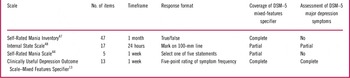
A few self-report questionnaires assessing the symptoms of mania/hypomania have demonstrated reliability and validity in inpatient and outpatient settings, though only one measure was specifically developed to assess the symptoms of the DSM–5 mixed-features specifier.Reference Altman, Hedeker, Peterson and Davis 44 – Reference Bauer, Crits-Christoph and Ball 48 The Self-Rated Mania Inventory (SRMI) is a 47-item scale assessing manic symptoms that might be too long to be used in routine clinical practice to screen for the mixed-features specifier and also be used to monitor outcomes.Reference Shugar, Schertzer, Toner and DiGasbarro 47 The instructions ask the respondent to indicate if an item is more true for them during the previous month compared to their usual self. The 47 items are rated true or false. The SRMI assesses all of the mixed-features criteria, though the item assessing reduction in number of hours of sleep does not distinguish insomnia from reduced need for sleep. In addition to the features of the mixed specifier, the SRMI assesses such related nonspecific features as increased alcohol consumption, increased food consumption, impaired concentration, and psychotic symptoms.
The Internal State Scale (ISS) is a 17-item scale in which each item is rated on a 100-mm visual analogue line.Reference Bauer, Crits-Christoph and Ball 48 The timeframe is the previous 24 hours. Scoring requires measurement of the location of a patient’s written mark on the 100-mm line, and this might be too cumbersome for clinical or support staff. The ISS is one of the few measures that assesses both manic and depressive symptoms, though it does not assess the majority of the DSM–5 mixed-specifier criteria (decreased need for sleep, grandiosity, pressured speech, and an increase in activities with potential negative consequences) or some core features of depression (sleep disturbance, appetite disturbance, guilt, anhedonia, and suicidal thoughts).
The Altman Self-Rating Mania Scale (SRMS) is a brief five-item measure of euphoric mood, increased self-confidence, decreased need for sleep, overtalkativeness, and increased activity.Reference Altman, Hedeker, Peterson and Davis 44 The brevity of the SRMS makes it more attractive for routine clinical use, though this brevity comes at a cost of only assessing five symptoms. The SRMS does not assess symptoms of depression and two defining features of the DSM–5 mixed specifier (racing thoughts, an increase in activities with potential negative consequences). Each of the five items on the scale consists of a group of five statements arranged in order of increasing symptom severity, and the respondent is asked to select the item that best describes them during the previous week.
The only scale specifically developed to assess the symptoms of the DSM–5 mixed specifier is the Clinically Useful Depression Outcome Scale with a Mixed Specifier subscale (CUDOS–M).Reference Zimmerman, Chelminski, Young, Dalrymple and Martinez 49 The CUDOS is a brief measure of depression severity that assesses the DSM–IV (and DSM–5) symptoms of MDD.Reference Zimmerman, Chelminski, McGlinchey and Posternak 29 Compound DSM–IV depression symptom criteria referring to more than one construct (e.g., increased or decreased appetite, insomnia or hypersomnia) are subdivided into their respective components, and a CUDOS item is written for each component. Distinguishing typical and reverse vegetative features of depression is particularly important in a depression scale to be used for bipolar depression or mixed depression because atypical features of depression are more common in bipolar than in nonbipolar depression.Reference Goodwin and Jamison 50 The 13 items assessing the symptoms of the mixed specifier that were included on the CUDOS–M subscale were drawn from a larger pool of 28 items assessing manic/hypomanic symptoms. The pool of items was reviewed by clinicians experienced in treating mood disorders, and consensus was reached regarding the items assessing the seven criteria of the DSM–5 specifier. The respondent is instructed to rate the CUDOS–M items on the same five-point ordinal scale indicating symptom frequency as the CUDOS depression items (0=not at all true, 1=rarely true, 2=sometimes true, 3=often true, 4=almost always true). In a study of 1,170 outpatients with major depressive disorder or bipolar disorder, the CUDOS–M subscale had high internal consistency and test–retest reliability; was more highly correlated with another self-report measure of mania than with measures of depression, anxiety, substance use problems, eating disorders, and anger; and was more highly correlated with clinician severity ratings of agitation and irritability than anxiety and depression. CUDOS–M scores were significantly higher in hypomanic patients than in depressed patients, and higher in patients with bipolar depression than in patients with MDD. A limitation of the CUDOS–M is that symptoms are assessed for the previous week. While this enables the measure to be employed for repeated assessments in evaluating an outcome, it contrasts with the DSM–5 diagnostic approach for the mixed specifier, which requires the manic/hypomanic symptoms to be present for the majority of the depressive episode. Table 1 provides a brief summary of the self-report measures.
Summary of self-administered measures of manic symptoms

Clinician Rated Severity Measures of Manic Symptoms
There are several clinician-rated measures of the severity of manic symptoms. The content of these scales overlap, thereby resulting in significant correlations between them,Reference Vieta, Bobes and Ballesteros 51 though there are also meaningful differences that can result in different response rates in bipolar depressed patients with mixed features.Reference Shansis, Reche and Capp 52 The scales also differ with respect to the timeframe of the assessment.
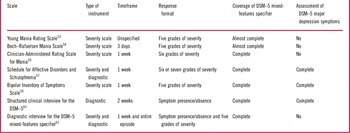
The most commonly used measure to assess manic symptoms is the Young Mania Rating Scale (YMRS).Reference Young, Biggs, Ziegler and Meyer 53 The YMRS contains 11 items, each rated according to five grades of severity. Four items are rated 0, 2, 4, 6, or 8, while the other seven are rated 0, 1, 2, 3, or 4. No timeframe is specified for the rating of items. The YMRS assesses four of the seven mixed-features specifiers and partially assesses three of the seven features. Only one aspect of the risk-taking behavior criterion is assessed by the YMRS—increased sexual activity. Only half of the increased energy/goal-directed activity criterion is assessed (i.e., increased energy, but not increased goal-directed activity). No single item assesses grandiosity; however, this symptom is a component of an item assessing thought content (hyperreligiousity, grandiosity, and paranoid or referential ideas).
The Bech–Rafaelsen Mania Scale (BRMS),Reference Bech 54 similar to the YRMS, was developed in the 1970s, prior to publication of the DSM–III. The timeframe for the BRMS is the previous three days. The instrument closely maps onto four of the seven mixed-features specifiers and partially assesses three of the seven features. It has an item assessing sleep disturbance without regard to whether the reduction in sleep is due to insomnia or a decreased need for sleep. Only one aspect of the risk-taking behavior criterion is assessed by the BRMS (increased sexual activity). Likewise, only one aspect of the increased energy/goal-directed activity is assessed by the BRMS (increased social activity).
The Clinician-Administered Rating Scale for Mania (CARS–M)Reference Altman, Hedeker, Janicak, Peterson and Davis 55 was derived from the Change version of the Schedule for Affective Disorders and Schizophrenia (SADS).Reference Endicott and Spitzer 56 The timeframe is the previous seven days. All items but one are rated from 0 to 5 (the item assessing insight is rated from 0 to 4). The measure includes items assessing the DSM–III–R criteria for mania and thus assesses all of the criteria of the mixed specifier. Additional items assess thought disorders, delusions, hallucinations, orientation, and insight. In contrast to the YMRS and the BRMS, the CARS–M follows the structure of the SADS insofar as each symptom is defined, and an interview guide is provided.
The SADS was developed as a diagnostic interview for the Research Diagnostic Criteria,Reference Spitzer, Endicott and Robins 57 the precursor of the DSM–III. A Change version of the SADS assesses each of the symptom criteria of MDD and mania/hypomania, and can therefore be used to assess the features of the DSM–5 mixed specifier. The Change version of the SADS has been utilized to evaluate depressive and manic symptoms in mixed states,Reference Swann, Steinberg, Lijffijt and Moeller 58 although it has not yet been employed to evaluate the DSM–5 mixed-features specifier.
The Bipolar Inventory of Symptoms Scale (BISS) adapted the same structure of the SADS but covered a wider range of symptoms exhibited by patients with bipolar disorder.Reference Bowden, Singh and Thompson 59 , Reference Gonzalez, Bowden and Katz 60 The BISS contains 44 items: 22 assessing features of depression and 22 assessing features of mania. The items are rated on a five-point ordinal scale based on symptom presence during the previous week. All of the criteria for major depression and the mixed-features specifier are assessed as well as a number of symptoms that are not diagnostic criteria.
A limitation of each of these scales is that the items are rated on an ordinal scale, and it is unclear what cutoff should be utilized to indicate symptom presence. Related to the issue of diagnostic utility, the timeframe of assessment is typically the previous week, which is at variance with the DSM–5 requirement that the manic/hypomanic features be present for the majority of the depressive episode.
The most commonly used semistructured diagnostic interview is the Structured Clinical Interview for the DSM–IV (SCID),Reference First, Spitzer, Williams and Gibbon 61 recently revised for the DSM–5. I am not aware of any published studies on the SCID–5’s reliability or validity in assessing the DSM–5 mixed-features specifier. A limitation of the SCID module is that assessment of the symptoms of the mixed-features specifier covers the previous two weeks, which contrasts with the DSM–5 definition, which requires that the symptoms be present for the majority of the depressive episode. In addition, the SCID is solely a diagnostic instrument. It does not include ratings of symptom severity, so that the measure cannot be utilized to monitor outcomes.
Finally, as part of the Rhode Island Methods to Improve Diagnostic Assessment and Services (MIDAS) Project, we have developed a semistructured interview that determines the presence of the DSM–5 mixed-features specifier according to the DSM–5 definition (requiring symptom presence for the majority of the depressive episode) as well as being based on symptom presence during the previous two weeks. In addition, the severity of mixed-specifier symptoms is rated to permit the instrument to be employed in order to measure outcomes. Similar to the SCID, data on the measure’s reliability and validity have not yet been published. Table 2 provides a brief summary of the interview measures of manic symptoms.
Summary of clinician-administered measures of manic symptoms

Discussion
Standardized scales should be routinely used to measure outcomes when treating depression.Reference Zimmerman, McGlinchey and Chelminski 62 This should be the standard of care. The term “measurement-based care” was coined in reference to the use of standardized scales to evaluate the outcome of treatment for depression.Reference Trivedi, Rush and Wisniewski 63 If the standard of care is to change in the future and scales are to be incorporated into clinical practice, then it will be necessary to consider feasibility issues as much as the psychometric properties of the measures.
During the last two decades, a number of studies have found that depressed patients frequently have manic symptoms intermixed with depressive symptoms.Reference Goldberg, Perlis and Bowden 3 – Reference Swann, Moeller, Steinberg, Schneider, Barratt and Dougherty 5 , Reference Masi, Toni, Perugi, Mucci, Millepiedi and Akiskal 8 , Reference Benazzi 12 , Reference Sato, Bottlender, Schroter and Möller 13 , Reference Koukopoulos, Sani, Koukopoulos, Manfredi, Pacchiarotti and Girardi 16 , Reference Akiskal and Benazzi 64 – Reference Serretti and Olgiati 67 While the frequency of mixed syndromes are more common in bipolar than in unipolar depressives,Reference Sato, Bottlender, Schroter and Möller 13 , Reference Akiskal and Benazzi 64 – Reference Benazzi and Akiskal 66 , Reference Benazzi 68 mixed states are nonetheless also common in patients with MDD. The admixture of symptoms may be evident when patients present for treatment or they may emerge during ongoing treatment. In some patients, treatment with antidepressant medication might precipitate the emergence of mixed states.Reference Goldberg, Perlis and Ghaemi 7 , Reference Koukopoulos, Sani, Koukopoulos, Manfredi, Pacchiarotti and Girardi 16 It would therefore be useful to systematically inquire into the presence of manic/hypomanic symptoms in depressed patients. A number of self-report and clinician-rated instruments have been developed to assess manic/hypomanic symptoms, though only a limited number of measures also assess the symptoms of depression. It is likely that in routine clinical practice only a self-report scale will be used to track outcomes, as clinician-rated instruments are too time-consuming to be utilized at each visit. Repeated administration of a self-report scale during the course of treatment could enable clinicians to more readily and quickly identify patients whose depressive episodes are evolving into a mixed state. Of course, such a measure could also be more useful than a measure assessing only the symptoms of depression in evaluating the course and outcome of the treatment of patients with bipolar disorder.
As efforts to adopt measurement-based care/treatment approaches continue to take shape during the next few years, the breadth of the assessment will require careful consideration. A balance will need to be struck between the comprehensiveness of the assessment and the feasibility of its incorporation into routine clinical practice. Given the potential clinical significance of mixed symptoms in depressed patients and the previous reports of the relatively high frequency of these symptoms, the addition of some items assessing manic/hypomanic symptoms to a depression scale seems worthwhile.
Conclusions
In conclusion, there are a number of measures that could be used to assess the criteria of the DSM–5 mixed-features specifier in depressed patients. In choosing which measure to employ, clinicians and researchers need to consider whether the measure should assess both depression and mania/hypomania, assess all or only some of the DSM–5 criteria for the mixed-features specifier, or assess manic/hypomanic symptoms that are not part of the DSM–5 definition. Feasibility, more so than reliability and validity, will likely determine whether these measures are incorporated into routine clinical practice.